Partial Replacement of Aging Industrial Pipelines: How to Avoid Replacing the Entire Pipeline
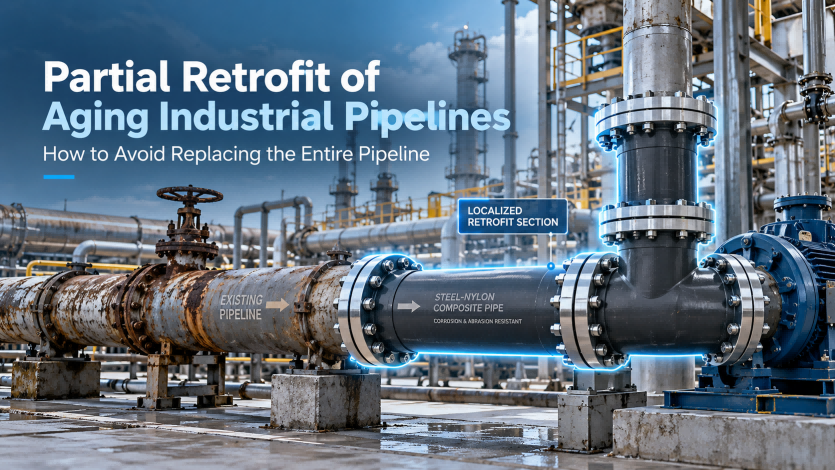
After industrial pipelines have been in operation for 10, 15, or even more years, problems such as corrosion, abrasion, scaling, localized wall thinning, and leakage often begin to appear.
When an industrial pipeline enters an aging stage, many plant operators face the same question:
Does the entire pipeline need to be removed and replaced?
In some cases, a complete replacement is necessary, particularly when deterioration is widespread or structural integrity can no longer be guaranteed.
However, in many industrial applications, the entire pipeline does not deteriorate at the same rate.
Failures are often concentrated at several high-risk locations, such as:
-
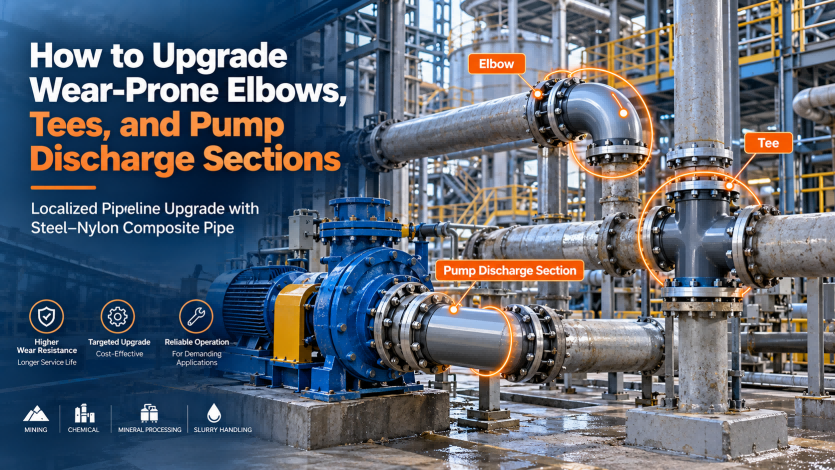
Elbows
-
Tees
-
Pump discharge sections
-
Upstream and downstream of valves
-
Slurry flow-direction change areas
-
High-velocity sections
-
Areas exposed to two-phase flow erosion
-
Pipeline low points
-
Locations where corrosive media accumulate
-
Sections with repeated historical leakage
If the main straight pipeline still retains sufficient structural strength and remaining service life, replacing the entire line may create unnecessary material, installation, shutdown, dismantling, welding, inspection, and commissioning costs.
For this reason, more industrial operators are moving from:
“full-line replacement”
to:
“risk-based segmentation and localized upgrading.”
The key is not simply repairing damaged pipe. It is identifying the sections most responsible for system failures and upgrading those areas with materials better suited to corrosion, abrasion, pressure, and complex process conditions.
For industrial systems where corrosion, abrasion, and pressure resistance must all be considered, steel–nylon composite piping can provide an effective option for localized pipeline rehabilitation.
1. Why Does an Industrial Pipeline Rarely Age Uniformly?
Different parts of an industrial pipeline can experience very different operating conditions.
Even when the same medium flows through an entire pipeline, parameters such as:
-
Flow velocity
-
Pressure
-
Solids concentration
-
Flow direction
-
Temperature
-
Gas-to-liquid ratio
-
Turbulence intensity
may vary significantly from one location to another.
As a result, pipeline failure is often highly localized.
Consider a slurry pipeline.
After several years of operation, inspection may show that the straight sections remain in relatively good condition while the elbows have already suffered severe wall loss.
The reason is straightforward.
When slurry containing solid particles passes through an elbow, particle inertia causes the solids to continuously impact the outer wall of the bend.
As a result:
The wear rate of an elbow can be significantly higher than that of a straight pipe section.
A similar phenomenon frequently occurs near pump outlets.
After the medium has been pressurized by the pump, the downstream piping may experience complex combinations of:
-
High velocity
-
Turbulence
-
Pressure fluctuations
-
Particle impact
-
Chemical corrosion
If the fluid contains salts, corrosive chemicals, suspended solids, or abrasive particles, the pump discharge section may simultaneously experience:
corrosion + erosion + abrasion + pressure fluctuations.
This explains a common problem in industrial piping systems:
The same few sections fail again and again.
If the underlying failure mechanism is not identified, replacing the damaged section with exactly the same material may simply restart the same failure cycle.
2. Which Pipeline Sections Should Be Prioritized for Localized Upgrading?
The first step in partial pipeline replacement is not selecting a new pipe material.
The first question should be:
Which sections actually need to be replaced?
Several locations deserve particular attention.
2.1 Elbows
For slurry, tailings, salt slurry, mud, crystallizing fluids, and other solids-containing media, elbows are often among the most abrasion-prone components in the entire pipeline.
High-risk locations include:
-
90-degree elbows
-
Short-radius bends
-
High-velocity elbows
-
Elbows located close to pump outlets
-
Direction-changing sections in long-distance slurry pipelines
These areas are exposed to continuous particle impact and turbulent flow.
If an industrial operator finds that:
straight pipe sections remain in service for years while elbows repeatedly wear through,
the first solution to evaluate may not be replacing the whole pipeline.
Instead, upgrading the elbow material—and possibly the adjacent sections—may provide a more targeted solution.
2.2 Tees and Branch Connections
Tees create significant changes in flow direction.
When the process medium splits, combines, or directly impacts the internal wall of a tee, localized wear can become severe.
This is particularly important in:
-
Slurry pipelines
-
Cooling water systems
-
Chemical mother liquor systems
-
Industrial wastewater systems
These components should therefore be included in any risk-based inspection program.
2.3 Pump Discharge Sections
Pump discharge piping is one of the most important areas to evaluate during industrial pipeline rehabilitation.
These sections may experience:
-
High flow velocity
-
Severe turbulence
-
Pressure fluctuations
-
Solid-particle erosion
-
Chemical corrosion
For conventional carbon steel piping, once the protective surface layer is damaged by erosion, the exposed metal can become increasingly vulnerable to corrosion.
Certain non-metallic materials, meanwhile, may require additional consideration regarding pressure resistance, mechanical stiffness, or installation conditions.
For this reason, pump discharge sections often require piping materials that combine:
corrosion resistance, abrasion resistance, and pressure-bearing capability.
3. Do Not Inspect Only Where the Pipeline Has Already Leaked
A common mistake in industrial pipeline maintenance is:
“Replace only where it leaks.”
This approach addresses the visible failure but may not address the actual deterioration zone.
For example, if an elbow develops a small perforation, the damaged area may not be limited to the few centimeters surrounding the hole.
The entire elbow, together with several meters of adjacent piping, may already be approaching the end of its useful life.
Before determining the replacement boundary, operators should consider information such as:
-
Ultrasonic thickness measurements
-
Remaining wall thickness distribution
-
Corrosion morphology
-
Operating history
-
Previous repair records
-
Fluid chemistry
-
Flow velocity
-
Solids concentration
-
Operating pressure
-
Temperature
-
Flow-direction changes
The key question should not simply be:
“Where has the pipe already failed?”
A more important question is:
“Where is the next failure most likely to occur?”
The difference between these two questions can fundamentally change the pipeline rehabilitation strategy.
4. Localized Pipeline Rehabilitation Should Target the Failure Mechanism
Successful pipeline upgrading is not simply a matter of replacing one material with another.
The original failure mechanism must first be identified.
Typical failure mechanisms include the following.
Corrosion Failure
Corrosion is commonly found in systems transporting:
-
Brine
-
Chemical mother liquor
-
Acids and alkalis
-
High-salinity wastewater
-
Oilfield produced water
-
Fluids containing CO₂ or H₂S
When conventional carbon steel is continuously exposed to corrosive service, gradual wall thinning may occur.
If the replacement pipeline uses a material with similar corrosion limitations, the maintenance cycle may not improve significantly.
Abrasion Failure
Abrasion is common in pipelines carrying:
-
Mineral slurry
-
Tailings
-
Salt slurry
-
Mud
-
Fly ash slurry
-
Wastewater containing suspended solids
In these systems, resistance to mechanical wear can directly affect pipeline life.
Wear can become particularly severe at:
-
Elbows
-
Tees
-
Pump discharge sections
-
Other locations where flow direction changes
Combined Corrosion and Abrasion
One of the most challenging industrial conditions occurs when corrosion and abrasion act together.
Consider a carbon steel slurry pipeline.
The metal surface first experiences corrosion.
The resulting corrosion products are then removed by high-velocity slurry.
Fresh metal is exposed.
Corrosion begins again.
The result is a repeating cycle:
Corrosion → Erosion → New Surface Exposure → Further Corrosion → Further Erosion
This combined mechanism can produce significantly faster deterioration than corrosion or abrasion acting alone.
These conditions are particularly relevant when considering steel–nylon composite piping.
5. Why Is Steel–Nylon Composite Pipe Suitable for Localized Pipeline Upgrades?
The engineering principle behind steel–nylon composite piping is not to make a single material perform every function.
Instead, different layers perform different roles.
In simplified terms:
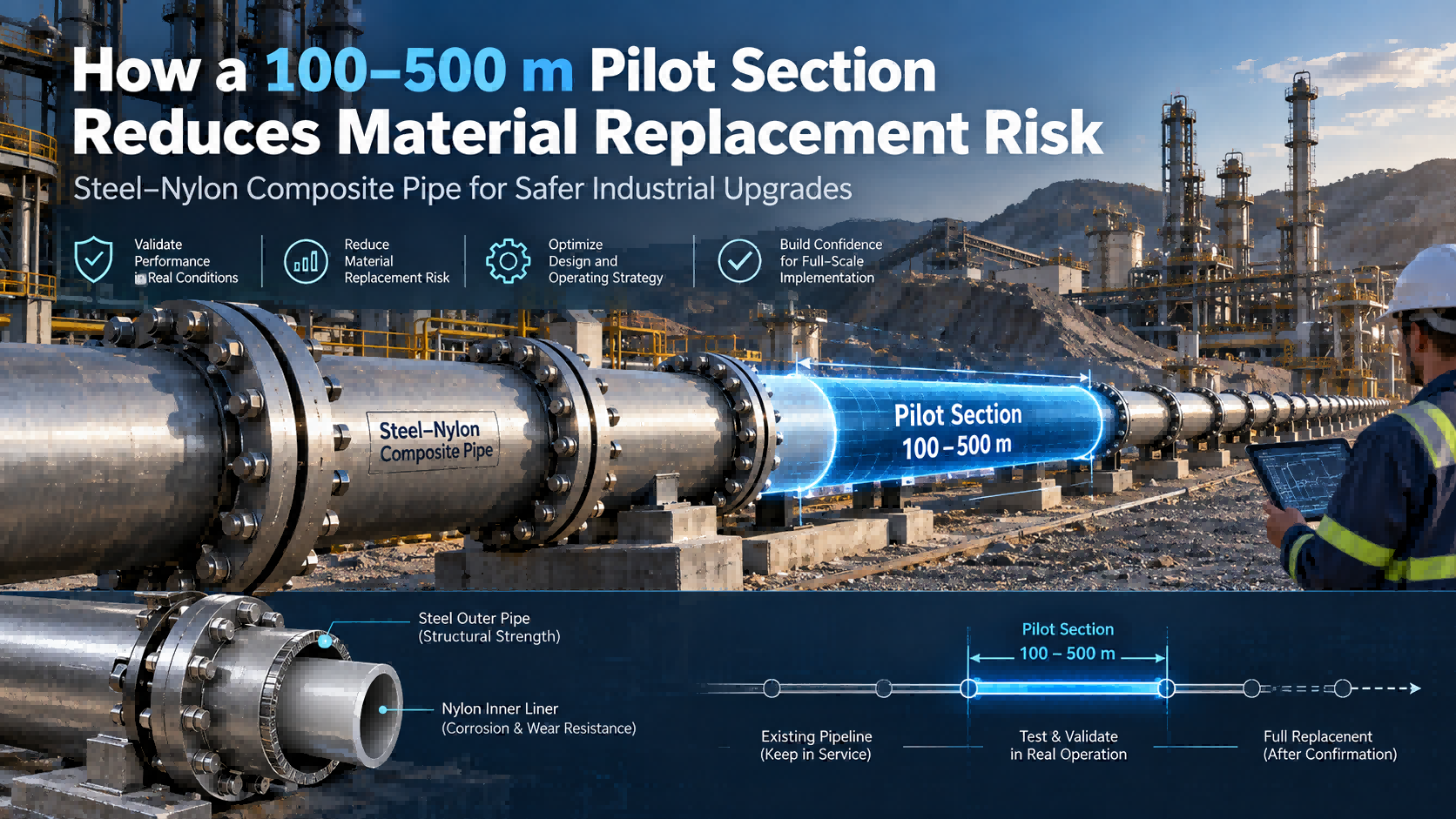
The steel structure provides mechanical strength and pressure resistance, while the nylon layer in contact with the medium provides corrosion and abrasion resistance.
This structural combination offers several advantages for aging pipeline rehabilitation.
5.1 Addressing Both Corrosion and Abrasion
Many pipeline materials perform well against one particular failure mechanism.
Some materials provide good corrosion resistance but may require additional evaluation when exposed to long-term abrasive particle impact.
Other materials provide excellent mechanical strength but require protective coatings or linings in aggressive chemical environments.
The advantage of a steel–nylon composite structure is that:
pressure-bearing and medium-contact functions can be optimized separately.
This makes the system especially relevant for applications involving:
-
High-salinity fluids
-
Chemical mother liquor
-
Mineral slurry
-
Tailings
-
Salt slurry
-
High-water-cut oilfield fluids
-
Combined corrosion-abrasion environments
5.2 Suitable for Short High-Risk Sections
Localized upgrading does not necessarily mean replacing hundreds of meters of pipeline.
In many projects, the problem may be limited to:
-
One elbow
-
A group of tees
-
20–50 meters downstream of a pump
-
A localized high-abrasion section
-
A pipe section that has experienced repeated leakage
Steel–nylon composite pipes can therefore be customized for specific high-risk areas.
A localized upgrade can include:
straight pipe + elbows + tees + flanged connections
to create a complete high-performance replacement module while retaining the original pipeline sections that remain in acceptable condition.
5.3 Retaining Existing Assets and Reducing Project Scope
Replacing an entire industrial pipeline involves much more than the purchase price of the new pipe.
Total project costs may also include:
-
Removal of the existing pipeline
-
Pipe support modifications
-
Lifting and handling
-
Welding
-
Corrosion protection
-
Inspection
-
Cleaning
-
Commissioning
-
Production shutdown
For this reason, comparing only the cost per meter of pipe does not accurately represent the economics of a rehabilitation project.
The real value of localized upgrading is that it allows operators to:
retain existing assets that still have useful service life and replace only the sections that significantly affect system reliability.
For chemical plants, mines, power stations, and oilfields, reducing downtime can sometimes be even more valuable than reducing the initial pipe purchase cost.
6. A Critical Engineering Question: How Should New and Existing Pipelines Be Connected?
Connection design is one of the most important considerations in partial pipeline replacement.
Existing piping systems may use:
-
Carbon steel
-
Stainless steel
-
FRP
-
Rubber-lined steel
-
Plastic pipe
-
Other composite piping systems
The new steel–nylon composite pipe must therefore be capable of reliably integrating with the existing system.
Before manufacturing, the project should confirm the required flange standard, such as:
-
ASME
-
EN
-
DIN
-
GB
-
JIS
or another project-specific standard.
Other parameters must also be verified, including:
-
Nominal diameter
-
Pressure class
-
Flange facing
-
Number of bolt holes
-
Bolt circle diameter
-
Sealing surface dimensions
If these details are not confirmed in advance, even a technically suitable pipeline material can create installation problems at the job site.
For this reason, one of the most important steps in localized rehabilitation projects is:
accurate measurement and verification of existing connection interfaces before manufacturing begins.
7. Why Are Integrated Flanged Connections Important for Rehabilitation Projects?
Industrial retrofit projects are frequently carried out in restricted spaces.
In operating chemical plants, mines, power stations, and processing facilities, new piping may need to be installed around:
-
Existing equipment
-
Structural supports
-
Cable trays
-
Other pipelines
-
Limited maintenance access
If extensive field welding is required, the project may also involve:
-
Hot-work permits
-
Fire protection measures
-
Gas detection
-
Safety supervision
-
Production shutdown coordination
Prefabricated flanged connections can reduce the amount of field welding required in suitable projects.
Steel–nylon composite piping systems can be designed with flange-connected straight pipes, elbows, tees, and equipment connections to support more modular installation.
For aging pipeline rehabilitation, this approach can help shorten the available maintenance window and simplify field installation.
8. A Typical Localized Pipeline Upgrade Strategy
Consider a chemical plant operating a DN400 mother liquor pipeline.
After several years of operation, the plant discovers that an elbow downstream of the pump repeatedly develops leaks.
However, inspection shows that the long straight pipeline downstream remains in relatively good condition.
The traditional approach may be:
Replace the damaged elbow with another elbow of the same material.
Although the initial cost may be low, the plant may continue experiencing the same cycle:
Leakage → Shutdown → Replacement → Restart → Leakage Again
A more systematic approach would begin with thickness inspection of the entire local area.
Suppose the high-risk area is found to include:
pump outlet + elbow + several meters of downstream straight pipe.
This complete area can then be treated as one high-risk module.
For example:
Pump Outlet
↓
Steel–Nylon Composite Short Pipe
↓
Steel–Nylon Composite Elbow
↓
Steel–Nylon Composite Straight Pipe
↓
Flanged Connection
↓
Existing Pipeline
The entire transmission line does not have to be replaced.
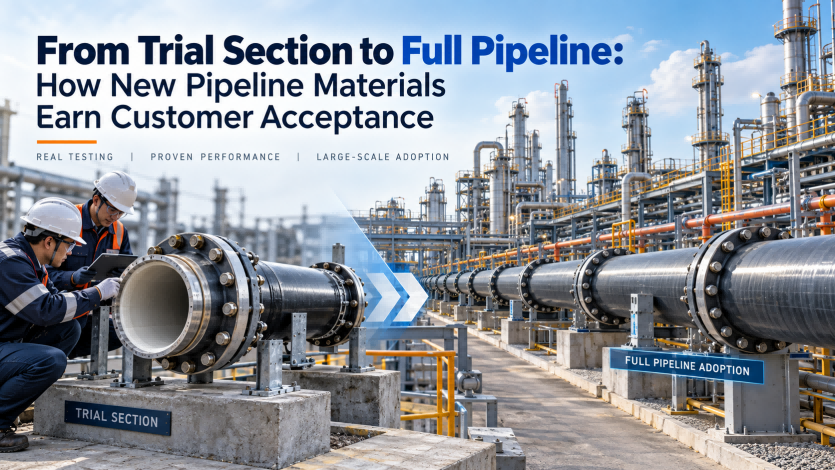
If operating data later confirms improved reliability, the upgraded section can gradually be expanded.
This approach can be summarized as:
localized trial → operating verification → phased expansion.
9. A 100–500 Meter Trial Section Can Reduce Material Replacement Risk
For industrial operators using a new piping material for the first time, replacing the entire line immediately may create unnecessary technical and commercial risk.
A more practical strategy is to select one of the most problematic areas and establish a trial section.
For example:
-
100 meters
-
200 meters
-
500 meters
The operator can then monitor:
-
Wall thickness changes
-
Abrasion
-
Corrosion
-
Leakage frequency
-
Maintenance frequency
-
Pressure stability
-
Inspection requirements
After one complete operating cycle, the new section can be compared with the existing pipeline.
If the results meet expectations, the application can be expanded gradually.
This changes the material-selection process from:
“theoretical evaluation”
to:
“field-data verification.”
For large industrial operators, this can be a more controlled and practical path for adopting new pipeline materials.
10. Do Not Compare Pipe Prices Alone—Compare Downtime Costs
Another common mistake in aging pipeline rehabilitation is focusing exclusively on the purchase price per meter.
A more useful approach is to evaluate:
Total Cost of Ownership (TCO)
A simplified model is:
TCO = Pipe Cost + Installation Cost + Maintenance Cost + Downtime Cost + Replacement Cost
Consider two options.
Option A has a lower initial purchase price but needs replacement every three to five years.
Option B has a higher initial cost but significantly reduces maintenance and replacement frequency.
If only the original purchase price is considered, Option A may appear more economical.
Over 10, 15, or more years of operation, however, the result may be very different.
This is particularly important for:
-
Continuous-process chemical plants
-
Large mining operations
-
Thermal power stations
-
Oil and gas gathering systems
In these industries, an unplanned production shutdown can be far more expensive than the piping material itself.
Industrial pipeline rehabilitation should therefore move from:
purchase-price thinking
toward:
life-cycle cost thinking.
11. When Is Partial Replacement Appropriate—and When Should the Entire Pipeline Be Replaced?
Localized upgrading is not appropriate for every pipeline.
A complete replacement should be carefully evaluated when:
-
Large portions of the pipeline are close to the minimum allowable wall thickness
-
Random leaks are occurring throughout the system
-
Corrosion is relatively uniform across the entire pipeline
-
The pipeline structure is severely deteriorated
-
The original design pressure no longer meets current operating requirements
-
A significant increase in transportation capacity is required
-
The original pipe diameter can no longer support production requirements
Localized upgrading may be more appropriate when:
-
Failures are highly concentrated
-
Most straight sections remain in acceptable condition
-
Elbows, tees, or pump outlets fail repeatedly
-
One relatively short area requires much more maintenance than the rest of the system
In these situations, a targeted material upgrade should be evaluated before committing to complete pipeline replacement.
12. Typical Applications for Steel–Nylon Composite Pipe in Localized Rehabilitation
Steel–nylon composite piping can be considered for localized upgrades in several industrial sectors.
Chemical Industry
Typical applications include:
-
Caustic soda transportation
-
Brine
-
Chemical mother liquor
-
High-salinity wastewater
-
Corrosive process fluids
Mining Industry
Typical applications include:
-
Mineral slurry
-
Tailings
-
Mine backfill slurry
-
Iron ore slurry
-
Copper ore slurry
Oil and Gas
Typical applications include:
-
High-water-cut gathering lines
-
Produced water
-
High-salinity water
-
Services involving CO₂ and H₂S corrosion
Power Industry
Typical applications include:
-
Circulating water
-
Flue gas desulfurization slurry
-
Industrial wastewater
-
Fluids containing suspended solids
In these applications, the steel–nylon composite structure can be engineered according to:
-
Medium characteristics
-
Operating pressure
-
Temperature
-
Pipe diameter
-
Installation requirements
-
Connection standards
13. Moving From “Pipeline Repair” to “Pipeline Life Management”
Industrial pipeline maintenance strategies are changing.
Historically, many operators followed a reactive model:
Repair the pipeline after it fails.
A more advanced approach is:
identify weak points → upgrade them before failure → extend inspection and maintenance intervals.
The logic is simple:
A planned pipeline upgrade is generally easier to control than an unexpected pipeline leak.
Instead of waiting until an aging pipeline system reaches the point where complete replacement becomes unavoidable, operators can develop a:
Pipeline Asset Health Map
The pipeline can be divided into:
-
Low-risk sections
-
Medium-risk sections
-
High-risk sections
Different maintenance strategies can then be applied.
Low-Risk Sections
Continue operation with scheduled inspection.
Medium-Risk Sections
Increase inspection frequency and monitor deterioration.
High-Risk Sections
Prioritize material upgrading or replacement.
This allows maintenance budgets to be directed toward the sections that have the greatest impact on system reliability.
14. The Real Value of Localized Rehabilitation: Invest Where Failure Risk Is Highest
The reliability of an industrial pipeline is not determined by its strongest section.
It is often determined by:
the section most likely to fail.
A single elbow failure may be enough to shut down an entire production line.
This is why aging pipeline rehabilitation should not simply be viewed as a question of:
“How many meters of pipe should we replace?”
The more important question is:
Which sections determine the reliability of the entire piping system?
For industrial systems that simultaneously face corrosion, abrasion, and pressure requirements, upgrading high-risk sections with steel–nylon composite piping can provide an alternative to complete pipeline replacement.
The goal is not simply to replace less pipe.
The real objective is:
to use the right material at the locations where performance matters most.
This can help industrial operators:
reduce leakage, reduce maintenance, reduce unplanned downtime, and extend the effective operating life of the overall piping system.
Conclusion
An aging industrial pipeline does not automatically mean that the entire pipeline must be removed.
A technically sound rehabilitation strategy should first answer three questions:
1. Why is the pipeline failing?
2. Where are the failures concentrated?
3. Which piping material is best suited to address the actual failure mechanism?
If 80% of a pipeline remains in acceptable condition while the majority of failures occur within 20% of the system, replacing 100% of the pipeline may not be the most economical solution.
A better approach may be to:
identify critical sections and prioritize high-risk pipeline upgrades.
Steel–nylon composite pipe combines the mechanical strength and pressure resistance of steel with the corrosion- and abrasion-resistant characteristics of the nylon medium-contact layer.
This makes it particularly suitable for localized upgrading of:
-
Elbows
-
Tees
-
Pump discharge sections
-
High-abrasion zones
-
Areas exposed to combined corrosion and erosion
For industrial operators experiencing frequent pipeline leakage, rising maintenance costs, or aging piping infrastructure, a complete pipeline replacement should not necessarily be the first step.
A more systematic process is:
Failure Analysis + Wall Thickness Inspection + High-Risk Section Identification + Localized Material Upgrade Evaluation
In many cases, extending the service life of an entire industrial pipeline does not require replacing the entire line.
It requires upgrading the weakest sections with the right material.
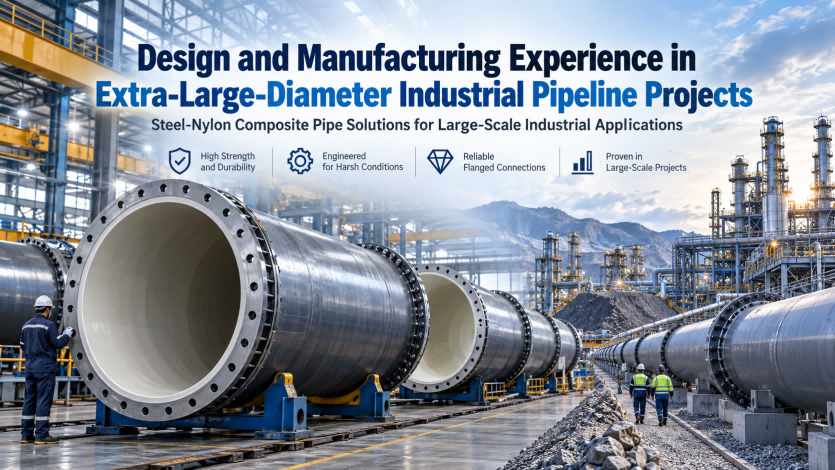
Design and Manufacturing Experience in Extra-Large-Diameter Industrial Pipeline Projects