How a 100–500 Meter Pilot Pipeline Helps Industrial Customers Reduce Material Replacement Risk
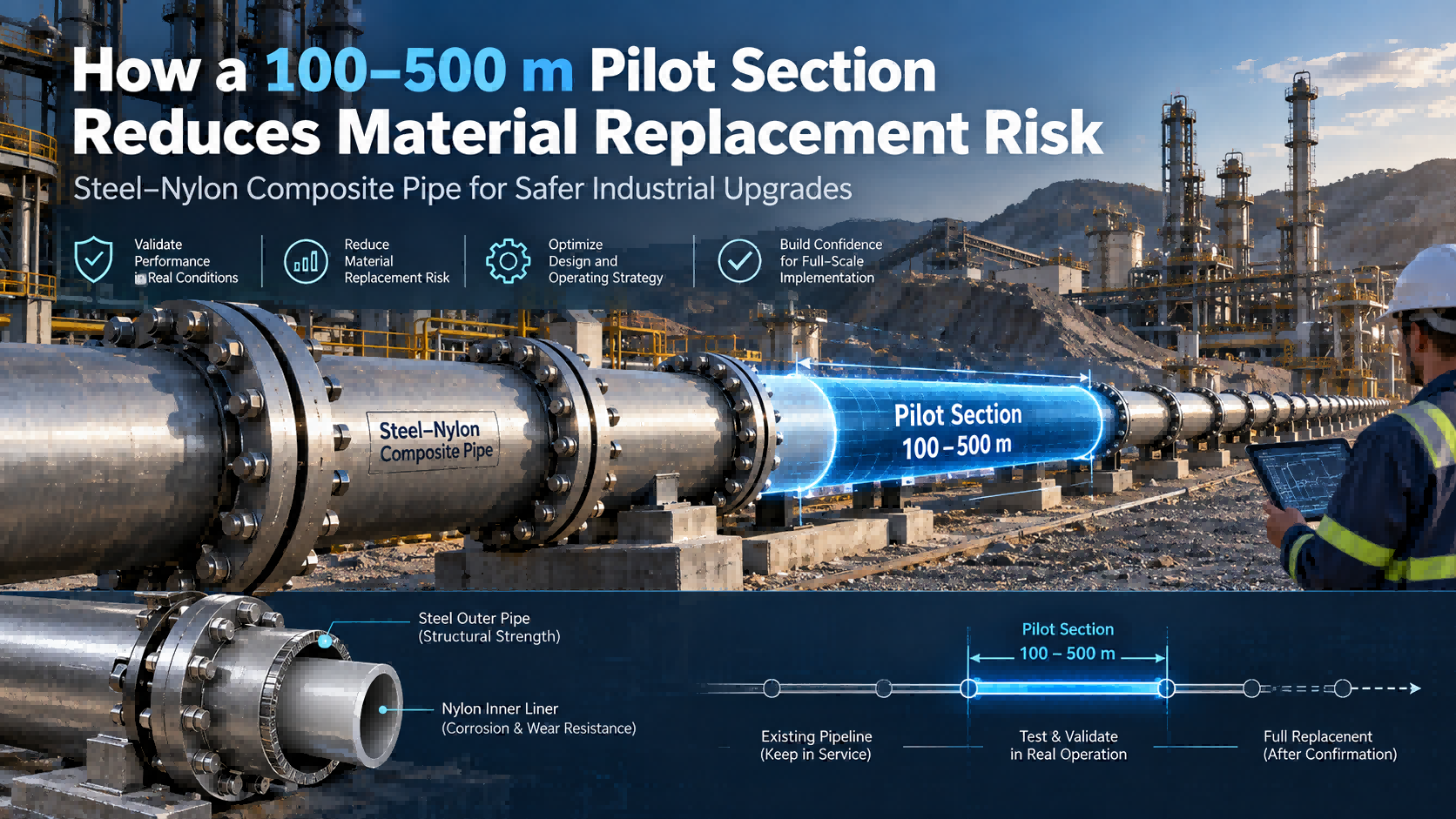
In mining, oil and gas, chemical processing, soda ash, chlor-alkali, and high-salinity wastewater applications, replacing an existing pipeline material is never simply a purchasing decision.
For a production pipeline that has been operating continuously for years, even when the existing material is suffering from corrosion, abrasion, leakage, or frequent maintenance, most industrial customers are reluctant to replace several kilometers—or even tens of kilometers—of pipeline with a completely new material in a single step.
The reason is straightforward:
The problems of the existing material are known, while the risks of a new material are still uncertain.
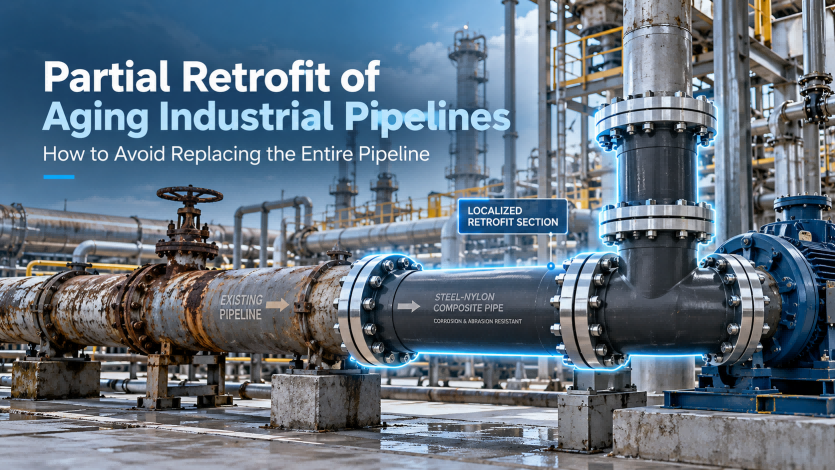
For this reason, more industrial customers introducing new pipeline materials such as steel–nylon composite pipe are adopting a more controlled strategy:
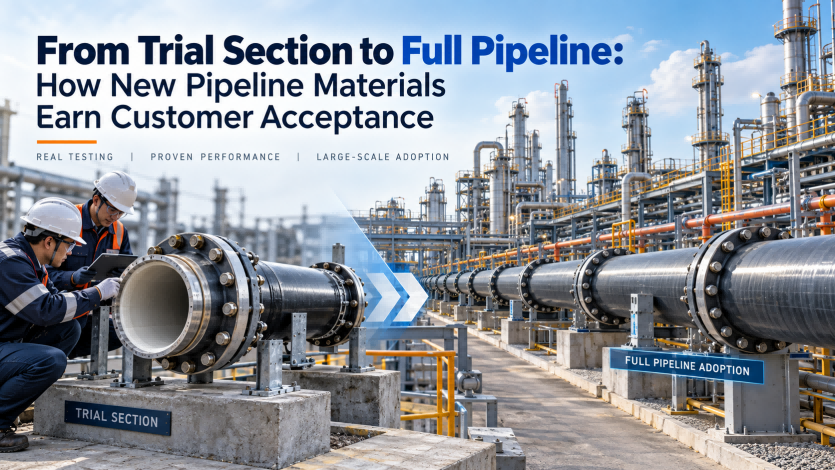
Install a 100–500 meter pilot section first, validate its performance under actual operating conditions, and then gradually expand the application.
For a large industrial project, the value of these first 100–500 meters goes far beyond the pipeline itself.
It serves as a bridge between technical evaluation and full-scale engineering decisions.
1. Why Industrial Customers Rarely Replace the Entire Pipeline Immediately
Consider a mine operating a 5-kilometer slurry transportation pipeline.
The existing steel pipe, rubber-lined steel pipe, or other material may already be experiencing severe wear and may require frequent repairs or replacement.
From a technical perspective, the customer may already recognize that a material upgrade is necessary.
However, before making a final decision, the engineering team will still ask many questions:
-
How abrasion-resistant is the new material under actual slurry conditions?
-
Will high-solids particles cause abnormal erosion?
-
Are the joints reliable under long-term pressure fluctuations?
-
Can the material withstand actual site temperature variations?
-
Is the installation method compatible with existing construction conditions?
-
Can the flange connections integrate with the existing pipeline system?
-
Will pipeline shutdown time increase during installation?
-
If a problem occurs, will maintenance be convenient?
-
Can the expected service life actually be achieved?
-
Can a higher initial investment be recovered through lower maintenance costs?
The same concerns exist in oilfield and chemical applications.
In an oilfield gathering system, engineers may be more concerned about:
CO₂, H₂S, highly mineralized produced water, sand erosion, and pressure cycling.
In chlor-alkali and soda ash plants, the key concerns may include:
strong alkalis, brine, mother liquor, salt mud, and the combined effects of corrosion and abrasion.
Therefore, even if a material performs extremely well in laboratory testing, industrial customers rarely adopt it across an entire production pipeline immediately.
What they really need is performance data generated under:
their own medium, their own pressure, their own temperature, and their own operating conditions.
This is the real value of a pilot pipeline section.
2. Why Is a Pilot Section Often 100–500 Meters Long?
If a pilot section is too short, it may not accurately represent actual pipeline operating conditions.
For example, installing only 10 or 20 meters of pipe may be sufficient to evaluate installation convenience, but it is difficult to fully assess:
-
Long-distance flow resistance
-
Changes in flow velocity
-
Solid-particle erosion
-
Pipeline vibration
-
Thermal expansion and contraction
-
The effects of support structures
-
Flange connection stability
-
Wear at elbows and other localized areas
-
Pressure variations caused by terrain differences
On the other hand, installing several kilometers at once defeats the purpose of controlling material replacement risk.
Therefore, depending on site conditions, many industrial projects can select a representative 100–500 meter section for field validation.
A section of this length can often include:
straight pipe + flange connections + elbows + supports + high-wear locations + pressure variation zones.
The important point is not whether the pilot must be exactly 100 meters or 500 meters.
The real principle is:
The pilot section should include the operating conditions that best represent the actual pipeline system.
3. A Pilot Pipeline First Reduces Technical Risk
One of the biggest challenges when replacing industrial pipeline materials is the difference between laboratory testing and real operating conditions.
Laboratory testing can evaluate:
-
Tensile properties
-
Impact resistance
-
Abrasion resistance
-
Chemical resistance
-
Hydrostatic pressure performance
-
Temperature performance
However, an actual industrial pipeline is usually exposed to several factors simultaneously.
For example, a mining slurry pipeline may experience:
abrasion + pressure + solid particles + elbow erosion + temperature fluctuations.
An oilfield produced-water pipeline may experience:
chlorides + CO₂ + H₂S + high water cut + solid particles + pressure fluctuations.
A chemical mother-liquor pipeline may experience:
corrosion + crystallization + particle abrasion + temperature changes.
The true engineering value of a material can often only be determined when these factors act together.
Therefore, the primary purpose of a 100–500 meter pilot section is to give the material a genuine field test under real operating conditions.
4. Why Steel–Nylon Composite Pipe Is Well Suited to Pilot-Section Introduction
The design philosophy of steel–nylon composite pipe is not simply to combine two materials.
Its fundamental principle is:
Use the steel structure to provide pressure-bearing capacity and mechanical strength, while enhanced nylon protects the internal surface against corrosion and abrasion.
This makes the structure particularly suitable for operating conditions where conventional materials struggle to simultaneously satisfy multiple requirements.
Typical applications include:
-
Combined corrosion and abrasion
-
Relatively high operating pressure
-
High-salinity media
-
Strong alkaline media
-
Slurry and tailings transportation
-
Oilfield produced water
-
Brine and salt mud
-
Chemical mother liquor
-
Industrial wastewater
Traditional single-material pipelines often solve only part of the problem.
For example, conventional carbon steel provides good structural strength, but additional corrosion protection is generally required when transporting aggressive media.
Some non-metallic materials provide excellent corrosion resistance but may require additional engineering considerations related to rigidity, support, pressure capacity, and connection reliability in large-diameter or demanding installations.
The purpose of a steel–nylon composite structure is to integrate these different performance requirements into one pipeline system.
A pilot section allows the customer to directly determine whether this structural concept performs effectively under their actual operating conditions.
5. What Should a 100–500 Meter Pilot Section Actually Validate?
A meaningful pilot project should involve much more than simply installing the pipeline and checking whether it leaks.
Professional pilot projects should establish clear performance indicators before operation begins.
5.1 Internal Pipe Wear
For slurry, tailings, salt mud, and high-solids media, wear is one of the most important parameters.
Inspection should focus on:
-
Wear in straight pipe sections
-
Wear at elbows
-
Areas where pipe diameter changes
-
High-velocity zones
-
Locations where solids may accumulate
After a defined operating period, wall condition or wear measurements can be compared with those of the original pipeline material.
5.2 Corrosion Condition
For oilfield produced water, brine, strong alkaline media, and other corrosive services, the inspection should evaluate:
-
Whether internal corrosion has occurred
-
Whether localized corrosion is present
-
Whether the joint areas are being attacked by the medium
-
Whether flange areas remain stable
-
Whether the external environment affects pipeline integrity
These results are often more valuable for engineering decisions than laboratory chemical-resistance data alone.
5.3 Flange Connection Reliability
Many industrial pipeline failures do not necessarily occur in the pipe body itself.
They may occur at the connections.
The pilot section should therefore evaluate:
-
Flange sealing performance
-
Bolt preload retention
-
Pressure cycling
-
Temperature cycling
-
Pipeline vibration
-
Long-term connection stability
For projects seeking to reduce on-site hot work or welding, reliable flange connections can offer significant practical advantages.
5.4 Pressure Stability
The pilot section should preferably be installed where operating pressure is representative of normal production conditions.
Engineers should observe:
-
Normal operating pressure
-
Pressure changes during startup and shutdown
-
Transient pressure fluctuations
-
Pump startup impact
-
Abnormal operating pressure
For steel–nylon composite pipe, the steel load-bearing structure is one of the key features distinguishing it from many conventional non-metallic pipeline systems.
5.5 Installation Efficiency
When selecting a new pipeline material, customers sometimes focus almost entirely on material performance while overlooking installation costs.
A pilot section makes it possible to directly measure:
-
Installation time per pipe section
-
Lifting requirements
-
Flange alignment difficulty
-
On-site welding requirements
-
Number of installation personnel
-
Production shutdown time
-
Difficulty connecting to the existing system
All of these factors eventually influence the project's total cost of ownership.
6. Do Not Only Compare Whether Damage Occurs—Compare the Rate of Damage
This is one of the most commonly overlooked aspects of industrial pilot projects.
Suppose that after six months of operation:
The original pipeline shows obvious wear.
The steel–nylon composite pipe shows no significant visible damage.
That is certainly valuable information.
However, much more useful questions include:
How much wall thickness has the original pipeline lost?
How much has the pilot pipeline changed?
How long is the original material expected to take before reaching its replacement limit?
How long could the new material potentially operate before reaching the same limit?
This allows the pilot section to evolve from a simple product trial into a:
service-life prediction model.
This type of information is particularly valuable to procurement departments and senior management.
7. Turning a Large Investment Into a Small-Scale Validation Project
Suppose a customer is considering upgrading a 10-kilometer industrial pipeline.
Replacing the entire line immediately involves:
-
Significant material investment
-
A long installation schedule
-
Greater technical risk
-
Higher management decision pressure
If the customer begins with a 300-meter pilot section, only approximately 3% of the total pipeline length is initially converted.
Even if the new solution ultimately proves unsuitable, the exposure is limited to a relatively small area.
However, if the 300-meter test section performs well, the customer gains one of the most valuable forms of engineering evidence:
data generated from its own operating environment.
In many cases, this carries more decision-making weight than dozens of pages of supplier technical documentation.
8. Pilot Sections Also Reduce Organizational Decision-Making Risk
Replacing a pipeline material in a large industrial facility is rarely a decision made by one engineer alone.
It may involve:
-
Equipment departments
-
Process engineering departments
-
Safety departments
-
Procurement departments
-
Finance departments
-
Project management teams
-
Senior management
Each department focuses on different questions.
Engineers ask:
Will it work?
Maintenance teams ask:
How long will it last?
Procurement asks:
How much does it cost?
Finance asks:
What is the payback period?
Production asks:
Will it affect continuous operation?
Management asks:
How much risk is involved?
A successful 100–500 meter pilot project can provide answers to all of these questions.
For this reason, a pilot pipeline does more than validate the material itself.
It helps create internal confidence and consensus within the customer organization.
9. From Pilot Section to Full Pipeline: A Five-Stage Approach
A more controlled new-material introduction process can be divided into five stages.
Stage 1: Failure Analysis
The first step is to understand why the existing pipeline is failing.
Possible causes include:
-
Corrosion
-
Abrasion
-
Erosion
-
Temperature
-
Pressure
-
Joint failure
-
Material aging
Without understanding the actual failure mechanism, it is difficult to select the correct replacement material.
Stage 2: Material Matching
Material selection should then be based on:
-
Transported medium
-
Concentration
-
Temperature
-
Pressure
-
Flow velocity
-
Solids concentration
-
Particle size
-
Pipe diameter
-
Installation environment
Based on these parameters, engineers can evaluate whether a steel–nylon composite structure is appropriate for the project.
Stage 3: Install a 100–500 Meter Pilot Section
Choose a location that represents the most important operating conditions.
In some projects, it may even be useful to deliberately select:
the area with the most severe corrosion or abrasion.
If the material performs reliably under the most demanding conditions, the value of the validation is much greater than testing it under relatively mild conditions.
Stage 4: Evaluate Operating Data
After an appropriate operating period, inspect the pipeline and compare:
existing material vs. new material.
Key comparison indicators may include:
-
Wear rate
-
Corrosion condition
-
Number of leaks
-
Maintenance frequency
-
Production downtime
-
Operating stability
-
Maintenance labor
-
Overall operating cost
Stage 5: Expand the Application
If the pilot section meets expectations, the application can gradually expand:
100 meters
↓
500 meters
↓
1 kilometer
↓
One production area
↓
Entire pipeline
↓
Standardized use in similar applications
This approach is often more consistent with industrial risk-management practices than immediate full-scale replacement.
10. The Pilot Project Should Ultimately Build a TCO Model, Not Just Compare Purchase Prices
One of the most common mistakes in pipeline projects is comparing only the price per meter.
For continuous-process industrial facilities, the more important measurement is:
Total Cost of Ownership (TCO)
A simplified model can be expressed as:
TCO = Initial Purchase Cost + Installation Cost + Maintenance Cost + Replacement Cost + Downtime Loss
A low-cost pipeline material does not necessarily result in a low total cost if it must be replaced frequently.
For example:
Material A may need to be replaced every 2–3 years.
Material B may require a higher initial investment but provide a significantly longer operating cycle.
Over time, the economics of the two systems may be completely different.
One of the most valuable outcomes of a 100–500 meter pilot project is therefore the ability to collect actual maintenance and service-life data and use it to establish a more reliable TCO model.
11. Which Projects Are Particularly Suitable for a Steel–Nylon Composite Pipe Pilot Section?
We particularly recommend the pilot-section approach for the following types of applications.
Mining
Suitable applications include:
-
Tailings transportation
-
Slurry pipelines
-
Mine backfill systems
-
High-solids slurry
-
Iron ore slurry
-
Copper ore slurry
-
Gold mine tailings
Primary validation objectives:
abrasion resistance + pressure resistance + long-distance transportation stability.
Oil & Gas
Suitable applications include:
-
Produced water
-
Gathering pipelines
-
Water injection systems
-
High-salinity water
-
Sand-containing media
-
Corrosive water systems
Primary validation objectives:
corrosion resistance + erosion resistance + pressure stability.
Chlor-Alkali and Soda Ash Industries
Suitable applications include:
-
Brine
-
Salt mud
-
Mother liquor
-
Strong alkaline media
-
Process wastewater
Primary validation objectives:
corrosion resistance + abrasion resistance + long-term operating stability.
Chemical Processing
Suitable applications include:
-
Corrosive process media
-
Chemical mother liquor
-
Industrial wastewater
-
Salt chemical media
-
Particle-containing fluids
Primary validation objective:
overall material performance under complex operating conditions.
12. Why Does Material Adoption Often Accelerate After a Successful Pilot Project?
When a new material first enters an industrial project, the customer's main question is:
“Can this material be trusted?”
After a successful pilot project, the question often changes to:
“Where else can we use it?”
These are two very different stages.
The first project validates the material.
The second project replicates the successful experience.
Once the customer confirms the performance of steel–nylon composite pipe under actual operating conditions, the pilot data can potentially support broader applications across:
-
The same process unit
-
Similar media
-
The same mining site
-
The same oilfield
-
Similar production lines
The resistance to adopting the new material can therefore decrease significantly.
This is why many new industrial materials do not begin their large-scale application with one enormous order.
Instead, they begin with a 100-meter, 200-meter, or 500-meter field trial pipeline.
13. How We Support Steel–Nylon Composite Pipe Pilot Projects
For industrial customers, a pipeline supplier should provide more than just pipe.
A professional supplier should participate in the initial operating-condition analysis.
For a pilot project, we recommend beginning with the following parameters:
Medium → Temperature → Pressure → Flow Velocity → Solids Content → Pipe Diameter → Installation Environment → Existing Pipeline Failure Mode
Based on this information, the project can determine:
-
Pipeline structure
-
Pressure rating
-
Pipe diameter
-
Flange configuration
-
Pipe section length
-
Installation method
-
Inspection interval
-
Pilot-section location
Our steel–nylon composite pipes combine the pressure-bearing and mechanical strength of steel with the corrosion- and abrasion-resistant properties of enhanced nylon.
They are particularly suitable for industrial transportation systems where conventional single-material pipelines struggle to simultaneously address corrosion, abrasion, and pressure requirements.
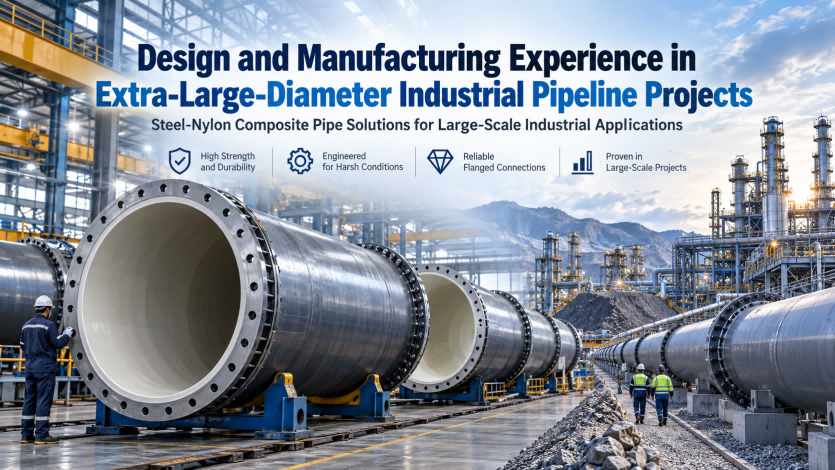
Pipeline specifications and pressure classes can be configured according to project operating conditions, including applications involving large-diameter industrial pipelines.
For the customer, the most reasonable objective should not be:
“Trust a new material first.”
Instead, it should be:
Let actual operating data prove whether the material deserves wider application.
14. A 100–500 Meter Section May Be Short, but It Can Change the Material Selection for Kilometers of Future Pipeline
The biggest barrier to replacing industrial pipeline materials is usually not that customers are unaware of the problems with their existing materials.
The real challenge is:
They cannot be certain whether a new solution will operate reliably over the long term in their specific production environment.
A 100–500 meter pilot section provides a practical way to address this uncertainty.
It transforms a high-risk, large-scale material replacement project into an engineering validation process that is:
testable, measurable, comparable, quantifiable, and scalable.
For steel–nylon composite pipe, this approach is particularly suitable for mining, oil and gas, soda ash, chlor-alkali, salt chemical, and other industrial pipeline systems where corrosion, abrasion, and pressure requirements exist simultaneously.
A successful material upgrade does not necessarily begin with:
“Replace everything.”
It often begins with:
“Select the most representative 100–500 meters and test it first.”
If the pilot section demonstrates:
-
Lower wear rates
-
Improved corrosion control
-
Stable connections
-
Reduced maintenance frequency
-
Less production downtime
-
Lower lifecycle costs
then the next discussion is no longer:
“Can this material be used?”
It becomes:
“Which pipeline should we upgrade next?”
Conclusion
For industrial customers, adopting a new pipeline material does not need to be an all-or-nothing decision.
A 100–500 meter pilot pipeline can provide a controlled bridge between laboratory performance and full-scale industrial application.
By testing steel–nylon composite pipe under actual operating conditions—including pressure, temperature, corrosion, abrasion, slurry concentration, and installation requirements—operators can obtain project-specific evidence before committing to several kilometers of pipeline replacement.
For mining, oil and gas, chlor-alkali, soda ash, and chemical processing projects, this approach can significantly reduce the uncertainty associated with material substitution.
Start with a representative section.
Measure the results.
Compare lifecycle performance.
Then scale with confidence.
That is often the most practical path from a new pipeline material to a long-term industrial solution.
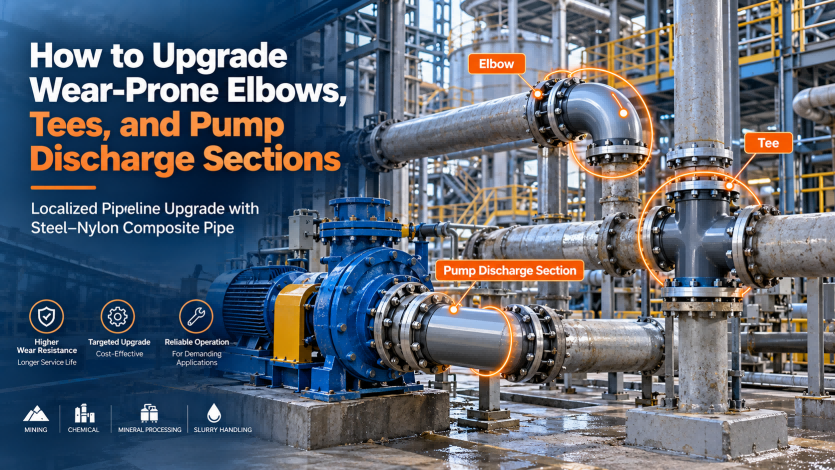
How to Upgrade Wear-Prone Elbows, Tees, and Pump Discharge Sections with Localized Pipeline Replacement
From Trial Section to Full Pipeline: How New Pipeline Materials Earn Customer Acceptance