From Trial Section to Full Pipeline: How New Pipeline Materials Earn Customer Acceptance
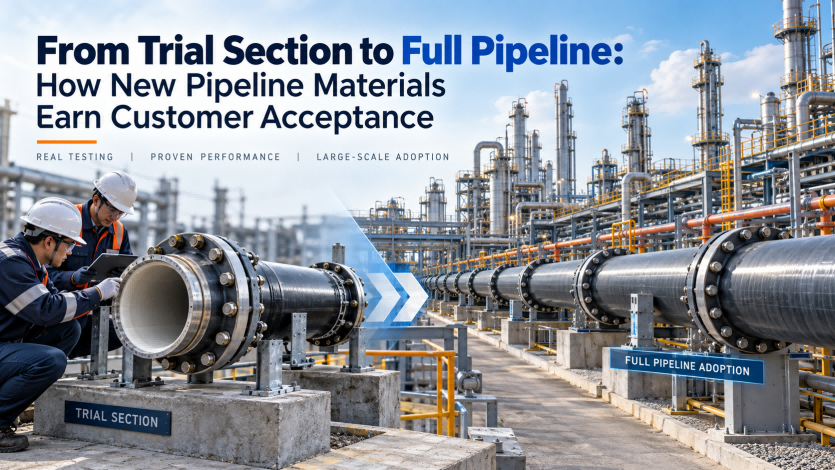
In the chemical, oil and gas, mining, salt chemical, soda ash, and other highly corrosive industrial sectors, replacing an existing pipeline material is never a simple purchasing decision.
For a production pipeline that has been operating continuously for years, even when the existing system suffers from corrosion, abrasion, leakage, or excessive maintenance costs, plant owners are rarely willing to adopt a new material immediately.
The reason is straightforward:
The cost of pipeline failure is often far greater than the cost of the pipe itself.
An incorrect material selection can lead to unplanned shutdowns, media leakage, equipment contamination, production losses, environmental incidents, and even safety risks.
For this reason, a new pipeline material rarely moves directly from a technical datasheet to full-scale plant application.
A more realistic adoption path is:
Laboratory testing → Sample testing → Trial section → Partial pipeline installation → Long-term operation under critical conditions → Full pipeline adoption
For steel-nylon composite pipes, customer acceptance follows the same logic.
It is essentially a process of continuously reducing technical uncertainty and accumulating reliable field-performance evidence.
1. Why Industrial Customers Rarely Adopt a New Pipeline Material Immediately
From a manufacturer's perspective, a material may offer excellent corrosion resistance, wear resistance, and mechanical performance.
However, plant owners, engineering companies, and EPC contractors usually ask much more specific questions.
For example:
-
Will the pipe remain stable at the actual operating temperature?
-
Can it withstand the design pressure over long-term operation?
-
How fast will the internal surface wear when transporting solids-containing media?
-
Will performance deteriorate in highly saline, alkaline, or corrosive environments?
-
Are flange connections reliable?
-
Will long pipelines experience deformation?
-
How will water hammer, vibration, and frequent startup and shutdown cycles affect service life?
-
Can large-diameter pipes maintain dimensional stability?
-
Is maintenance convenient?
-
Can the manufacturer consistently reproduce the same quality in large production batches?
These questions cannot be fully answered by a product brochure.
For industrial pipeline projects:
The customer is not simply purchasing a length of pipe. The customer is purchasing a long-term, reliable fluid transportation solution.
This is exactly why trial sections play such an important role in the adoption of new pipeline materials.
2. A Trial Section Is Not Simply a Trial — It Is a Small-Scale Engineering Validation
Some people interpret a trial section as installing several dozen meters of pipe and “seeing what happens.”
In serious industrial projects, however, a meaningful trial section should be treated as:
A reduced-scale version of the future complete pipeline system.
The testing conditions should be as close as possible to the actual operating environment, including:
-
Actual transported medium
-
Actual operating temperature
-
Actual pressure
-
Actual flow velocity
-
Solid particle concentration
-
Pipe diameter
-
Number of elbows
-
Pipeline support configuration
-
Flanged connection method
-
Startup and shutdown frequency
-
Vibration and impact conditions
Only when the test conditions reflect actual service conditions can the resulting data provide meaningful engineering value.
If the trial conditions are significantly different from the final operating environment, even a successful trial may provide limited support for full-scale material selection.
3. What Should Customers Actually Evaluate During the Trial Stage?
Evaluating a new industrial pipe should involve far more than checking whether leakage occurs.
A meaningful field validation should include several critical performance indicators.
3.1 Corrosion Resistance
Corrosion is one of the major causes of shortened pipeline life in chemical processing and oilfield systems.
Typical aggressive media may include:
-
High-salinity water
-
Brine
-
Mother liquor
-
Caustic soda
-
Acid-alkali process fluids
-
Oilfield produced water
-
CO₂-containing fluids
-
H₂S-containing service
For conventional carbon steel pipelines, additional corrosion-control measures are often required, such as coatings, corrosion inhibitors, or internal lining systems.
Steel-nylon composite pipe follows a different design philosophy:
The steel structure provides mechanical strength and pressure resistance, while the nylon functional layer is exposed to the transported medium.
This structure can help reduce direct contact between the corrosive medium and the steel pressure-bearing structure, thereby reducing the risk of internal corrosion.
3.2 Abrasion Resistance
For slurry, salt mud, mother liquor, tailings, iron ore slurry, copper concentrate slurry, and sand-containing produced fluids, corrosion is often only part of the problem.
The more challenging condition is:
Corrosion + abrasion occurring simultaneously.
Traditional pipelines may show a common failure pattern:
The overall pipe appears structurally intact, while elbows, reducers, tees, or high-velocity areas experience serious localized wall thinning.
During trial operation, the following parameters can therefore be monitored regularly:
-
Internal surface wear
-
Wall-thickness reduction
-
Elbow wear
-
Surface condition
-
Changes in flow performance
By accumulating this data over time, customers can determine whether the material is suitable for wider application.
4. Why the Steel-Nylon Composite Structure Is Well Suited to This Validation Process
Industrial piping has always faced a fundamental materials challenge:
Different materials are often excellent at solving only one problem.
Metal pipes generally offer high mechanical strength and pressure resistance, but may require additional protection in corrosive environments.
Certain non-metallic pipes offer excellent corrosion resistance but require careful evaluation of structural stiffness, mechanical impact resistance, pressure capability, and dimensional stability, particularly in large-diameter or demanding installations.
Steel-nylon composite pipe follows another engineering approach:
Allow each material to perform the function it is best suited for.
The steel structure mainly provides:
-
Structural strength
-
Internal pressure resistance
-
Resistance to external mechanical loads
-
Support for installation loads
The nylon functional layer mainly addresses:
-
Media corrosion
-
Abrasive wear
-
Internal surface protection
-
Long-term fluid contact
Therefore, steel-nylon composite pipe is not simply intended to “replace steel with nylon.”
Instead, the composite structure is designed to address the conflict between:
Corrosion resistance, wear resistance, and pressure-bearing capability.
5. Why Does a Successful Trial Section Not Automatically Lead to Full-Pipeline Replacement?
Even when a trial section operates successfully, customers rarely move immediately into large-scale procurement.
They usually begin asking three additional questions.
First: Can the Results Be Reproduced?
One high-performing pipe does not guarantee that hundreds or thousands of pipes will perform identically.
As the project moves from a trial section to a complete pipeline, the customer's concern gradually shifts from:
“Does this material work?”
to:
“Can this product be manufactured consistently at scale?”
At this point, manufacturing quality control becomes critical.
Important factors include:
-
Raw material consistency
-
Nylon layer thickness control
-
Steel structure manufacturing accuracy
-
Flange dimensions
-
Pipe concentricity
-
Length tolerance
-
Pressure testing
-
Factory inspection
-
Batch traceability
For large industrial projects, what ultimately builds customer confidence is not the performance of one sample pipe.
It is:
Consistency across the entire production batch.
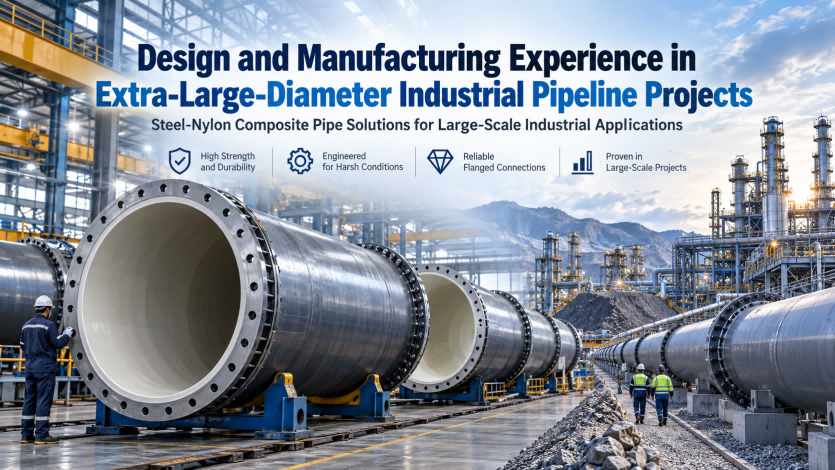
6. What Changes When a Project Expands from Tens of Meters to Several Kilometers?
Trial sections are usually short.
However, as the application expands, system-level engineering challenges become increasingly important.
Pressure Changes
The longer the pipeline, the more important hydraulic pressure-loss calculations become.
Pump selection, pipe diameter, flow velocity, and local resistance all affect system performance.
Temperature Changes
For outdoor pipelines, temperature fluctuations caused by day-night cycles, seasonal changes, and transported media can generate thermal expansion and contraction.
Terrain Conditions
Oilfields, mining operations, and long-distance industrial pipelines may need to cross:
-
Slopes
-
Valleys
-
Roads
-
Process areas
-
Pipe racks
-
Underground corridors
These environments impose higher requirements on structural stability.
Increasing Number of Connections
A trial section of several dozen meters may contain only a few joints.
A pipeline several kilometers long may contain hundreds or even thousands of connections.
Therefore, standardized connection design becomes increasingly important.
For steel-nylon composite pipeline systems using flange connections, field welding requirements can be reduced.
This can simplify:
-
Installation
-
Disassembly
-
Local maintenance
-
Construction organization
-
Pipeline replacement
This becomes particularly valuable in chemical plants and other environments where hot work is tightly controlled.
7. Long-Term Operating Data Is What Truly Moves Customers from Trial to Full Adoption
No marketing claim can fully replace actual operating time.
For industrial customers, the most convincing statement is usually not:
“Excellent corrosion resistance.”
Instead, it is:
“This pipeline has operated continuously for a defined period under this specific medium, temperature, pressure, and flow condition.”
As trial time increases, customers can obtain real operating data such as:
| Evaluation Item | What the Customer Really Wants to Know |
|---|---|
| Internal surface condition | Is significant corrosion or abrasion occurring? |
| Wall-thickness change | Is the wear rate acceptable? |
| Flange connections | Are the joints stable and low-maintenance? |
| Pipeline structure | Has noticeable deformation occurred? |
| Operating pressure | Does the system remain stable? |
| Maintenance frequency | Has maintenance demand decreased? |
| Replacement interval | Has pipeline life been extended? |
| Total cost | Is the new solution economically better than the previous system? |
Once these indicators remain stable over time, customer perception begins to change.
At the beginning, the customer asks:
“Can we trust this material?”
Later, the question becomes:
“Where else can we use this material?”
That is the real turning point in the adoption of a new industrial pipeline material.
8. From Local Replacement to Complete Pipeline Upgrade
New pipeline materials usually enter industrial facilities through several stages.
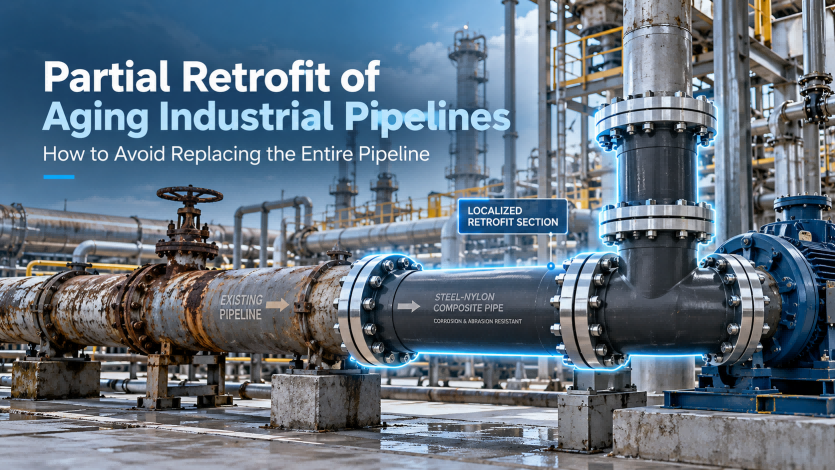
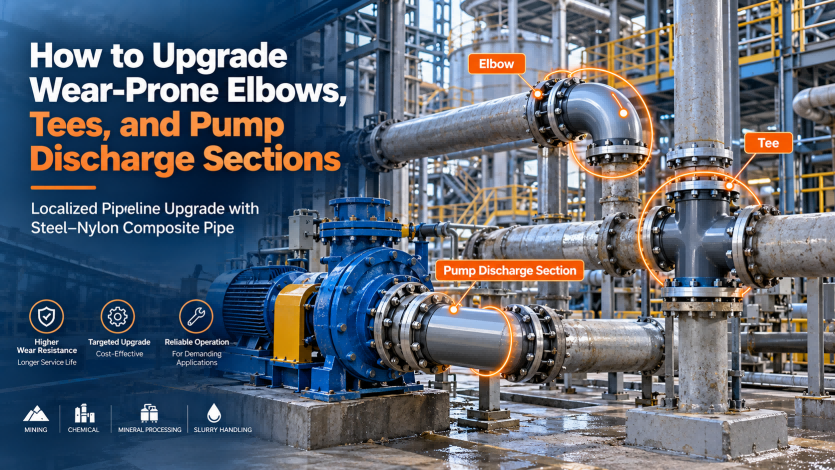
Stage 1: Replace the Most Failure-Prone Sections
Customers often start with areas such as:
-
Elbows
-
High-wear sections
-
High-corrosion sections
-
Drainage lines
-
Salt mud pipelines
-
High-salinity water pipelines
These locations already experience frequent replacement, making the value of a new material easier to demonstrate.
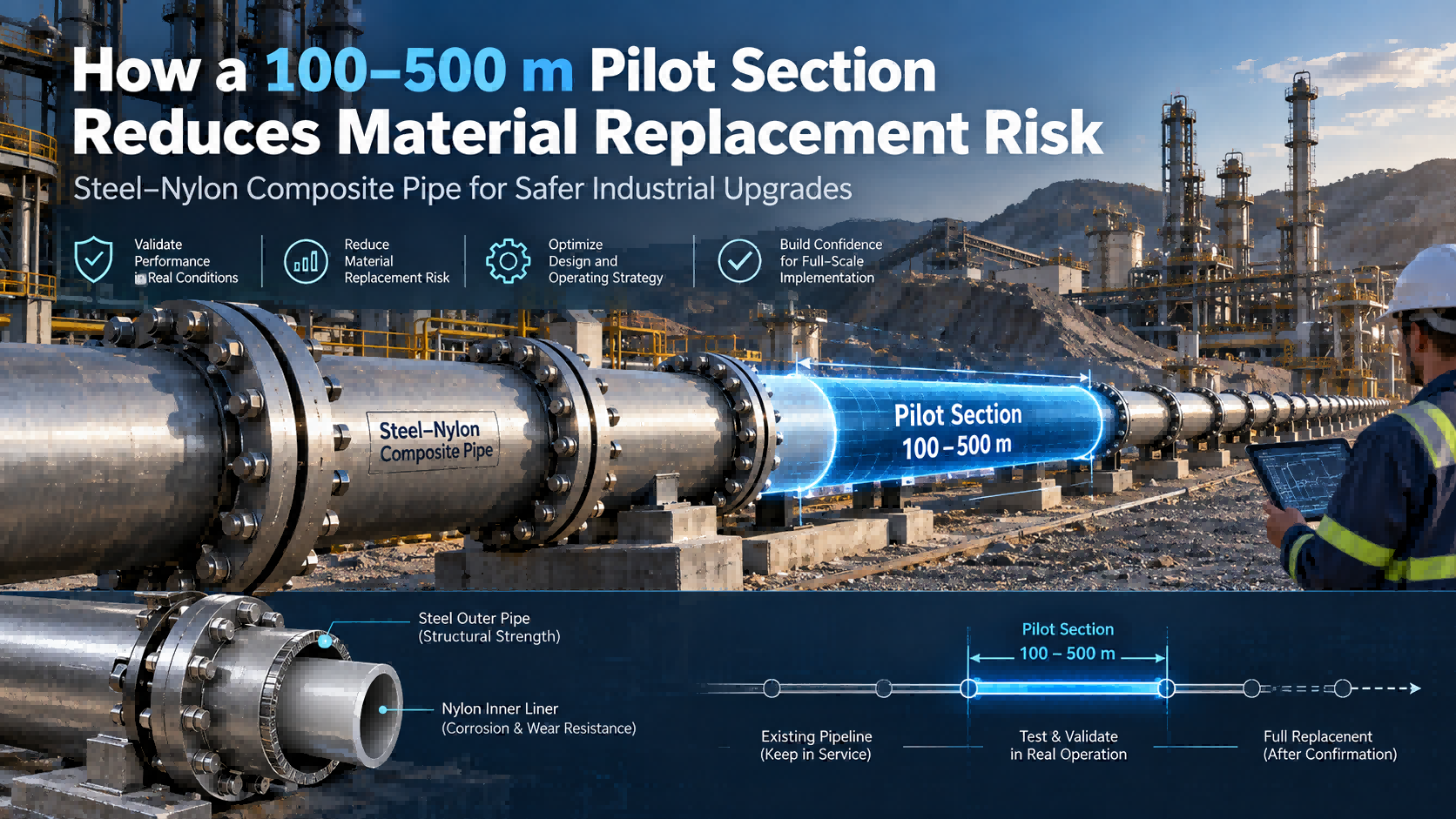
Stage 2: Extend to Continuous Pipeline Sections
If the localized application performs well, customers may expand the installation to:
100 meters, 500 meters, or longer continuous pipeline sections.
At this stage, they begin evaluating:
-
Long-distance pressure stability
-
Support design
-
Flange connections
-
Thermal expansion
-
Installation efficiency
Stage 3: Enter Critical Production Pipelines
After sufficient operating experience has been accumulated, the new material may be introduced into critical production systems such as:
-
Process mother liquor pipelines
-
Brine systems
-
Oilfield gathering systems
-
Produced water systems
-
Slurry transportation systems
-
Chemical process pipelines
This is an important transition.
Once a material enters a critical production system, the customer no longer regards it as an experimental product.
It has become an accepted engineering material.
Stage 4: Plant-Wide or Project-Wide Adoption
The final stage is standardization.
In new construction, plant expansion, or pipeline rehabilitation projects, steel-nylon composite pipe may begin to be included directly in the material-selection process.
At this point, the customer's question has changed completely.
Instead of asking:
“Can this material be used?”
the question becomes:
“In which services should this material be prioritized?”
9. Why Lifecycle Cost Matters More Than Initial Pipe Price
Pipeline selection is sometimes overly focused on initial procurement cost.
However, for industrial pipelines, a more meaningful economic metric is:
TCO — Total Cost of Ownership
A simplified formula can be expressed as:
TCO = Initial Purchase + Installation + Maintenance + Replacement + Production Downtime + Other Lifecycle Costs
For example, a low-cost pipeline may seem economical at the procurement stage.
But if it:
-
Requires replacement every few years
-
Needs regular shutdown maintenance
-
Experiences frequent leakage
-
Requires continuous corrosion protection
its long-term cost may be significantly higher than expected.
By contrast, a pipeline that reduces maintenance frequency and extends replacement intervals may provide a lower overall lifecycle cost, even if its initial purchase price is higher.
This is one of the most important reasons why steel-nylon composite pipes may progress from trial sections to full-pipeline applications.
The correct question is not simply:
“How much does one meter of pipe cost?”
The better question is:
“How much will this entire pipeline system cost to own and operate over the next 10 years?”
10. What Makes a New Pipeline Material Easier for Large Industrial Customers to Accept?
In real industrial projects, advanced material performance alone is not enough.
A new pipeline material usually needs to satisfy at least six conditions.
1. Performance Must Be Verifiable
Material advantages should be supported by:
-
Laboratory testing
-
Factory inspection
-
Field testing
-
Long-term operating data
2. Quality Must Be Reproducible
There should not be a major difference between small-batch samples and large-scale production.
3. The Product Must Be Engineerable
Design institutes and engineering teams need access to reliable technical data, including:
-
Dimensions
-
Pressure ratings
-
Connection parameters
-
Installation requirements
-
Support design guidance
4. Installation Must Be Practical
A product must work in real industrial environments, not only in controlled laboratory conditions.
5. Supply Must Be Sustainable
Large projects require more than a technically good product.
They also require:
-
Manufacturing capacity
-
Delivery capability
-
Quality-control systems
-
Inspection capability
-
Technical support
6. Economic Value Must Be Demonstrable
Customers ultimately need to understand how the material can reduce total lifecycle costs.
11. The Value of Steel-Nylon Composite Pipe Goes Beyond Replacing One Existing Material
The real value of steel-nylon composite pipe is not simply that it can replace stainless steel, FRP, HDPE, or conventional lined pipelines.
More importantly, it represents a different industrial piping design philosophy:
Separate the pressure-bearing function from the corrosion- and wear-resistance function, and assign each function to the material best suited to perform it.
For demanding applications involving combinations of:
-
Corrosion
-
Abrasion
-
Pressure
-
Mechanical impact
-
Large diameter
-
Long-distance transportation
this composite-material approach can provide significant engineering value.
This is particularly relevant in:
-
Oil and gas fields
-
Salt chemical plants
-
Soda ash production
-
Chlor-alkali facilities
-
Mining operations
-
High-salinity industrial water systems
In these environments, a single material often struggles to solve every challenge simultaneously.
12. From Trial Section to Full Pipeline: It Is Ultimately a Process of Building Trust
There is rarely a shortcut for introducing a new material into industrial service.
Laboratory testing demonstrates:
Technical feasibility.
A trial section demonstrates:
Field feasibility.
Long-term operation demonstrates:
Reliability.
Large-scale production demonstrates:
Manufacturing consistency.
Years of successful application ultimately create:
Customer confidence.
For a pipeline manufacturer, the real objective is not simply to persuade a customer to purchase more pipe in the first order.
The objective is to demonstrate, through one trial section, one pipeline, and one project after another, that the material can continue operating reliably under real industrial conditions.
When customers begin actively expanding the material into additional production systems, the material has completed its most important transformation:
From a “new material” into a proven engineering solution.
Conclusion: Long-Term Reliability Is the Strongest Proof
The industrial pipeline market does not lack new materials.
What is much rarer is:
New materials that have been validated through long-term field operation.
For corrosive, abrasive, high-salinity, high-pressure, and complex industrial fluid transportation, customers ultimately care about a few practical questions:
How long will the pipeline operate?
How much maintenance will it require?
Will it affect production continuity?
What will the total lifecycle cost be?
The value of steel-nylon composite pipe lies in combining the structural strength of steel with the corrosion- and wear-resistant properties of nylon, providing an alternative material solution for demanding industrial transportation systems.
From a trial section of several dozen meters, to hundreds of meters of production pipeline, and eventually to several kilometers or an entire transportation network, the physical scale of the application continues to increase.
But behind this expansion lies one fundamental principle:
Every section of pipeline that operates reliably increases the customer's confidence in the material.
For industrial pipeline systems, long-term stable operation remains one of the strongest forms of technical proof.
How a 100–500 Meter Pilot Pipeline Helps Industrial Customers Reduce Material Replacement Risk
Why Customers Turn to Composite Piping After Frequent Replacement of Traditional Pipes