Design and Manufacturing Experience in Extra-Large-Diameter Industrial Pipeline Projects
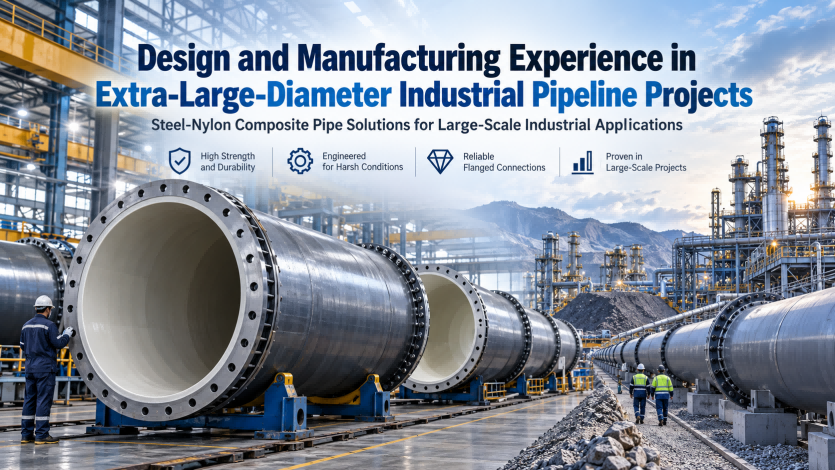
In chemical processing, mining, power generation, oil and gas fields, seawater desalination, and large-scale industrial water systems, pipelines are increasingly moving toward larger diameters, higher flow capacities, more complex media, and longer service lives as industrial facilities continue to expand in scale.
Industrial pipelines with diameters of DN1000, DN1200, DN1600, or even DN2000 and above can no longer be treated simply as enlarged versions of conventional pipes.
Once pipeline diameter enters the extra-large range, engineering priorities change significantly:
-
Pipe self-weight increases rapidly;
-
Ring stiffness and local deformation become more critical;
-
The risk of vacuum buckling increases;
-
Flange rigidity and sealing become more difficult to control;
-
Support spacing and foundation settlement have greater influence;
-
Axial displacement caused by temperature changes becomes more significant;
-
Manufacturing dimensional consistency becomes more difficult;
-
Transportation, lifting, and field installation become considerably more complex;
-
Repairs caused by corrosion or abrasion become much more expensive.
Therefore, the real challenge in extra-large-diameter industrial pipelines is not simply material performance.
It is the systematic balance between:
Material, structural design, manufacturing, connection, transportation, installation, and long-term maintenance.
This is especially important for projects transporting corrosive media, abrasive slurries, high-salinity wastewater, circulating water, and other complex industrial fluids over long operating periods.
This is also where steel–nylon composite pipe can provide significant engineering value.
1. Why Are Extra-Large-Diameter Industrial Pipelines Becoming Increasingly Important?
Larger industrial facilities fundamentally require larger volumes of fluid to be transported within a given period.
For the same conveying capacity, an undersized pipeline generally means:
-
Higher flow velocity;
-
Greater friction losses;
-
Higher pumping energy consumption.
Increasing pipe diameter can reduce flow velocity and hydraulic losses under appropriate system conditions.
As a result, large- and extra-large-diameter pipelines are becoming increasingly common in the following applications.
Mining Slurry and Tailings Transportation
As mine processing capacities increase, the required conveying volumes for slurry, tailings, and backfill materials also continue to rise.
These media often involve a combination of:
-
High solids concentration;
-
Severe abrasion;
-
Long-distance transportation;
-
High flow rates;
-
Continuous operation;
-
High downtime costs.
The pipeline must therefore provide not only sufficient flow capacity but also long-term resistance to abrasive wear.
Chemical Plant Circulating Water and Process Media Systems
Large chemical complexes, including soda ash, chlor-alkali, salt chemical, and phosphate chemical plants, require large volumes of media to be transported through extensive pipeline networks.
Typical media include:
-
Brine;
-
Mother liquor;
-
Alkaline solutions;
-
Industrial circulating water;
-
Wastewater;
-
High-salinity water;
-
Fluids containing suspended solids.
These media may cause corrosion, scaling, and abrasion at the same time.
For pipelines above DN1000, once local corrosion perforation or leakage occurs, repair work can be substantially more difficult and expensive than for small-diameter pipelines.
Power Plant Circulating Water and Desulfurization Systems
Power plant cooling water systems commonly require very high flow rates.
In flue gas desulfurization, circulating water, and industrial wastewater systems, pipelines may also be exposed to:
-
Chloride-induced corrosion;
-
Slurry abrasion;
-
Variations in water chemistry;
-
Sediment erosion;
-
Long-term external corrosion in humid environments.
Large diameter alone cannot guarantee reliability.
Seawater Desalination and Industrial Water Transmission
Seawater, concentrated brine, and high-salinity industrial water can be highly aggressive toward many metallic materials.
When transportation capacity reaches tens of thousands of tons per day or even higher levels, large-diameter pipelines become a key part of the infrastructure.
This is why many projects now evaluate four factors together during the design stage:
Diameter + Corrosion Resistance + Pressure Capability + Maintenance Cost
2. Extra-Large-Diameter Pipeline Design Is Not Simply “Scaling Up” a Small Pipe
One of the most common misconceptions in large industrial pipeline engineering is that a larger pipe can simply be designed by proportionally enlarging a smaller pipe.
Consider increasing a pipeline from DN500 to DN2000.
Although the diameter increases by only several times, many structural problems do not increase linearly.
Several important engineering factors therefore require special attention.
Ring Stiffness
For extra-large-diameter pipelines, external loads can be just as important as internal pressure.
Typical external loads include:
-
Soil pressure;
-
Groundwater pressure;
-
Vehicle loads;
-
Pipe self-weight;
-
Local loads during installation.
If the pipeline does not have sufficient ring stiffness, problems may include:
-
Ovalization;
-
Local buckling;
-
Joint misalignment;
-
Seal failure.
Therefore, extra-large-diameter pipeline selection should never be based only on the question:
“How many MPa can the pipe withstand?”
Ring stiffness is equally important.
3. Both Internal and External Pressure Must Be Considered
When selecting industrial pipelines, one of the first questions users often ask is:
“What pressure can this pipe withstand?”
This is certainly important.
However, positive internal pressure is not the only pressure condition that matters in an extra-large-diameter pipeline.
Negative pressure or vacuum conditions may occur as a result of:
-
Sudden pump shutdown;
-
Pipeline draining;
-
Rapid valve closure;
-
Water hammer;
-
Cooling-induced internal pressure reduction;
-
Elevation differences within the pipeline system.
These conditions may create partial vacuum inside the pipeline.
For pipes with insufficient structural stiffness, atmospheric pressure from outside the pipe can potentially cause structural instability or collapse.
Pipeline engineering should therefore evaluate both:
Internal Pressure
and
External Pressure / Vacuum Resistance
This is one of the major advantages of incorporating a steel structural layer into a composite pipeline.
4. Why Is a Steel–Nylon Composite Structure Suitable for Large Industrial Pipelines?
The fundamental design concept of steel–nylon composite pipe is not simply to combine two materials.
Instead, each material is used to perform the function it is best suited for.
In simplified terms:
Steel = Structural Strength
Nylon = Corrosion and Wear Resistance
In other words:
Steel provides structural and pressure-bearing capability, while nylon protects the pipe from the transported medium.
This combination enables the pipeline to simultaneously provide:
-
Pressure resistance;
-
Ring stiffness;
-
Impact resistance;
-
Corrosion resistance;
-
Abrasion resistance.
These advantages become particularly important as pipeline diameter increases.
5. Why Do Single-Material Pipelines Often Have Limitations in Complex Industrial Conditions?
Carbon Steel
Carbon steel offers several obvious advantages:
-
High mechanical strength;
-
Mature manufacturing technology;
-
Good structural performance;
-
Relatively controllable initial cost.
However, its limitations become significant in corrosive environments.
Typical challenging media include:
-
High-salinity water;
-
Acids and alkalis;
-
Industrial wastewater;
-
Seawater;
-
Chloride-containing fluids.
Additional anticorrosion protection is usually required.
If the protective coating becomes damaged during service, local corrosion may develop rapidly.
Stainless Steel
Materials such as 304 and 316L stainless steel offer good general performance.
However, material costs can rise dramatically when the pipeline diameter becomes very large.
In high-chloride, high-salinity, or specific chemical environments, engineers must also consider:
-
Pitting corrosion;
-
Crevice corrosion;
-
Stress corrosion cracking.
Therefore, stainless steel selection should be evaluated according to the actual process medium and lifecycle economics rather than material reputation alone.
FRP Pipe
Fiberglass-reinforced plastic pipes are widely used in corrosion-resistant applications.
However, large industrial projects also need to evaluate:
-
Impact resistance;
-
Flange connections;
-
Local mechanical loads;
-
Laminate integrity;
-
Mechanical damage during installation.
In mining, heavy chemical, and other demanding industrial environments, pipelines may experience lifting impacts, accidental collision, and uneven support conditions.
These factors must be considered carefully.
HDPE Pipe
HDPE is widely used in water treatment and relatively low-pressure transportation applications.
Its advantages include:
-
Corrosion resistance;
-
Low weight;
-
Convenient installation.
However, as diameter, pressure, and operating temperature increase, engineers must pay greater attention to:
-
Creep;
-
Ring deformation;
-
Support design;
-
Temperature effects;
-
Long-term pressure performance.
For demanding industrial applications, these factors should be evaluated against actual project conditions.
6. Core Design Philosophy of Extra-Large-Diameter Steel–Nylon Composite Pipe
A properly engineered large-diameter composite pipeline should consider three functional layers.
Layer 1: Medium Protection Layer
The nylon layer is in direct contact with the transported medium.
Its primary functions include:
-
Isolating corrosive media from the steel structure;
-
Reducing metallic corrosion risk;
-
Providing abrasion protection;
-
Creating a relatively smooth internal flow surface.
This layer is especially important when transporting:
-
Slurry;
-
High-salinity water;
-
Mother liquor;
-
Industrial wastewater;
-
Other corrosive and abrasive media.
Layer 2: Steel Load-Bearing Structure
The steel structure mainly provides:
-
Hoop strength;
-
Axial strength;
-
Ring stiffness;
-
Impact resistance;
-
Structural support for fittings and connections.
This structural concept is one of the reasons steel–nylon composite pipe is particularly suitable for development toward larger diameters.
Layer 3: Connection Structure
For large industrial pipelines, the connection system itself is a major part of pipeline reliability.
Many industrial pipeline leaks occur not in the straight pipe body, but around:
-
Flanges;
-
Elbows;
-
Tees;
-
Reducers;
-
Valve connections.
For this reason, our design philosophy places strong emphasis on:
Pipeline System Design — not merely Pipe Design.
7. Why Is Integrated Flange Design So Important?
Flange design becomes substantially more complicated as pipeline diameter increases.
Larger flanges experience greater sensitivity to:
-
Bending moments;
-
Gasket seating loads;
-
Bolt preload distribution;
-
Installation tolerances.
Insufficient flange rigidity may lead to:
-
Flange-face deformation;
-
Uneven bolt loading;
-
Uneven gasket compression;
-
Local leakage.
For steel–nylon composite pipes, the structural relationship between the flange and the main pipe body therefore deserves particular attention.
Through appropriate steel reinforcement combined with nylon corrosion protection, it is possible to engineer:
Pipe + Flange + Lining
as an integrated system.
This can be especially valuable in large chemical, mining, and industrial water projects.
8. What Makes DN1600 and DN2000 Pipe Manufacturing Difficult?
It is easy to assume:
“If a factory can manufacture DN500 pipe, manufacturing DN2000 pipe is simply a matter of using larger equipment.”
In practice, this is not the case.
One of the greatest challenges in extra-large-diameter pipeline manufacturing is:
Consistency.
Important manufacturing parameters include:
-
Roundness;
-
Wall thickness;
-
Concentricity;
-
Flange flatness;
-
Lining uniformity;
-
Pipe straightness;
-
Dimensional stability.
As pipe diameter increases, even relatively small dimensional deviations can become significant during field installation.
Therefore, the real benchmark for extra-large-diameter manufacturing capability is not simply:
“Can the factory produce one pipe?”
The more important question is:
Can the factory manufacture large quantities consistently, repeatedly, and within the dimensional requirements of the entire pipeline project?
9. Uniform Nylon Layer Thickness Is Critical
For composite pipelines, thicker corrosion- and wear-resistant layers are not automatically better.
What matters is:
Uniformity.
Excessive variations in layer thickness may lead to:
-
Uneven cooling shrinkage;
-
Residual stress;
-
Local performance differences;
-
Variations in service life.
Therefore, during the manufacturing of large composite pipes, careful control is required over:
-
Raw material temperature;
-
Forming temperature;
-
Material flow conditions;
-
Cooling rate;
-
Mold accuracy.
These manufacturing controls form an important part of the technical barrier to reliable extra-large-diameter composite pipe production.
10. Roundness Control Directly Affects Installation Efficiency
For a DN2000 pipeline, poor roundness can directly affect:
-
Flange alignment;
-
Pipe positioning;
-
Gasket sealing;
-
Support installation.
Large-diameter pipeline manufacturing therefore needs to go beyond controlling the quality of individual pipe sections.
The real target should be:
System-Level Compatibility Across the Entire Pipeline.
When dozens or hundreds of pipe sections are installed consecutively, cumulative dimensional errors must remain under control.
Otherwise, extensive field adjustment may become necessary.
This increases installation costs and can introduce additional engineering risks.
11. Thermal Expansion Must Be Considered in Extra-Large-Diameter Pipeline Design
For long-distance industrial pipelines, accumulated thermal movement should not be ignored even when the material itself has a relatively moderate coefficient of thermal expansion.
Thermal movement can be represented by the simplified equation:
ΔL = α × L × ΔT
Where:
ΔL = Change in pipeline length
α = Coefficient of linear thermal expansion
L = Pipeline length
ΔT = Temperature change
For pipelines extending hundreds of meters or several kilometers, changes in operating or ambient temperature can produce significant axial displacement.
Pipeline engineering should therefore properly consider:
-
Fixed supports;
-
Sliding supports;
-
Guide supports;
-
Expansion compensation structures.
12. Support System Design Is Critical to Extra-Large-Diameter Pipeline Reliability
Many large pipeline failures are not caused by the pipe material itself.
Instead, the problem may originate from:
Improper Support Design.
Typical examples include:
-
Excessive support spacing;
-
Foundation settlement;
-
Support elevation deviations;
-
Concentrated hard supports;
-
Unsupported pipe sections.
These conditions can generate additional bending moments and local stresses.
For large composite pipeline systems, designers should avoid allowing excessive loads to become concentrated at individual support points.
The support system should therefore consider:
-
Pipe self-weight;
-
Fluid weight;
-
Valve weight;
-
Fitting weight;
-
Dynamic loads;
-
Thermal displacement;
-
Civil foundation conditions.
13. Elbows Often Deserve More Attention Than Straight Pipe
In slurry, tailings, and high-solids transportation systems, wear is rarely distributed uniformly throughout the pipeline.
Elbows are typical high-wear locations.
When solid particles pass through an elbow, their direction changes.
Particles repeatedly impact the outer radius of the elbow.
As a result:
Elbow Wear > Straight Pipe Wear
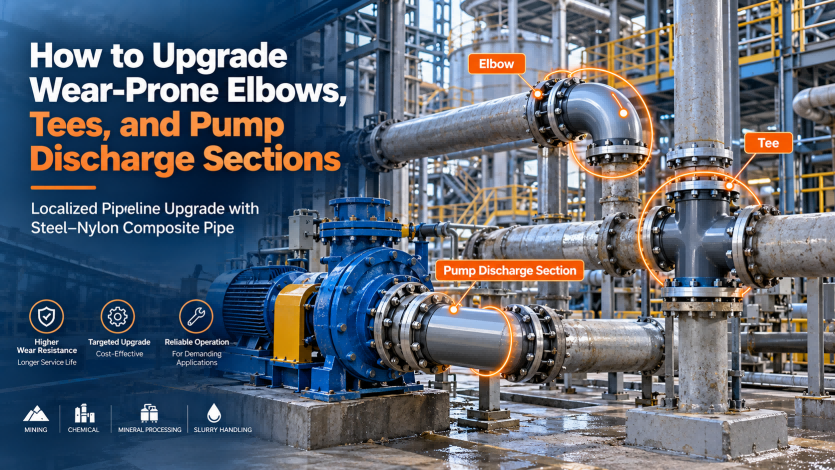
A reliable abrasion-resistant pipeline solution therefore cannot focus only on straight pipe sections.
It should also address:
-
Wear-resistant elbows;
-
Tees;
-
Reducers;
-
Pump discharge sections.
Steel–nylon composite pipeline systems can be structurally optimized for these high-wear locations.
14. Low Internal Roughness Can Provide Long-Term Value in Large Conveying Systems
In high-flow transportation systems, the internal condition of the pipeline directly affects hydraulic losses.
If the inner surface gradually becomes affected by:
-
Corrosion;
-
Scaling;
-
Sediment accumulation;
its effective roughness increases.
This means that more pumping pressure — and therefore more energy — may be required to maintain the same flow rate.
Pipeline material selection can therefore influence not only maintenance costs but also:
Long-Term Energy Consumption.
A nylon internal surface avoids metallic rust formation while maintaining a relatively smooth flow path, which can provide long-term benefits in continuous conveying systems.
15. Transportation and Lifting Are Part of Extra-Large-Diameter Pipeline Engineering
Manufacturing an extra-large-diameter pipeline is not the end of the engineering process.
Transportation presents another major challenge.
For DN1600, DN2000, and larger pipelines, engineers should consider in advance:
-
Road transportation width restrictions;
-
Vehicle length;
-
Port handling requirements;
-
Container limitations;
-
Breakbulk shipping;
-
On-site storage space.
For overseas industrial projects, it is therefore advisable to discuss:
Manufacturing + Transportation + Installation
during the design stage rather than waiting until manufacturing has been completed to address logistics.
16. Field Lifting Must Protect Functional Pipe Surfaces
Extra-large-diameter pipes are relatively heavy.
If steel wire ropes come into direct contact with the pipe during lifting, local surface damage may occur.
Depending on site conditions, appropriate lifting arrangements may include:
-
Wide lifting slings;
-
Properly selected lifting points;
-
Protective pads;
-
Dedicated lifting fixtures.
Special care should be taken to protect:
-
Flange sealing surfaces;
-
Pipe ends;
-
Internal liner surfaces.
Industrial pipeline reliability often depends on installation details that may appear minor but have significant long-term consequences.
17. TCO Is More Important Than Price per Meter
When purchasing large industrial pipelines, comparing only the price per meter rarely reflects the true economic impact of the system.
A more useful evaluation method is:
Total Cost of Ownership
A simplified TCO model can be expressed as:
TCO = Purchase + Installation + Maintenance + Replacement + Downtime + Energy
Where:
-
Purchase = Initial procurement cost;
-
Installation = Installation and construction cost;
-
Maintenance = Routine maintenance cost;
-
Replacement = Pipe replacement cost;
-
Downtime = Production losses caused by shutdown;
-
Energy = Operating and pumping energy cost.
For large chemical plants and mining operations:
Downtime Cost
can sometimes exceed the cost of the pipeline itself.
Therefore, if one pipeline solution can significantly extend maintenance intervals, a somewhat higher initial purchase cost may still result in better lifecycle economics.
18. Why Are Steel–Nylon Composite Pipes Suitable for Combined Corrosion and Abrasion Conditions?
Many industrial fluids do not create only corrosion.
Nor do they create only abrasion.
Instead, the pipeline may experience:
Corrosion + Abrasion
at the same time.
For example:
Slurry
Mineral particles cause abrasive wear.
Brine
Chloride ions can create corrosion risks.
Mother Liquor
Chemical corrosion and crystallization may occur simultaneously.
High-Salinity Produced Water
High mineral content creates severe internal corrosion challenges.
If a pipeline solution addresses only corrosion, abrasion may still cause premature failure.
If it focuses only on hardness, chemical corrosion may continue to attack the material.
The engineering value of the steel–nylon composite structure is therefore the ability to integrate:
Strength + Corrosion Resistance + Wear Resistance
within one pipeline system.
19. Why Should Extra-Large-Diameter Pipelines Be Engineered for Each Project?
DN2000-class industrial pipelines rarely operate under identical conditions.
Different projects may involve different:
-
Pressures;
-
Temperatures;
-
Media;
-
Solids concentrations;
-
Flow velocities;
-
Burial depths;
-
Installation methods.
For this reason, we believe:
Extra-large-diameter industrial pipelines should not be treated merely as product procurement. They should be treated as an engineering project.
Before finalizing the pipeline design, at least the following parameters should be identified:
-
Design Pressure — Determines the pressure-bearing structure;
-
Operating Pressure — Defines normal operating conditions;
-
Temperature — Influences material behavior and thermal movement;
-
Medium — Determines corrosion-resistance requirements;
-
Solid Content — Influences abrasion severity;
-
Particle Size — Influences erosion and impact;
-
Flow Velocity — Influences hydraulic performance and wear;
-
Installation Method — Influences structural design;
-
Vacuum Condition — Determines buckling and collapse risk;
-
Design Life — Influences lifecycle material economics.
Only when these parameters are clearly defined can an appropriate pipeline structure be engineered.
20. Key Advantages of Steel–Nylon Composite Pipe in Extra-Large-Diameter Industrial Applications
Considering the practical requirements of large industrial pipeline projects, steel–nylon composite pipe offers several important advantages.
1. Steel Structure Provides Pressure-Bearing Capability
The steel structural layer provides the strength required for demanding industrial systems.
2. Nylon Layer Isolates Corrosive Media
The nylon layer reduces direct contact between the transported medium and the steel structure.
3. Abrasion Resistance for Particle-Containing Media
The system can be applied to slurry, tailings, salt mud, and other media containing suspended or abrasive solids.
4. Compatibility With Complex Industrial Fittings
A complete system can be engineered around:
-
Elbows;
-
Tees;
-
Reducers;
-
Flanges.
5. Suitable Structural Concept for Large Diameters
The steel structure provides the rigidity required to better withstand transportation, installation, and long-term structural loads.
6. Potential to Reduce Lifecycle Maintenance Requirements
In severely corrosive and abrasive industrial environments, reducing repeated repairs and replacement can be more economically important than minimizing initial material cost.
21. Our Manufacturing Experience With Extra-Large-Diameter Steel–Nylon Composite Pipes
Through long-term research, development, and manufacturing of industrial pipeline systems, we have continuously integrated steel structures with reinforced nylon materials for complex industrial media transportation.
Our product portfolio includes:
-
Reinforced MC nylon pipe;
-
Steel–nylon composite pipe;
-
Matching elbows;
-
Tees;
-
Reducers;
-
Flanged connections;
-
Customized industrial pipeline systems.
Products can be engineered for different project requirements, including:
-
Pipe diameter;
-
Pressure rating;
-
Wall thickness;
-
Flange standard;
-
Fitting configuration;
-
Connection method.
Our steel–nylon composite pipes can be designed for industrial applications in approximately the 1.0–4.0 MPa pressure range, and we have developed manufacturing capability for DN1600-class production as well as extra-large-diameter products above DN2000.
However, for large industrial projects, our focus is not simply on producing a larger pipe.
The more important objective is:
To create a pipeline system that is stable, reliable, manufacturable, transportable, installable, and suitable for long-term service at the required diameter.
22. Future Development of Extra-Large-Diameter Industrial Pipelines
The future of large industrial pipeline technology is unlikely to be defined by strength alone.
Several broader trends are emerging.
Multi-Material Design
Different materials can be combined to maximize their respective advantages.
Longer Service Life
Pipeline engineering is shifting from repeated repair toward designing for longer operating life.
Lower Maintenance
Reducing the frequency of shutdowns, repairs, and replacements is becoming increasingly important.
Larger Diameter
Large industrial facilities require increasingly high-volume transportation capacity.
Customized Engineering
Pipeline structures are increasingly being designed around specific media and operating conditions.
These trends are also important development directions for steel–nylon composite pipeline technology.
Conclusion: Extra-Large-Diameter Industrial Pipelines Are System Engineering Projects
When an industrial pipeline increases from DN500 to DN1000, DN1600, or even DN2000, the engineering challenge changes fundamentally.
Project reliability is no longer determined simply by:
Pipe Material
Instead, it depends on:
Material + Structure + Manufacturing + Connection + Installation + Maintenance
Steel–nylon composite pipe combines the structural and pressure-bearing capability of steel with the corrosion- and abrasion-resistant characteristics of nylon.
This provides a technical approach for extra-large-diameter industrial pipelines that aims to balance:
-
Pressure resistance;
-
Structural rigidity;
-
Corrosion resistance;
-
Abrasion resistance;
-
Long-term maintenance cost.
For mining, chemical processing, oil and gas, power generation, seawater desalination, and large industrial water systems, pipeline material selection should go beyond initial purchase price when the project simultaneously involves:
-
Large diameter;
-
High flow capacity;
-
Corrosive media;
-
Abrasive media;
-
Continuous long-term operation;
-
High maintenance costs.
The more important question is:
Over the next 10 years or longer, which pipeline system can deliver lower failure risk, fewer maintenance interventions, and more stable long-term operation?
That is the core logic behind extra-large-diameter industrial pipeline design and material selection.
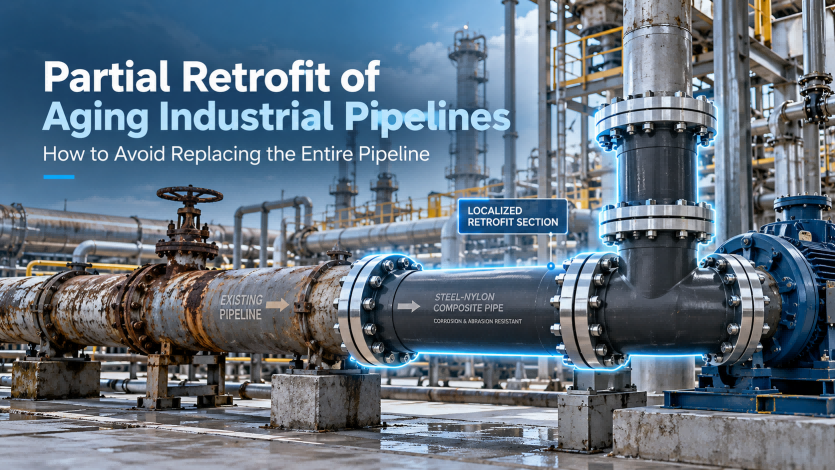
Partial Replacement of Aging Industrial Pipelines: How to Avoid Replacing the Entire Pipeline
How to Upgrade Wear-Prone Elbows, Tees, and Pump Discharge Sections with Localized Pipeline Replacement