Global Industrial Piping Market Trends 2026: Why Corrosion-Resistant Composite Pipes Are Gaining Ground

In the past, industrial companies often focused on three basic questions when selecting piping systems:
How much does the pipe cost? How much pressure can it withstand? Is it readily available?
Today, these questions are no longer enough.
For oil & gas, chemical processing, mining, power generation, desalination, industrial water treatment, and municipal infrastructure projects, corrosion, abrasion, energy costs, labor shortages, downtime losses, environmental requirements, and aging infrastructure are fundamentally changing how piping materials are selected.
The industry is gradually moving away from asking:
“Which pipe has the lowest purchase price?”
toward asking:
“Which piping system can reduce total operating costs over the next 10, 20, or even more years?”
This represents a deeper structural shift in the industrial piping market.
Industrial piping is evolving from a standardized procurement item into a strategic engineering asset that directly affects plant reliability, maintenance costs, and lifecycle economics.
Against this background, corrosion-resistant, wear-resistant, long-life, low-maintenance, and composite piping technologies are gaining increasing attention.
1. The Key Drivers of the Industrial Piping Market Are Changing
The industrial piping market is closely connected with global investment in energy, chemicals, water treatment, mining, and infrastructure.
Large investments in oil & gas, LNG, electricity grids, renewable energy, industrial facilities, and water infrastructure continue to generate demand for:
-
Oil and gas gathering pipelines
-
Chemical process piping
-
Slurry transportation pipelines
-
Cooling water systems
-
Flue gas desulfurization piping
-
Industrial wastewater pipelines
-
Desalination systems
-
Municipal water supply and drainage systems
However, the most important change is not simply that the world needs more pipelines.
The market increasingly needs better-performing pipelines with longer service life and lower maintenance requirements.
This is fundamentally changing competition among industrial piping materials.
Trend 1: Corrosion Resistance Is Becoming a Basic Requirement
Corrosion remains one of the biggest long-term challenges facing industrial piping systems.
Pipelines used in oil & gas, chlor-alkali, soda ash, salt chemical, phosphate chemical, wastewater treatment, and seawater desalination applications may be continuously exposed to:
-
CO₂ corrosion
-
H₂S corrosion
-
Chloride-induced corrosion
-
Saltwater corrosion
-
Strong alkaline environments
-
Weak acidic media
-
Electrochemical corrosion
-
Combined corrosion and erosion
Carbon steel provides excellent mechanical strength and has a well-established engineering history.
However, when exposed to aggressive media, carbon steel may require coatings, liners, cathodic protection, corrosion allowances, or frequent maintenance.
Stainless steel can solve some corrosion problems, but it is not a universal corrosion-resistant material.
Under high chloride concentrations and certain chemical environments, stainless steels can still suffer from pitting, crevice corrosion, and stress corrosion cracking.
As a result, the question is changing from:
“Which material is more corrosion resistant?”
to:
“Which piping system can isolate corrosive media while maintaining sufficient mechanical strength?”
This is one of the key reasons why composite piping technologies are attracting more attention.
Trend 2: The Boundary Between Metallic and Non-Metallic Pipes Is Becoming Less Clear
Traditional industrial piping materials can generally be divided into two categories.
Metallic Pipes
These include:
-
Carbon steel
-
Stainless steel
-
Duplex stainless steel
-
Ductile iron
Their major advantages are typically:
High strength, high rigidity, and high pressure capability.
Their disadvantages may include corrosion, heavy weight, and the high cost of certain alloy grades.
Non-Metallic Pipes
These include:
-
PE
-
HDPE
-
PVC
-
FRP/GRP
-
Engineering polymer pipes
Their typical advantages include:
Corrosion resistance and relatively low weight.
However, different non-metallic materials have their own engineering limitations when exposed to high temperatures, high pressures, large diameters, vacuum conditions, structural loads, or demanding industrial environments.
Therefore, the future of industrial piping may not simply be:
Metal vs. Plastic
Instead, one important direction is:
Metal + Polymer
Composite structures allow different materials to perform the functions for which they are best suited.
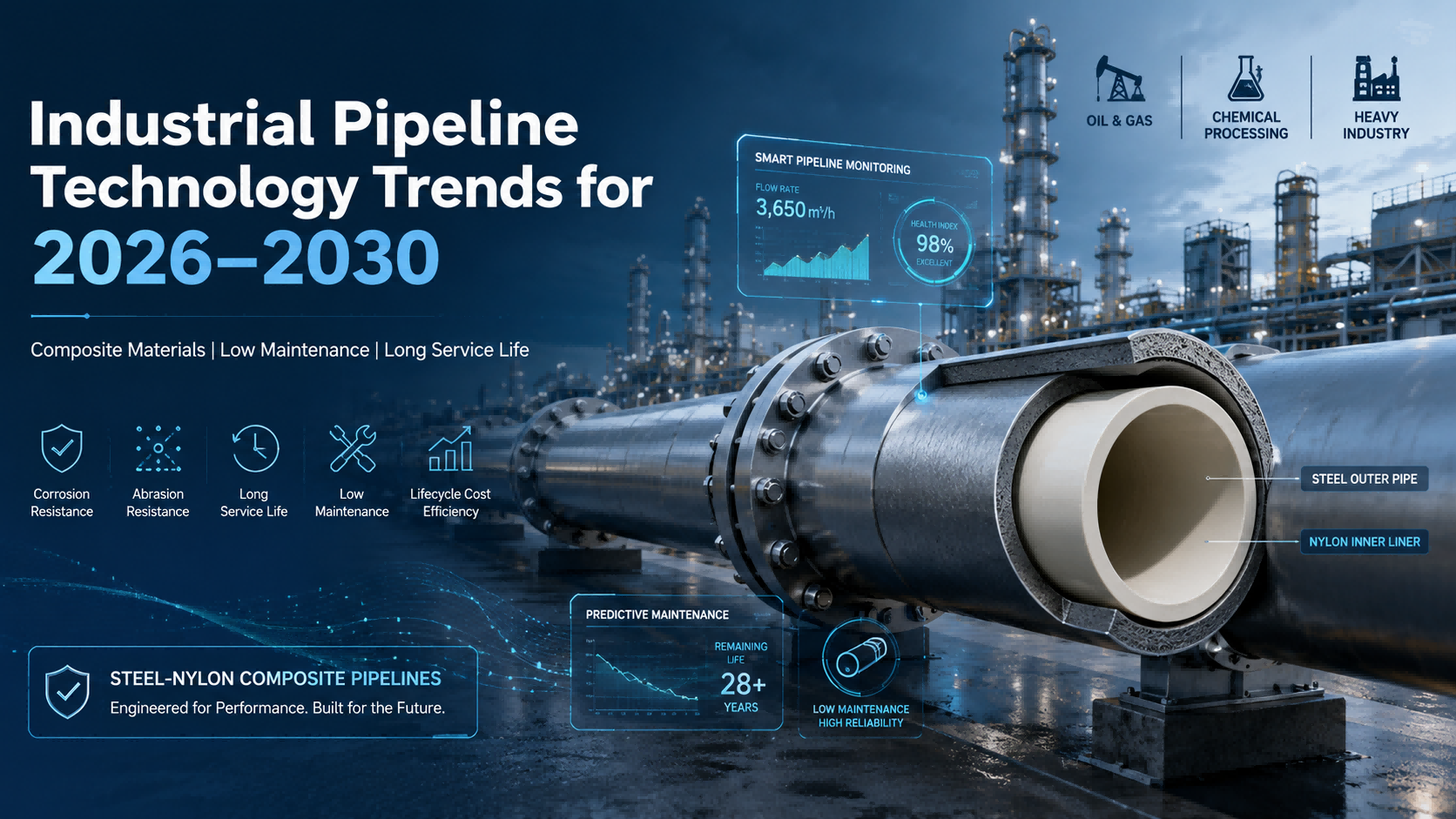
This is the fundamental engineering concept behind steel-nylon composite pipes.
The steel structure provides:
Mechanical strength, structural rigidity, and pressure resistance.
The nylon functional layer provides:
Corrosion resistance, wear resistance, low friction, and isolation from aggressive media.
The philosophy is simple:
Instead of asking one material to solve every engineering problem, combine materials so that each performs the function it does best.
Trend 3: Composite Pipes Are Entering a Larger Industrial Market
Composite pipes are no longer merely niche alternatives to conventional piping materials.
Increasingly demanding operating conditions are driving industries to look for piping systems capable of combining:
Strength + Corrosion Resistance + Wear Resistance + Long Service Life
Traditional single-material pipes often require compromises between these properties.
Composite structures are designed to reduce these compromises.
This means that competition in the future industrial piping market may increasingly shift from competition between individual materials toward competition between material systems and engineered structures.
For applications involving corrosion, abrasion, pressure, and structural requirements simultaneously, this trend is particularly important.
Trend 4: Total Cost of Ownership Is Replacing Purchase Price as a Key Decision Factor
This is one of the most important trends in industrial piping procurement.
Consider a simple example.
Pipe A has a purchase cost of 100.
Pipe B has a purchase cost of 140.
Based purely on initial CAPEX:
Pipe A appears cheaper.
But what happens if Pipe A requires major maintenance or replacement every three to five years, while Pipe B operates reliably for 10, 20, or more years?
The economic result may be completely different.
The real cost of an industrial piping system should be evaluated through:
Total Cost of Ownership (TCO)
This includes:
Purchase Cost + Installation Cost + Maintenance Cost + Replacement Cost + Downtime Losses + Risk-Related Costs
For continuous-process industries, downtime can be significantly more expensive than the pipe itself.
A chemical plant, oilfield facility, mine, or power plant may suffer substantial production losses if a critical pipeline fails.
As a result, procurement teams are increasingly likely to ask:
“How much will this pipeline cost over 10 years?”
rather than simply:
“How much does this pipe cost per meter?”
This shift favors piping systems designed for long service life and low maintenance.
Trend 5: Extreme Operating Conditions Are Driving Material Upgrades
Modern industrial pipelines increasingly face combinations of challenging operating conditions.
For example:
High Pressure + Corrosion
High Temperature + Strong Alkali
Solid Particles + High Flow Velocity
Large Diameter + Long-Distance Transportation
Negative Pressure + Corrosion
Outdoor UV Exposure + Temperature Cycling
Historically, piping materials were often selected based on one dominant performance requirement.
In reality, industrial pipeline failures are frequently caused by multiple mechanisms acting simultaneously.
Consider slurry transportation.
The problem may not simply be corrosion.
The pipeline may experience:
Corrosion + Erosion + Abrasion + Solid Particle Impact
Oilfield wastewater pipelines may simultaneously encounter:
CO₂ + H₂S + High Water Cut + Salts + Sand
Therefore, future competition among piping materials will increasingly focus on:
Multi-Condition Performance
rather than one-dimensional material properties.
A successful industrial piping material must perform reliably under combinations of chemical, mechanical, thermal, and hydraulic stresses.
Trend 6: Large-Diameter Piping Is Becoming a New Competitive Field
As mining, desalination, water treatment, chemical complexes, and major infrastructure projects expand, demand for large-diameter industrial pipelines continues to grow.
Applications involving:
DN1000, DN1200, DN1600, DN2000 and even larger diameters
create new engineering challenges.
As pipe diameter increases, engineers must pay greater attention to:
-
Ring stiffness
-
Structural stability
-
Vacuum resistance
-
Transportation
-
Lifting and installation
-
Joint reliability
-
On-site construction complexity
Large-diameter pipelines therefore require more than corrosion resistance.
They increasingly require:
Corrosion Resistance + Structural Strength + Installation Efficiency
This creates an important application opportunity for steel-nylon composite structures.
The steel structure can provide mechanical support and pressure capability, while the nylon layer provides corrosion resistance, wear resistance, and protection against aggressive transported media.
This creates an alternative engineering route to both conventional metallic pipes and purely polymeric piping systems.
Trend 7: Installation Efficiency Is Becoming a Hidden Competitive Advantage
Many pipeline projects focus heavily on material prices while underestimating installation costs.
However:
Pipe Cost ≠ Pipeline Cost
The cost of a complete piping system also includes:
-
Transportation
-
Lifting
-
Welding
-
Fusion joining
-
Field corrosion protection
-
Inspection
-
Labor
-
Construction time
-
Plant shutdown windows
Future industrial piping products therefore need to become increasingly installation-oriented.
Our steel-nylon composite pipes primarily use flanged connections.
This connection method can reduce complicated field joining work and is particularly valuable for pipeline replacement and plant retrofit projects.
For chemical plants, oilfields, and potentially hazardous areas, reducing hot work requirements can also simplify construction management and improve installation efficiency.
Therefore:
The industrial pipe of the future must not only last longer—it must also be easier to install.
Trend 8: Water Treatment and Desalination Will Create New Opportunities
Beyond oil, gas, and chemicals, water infrastructure is becoming an increasingly important source of industrial piping demand.
Applications include:
-
Seawater desalination
-
Industrial wastewater treatment
-
Circulating water systems
-
Municipal water supply
-
Municipal drainage
-
Brine transportation
-
Chemical wastewater systems
These applications often expose pipelines to chloride-rich water, salts, chemicals, and long-term wet environments.
This creates persistent corrosion challenges for conventional metallic piping systems.
At the same time, large water infrastructure projects often require large diameters and significant structural stability.
As a result, piping systems capable of combining:
Large Diameter + Corrosion Resistance + Structural Strength + Long Service Life
may find growing opportunities in the global water infrastructure market.
Steel-nylon composite piping represents one potential solution for suitable applications.
Trend 9: Supply Chain Volatility Is Accelerating Material Substitution
Raw material prices, energy costs, transportation expenses, and supply chain uncertainty continue to influence industrial project economics.
This creates an important procurement question:
Is expensive alloy piping always necessary to solve corrosion problems?
Traditionally, when carbon steel could not provide sufficient corrosion resistance, projects often upgraded to:
304 stainless steel, 316L stainless steel, duplex stainless steel, or higher alloy materials.
However, higher material costs encourage engineering and procurement teams to evaluate alternative solutions.
This is creating stronger interest in:
Alternatives to Stainless Steel Piping
This does not mean composite pipes can replace stainless steel in every application.
Material selection must always consider:
Chemical composition, concentration, temperature, pressure, flow velocity, safety requirements, and design standards.
However, in suitable corrosive and abrasive industrial environments, a:
Steel Structure + Nylon Functional Layer
can provide another balance between performance and lifecycle cost.
Why Do Steel-Nylon Composite Pipes Match These Market Trends?
When we combine the major trends above, the requirements for next-generation industrial piping become increasingly clear.
| Market Requirement | Steel-Nylon Composite Pipe Advantage |
|---|---|
| Corrosion Resistance | Nylon isolates the steel structure from corrosive media |
| Wear Resistance | Suitable for abrasive and particle-containing media |
| Mechanical Strength | Steel structure provides strength and rigidity |
| Pressure Capability | Can be engineered for demanding industrial pressure applications |
| Large Diameter | Suitable for large industrial transportation systems |
| Wide Temperature Applications | Can be selected according to operating conditions |
| Installation Efficiency | Flanged connections simplify field installation |
| Low Maintenance | Reduces corrosion-related maintenance requirements |
| Long Service Life | Designed for lifecycle performance |
| TCO Optimization | Potentially reduces maintenance, replacement, and downtime costs |
This is one of the key differences between steel-nylon composite pipes and conventional single-material piping systems.
The concept is not simply to replace steel with nylon.
Nor is it simply to reinforce a polymer with steel.
The fundamental engineering principle is:
Use steel to solve structural problems and nylon to solve corrosion and wear problems at the media-contact surface.
From “Material Selection” to “Failure-Mode Selection”
For engineers, perhaps the most important future question is not:
“Which pipe material is best?”
There is no single piping material that is ideal for every industrial application.
A better question is:
“What is the dominant failure mechanism of this pipeline?”
If corrosion is the primary problem, chemical compatibility should receive greater attention.
If abrasion is the dominant problem, engineers should evaluate particle concentration, particle size, flow velocity, and erosion.
If pressure is the major challenge, structural strength becomes critical.
If temperature is the limiting factor, long-term thermal performance must be evaluated.
But when the pipeline simultaneously faces:
Corrosion + Abrasion + Pressure + Large Diameter
the value of a composite structure becomes significantly greater.
This also changes how steel-nylon composite pipes should be positioned in the market.
We are not simply supplying:
“A pipe.”
We are providing:
An engineered industrial piping solution for challenging corrosion and wear environments.
2026–2030: The Industrial Piping Industry May Enter an Era of “Long-Life Competition”
Over the next several years, the industrial piping market is likely to become increasingly segmented.
Conventional materials will continue to dominate many standard applications.
However, in systems characterized by severe corrosion, high abrasion, frequent maintenance, expensive downtime, or difficult replacement conditions, procurement decisions will increasingly focus on:
Service Life
Maintenance Frequency
Installation Efficiency
System Reliability
Total Cost of Ownership
rather than simply the initial material price.
The most competitive industrial pipeline may therefore not be:
The cheapest pipe to purchase.
Instead, it may be:
The piping system that generates the lowest total cost throughout its entire service life.
Conclusion: The Next Generation of Industrial Piping Will Compete on Lifecycle Value
The global industrial piping market is entering a new stage in 2026.
Energy infrastructure investment, chemical industry modernization, growing water treatment demand, corrosion challenges, labor costs, supply chain volatility, and increasing requirements for plant reliability are collectively pushing the market toward higher-performance, longer-life, and lower-maintenance piping systems.
Metal pipes will not disappear.
Non-metallic pipes will not completely replace metals.
One of the most important directions, however, is the combination of the advantages of different materials.
This is exactly the engineering philosophy behind steel-nylon composite pipes.
Steel provides structure.
Nylon provides corrosion and wear resistance.
Flanged connections simplify installation.
The composite structure creates a new balance between strength, corrosion resistance, wear resistance, installation efficiency, and lifecycle cost.
For oil & gas, chemical processing, mining, power generation, desalination, industrial water treatment, and infrastructure projects, the key question in pipeline selection is gradually changing from:
“Which material has the lowest price per meter?”
to:
“Which piping system can deliver the lowest total operating cost over the next 10–20 years?”
That may be one of the most important trends shaping the global industrial piping market in 2026 and beyond.
Our Steel-Nylon Composite Piping Solutions
We specialize in the development and manufacturing of steel-nylon composite pipes and industrial nylon piping systems for demanding industrial applications.
Our solutions are designed for industries including:
Oil & Gas | Chemical Processing | Mining | Power Generation | Water Treatment | Desalination | Municipal Infrastructure
For applications involving corrosion, abrasion, pressure, large diameters, and challenging operating environments, piping selection can be evaluated according to:
Media Composition + Concentration + Operating Temperature + Design Pressure + Pipe Diameter + Flow Velocity + Installation Conditions
If your existing pipelines are experiencing:
-
Frequent corrosion and perforation
-
Abrasive wear
-
Repeated leakage
-
Short replacement cycles
-
High maintenance costs
-
Excessive plant downtime
-
High stainless steel investment costs
steel-nylon composite piping may provide an alternative solution worth evaluating.
Our approach considers six major dimensions:
Material Compatibility + Pressure + Temperature + Wear + Installation + Lifecycle Cost
The goal is not simply to supply a pipe.
The goal is to help industrial operators build more reliable, corrosion-resistant, wear-resistant, and cost-effective piping systems for long-term operation.
Why Industrial Companies Are Shifting Toward Longer-Lasting Pipeline Materials