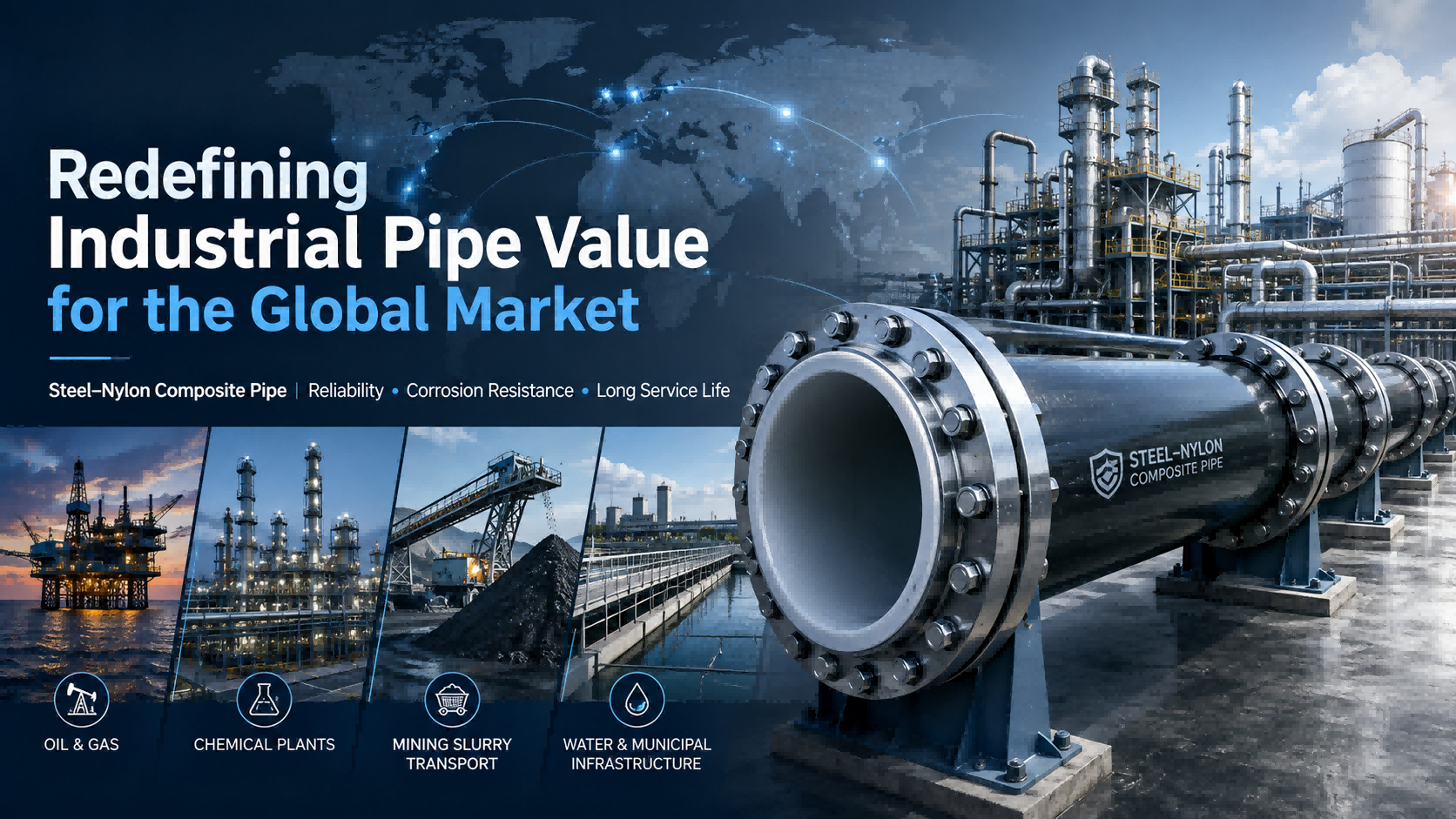
40 Years of Industrial Pipeline Innovation: The Evolution of Steel–Nylon Composite Pipe Technology

From traditional carbon steel pipes to stainless steel, rubber-lined steel pipes, FRP, PE/HDPE, and today’s increasingly important composite piping systems, the criteria used by industrial companies to select pipelines have fundamentally changed.
In the past, the main question was simple:
“Can this pipe transport the required medium?”
Today, engineers, EPC contractors, and procurement teams ask much more demanding questions:
-
Can the pipe resist corrosion over the long term?
-
Can it withstand abrasion and erosion?
-
Is it reliable under high-temperature and high-pressure conditions?
-
Is it prone to scaling?
-
Is there a risk of liner delamination?
-
Does installation require extensive welding or hot work?
-
What is the total operating cost over 10 or even 20 years?
-
If a leak occurs, how much production downtime could it cause?
It is within this changing industrial environment that Steel–Nylon Composite Pipe has gradually established its own technological path.
It is not simply a combination of two different materials. Instead, it is designed to solve a long-standing contradiction in industrial piping:
How can a pipeline combine the structural strength of steel with the corrosion resistance, abrasion resistance, and low-scaling characteristics of engineering polymers?
After decades of material development, structural optimization, and real-world engineering applications, steel–nylon composite pipe has evolved from a specialized solution for difficult operating conditions into an increasingly valuable option for corrosive, abrasive, high-pressure, and large-diameter industrial pipeline systems.
1. The 1980s: Corrosion Became One of the Biggest Pipeline Challenges
Early industrial pipeline systems relied heavily on carbon steel.
The reasons were straightforward.
Carbon steel offered:
-
High mechanical strength
-
Mature manufacturing technology
-
Well-established engineering standards
-
Relatively low initial cost
However, as industries such as oil and gas, chemicals, mining, power generation, chlor-alkali, and salt chemicals expanded, one major problem became increasingly obvious:
A strong steel pipe is not necessarily a durable pipe.
In ordinary water service, carbon steel may perform satisfactorily.
But the situation changes dramatically when pipelines transport aggressive industrial media such as:
-
Chloride-containing fluids
-
High-salinity brine
-
Strong alkaline solutions
-
CO₂-containing oilfield fluids
-
H₂S-containing media
-
Seawater
-
Chemical mother liquor
-
Phosphate slurry
-
Sand-containing produced fluids
These media often create more than simple chemical corrosion.
They may also involve:
-
Elevated temperature
-
Internal pressure
-
High flow velocity
-
Suspended solids
-
Abrasive particles
The result is frequently a combination of:
Corrosion + Erosion + Abrasion
Under such conditions, simply increasing the wall thickness of a steel pipe may delay failure, but it does not fundamentally solve the problem.
This pushed the industrial pipeline industry to search for new material solutions.
2. The First Generation of Solutions: Adding a Protective Layer to Steel
One of the earliest and most logical approaches was to retain the strength of steel while adding a corrosion-resistant inner layer.
This led to the widespread use of:
-
Rubber-lined steel pipe
-
Plastic-lined steel pipe
-
Coated steel pipe
-
Internally lined corrosion-resistant steel pipe
This generation of technology addressed one important issue:
Preventing the process medium from directly contacting the steel substrate.
In theory, if the liner successfully isolates the corrosive medium while the steel carries the mechanical load, pipeline life can be significantly extended.
This concept laid an important foundation for later composite pipe technologies.
However, long-term industrial experience revealed a major challenge:
Having a liner and having a liner that remains stable for years are two completely different things.
Common problems with traditional lined piping systems can include:
-
Failure of the bond between the liner and the steel
-
Interface stress caused by different thermal expansion rates
-
Liner bulging under vacuum or negative pressure
-
Local delamination
-
Weak points at joints and connections
-
Penetration of corrosive media behind the liner
-
Rapid hidden corrosion once the liner is damaged
The industry gradually realized that:
A high-reliability composite pipe must solve not only the material problem, but also the interface and structural stability problem.
This became an important direction in the development of steel–nylon composite pipe technology.
3. The Rise of Non-Metallic Pipes: Moving Beyond an “All-Metal” Mindset
As polymer science and composite materials advanced, industrial piping entered another important stage of development.
PE, HDPE, PVC, FRP, and other non-metallic pipe materials began to be used more widely.
Compared with carbon steel, their major advantage was clear:
The material itself could provide corrosion resistance.
For the first time, engineers had another option.
Instead of protecting a metal pipe with a coating, they could select a material that was naturally resistant to many corrosive environments.
This was a major turning point in industrial pipeline engineering.
But new limitations also appeared.
4. Every Single Material Has Its Performance Boundaries
The most difficult aspect of industrial piping is that real operating conditions rarely involve only one variable.
A single pipeline may simultaneously face:
-
Corrosion
-
Pressure
-
Temperature
-
Abrasion
-
Impact
-
Vacuum
-
Large diameter
-
Long-distance transport
-
Outdoor exposure
Therefore, a material that performs extremely well in one category may still have limitations in another.
PE / HDPE
PE and HDPE offer excellent corrosion resistance, but as temperature, pressure, and pipe diameter increase, structural design, wall thickness, and ring stiffness become increasingly important.
FRP
FRP is lightweight and corrosion resistant, but engineers must carefully evaluate interlaminar behavior, impact resistance, structural integrity, and long-term reliability under complex loading conditions.
Stainless Steel
Stainless steel offers strong mechanical performance and good corrosion resistance in many environments.
However, chloride-containing media can still create risks such as:
-
Pitting corrosion
-
Crevice corrosion
-
Weld-zone corrosion
Higher grades of stainless steel can also significantly increase project costs.
Rubber-Lined Steel Pipe
Rubber-lined steel pipe combines steel strength with corrosion resistance, but long-term service may involve concerns related to:
-
Wear
-
Aging
-
Rubber separation
-
Vacuum-induced liner deformation
These realities gradually changed the way engineers think about industrial pipe materials.
No single material is ideal for every industrial operating condition.
The next stage of material innovation therefore became less about finding one “perfect material” and more about combining the best properties of different materials.
This is the engineering logic behind steel–nylon composite pipe.
5. Steel–Nylon Composite Pipe: Combining Structural Strength with Corrosion Resistance
The core concept of steel–nylon composite pipe can be summarized simply:
Steel provides structural strength. Nylon manages the process environment.
The steel structure contributes:
-
Mechanical strength
-
Ring stiffness
-
Pressure resistance
-
Large-diameter structural stability
-
Pipeline support capability
The nylon layer contributes:
-
Corrosion resistance
-
Abrasion resistance
-
Smooth internal surface
-
Reduced scaling tendency
-
Resistance to complex industrial media
The objective is not to make one material perform every function.
Instead, different materials are assigned the roles they perform best.
This reflects a broader principle in modern materials engineering:
The best industrial pipeline may not be made from one “strongest” material, but from a structure that combines the strengths of multiple materials.
6. First Major Development: From Corrosion Resistance to Corrosion + Abrasion Resistance
Many industrial pipeline failures are not caused by chemical corrosion alone.
Oilfield produced fluids, for example, may contain:
-
Water
-
Salts
-
CO₂
-
H₂S
-
Sand particles
Mining and phosphate chemical systems may transport:
-
Mineral slurry
-
Phosphate slurry
-
Lime slurry
-
Other solid-liquid mixtures
In these systems, the pipe wall is exposed to:
Corrosion–Erosion–Abrasion Synergy
Solving corrosion alone is not enough.
A pipeline may still fail rapidly if solid particles continuously wear away the inner surface.
Nylon materials offer strong abrasion resistance, which allowed steel–nylon composite pipe systems to evolve from simple corrosion protection into solutions for combined:
Corrosion + Wear
This is particularly important in slurry and particle-containing services.
7. Second Major Development: Addressing Scaling and Flow Efficiency
Another problem that is often underestimated in industrial pipeline systems is:
Scaling
Scaling does not only increase cleaning frequency.
As deposits accumulate:
Effective internal diameter decreases
↓
Flow resistance increases
↓
Transport efficiency declines
↓
Pumping energy consumption rises
↓
Severe blockage may eventually cause shutdown
After years of corrosion, traditional carbon steel surfaces can become increasingly rough.
Rough surfaces provide more opportunities for deposits to adhere and accumulate.
Steel–nylon composite pipe provides a relatively smooth nylon inner surface, helping reduce friction and limiting the tendency of solids to adhere to the pipe wall.
Therefore, its engineering value is not limited to:
“How long before the pipe corrodes through?”
It also includes:
“How well can the pipeline maintain hydraulic performance over long-term operation?”
This is becoming increasingly important in modern industrial pipeline design.
8. Third Major Development: From Small Diameters to Ultra-Large Diameters
Polymer pipes are relatively easy to apply in small and medium diameters.
The real engineering challenge begins when pipe diameter increases.
As diameter grows:
-
Structural loads increase
-
Ring stiffness becomes more important
-
Transportation and installation become more complex
-
Pipe support design becomes more demanding
-
Vacuum stability becomes more critical
-
Deformation control becomes more difficult
This is where the steel structure provides significant value.
In a steel–nylon composite system, the steel component provides structural support, meaning the nylon material does not need to carry the full mechanical load on its own.
After years of manufacturing and engineering development, steel–nylon composite pipe systems can now extend from conventional industrial diameters to:
DN2000-class and even larger pipeline systems
This significantly expands potential applications, including:
-
Large-scale chemical transport
-
Mining slurry systems
-
Municipal water supply and drainage
-
Seawater pipelines
-
Power plant circulating water systems
-
Flue gas desulfurization systems
-
Large industrial mother liquor systems
9. Fourth Major Development: From Pipe Material to Complete System Reliability
Modern industrial operators do not evaluate only straight pipe sections.
Many pipeline failures occur at:
-
Welds
-
Elbows
-
Tees
-
Reducers
-
Flanges
-
Upstream and downstream of valves
-
Pump discharge sections
For this reason, steel–nylon composite technology has gradually evolved from a simple “pipe material” into a:
Complete Pipeline System Solution
This may include:
-
Straight pipes
-
Elbows
-
Tees
-
Reducers
-
Flanges
-
Customized fittings
-
High-wear pipe sections
System-level design can reduce transitions between different materials and minimize potential weak points in the overall pipeline.
10. Integrated Flanges: A Simple Feature with Significant Engineering Value
Many industrial piping systems depend heavily on field welding.
But welding also introduces:
-
Skilled labor requirements
-
Hot-work permits
-
Longer installation time
-
Variation in weld quality
-
Potential corrosion risks around weld areas
Steel–nylon composite pipes with integrated flange connections can reduce reliance on field welding and allow greater use of mechanical assembly.
The advantage is not simply:
“Easier installation.”
The more important benefit is reducing installation complexity throughout the pipeline lifecycle.
This can be especially valuable in industries such as:
-
Oil and gas
-
Chemicals
-
Petrochemicals
-
Hazardous process plants
where hot work is tightly controlled.
Flanged connections can also make future:
-
Removal
-
Inspection
-
Replacement
-
Modification
more convenient.
As a result, connection design has become an increasingly important part of industrial pipe material selection.
11. From Corrosion Protection to High-Performance Industrial Piping
A traditional assumption has often been:
Polymer pipes are for low pressure. Steel pipes are for high pressure.
Composite structures challenge this simple distinction.
By using steel to carry a major portion of the mechanical load, the pipeline system can achieve significantly improved pressure capability.
Our steel–nylon composite pipe systems are available in multiple pressure classes, including:
1.0–4.0 MPa
This allows them to enter industrial applications historically dominated by metallic piping, including:
-
Oilfield gathering and transportation
-
Industrial process water
-
Higher-pressure process media
-
Chemical transport
-
Slurry pipelines
This marks an important shift from a specialized corrosion-resistant pipe toward a broader high-performance industrial pipeline solution.
12. Expanding the Temperature Operating Window
Temperature is another major limitation in industrial pipe material selection.
Low temperatures may cause some materials to become brittle.
High temperatures may result in:
-
Reduced material strength
-
Softening
-
Increased creep
-
Changes in sealing performance
Through long-term development of material formulations, reinforcement technologies, and structural design, our nylon and steel–nylon composite pipe products can be designed for operating temperatures of approximately:
-36°C to 160°C
depending on the specific design and service conditions.
This enables application in demanding environments such as:
-
Oilfields
-
Chemical plants
-
Salt chemical industries
-
Phosphate chemical industries
-
Power generation
-
Outdoor industrial pipe racks
13. The Real Meaning of 40 Years of Development: From Pipe Price to Lifecycle Value
Forty years ago, one of the most common procurement questions was:
“How much does the pipe cost per meter?”
Today, more sophisticated industrial projects ask:
“How much will the pipeline cost over 10 years?”
This is one of the biggest changes in industrial procurement.
Consider two hypothetical pipes.
Pipe A
Lower initial purchase cost, but:
-
Requires replacement every 3–5 years
-
Needs frequent cleaning
-
Requires recurring welding repairs
-
Experiences leakage
-
Causes unplanned shutdowns
Pipe B
Higher initial investment, but:
-
Longer service life
-
Lower maintenance frequency
-
Lower scaling tendency
-
Reduced leakage risk
-
Less production downtime
If only purchase price is compared, Pipe A may appear cheaper.
But once the full cost is considered:
Purchase Cost + Installation + Maintenance + Replacement + Downtime Losses
the result can be completely different.
This is why modern industrial pipeline procurement increasingly focuses on:
Total Cost of Ownership — TCO
This is also one of the most important competitive advantages of steel–nylon composite pipe.
Our objective is not necessarily to offer the lowest initial pipe price.
The goal is to reduce long-term system cost through:
-
Longer service life
-
Lower corrosion risk
-
Reduced abrasion
-
Less scaling
-
Lower maintenance frequency
-
Reduced shutdowns
-
Simplified installation
14. Why Steel–Nylon Composite Pipe Fits Modern Industrial Requirements
Several important changes are taking place across modern industry.
1. Operating Conditions Are Becoming More Complex
Industrial facilities increasingly handle:
-
Higher concentrations
-
More aggressive chemicals
-
Higher solid content
-
More complex process media
Traditional single-material pipes are more likely to reach their performance limits.
2. Downtime Is Becoming More Expensive
In large continuous-process plants, a pipeline leak can create losses far greater than the value of the pipe itself.
This means:
Reliability is becoming more important than initial pipe price.
3. Environmental Requirements Are Becoming Stricter
Pipeline leakage is no longer simply a maintenance issue.
It may also create:
-
Environmental risk
-
Safety risk
-
Soil contamination
-
Water pollution
-
Regulatory and compliance risk
Pipeline reliability is therefore becoming an important part of industrial safety and sustainability strategies.
4. Industrial Companies Want Lower Maintenance Requirements
Industrial maintenance strategies are moving from:
Reactive Maintenance
toward:
Preventive Maintenance
and increasingly toward:
Long-Life Infrastructure
Long-life, low-maintenance pipeline systems fit naturally into this trend.
15. Where Is Steel–Nylon Composite Pipe Used?
After decades of development, steel–nylon composite piping technology can be applied across a growing range of demanding industries.
Oil & Gas
Typical applications include:
-
Produced fluids
-
High-water-cut crude oil
-
Produced water
-
Sand-containing fluids
-
CO₂/H₂S-containing environments
Key challenges:
Corrosion + Erosion + Pressure
Chlor-Alkali
Chlor-alkali systems commonly involve:
-
High salinity
-
High chloride concentration
-
Strong alkaline media
-
Complex temperatures
Steel–nylon composite structures help isolate the metal structure from direct contact with aggressive process fluids.
Soda Ash
Soda ash mother liquor systems may contain:
-
Ammonia
-
Chlorides
-
Carbonates
-
Suspended solids
These environments can create combined risks of:
Corrosion + Abrasion + Scaling
making them a representative application area for steel–nylon composite systems.
Phosphate Chemicals
Phosphate slurry and related media often combine:
Corrosion + Abrasive Wear
Corrosion resistance alone may therefore be insufficient.
Abrasion resistance must also be considered.
Mining
Mining slurry pipelines commonly face:
-
Severe particle abrasion
-
High-velocity erosion
-
Localized elbow wear
-
Frequent replacement
Wear resistance becomes one of the most important material-selection criteria.
Power Generation
FGD slurry and circulating-water systems may face:
-
Corrosion
-
Scaling
-
Suspended solids
-
Continuous operation
Reducing maintenance frequency can therefore deliver significant economic value.
Seawater & Desalination
The chloride content of seawater can create serious corrosion risks for many conventional metallic pipelines.
For this reason, non-metallic and composite piping systems are becoming increasingly important in seawater and desalination applications.
16. Steel–Nylon Composite Pipe Does Not Compete with Only One Material
A common question is:
How does steel–nylon composite pipe compare with 316L stainless steel?
Or:
How does it compare with FRP?
Or:
How does it compare with HDPE?
A better question is:
“Which material provides the lowest overall risk under my operating conditions?”
Industrial pipeline material selection should consider:
-
Process medium
-
Concentration
-
Temperature
-
Pressure
-
Flow velocity
-
Solid particle content
-
Pipe diameter
-
Installation environment
-
Required design life
-
Lifecycle cost
For low-pressure ordinary water service, PE may be a highly economical solution.
For some extremely high-temperature environments, advanced metallic materials may be more appropriate.
But when a pipeline simultaneously faces:
Corrosion + Abrasion + Pressure + Large Diameter
the overall value of a steel–nylon composite structure becomes increasingly attractive.
17. Where Will Industrial Pipeline Technology Go in the Next 10 Years?
Looking back over the past 40 years, industrial pipeline technology has broadly moved through three stages.
Stage 1
Can the pipe transport the medium?
↓
Stage 2
Can the pipe resist corrosion?
↓
Stage 3
Can the pipeline operate safely, reliably, and economically for many years?
Future industrial pipeline development is likely to focus on several major trends.
Trend 1: Multi-Material Composite Structures
A single material rarely provides the best performance in every category.
As a result, combinations such as:
Metal + Polymer
and increasingly sophisticated multilayer structures will continue to develop.
Trend 2: Longer Design Life
Industrial companies will increasingly move away from the traditional approach of:
“Replace it when it fails.”
The new objective will be:
Install once and operate reliably for many years.
Trend 3: Lower Maintenance Requirements
Future competition will not be based only on material price.
It will increasingly focus on:
Low-Maintenance Pipeline Systems
and, where technically achievable:
Maintenance-Reduced Infrastructure
Trend 4: Larger Diameters
As industries such as:
-
Mining
-
Desalination
-
Industrial water
-
Chemicals
-
Municipal infrastructure
continue to scale up, demand for DN1000, DN1600, and even DN2000-class pipeline systems is likely to increase.
Trend 5: Lifecycle Economics Will Become a Core Metric
More engineering projects will move away from evaluating only:
CAPEX
Initial capital expenditure
toward evaluating:
CAPEX + OPEX
Initial investment plus long-term operating cost.
This means that pipes offering:
-
Corrosion resistance
-
Abrasion resistance
-
Low scaling
-
Long service life
-
Reduced maintenance
will become increasingly attractive from an economic perspective.
18. The Ultimate Goal of 40 Years of Innovation: Making Industrial Pipelines Last Longer
Industrial pipeline innovation has never been only about material science.
The real objective has always been:
To help industrial plants operate more safely, reliably, and economically.
From traditional steel pipe to corrosion-resistant linings;
from single materials to composite structures;
from focusing on purchase price to evaluating lifecycle cost;
the last 40 years of technological development show one clear trend:
The future of industrial piping will not belong exclusively to either “metal” or “plastic.”
It will increasingly belong to:
Composite systems that successfully balance strength, corrosion resistance, abrasion resistance, temperature capability, pressure performance, and lifecycle economics.
Steel–nylon composite pipe has continued to develop within this technological trend.
By combining the structural strength of steel with a nylon process-contact layer designed for corrosion resistance, abrasion resistance, and low scaling tendency, together with integrated flange connections, large-diameter manufacturing capability, and multiple pressure classes, steel–nylon composite pipe has evolved from a specialized corrosion-control solution into an important option for demanding industrial pipeline systems.
For companies facing problems such as:
-
Frequent corrosion perforation
-
Rapid elbow wear
-
Repeated pipeline scaling
-
Liner delamination
-
High stainless steel investment costs
-
Frequent maintenance
-
Expensive production shutdowns
-
Insufficient structural strength in large-diameter non-metallic pipes
perhaps the most important question is no longer:
“What pipe should we replace it with next time?”
Instead, the better question may be:
“What kind of pipeline system can prevent us from solving the same problem again and again over the next 10 years—or longer?”
That is the real significance of 40 years of steel–nylon composite pipe innovation.
Looking for a Long-Life Industrial Pipeline Solution?
If your project involves corrosion, abrasion, high pressure, large pipe diameters, or aggressive industrial media, material selection should be based on the complete operating environment rather than initial pipe price alone.
Our Steel–Nylon Composite Pipe systems are designed for demanding applications in:
Oil & Gas | Chemical | Chlor-Alkali | Soda Ash | Mining | Phosphate | Power | Seawater | Industrial Water
Our solutions can include:
-
Large-diameter industrial pipes
-
Integrated flange-connected piping systems
-
Custom elbows, tees, reducers, and fittings
-
Wear-resistant pipe sections
-
Pipeline solutions for specific pressure, temperature, and chemical environments
Our steel–nylon composite pipe products are available in multiple specifications, including large diameters up to DN2000-class systems, pressure ratings from 1.0 to 4.0 MPa, and operating temperature ranges of approximately -36°C to 160°C, depending on project design and service conditions.
Contact our engineering team with your medium, concentration, temperature, pressure, pipe diameter, flow conditions, and existing pipeline problems. We can help evaluate whether Steel–Nylon Composite Pipe is suitable for your application.
From China to the World: The International Expansion of Advanced Pipeline Solutions