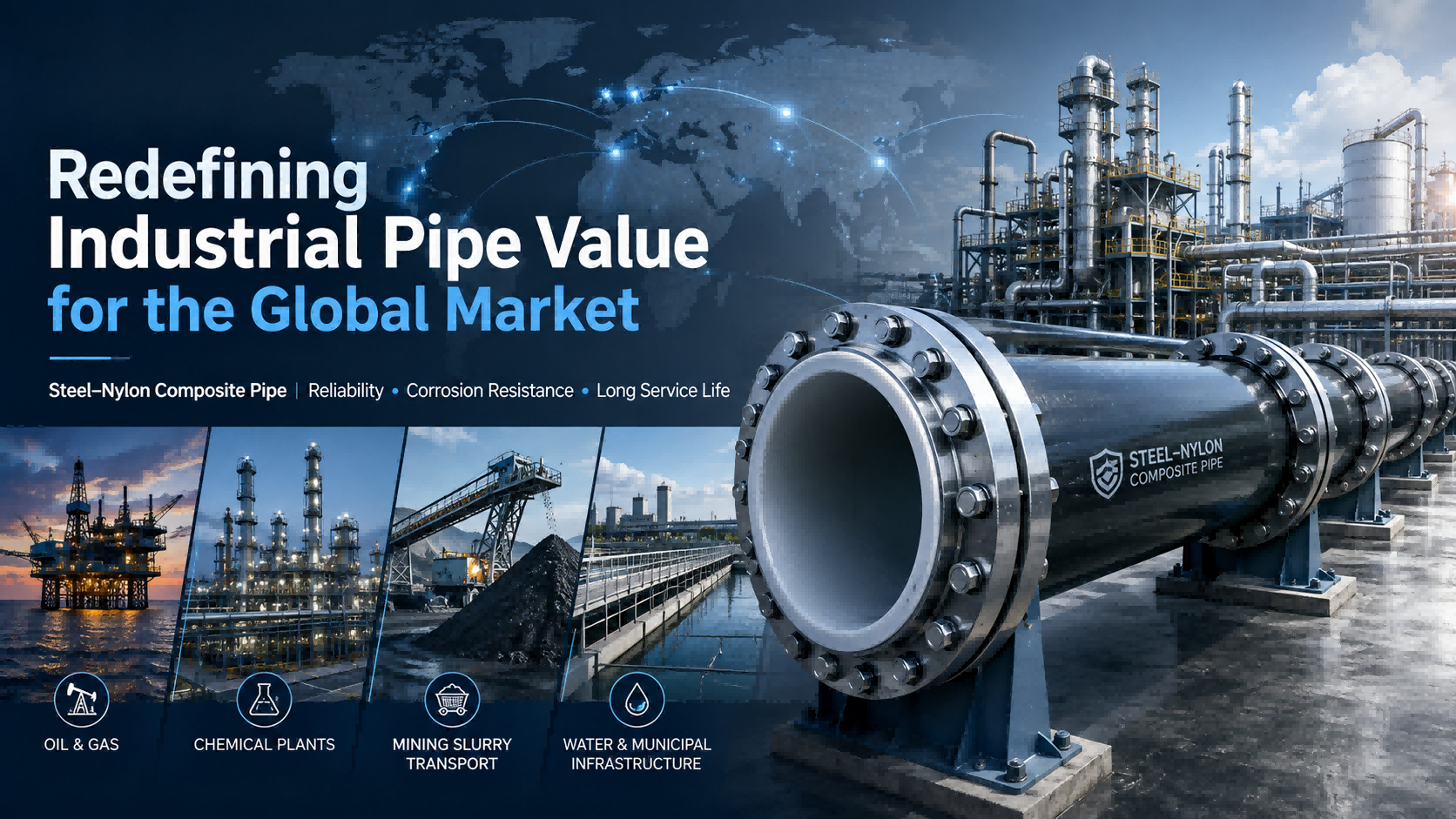
How Engineering Experience Continuously Drives the Evolution of Our Industrial Pipeline Technology

In the industrial pipeline industry, truly valuable technological innovation rarely comes from the laboratory alone.
More often, it is shaped by years of real-world operating experience.
A pipeline that successfully passes pressure tests in a laboratory does not necessarily mean it can operate reliably for ten, twenty, or even more years in oilfields, chemical plants, mines, power plants, or environments involving high salinity, severe corrosion, or abrasive media.
The long-term reliability of an industrial piping system depends on the combined compatibility of multiple factors, including materials, structural design, connection methods, pressure, temperature, conveyed media, flow velocity, installation conditions, and the surrounding operating environment.
For this reason, we have always believed that:
The continuous evolution of industrial pipeline technology is, fundamentally, a long-term process driven by engineering experience.
For decades, we have focused on the development of steel–nylon composite pipes and reinforced nylon piping technologies. Problems encountered in actual projects—including corrosion, abrasion, scaling, leakage, connection failures, and maintenance challenges—have continuously been fed back into our product design and manufacturing systems.
Our development goals have evolved from simply asking whether a pipeline can operate to asking more important questions:
Can it operate reliably for the long term? Can it reduce maintenance requirements? Can it lower total lifecycle costs?
This philosophy has become the foundation of our continuous technological development:
Making industrial transportation systems more reliable, more durable, and easier to maintain.
1. Laboratory Performance Is Only the Beginning—Real Operating Conditions Are the True Test
Industrial pipeline selection normally starts with several basic parameters:
-
Operating pressure
-
Transport temperature
-
Corrosiveness of the medium
-
Solid particle concentration
-
Flow velocity
-
Pipe diameter
-
Installation environment
However, once a pipeline enters long-term operation, actual conditions are often much more complicated than those anticipated during the design stage.
For example, an oilfield pipeline may simultaneously face:
High-salinity produced water + CO₂/H₂S corrosion + sand erosion + pressure fluctuations + outdoor low-temperature conditions.
Chemical industry pipelines may simultaneously experience:
Strong alkalis, high salt concentrations, temperature fluctuations, crystallizing media, erosion, and continuous production requirements.
For mining pipeline systems, the primary challenge may not be corrosion alone, but:
Continuous abrasive wear caused by high-velocity slurry transportation.
In power plant desulfurization, salt chemical production, and other industrial systems, scaling and deposits can gradually reduce the effective internal diameter of pipelines, seriously affecting long-term transportation efficiency.
These conditions demonstrate an important engineering reality:
Industrial pipelines rarely face only one failure mechanism.
A mature pipeline solution must therefore be capable of handling complex operating conditions in which multiple failure mechanisms occur simultaneously.
For this reason, our product development does not simply pursue higher values for a single performance parameter.
Instead, we continuously improve the overall adaptability and reliability of the complete piping system under demanding industrial conditions.
2. The First Technology Upgrade: From Corrosion Resistance to Corrosion and Abrasion Resistance
Traditional carbon steel pipelines provide excellent mechanical strength in many industrial systems.
However, when used in high-salinity, highly corrosive, or particle-containing media, internal corrosion can become one of the most important factors limiting pipeline service life.
As corrosion progresses, pipe wall thickness gradually decreases, potentially resulting in:
-
Pitting corrosion
-
Localized perforation
-
Leakage
-
Wall thinning
-
Unplanned shutdowns
-
Large-scale pipeline replacement
As a result, many industrial projects have turned to alternatives such as stainless steel, plastic pipes, FRP pipes, rubber-lined steel pipes, and plastic-lined steel pipes.
However, practical engineering experience has revealed another important lesson:
Solving corrosion does not necessarily solve all pipeline problems.
When sand, slurry, crystals, or other solid particles are present in the transported medium, even corrosion-resistant materials may still suffer from continuous erosive wear.
This is one of the key reasons behind our long-term development of steel–nylon composite pipe technology.
The steel–nylon composite structure combines the advantages of two different material systems:
The steel structure provides mechanical strength and pressure-bearing capability, while the nylon inner layer provides corrosion resistance, abrasion resistance, and isolation between the steel structure and the transported medium.
This design philosophy does not simply attempt to replace a traditional piping material.
Instead, it addresses industrial environments where strength, corrosion, and abrasion problems exist simultaneously.
3. The Second Technology Upgrade: From Individual Material Performance to Composite Structural Design
One of the most important trends in industrial pipeline development is the gradual transition from:
Material competition to structural design competition.
Traditional steel pipelines provide high mechanical strength, but the conveyed medium remains in direct contact with the metal, making internal corrosion difficult to avoid.
Pure plastic pipes offer excellent corrosion resistance, but their application may be restricted under high pressure, large diameter, elevated temperature, or complex mechanical loading conditions.
FRP pipes also provide good corrosion resistance, but long-term applications still require careful consideration of impact resistance, delamination, connection reliability, and mechanical damage.
The fundamental principle behind steel–nylon composite pipes is therefore not simply to combine two materials.
The more important concept is:
Allow each material to perform the function it is best suited to perform.
External Steel Structure
The external steel structure primarily provides:
-
Pressure-bearing capability
-
Mechanical load resistance
-
Structural rigidity
-
Stability for large-diameter pipelines
-
Mechanical protection under demanding installation conditions
Internal Nylon Functional Layer
The nylon inner layer primarily provides:
-
Isolation of conveyed media
-
Internal corrosion resistance
-
Abrasion resistance
-
Reduced scaling tendency
-
Reduced direct contact between corrosive media and steel
Through this functional division, a single material does not need to satisfy every performance requirement.
This is one of the major reasons composite pipeline technologies are receiving increasing attention in industrial projects.
4. The Third Technology Upgrade: From Reliable Pipe Materials to Reliable Pipeline Systems
A large number of engineering projects have taught us another important lesson:
Industrial pipeline failures do not necessarily occur in straight pipe sections.
Many serious problems are concentrated around:
-
Elbows
-
Tees
-
Reducers
-
Valve connections
-
Pump outlets
-
Flange connections
-
Welded sections
-
Areas where flow direction changes
The reason is straightforward.
These locations commonly experience a combination of:
Flow velocity changes, turbulence, localized erosion, stress concentration, and more complex connection structures.
Improving only the performance of straight pipe sections while ignoring these high-risk areas cannot truly improve the reliability of the entire piping system.
For this reason, we have gradually expanded our technology from individual pipe products toward complete industrial fluid transportation solutions.
Our product and engineering capabilities include:
-
Steel–nylon composite straight pipes
-
Elbows
-
Tees
-
Reducers
-
Upstream and downstream valve sections
-
Wear-resistant pump outlet sections
-
High-wear pipeline components
-
Trial sections
-
Partial pipeline replacement and upgrading solutions
The key principle behind this development is the transition from simply supplying pipe products to:
Solving the weakest points within the entire pipeline system.
5. Field Experience Has Driven Continuous Optimization of Our Integral Flange Design
Connection methods are an important part of industrial pipeline reliability, yet they are often underestimated.
Traditional steel piping systems frequently rely heavily on field welding.
Although welding is a mature industrial technology, it can still introduce additional challenges in certain applications, including:
-
Hot-work management requirements
-
Variations in welding quality
-
Damage to protective coatings
-
Weld corrosion
-
Longer installation schedules
-
More difficult disassembly and maintenance
This is particularly important in oilfields, chemical plants, and facilities handling flammable media, where reducing field hot work can provide significant engineering and safety advantages.
For this reason, our steel–nylon composite pipes use an integral flange connection design.
By integrating the pipe body, internal nylon functional layer, and connection structure into the overall design, the system reduces potential risks associated with extensive field welding.
The value of this structure is not simply that installation becomes easier.
More importantly, it supports:
More standardized installation, more controllable connection quality, and higher maintenance efficiency.
When valves, fittings, or individual pipeline sections need to be replaced in the future, flange connections also make disassembly and reconnection significantly easier.
6. Long-Term Engineering Experience Has Made Interface Reliability a Key Priority
One critical but frequently overlooked issue in composite piping systems is:
Whether the interface between different materials can remain stable over the long term.
Many composite structures may perform well during short-term testing.
However, after prolonged exposure to:
-
Temperature cycling
-
Pressure fluctuations
-
Vibration
-
Thermal expansion and contraction
-
Continuous erosion
-
Installation stress
the interface between different materials can potentially become a weak point.
Possible failures include:
-
Liner separation
-
Blistering
-
Local deformation
-
Damage to the internal layer
Once these problems occur, pipeline service life can decline rapidly.
For this reason, during the long-term development of our steel–nylon composite pipe technology, we have increasingly focused on:
The coordinated stability of the steel structure, nylon functional layer, and integral connection system.
We consider this one of the true technical barriers in industrial composite piping technology.
Simply adding a corrosion-resistant liner is not enough.
A genuinely reliable composite pipeline must answer a more important question:
Can the complete structure remain stable under long-term pressure, temperature changes, and varying operating media?
7. What Oilfield Projects Have Taught Us: Corrosion and Abrasion Must Be Addressed Together
Oil and gas fields represent an important long-term application area for steel–nylon composite piping.
As many oilfields enter high-water-cut stages, corrosion in gathering and transportation systems becomes increasingly severe.
Produced fluids may simultaneously contain:
-
High-salinity water
-
CO₂
-
H₂S
-
Chloride ions
-
Sand and solids
-
Crude oil
-
Other corrosive components
As a result, pipelines are not facing simple electrochemical corrosion.
In many cases, the real mechanism is:
Corrosion + erosion + deposition + temperature fluctuations acting simultaneously.
If the internal surface is first damaged by abrasive particles, corrosion may accelerate.
Conversely, if corrosion creates a rough internal surface, deposits and flow resistance may increase.
These complex failure mechanisms have encouraged us to further utilize the combined advantages of nylon materials in abrasion resistance, corrosion resistance, and surface smoothness.
Instead of simply increasing the wall thickness of a carbon steel pipe, our preferred approach is to:
Reduce or eliminate direct contact between the corrosive medium and the steel structure.
This represents an important shift in design philosophy:
from resisting corrosion to isolating corrosion.
8. What Chemical Industry Projects Have Taught Us: Material Compatibility Is More Important Than Initial Price
The chemical industry creates a very different set of requirements for industrial pipeline materials.
In applications involving:
-
Chlor-alkali production
-
Soda ash production
-
Salt chemicals
-
Phosphate chemicals
-
High-salinity water
-
Strong alkaline media
long-term chemical compatibility between the pipeline material and the conveyed medium becomes critically important.
If procurement decisions are based only on initial pipe price, an even more important question can easily be overlooked:
Is the selected material truly suitable for long-term contact with the target medium?
Some materials may perform well in ordinary water environments but experience substantially reduced service life when exposed to high-salinity, strongly alkaline, or chemically complex media.
Our long-term engineering experience has therefore led us to a very clear technical principle:
Analyze the medium first, then select the material—not the other way around.
In suitable industrial applications, the nylon functional layer of steel–nylon composite pipes provides effective corrosion resistance while separating the steel structure from the transported medium.
At the same time, the steel structure retains its advantages in pressure-bearing capability and mechanical strength.
This combination makes steel–nylon composite piping particularly valuable for industrial transportation systems that must simultaneously consider:
Corrosion resistance, mechanical strength, and long-term stability.
9. What Slurry Transportation Has Taught Us: Wear Resistance Affects More Than Pipeline Service Life
In mining, tailings, industrial slurry, and other abrasive transportation systems, wear is one of the most common problems.
Wear resistance is often viewed simply as a question of:
How often does the pipe need to be replaced?
In real industrial operations, however, the consequences are much broader.
Frequent wear can result in:
-
Frequent shutdowns
-
Increased spare-part inventory
-
Higher labor and maintenance costs
-
Disruption of production schedules
-
Increased leakage risk
-
Higher safety management costs
Improving pipeline wear resistance therefore does much more than extend pipe service life.
It helps increase:
The overall availability of the production system.
This is why we increasingly emphasize another important industrial reliability indicator:
MTBF — Mean Time Between Failures
Industrial companies do not simply need the lowest-priced pipe.
What they really need is:
A piping system with longer intervals between failures, fewer maintenance events, and more stable long-term operation.
10. Engineering Experience Has Shifted Our Design Goal from “Service Life” to “TCO”
Historically, many industrial pipeline procurement decisions were based on a simple question:
Which pipeline has the lowest purchase price?
Long-term operating experience, however, has encouraged more industrial companies to focus on a more comprehensive metric:
Total Cost of Ownership — TCO
The true cost of an industrial piping system should include:
TCO = Purchase Cost + Installation Cost + Maintenance Cost + Replacement Cost + Shutdown Losses + Safety-Related Costs
This means that a pipeline costing 20% less initially may ultimately cost significantly more over ten years if it must be replaced every three years.
This is especially important for continuous-process industrial operations.
In many cases:
The financial loss caused by a single day of production shutdown can exceed the purchase cost of the pipeline section itself.
Therefore, our product development philosophy has gradually evolved from:
How can we manufacture a pipe?
to:
How can we reduce the customer's total transportation-system cost over the next 10 or even 20 years?
This is one of the fundamental reasons we continue to develop steel–nylon composite pipe technology.
11. What Decades of Engineering Experience Really Create Is Not Just a Product, but a Decision-Making System
One of the most valuable assets in industrial manufacturing is not simply production equipment.
It is:
A database of problems accumulated through long-term engineering experience.
Every case of corrosion, abrasion, scaling, leakage, or pipeline failure provides information that can contribute to the next technology upgrade.
Decades of engineering practice have gradually helped us establish a more comprehensive pipeline selection methodology.
When evaluating a project, we typically consider the following questions.
1. What Medium Is Being Transported?
Important factors include:
-
pH
-
Salt concentration
-
Chemical composition
-
Solid particle content
-
Corrosive gases
-
Crystallization tendency
2. What Is the Operating Temperature?
Temperature affects not only material strength but also:
-
Corrosion rate
-
Thermal expansion
-
Material stability
-
Connection performance
3. What Is the Operating Pressure?
Industrial pipeline pressure ratings must be matched to the requirements of the entire system.
Our steel–nylon composite pipes can be engineered with different pressure classes for a variety of industrial applications within approximately the 1.0–4.0 MPa range.
4. Is Abrasive Wear Present?
Important considerations include:
-
Solid concentration
-
Particle size
-
Flow velocity
-
Elbow locations
-
Changes in pipe diameter
5. What Are the Maintenance Conditions?
Remote oilfields, mining areas, large chemical complexes, and urban industrial parks all have very different maintenance requirements.
6. What Is the Project Actually Trying to Achieve?
Is the goal simply the lowest initial investment?
Or is the priority:
Lower maintenance costs, longer service life, and fewer shutdowns?
The answer can directly influence the appropriate pipeline material.
12. Why We Continue to Focus on Steel–Nylon Composite Pipe Technology
The industrial pipeline market does not suffer from a shortage of materials.
What the market truly needs is:
Pipeline solutions capable of adapting to demanding operating conditions over the long term.
We continue to develop steel–nylon composite pipe technology not because we believe a single material can replace every other piping system.
Every engineering material has its own appropriate application range and limitations.
Professional pipeline selection should always be based on a comprehensive evaluation of:
Medium + Pressure + Temperature + Abrasion + Diameter + Installation Environment + Lifecycle Cost
However, in industrial environments where corrosion, abrasion, pressure, and long-term reliability requirements exist simultaneously, steel–nylon composite structures can offer unique engineering advantages.
Key advantages include:
-
High mechanical strength from the external steel structure
-
Strong pressure-bearing capability
-
Corrosion resistance from the internal nylon layer
-
Excellent abrasion resistance
-
Smooth internal surface
-
Reduced scaling tendency
-
Integral flange connections
-
Reduced field welding requirements
-
Large-diameter manufacturing capability
-
Lower long-term maintenance requirements
Our products now cover a broad range of industrial pipeline sizes, from medium-diameter systems to large-scale industrial pipelines, while our manufacturing and engineering capabilities continue to expand toward larger diameters, more demanding operating conditions, and more integrated industrial fluid transportation solutions.
13. The Next Stage of Industrial Pipeline Competition: Turning Experience into Engineering Capability
The real technological barrier in the future industrial pipeline industry may no longer be simply:
Who has developed a new material?
Instead, the key question may become:
Who can transform decades of engineering experience into:
-
Better material systems
-
More reliable structures
-
More effective fitting designs
-
More accurate material-selection methods
-
Lower lifecycle costs
-
More reliable engineering solutions
This is what we mean by:
Engineering-Driven Innovation
Technological innovation driven by real engineering experience.
Mature industrial pipeline technology is never completed in a single step.
Instead, it should evolve through a continuous cycle:
Engineering Application
↓
Operating Feedback
↓
Failure Analysis
↓
Material Optimization
↓
Structural Improvement
↓
Manufacturing Upgrade
↓
Return to Real-World Engineering Applications
Every cycle allows the product to become more closely aligned with the actual requirements of industrial operations.
Conclusion: Reliable Industrial Pipelines Are the Result of Decades of Engineering Experience
Industrial pipelines may appear to be simple components within a production facility.
But for oilfields, chemical plants, mines, power plants, and large industrial enterprises, pipelines form the transportation infrastructure that keeps the entire production system operating.
When a pipeline fails, the impact may extend far beyond a single pipe section.
It can affect:
An entire production system.
For this reason, we believe the true value of industrial piping should not be measured solely by price per meter.
It should also be evaluated according to:
10-year operating cost, maintenance frequency, shutdown time, and overall system reliability.
Decades of engineering applications have allowed us to continuously improve the materials, structures, connection systems, and application capabilities of our steel–nylon composite pipes.
In the future, we will continue following the same technological development path:
Identify problems in real engineering environments, solve them through materials and structural design, and return improved technologies to the field for further verification.
Because in industrial piping:
Truly reliable technology is never the final result of a design process—it is the result of continuous evolution through long-term engineering practice.
Steel–Nylon Composite Pipe Solutions
If your industrial project is currently facing challenges such as:
-
Severe pipeline corrosion
-
Rapid abrasive wear
-
Frequent failure of FRP or lined piping systems
-
High investment costs associated with stainless steel
-
High-salinity, high-alkaline, or chemically complex media
-
Corrosion in oilfield produced-water and gathering pipelines
-
Mining slurry and abrasive media transportation
-
Large-diameter industrial pipeline selection
-
DN100–DN2000 industrial pipeline requirements
-
1.0–4.0 MPa pressure pipeline applications
-
The need to reduce maintenance and replacement costs over the next 10 years
the suitability of steel–nylon composite piping can be evaluated based on your actual operating parameters, including:
Medium composition, temperature, pressure, flow velocity, pipe diameter, and the failure history of the existing pipeline system.
For an industrial project, selecting the right pipeline material is not about finding the most expensive or the cheapest option.
It is about finding:
The pipeline solution that provides the lowest total lifecycle cost and the highest long-term reliability under the actual operating conditions.
Why We Make Complex Industrial Operating Conditions a Core Direction of Product Development
From Product Manufacturer to Industrial Pipeline Solution Provider