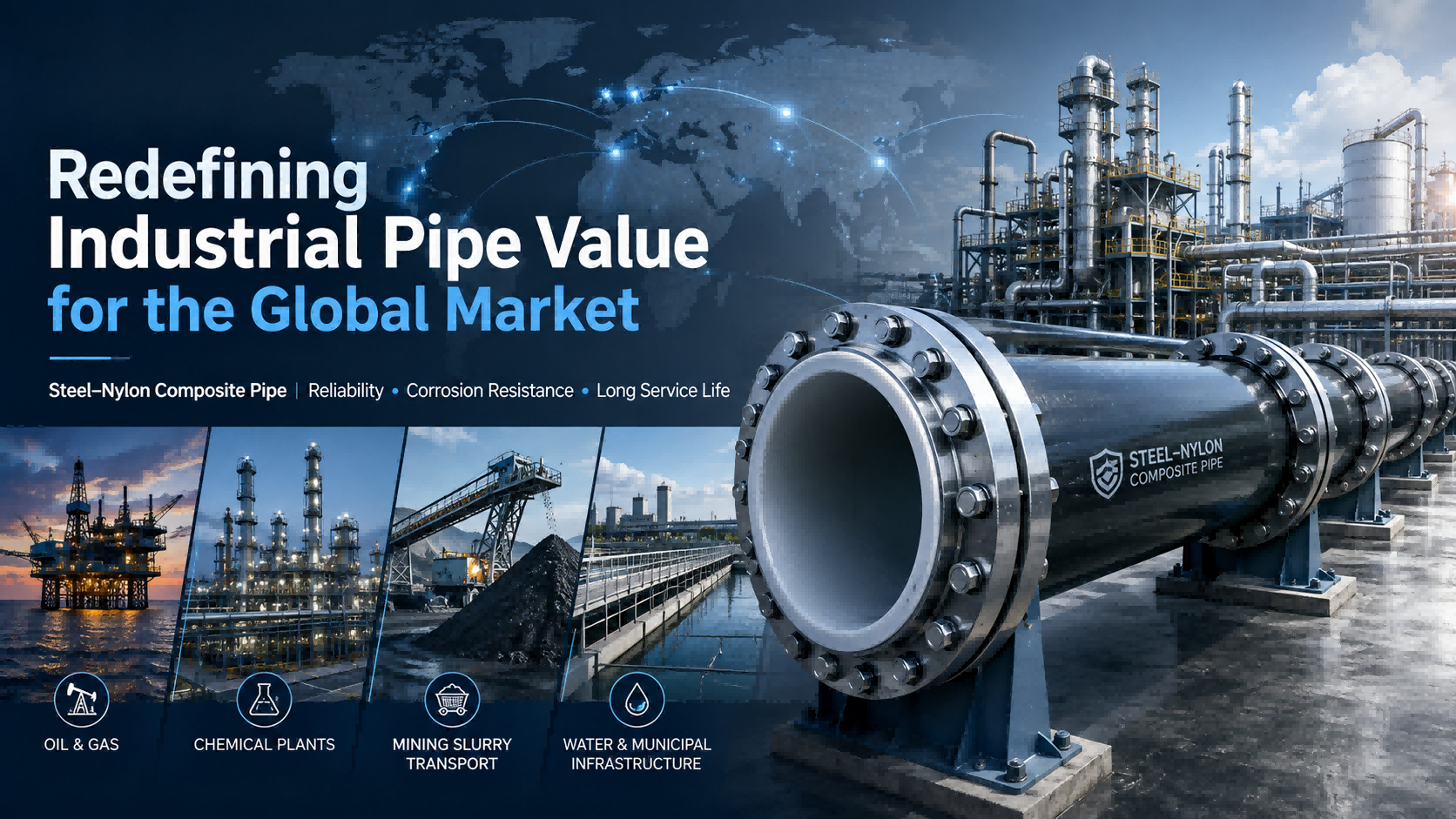
Our Mission: Helping Industrial Pipelines Achieve Lower Maintenance Costs and Longer Service Life

When a pipeline suffers corrosion perforation or leakage, the real loss is rarely limited to replacing a few meters of pipe. It may lead to unplanned shutdowns, interrupted production, loss of process media, emergency repairs, and even disruption of the entire production system.
That is why we have always believed:
The true value of an industrial pipeline should not be measured only by its purchase price. It should be evaluated by its reliability, maintenance requirements, and service life throughout the entire operating lifecycle.
This is also why we have remained focused on steel–nylon composite pipe technology.
Our mission is clear:
To provide more corrosion-resistant, wear-resistant, and reliable industrial pipeline solutions that help customers reduce maintenance, replacement, and shutdowns—ultimately achieving lower maintenance costs and longer pipeline service life.
1. The Real Cost of an Industrial Pipeline Is Often Not the Initial Purchase Price
When selecting industrial pipelines, the easiest factor to compare is usually the material price.
How much does carbon steel cost per ton?
How much does stainless steel cost per meter?
How do FRP, HDPE, rubber-lined steel pipe, and composite pipe compare in price?
These numbers certainly matter.
However, comparing only the initial purchase cost rarely reflects the real economics of an industrial piping system.
Over a 10-year or even longer operating lifecycle, the total cost of a pipeline can include:
-
Initial pipe material cost
-
Fittings and connection system costs
-
Transportation and installation
-
External and internal corrosion protection
-
Periodic inspection
-
Cleaning and descaling
-
Leakage repairs
-
Replacement of high-wear pipe sections
-
Labor and lifting equipment
-
Production shutdown losses
-
Environmental and safety risks
For systems exposed to severe corrosion or abrasion, these subsequent expenses can far exceed the original cost of the pipeline itself.
This is why industrial pipeline selection is undergoing an important shift:
More companies are moving from the lowest purchase price toward the lowest lifecycle cost.
That is exactly the problem we focus on solving.
2. Why Do Traditional Industrial Pipelines Often Fall Into a “Repair–Replace–Repair Again” Cycle?
In conventional water transmission systems, the primary requirements may simply be pressure resistance and fluid transport.
Real industrial environments are far more complex.
In oil and gas fields, chemical plants, salt chemical facilities, mines, power stations, and slurry transport systems, a pipeline may simultaneously face:
Corrosion + Abrasion + Pressure + Temperature + Scaling + Outdoor Exposure
This means that relying on a single material property is often not enough to ensure long-term reliability.
2.1 Corrosion Is One of the Most Common Causes of Pipeline Failure
Oilfield produced water, saline water, chemical mother liquor, alkaline solutions, and industrial fluids containing aggressive ions can all accelerate corrosion of metallic materials.
Once the protective layer of a conventional carbon steel pipeline is damaged, the corrosive medium may directly attack the steel substrate.
As the pipe wall gradually becomes thinner, the failure process may develop as follows:
Pitting → Local Wall Thinning → Perforation → Leakage
Many pipelines are therefore replaced not because the overall structural strength is insufficient, but because localized corrosion causes premature failure.
2.2 Abrasion Can Accelerate Corrosion Damage
Mining slurry, sand-containing produced fluids, crystallized particles, desulfurization slurry, and other solid-liquid mixtures continuously scour pipeline walls during transportation.
The most vulnerable areas often include:
-
Elbows
-
Tees
-
Reducers
-
Pump discharge sections
-
Upstream and downstream sections of valves
-
Areas where the flow direction changes
When the internal material is exposed to both chemical corrosion and mechanical erosion, pipeline life can decrease significantly.
This type of damage is commonly described as:
Corrosion–erosion synergistic failure.
2.3 Scaling Can Reduce the Efficiency of the Entire Transport System
Some industrial fluids tend to form deposits inside pipelines.
As operating time increases, the system may experience:
Reduced internal diameter → Increased flow resistance → Higher pumping energy consumption → Lower transport capacity
In severe cases, regular shutdowns may be required for mechanical or chemical cleaning.
For this reason, the scaling tendency of a pipeline should also be included in lifecycle cost calculations.
2.4 Every Pipe Replacement Can Mean Production Loss
Consider a pipe section that needs replacement every few years—or even every few months—because of severe abrasion.
The replacement itself may involve only several dozen meters of material.
However, the maintenance procedure may require:
Shutdown, drainage, dismantling, lifting, installation, inspection, and recommissioning.
If the pipeline is part of a critical production process, the most expensive element may not be the pipe itself.
It may be:
Production downtime.
That is why modern industrial pipeline design increasingly focuses on one important indicator:
Maintenance Interval
The longer the maintenance interval, the better the potential for continuous and stable production.
3. Our Approach: We Are Not Simply Manufacturing a Pipe—We Are Addressing Lifecycle Performance
The engineering philosophy behind steel–nylon composite pipe is not simply to combine two different materials.
The goal is to take advantage of:
The structural strength of steel
and
The corrosion resistance, wear resistance, and low-friction characteristics of nylon.
Together, these materials create a composite structure designed to balance mechanical performance with resistance to aggressive process media.
This has been the core direction of our long-term development of steel–nylon composite pipeline technology.
4. Steel Provides Structural Strength, While Nylon Handles Aggressive Media
Industrial pipeline engineering has always faced a fundamental material trade-off.
Metallic materials generally provide high mechanical strength, but they may be vulnerable to certain corrosive environments.
Many non-metallic materials offer excellent corrosion resistance, but may face limitations related to pressure, rigidity, large-diameter structural performance, or operating temperature.
Steel–nylon composite pipe aims to create a better balance between the two.
External Steel Structure
The steel structure is mainly responsible for:
-
Pressure resistance
-
Mechanical loads
-
Structural support for large-diameter pipelines
-
Installation loads
-
Complex industrial operating conditions
Internal Nylon Working Layer
The nylon layer directly contacts the transported medium and provides:
-
Corrosion resistance
-
Wear resistance
-
Smooth internal surface
-
Reduced scaling tendency
-
Isolation between the process medium and steel substrate
This does not mean that one material can solve every pipeline problem.
What matters is:
Allowing each material to perform the function it is best suited for.
That is the real engineering value of composite pipeline technology.
5. Why Do We Place Such Strong Emphasis on Corrosion Resistance?
For many industrial pipelines, preventing corrosive media from continuously contacting the pressure-bearing steel structure can significantly extend service life.
Steel–nylon composite pipe uses an internal nylon layer to isolate the transported medium from the steel structure.
Under suitable medium, temperature, and pressure conditions, this can reduce the possibility of corrosive fluids directly attacking the metallic substrate.
This characteristic makes steel–nylon composite pipe particularly suitable for consideration in applications such as:
-
Oil and gas gathering systems
-
Oilfield produced fluid transportation
-
Oilfield water injection
-
High-water-cut oilfield systems
-
Salt chemical processing
-
Chlor-alkali plants
-
Soda ash production
-
Selected alkaline media
-
Industrial wastewater
-
Seawater and saline fluids
-
Mining slurry transportation
However, industrial material selection should never be based only on the words “corrosion resistant.”
Concentration, temperature, pressure, flow velocity, and fluid composition must all be evaluated together.
We advocate engineering-based material selection rather than simply selling pipe products.
6. Wear Resistance Is Another Key Factor in Reducing Maintenance Frequency
Many pipelines do not fail primarily because of corrosion.
They fail because they are continuously worn away.
This is especially common in systems transporting fluids containing solid particles, where abrasion tends to concentrate in specific sections.
We therefore pay particular attention to the application of steel–nylon composite pipe in demanding abrasive environments.
Oil and Gas Fields
High-water-cut and sand-containing fluids can create both corrosion and erosion problems.
Mining
Mining slurry, tailings, and backfill mixtures can cause severe pipeline abrasion.
Chemical Processing
Chemical fluids containing crystallized solids can continuously scour the internal pipe wall.
Power Plants
Desulfurization slurry and other solid-liquid media can cause significant wear at elbows and other local sections.
In these systems, longer service life means more than simply having a “wear-resistant pipe.”
The real benefit is:
Reducing the number of replacement cycles.
7. We Focus on the Entire Pipeline System, Not Only Straight Pipe
In many industrial pipeline systems, the first components to fail are not necessarily long sections of straight pipe.
Failure often begins at:
-
Elbows
-
Tees
-
Reducers
-
Pump outlets
-
Valve upstream and downstream sections
-
Manifolds
-
High-erosion areas
These areas experience changing flow direction, localized turbulence, and particle impact.
Therefore, a truly effective corrosion- and wear-resistant solution cannot focus only on straight pipe.
It must address the:
Pipeline System, Not Just the Pipe
This is also an important direction in the continued development of our product range.
From straight pipe, we have expanded toward elbows, tees, reducers, and other critical wear components so that the entire transportation system can follow a more consistent material and engineering philosophy.
8. Integral Flange Design Helps Reduce Uncertainty From On-Site Welding
In addition to the pipe material itself, the connection method also has a major influence on pipeline reliability.
Many traditional pipeline systems require extensive on-site:
Cutting, welding, joint treatment, and corrosion-protection repair.
Every additional field process introduces another potential quality variable.
Steel–nylon composite pipes can use an integrally formed flange structure, allowing flange connections between:
-
Pipe and pipe
-
Pipe and elbow
-
Pipe and tee
-
Pipe and valve
-
Pipe and equipment
This reduces the need for field hot work and can improve installation standardization.
For oilfields, chemical plants, and pipeline renovation projects, this can offer significant practical advantages.
Because in many industrial projects:
Reducing installation time is itself a form of cost reduction.
9. Why Is a Smooth Inner Wall Also an Economic Advantage?
Pipeline operating cost is frequently underestimated.
Yet every fluid transportation system must deal with one long-term issue:
Flow Resistance
As corrosion, deposits, and scaling accumulate, the internal pipe surface becomes increasingly rough.
This means more pumping energy may be required to maintain the same flow rate.
Nylon has a relatively smooth internal surface, which can help reduce the tendency toward deposition and scaling.
Its economic value can therefore extend beyond material service life and include:
-
Reduced cleaning frequency
-
Lower blockage risk
-
Better preservation of effective flow area
-
More stable transportation capacity
-
Lower long-term hydraulic resistance
All of these factors contribute to lifecycle cost.
10. Our Product Development Is Built Around Demanding Industrial Conditions
We do not position steel–nylon composite pipe as a “universal pipe material.”
In reality, no industrial pipeline material is suitable for every fluid and every operating condition.
The real value of an engineering material lies in:
Finding the Applications Where It Performs Best
Our steel–nylon composite pipes are primarily designed for corrosive, abrasive, and demanding industrial transportation environments.
Depending on project design and operating requirements, the product system can cover different:
Diameters, pressure levels, temperatures, and process media.
Our product portfolio can support pressure classes of approximately:
1.0–4.0 MPa
Depending on the specific material system and engineering design, the operating temperature range can extend approximately from:
-36°C to 160°C
We also continue to develop and manufacture large-diameter steel–nylon composite pipelines.
This means the technology is not limited to ordinary process piping, but is increasingly suitable for larger and more demanding industrial transportation systems.
11. Decades of Engineering Experience Have Strengthened Our Belief in Long-Term Thinking
The industrial pipeline industry is unique.
Immediately after installation, many different pipe materials may appear to perform well.
The real differences often become visible:
After 3 years, 5 years, 10 years, or even longer.
Laboratory testing can tell us part of the story.
Real industrial environments introduce many additional variables simultaneously:
Temperature changes, pressure fluctuations, installation tolerances, complex fluids, long-term abrasion, outdoor aging, and continuous operation.
That is why we believe:
Industrial Pipeline Technology Must Ultimately Be Proven Through Long-Term Field Performance
For decades, reinforced nylon and steel–nylon composite pipeline systems have been applied in petroleum, chemical processing, mining, power generation, and other industrial sectors.
These long-term operating experiences continuously feed back into product development and engineering improvements.
For us, decades of experience are more than simply a number.
They represent an ongoing effort to understand:
Why some industrial pipelines remain reliable over the long term while others fail prematurely.
12. Our Goal Is Not to Make Customers Buy More Pipes—It Is to Help Them Replace Pipes Less Often
Traditional business logic might suggest that the more frequently a pipeline needs replacement, the more products a manufacturer can sell.
Our philosophy is the opposite.
We would rather help customers:
Perform one fewer repair.
Replace a pipeline one fewer time.
Avoid one additional shutdown.
Because this is where industrial customers receive real value.
If a pipeline previously needed replacement every few years, but a new material system can significantly extend the maintenance interval, the value created goes far beyond the cost of a few meters of pipe.
It can mean:
-
Higher production continuity
-
Lower labor costs
-
Reduced spare-part inventory
-
Lower installation risk
-
Fewer leakage incidents
-
More stable production capacity
-
Lower total lifecycle cost
This is what we define as:
Long-Term Pipeline Value
13. Moving From “Selling Pipes” to Solving Industrial Transportation Problems
The industrial pipeline supplier of the future cannot simply provide a pipe specification and a quotation.
Customers increasingly need suppliers who understand questions such as:
What medium is being transported?
What is the operating temperature?
What is the pressure?
What is the flow velocity?
Are solid particles present?
What pipe material is currently being used?
Why did the previous pipeline fail?
Which sections fail most frequently?
What is the cost of one production shutdown?
Only after answering these questions can an appropriate material solution be selected.
This is why we are gradually evolving from a pipe manufacturer toward an:
Industrial Pipeline Solution Provider
Our goal is to provide more complete engineering support around specific operating conditions, including:
Material selection + Pipeline structure + Fitting configuration + Connection method + High-wear section optimization + Lifecycle cost analysis
14. For High-Risk Projects, We Prefer “Verify First, Then Scale Up”
When a new material is introduced into a major industrial project, customer concerns about risk are completely reasonable.
This is particularly true for continuous-process production systems.
For certain retrofit projects, we therefore prefer the following approach:
Small-Scale Trial → Long-Term Verification → Large-Scale Application
For example, customers may begin with:
-
A 100–500 meter trial section
-
One highly corrosive pipeline section
-
One high-wear elbow
-
One valve-group pipeline section
-
One vulnerable pump discharge section
The material can then be evaluated under real operating conditions.
If actual service life, maintenance frequency, and operating performance meet expectations, the application can gradually be expanded.
For customers, this approach reduces the risk of material replacement.
For us, it represents responsible engineering.
15. The Better Question Is Not “How Much Does It Cost Per Meter?” but “How Much Does It Cost Per Operating Year?”
Consider two pipeline options.
Option A
Lower initial purchase price, but frequent maintenance and replacement.
Option B
Slightly higher initial investment, but longer operating life and fewer repairs.
Which one is actually cheaper?
If only the initial purchase price is considered, Option A may appear more economical.
But when the evaluation period extends to:
5 years, 10 years, or the entire project lifecycle,
the answer may be completely different.
That is why we increasingly recommend that industrial customers use:
Total Cost of Ownership — TCO
when selecting pipeline materials.
The real calculation should include:
Purchase + Installation + Maintenance + Replacement + Downtime + Energy Consumption + Risk
Only then can a company determine which pipeline material is truly more economical.
16. Longer Service Life Is Also a Form of Sustainability
Extending industrial pipeline service life is not only an economic issue.
It can also mean:
Less manufacturing.
Less transportation.
Less dismantling.
Less discarded pipe.
Less construction work.
Lower resource consumption.
As more industrial companies focus on energy efficiency, resource utilization, and sustainability, extending equipment life itself becomes a practical way to reduce waste.
We therefore believe the future of industrial pipeline technology should not simply be about finding cheaper materials.
It should be about developing:
More Reliable, Longer-Lasting Pipeline Systems With Lower Lifecycle Costs
17. Our Mission Defines the Direction We Intend to Follow for the Long Term
We do not believe the industrial pipeline industry needs a constant stream of new marketing concepts.
The core problems that need to be solved have remained remarkably consistent for decades:
Corrosion.
Abrasion.
Scaling.
Leakage.
Maintenance.
Shutdowns.
Through steel–nylon composite material technology, we want to progressively reduce these problems.
We hope that more industrial customers will eventually stop asking only:
“Which pipe is the cheapest?”
and begin asking:
“Which pipeline can help me reduce maintenance over the next 10 years?”
The difference may appear to be only one sentence.
But it represents two completely different engineering philosophies.
The first focuses on purchase price.
The second focuses on asset value.
Conclusion: Turning Pipelines Into Long-Term Assets Instead of Frequently Replaced Consumables
The ideal industrial pipeline system is not one where maintenance teams become increasingly skilled at emergency repairs.
It is one where:
Emergency repairs are needed less and less often.
Our goal is not simply to manufacture a pipe that appears more advanced.
Our goal is to build pipeline systems that can withstand the real challenges of industrial operation:
Corrosion, abrasion, pressure, temperature, and continuous service.
By combining the structural strength of steel with the corrosion resistance and wear resistance of nylon, we aim to provide oil and gas, chemical processing, mining, power generation, and other industrial sectors with a more reliable long-term pipeline option.
Ultimately, we want to help customers achieve something simple but extremely valuable:
Less Maintenance. Fewer Replacements. Less Downtime.
Longer Service Life. Lower Lifecycle Cost. More Reliable Production.
That is our mission.
To help industrial pipelines achieve lower maintenance costs and longer service life.
Need a Longer-Lasting Industrial Pipeline Solution?
If your existing pipeline is experiencing corrosion, abrasion, scaling, repeated leakage, or frequent replacement, steel–nylon composite piping may provide an alternative engineering solution.
Send us your key operating parameters:
Medium · Temperature · Pressure · Diameter · Flow Rate · Existing Pipe Material · Main Failure Problem
and we can evaluate whether a steel–nylon composite pipeline solution is suitable for your project.
From Product Manufacturer to Industrial Pipeline Solution Provider
Long-Term Thinking: Why Industrial Pipeline Manufacturing Requires Decades of Engineering Experience