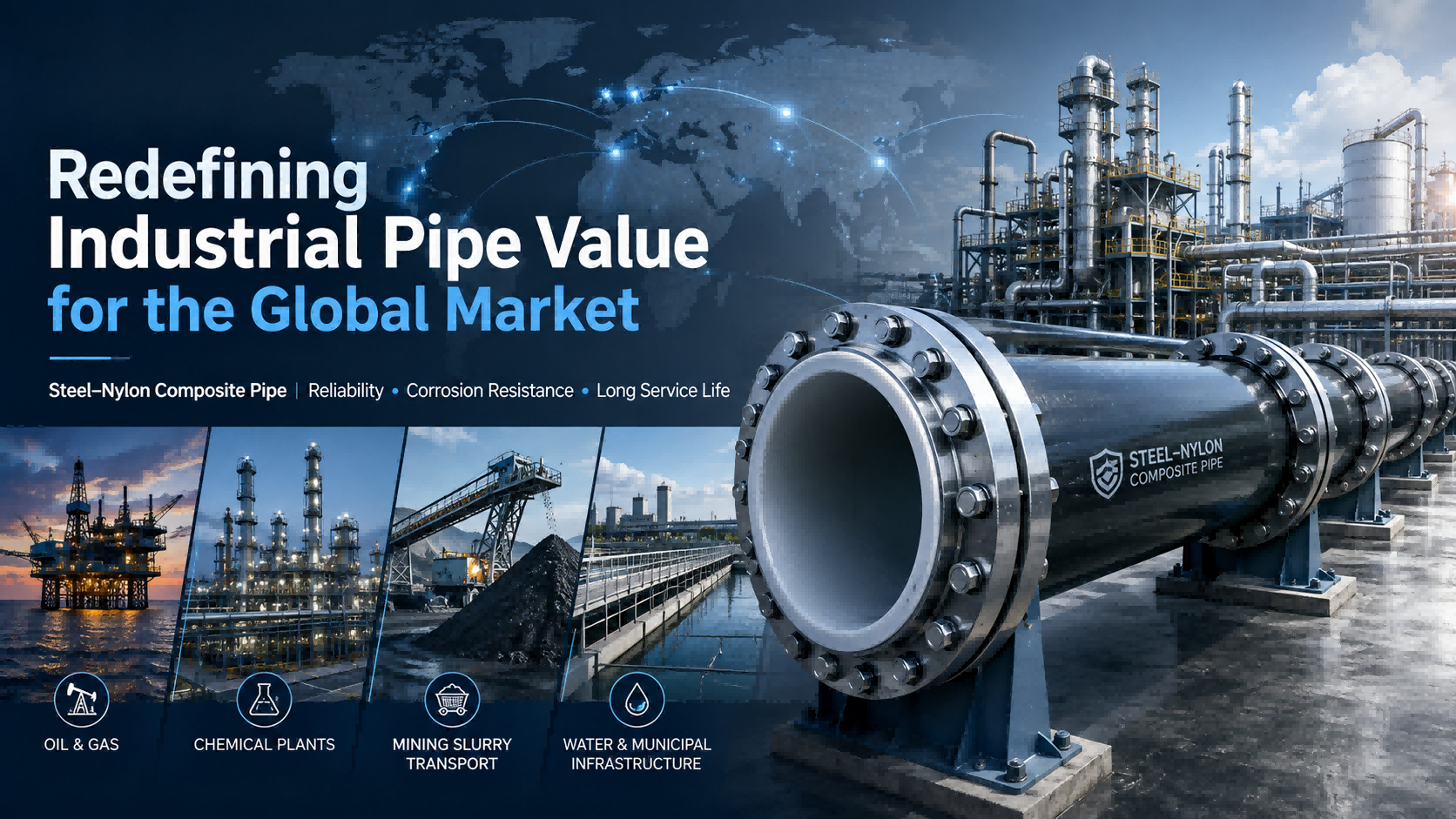
From Product Manufacturer to Industrial Pipeline Solution Provider

In the traditional industrial procurement model, pipelines are often treated as standardized products.
Customers provide specifications such as diameter, pressure rating, length, and quantity. Manufacturers produce according to those requirements and deliver the finished pipes.
However, in demanding industrial environments such as oil and gas fields, chemical plants, mining operations, power generation, and salt chemical industries, the long-term reliability of a pipeline depends on much more than whether it simply meets dimensional specifications.
The real question is:
Is the selected pipeline material truly suitable for the actual medium, temperature, pressure, corrosion, abrasion, and operating conditions?
This is one of the most important changes taking place in the industrial pipeline market.
Customers increasingly need more than a pipe supplier. They need a partner capable of understanding operating conditions, analyzing failure mechanisms, selecting suitable materials, and reducing lifecycle risks.
For a company specializing in steel-nylon composite pipe technology, this transition is not simply about expanding the product range.
It represents a fundamental evolution in capability:
From manufacturing a pipe to solving an industrial fluid transportation problem.
1. Industrial Customers Are Not Really Buying Pipes — They Are Buying Reliable Operation
On the surface, an industrial project purchases pipelines.
In reality, what the customer wants is:
fewer leaks, less corrosion, less maintenance, fewer shutdowns, and longer periods of stable operation.
This is especially important for continuous-process industries, where the financial impact of pipeline failure can be much greater than the original purchase price of the pipe itself.
For example, corrosion perforation in an oilfield gathering pipeline may result not only in pipe replacement costs, but also in oil leakage, environmental risks, and production interruptions.
A leak in a chemical processing pipeline may cause plant shutdowns, safety risks, maintenance costs, and disruptions to an entire production unit.
In mining slurry or solid-liquid transportation systems, severe abrasion can lead to frequent replacement of elbows, tees, reducers, and other high-wear sections.
As a result, industrial pipeline procurement is gradually moving away from one simple question:
“How much does this pipe cost?”
toward a much more important question:
“How much will this pipeline system cost over the next 5, 10, or even more years?”
This change is the fundamental reason why pipeline manufacturers must evolve into solution providers.
2. Why the Traditional “Selling Pipes” Model Is No Longer Enough
Industrial pipeline failures are rarely caused by a single factor.
Corrosion, abrasion, temperature, pressure, chemical composition, flow velocity, solid particles, installation methods, and structural design often interact simultaneously.
Consider an oilfield produced-fluid gathering pipeline.
The transported medium may contain:
-
High water content
-
Dissolved salts
-
CO₂
-
H₂S
-
Solid particles
-
Crude oil and other complex components
If pipeline selection is based only on design pressure and diameter, the real failure mechanism may never be addressed.
The same applies to soda ash, chlor-alkali, salt chemical, phosphate chemical, and other industrial applications.
In these environments, pipeline materials may need to withstand not only chemical corrosion, but also crystallization, erosion, abrasion, scaling, and temperature fluctuations.
Therefore:
Industrial pipeline selection is fundamentally a materials engineering challenge, not simply a procurement decision.
A capable industrial pipeline supplier should first answer:
Why did the previous pipeline fail?
Then:
What material should replace it?
Only after that should the discussion move to:
How should the new pipeline be manufactured?
3. From Product Parameters to Operating-Condition Parameters
Traditional pipe manufacturers usually begin with product specifications:
What is the diameter?
What is the wall thickness?
What is the pressure rating?
What is the required length?
A solution-oriented supplier begins somewhere else — with the operating conditions.
For example:
What medium is being transported?
Does the medium contain salts, acids, alkalis, CO₂, H₂S, or abrasive solids?
What is the operating temperature?
What are the design pressure and normal working pressure?
What is the flow velocity?
Can vacuum or negative pressure occur?
Will the pipeline operate outdoors for long periods?
Does the system experience frequent startup and shutdown cycles?
What material was previously used?
Why did the previous pipeline fail?
How frequently does the pipeline require replacement?
Only after understanding these factors can we determine whether the primary challenge is:
corrosion, abrasion, scaling, structural failure, or a combination of several mechanisms.
This is particularly important for steel-nylon composite pipes.
Their value is not simply that they replace one traditional material.
Their real advantage appears in complex operating conditions where corrosion, abrasion, pressure, and temperature requirements exist simultaneously.
4. The Core Principle of Steel-Nylon Composite Pipe: Different Materials Perform Different Functions
Industrial pipeline materials have always faced a fundamental engineering trade-off.
Metallic materials provide high mechanical strength and structural rigidity, but may suffer from corrosion in certain chemical environments.
Many non-metallic materials offer good corrosion resistance, but may face limitations under higher pressure, large diameters, elevated temperatures, or demanding mechanical conditions.
Steel-nylon composite pipes take a different approach:
Allow each material to perform the function it is best suited for.
The steel structure primarily provides:
-
Mechanical strength
-
Structural rigidity
-
Pressure-bearing capability
-
Stable support for industrial pipeline systems
The nylon working layer primarily provides:
-
Isolation of the transported medium from the steel structure
-
Corrosion resistance
-
Abrasion resistance
-
Reduced scaling tendency
-
A smoother internal flow surface
This is more than simply combining two different materials.
It is a functional composite design philosophy in which different materials perform different engineering roles.
The objective is not to maximize one individual property.
Instead, the goal is to achieve a better balance of mechanical reliability, corrosion resistance, abrasion resistance, and long-term operational stability.
5. Why We Have Focused on Steel-Nylon Composite Pipe Technology
There is no universal pipeline material suitable for every industrial application.
Our objective is not to claim that steel-nylon composite pipe is superior to every alternative under every operating condition.
Professional material selection must always begin with the actual service environment.
However, steel-nylon composite pipes can provide significant advantages in many demanding industrial applications, including:
-
Oil and gas gathering and transportation systems
-
Oilfield produced-water and water-injection pipelines
-
Soda ash, chlor-alkali, and salt chemical industries
-
Certain weak-acid and strong-alkali applications
-
Mining slurry transportation
-
Solid-containing and abrasive media
-
Power plant desulfurization systems
-
Industrial slurry pipelines
-
Seawater and high-salinity media
-
Municipal water supply and drainage systems with long-term corrosion concerns
Our steel-nylon composite pipeline systems can be engineered for different diameters and pressure requirements.
By combining the structural strength of steel with the functional properties of nylon, the system is designed to achieve a practical balance between:
corrosion resistance, abrasion resistance, pressure capability, structural stability, and long-term operating performance.
This forms the technical foundation of our transition from a product manufacturer to an engineering solution provider.
6. Integrated Flange Design: More Than an Installation Feature
In industrial pipeline systems, straight pipe sections are often not the most difficult components.
The more challenging areas are usually connections and fittings.
Welds, elbows, tees, reducers, valve connections, pump outlet sections, and other complex transition points often require particular attention.
For this reason, connection design is an important part of our steel-nylon composite pipeline system.
Through an integrated flange structure, straight pipes, elbows, tees, reducers, and other components can form a complete flange-connected pipeline system.
The benefit goes beyond easier installation.
More importantly, such a design can:
-
Reduce certain on-site hot-work requirements
-
Improve installation flexibility in demanding industrial environments
-
Simplify disassembly and replacement
-
Facilitate local maintenance and future system upgrades
This reflects another important principle:
A pipeline solution provider must consider not only how a pipe is manufactured, but also how the customer will install, operate, maintain, and eventually replace it.
7. From Complete Pipeline Replacement to Solving the Most Critical Failure Points First
Many industrial companies know that their existing pipelines suffer from corrosion or abrasion, but they may not be ready to replace the entire pipeline system immediately.
The reasons are practical.
A full replacement project may involve:
-
High capital expenditure
-
Long construction periods
-
Production shutdown pressure
-
Technical uncertainty when adopting a new material for the first time
Therefore, we increasingly focus on another engineering strategy:
Start with the sections that fail most frequently.
Typical examples include:
-
Elbows
-
Tees
-
Pump outlet sections
-
Sections upstream and downstream of valves
-
High-velocity areas
-
High-abrasion sections
-
Frequently leaking pipe sections
These locations may represent only a small percentage of the entire pipeline network, but they can account for a disproportionately large share of maintenance work.
In these situations, steel-nylon composite pipe can first be introduced as a localized upgrade.
Another approach is to install a controlled trial section.
This allows the customer to evaluate actual operating performance, including:
-
Corrosion behavior
-
Abrasion performance
-
Scaling tendency
-
Pressure stability
-
Connection reliability
-
Maintenance frequency
-
Overall operating cost
Once actual field performance has been verified, the solution can gradually be expanded to larger areas of the pipeline system.
Therefore, a good industrial pipeline solution does not necessarily mean replacing the entire system immediately.
In some cases, the more practical strategy is:
Replace the most problematic 5%–20% of the pipeline first.
8. From Purchase Price to Total Cost of Ownership
If pipeline materials are compared only by their price per meter, it is easy to reach a simple conclusion.
But for an industrial operator, that comparison is incomplete.
What should really be evaluated is:
Total Cost of Ownership — TCO.
This includes:
-
Initial material cost
-
Transportation cost
-
Installation cost
-
Construction time
-
Corrosion protection and maintenance
-
Repair expenses
-
Spare-parts inventory
-
Pipeline replacement
-
Production shutdown losses
-
Environmental and safety risks
-
Long-term operation and maintenance costs
Consider two pipeline materials.
One has a lower initial purchase price but requires replacement every few years.
The other requires a somewhat higher initial investment but significantly extends the maintenance and replacement cycle.
After 10 years, which solution is actually more economical?
The answer may be very different from what the original purchase quotation suggested.
This is why our technical discussions increasingly emphasize one principle:
Do not compare only the cost per meter. Compare the cost per year of reliable operation.
For continuously operating oilfields, chemical plants, mines, and power plants, extending a maintenance cycle can sometimes create more value than reducing the initial pipeline purchase price by 10%.
9. A Solution Provider Must Understand Pipeline Failure
The true technical capability of an industrial pipeline company should not be measured simply by the number of products in its catalog.
A more important question is:
When faced with a pipeline that has already failed, can the supplier determine:
Why did it fail?
The same visible problem — such as leakage — may have very different underlying causes.
These may include:
-
Chemical corrosion
-
Erosion-corrosion
-
Particle abrasion
-
Pitting corrosion
-
Stress corrosion
-
Liner delamination
-
Negative-pressure deformation
-
Temperature-related material degradation
-
Connection failure
-
Multiple interacting failure mechanisms
If the failure mechanism is incorrectly identified, replacing the existing pipeline with a more expensive material may still fail to solve the problem.
Therefore, we believe one of the most important capabilities of a future industrial pipeline solution provider is:
Analyze the failure mechanism from field evidence, understand the operating conditions, and then select the appropriate material.
This is one of the fundamental differences between a product supplier and a solution provider.
10. What Decades of Experience Really Mean
Industrial pipeline materials have one important characteristic:
Not every aspect of long-term performance can be demonstrated through short-term laboratory testing.
Laboratory testing can evaluate:
-
Tensile strength
-
Impact strength
-
Abrasion resistance
-
Chemical resistance
-
Pressure performance
But real industrial reliability also depends on questions such as:
What happens to the material after years of operation?
How does it behave after long-term exposure to multiple aggressive factors simultaneously?
How does outdoor exposure affect performance?
What happens under temperature cycling?
How does pressure fluctuation affect the system?
How does installation quality influence long-term reliability?
What maintenance conditions will the system experience?
This is why long-term engineering experience is so valuable in industrial pipeline technology.
Decades of application experience in petroleum, chemical processing, mining, power generation, seawater service, and municipal infrastructure provide more than manufacturing knowledge.
They create an accumulated understanding of operating conditions.
Where does abrasion usually become most severe?
Which media create the highest corrosion risks?
Which locations are most likely to become leakage points?
When should composite construction be considered?
When is it better to begin with a trial section?
These questions cannot always be answered by a product catalog.
They are answered through engineering experience.
11. Future Competition Will Not Be About Who Can Manufacture Pipes — It Will Be About Who Can Reduce Customer Risk
Industrial projects are placing increasing importance on:
-
Safety
-
Environmental performance
-
Equipment reliability
-
Maintenance efficiency
-
Total lifecycle cost
-
Long-term operating stability
As a result, the competitive logic of the industrial pipeline industry is changing.
In the past, competition was largely based on:
Products.
In the future, it will increasingly be based on:
Engineering capability.
Customers will no longer ask only:
“What pipe diameters can you manufacture?”
They will increasingly ask:
“Can this pipeline handle our medium?”
“Can it operate reliably at this temperature?”
“What pressure class should we select?”
“Why did our previous stainless steel pipeline corrode?”
“Why does our FRP pipeline repeatedly fail?”
“This section requires maintenance every year. How can we solve the problem?”
“Can we begin with a 100-meter trial section?”
“What will the total cost be over 10 years?”
Companies capable of answering these questions are moving beyond product manufacturing and toward true industrial pipeline solution capability.
12. Our Direction: Lifecycle Solutions for Industrial Fluid Transportation
We are still a pipeline manufacturer.
Manufacturing remains the foundation of everything we do.
Without reliable materials, stable manufacturing processes, quality control, and engineering capability, the term “solution provider” has little meaning.
But our goal extends beyond manufacturing steel-nylon composite pipes.
We aim to build a more complete capability around demanding industrial transportation systems:
Operating Condition Analysis → Material Selection → Pipeline Design → Product Manufacturing → Fittings Integration → Installation Adaptation → Trial Section Validation → Localized Upgrade → Long-Term Performance Evaluation
This means that when we communicate with a customer, the first question should no longer be:
“Which of our products can we sell?”
Instead, it should be:
“Why is the customer's pipeline failing?”
Only after understanding the problem should we determine whether steel-nylon composite pipe is the appropriate solution.
At first glance, this may appear to be simply a change in business positioning.
In reality, it represents something much deeper:
the evolution from product thinking to engineering thinking.
Conclusion: The Best Pipeline Is the One the Customer Gradually Stops Thinking About
Industrial pipelines are unusual products.
The better they perform, the less attention they receive.
No leaks.
No frequent repairs.
No unexpected shutdowns.
No repetitive replacement every few years.
For an industrial operator, that is the ideal situation.
Therefore, what we aim to provide is more than steel-nylon composite pipe.
We aim to provide a long-term approach to industrial fluid transportation:
Use the right material, the right structure, and the right engineering solution to transform pipelines from high-maintenance components into long-term industrial assets.
Moving from a product manufacturer to an industrial pipeline solution provider does not mean moving away from manufacturing.
Quite the opposite.
It means using manufacturing technology as the foundation while developing a deeper understanding of the customer's process conditions, equipment, maintenance requirements, and lifecycle costs.
In the past, we manufactured pipes.
Today, we solve pipeline problems.
In the future, we aim to help more industrial companies build pipeline systems with longer service life, lower maintenance requirements, and lower total cost of ownership.
How Engineering Experience Continuously Drives the Evolution of Our Industrial Pipeline Technology
Our Mission: Helping Industrial Pipelines Achieve Lower Maintenance Costs and Longer Service Life