
How We Are Redefining the Value of Industrial Piping for the Global Market
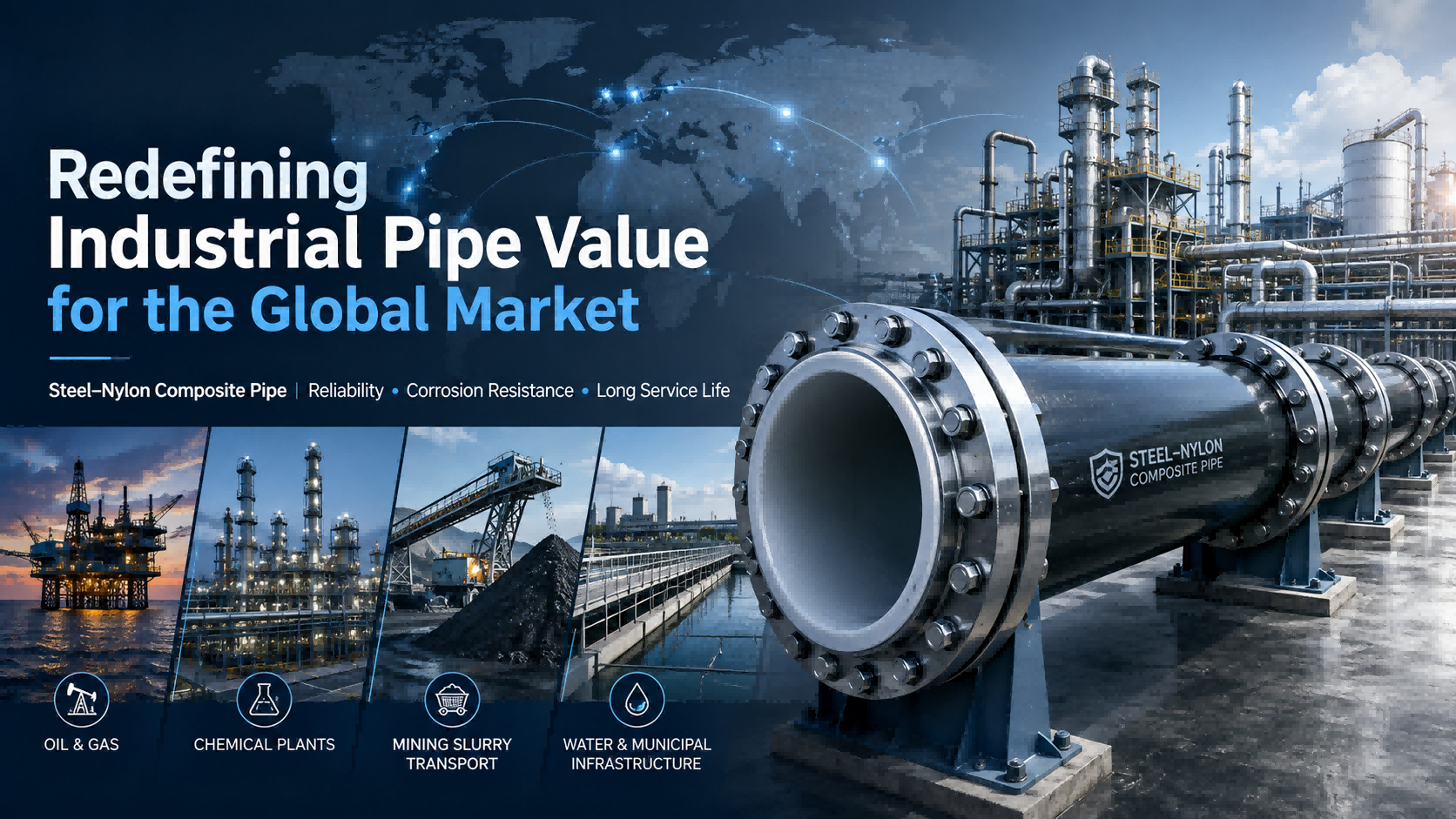
Traditionally, industrial piping has often been treated as a standardized engineering material.
During the design stage, engineers typically focus on pipe diameter, pressure rating, material grade, and purchase price. During procurement, the discussion often comes down to price differences between suppliers.
However, as industrial projects around the world move into increasingly complex operating environments, this price-centered approach to evaluating piping systems is beginning to change.
More oil & gas, chemical, mining, power generation, and infrastructure projects are reconsidering a fundamental question:
What truly defines the value of an industrial pipeline?
Is it a lower initial purchase price?
Or a longer service life?
Is it a higher material grade?
Or fewer leaks, lower maintenance frequency, and more stable long-term operation?
For industrial systems designed to operate continuously for many years, project economics are often determined not by the price paid on the day the pipe is purchased, but by what happens over the next 10, 15, or even 20 years:
-
Corrosion rate
-
Wear rate
-
Leakage probability
-
Maintenance frequency
-
Production downtime
-
Replacement cost
-
Installation complexity
-
Overall system risk
From this perspective, we believe that:
The future of industrial piping will increasingly shift from competition based on material price to competition based on total lifecycle value.
Steel–nylon composite pipe has been developed precisely around this principle—as a piping solution designed for demanding industrial service conditions.
1. Global Industrial Pipelines Are Facing More Complex Operating Conditions
In the past, the design philosophy behind many industrial piping systems was relatively straightforward.
The transported media were stable, operating conditions were clearly defined, and expected service lives were often limited. As a result, conventional carbon steel, stainless steel, rubber-lined steel, or common plastic piping could often satisfy basic engineering requirements.
Today, however, industrial operating environments are becoming significantly more demanding.
More Aggressive Corrosive Environments
In industries such as oil & gas, salt chemicals, chlor-alkali, soda ash, and phosphate chemicals, pipelines may transport media containing:
-
High concentrations of dissolved salts
-
Chloride ions
-
Hydrogen sulfide
-
Carbon dioxide
-
Strong alkaline substances
-
Weak acids
-
Industrial wastewater
-
Various dissolved salts and chemicals
These media can cause continuous corrosion of conventional metallic piping.
Once pitting, localized corrosion, groove corrosion, weld corrosion, or perforation begins, the damage may eventually result in leakage, unplanned maintenance, or even plant shutdown.
Corrosion and Abrasion Often Occur Simultaneously
Many industrial fluids are not clean liquids.
Typical examples include:
-
Oilfield produced fluids
-
Mining slurry
-
Chemical mother liquor
-
Flue gas desulfurization slurry
-
Sand-containing wastewater
-
Industrial wastewater carrying suspended solids
These fluids may be chemically corrosive while also containing solid particles.
As a result, the pipe is not exposed to corrosion alone. It may experience a combination of:
corrosion + erosion + abrasion + pressure cycling.
This combined damage mechanism is one of the major reasons why conventional piping systems sometimes fail much earlier than their original design life.
Industrial Projects Require Longer Maintenance Intervals
For large oilfields, chemical plants, mines, and power stations, pipeline maintenance involves far more than simply replacing a section of pipe.
It may require:
shutdown, draining, cleaning, cutting, welding, inspection, testing, and recommissioning.
Therefore, the real cost of a pipeline failure can be many times greater than the price of the pipe itself.
This is why more industrial operators are asking a different question:
Can a more reliable piping material reduce maintenance frequency across the entire system?
2. Industrial Pipeline Value Should Not Be Defined by Purchase Price Alone
If a project compares only the price per meter of pipe, it is easy to reach an incomplete conclusion:
A cheaper material means a cheaper project.
In real industrial applications, however, this is often not the case.
Consider a pipeline system designed to operate for 20 years.
Its true cost should include:
Lifecycle Cost = Initial Cost + Installation Cost + Maintenance Cost + Replacement Cost + Shutdown Loss
In other words:
Total lifecycle cost = initial procurement + installation + maintenance + replacement + downtime losses
If a piping material has a low initial price but requires frequent repairs and replacement, its long-term total cost may actually be much higher.
We therefore prefer to evaluate industrial piping based on three core indicators:
Reliability
Service Life
Total Cost of Ownership
These factors are becoming increasingly important in pipeline material selection for industrial projects around the world.
3. Why Steel–Nylon Composite Pipe Is an Important Technical Approach
A single material rarely solves every industrial piping challenge.
Metallic materials provide excellent structural strength, but they are vulnerable to corrosion.
Some non-metallic materials offer excellent corrosion resistance but may face limitations in stiffness, pressure capability, temperature resistance, long-term creep performance, or structural stability in large diameters.
The fundamental idea behind composite piping technology is simple:
Different materials should perform different functions.
Steel–nylon composite pipe is built around this principle.
Its functional structure can be summarized as follows:
Steel provides pressure-bearing strength and structural stability, while the nylon functional layer provides corrosion resistance, wear resistance, and isolation from the transported medium.
This is not simply about combining two materials.
It is about creating a system capable of balancing:
-
Mechanical strength
-
Corrosion resistance
-
Wear resistance
-
Temperature capability
-
Pressure performance
-
Structural stability
This multi-functional approach is one of the reasons composite piping technologies are attracting increasing attention in industrial projects.
4. How We Redefine the Value of Steel–Nylon Composite Pipe
For us, manufacturing industrial pipe is not simply about producing a pipe.
The more important question is:
After installation, can that pipeline continue operating reliably for years?
This is why we focus on several key dimensions of long-term performance.
4.1 Using a Nylon Functional Layer to Address Internal Corrosion
One of the major weaknesses of conventional steel pipe is that the process medium comes into direct contact with the metal surface.
Over time, this can lead to:
-
Internal corrosion
-
Pitting
-
Perforation
-
Rust formation
-
Scaling and deposits
Steel–nylon composite pipe uses a nylon functional layer to isolate the transported medium from the steel structure.
This significantly reduces direct contact between corrosive fluids and the metallic load-bearing structure.
This design can provide substantial engineering value in applications involving:
-
High-salinity water
-
Oilfield produced water
-
Industrial wastewater
-
Strong alkaline fluids
-
Salt chemical mother liquor
4.2 Combining Corrosion Resistance With Wear Resistance
In many industrial projects, corrosion is only part of the problem.
The real challenge is often:
corrosion and abrasion occurring at the same time.
For example, high-water-cut oilfield produced fluids may contain sand.
Mining slurry contains large quantities of solid particles.
Soda ash, salt chemical, and other process mother liquors may contain crystals or suspended solids.
At high flow velocities, these solids continuously scour and wear the internal surface of the pipe.
Nylon materials offer strong wear-resistant characteristics.
For this reason, steel–nylon composite pipe is particularly suitable for consideration in complex services where:
corrosion + erosion + abrasion occur simultaneously.
4.3 Steel Provides Greater Structural Stability
Fully non-metallic piping materials may encounter limitations in certain high-pressure, large-diameter, or higher-temperature applications because of stiffness, long-term creep behavior, or structural deformation.
Steel–nylon composite pipe retains steel as its primary structural framework.
As a result, it can combine:
-
Pressure-bearing capability
-
Pipe stiffness
-
Large-diameter structural stability
-
Support capability in elevated pipe racks
These characteristics are particularly important for large industrial piping networks.
Our steel–nylon composite pipes are available for pressure classes of approximately:
1.0–4.0 MPa
and can be manufactured in large diameters of:
DN2000 mm and above.
This provides greater flexibility for a wide range of industrial transportation systems.
5. Temperature Capability Determines Where a Pipeline Can Be Used
For many industrial piping materials, the real application boundary is not corrosion resistance—it is temperature.
This is especially important in:
-
Oil & gas operations
-
Chemical processing plants
-
Hot industrial water systems
-
Process mother liquor systems
-
Outdoor pipe racks
where fluid and ambient temperatures can vary significantly.
Our steel–nylon composite pipe is designed for service temperatures ranging approximately from:
-36°C to 160°C.
This makes it suitable for consideration in both low-temperature oilfield environments and certain higher-temperature industrial transport applications.
For international projects, a broad operating temperature range can significantly expand material selection flexibility.
6. Integral Flange Connections: Rethinking Industrial Pipeline Installation
Long-term pipeline reliability is not determined by pipe material alone.
The connection system is equally important.
Many conventional industrial piping systems require:
-
Field welding
-
Heat fusion
-
On-site lining
-
Secondary anti-corrosion treatment
-
Non-destructive testing
Each additional construction process increases installation time and creates another variable that must be controlled.
Our steel–nylon composite pipes use an integrally formed flange connection design.
The pipeline can be connected directly through flanges during installation.
This provides several practical advantages.
No Field Welding Required
This can reduce hot-work requirements.
For oil & gas facilities and chemical plants with strict safety controls, this can be particularly valuable.
Faster Installation
Flanged connections can simplify site installation and reduce complicated field fabrication procedures.
Easier Maintenance and Replacement
If a specific pipe section needs inspection, repair, or replacement, it can be disconnected through the flange system.
From a lifecycle perspective:
the connection method itself is part of the total cost of ownership.
7. Integral Forming Helps Reduce Interface Failure Risks
Some traditional composite or lined piping systems rely on bonded liners, layered structures, or mechanically combined materials.
After years of operation, these systems may experience:
-
Delamination
-
Liner separation
-
Bulging
-
Liner peeling
-
Interface failure
These problems may become more pronounced under temperature fluctuations, pressure cycling, or negative-pressure conditions.
In our product development, particular attention is given to the long-term stability of the steel structure and nylon functional layer.
Through an integrally formed composite structure, the risk of interlayer separation during long-term operation can be reduced.
This is especially important in continuously operating systems such as:
-
Oilfield gathering pipelines
-
Industrial wastewater systems
-
Chemical mother liquor pipelines
-
Slurry transportation
-
Industrial circulating water systems
8. A Smooth Internal Surface Supports Long-Term Hydraulic Efficiency
After several years of operation, many industrial piping systems gradually experience:
-
Scaling
-
Sediment accumulation
-
Reduced flow area
-
Increased pressure loss
-
Higher pumping energy consumption
Oilfield and chemical process fluids can be particularly prone to deposits and scaling.
The smooth nylon internal surface has relatively low surface roughness, helping reduce the tendency of solids and scale to adhere to the pipe wall.
Over the long term, this can contribute to:
More stable flow capacity
and potentially:
Lower cleaning frequency and maintenance requirements.
A pipeline should therefore not be evaluated only by whether it can transport fluid on the first day of operation.
A more important question is:
Can it still maintain stable hydraulic performance after ten years of service?
9. Large-Diameter Capability Is Becoming Increasingly Important
As industrial projects become larger, more systems require pipelines in sizes such as:
DN800
DN1000
DN1200
DN1600
and even DN2000 or larger.
Typical applications include:
-
Large mining operations
-
Chemical industrial parks
-
Power plants
-
Seawater transportation
-
Industrial circulating water
-
Municipal water supply and drainage
-
Large oilfield surface facilities
In these applications, corrosion resistance alone is not enough.
The pipeline must also provide:
sufficient ring stiffness, structural stability, and long-term pressure performance.
This is where combining steel with engineering polymers can provide an important advantage.
The steel structure provides mechanical strength.
The nylon functional layer provides protection against the process medium.
By assigning different functions to different materials, larger pipe diameters can be achieved while maintaining structural reliability.
10. A Truly Global Product Must Adapt to Different Industrial Environments
Entering the global market does not simply mean exporting products to more countries.
A truly global industrial piping solution must be able to adapt to different:
-
Climate conditions
-
Industrial standards
-
Process media
-
Temperature ranges
-
Operating pressures
-
Installation methods
-
Maintenance practices
For example:
Oilfields in the Middle East may face high temperatures, high salinity, and intense UV exposure.
Oilfields in Russia, Central Asia, and other northern regions may face extremely low ambient temperatures.
Coastal industrial projects must consider high salinity, humidity, and marine environments.
Chemical facilities may need to handle complex acidic or alkaline process media.
Mining operations may place greater emphasis on abrasion and impact resistance.
The global industrial piping market therefore does not simply need another pipe material.
It needs:
pipeline solutions that can be engineered according to actual operating conditions.
11. Moving From “Selling Pipe” to “Solving Transportation Problems”
We believe this represents an important shift in the future of the industrial piping industry.
The traditional model is simple:
The customer provides specifications.
The supplier provides a quotation.
The pipe is then manufactured.
But complex industrial projects usually involve deeper questions:
Why does the existing pipeline leak so frequently?
Why does severe scaling develop after several years?
Why do elbows wear faster than straight pipe sections?
Why do certain areas of the system experience more severe corrosion?
Why does maintenance frequency continue to increase?
Only after understanding these problems can the right piping structure and material be selected.
This is why we aim to move beyond being only a:
Pipe Manufacturer
and increasingly become an:
Industrial Pipeline Solution Provider.
12. Forty Years of Engineering Application Matters More Than Laboratory Data Alone
Industrial piping is fundamentally different from ordinary consumer products because the validation cycle is extremely long.
Many materials perform well under laboratory testing.
The real engineering challenges, however, may only become visible after:
5 years,
10 years,
or even 20 years.
For industrial piping:
long-term field application experience is itself a technical asset.
Our nylon pipe and steel–nylon composite pipe technologies have accumulated decades of engineering application experience across multiple industries in China, including:
-
Petroleum
-
Chemical processing
-
Mining
-
Power generation
-
Seawater-related projects
-
Municipal and infrastructure projects
These long-term applications have helped us continuously optimize:
-
Material formulations
-
Composite structures
-
Wall thickness design
-
Flange structures
-
Manufacturing processes
-
Application-specific engineering
Over time, our products have evolved from individual piping materials into increasingly complete industrial transportation solutions.
13. Global Industrial Projects Are Shifting From CAPEX Thinking to TCO Thinking
Historically, many procurement decisions have focused primarily on:
CAPEX — Capital Expenditure
or the initial project investment.
Increasingly, however, mature industrial operators are focusing on:
TCO — Total Cost of Ownership
The TCO of an industrial piping system may include:
-
Pipe procurement cost
-
Installation and construction cost
-
Corrosion protection cost
-
Routine maintenance cost
-
Cleaning cost
-
Replacement cost
-
Production downtime losses
-
Leakage risk
-
Environmental remediation cost
Therefore, a piping material with a slightly higher initial purchase price but significantly lower maintenance requirements may ultimately deliver a much lower total cost.
This is one of the most important areas where steel–nylon composite pipe can create long-term value.
14. The True Value of Industrial Piping Is Its Ability to Reduce Problems
The best industrial pipeline of the future should not simply offer higher material specifications.
It should help the entire industrial system reduce problems.
Reduce corrosion.
Reduce abrasion.
Reduce leakage.
Reduce scaling.
Reduce maintenance.
Reduce shutdowns.
Reduce replacement frequency.
From this perspective:
industrial piping should not be viewed merely as a cost item—it should be treated as reliability infrastructure.
15. How We Aim to Redefine Industrial Pipeline Value for the Global Market
Our objective is not to claim that one material can replace every piping material.
There is no universal material for all industrial pipeline applications.
Different temperatures, pressures, process media, and operating environments require different engineering solutions.
However, in many demanding industrial applications involving:
-
High corrosion
-
High salinity
-
Severe abrasion
-
Low temperatures
-
Elevated temperatures
-
Large diameters
-
Continuous long-term operation
steel–nylon composite structures offer a technical solution worth serious consideration.
They are designed to achieve a more practical balance between:
strength, corrosion resistance, wear resistance, temperature capability, and long-term reliability.
Conclusion: The Future of Industrial Piping Will Be Defined by Long-Term Value
Global industrial infrastructure is entering a new stage of development.
Projects are becoming larger.
Operating conditions are becoming more complex.
Environmental, safety, and reliability requirements are becoming more demanding.
In this environment, industrial customers are not simply purchasing a piece of pipe.
What they are really purchasing is:
the ability of a transportation system to operate reliably for the next 10 or even 20 years.
This is why we believe that the future competition in the industrial piping industry will not be determined solely by price per meter.
The real competition will increasingly focus on:
Service Life
Reliability
Maintenance Cost
Lifecycle Cost
and
Engineering Experience
For us, steel–nylon composite pipe is therefore more than just a product.
It represents a different philosophy for industrial pipeline design:
Let steel provide the strength. Let nylon manage the process environment. Let the composite structure deliver long-term reliability.
As we expand into global markets, our goal is not simply to sell pipelines to more countries.
Our goal is to provide more reliable, durable, and low-maintenance industrial piping solutions that help industrial projects around the world reduce lifecycle costs and improve the long-term reliability of their transportation systems.
That is how we aim to redefine the value of industrial piping for the global market.
Why We Make Complex Industrial Operating Conditions a Core Direction of Product Development


