Why We Make Complex Industrial Operating Conditions a Core Direction of Product Development

In the industrial piping industry, the true test of a piping material is often not found under standard operating conditions, but in environments involving long-term corrosion, abrasion, high pressure, temperature fluctuations, complex chemical media, and frequent start-stop cycles.
Under ordinary service conditions, many piping materials can perform basic transportation tasks.
However, once pipelines are used in oil and gas fields, salt chemical plants, chlor-alkali facilities, soda ash production, mining operations, power plant desulfurization systems, slurry transportation, and other highly corrosive or abrasive industrial environments, the challenges become significantly more complex.
Typical problems include:
-
Corrosion and abrasion occurring simultaneously
-
Constant fluctuations in temperature and pressure
-
Media containing salts, alkalis, sand, and suspended solids
-
Long periods of continuous operation
-
Pipeline failures that can shut down an entire production line
-
Replacement costs that may far exceed the original pipe purchase cost
For this reason, we have always believed that:
The true technical value of an industrial pipeline should not only be reflected in laboratory performance data, but in its ability to operate reliably for years under complex real-world conditions.
This is why complex industrial environments have become one of the most important directions in the continuous development of our steel-nylon composite pipe technology.
1. The Most Difficult Pipeline Problems Are Rarely Caused by a Single Factor
Many industrial pipeline failures do not occur because a material has absolutely no corrosion resistance or no wear resistance.
The real challenge is usually the interaction of several failure mechanisms.
Consider an oilfield produced-water or gathering pipeline.
It may simultaneously be exposed to:
-
High-salinity water
-
CO₂ and H₂S
-
Crude oil and chemical additives
-
Sand and solid particles
-
Pressure fluctuations
-
Temperature variations
-
Continuous long-term operation
If pipeline material selection is based only on the question of whether a material is "corrosion resistant," it may fail to address the actual operating environment.
Mining slurry pipelines provide another example.
The challenge is not simply abrasion.
High concentrations of solid particles continuously impact and scour the internal pipe wall, while the slurry itself may also be chemically corrosive.
As a result, conventional carbon steel may experience:
Corrosion thinning + abrasive erosion + localized perforation
at the same time.
In our view, therefore, the defining characteristic of a complex industrial application is not necessarily one extreme operating parameter.
The more important question is:
Can the pipeline remain stable when multiple failure mechanisms act together over a long period of time?
This is one of the key engineering questions behind the development of our steel-nylon composite piping systems.
2. Why Do Conventional Pipes Often Have Shorter Service Lives Under Complex Conditions?
Many materials are used in industrial pipeline systems, including:
Carbon steel, stainless steel, PE, HDPE, FRP, rubber-lined steel, plastic-lined steel, and various composite piping materials.
Every material has its advantages.
But every material also has its limitations.
Carbon Steel
Carbon steel provides good structural strength and has a mature manufacturing and installation system.
However, in saline water, corrosive chemicals, and many oilfield environments, it may suffer from:
-
General corrosion
-
Pitting corrosion
-
Corrosion perforation
-
Internal scaling
When solid particles are also present, corrosion and erosion can interact with each other, accelerating wall-thickness loss.
Stainless Steel
304, 316L, and higher grades of stainless steel are widely used in many industrial projects.
However, stainless steel is not universally corrosion resistant.
In environments involving high chloride concentrations, strong alkalis, elevated temperatures, or special chemical media, stainless steel may still face:
-
Pitting corrosion
-
Crevice corrosion
-
Stress corrosion cracking
-
Corrosion around welded areas
At the same time, large-diameter stainless steel systems may involve significantly higher material, welding, installation, and maintenance costs.
PE and HDPE
Polyethylene piping provides excellent resistance to many forms of chemical corrosion.
However, in applications involving elevated temperatures, higher pressures, large diameters, and high structural-stiffness requirements, engineers must carefully consider:
-
Reduction in material strength as temperature increases
-
Long-term creep
-
Ring stiffness
-
Quality of heat-fusion joints
-
Pressure-rating changes at elevated temperatures
For certain demanding industrial systems, relying entirely on a single polymer material may therefore not solve every engineering problem.
FRP Pipes
FRP pipes provide good corrosion resistance and relatively low weight and are widely used in chemical-processing applications.
However, long-term operating conditions require careful consideration of factors such as:
-
Interlaminar structural integrity
-
Joint reliability
-
Impact resistance
-
High-pressure operation
-
Particle erosion
-
Long-term fatigue
These issues become particularly important in systems involving abrasive media or frequent pressure fluctuations.
3. Our Development Philosophy: Combining Material Advantages Instead of Searching for a "Universal Material"
The fundamental design philosophy behind steel-nylon composite pipe is not to expect one single material to solve every industrial challenge.
Instead, different materials are used to perform the functions they are best suited for.
Steel Provides Structural Strength
The steel structure primarily provides:
-
Mechanical strength
-
Pressure resistance
-
Resistance to external loads
-
Structural stability for large-diameter pipelines
-
Support for installation and piping systems
This allows steel-nylon composite pipes to serve certain high-pressure and large-diameter applications that may be difficult for conventional non-metallic pipes.
Depending on project requirements, our steel-nylon composite piping systems can be designed for pressure classes of approximately:
1.0–4.0 MPa.
They can also be engineered for industrial piping projects ranging approximately from DN100 to DN2000.
Nylon Provides the Medium-Contacting Layer
The internal layer uses reinforced nylon so that the transported medium is largely isolated from the steel structural layer.
This design helps address several long-term problems.
1. Reduced Internal Corrosion
Nylon provides good resistance to many salts, strong alkalis, and certain weak acidic media.
This helps reduce the electrochemical corrosion commonly experienced by traditional carbon steel pipelines.
2. Improved Abrasion Resistance
In applications involving mineral slurry, sand-water mixtures, oilfield fluids containing solids, and other particle-laden media, the internal pipe wall is constantly exposed to impact and friction.
The excellent wear resistance of reinforced nylon can help reduce wall loss caused by erosion.
3. Lower Scaling Tendency
Compared with rough or corroded metal surfaces, nylon provides a smoother internal flow surface.
For certain crystallizing or scaling media, a smoother bore can help reduce deposition and maintain better hydraulic performance.
4. Complex Industrial Conditions Require Comprehensive Performance
One common mistake in industrial pipeline selection is focusing on only one parameter.
For example:
"Which pipe has the best corrosion resistance?"
"Which pipe has the highest pressure rating?"
"Which pipe has the lowest purchase price?"
But real industrial projects are not single-parameter competitions.
The real question is:
Can one piping system satisfy five, eight, or even ten operating requirements simultaneously?
For example:
| Operating Requirement | What the Pipeline Must Address |
|---|---|
| High corrosion | Long-term chemical resistance of the internal surface |
| Severe abrasion | Resistance to particle erosion |
| High pressure | Structural strength |
| Temperature fluctuations | Long-term material stability |
| Large diameter | Ring stiffness and structural stability |
| Outdoor installation | Weather and environmental resistance |
| Long-distance transportation | Hydraulic efficiency and system stability |
| Continuous production | Low failure frequency |
| Difficult maintenance | Longer maintenance intervals |
| High shutdown costs | Lower lifecycle risk |
This is one of the reasons composite piping technologies are attracting increasing attention.
Complex industrial systems often require:
Structural strength + corrosion resistance + abrasion resistance + temperature adaptability + reliable engineering connections
to work together.
5. Complex Operating Conditions First Challenge the Inside of the Pipeline
Some of the most dangerous pipeline problems occur where they cannot easily be seen.
Examples include:
-
Internal pitting
-
Corrosion thinning
-
Weld corrosion
-
Liner detachment
-
Localized erosion
-
Scale accumulation and blockage
A pipeline may appear completely intact from the outside while serious deterioration is already occurring internally.
This is why we place considerable emphasis on:
Keeping the transported medium isolated from the steel structural layer as much as possible.
In a steel-nylon composite pipe, the nylon layer is responsible for direct contact with the transported medium, while the steel structure primarily carries pressure and mechanical loads.
From a material-design perspective, this represents a typical:
Separation of structural functions from medium-resistance functions.
This is one of the important advantages of composite piping compared with pipes made entirely from a single material.
6. Why Are Highly Abrasive Media an Important Area of Our Development?
Abrasion inside industrial pipelines is much more complicated than simple friction.
Particles suspended in slurry continuously strike the pipe wall at different velocities and angles.
This problem becomes particularly serious at:
-
Elbows
-
Tees
-
Reducers
-
Pump discharge sections
-
Areas around valves
-
Locations with sudden flow-direction or velocity changes
Local erosion in these areas can be much more severe than in straight pipe sections.
As a result, the service life of an entire pipeline may not be determined by the average condition of the pipe.
It may instead be determined by the weakest local section.
For this reason, we focus not only on straight pipes but also on critical fittings and high-wear sections, including:
-
Elbows
-
Tees
-
Reducers
-
Pump outlet sections
-
Upstream and downstream valve sections
-
Gathering manifolds
-
High-wear connection areas
For many existing industrial pipeline systems, it is also unnecessary to replace the entire system immediately.
A practical approach is to first install:
100–500 meter high-risk trial sections or selected high-wear fittings
to verify performance under actual operating conditions before expanding the replacement program.
This can substantially reduce the risk associated with introducing a new piping material.
7. Complex Chemical Media Require a Wider Material Operating Window
In chemical-processing industries, transported media are often far from simple.
In soda ash, chlor-alkali, salt chemical, and phosphate chemical applications, pipelines may be exposed to:
-
NaOH
-
NaCl
-
Mother liquor
-
Brine
-
Various weak acids
-
Mixed chemical solutions
-
Media containing crystals or suspended solids
Such applications often require several properties at the same time:
Chemical resistance + abrasion resistance + anti-scaling performance + long-term mechanical stability
Reinforced nylon provides good resistance to many strong alkalis, salts, and certain weak acidic media.
When combined with a steel structural layer, its application range can be extended to higher-pressure and larger-diameter industrial piping systems.
This is another major reason why we continue to develop steel-nylon composite pipe technology.
8. Complex Industrial Conditions Also Mean Complex Temperatures
Temperature is one of the most underestimated parameters in industrial pipeline design.
Temperature affects much more than the pipe material itself.
It can also influence:
-
Pressure rating
-
Thermal expansion
-
Sealing performance
-
Connections
-
Creep behavior
-
Structural strength
-
Chemical corrosion rates
Our steel-nylon composite piping products can be engineered for different industrial applications within an approximate temperature range of:
-36°C to 160°C.
This allows the technology to address applications such as:
-
Oilfields in cold regions
-
Outdoor long-distance pipelines
-
Higher-temperature industrial media
-
Projects exposed to significant seasonal temperature variations
Actual design temperatures should, of course, always be evaluated according to:
Medium composition, operating pressure, operating duration, and specific process conditions.
9. Why Do We Place So Much Emphasis on Integral Flange Connections?
Complex industrial projects require more than reliable pipe bodies.
Connections are equally important.
Many pipeline leaks do not occur in straight sections but around:
-
Welds
-
Joints
-
Flanges
-
Valve connections
-
Reducer connections
For this reason, our piping systems use an integral flange design.
One of its major objectives is to:
Reduce the need for on-site hot work and complicated welding procedures.
This is particularly valuable in oil and gas facilities, chemical plants, and other industrial sites where hot-work permits and safety management are strict.
Flanged connections can also improve:
-
Modular installation
-
Maintenance convenience
-
Fitting replacement efficiency
-
Retrofit efficiency for existing pipelines
For industrial projects where shutdown windows are extremely limited, installation efficiency itself creates significant economic value.
10. Lifecycle Cost Determines the Real Value of an Industrial Pipeline
One of the most common mistakes in difficult industrial applications is comparing only initial purchase prices.
The real cost of an industrial pipeline should include:
Pipe purchase + installation + maintenance + replacement + production shutdowns + leakage risk
A more meaningful evaluation method is therefore:
Total Cost of Ownership — TCO
Suppose one piping material has a lower purchase price but requires replacement every three years.
Another system has a somewhat higher initial cost but remains stable for a much longer period.
Over ten or twenty years, their actual economic performance may be completely different.
This is particularly important for:
-
Oil and gas fields
-
Continuous-process chemical plants
-
Mines
-
Power plants
-
Large industrial complexes
In these industries, the cost of a single unplanned shutdown can sometimes exceed the purchase cost of an entire pipeline.
Therefore, the ultimate objective behind developing piping systems for complex industrial conditions is not simply to extend pipe service life.
It is to reduce:
The probability of failures, maintenance, replacement, leakage, and production shutdowns throughout the lifecycle of the entire transportation system.
11. Complex Operating Conditions Continuously Drive Product Improvement
Real progress in industrial materials rarely comes from optimizing a single laboratory parameter.
More often, it comes from solving real field problems.
When we encounter high-salinity media, we study corrosion resistance.
When we encounter mineral slurry, we study abrasion.
When we work with oilfield gathering systems, we study how:
Corrosion + abrasion + pressure + temperature
interact simultaneously.
When we enter large-diameter industrial piping applications, we must further consider:
Structural strength, ring stiffness, support design, thermal expansion, and connection methods.
Every complex application therefore becomes a source of product improvement.
This is one of the reasons why long-term engineering experience is so important to our development philosophy.
12. Complex Industrial Conditions Are Changing Not Only Materials, but the Logic of Pipeline Selection
Traditionally, many industrial projects selected pipelines based on a simple principle:
"This is the material we have always used."
Today, however, more industrial companies are asking different questions:
-
Why does this pipeline leak so frequently?
-
Why does it need replacement every few years?
-
Why do the elbows always wear through first?
-
Why do welds become corrosion weak points?
-
Why does scaling continue to increase?
-
Why are maintenance costs rising every year?
-
Is there a solution with a lower lifecycle cost?
This means industrial pipeline selection is gradually moving away from:
Traditional material purchasing
toward:
Operating-condition-driven material selection.
We believe this will become one of the most important directions in the future development of industrial pipeline technology.
13. What Problems Are Steel-Nylon Composite Pipes Designed to Solve?
Steel-nylon composite pipe is not intended to replace every industrial piping material.
Its greatest value appears in projects where conventional materials repeatedly experience performance limitations or high maintenance costs.
Typical applications include:
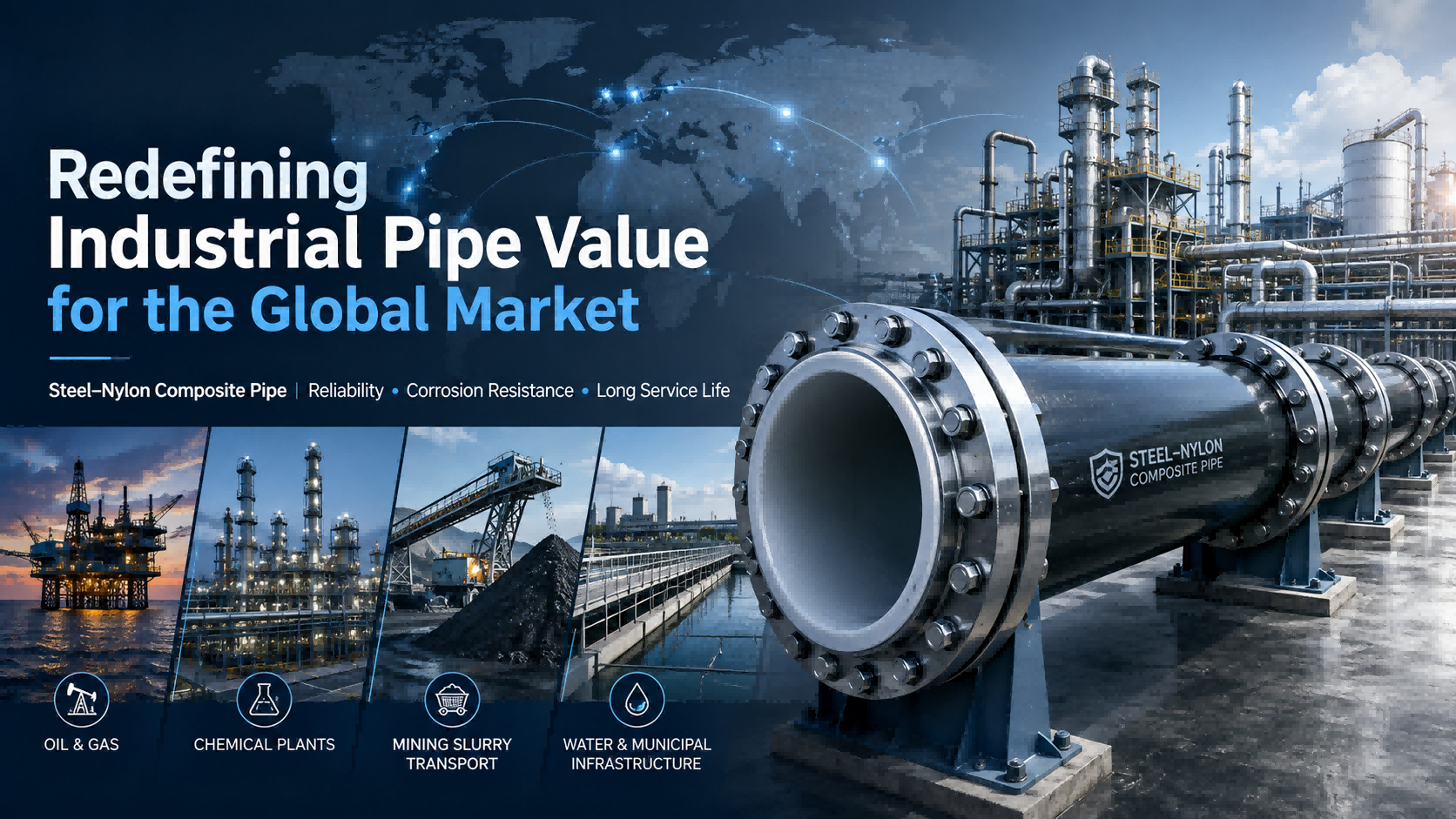
Oil & Gas Fields
Produced water, gathering pipelines, wastewater, sand-containing fluids, and corrosive media transportation.
Salt Chemical and Soda Ash Industries
Mother liquor, brine, strong alkaline media, and fluids prone to corrosion and scaling.
Chlor-Alkali Industry
Strong alkalis, high-salinity solutions, and complex chemical media.
Mining
Mineral slurry, tailings, backfill slurry, and other highly abrasive media.
Power Plants
Flue-gas desulfurization slurry and other corrosive slurry transportation applications.
Seawater and Industrial Water Systems
Seawater, circulating water, and other corrosive industrial water services.
These applications share one important characteristic:
Conventional pipelines may be technically usable, but their long-term operating cost may not be optimal.
This is precisely where composite piping technology can create greater engineering and economic value.
14. Our Development Direction: Let the Pipeline Adapt to the Operating Conditions
Decades of industrial pipeline experience have taught us one important lesson:
The most difficult industrial projects rarely involve only one challenge.
More often, corrosion, abrasion, pressure, temperature, scaling, installation constraints, and maintenance conditions exist simultaneously.
For this reason, we do not define our development objective simply as:
"Producing a more corrosion-resistant pipe."
Our goal is broader:
To improve the long-term reliability of industrial piping systems under complex transportation conditions.
This is the fundamental logic behind the continuous development of steel-nylon composite piping technology:
Use steel to provide structural strength and pressure resistance.
Use reinforced nylon to provide corrosion resistance, abrasion resistance, and a smooth internal flow surface.
Use a composite structure to achieve a wider industrial application range.
And ultimately reduce lifecycle risks across the entire industrial transportation system.
Conclusion: Truly Reliable Industrial Pipelines Must Withstand Complex Operating Conditions
Laboratory testing can verify material properties.
But the true value of an industrial pipeline is ultimately determined in the field.
After five, ten, or even more years of continuous operation, can the pipeline still perform reliably?
When it is exposed to:
Corrosion, abrasion, high pressure, temperature fluctuations, complex chemicals, and harsh environments
can it continue transporting media safely and efficiently?
This is why we have chosen complex industrial operating conditions as a major direction for our product development.
Because the real challenge in industrial piping is not simply:
"How do we manufacture a pipe?"
The more important question is:
How can we help an industrial transportation system operate longer, more reliably, and at a lower total lifecycle cost?
For oil and gas, chemical processing, mining, power generation, seawater systems, and other demanding industrial applications, this is becoming an increasingly important criterion for pipeline selection.
How We Are Redefining the Value of Industrial Piping for the Global Market
How Engineering Experience Continuously Drives the Evolution of Our Industrial Pipeline Technology