Aging Chemical Pipelines Are Entering a New Upgrade Cycle

Chemical companies are entering a new cycle of pipeline modernization.
Over the past several decades, chemical plants around the world have relied on carbon steel, stainless steel, rubber-lined steel, FRP, and various plastic piping systems to transport acids, alkalis, brines, mother liquors, slurries, circulating water, wastewater, and other process media.
As these facilities continue to age, many chemical companies are encountering the same problems:
-
Increasing internal corrosion
-
Localized pitting and perforation
-
Aging, blistering, or delamination of internal linings
-
Continuous erosion caused by solid particles
-
Scaling that gradually reduces flow capacity
-
Frequent leakage around flanges, elbows, valves, and fittings
-
Increasing inspection and maintenance frequency
-
Aging pipelines becoming a growing threat to continuous plant operation
As a result, chemical pipeline modernization is no longer simply a matter of:
“The old pipe has failed, so replace it with another one.”
More companies are beginning to ask a more important question:
How can the next generation of piping systems avoid repeating the same cycle of corrosion, leakage, maintenance, and replacement?
This change in thinking means that aging chemical pipelines are moving beyond a simple maintenance cycle and entering a genuine material upgrade cycle.
1. Why Are Chemical Companies Entering a Major Pipeline Upgrade Cycle?
Chemical plants typically have long operating lives.
However, within these facilities, piping systems are often among the components most exposed to long-term degradation.
This is especially true in applications involving:
-
High-salinity media
-
High-chloride solutions
-
Strong alkaline environments
-
Weak acidic media
-
Slurries containing solid particles
-
High-velocity abrasive fluids
-
Circulating mother liquor
-
Chemical wastewater and process effluent
-
Salt chemical production
-
Soda ash production
-
Chlor-alkali production
-
Phosphate chemical production
In these applications, piping systems may simultaneously face:
Corrosion + Abrasion + Temperature + Pressure + Mechanical Stress + Scaling
This explains why even a material that appears to be “corrosion-resistant” during the original design stage may still experience leakage, cracking, delamination, or connection failure after years of continuous operation.
As earlier generations of chemical plants move into the middle and later stages of their service lives, large-scale pipeline replacement and modernization will become increasingly common.
2. The Real Problem with Aging Chemical Pipelines Is More Than Corrosion
When companies begin upgrading old piping systems, the first idea is often:
Choose a more corrosion-resistant material.
That is a reasonable starting point, but it is not enough.
Chemical pipeline failures are usually caused by several mechanisms acting together.
2.1 Corrosion
Corrosion is one of the most common causes of chemical pipeline failure.
In salt solutions, acidic media, humid environments, and complex chemical fluids, carbon steel may suffer from:
-
General corrosion
-
Pitting corrosion
-
Crevice corrosion
-
Electrochemical corrosion
-
Corrosion perforation
Simply replacing carbon steel with stainless steel does not automatically eliminate every problem.
In certain high-chloride environments, even stainless steel may require careful evaluation because of the potential for pitting and crevice corrosion.
Therefore:
A higher-grade metal does not necessarily mean higher reliability in every chemical environment.
2.2 Erosion and Abrasive Wear
Many chemical process fluids are not pure liquids.
Examples include:
-
Salt slurry
-
Crystal-containing slurry
-
Lime slurry
-
Mineral slurry
-
Mother liquor containing suspended solids
-
Process wastewater containing particles
When solid particles move through elbows, tees, reducers, valve sections, and other high-turbulence areas at high velocity, continuous erosion occurs.
This means the piping material must provide not only corrosion resistance but also strong wear resistance.
Otherwise, a common failure pattern may appear:
The straight pipe remains functional while the elbows wear through prematurely.
For this reason, corrosion resistance alone cannot define the suitability of a pipeline material for demanding chemical applications.
2.3 Scaling
Some salt chemical, soda ash, circulating water, and process systems also experience severe scaling.
As deposits accumulate inside the pipe:
Effective internal diameter decreases
↓
Flow capacity decreases
↓
Hydraulic resistance increases
↓
Pumping energy consumption increases
↓
Eventually, shutdown and cleaning become necessary
The smoothness and surface characteristics of the inner pipe wall therefore have a direct effect on the long-term operating efficiency of the entire transport system.
2.4 Lining Failure
Traditional rubber-lined or plastic-lined steel pipes generally follow a straightforward design concept:
The steel provides structural strength, while the internal lining provides corrosion protection.
This approach can work effectively in appropriate applications.
However, long-term operation requires careful consideration of:
-
Bonding reliability between the lining and substrate
-
Thermal expansion and contraction
-
Vacuum or negative-pressure conditions
-
Localized delamination
-
Blistering
-
Integrity around joints and connections
Once the protective lining fails, the corrosive medium may come into direct contact with the steel substrate, potentially causing rapid localized corrosion.
For chemical plants designed for continuous operation:
Long-term stability of the corrosion protection system is more important than initial corrosion-resistance data alone.
3. The Core Objective of Chemical Pipeline Modernization Is Changing
In the past, pipeline procurement decisions often began with one question:
How much does the pipe cost per meter?
Increasingly, chemical companies are evaluating a different metric:
Total Cost of Ownership — TCO
This includes:
Purchase Cost + Installation Cost + Maintenance Cost + Shutdown Cost + Replacement Cost + Energy Cost + Leakage Risk Cost
This fundamentally changes pipeline material selection.
Consider two alternatives.
Pipeline A has a lower initial purchase price but requires significant repair or replacement every three to five years.
Pipeline B requires a somewhat higher initial investment but significantly extends maintenance and replacement intervals.
Over a 10-year or even 20-year operating period, Pipeline B may ultimately deliver the lower total cost.
As a result, the next generation of chemical pipeline modernization is increasingly focused on several key objectives:
Long Service Life
Low Maintenance
Corrosion Resistance
Wear Resistance
Operational Reliability
These priorities are also why steel–nylon composite pipe deserves increasing attention in demanding chemical applications.
4. Why Is Steel–Nylon Composite Pipe Suitable for Aging Chemical Pipeline Upgrades?
Steel–nylon composite pipe is not simply about replacing one traditional material with another.
Its fundamental engineering concept is:
Use different materials to solve different engineering problems.
The steel structure provides:
-
Mechanical strength
-
Rigidity
-
Pressure resistance
-
Structural stability for large-diameter pipelines
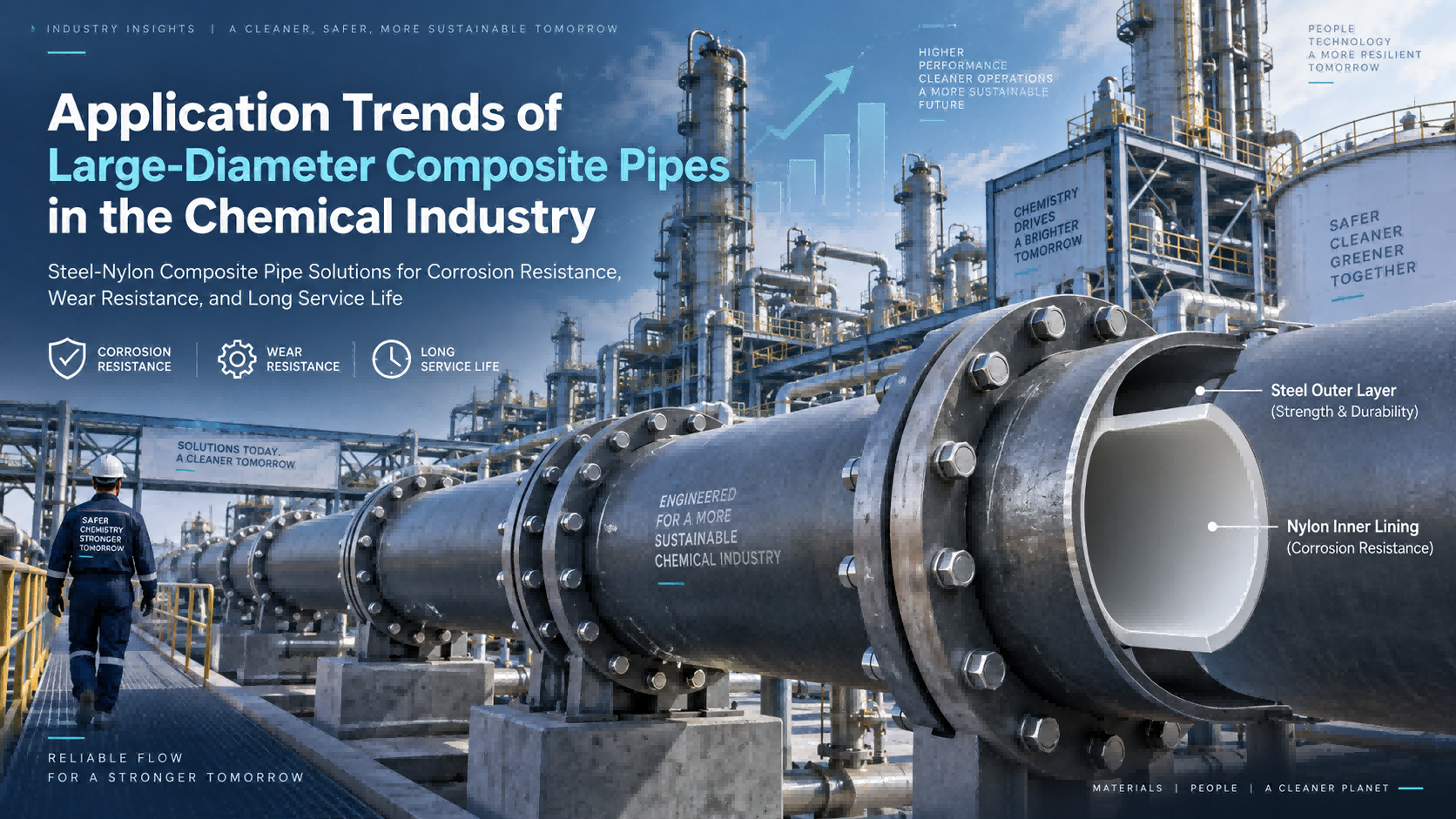
The nylon functional layer is designed to address:
-
Corrosion
-
Abrasion
-
Scaling
-
Direct contact with aggressive process media
Together, they create a composite piping system that integrates:
Structural Strength + Corrosion Resistance + Wear Resistance
This combination is particularly valuable in the chemical industry.
5. Advantage 1: Suitable for Applications with Both Corrosion and Abrasion
Many of the most difficult pipelines in chemical plants do not suffer from corrosion alone.
A mother liquor system, for example, may simultaneously contain:
High Salinity + Corrosive Ions + Solid Particles + Continuous Erosion
Conventional materials may perform well against one of these factors but struggle when several occur at the same time.
Steel–nylon composite pipe combines the corrosion-resistant and wear-resistant characteristics of nylon with the structural strength of steel.
This makes it particularly suitable for applications such as:
-
Chemical mother liquor
-
High-salinity water
-
Salt chemical process media
-
Process wastewater
-
Solid-containing fluids
-
Circulating slurry
-
Certain strong alkaline and weak acidic services
For pipeline sections that have historically required frequent replacement, composite piping can therefore provide significant modernization value.
6. Advantage 2: Combining Pressure Capability with Structural Stability
Non-metallic piping materials can provide excellent corrosion resistance.
However, many chemical projects must simultaneously consider:
-
Operating pressure
-
Large pipe diameter
-
Support spacing
-
External loading
-
Temperature fluctuations
-
Pipe-rack installation
-
Long-span above-ground installation
Structural stiffness becomes increasingly important for DN500, DN800, and even larger-diameter pipelines.
A steel–nylon composite structure retains a metallic structural layer, allowing the system to maintain high mechanical stability while benefiting from a corrosion-resistant internal surface.
Our steel–nylon composite pipes can be designed for pressure classes of approximately:
1.0–4.0 MPa
and can be manufactured in large diameters exceeding:
DN2000 mm
This enables the technology to serve not only conventional process pipelines but also high-flow, large-diameter transport systems in major chemical facilities.
7. Advantage 3: Integrally Formed Composite Structure Helps Reduce Delamination Risk
One of the key questions surrounding any composite pipeline is:
Can the different materials remain reliably integrated over long-term operation?
If a pipeline simply relies on an internal lining, stresses may develop under conditions such as:
-
Repeated thermal cycling
-
Pressure fluctuations
-
Negative pressure
-
Long-term media penetration
-
Mechanical vibration
For this reason, we place particular emphasis on the structural reliability between the steel reinforcement and the nylon functional layer.
Through an integrally formed composite design, the pipe is engineered as a stable composite structure, helping reduce long-term risks commonly associated with conventional lined systems, including:
-
Delamination
-
Blistering
-
Peeling
-
Localized lining failure
For chemical facilities expected to operate for ten years, twenty years, or longer, structural integrity over time can be more important than laboratory corrosion-resistance data alone.
8. Advantage 4: Smooth Internal Surface Helps Reduce Scaling and Hydraulic Resistance
As conventional carbon steel pipelines age, they frequently develop a combination of:
Corrosion
+
Scaling
+
Deposits
The internal surface becomes increasingly rough.
Increased roughness can then accelerate:
-
Deposition
-
Local turbulence
-
Hydraulic resistance
-
Energy consumption
-
Erosive wear
This creates a self-reinforcing cycle of deterioration.
Steel–nylon composite pipe provides a comparatively smooth internal transport surface, helping reduce adhesion and deposition.
This can be particularly valuable for:
-
Brine
-
Mother liquor
-
Circulating water
-
Process wastewater
-
Scaling-prone process media
Lower internal roughness can contribute not only to reduced scaling but also to improved long-term hydraulic efficiency.
9. Advantage 5: Integral Flange Design Supports Brownfield Pipeline Upgrades
There is another practical challenge when modernizing aging chemical plants:
Many facilities cannot afford prolonged shutdowns.
Pipeline replacement therefore must consider more than material performance.
Projects must also evaluate:
-
Installation time
-
Compatibility with the existing system
-
Construction safety
-
Hot-work requirements
-
Limited installation space
Our steel–nylon composite pipes feature an integral flange connection design.
The flange is formed as part of the pipe structure, allowing mechanical flange connections to be completed on site.
Compared with systems requiring extensive field welding or heat fusion, this approach can offer significant advantages for:
-
Existing plant modernization
-
Partial pipeline replacement
-
Pump outlet sections
-
Pipeline sections before and after valves
-
Elbows
-
Tees
-
High-wear fittings
-
Trial pipeline sections
In chemical plants with strict fire and explosion prevention requirements, reducing on-site hot work can itself provide considerable practical value.
10. Aging Chemical Pipelines Do Not Always Need to Be Replaced All at Once
When companies face several kilometers or even tens of kilometers of aging pipeline, complete replacement can appear prohibitively expensive.
A more practical modernization strategy can be implemented in stages.
Stage 1: Identify High-Failure Pipeline Sections
Begin by reviewing maintenance records from the previous three to five years.
Key questions should include:
-
Which elbows fail most frequently?
-
Which pipeline sections corrode the fastest?
-
Which valve areas experience repeated leakage?
-
Which pipelines require repair several times per year?
-
Where is scaling most severe?
In many plants, analysis reveals that:
Approximately 20% of high-risk pipeline sections may account for 80% of maintenance activity.
These sections should become the first priority for modernization.
Stage 2: Install a 100–500 Meter Trial Section
When evaluating a new pipeline material, a representative corrosive application can be selected for a:
100–500 meter trial installation.
Performance can then be monitored for:
-
Corrosion
-
Abrasion
-
Pressure stability
-
Scaling
-
Joint condition
-
Maintenance frequency
This allows the material to be evaluated under real plant operating conditions.
For industrial piping materials:
Actual operating data is always more convincing than promotional claims.
Stage 3: Upgrade High-Wear Fittings First
In many systems, straight pipe is not the first component to fail.
The most vulnerable areas are often:
-
Elbows
-
Tees
-
Reducers
-
Pump outlets
-
Pipeline sections before and after valves
-
High-velocity zones
An effective strategy is therefore to begin with a:
High-Wear Fitting Upgrade Program
before replacing the entire pipeline.
Stage 4: Gradually Upgrade the Entire System
Once the trial section has demonstrated stable performance, modernization can expand progressively from:
Point
↓
Pipeline Section
↓
Complete System
This approach can significantly reduce the technical and financial risk of introducing a new piping material.
11. Comparing Pipeline Materials for Aging Chemical Plant Modernization
Different pipeline materials offer different advantages.
For aging chemical facilities, the key is not to find one material that is theoretically “best,” but to identify the material that best matches the actual operating environment.
Carbon Steel
Main advantages:
Low initial cost and high mechanical strength.
Key considerations:
Corrosion, scaling, and frequent maintenance.
Stainless Steel
Main advantages:
High mechanical strength and good corrosion resistance in many environments.
Key considerations:
Potential pitting in high-chloride environments and relatively high material cost.
FRP Pipe
Main advantages:
Good corrosion resistance and relatively low weight.
Key considerations:
Long-term pressure performance, connection reliability, impact resistance, and structural stability.
HDPE Pipe
Main advantages:
Good corrosion resistance and convenient installation.
Key considerations:
Temperature capability, pressure limitations, and stiffness in large-diameter installations.
Rubber-Lined Steel Pipe
Main advantages:
Steel provides structural strength while the rubber lining protects against corrosion and abrasion.
Key considerations:
Lining aging, delamination, blistering, and negative-pressure conditions.
Steel–Nylon Composite Pipe
Main advantages:
Corrosion resistance, wear resistance, pressure capability, structural strength, and a smooth internal surface.
Key considerations:
The specific chemical medium, concentration, temperature, pressure, flow velocity, and operating conditions should always be evaluated during engineering selection.
This is why the future chemical pipeline market is unlikely to be defined by:
One material completely replacing every other material.
Instead, the real trend will be:
Selecting the most appropriate material system for each specific operating condition.
The value of composite materials lies precisely in their ability to combine functions that previously required difficult compromises between different piping materials.
12. Which Aging Chemical Pipelines Should Consider Steel–Nylon Composite Pipe First?
Steel–nylon composite pipe should be considered particularly carefully when a plant experiences one or more of the following conditions.
1. Carbon Steel Pipelines Frequently Suffer Corrosion Perforation
Especially in high-salinity, humid, or chemically complex environments.
2. Stainless Steel Has Become Too Expensive
The project needs high reliability while improving lifecycle economics.
3. Rubber-Lined Pipe Experiences Repeated Lining Problems
Particularly under pressure fluctuations, long-term service, or complex operating conditions.
4. FRP Pipelines Experience Cracking or Long-Term Structural Problems
The application requires greater rigidity or structural reliability.
5. HDPE Cannot Meet Temperature or Pressure Requirements
Especially in higher-temperature, higher-pressure, or large-diameter systems.
6. Corrosion and Abrasive Wear Occur Simultaneously
This is one of the most important application areas in which steel–nylon composite structures should be evaluated.
13. The Next Chemical Pipeline Upgrade Cycle Is Fundamentally About Reliability
Over the next decade, chemical pipeline procurement standards may undergo an important transformation.
In the past, the most common question was:
“How much does this pipe cost?”
Increasingly, project owners will ask:
“How many years can this pipeline system operate reliably?”
The reason is simple.
For a continuous-process chemical plant, the cost of a single unplanned shutdown can far exceed the purchase price of the pipeline itself.
A truly effective industrial piping system should therefore do more than simply transport process media.
It should help:
-
Reduce corrosion
-
Reduce abrasion
-
Reduce scaling
-
Reduce leakage
-
Reduce maintenance
-
Reduce shutdowns
-
Extend service life
In other words:
Industrial pipelines are evolving from simple engineering materials into infrastructure for production reliability.
14. From Replacing Old Pipes to Redesigning the Pipeline Lifecycle
The modernization of aging chemical pipelines is creating an important opportunity for material innovation.
However, the most important question is not:
Which material should replace the old pipe?
The better question is:
How can this modernization project prevent the same corrosion, leakage, maintenance, and replacement problems from recurring over the next ten years or longer?
That is the real significance of the next pipeline upgrade cycle.
Steel–nylon composite pipe uses a steel structure to provide strength, rigidity, and pressure capability, while the nylon functional layer addresses corrosion, wear, and internal transport-surface performance.
Combined with an integrally formed structure and flange connection system, it provides a different technical approach for transporting demanding chemical process media.
For companies in:
-
Salt chemical production
-
Soda ash production
-
Chlor-alkali production
-
Phosphate chemical production
-
Chemical wastewater treatment
-
Other highly corrosive and abrasive process industries
pipeline modernization should no longer be viewed as a simple equipment replacement project.
It should become a:
Pipeline Lifecycle Upgrade
Conclusion
A large number of chemical plants worldwide are gradually entering a new period of equipment renewal and pipeline modernization.
As a result, the competitive criteria for the next generation of chemical piping systems are shifting from:
Initial Cost
toward:
Lifecycle Reliability + Total Cost of Ownership
The pipeline material with the lowest purchase price is not necessarily the material with the lowest real cost.
In demanding chemical environments, the more valuable solution may be the one that can:
Operate Longer, Require Less Maintenance, Reduce Leakage, and Minimize Unplanned Shutdowns.
This is precisely the type of problem that steel–nylon composite pipe technology is designed to address.
For chemical companies planning to modernize aging pipeline systems, continuing the traditional cycle of:
Corrosion → Repair → Replacement → Corrosion Again
may no longer be the most economical approach.
Instead, the modernization project should be used as an opportunity to reconsider the entire piping material strategy.
The next cycle of chemical pipeline modernization is not simply about replacing aging pipes.
It is about redefining the lifecycle of industrial piping systems.
Severe Corrosive Service Is Driving Continuous Upgrades in Chemical Pipeline Materials