What Performance Indicators Will Future Chemical Pipeline Projects Focus On?

In the past, chemical pipeline selection often revolved around a few straightforward questions:
Is the material corrosion-resistant? Can it handle the required pressure? How much does it cost?
However, as chemical plants become larger, more continuous, and more demanding in terms of operational safety and reliability, the way pipeline systems are evaluated is changing significantly.
Future chemical pipeline projects will no longer focus only on the performance of a single material. Instead, engineers, EPC contractors, plant owners, and procurement teams will increasingly evaluate the overall performance of a pipeline system throughout its entire service life:
Can it resist corrosion and abrasion over the long term?
Can it withstand pressure, temperature, and operating fluctuations?
Is it easy to install and maintain?
How high is the risk of leakage?
What is the real total cost after years of operation?
This means that the chemical pipeline industry is gradually moving from material performance competition toward system reliability competition.
For chemical companies, the following performance indicators are likely to become increasingly important in future pipeline engineering projects.
1. Corrosion Resistance: Still the Fundamental Requirement
Corrosion remains one of the most important challenges in chemical pipeline systems.
Acids, alkalis, salt solutions, chlorides, industrial wastewater, and complex mixed media can cause different types of material degradation, including:
-
Uniform corrosion
-
Pitting corrosion
-
Crevice corrosion
-
Electrochemical corrosion
-
Stress corrosion
-
Wall-thickness reduction
-
Localized perforation
Therefore, future material selection will no longer stop at asking:
“Is this material corrosion-resistant?”
The more important question will be:
How will this material perform over the long term under a specific combination of medium, concentration, temperature, flow velocity, pressure, and operating duration?
This distinction is important because the same material may behave very differently under different chemical environments.
For example, stainless steel performs well in many applications, but certain chloride-containing environments can still create risks of pitting or crevice corrosion. Carbon steel, meanwhile, often relies on coatings, linings, corrosion allowances, or other protection methods when handling aggressive media.
Modern corrosion management therefore increasingly focuses on controlling corrosion from the design stage rather than simply repairing pipelines after corrosion has already occurred.
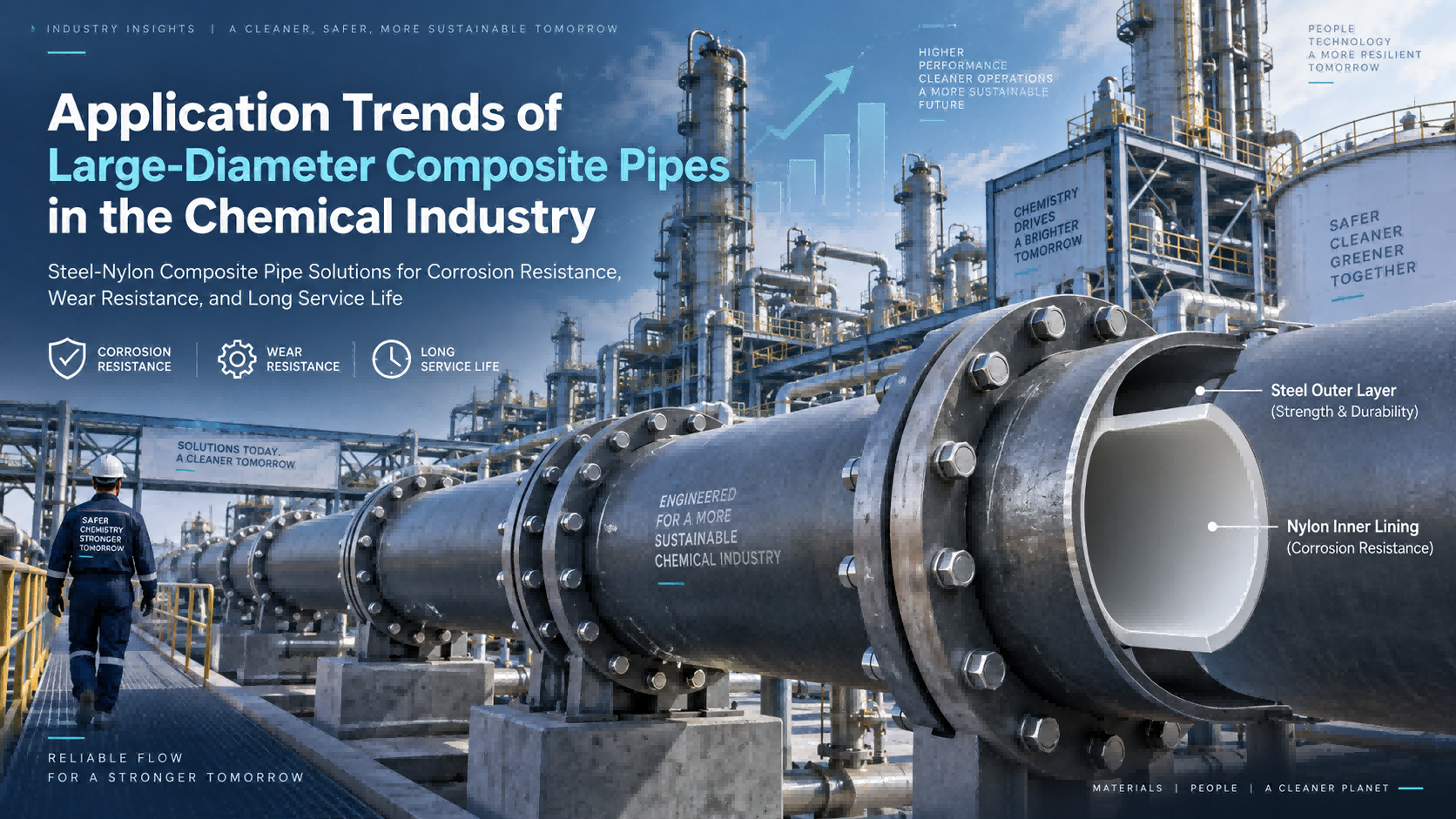
Where Does Steel-Nylon Composite Pipe Fit In?
Steel-nylon composite pipe follows a functional separation concept:
-
The steel structure provides mechanical strength and pressure resistance.
-
The nylon inner layer contacts the transported medium and provides corrosion and wear protection.
This configuration combines the structural advantages of steel with the chemical resistance of a non-metallic functional layer.
For applications involving strong alkalis, salt-containing media, certain weak acids, industrial wastewater, and some corrosive slurries, this structure can reduce direct contact between the process medium and the steel substrate.
The real value of the composite structure is therefore not simply:
“Nylon is more corrosion-resistant than steel.”
Instead, it is:
Different materials perform different functions, allowing the pipeline to achieve both structural strength and resistance to the transported medium.
2. Abrasion Resistance: Increasingly Important Beyond Corrosion
Not all chemical pipeline failures are caused by corrosion alone.
In industries such as:
-
Phosphate chemicals
-
Soda ash
-
Salt chemicals
-
Mining
-
Flue gas desulfurization
-
Industrial wastewater treatment
-
Solid-liquid slurry transportation
the transported media often contain crystals, salt mud, mineral particles, or other suspended solids.
Under these conditions, pipeline degradation can result from a combination of:
Corrosion + Erosion + Abrasion
If a material has good corrosion resistance but insufficient wear resistance, rapid failure may still occur at:
-
Elbows
-
Tees
-
Reducers
-
Pump discharge sections
-
Valve upstream and downstream sections
-
High-velocity zones
As a result, future chemical pipeline projects will increasingly focus on:
Corrosion-Abrasion Resistance
In other words, the material must resist both chemical attack and mechanical wear.
This is one of the areas where composite pipeline materials can offer significant value.
The nylon inner layer of steel-nylon composite pipe provides useful wear resistance for certain particle-containing media, salt mud, slurry, and other erosive industrial fluids.
In many projects, the performance of critical fittings may actually be more important than that of straight pipe sections.
3. Pressure-Bearing Capacity: Corrosion Resistance Cannot Come at the Expense of Strength
One major reason for the development of non-metallic and composite piping systems is the need to reduce corrosion.
However, industrial projects face an important engineering reality:
A corrosion-resistant material is not necessarily suitable for medium- or high-pressure industrial service.
Chemical piping systems may experience:
-
Normal operating pressure
-
Pressure fluctuations
-
Water hammer
-
Vacuum or negative pressure
-
Support loads
-
Long-span installation
-
Equipment nozzle loads
-
Mechanical impact
Future composite piping technologies therefore need to solve two challenges simultaneously:
Corrosion resistance and structural strength.
This is one of the core design principles behind steel-nylon composite pipe.
The steel structure provides the main mechanical strength, while the nylon inner layer protects the internal surface from suitable corrosive media.
Compared with piping systems where the polymer material itself carries most of the pressure load, this composite structure provides another engineering option for medium- and high-pressure industrial piping and large-diameter applications.
For certain industrial transportation systems requiring pressure ratings in the 1.0–4.0 MPa range, this structural concept can be particularly valuable.
4. Temperature Adaptability: Maximum Temperature Is Not the Only Parameter
A common mistake in chemical pipeline selection is to compare materials only according to their maximum allowable temperature.
In actual engineering conditions, other factors can be equally important:
-
Continuous operating temperature
-
Short-term temperature peaks
-
Startup and shutdown temperature changes
-
Day-night temperature variation
-
Thermal expansion
-
Thermal cycling
-
Material creep
-
Differences in thermal expansion between materials
For example, a pipeline may normally operate at 80°C but experience several heating and cooling cycles every day.
Under these conditions, thermal cycling resistance may be just as important as the maximum temperature rating.
Future chemical pipeline engineering will therefore increasingly evaluate:
Continuous Operating Temperature
The temperature the pipeline can withstand reliably over long-term operation.
Temperature Cycling Resistance
Its ability to withstand repeated heating and cooling.
Thermal Expansion
How much dimensional change occurs with temperature variation.
Structural Stability
Whether the pipeline maintains mechanical stability at elevated temperatures.
Steel-nylon composite pipe benefits from the structural stability provided by the steel reinforcement while using the nylon inner layer for corrosion and wear protection.
However, an important engineering principle must always be emphasized:
Every polymer-based lining material has defined chemical and temperature limitations.
Pipeline selection should therefore be based on the combined conditions of:
Medium + Concentration + Temperature + Pressure
rather than any single temperature specification.
5. Internal Surface Roughness and Hydraulic Efficiency Will Become More Important
Historically, industrial companies often focused on one question:
Will the pipeline fail?
In the future, another question will become increasingly important:
How efficiently does the pipeline transport the medium?
Industrial pipelines may operate continuously for 10, 20, or even more years.
If the inner surface becomes:
-
Rough
-
Heavily scaled
-
Prone to deposition
-
Increasingly resistant to flow
the pipeline can generate significant long-term energy losses even if no obvious leakage occurs.
Important future indicators therefore include:
Surface Roughness
The condition and smoothness of the internal pipe surface.
Friction Loss
The hydraulic resistance generated during fluid transportation.
Scaling Resistance
The ability to reduce or delay internal deposits.
Hydraulic Efficiency
The ability to maintain efficient flow over long-term operation.
The relatively smooth nylon inner surface of steel-nylon composite pipe can be beneficial in transporting certain salt solutions, mother liquor, industrial wastewater, and slurry media.
By preventing the transported medium from directly attacking the steel surface, the composite structure can also reduce the formation of rough corrosion surfaces that increase hydraulic resistance.
Therefore, future pipeline value will not only be measured by:
“How many years can it last?”
but also by:
“Can it maintain efficient transportation after many years of operation?”
6. Scaling Resistance May Become an Underestimated Performance Indicator
For many chemical plants, blockage and scaling can generate losses comparable to those caused by corrosion leakage.
This is particularly relevant in pipelines transporting:
-
High-salinity media
-
Mother liquor
-
Brine
-
Desulfurization slurry
-
Industrial wastewater
-
Crystal-containing solutions
Deposits can gradually accumulate on the internal surface.
Over time, this may result in:
Reduced effective diameter → Lower flow capacity → Higher pumping energy → More frequent cleaning → More shutdowns
Therefore, future pipeline selection should not compare corrosion rates alone.
Engineers should also consider:
Surface adhesion tendency and long-term scaling behavior.
A smooth, corrosion-resistant internal surface can reduce some of the conditions that promote deposition, especially those associated with rough metal corrosion surfaces.
This is another potential advantage of steel-nylon composite pipe in selected high-salinity, mother-liquor, and industrial wastewater applications.
7. Connection Reliability Will Become a Critical System-Level Indicator
Many pipeline failures do not originate in straight pipe sections.
Instead, problems frequently occur at:
-
Flanges
-
Welds
-
Elbows
-
Tees
-
Valve connections
-
Expansion joints
-
Equipment interfaces
Future chemical pipeline engineering will therefore increasingly focus on:
Pipeline System Reliability
rather than simply the performance of individual pipes.
Two materials may show similar laboratory performance, but if one solution requires:
-
More joints
-
More complicated installation
-
Higher installer skill
-
Greater dependence on field workmanship
its overall leakage risk may still be higher.
Steel-nylon composite pipes can use industrial flange connections, making them compatible with pumps, valves, tanks, and other process equipment.
This can be particularly advantageous for chemical plant retrofit projects where installation must be completed within a limited shutdown window.
8. Installation Method: Reducing Hot Work Will Become Increasingly Valuable
Modern chemical companies are placing greater emphasis on construction and maintenance safety.
This is especially important in:
-
Oil and gas facilities
-
Chemical plants
-
Chlor-alkali facilities
-
Flammable or explosive environments
On-site welding can require:
-
Hot-work permits
-
Combustible gas detection
-
Fire protection measures
-
Area isolation
-
Certified welders
-
Post-weld inspection
As a result, future piping systems will increasingly be evaluated according to:
Installation Complexity
and:
Hot Work Requirements
Flanged steel-nylon composite piping can reduce the amount of on-site welding required in suitable projects.
This can be particularly useful for:
-
Existing pipeline retrofits
-
Partial pipeline replacement
-
Trial pipeline sections
-
Maintenance shutdown replacements
Future procurement teams will not only ask:
“How much does the pipe cost per meter?”
They will increasingly ask:
How many workers, welds, installation hours, and shutdown hours are required to install one kilometer of pipeline?
9. Predictability of Failure Will Become More Important Than a Simple “Service Life” Claim
Pipeline suppliers traditionally emphasize statements such as:
“Our pipeline can last for many years.”
Future engineering customers will increasingly respond with another question:
“How can you prove it?”
This represents an important evolution in industrial pipeline evaluation.
Customers will increasingly examine:
-
Raw material batches
-
Product dimensions
-
Wall thickness
-
Liner thickness
-
Pressure testing
-
Visual inspection
-
Dimensional inspection
-
Factory records
-
Product traceability
-
Batch consistency
Industrial pipeline competition is therefore gradually moving from:
Performance specifications
toward:
Manufacturing consistency.
Large industrial projects do not purchase one sample pipe.
They may purchase:
Hundreds of meters, several kilometers, or even tens of kilometers of pipeline.
Excellent performance from one sample does not prove consistent quality across an entire project.
For steel-nylon composite pipe manufacturers, future competitiveness will therefore depend not only on the material itself but also on:
Production equipment, manufacturing processes, quality control systems, inspection capability, and large-volume delivery capacity.
10. Inspectability and Digital Asset Management Will Become More Important
Future chemical plant piping will increasingly be treated as part of a dynamic asset-management system rather than as a purely static piece of equipment.
More companies are incorporating pipelines into:
-
Equipment asset management systems
-
Corrosion management systems
-
Predictive maintenance programs
-
Digital inspection systems
Important future indicators will therefore include:
Traceability
The ability to trace production batches, materials, inspections, and installation data.
Inspection Data
Records generated during manufacturing and operation.
Failure History
Historical data related to leakage, wear, corrosion, and maintenance.
Maintenance Records
A structured history of inspection, repair, and replacement.
Future systems may also increasingly integrate:
-
Wall-thickness monitoring
-
Pressure monitoring
-
Flow monitoring
-
Leak detection
-
RFID
-
QR codes
-
Digital twins
This means that future industrial pipeline suppliers may need to provide more than:
Pipe.
They may increasingly need to provide:
Pipe + Data + Engineering Support.
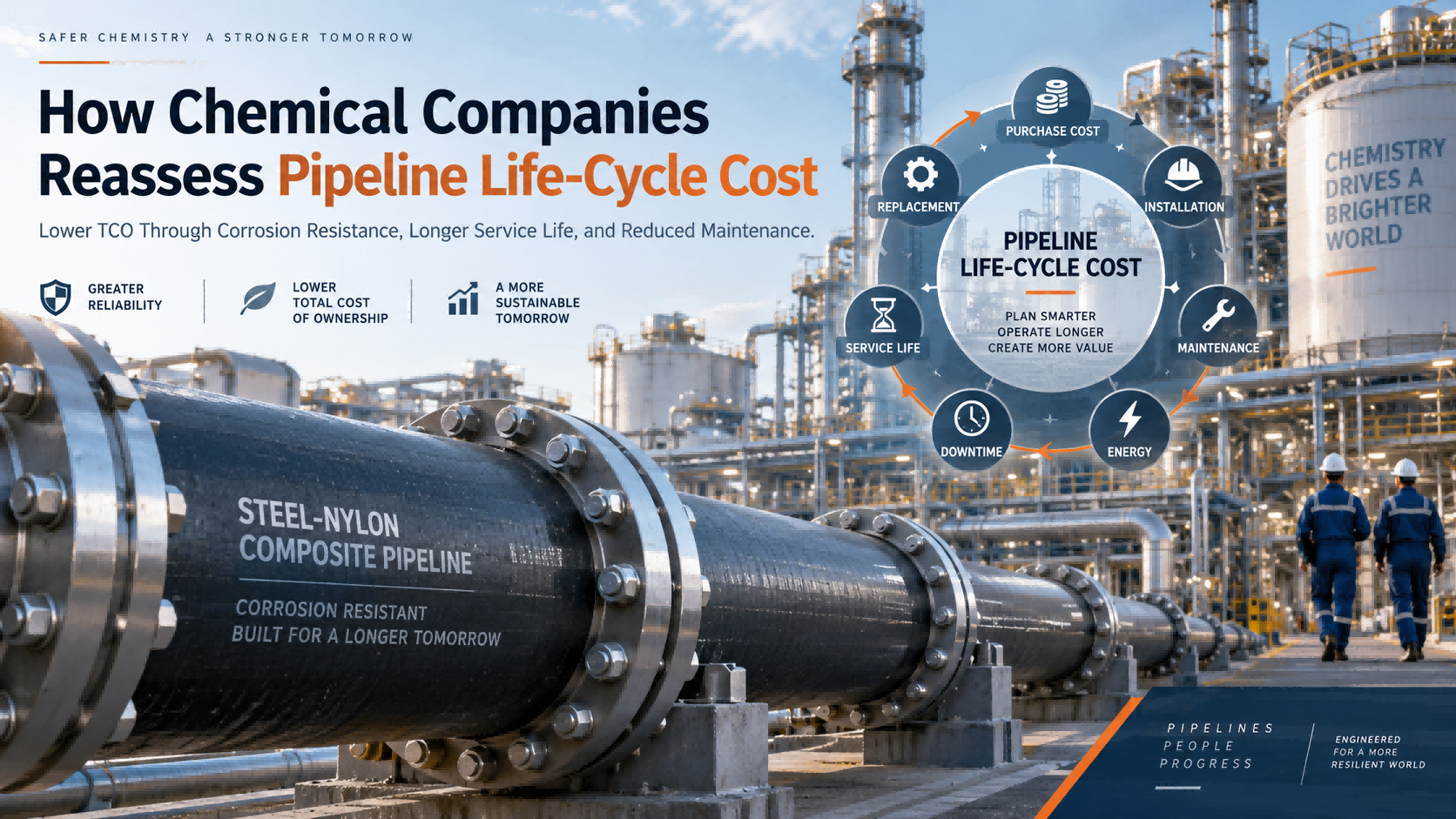
11. Total Lifecycle Cost Will Become More Important Than Purchase Price
This is likely to be one of the most important changes in future chemical pipeline procurement.
The traditional purchasing question is:
Which pipe has the lowest price per meter?
The future question will increasingly become:
Which pipeline solution has the lowest total cost over 20 years?
Pipeline total cost of ownership can be expressed as:
TCO = Initial Cost + Installation Cost + Maintenance Cost + Energy Cost + Replacement Cost + Downtime Cost
In practical terms:
TCO = Purchase + Installation + Maintenance + Energy + Replacement + Production Downtime
Consider a pipeline that costs 20% less initially but:
-
Requires replacement every five years
-
Needs frequent cleaning
-
Requires annual repairs
-
Occasionally leaks
Its real lifecycle cost may ultimately be much higher than a more durable system with a higher initial purchase price.
This is why corrosion management and industrial asset strategies increasingly focus on minimizing lifecycle cost rather than simply minimizing initial capital expenditure.
For steel-nylon composite pipe, the value proposition should therefore not simply be:
“Our pipeline is cheaper.”
A more meaningful value proposition is:
Under suitable operating conditions, steel-nylon composite pipe can help reduce corrosion, abrasion, scaling, maintenance frequency, replacement frequency, and ultimately the total lifecycle cost of the piping system.
12. Environmental and Safety Risks Will Become Part of Material Selection
Pipeline leakage was once primarily treated as a maintenance problem.
Today, it is increasingly considered:
A safety risk + An environmental risk + A production risk
For pipelines carrying:
-
Acids
-
Alkalis
-
Salt solutions
-
Chemical raw materials
-
Industrial wastewater
-
Oily wastewater
the consequences of a single leak may far exceed the cost of the affected pipe section itself.
Future pipeline material selection will therefore increasingly consider:
Leakage Risk
How likely the pipeline is to develop leakage during long-term operation.
Environmental Impact
The potential environmental consequences of pipeline failure.
Maintenance Safety
The risks involved in inspection, repair, and replacement.
Operational Continuity
The ability to keep the production system running reliably.
For this reason, chemical companies will find it increasingly difficult to select pipeline materials based solely on purchase price.
13. The Future Is About Balanced Performance
Future industrial piping materials are unlikely to win the market through one extreme property alone.
Engineering requirements are inherently multidimensional.
A future chemical pipeline may need to deliver all of the following simultaneously:
-
Corrosion resistance
-
Wear resistance
-
Pressure capability
-
Temperature stability
-
Scaling resistance
-
Hydraulic efficiency
-
Installation efficiency
-
Reduced hot work
-
Manufacturing consistency
-
Traceability
-
Low lifecycle cost
-
Digital asset compatibility
Therefore, the most competitive pipeline will not necessarily be the product with the highest value in one laboratory parameter.
Instead, it will be the solution that achieves the best overall balance between:
Corrosion resistance, wear resistance, strength, temperature capability, installation efficiency, maintenance requirements, reliability, and lifecycle cost.
14. Why Steel-Nylon Composite Pipe Fits This Development Direction
The fundamental design concept of steel-nylon composite pipe can be summarized as:
Steel for Strength + Nylon for Protection
In other words:
Steel provides structural strength, while nylon provides the functional medium-contact layer.
Under suitable chemical operating conditions, this structure can offer several important advantages.
1. Corrosion Resistance
The nylon inner layer prevents selected corrosive media from directly contacting the steel structure.
2. Wear Resistance
It can be suitable for certain particle-containing, slurry, and erosion-abrasion applications.
3. Pressure Capability
The steel structure provides the mechanical foundation required for industrial pressure service.
4. Large-Diameter Manufacturing
The steel-reinforced composite concept provides advantages for developing industrial large-diameter piping systems.
5. Smooth Internal Surface
The nylon inner layer can help maintain a relatively smooth fluid-contact surface and reduce deterioration caused by metal corrosion.
6. Potential Scaling Resistance
In selected high-salinity, mother-liquor, and industrial wastewater applications, the smooth internal surface can help reduce conditions associated with severe deposition.
7. Flange Connections
Flanged connections facilitate integration with industrial pumps, valves, tanks, and existing process piping systems.
8. Retrofit Flexibility
The system can be particularly useful for:
-
Existing pipeline partial replacement
-
High-wear pipeline section replacement
-
Pump outlet sections
-
Valve upstream and downstream sections
-
100–500-meter trial sections
-
Existing plant renovation projects
15. Steel-Nylon Composite Pipe Is Not a Universal Solution for Every Chemical Medium
A professional pipeline manufacturer should not simply tell customers:
“Our material works.”
It should also explain:
Where the material is suitable and where it should not be used.
Steel-nylon composite pipe is particularly worth evaluating for applications involving:
-
Strong alkaline media
-
Salt-containing media
-
High-salinity industrial water
-
Certain weak-acid media
-
Particle-containing slurries
-
Combined corrosion and abrasion
-
Industrial wastewater
-
Selected corrosive oilfield fluids
However, additional compatibility evaluation is necessary for:
-
High-concentration strong acids
-
Special organic solvents
-
Operating temperatures beyond the long-term limits of the lining material
-
Extremely aggressive chemical environments
For example, highly concentrated sulfuric acid service should not be selected simply because a product is described as a “corrosion-resistant composite pipe.”
The specific combination of:
Concentration + Temperature + Pressure + Chemical Compatibility
must be evaluated independently.
Clearly defining application boundaries does not weaken a supplier's position.
On the contrary, it demonstrates engineering professionalism and can strengthen customer confidence.
16. Future Competition Will Extend Beyond Supplying a Pipe
Future chemical projects may no longer need only a:
Pipe Supplier
They will increasingly need a:
Pipeline Solution Provider
A capable industrial pipeline supplier should gradually participate throughout the complete engineering process:
Operating Condition Analysis
↓
Medium Analysis
↓
Material Selection
↓
Pressure Rating Selection
↓
Diameter Selection
↓
Connection Design
↓
Fitting Configuration
↓
Manufacturing
↓
Quality Inspection
↓
Installation Support
↓
Operating Feedback
↓
Lifecycle Optimization
This represents an important structural change in the industrial pipeline market.
Conclusion: Long-Term Reliability Will Define the Future of Chemical Piping
Over the next decade, chemical pipeline evaluation will become increasingly comprehensive.
Customers will no longer ask only:
How much does it cost per meter?
They will increasingly ask:
How long can it operate reliably?
What happens when corrosion and abrasion occur at the same time?
Will the pipeline scale or become blocked over time?
Can installation reduce on-site hot work?
How easy is it to maintain if a problem occurs?
Can the manufacturer guarantee consistent quality across several kilometers of pipeline?
What will the true lifecycle cost be?
This means the chemical pipeline industry is gradually moving from:
Material Selection
toward:
Lifecycle Engineering
In other words, the industry is evolving from simply selecting a material toward designing a pipeline system for its complete operating life.
For steel-nylon composite pipe, this transition creates an important opportunity.
Its value is not simply about replacing stainless steel, PE, FRP, carbon steel, or other traditional piping materials.
Its real value lies in achieving a different balance between:
Structural strength, corrosion resistance, wear resistance, hydraulic performance, installation efficiency, maintenance requirements, and lifecycle cost.
The most competitive industrial pipeline of the future may not be the one with the most impressive single performance parameter.
It will be the pipeline system capable of delivering:
Fewer leaks, less maintenance, fewer shutdowns, and more stable operation over a longer service life.
Ultimately, long-term reliability may become the most important performance indicator of all.
Frequently Asked Questions
What are the most important performance indicators when selecting chemical pipelines?
No single parameter can determine the correct pipeline material. Engineers should evaluate chemical compatibility, concentration, temperature, pressure, corrosion, abrasion, flow velocity, scaling tendency, connection method, installation requirements, and lifecycle cost together.
What chemical media are steel-nylon composite pipes suitable for?
Their advantages are mainly found in selected strong-alkali media, salt solutions, high-salinity industrial water, certain weak acids, industrial wastewater, and applications involving both corrosion and abrasion. Final material selection should always be based on the actual medium composition, concentration, temperature, and pressure.
Why will lifecycle cost become more important in chemical pipeline projects?
Because the purchase price represents only part of the true cost of a pipeline system. Installation, maintenance, cleaning, replacement, pumping energy, and production downtime can ultimately cost far more than the initial pipe purchase.
What are the main advantages of steel-nylon composite pipe compared with ordinary steel pipe?
The core advantage is its composite structure. Steel provides mechanical strength, while the nylon inner layer isolates the steel from suitable transported media. Under appropriate operating conditions, this allows the pipeline to combine pressure capability, corrosion resistance, wear resistance, and a relatively smooth internal surface.
What is the future direction of industrial pipeline technology?
Future industrial piping systems will increasingly focus on reliability, lower maintenance, longer service life, digital management, manufacturing consistency, lifecycle cost, and more precise matching between material properties and actual operating conditions rather than relying on a single performance parameter.
How Digital Management Will Transform Chemical Pipeline Maintenance