How Digital Management Will Transform Chemical Pipeline Maintenance

In traditional chemical plants, pipeline maintenance has often followed a relatively reactive model:
Corrosion occurs → wall thinning is detected → repairs are scheduled.
A leak occurs → the system is shut down → the damaged section is replaced.
A maintenance interval arrives → inspections are performed → continued operation is evaluated.
This maintenance approach has played an important role for decades. However, as chemical plants become larger, continuous operating cycles grow longer, and requirements for safety, environmental protection, and reliability become more stringent, relying solely on manual inspections and fixed maintenance intervals is increasingly insufficient.
The future of chemical pipeline maintenance is gradually shifting from conventional corrective maintenance and time-based preventive maintenance toward:
Data Monitoring + Condition Assessment + Risk Prediction + Lifecycle Management
Digital management is becoming one of the key forces driving this transition.
But digitalization does not simply mean installing more sensors on pipelines.
The real change lies in answering a fundamental question:
Can we know when a pipeline is likely to develop a problem before the failure actually occurs?
Once this becomes possible, the entire logic of chemical pipeline maintenance begins to change.
1. What Is the Biggest Challenge in Traditional Chemical Pipeline Maintenance?
Chemical process pipelines operate under conditions that are often far more demanding than ordinary water pipelines.
They may transport corrosive, abrasive, crystallizing, high-temperature, or high-pressure media, including:
-
Acids, alkalis, and salt solutions
-
High-salinity wastewater
-
Chemical mother liquor
-
Slurries and solid-liquid mixtures
-
Oilfield produced fluids
-
Industrial wastewater
-
Corrosive circulating liquids
-
Process media containing suspended solids
Under these conditions, pipeline performance changes continuously throughout its service life.
The difficulty is that these changes are not always visible.
For example, a carbon steel pipeline may appear completely normal externally while severe internal corrosion is already occurring.
A lined pipe may show no obvious damage to its steel shell, while the internal lining has already suffered localized deterioration.
A slurry pipeline may still appear operational, while elbows or reducers are wearing significantly faster than straight pipe sections.
Therefore, the greatest challenge in traditional maintenance is not a lack of repair capability.
It is:
Not knowing exactly when maintenance should be performed.
Replace a pipeline too early, and unnecessary costs are created.
Replace it too late, and the result may be leakage, unplanned shutdowns, environmental problems, or even safety incidents.
One of the most important benefits of digital pipeline management is reducing this information gap.
2. From Time-Based Maintenance to Condition-Based Maintenance
Historically, many industrial pipeline systems have been maintained according to fixed intervals.
For example:
Inspections every six months;
Wall thickness measurements once a year;
Replacement of certain pipelines every few years.
This is essentially:
Time-Based Maintenance.
Its biggest advantage is simplicity.
Its limitation, however, is equally clear.
The actual condition of different pipelines can vary dramatically.
Even when the same pipe material is used, differences in:
-
Fluid concentration
-
Flow velocity
-
Temperature
-
Solid particle content
-
Pressure
-
Installation conditions
-
Operating cycles
can produce completely different service lives.
As a result, more chemical companies are moving toward:
Condition-Based Maintenance.
Instead of deciding whether a pipeline should be replaced simply because it has been operating for a certain number of years, maintenance decisions are increasingly based on its actual condition.
A digital management system can integrate data such as:
-
Operating pressure
-
Temperature
-
Flow rate
-
Vibration
-
Wall thickness
-
Corrosion rate
-
Leakage signals
-
Valve condition
-
Pump operating data
-
Historical maintenance records
Over time, these data points can create a much clearer picture of the pipeline's overall health condition.
3. The First Step in Digital Pipeline Management: Giving Every Pipeline a Digital Identity
Large chemical plants may operate tens or even hundreds of kilometers of process piping.
Under traditional management systems, pipeline information is often distributed across:
-
P&ID drawings
-
Excel spreadsheets
-
Inspection reports
-
Equipment records
-
Procurement documents
-
Paper-based construction files
When a particular pipeline section develops a problem, engineers may first need to determine:
What material is it made from?
When was it installed?
What medium does it transport?
What is its design pressure?
Has it been replaced before?
What failures has it experienced historically?
A fundamental step toward digital pipeline management is therefore establishing a complete digital record for each critical pipeline.
For example:
Pipeline ID: PL-CH-2026-001
The corresponding database might include:
-
Nominal diameter
-
Wall thickness
-
Pipe material
-
Lining material
-
Pressure rating
-
Transported medium
-
Chemical concentration
-
Operating temperature
-
Design flow velocity
-
Commissioning date
-
Manufacturing batch
-
Inspection reports
-
Installation records
-
Maintenance history
In this way, every physical pipeline acquires a corresponding digital identity.
This also provides the foundation for future digital twin systems.
4. Corrosion Monitoring Will Increasingly Focus on Trends Rather Than Single Measurements
Traditional pipeline inspection often focuses on one number:
What is the current wall thickness?
In a digital maintenance environment, a more important question becomes:
How quickly is the wall thickness changing?
Consider a carbon steel pipeline with an original wall thickness of 8 mm.
The first inspection records:
7.6 mm.
The second inspection:
7.1 mm.
The third inspection:
6.5 mm.
Viewed separately, each measurement represents only a snapshot.
Placed on a timeline, however, these measurements reveal something much more valuable:
The corrosion rate.
Once the corrosion rate has been established, engineers can begin predicting:
When will the pipe approach its minimum allowable wall thickness?
When should a planned shutdown be scheduled?
When should replacement materials be prepared?
Should an alternative pipeline material be considered?
This represents one of the most important changes created by digital maintenance:
Moving from detecting problems to predicting problems.
5. Artificial Intelligence May Further Transform Pipeline Risk Prediction
Once a chemical plant accumulates sufficient operational data, the next step is predictive maintenance.
Predictive Maintenance uses historical and real-time information to estimate where failures are most likely to occur.
A system may analyze multiple variables simultaneously, including:
-
Pressure fluctuations
-
Temperature changes
-
Flow velocity
-
Corrosion data
-
Pipeline material
-
Operating hours
-
Maintenance history
-
Failure records from similar pipelines
This can help identify high-risk pipeline sections.
For example, data analysis may reveal that:
Certain high-velocity sections experience accelerated wear;
Specific elbow locations repeatedly suffer localized wall thinning;
A particular material has a much shorter service life at certain chemical concentrations;
Pump discharge sections have significantly higher failure rates than ordinary straight pipe.
Historically, much of this knowledge existed primarily in the experience of senior engineers.
Digitalization allows this knowledge to gradually become:
Organizational Data Assets
rather than remaining only:
Individual Experience.
This is a major transformation in industrial maintenance management.
6. Digital Management Will Make the Most Vulnerable Pipeline Locations Easier to Identify
Risk is rarely distributed evenly throughout a chemical pipeline system.
Some locations typically experience much higher corrosion, erosion, or mechanical stress.
High-risk areas may include:
-
Pump discharge sections
-
Elbows
-
Tees
-
Reducers
-
Upstream and downstream sections around valves
-
High-velocity pipeline sections
-
Slurry pipeline bends
-
Areas affected by multiphase-flow impact
Traditional maintenance may treat an entire pipeline as one unit.
Digital management makes more refined risk classification possible.
For example:
Grade A: High Risk
Pump outlets, elbows, severe erosion zones, and locations with historical failures.
Grade B: Medium Risk
General process pipelines exposed to moderate corrosion or wear.
Grade C: Low Risk
Pipeline sections operating under relatively mild conditions.
This approach allows companies to concentrate inspection resources where they are actually needed.
As a result, maintenance expenditure can become more targeted and efficient.
7. Digitalization Will Change How Pipeline Materials Are Selected
This is one of the most important long-term implications of digital pipeline management.
Traditionally, pipeline material selection occurs primarily during project design.
After commissioning, companies may rarely conduct a systematic comparison of how different materials actually perform over their complete service lives.
However, once large amounts of operational data are available, chemical companies may discover that the true lifecycle cost difference between materials is significantly greater than expected.
Consider one pipeline material that has:
A relatively low purchase price,
but requires frequent replacement.
Another material may have:
A higher initial investment,
but operates reliably for a much longer period.
Without reliable operating data, comparing the two can be difficult.
Digital management makes it possible to record:
-
Initial procurement cost
-
Installation cost
-
Number of repairs
-
Downtime
-
Replacement cost
-
Labor cost
-
Leakage-related losses
-
Actual service life
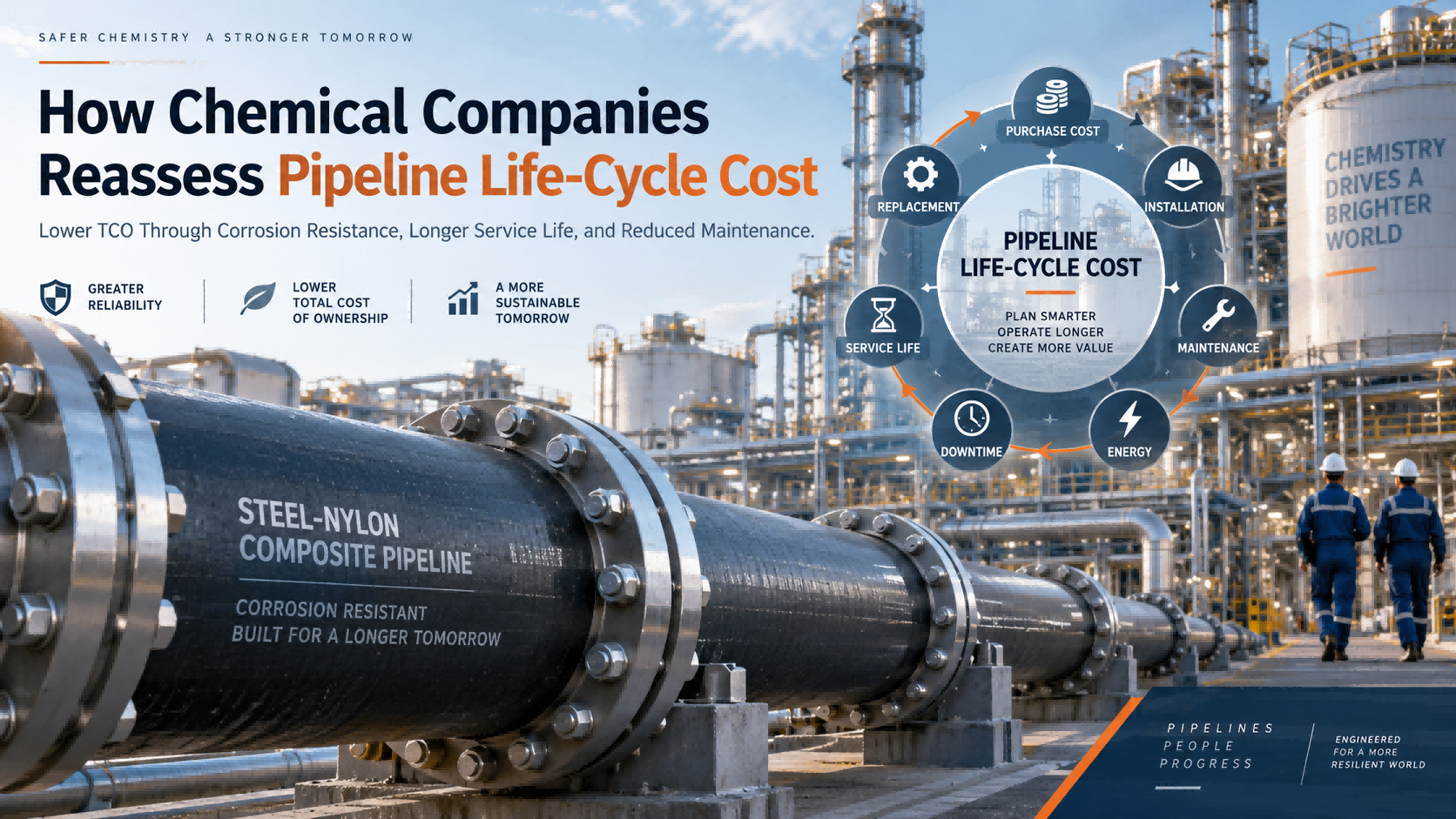
This allows companies to calculate a more meaningful metric:
Total Cost of Ownership (TCO).
As lifecycle data becomes more transparent, purchasing decisions are likely to change.
The best pipeline material will not necessarily be the material with the lowest purchase price.
Increasingly, it may be the material with the:
Lowest Cost per Year of Reliable Operation.
8. Why the Value of Steel-Nylon Composite Pipe Becomes More Visible in a Digital Environment
Digital maintenance does not reduce the importance of high-performance pipeline materials.
In many respects, it does the opposite.
Digitalization makes the real performance difference between materials easier to measure.
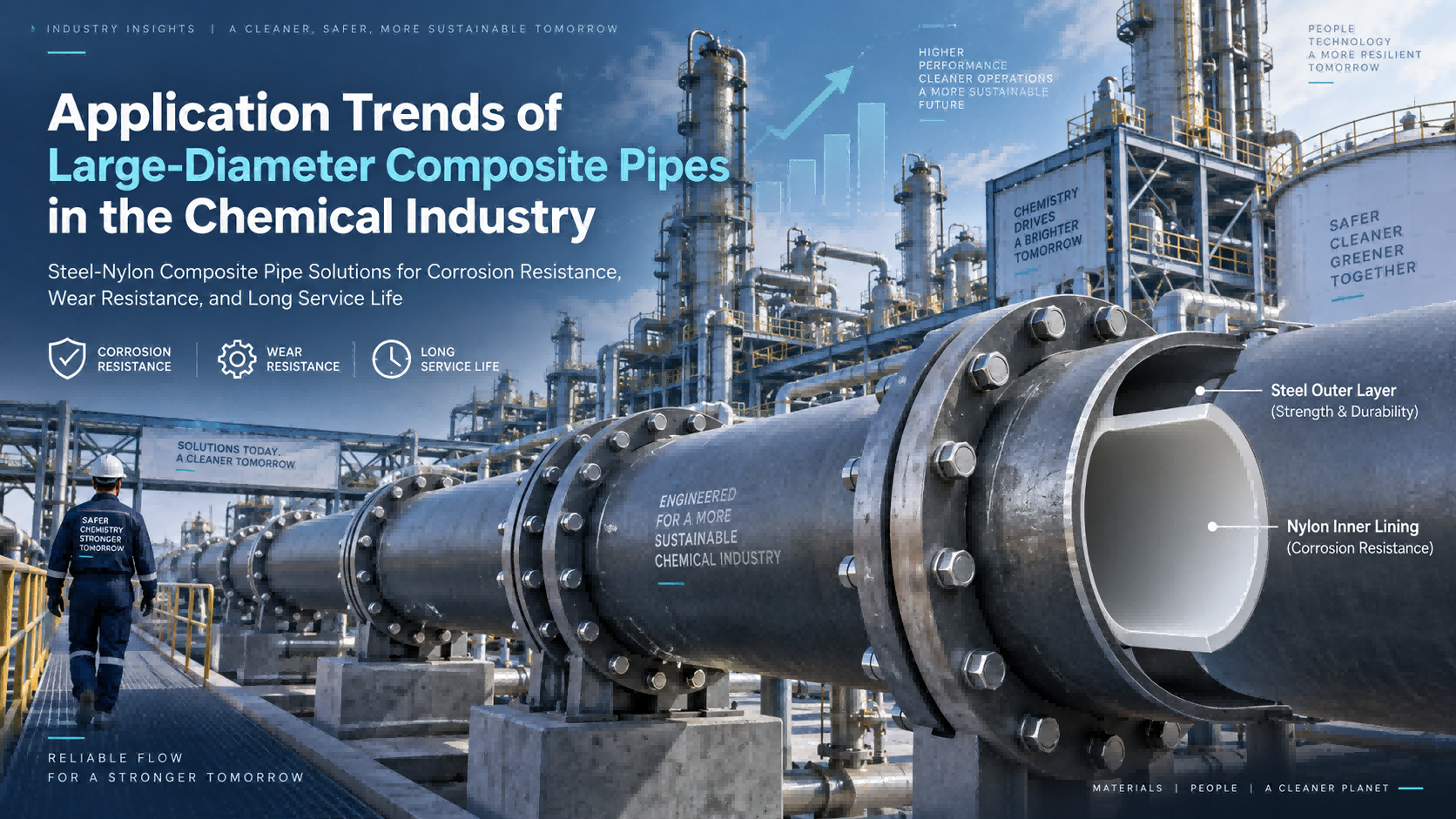
Steel-nylon composite pipe is based on a functional composite design:
The steel structure provides mechanical strength and pressure resistance, while the nylon inner layer provides the primary corrosion- and wear-resistant surface in contact with the transported medium.
Under suitable operating conditions, this structure can provide a combination of:
-
Mechanical strength
-
Pressure resistance
-
Corrosion resistance
-
Wear resistance
-
Smooth internal surface
-
Reduced scaling tendency
-
Long-term operational stability
This is particularly valuable in applications where:
Corrosion + Abrasion
occur simultaneously.
Traditional single-material pipelines often struggle to optimize both requirements.
For example:
A metallic pipeline may provide high structural strength but continue to experience internal corrosion.
Conventional polymer piping may provide good resistance to certain corrosive media but can face limitations under higher pressure, large-diameter, elevated-temperature, or demanding mechanical conditions.
Some soft-lined systems can provide corrosion protection, but severe slurry erosion may place additional demands on liner durability and interface reliability.
Steel-nylon composite piping approaches the problem differently.
The structural and medium-contact functions are assigned to different materials.
This is one of the core principles behind functional composite pipeline design.
9. What Digital Maintenance Really Needs Is Low-Degradation Pipeline Materials
If a pipeline material corrodes rapidly, a digital monitoring system mainly helps the operator:
Predict more accurately when it will fail.
A more advanced industrial system should aim to reduce the rate of degradation itself.
Therefore, digital management and high-performance materials should not be viewed as substitutes.
An optimized pipeline system is more likely to combine:
Advanced Materials + Condition Monitoring + Predictive Maintenance
For suitable applications, if the nylon inner layer provides strong resistance to the transported medium, the performance degradation rate of a steel-nylon composite pipe may be significantly lower than that of conventional corrosion-prone materials.
This can potentially result in:
More rational inspection intervals;
Fewer unplanned repairs;
Longer replacement cycles;
More stable operating performance.
From a maintenance-management perspective, materials with these characteristics are particularly suitable for building a:
Low-Maintenance Pipeline System.
10. Why Steel-Nylon Composite Pipe Fits Digital Lifecycle Management
10.1 Clear Functional Structure
Steel-nylon composite pipe is generally based on a structure consisting of:
Steel Structural Layer + Nylon Functional Inner Layer
The two materials perform different functions.
This makes it possible for engineers to separately evaluate:
Mechanical integrity and media compatibility.
10.2 Suitable for Combined Corrosion and Abrasion Conditions
In chemical processing, slurry transportation, mining, and some oilfield applications, pipeline damage is rarely caused by corrosion alone.
The pipeline may simultaneously experience:
-
Corrosion
-
Erosion
-
Particle abrasion
-
Hydraulic impact
Steel-nylon composite construction provides an alternative material strategy for these complex operating environments.
10.3 Smooth Internal Surface Can Support Long-Term Conveying Efficiency
During long-term operation, corrosion products, deposits, and scale can gradually increase pipeline flow resistance.
This may increase pumping energy consumption.
The relatively smooth nylon inner surface can help reduce material adhesion and deposit formation under suitable service conditions.
From a digital operating perspective, this means companies can monitor more than whether a pipeline is leaking.
They can also monitor:
Whether conveying efficiency is gradually deteriorating.
Changes in pressure loss, pump energy consumption, and flow performance can become part of the pipeline's lifecycle data.
10.4 Flanged Connections Support Modular Maintenance
Maintenance efficiency depends not only on material durability, but also on how the pipeline system is assembled.
Steel-nylon composite pipes can use flanged connections.
For many industrial applications, this provides several practical advantages:
Pipeline sections can be installed modularly;
Individual sections can be replaced;
Elbows, tees, reducers, and other fittings can be managed independently;
Installation does not depend on on-site thermofusion joining.
This becomes increasingly important in digitally managed maintenance systems.
A digital platform may indicate that:
The entire pipeline does not need to be replaced.
Instead:
Only one high-risk section requires replacement.
A modular connection system makes this maintenance strategy easier to implement.
11. The Rise of Digitally Monitored Pilot Pipeline Sections
When evaluating a new pipeline material, most industrial operators are unlikely to immediately replace an entire plant-wide piping system.
A more practical approach is to begin with a pilot installation in a high-failure area.
For example:
-
100 meters
-
200 meters
-
500 meters
Or a specific component such as:
-
A pump discharge section
-
A group of elbows
-
Pipeline sections upstream and downstream of a valve
-
A section of highly corrosive process piping
After installing steel-nylon composite pipe, the operator can continuously record:
Operating time;
Pressure;
Flow rate;
Number of maintenance events;
Wear condition;
Corrosion condition;
Maintenance costs.
After one to three years of operation, this information can be compared with the performance of the original pipeline material.
This approach can be described as:
Pilot Pipeline + Digital Monitoring
Compared with relying solely on laboratory data, long-term performance data from actual operating conditions can provide much stronger evidence for large industrial material-selection decisions.
12. Digital Twins May Become an Important Tool for Managing Large Chemical Pipeline Networks
Another major direction in industrial digitalization is the Digital Twin.
In simple terms:
There is a physical pipeline system in the plant.
At the same time, a corresponding digital model exists within the management system.
Each pipeline section can be associated with information such as:
-
Material
-
Diameter
-
Pressure
-
Temperature
-
Flow rate
-
Transported medium
-
Operating time
-
Corrosion condition
-
Risk classification
As the physical pipeline changes, the digital model is continuously updated.
Eventually, operators may be able to answer questions such as:
Which pipelines currently have the highest risk?
Which pipelines are approaching their expected service-life limits?
Which areas should be inspected during the next shutdown?
Which materials have demonstrated the best actual performance?
Which pipeline sections may require replacement during the next 12 months?
This has the potential to significantly change traditional chemical plant asset management.
13. Future Pipeline Procurement May No Longer Be About Buying Only “Pipe”
Digitalization is also likely to change the role of industrial pipeline suppliers.
The traditional procurement model is relatively straightforward:
Customer defines specifications → Supplier manufactures the pipe → Product is delivered
The future model may increasingly become:
Operating Condition Analysis → Material Selection → Pipeline Design → Manufacturing → Installation → Performance Tracking → Lifecycle Optimization
This means pipeline suppliers will need to provide more than products.
They must increasingly understand:
-
Transported media
-
Process parameters
-
Corrosion mechanisms
-
Wear mechanisms
-
Connection methods
-
Maintenance cycles
-
Lifecycle costs
For steel-nylon composite pipe manufacturers, this represents an important strategic transition:
From a:
Pipe Manufacturer
toward an:
Industrial Pipeline Solution Provider
The ability to understand operating conditions and recommend an appropriate pipeline solution may become just as important as manufacturing capability itself.
14. Digitalization Will Ultimately Change How Pipeline Value Is Measured
Historically, one of the most common questions in pipeline procurement has been:
How much does it cost per meter?
In the future, companies are increasingly likely to ask:
How much does this pipeline cost per year of operation?
The analysis may eventually become even more sophisticated:
What is the pipeline lifecycle cost per ton of medium transported?
Consider two hypothetical pipeline systems.
Pipeline A
Lower initial purchase cost,
but replaced three times within five years.
Pipeline B
Higher initial purchase cost,
but remains in stable operation over a much longer period.
If only the initial purchase price is considered, Pipeline A appears cheaper.
If the calculation includes:
Procurement + Installation + Downtime + Maintenance + Replacement
the result may be completely different.
One of the most important contributions of digital management is making costs that were previously difficult to quantify much more visible.
15. The Future May Not Be “Maintenance-Free” Pipelines, but Predictable Maintenance
It is difficult for industrial systems to achieve truly zero maintenance.
A more realistic goal is:
Predictable Maintenance.
A reliable industrial pipeline system should allow operators to:
Identify deterioration before failure occurs;
Predict when a component is approaching its service limit;
Schedule maintenance in advance;
Prepare replacement components before shutdown;
Coordinate maintenance with planned production outages.
This becomes much more achievable when both material performance and operating data are stable and transparent.
The next generation of high-reliability industrial pipeline systems may therefore combine:
Corrosion-Resistant Materials
+
Wear-Resistant Design
+
Condition Monitoring
+
Digital Management
+
Predictive Maintenance
The value does not come from any single element.
It comes from integrating them into one lifecycle-management system.
16. Steel-Nylon Composite Pipe and the Shift Toward Low-Maintenance Industrial Pipelines
For chemical companies, the most expensive part of a pipeline is often not the pipe itself.
The real cost may come from:
Pipeline leakage;
Production shutdowns;
Repeated maintenance labor;
Corrosion damage to surrounding equipment;
Environmental risks;
Lost production;
Repeated replacement projects.
This is why one of the major directions in industrial pipeline technology is likely to be:
Reducing the maintenance frequency of the entire pipeline system.
Steel-nylon composite pipe is designed around this objective.
By using a steel structure to provide mechanical strength and pressure resistance, while using a nylon inner layer to handle suitable corrosive and abrasive media, the composite structure aims to achieve a more balanced combination of performance characteristics.
For applications involving corrosion, abrasion, or frequent maintenance challenges in industries such as:
-
Chemical processing
-
Chlor-alkali
-
Soda ash
-
Salt chemicals
-
Phosphate chemicals
-
Oil and gas fields
-
Slurry transportation
-
Industrial wastewater
steel-nylon composite pipe can be evaluated as an alternative pipeline solution.
However, no pipeline material is universally suitable for every chemical medium or operating condition.
Reliable material selection should always consider:
Chemical composition, concentration, temperature, pressure, flow velocity, solid particle content, and installation environment.
Engineering evaluation remains essential.
Conclusion: The Future of Chemical Pipelines Will Be Defined by Lifecycle Reliability
Digitalization will not only transform chemical plant control systems.
It will also redefine the pipeline itself.
Historically, pipelines were primarily viewed as components used to transport fluids between pieces of equipment.
In the future, a pipeline may increasingly become an industrial asset with its own:
Digital identity,
Operating history,
Health condition,
Risk level,
And predicted remaining service life.
When the operating history of every pipeline can be recorded, when the real service life of different materials can be compared, and when maintenance costs can be quantified, industrial material-selection logic will inevitably change.
Companies will increasingly move away from asking:
“Which pipeline has the lowest purchase price?”
and toward asking:
“Which pipeline can keep our system operating more reliably over the next 10 years?”
This is also where the value of steel-nylon composite pipe deserves greater attention.
Its value is not simply that it represents another type of pipeline material.
Its deeper value lies in combining corrosion resistance, wear resistance, structural strength, and modular connection capability to help industrial operators build pipeline systems that are:
Longer-lasting, lower-maintenance, and more predictable.
In the era of digital industrial management, the most competitive pipeline will not simply be one that can transport media from one point to another.
It will be a reliable industrial asset that can be integrated into the plant's complete lifecycle management system.
What Performance Indicators Will Future Chemical Pipeline Projects Focus On?
Application Trends of Large-Diameter Composite Pipes in the Chemical Industry: From Traditional Corrosion Protection to High-Performance Pipeline Systems