Application Trends of Large-Diameter Composite Pipes in the Chemical Industry: From Traditional Corrosion Protection to High-Performance Pipeline Systems
Introduction: Large Industrial Pipeline Systems Are Entering a New Era of Material Selection
With the global chemical industry moving toward larger-scale production, continuous operation, and intelligent manufacturing, industrial pipeline systems are facing increasingly complex operating challenges.
For decades, traditional materials such as carbon steel, stainless steel, fiberglass reinforced plastic (FRP), rubber-lined steel pipes, and plastic pipelines have been widely used in chemical applications. However, in large-scale chemical plants, salt chemical production, chlor-alkali industries, soda ash plants, phosphate chemical projects, mining slurry transportation, and high-salt industrial media systems, single-material pipelines are becoming increasingly difficult to meet comprehensive performance requirements.
Modern industrial projects require pipelines that can simultaneously provide:
-
Large-diameter flow capacity;
-
High-pressure operating capability;
-
Long-term corrosion resistance;
-
Excellent wear resistance;
-
Low maintenance costs throughout the service life.
As a result, large-diameter composite pipelines are becoming an important direction for industrial pipeline upgrades.
Steel-nylon composite pipes, combining the mechanical strength of steel with the corrosion and wear resistance of MC nylon, provide a reliable solution for large industrial projects requiring safety, durability, and cost efficiency.
1. Large-Diameter Pipeline Systems Are Becoming a Major Trend in Chemical Engineering
1.1 Large Chemical Projects Are Driving Demand for DN500+ Pipelines
Modern chemical production is increasingly concentrated in large-scale industrial bases, including:
-
Large soda ash production facilities;
-
Million-ton-level chlor-alkali projects;
-
Large salt chemical industrial parks;
-
Phosphate chemical production bases;
-
Mining backfill and tailings treatment systems.
These projects typically feature:
-
High-volume material transportation;
-
Long continuous operating cycles;
-
Long-distance pipeline networks;
-
High losses caused by unexpected shutdowns.
Therefore, traditional pipeline designs with multiple small-diameter lines are gradually being replaced by large-diameter transportation systems.
In applications such as slurry transportation, mother liquor circulation, process water, and industrial wastewater transfer, large-diameter pipelines can reduce flow resistance, improve transportation efficiency, and reduce the number of connection points, thereby enhancing overall system reliability.
The demand for:
-
DN500;
-
DN800;
-
DN1000;
-
DN1600;
and even DN2000-class ultra-large-diameter pipelines continues to grow in major industrial projects.
2. Why Traditional Pipeline Materials Face Challenges in Large-Diameter Chemical Applications
2.1 Metal Pipelines Face Increasing Corrosion and Maintenance Pressure
Carbon steel pipelines offer excellent mechanical strength but can suffer from corrosion when exposed to:
-
Chloride ions;
-
Brine;
-
Caustic solutions;
-
Chemical mother liquor;
-
Solid-particle-containing media.
Common failure problems include:
-
Pitting corrosion;
-
Uniform corrosion;
-
Wall thinning;
-
Leakage risks.
Although stainless steel provides improved corrosion resistance, materials such as 316L stainless steel and duplex stainless steel may still face challenges in highly saline and chloride-rich environments, including:
-
Stress corrosion cracking;
-
Pitting corrosion;
-
Excessive material costs.
For large-diameter industrial pipelines, the cost of high-alloy metals can significantly increase project investment.
2.2 Non-Metallic Pipelines Have Structural Limitations
Materials such as FRP, PE, and PVC offer corrosion resistance advantages, but they also have limitations in demanding industrial applications.
PE Pipes
Advantages:
-
Lightweight;
-
Easy installation.
Limitations:
-
Limited pressure capability;
-
Restricted performance at elevated temperatures;
-
Challenges in high-pressure large-diameter applications.
FRP Pipes
Advantages:
-
Good corrosion resistance.
Limitations:
-
Potential long-term delamination risks;
-
Limited impact resistance;
-
Reduced adaptability in complex industrial conditions.
For chemical enterprises, pipelines must provide not only corrosion resistance but also long-term stability under pressure, abrasion, and mechanical stress.
3. Steel-Nylon Composite Pipes: A Key Direction for Large-Diameter Applications
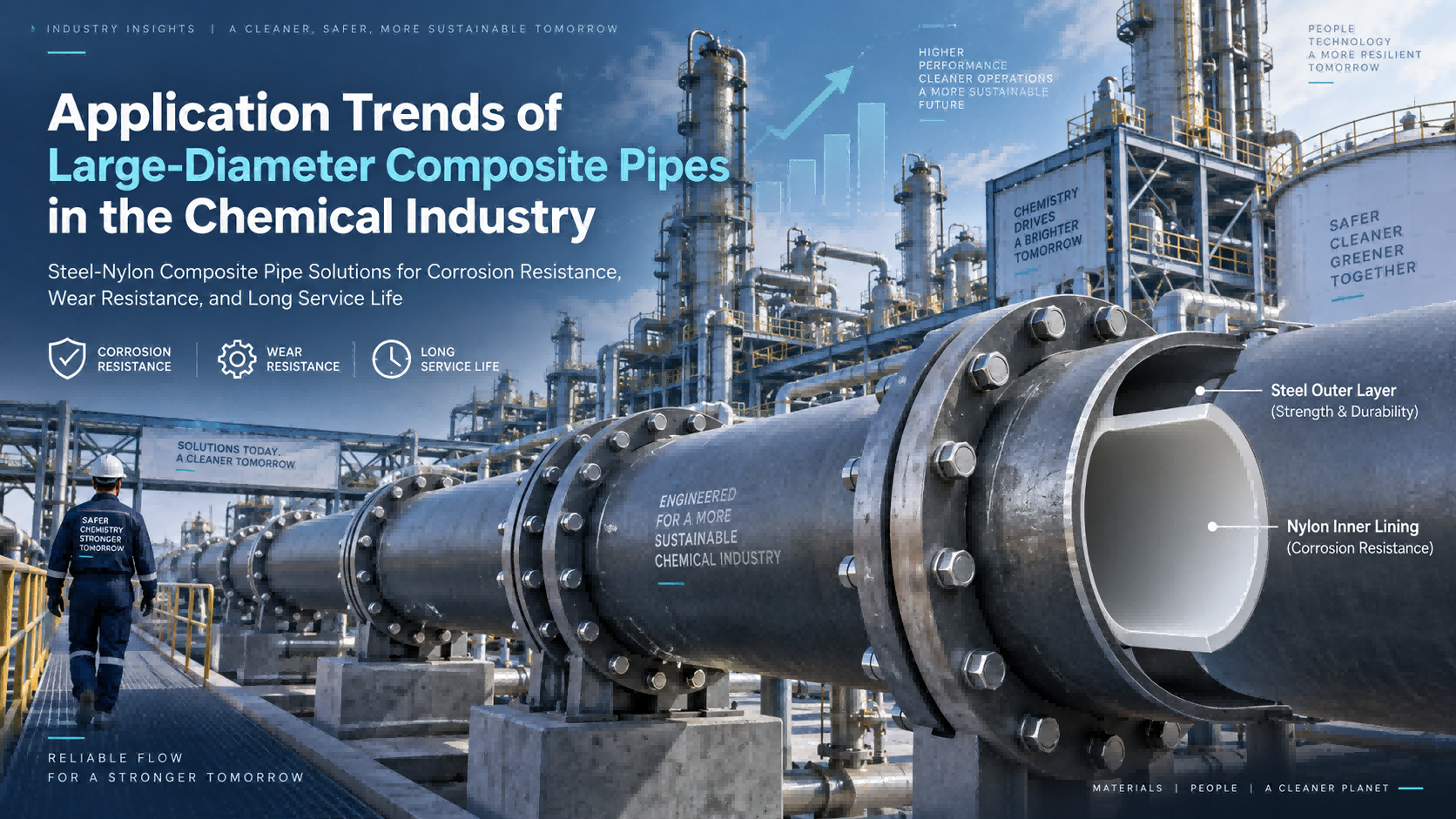
Steel-nylon composite pipes integrate the advantages of both steel and MC nylon materials.
3.1 Steel Structure Provides High Mechanical Strength
The external steel layer provides:
-
Pressure-bearing capability;
-
Mechanical strength;
-
Installation and transportation durability.
Therefore, steel-nylon composite pipes are suitable for:
-
1.0–4.0 MPa pressure systems;
-
Large-diameter industrial transportation;
-
Long-distance pipeline networks.
Compared with conventional plastic pipes, steel-nylon composite pipes offer broader pressure application ranges.
3.2 Nylon Inner Layer Provides Long-Term Corrosion Protection
MC nylon lining offers:
-
Excellent corrosion resistance;
-
Superior wear resistance;
-
Smooth inner surface;
-
Reduced scaling tendency.
It is suitable for transporting:
-
Brine;
-
Caustic soda solutions;
-
Chemical mother liquor;
-
Mining slurry;
-
High-salt industrial wastewater.
In environments where corrosion and abrasion occur simultaneously, steel-nylon composite structures effectively reduce premature failures commonly seen in traditional steel pipelines.
4. Large-Diameter Composite Pipes Are Changing Chemical Pipeline Design Concepts
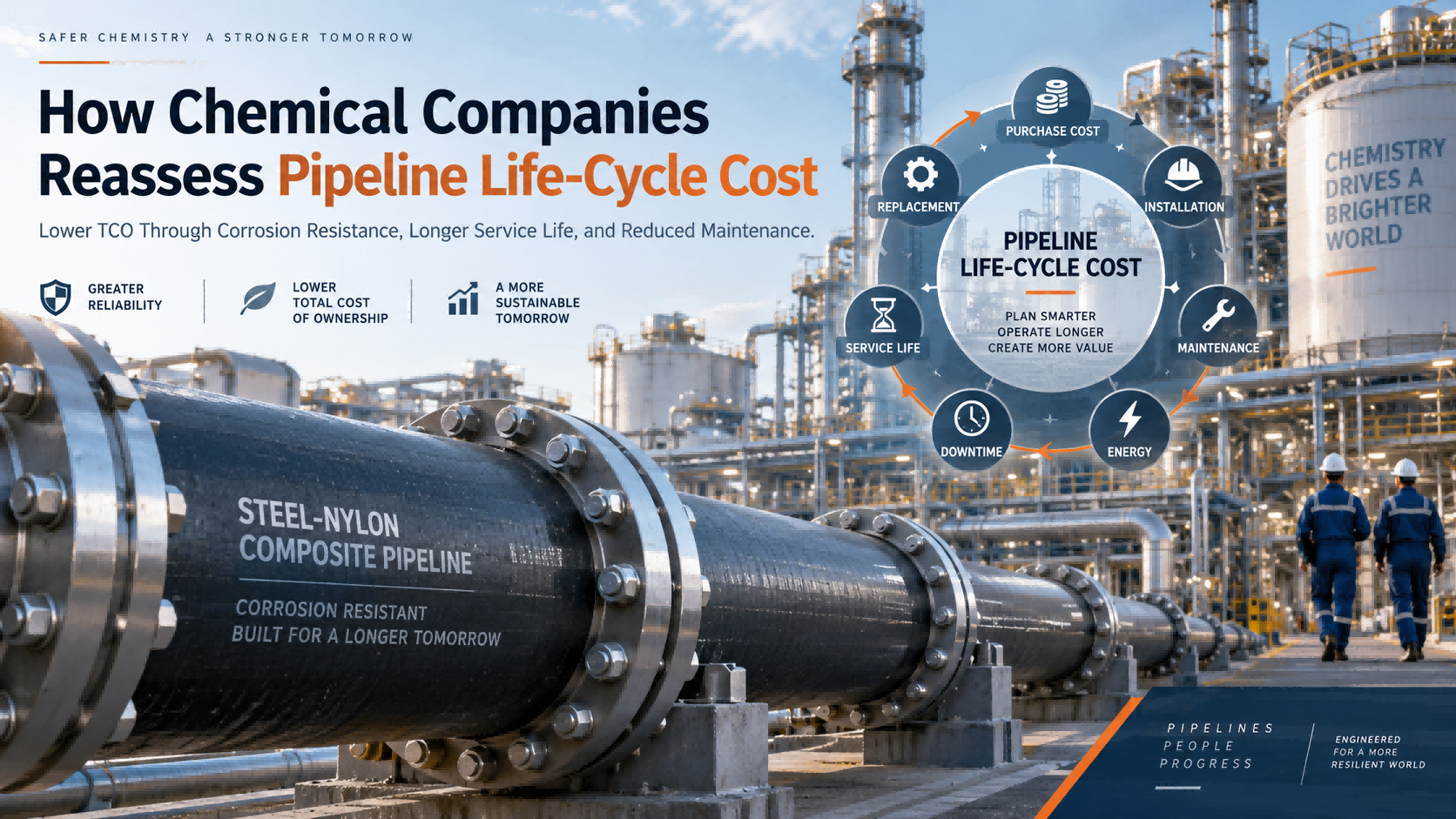
4.1 From Initial Purchase Cost to Life Cycle Cost
In the past, pipeline selection often focused mainly on:
-
Price per meter;
-
Initial investment.
However, modern chemical enterprises increasingly consider:
-
Service life;
-
Downtime losses;
-
Replacement frequency;
-
Maintenance expenses.
Although steel-nylon composite pipes may have a higher initial cost than ordinary carbon steel pipes, they can reduce overall life cycle costs through:
-
Lower corrosion rates;
-
Longer wear life;
-
Reduced maintenance requirements.
4.2 From Single Materials to Optimized Composite Structures
The future of industrial pipelines is not simply choosing between “metal” and “plastic.” Instead, it is about combining materials to achieve optimized performance.
Steel-nylon composite pipes represent this development trend:
Steel:
Provides structural strength and pressure resistance.
Nylon:
Provides corrosion protection and wear resistance.
This “material integration and performance optimization” concept is becoming an important direction for next-generation industrial pipelines.
5. Application Trends of Steel-Nylon Composite Pipes in Chemical Industries
5.1 Soda Ash Industry
Soda ash production involves challenging media such as:
-
Salt mud;
-
Mother liquor;
-
Alkaline circulating solutions;
-
High-salt fluids.
Traditional steel pipelines may experience corrosion and abrasion problems.
Steel-nylon composite pipes can be applied in:
-
Mother liquor transportation systems;
-
Brine pipelines;
-
Environmental wastewater pipelines.
5.2 Chlor-Alkali Industry
Chlor-alkali production environments involve:
-
High chloride concentrations;
-
Strong alkaline media;
-
Continuous operation requirements.
Steel-nylon composite pipes are suitable for:
-
Caustic soda transportation;
-
Brine circulation systems;
-
Process auxiliary pipelines.
5.3 Mining and Slurry Transportation
The biggest challenges in slurry transportation include:
-
Solid particle erosion;
-
Continuous pipe wall wear.
With the excellent wear resistance of MC nylon, steel-nylon composite pipes can significantly extend pipeline service life.
5.4 Oil and Gas Gathering Systems
Oilfield pipelines often face:
-
High water cut;
-
High salinity;
-
CO₂ corrosion;
-
Sand erosion.
Steel-nylon composite pipes are suitable for:
-
Gathering pipelines;
-
Water injection pipelines;
-
Station process pipelines.
6. Manufacturing Capability Determines the Reliability of Large-Diameter Composite Pipelines
Large-diameter composite pipes are not simply enlarged versions of standard pipes. They require advanced manufacturing capabilities.
6.1 Long-Term Stability of the Composite Interface
The bonding between steel and nylon must remain stable over long operating periods to prevent:
-
Delamination;
-
Separation;
-
Inner liner movement.
6.2 Dimensional Accuracy Control
Large-diameter pipelines require strict control of:
-
Wall thickness uniformity;
-
Roundness;
-
Flange connection accuracy.
6.3 Batch Production Consistency
Large industrial projects often require:
-
Hundreds of meters;
-
Thousands of meters;
or even longer pipeline systems.
Stable manufacturing capability directly determines project quality and delivery reliability.
7. Future Outlook: Large-Diameter Composite Pipes Will Become an Important Choice for Industrial Transportation
Over the next 5–10 years, the demand for large-diameter composite pipelines will continue to grow due to:
-
Larger chemical production facilities;
-
Higher environmental requirements;
-
Increasing maintenance costs;
-
Stricter industrial safety standards.
Especially in applications involving:
-
Severe corrosion;
-
High abrasion;
-
High salinity;
-
Long-distance transportation;
-
Large flow capacity;
composite pipelines will gradually replace some traditional metal and conventional plastic pipeline systems.
Conclusion: Steel-Nylon Composite Pipes Are Supporting a New Era of High-Reliability Industrial Pipelines
The development of large-diameter chemical pipelines is shifting from simply “transporting materials” toward achieving long-term operational reliability.
Steel-nylon composite pipes provide an advanced industrial pipeline solution through:
-
High-strength steel structures;
-
MC nylon corrosion resistance;
-
Excellent wear performance;
-
Large-diameter manufacturing capability;
-
1.0–4.0 MPa pressure adaptability.
For chemical, mining, oil & gas, and salt chemical industries, steel-nylon composite pipes help improve system safety, reduce maintenance requirements, and increase long-term project value.
For future large-scale industrial projects, selecting the right pipeline material is not only about reducing initial investment—it is about creating a safer, more stable, and more cost-effective transportation system throughout the entire service life.
How Digital Management Will Transform Chemical Pipeline Maintenance
How Highly Corrosive and Abrasive Chemical Environments Are Driving the Adoption of New Pipeline Materials