How Highly Corrosive and Abrasive Chemical Environments Are Driving the Adoption of New Pipeline Materials

In many chemical processing projects, pipeline failure is rarely caused by a single factor.
The most challenging operating conditions often involve a combination of corrosion, abrasion, pressure, temperature, suspended solids, and high-velocity fluid erosion.
Typical examples include:
-
Fluids containing chloride ions or strong alkalis together with solid particles;
-
High-salinity slurries in phosphate and salt chemical processing;
-
Chemical mother liquors, salt sludge, mineral slurries, and crystallizing fluids;
-
Desulfurization slurry, industrial wastewater, and high-solids-content media;
-
Sand particles and corrosive ions in highly mineralized oilfield produced water;
-
Corrosive solid-liquid two-phase flows transported at high velocity.
Under these conditions, traditional approaches to pipeline material selection are increasingly being challenged.
In the past, a pipeline project might have needed to answer only one question:
Is this material corrosion-resistant?
Or:
Is this material abrasion-resistant?
However, increasingly complex chemical processes now require engineers to answer a much broader question:
Can a pipeline material remain stable when corrosion, abrasion, pressure, and continuous long-term operation occur simultaneously?
This change in operating conditions is one of the major factors driving industrial piping systems away from conventional single-material solutions and toward high-performance composite material systems.
For steel-nylon composite pipes, this is also one of the key reasons their engineering value is becoming increasingly significant.
1. Why Is the Combination of High Corrosion and High Abrasion So Difficult for Industrial Pipelines?
Corrosion alone can significantly shorten the service life of metal pipelines.
Abrasion alone can progressively reduce pipe wall thickness.
However, when corrosion and abrasion occur simultaneously, the resulting damage is not simply:
Corrosion Loss + Abrasion Loss
Instead, the two mechanisms can reinforce each other, creating what is commonly referred to as:
Corrosion-Erosion Synergy
Corrosion First Damages the Protective Surface
Some metallic materials rely on oxide layers or passive films to provide corrosion resistance.
However, when high-velocity slurry, sand, or solid particles continuously strike the pipe wall, these protective layers may be mechanically damaged.
Once the protective surface is removed, fresh metal becomes exposed to the corrosive medium.
A continuous cycle may develop:
Protective Film Formation → Erosion Damage → Metal Exposure → Corrosion → Further Erosion
As a result, the overall rate of material degradation can increase significantly.
2. Corrosion Can Also Accelerate Abrasion
The interaction works in both directions.
Corrosion can alter the microscopic structure of a material surface, making it:
-
Rougher;
-
More porous;
-
Susceptible to pitting;
-
More vulnerable to localized defects;
-
Mechanically weaker in affected areas.
When high-velocity particles continue to strike these weakened regions, material loss becomes easier.
This creates another reinforcing cycle:
Corrosion → Surface Damage → Erosion → More Corrosion
This explains why certain materials may perform well in laboratory static corrosion tests but achieve much shorter service lives when exposed to real slurry transportation systems.
Industrial operating environments are rarely governed by only one failure mechanism.
3. The Most Vulnerable Locations Are Often Not Straight Pipe Sections
Failures in highly corrosive and abrasive piping systems are usually not distributed uniformly.
The following locations often face greater risks:
-
Elbows;
-
Tees;
-
Reducers;
-
Pump outlets;
-
Upstream and downstream sections of valves;
-
Sudden changes in pipe diameter;
-
Flow direction changes;
-
Local high-velocity zones.
The reason is straightforward.
When particles change direction in these areas, they can strike the pipe wall with greater impact energy.
At an elbow, for example, high-speed particles may continuously impact the outer radius.
As a result, the outer wall of the elbow may become one of the first locations in the entire piping system to fail.
Therefore, in complex industrial systems:
Average corrosion rate does not necessarily represent actual pipeline service life.
What often determines the reliability of the entire system is:
When will the weakest section fail?
4. Which Chemical Industries Commonly Face Combined Corrosion and Abrasion?
Corrosion-abrasion conditions are widespread across chemical processing industries.
4.1 Phosphate Chemical Industry
Phosphate chemical processes commonly involve:
-
Phosphate rock slurry;
-
Phosphoric-acid-related slurries;
-
Solid-containing process fluids;
-
Acidic environments with complex ionic compositions.
These conditions may simultaneously involve:
Chemical Corrosion + Solid Particle Abrasion + Slurry Erosion
For this reason, relying solely on conventional metallic piping requires careful evaluation of long-term corrosion and erosion performance.
4.2 Salt Chemical Industry
High-salinity systems often contain:
-
Cl⁻;
-
Na⁺;
-
Highly concentrated salt solutions;
-
Salt sludge;
-
Crystalline particles.
For certain metallic materials, high chloride concentrations may increase the risk of localized corrosion mechanisms such as pitting and crevice corrosion.
When solid particles are also present, material selection becomes even more complicated.
4.3 Soda Ash Industry
In soda ash production, pipelines may transport:
-
Mother liquor;
-
Brine;
-
Brine sludge;
-
Process wastewater.
These media can contain complex ionic compositions together with suspended solids.
The pipeline therefore needs to withstand both chemical attack and long-term mechanical abrasion.
4.4 Chlor-Alkali Industry
Caustic soda and related process media place demanding requirements on material compatibility.
If the system simultaneously involves:
-
High-concentration alkali;
-
Salts;
-
Impurities;
-
Solid particles;
-
Temperature fluctuations;
material selection cannot be based solely on whether the pipe can resist chemical corrosion.
Long-term mechanical performance and operational stability must also be considered.
4.5 Chemical Slurry and Industrial Wastewater Systems
Many types of industrial wastewater are not simply liquids.
They may contain:
-
Crystals;
-
Precipitates;
-
Sand;
-
Salts;
-
Acids or alkalis;
-
Suspended particles.
From a piping engineering perspective, these are essentially:
Corrosive Solid-Liquid Two-Phase Flows
Such applications are among the environments where the lifecycle cost of conventional piping systems can become increasingly difficult to control.
5. Why Is the Traditional “Single-Material” Approach Becoming Less Effective?
Industrial piping materials have traditionally been divided into two major categories.
Metallic Materials
Typical examples include:
-
Carbon steel;
-
304 stainless steel;
-
316L stainless steel;
-
Duplex stainless steel;
-
High-alloy materials.
These materials generally provide good:
-
Structural strength;
-
Pressure resistance;
-
Mechanical rigidity.
However, depending on the chemical environment, they may still face risks such as:
-
Pitting corrosion;
-
Crevice corrosion;
-
Localized corrosion;
-
Erosion-corrosion;
-
Electrochemical corrosion.
Non-Metallic Materials
Typical examples include:
-
PE;
-
PVC;
-
FRP;
-
Various engineering plastic pipes.
These materials often offer good chemical stability.
However, industrial projects must also evaluate:
-
Pressure capability;
-
Mechanical strength;
-
Rigidity;
-
Temperature resistance;
-
Vacuum resistance;
-
Large-diameter structural stability;
-
Long-term dimensional stability.
An increasingly important trend is therefore emerging:
Complex industrial piping systems may not need one “perfect” material. Instead, different materials can be combined so that each performs the function it is best suited for.
This is the fundamental engineering logic behind composite piping systems.
6. Why Are Steel-Nylon Composite Pipes Suitable for Complex Corrosive and Abrasive Conditions?
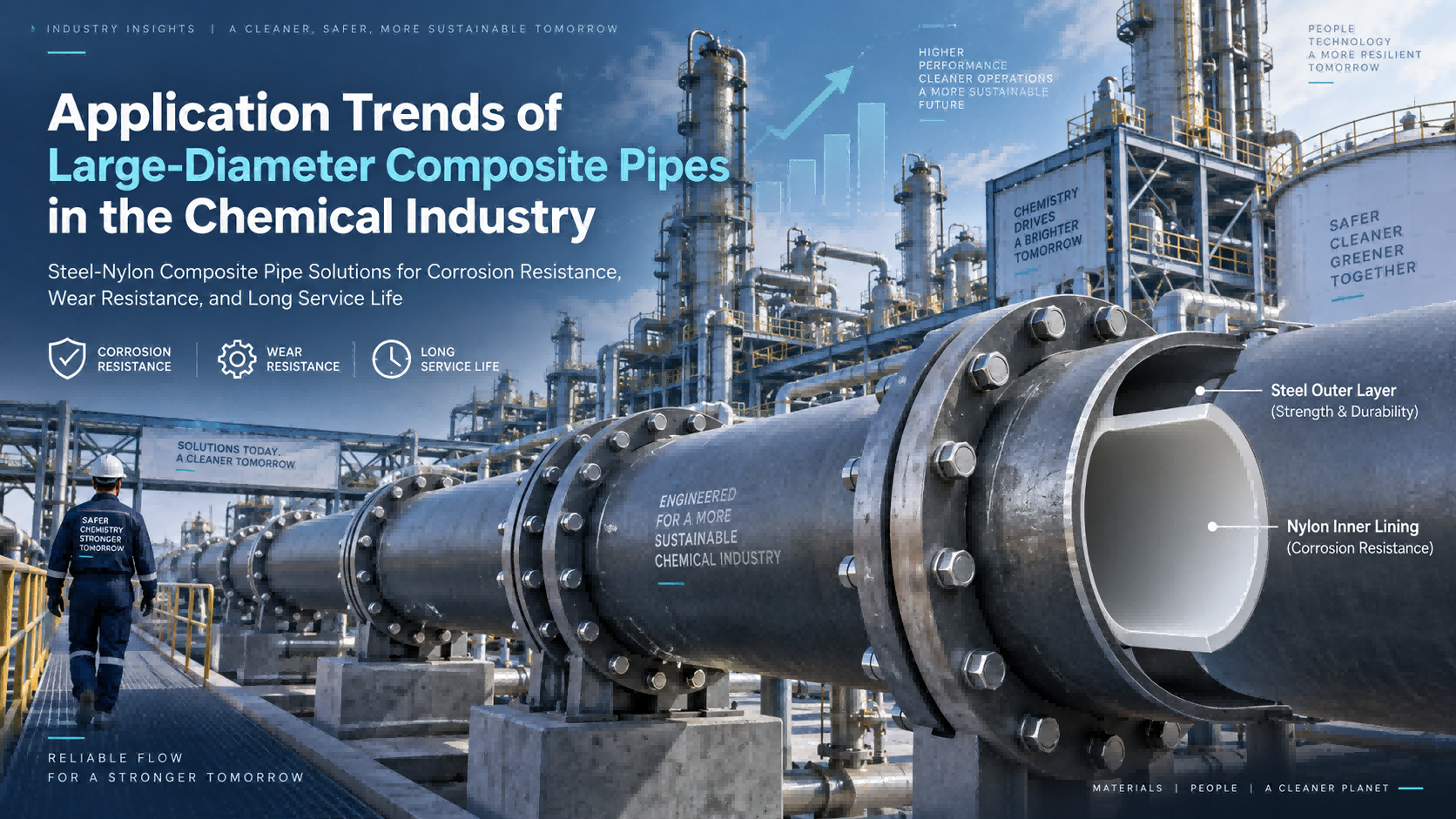
The core concept of a steel-nylon composite pipe can be summarized as:
Let steel provide the structure, and let nylon handle the process medium.
This approach differs fundamentally from conventional single-material piping.
The steel structural layer primarily provides:
-
Mechanical strength;
-
Pressure resistance;
-
Structural rigidity;
-
Dimensional stability in large diameters;
-
Resistance to installation and engineering loads.
The nylon layer in contact with the process medium primarily provides:
-
Corrosion resistance;
-
Abrasion resistance;
-
Separation between corrosive media and steel;
-
Reduced scaling tendency;
-
A smoother fluid-contact surface.
From a materials engineering perspective, this is essentially a combination of:
Structural Material + Functional Material
7. Advantage 1: Separating Corrosive Media from the Steel Structure
In conventional carbon steel pipes, the process fluid directly contacts the steel.
Once corrosion begins, the load-bearing pipe wall itself starts losing thickness.
This is one of the major risks associated with traditional metallic piping:
The corrosion-resistant layer and the structural load-bearing layer are the same material.
Steel-nylon composite pipes change this design logic.
The process medium primarily contacts the internal nylon functional layer, while the steel provides the external load-bearing structure.
This can significantly reduce direct exposure of the structural steel layer to corrosive media.
For suitable applications involving:
-
High-salinity media;
-
Strong alkalis;
-
Certain weak acids;
-
Chemical mother liquors;
-
Corrosive industrial wastewater;
this structural concept can offer significant engineering value.
However, material selection should always be confirmed according to:
Chemical composition, concentration, temperature, pressure, and actual operating conditions.
8. Advantage 2: Nylon Provides Both Corrosion and Abrasion Resistance
Corrosion resistance alone is not enough.
If the internal material lacks sufficient abrasion resistance, slurry service can still result in rapid failure.
This is why more chemical projects are increasingly focused on achieving both:
Corrosion Resistance + Abrasion Resistance
Nylon not only offers good chemical stability under suitable operating conditions, but also provides strong wear resistance and toughness.
For media such as:
-
Salt sludge;
-
Mineral slurry;
-
Particle-containing slurry;
-
Sand-containing fluids;
-
Industrial wastewater;
the nylon inner layer can help reduce long-term surface damage caused by solid particle erosion.
This means that steel-nylon composite pipe is not simply designed to address corrosion.
It is particularly relevant to applications where:
Corrosion and abrasion occur simultaneously.
9. Advantage 3: A Smooth Inner Surface Helps Reduce Hydraulic Resistance
Another issue that is often underestimated in slurry transportation is:
Internal Surface Roughness
As metallic pipelines experience:
-
Corrosion;
-
Pitting;
-
Scaling;
-
Deposits;
their inner surfaces become progressively rougher.
This can result in:
-
Increased hydraulic resistance;
-
Higher pumping energy consumption;
-
Reduced flow capacity;
-
Increased local deposition;
-
More uneven erosion patterns.
Nylon generally provides a smoother internal surface.
Its engineering value extends beyond surface appearance.
A smoother bore can help maintain more stable fluid transportation characteristics.
This can be particularly important in long-distance pipeline systems, where long-term changes in surface roughness may have a measurable impact on operating costs.
10. Advantage 4: The Steel Structure Addresses the Limitations of All-Plastic Pipes in High-Pressure and Large-Diameter Applications
If corrosion problems are addressed entirely with non-metallic piping, other engineering challenges may emerge.
This becomes particularly important in:
-
High-pressure systems;
-
Large-diameter pipelines;
-
Long-distance transportation;
-
Above-ground piping;
-
Complex support structures;
-
Negative-pressure conditions.
These applications place significant demands on structural performance.
Steel-nylon composite pipe retains a steel structural layer, allowing the system to benefit from steel's:
-
High strength;
-
High rigidity;
-
Pressure-bearing capability;
-
Dimensional stability.
Depending on design and specification, steel-nylon composite pipes can cover approximately 1.0–4.0 MPa pressure classes and can be developed for large-diameter industrial pipeline applications.
This helps address an important engineering contradiction:
Projects want the corrosion and abrasion resistance of non-metallic materials, while still requiring the structural capabilities of steel pipe.
11. Advantage 5: Composite Design Can Be More Rational Than Simply Upgrading the Metal Grade
When corrosion problems occur, a common traditional engineering approach is:
Carbon Steel →
304 Stainless Steel →
316L Stainless Steel →
Duplex Stainless Steel →
Higher-Alloy Materials
This approach is valid in many applications.
However, as the material grade increases, procurement costs can also rise substantially.
Furthermore, in environments where abrasion and corrosion occur simultaneously, increasing the grade of the metal does not necessarily result in a proportional increase in service life.
This raises an important question:
Does the entire pipe wall need to be made from an expensive corrosion-resistant material?
Composite materials provide another option:
-
Structural strength is provided by steel;
-
Corrosion resistance is provided by nylon;
-
Abrasion resistance is provided by the nylon functional layer.
Essentially, this is a different way of allocating material cost.
For suitable operating conditions, steel-nylon composite pipe should therefore be evaluated against alternatives such as:
-
Stainless steel;
-
Rubber-lined steel pipe;
-
Plastic-lined steel pipe;
-
FRP;
-
PE;
based on lifecycle performance rather than only initial purchase price.
12. The Real Comparison Should Be Lifecycle Cost, Not Price per Meter
One of the most common mistakes in industrial pipeline selection is comparing only:
Price per Meter
A more complete evaluation should consider:
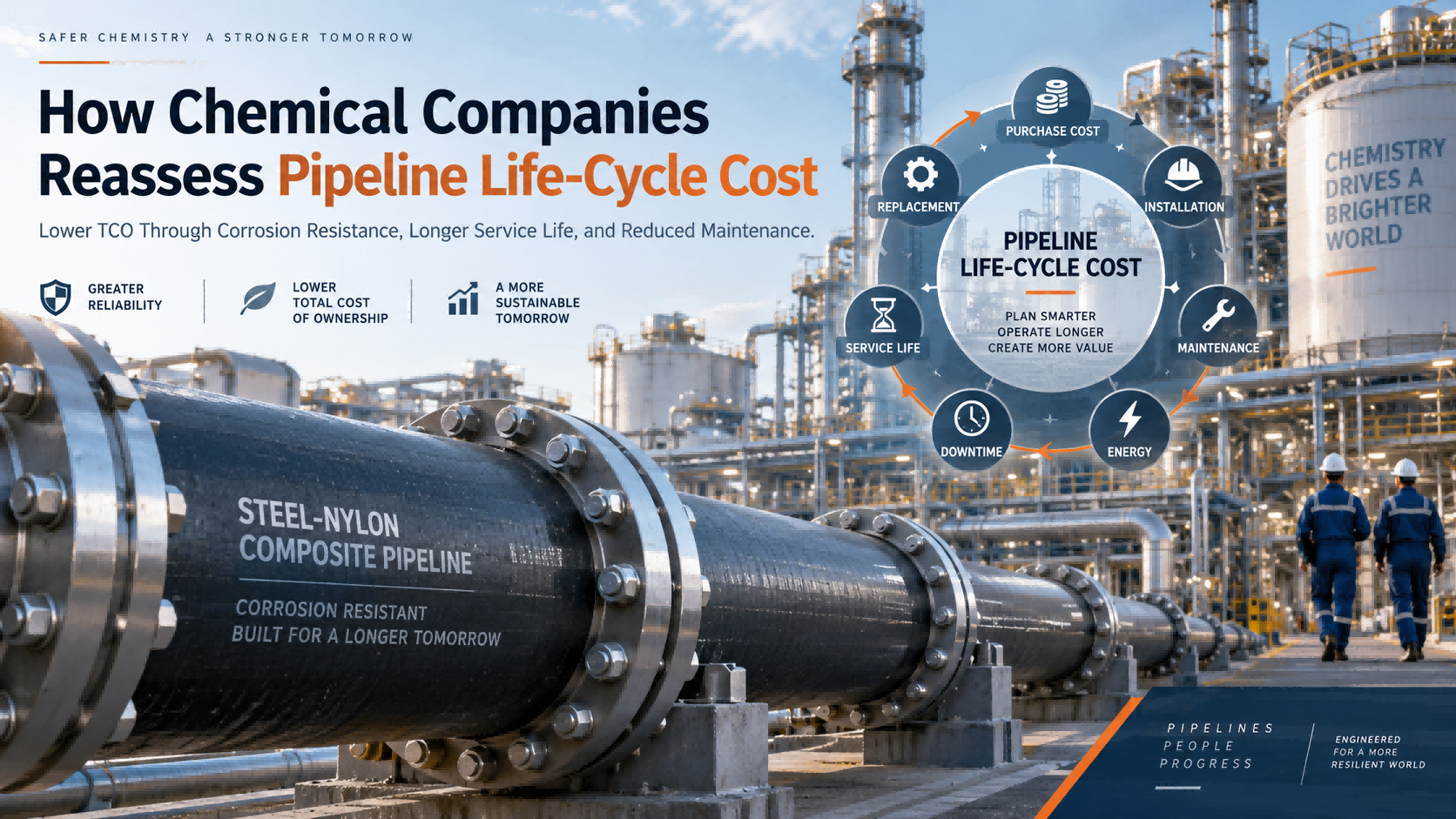
Total Cost of Ownership (TCO)
A realistic pipeline TCO assessment should include at least:
Initial Procurement Cost
Installation Cost
Corrosion Protection Cost
Maintenance Cost
Replacement Cost
Production Shutdown Losses
Leakage and Incident Costs
Energy Consumption
Lifecycle Risk Costs
For highly corrosive and abrasive systems, maintenance frequency can be more important than initial pipe price.
Consider two pipeline solutions.
One has a lower initial purchase price but requires repair or replacement every two or three years.
Another requires a higher initial investment but significantly extends the maintenance interval.
Over a ten-year operating period, their actual total costs may be completely different.
This is why more industrial projects are moving away from:
Lowest Purchase Price
toward:
Lowest Lifecycle Cost
13. Shutdown Costs Are Becoming a Major Driver of Material Upgrades
In large chemical processing facilities, the direct material cost of replacing a section of pipe may not be the largest expense.
The greater cost can be:
Shutdown Cost
Pipeline replacement may require:
-
Stopping production;
-
Draining the system;
-
Cleaning the pipeline;
-
Isolating hazardous process media;
-
Removing the existing pipe;
-
Installing the replacement;
-
Conducting pressure testing;
-
Restarting production.
For continuously operating chemical plants, the financial impact of an unplanned shutdown can greatly exceed the purchase price of the pipe itself.
As a result, modern chemical projects are redefining what a “low-cost pipeline” actually means.
The lowest-cost pipeline is not necessarily:
The cheapest one to purchase.
Instead, it may be:
The one that requires the fewest shutdowns, repairs, and replacements throughout its service life.
14. The Value of Hot-Work-Free Installation Is Increasing in Chemical Plant Upgrades
Welding inside chemical plants is typically classified as hot work.
It can require:
-
Hot-work permits;
-
Gas detection;
-
Fire watch;
-
Safety isolation;
-
Specialized construction procedures;
-
Longer installation schedules.
Steel-nylon composite pipes are commonly designed with flange connections.
For many chemical plant retrofit projects, this can reduce the amount of on-site welding required.
This is particularly valuable in:
-
Flammable and explosive areas;
-
Active chemical processing facilities;
-
Aging industrial plants;
-
Projects with limited maintenance shutdown windows.
Therefore, future competition in industrial piping will involve more than:
Material Performance
It will also involve:
Installation Engineering Efficiency
15. Highly Corrosive and Abrasive Conditions Are Changing Pipeline Material Selection
Traditional industrial pipeline design often focused on one question:
“Which material has the best corrosion resistance?”
Future projects will increasingly focus on a different question:
“Which material system can maintain long-term stability under complex operating conditions?”
These questions may appear similar, but they represent fundamentally different engineering approaches.
The first focuses on:
Material
The second focuses on:
System Performance
The evaluation criteria are therefore expanding from corrosion resistance alone to include:
-
Corrosion resistance;
-
Abrasion resistance;
-
Pressure capability;
-
Temperature adaptability;
-
Vacuum performance;
-
Installation method;
-
Large-diameter capability;
-
Maintenance interval;
-
Energy consumption;
-
Lifecycle cost.
Industrial piping is therefore entering an era of:
Multi-Performance Integrated Design
16. Why Are Composite Materials Becoming an Important Development Direction?
The greatest value of composite materials is not that they create a “universal material.”
Instead, their value comes from:
Using the strengths of different materials to solve different engineering problems.
Steel provides:
-
High strength;
-
High rigidity;
-
Strong structural pressure resistance.
Nylon provides:
-
Good corrosion resistance under suitable chemical conditions;
-
Excellent wear resistance;
-
Low friction characteristics;
-
Good toughness.
When these two materials are combined, the result is:
Steel Structure + Nylon Functional Layer
This is a typical example of functional division between materials.
Looking ahead, this design philosophy may become increasingly important in industrial material development:
Instead of searching for one material that performs every function, engineers can design a system in which different materials perform the functions they are best suited for.
17. Which Applications Are Particularly Suitable for Evaluating Steel-Nylon Composite Pipe?
From an engineering perspective, steel-nylon composite pipes are particularly worth evaluating in the following operating environments.
High Corrosion + High Abrasion
Examples include:
Chemical slurry, salt sludge, and mineral slurry.
High Salinity + Solid Particles
Examples include:
Salt chemical processing and oilfield produced water.
Strong Alkali + Particle Erosion
Examples include:
Certain chlor-alkali and soda ash process systems.
High Pressure + Corrosive Media
Where the pressure capability of conventional non-metallic piping becomes a limitation, the steel structure can provide greater mechanical stability.
Large Diameter + Corrosive Environment
As DN500, DN800, DN1000, and even larger industrial pipelines become more common, structural stability becomes increasingly important.
Continuous Production Systems Highly Sensitive to Shutdowns
If a single pipeline leak can result in significant production losses, extending pipeline service intervals can deliver substantial economic value.
18. New Materials Will Not Completely Replace Traditional Materials—They Will Redefine Their Application Boundaries
No single piping material is suitable for every operating condition.
Stainless steel will continue to have important applications.
PE will continue to be used.
FRP will continue to be used.
Carbon steel will also remain essential.
What is changing is:
The application boundaries of different materials are being redefined.
Traditional materials can remain suitable for ordinary operating conditions.
However, as corrosion severity, abrasion intensity, pressure, and system criticality increase, projects require increasingly sophisticated material performance.
The industrial pipeline market may therefore develop into clearer application levels:
Standard Operating Conditions
Traditional materials.
Moderate Corrosion Conditions
Corrosion-resistant materials.
Severe Corrosion Conditions
High-performance corrosion-resistant materials.
Severe Corrosion + High Abrasion + High Pressure
High-performance composite piping systems.
This is one of the most important areas in which steel-nylon composite pipe deserves greater attention.
19. How Do We Define the Value of Steel-Nylon Composite Pipe?
We do not view steel-nylon composite pipe simply as:
“A steel pipe with a nylon layer inside.”
It represents a fundamentally different approach to industrial pipeline engineering:
Structural performance and process-medium compatibility are designed separately.
Our steel-nylon composite pipes are primarily developed for challenging industrial environments.
By combining a steel structure with a nylon functional layer, the system can simultaneously address:
-
Corrosion resistance;
-
Abrasion resistance;
-
Pressure capability;
-
Large-diameter structural stability;
-
Hydraulic performance;
-
Installation efficiency;
-
Long-term operation;
-
Lifecycle cost.
For complex chemical projects, these combined performance characteristics are often more important than comparing a single material property.
20. The Future of Industrial Piping Is Ultimately a Competition in Reliability
As chemical processing facilities become larger and continuous operating cycles become longer, expectations for piping systems are fundamentally changing.
In the past, companies focused on:
Purchase Cost
Today, they increasingly focus on:
Lifecycle Cost
In the past, they focused on:
Material Price
Today, they focus on:
Shutdown Frequency
In the past, they focused on:
Individual Corrosion Resistance
Today, they evaluate:
Corrosion + Abrasion + Pressure + Temperature + Installation + Maintenance
Therefore, highly corrosive and abrasive operating conditions are not merely driving the adoption of one new material.
They are pushing the entire industrial piping industry from:
Single-Material Competition
toward:
System Performance Competition
Conclusion: Complex Operating Conditions Are Redefining What Makes a Good Industrial Pipeline
Truly demanding chemical processing environments rarely involve only one failure mechanism.
Corrosion, abrasion, erosion, scaling, pressure, temperature, installation conditions, and maintenance costs can all influence pipeline service life simultaneously.
For this reason, the next generation of industrial piping materials must answer more than:
“Can this pipe transport the medium?”
The more important question is:
“Can this pipeline remain stable over the long term under this chemical composition, pressure, solids content, flow condition, and operating cycle?”
This is the fundamental engineering logic behind the development and application of steel-nylon composite pipes.
By using steel to provide mechanical strength and pressure-bearing capability, while using the nylon functional layer to provide corrosion resistance, abrasion resistance, and fluid-contact performance, steel-nylon composite piping can offer an alternative solution for demanding industrial applications involving severe corrosion, high abrasion, higher pressure, and long-term continuous operation.
For chemical companies, the most important question in the future may no longer be:
Which pipeline is the cheapest?
Instead, it will increasingly become:
Which pipeline can keep the entire system operating longer and more reliably while reducing maintenance and shutdown costs over the next ten years?
That is the real economic logic behind the adoption of new materials in increasingly complex industrial environments.
Application Trends of Large-Diameter Composite Pipes in the Chemical Industry: From Traditional Corrosion Protection to High-Performance Pipeline Systems
How Chemical Companies Should Reassess the Total Life-Cycle Cost of Industrial Piping