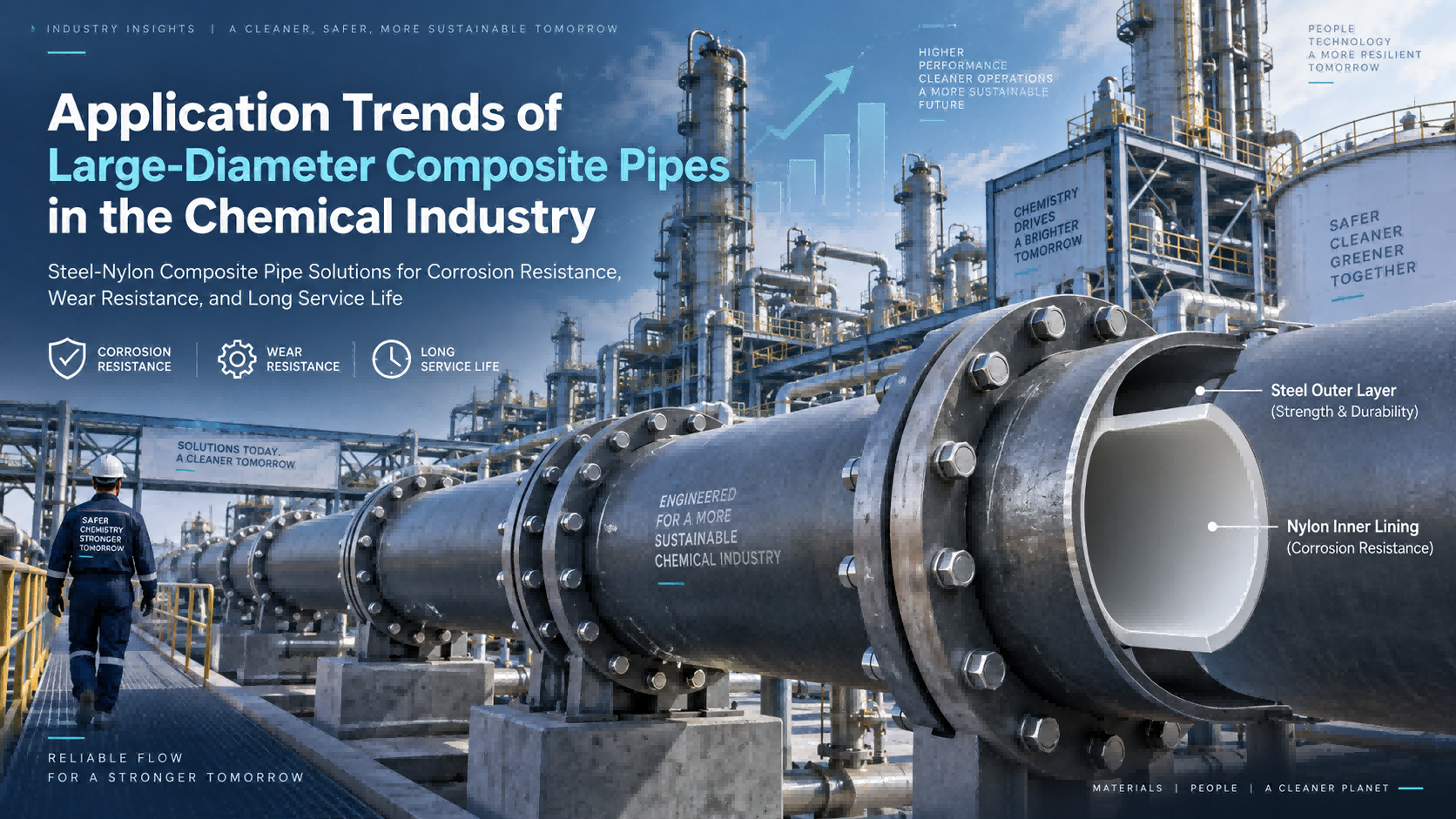
How Chemical Companies Should Reassess the Total Life-Cycle Cost of Industrial Piping
In many chemical projects, pipeline selection still begins with one seemingly straightforward question:
How much does the pipe cost per meter?
How much does carbon steel cost?
How much does stainless steel cost?
What about non-metallic piping?
And how much does composite piping cost?
As a result, the initial purchase price often becomes one of the most influential factors in material selection.
However, in demanding chemical applications involving corrosion, abrasion, scaling, high salinity, strong alkalis, or solid-liquid mixtures, the purchase price is only one part of the true cost of a piping system.
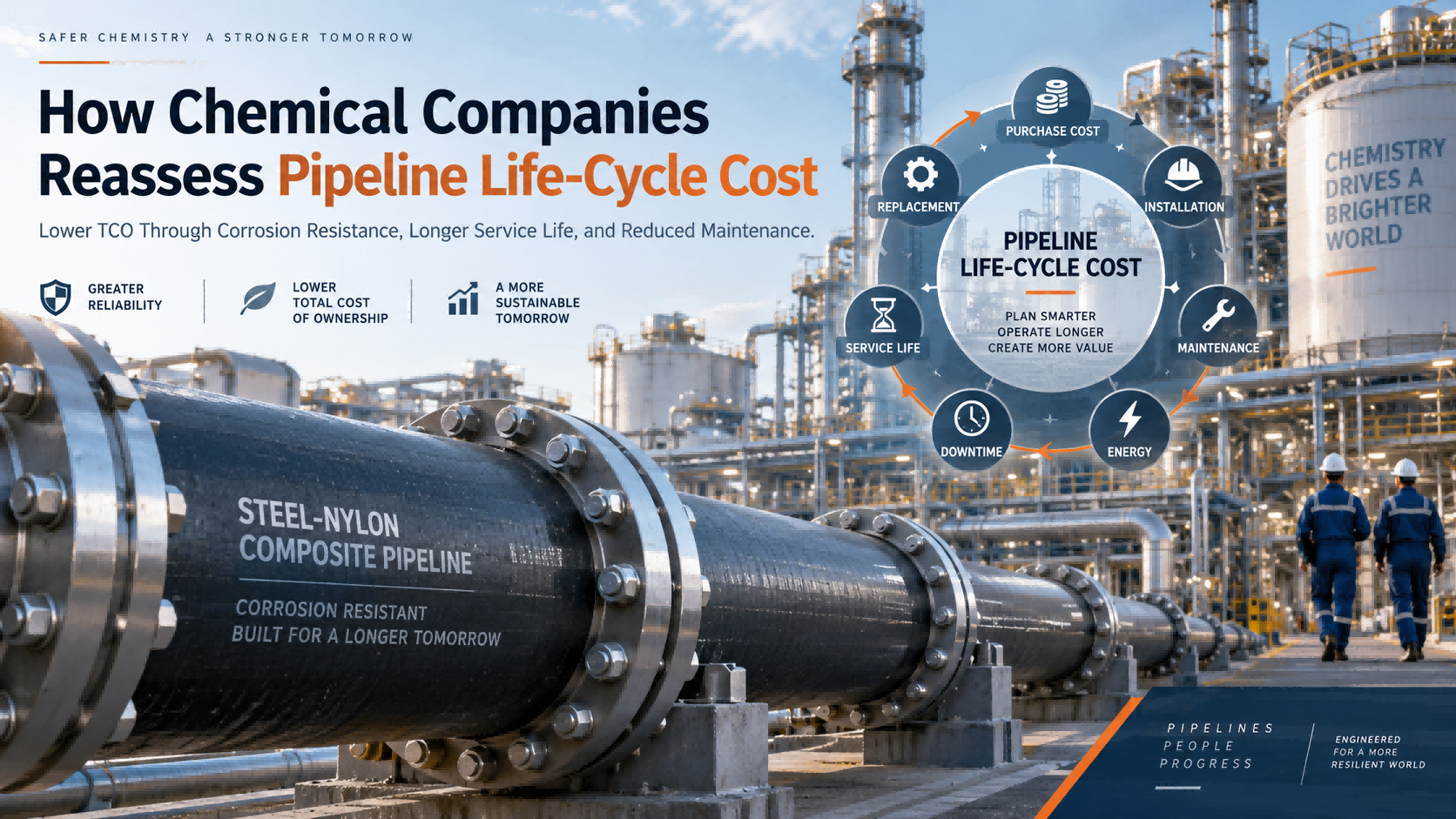
Once a pipeline enters service, additional costs continue to accumulate throughout its operating life, including:
-
Installation costs
-
Anti-corrosion treatment
-
Inspection and maintenance
-
Leak repair
-
Cleaning and descaling
-
Spare parts
-
Pumping energy
-
Production downtime
-
Pipeline replacement
-
Safety and environmental risks
A pipe with a lower initial price may ultimately cost far more if it requires frequent repair, repeated replacement, or causes unplanned shutdowns.
Therefore, more chemical companies are beginning to reconsider a fundamental question:
Are we purchasing a pipe, or are we purchasing the next 10 to 20 years of reliable fluid transportation?
This is why Total Cost of Ownership (TCO) is becoming increasingly important in industrial pipeline selection.
1. Why Is the Traditional “Price per Meter” Purchasing Model Becoming Inadequate?
Comparing purchase prices is reasonable.
The problem arises when price becomes the primary decision criterion without considering how different piping materials perform over their actual service life.
For ordinary water pipelines, material cost may represent a significant portion of total project expenditure.
But the situation changes dramatically in chemical applications involving:
-
Highly corrosive media
-
Strong alkaline solutions
-
High-chloride environments
-
High-salinity wastewater
-
Brine and salt sludge
-
Chemical mother liquor
-
Slurries containing solid particles
-
High-erosion service
-
Combined corrosion and abrasion
In these conditions, economic performance is determined not simply by:
Purchase Price
but by:
Service Life + Maintenance + Downtime + Energy Consumption + Replacement Cost
In other words:
Acquisition Cost + Operating Cost + Risk Cost
2. What Is the Total Life-Cycle Cost of an Industrial Pipeline?
In simple terms, the total cost of ownership of an industrial piping system can be expressed as:
TCO = Initial Purchase Cost + Installation Cost + Operating Cost + Maintenance Cost + Downtime Cost + Replacement Cost + Risk Cost
These costs can be divided into seven major categories.
1. Initial Material Cost
The cost of pipes, fittings, flanges, and other system components.
2. Installation Cost
Transportation, lifting, welding, anti-corrosion treatment, connection, site construction, and labor.
3. Operating Cost
Pumping energy, pressure losses, cleaning, descaling, and other long-term operating expenses.
4. Maintenance Cost
Weld repairs, local pipe replacement, lining repair, corrosion inspection, and preventive maintenance.
5. Downtime Cost
Production losses resulting from leakage, blockage, maintenance, or pipeline replacement.
6. Replacement Cost
Removal of old piping, procurement of new piping, reinstallation, testing, and recommissioning.
7. Safety and Environmental Risk Cost
Potential costs associated with leakage, environmental incidents, workplace safety, and production continuity.
Only when these seven categories are considered together can a company understand the true economic cost of a chemical pipeline.
3. Why Can the Initial Purchase Price Hide the Real Cost of a Pipeline?
Consider a chemical plant comparing two piping systems.
Option A has a lower initial investment.
Option B has a higher initial investment.
From a procurement-only perspective, Option A appears more attractive.
But what happens if Option A later develops:
-
Internal corrosion
-
Pitting
-
Weld corrosion
-
Lining delamination
-
Particle erosion
-
Scaling and reduced internal diameter
-
Localized leakage
The cost structure changes completely.
The first repair may require:
Shutdown → Isolation → Drainage → Cleaning → Repair → Corrosion Protection → Testing → Restart
The second intervention may require:
Partial pipeline replacement.
The third may become:
A complete pipeline upgrade.
At that point, the critical question is no longer:
How much does the pipe cost per meter?
It becomes:
How many times will this pipeline need to be repaired or replaced during the life of the plant?
These two questions can lead to completely different material-selection decisions.
4. The First Factor Chemical Companies Should Recalculate: Replacement Frequency
Replacement frequency is one of the most frequently underestimated elements of industrial pipeline economics.
Suppose a chemical project is designed to operate for 20 years.
If one piping material has a relatively short actual service life, the pipeline may need to be replaced several times during that period.
Its real cost is therefore not simply the first purchase.
It may include:
First Purchase + First Installation + Second Purchase + Second Installation + Third Replacement + Additional Maintenance
Every replacement may also require:
-
Shutdown
-
Removal
-
Lifting
-
Hot-work permits
-
Scaffolding
-
Cleaning
-
Process isolation
-
Inspection
-
Hydrostatic testing
Therefore:
Extending pipeline service life does more than save the cost of another batch of pipe.
It may eliminate an entire replacement project.
This is why longer service life can have far greater economic value than a lower purchase price in corrosive chemical facilities.
5. The Second Frequently Overlooked Cost: Production Downtime
For continuous-process chemical plants, downtime can be one of the largest hidden costs associated with piping failure.
The most valuable asset in a chemical plant is not the pipeline itself.
It is:
Production capacity.
If a pipeline leak causes:
-
Reduced plant throughput
-
A process-unit shutdown
-
Production interruption
-
Loss of raw-material transfer
-
Wastewater-system interruption
the resulting economic loss may far exceed the cost of the pipe.
Therefore, pipeline value should not be evaluated only by asking:
“Can it transport the medium?”
A more important question is:
Can it transport the medium reliably for many years while minimizing the probability of unplanned shutdowns?
From this perspective, industrial piping should be regarded as:
Production Reliability Infrastructure
6. How Should Corrosion Cost Be Included in Pipeline TCO?
Corrosion is one of the largest contributors to long-term pipeline costs in chemical plants.
Conventional steel pipelines exposed to certain corrosive environments may experience:
-
Internal corrosion
-
External corrosion
-
Weld corrosion
-
Electrochemical corrosion
-
Pitting
-
Crevice corrosion
-
Wall-thickness loss
To manage these risks, engineering systems may require:
-
Protective coatings
-
Linings
-
Corrosion allowances
-
Periodic wall-thickness inspection
-
Coating maintenance
-
Local welding repairs
-
Periodic replacement
All of these should be included in pipeline life-cycle cost.
Therefore, in highly corrosive environments, the question should not only be:
How can we improve corrosion-maintenance capability?
It should also be:
Can the pipeline material and structure itself reduce exposure to corrosion?
This is one of the key reasons composite piping technologies are gaining attention in industrial applications.
7. Why Should Steel-Nylon Composite Pipe Be Evaluated from a TCO Perspective?
Steel-nylon composite pipe is not simply another material intended to replace conventional piping.
Its fundamental design concept is:
Different materials perform different functions within the same pipe structure.
The steel structure primarily provides:
Mechanical strength and structural support.
The nylon working layer primarily provides:
Media contact protection, corrosion resistance, wear resistance, and reduced scaling tendency.
This design addresses a common challenge associated with single-material piping.
Metals can offer strong structural performance but may require extensive corrosion protection in aggressive chemical environments.
Some non-metallic pipes provide excellent corrosion resistance but may face additional engineering limitations in applications involving:
-
Large diameters
-
Higher pressures
-
Elevated temperatures
-
Long-span above-ground installation
-
Complex mechanical loads
The value of steel-nylon composite construction is therefore based on separating:
Structural Load-Bearing Requirements
from:
Media Resistance Requirements
8. Advantage One: Reducing Long-Term Corrosion-Related Maintenance Costs
In certain weak-acid, strong-alkali, high-salinity, and corrosive industrial environments, the nylon working layer helps prevent the transported medium from directly contacting the steel load-bearing structure.
This differs from conventional solutions that rely primarily on:
Coating + Corrosion Protection + Corrosion Allowance
When the material directly contacting the medium is better suited to the operating environment, it can potentially reduce long-term problems such as:
-
Corrosion-induced wall thinning
-
Perforation
-
Leakage
-
Frequent corrosion inspection
-
Local repair
-
Pipeline replacement
Therefore, the economic comparison should not simply be:
Steel Pipe Price vs. Steel-Nylon Composite Pipe Price
The better comparison is:
20-Year Pipeline System Cost vs. 20-Year Pipeline System Cost
9. Advantage Two: Addressing Corrosion and Wear at the Same Time
Many chemical-process conditions involve more than corrosion alone.
Examples include:
-
Salt sludge
-
Slurry
-
Mother liquor containing solid particles
-
Chemical wastewater
-
Mineral slurry
-
Process circulation fluids
These media may create:
Corrosion + Erosion
at the same time.
This combination can accelerate the failure of conventional piping.
Corrosion weakens the material surface, while solid particles continuously erode or damage the protective layer.
As a result, simply improving corrosion resistance may not solve the entire problem.
Steel-nylon composite pipe combines the structural strength of steel with the corrosion- and wear-resistant characteristics of nylon, making it particularly valuable in industrial conveying systems where corrosion and abrasion occur simultaneously.
10. Advantage Three: A Smooth Inner Surface Can Influence Long-Term Operating Cost
Life-cycle cost includes more than repair expenses.
It also includes:
Energy consumption.
One common problem in industrial pipelines after years of operation is:
Scaling and deposition.
As deposits accumulate, the effective internal diameter decreases.
This can lead to:
Reduced Internal Diameter → Increased Resistance → Higher Pressure Loss → Increased Pumping Energy
In severe cases, it may eventually require:
Mechanical Cleaning → Chemical Cleaning → Shutdown Maintenance
The smooth nylon working surface can help reduce deposition and scaling tendencies under suitable process conditions.
Therefore, another important metric should be included in industrial pipeline assessment:
Hydraulic Performance Over Time
The key question is:
How much of the original hydraulic performance can the pipeline maintain after years of service?
A pipeline may have low friction when newly installed.
That does not mean it will have the same hydraulic characteristics after ten years.
Long-term internal surface condition directly affects energy consumption throughout the system's operating life.
11. Advantage Four: No On-Site Welding Can Change the Installation Cost Structure
In many chemical-plant retrofit projects, replacing a pipeline is difficult not because the pipe itself is difficult to install, but because:
Hot-work management is complex.
In operating chemical plants, oil and gas facilities, and aging industrial units, welding may require:
-
Hot-work permits
-
Gas detection
-
Process isolation
-
Cleaning and purging
-
Fire-watch personnel
-
Certified welders
-
Additional safety procedures
-
Longer construction windows
Our steel-nylon composite pipes use an integrated flange connection design, allowing on-site assembly primarily through bolted flange connections without relying on conventional field welding or heat-fusion joining.
In suitable retrofit projects, this can simplify site installation and reduce the work associated with hot-work procedures.
From a TCO perspective:
The connection method is also part of the cost.
12. Advantage Five: Large-Diameter and Higher-Pressure Capability Expands the Application Range of Composite Piping
Industrial pipeline material selection becomes more difficult as project specifications increase.
At relatively small diameters, many materials may be suitable.
However, as pipeline diameter increases:
DN300 → DN800 → DN1200 → DN1600 → DN2000
and pressure requirements rise at the same time, the number of viable material options can decrease significantly.
Our steel-nylon composite pipe covers a broad range of industrial applications, including:
-
Working pressure: 1.0–4.0 MPa
-
Operating temperature: approximately -36°C to 160°C
-
Large-diameter manufacturing capability: DN2000 and above
-
Integrated flange connections
-
Suitable for various corrosive, abrasive, and demanding industrial conveying conditions
This allows steel-nylon composite pipe to serve not only as a corrosion-resistant alternative, but also as an option for demanding applications involving combinations such as:
Large Diameter + Pressure + Corrosion + Abrasion
Specific material suitability should always be verified according to actual medium composition, concentration, temperature, pressure, flow velocity, solid content, and installation conditions.
13. Why Service Life Alone Does Not Define TCO
Another common misconception in life-cycle cost analysis is that a longer theoretical service life automatically means better economics.
That is not always true.
A more meaningful concept is:
Reliability-Adjusted Service Life
In other words:
How many years can the pipeline operate reliably with acceptable maintenance requirements?
For example, a pipeline may theoretically remain in service for 15 years but require:
-
Annual maintenance
-
Repeated welding repairs
-
Frequent cleaning
-
Multiple local replacements
Its economic performance will be very different from that of a pipeline that operates reliably for 15 years with minimal maintenance.
Therefore, service life should be evaluated together with other performance indicators.
| Evaluation Factor | Traditional Procurement Approach | TCO-Based Approach |
|---|---|---|
| Initial price | Very important | Important |
| Service life | Secondary | Critical |
| Maintenance frequency | Often overlooked | Critical |
| Downtime | Often overlooked | Critical |
| Energy consumption | Rarely considered | Important |
| Scaling | Treated as a technical issue | Treated as an economic issue |
| Replacement frequency | Considered later | Calculated in advance |
| Leakage risk | Assigned to maintenance | Included in material selection |
| Installation method | Construction issue | Included in TCO |
| Safety risk | Evaluated separately | Included in TCO |
This illustrates how industrial pipeline procurement logic is changing.
14. How Can Chemical Companies Build a 10-Year Pipeline TCO Model?
Companies can establish a relatively simple internal model for comparing different piping materials.
Assume the evaluation period is 10 years.
The TCO can be calculated as:
TCO₁₀ = P + I + M + E + D + R + S
Where:
P — Purchase Cost
Initial procurement cost
I — Installation Cost
Construction and installation cost
M — Maintenance Cost
Inspection, repair, and maintenance expenses
E — Energy Cost
Long-term pumping and operating energy consumption
D — Downtime Cost
Production losses caused by maintenance or failure
R — Replacement Cost
Pipeline removal, replacement, and recommissioning cost
S — Safety & Environmental Risk Cost
Potential safety and environmental costs
The same model can then be applied to different alternatives, such as:
-
Carbon steel
-
Stainless steel
-
FRP
-
HDPE
-
Lined steel pipe
-
Steel-nylon composite pipe
Only then can the company reach an economic conclusion that more closely reflects actual plant operation.
15. Chemical Companies Should Consider “Annualized Pipeline Cost” as a New Procurement Metric
Future industrial pipeline procurement can adopt a more meaningful economic indicator:
Annualized Pipeline Cost
This can be calculated as:
Annualized Cost = Total Life-Cycle Cost ÷ Effective Service Life
Companies can go one step further:
Cost per Unit of Fluid Transported
For example:
Unit Transportation Cost = Total Life-Cycle Cost ÷ Total Life-Cycle Throughput
This changes the comparison from simply:
Cost per Meter
to:
Cost per Meter per Year
or even:
Cost per Unit of Fluid Transported
This is particularly important for large chemical projects.
The objective of industrial procurement is not simply to purchase the cheapest equipment.
It is to:
Maintain stable production at the lowest sustainable long-term cost.
16. Which Chemical Pipelines Should Be Prioritized for TCO Reassessment?
Not every industrial pipeline requires a complex life-cycle analysis.
However, several types of pipelines deserve special attention.
1. Pipelines with Repeated Corrosion and Leakage
If a pipeline has already required multiple repairs or replacements over the past few years, continuing to use the same material may simply repeat the same failure cycle.
2. Strong-Alkali Pipelines
Including certain caustic soda and alkaline chemical process systems.
3. High-Salinity Pipelines
Including chloride-rich solutions, high-salinity wastewater, brine, and certain chemical mother liquors.
4. Slurry Pipelines Containing Solid Particles
When corrosion and erosion occur simultaneously, conventional piping materials may experience accelerated deterioration.
5. Large-Diameter Circulation Pipelines
The larger the pipeline, the greater the construction effort and potential shutdown cost associated with each replacement.
6. Critical Process Pipelines That Are Difficult to Shut Down
For continuous-process plants, reliability may be economically more important than initial material price.
7. Aging-Plant Retrofit Projects
Older plants frequently face limited construction space, strict hot-work requirements, and short shutdown windows. Installation efficiency and future maintenance requirements therefore become particularly important.
17. Why Is a Trial Section a Practical Way to Validate Pipeline TCO?
When evaluating a new piping material, a chemical company does not necessarily need to replace an entire plant system immediately.
A more practical approach is the:
Trial Section Strategy
The company can begin with areas experiencing the most severe operating conditions, such as:
-
Highly corroded pipeline sections
-
Pump outlet sections exposed to high erosion
-
Elbows
-
Tees
-
Pipe sections upstream and downstream of valves
-
Salt-sludge pipelines
-
Mother-liquor pipelines
-
Wastewater pipelines
A typical trial installation may involve:
100–500 meters of pipeline
The company can then monitor:
-
Corrosion
-
Wear
-
Internal scaling
-
Pressure-loss changes
-
Leakage
-
Maintenance frequency
-
Flange connection condition
-
Actual maintenance cost
Once real operating data has been collected, the new system can be compared with the original piping solution from a TCO perspective.
This approach can provide more meaningful engineering evidence than relying solely on laboratory material properties.
18. Steel-Nylon Composite Pipe Should Not Compete Only on “Price per Meter”
As a manufacturer of steel-nylon composite pipes, we do not believe that steel-nylon composite pipe is the correct solution for every industrial application.
Responsible pipeline selection should always consider:
-
Transported medium
-
Chemical concentration
-
Temperature
-
Pressure
-
Flow velocity
-
Solid-particle content
-
Pipe diameter
-
Installation method
-
Operating environment
-
Required service life
However, the value of steel-nylon composite piping becomes particularly significant when:
Existing piping systems already generate high life-cycle costs because of corrosion, abrasion, scaling, frequent maintenance, or repeated replacement.
In these situations, the company is no longer looking for:
Another Pipe
It is looking for:
A Lower-TCO Pipeline Solution
In other words:
An industrial conveying system designed to reduce long-term ownership cost.
19. Chemical Pipeline Procurement Is Moving from CAPEX to TCO
Historically, procurement departments have focused heavily on:
CAPEX — Capital Expenditure
Increasingly, companies are also paying attention to:
OPEX — Operating Expenditure
The next stage is:
TCO — Total Cost of Ownership
These three approaches represent very different decision-making philosophies.
CAPEX Thinking
Which pipe is the cheapest to purchase?
OPEX Thinking
Which pipe has the lowest operating and maintenance cost?
TCO Thinking
Which piping system provides the lowest overall cost and the highest operating stability throughout the entire project life cycle?
For industrial projects designed to operate for 10, 20, or more years, the third question is increasingly important.
20. Conclusion: The Lowest-Cost Pipe Is the One with the Lowest Life-Cycle Cost
Industrial pipeline materials are entering a new stage of competition.
The future question will no longer simply be:
Carbon steel, stainless steel, plastic pipe, or composite pipe?
Instead, it will be:
Which material can keep the production system operating reliably for longer at the lowest total cost?
Once a company places the following factors into the same economic model:
Purchase + Installation + Corrosion + Wear + Scaling + Energy + Maintenance + Downtime + Replacement
many pipeline solutions that initially appear more expensive may prove to be significantly more economical over the long term.
This is also where the value of steel-nylon composite piping becomes more apparent.
By using steel to provide mechanical strength and a nylon working layer to improve corrosion and wear resistance, while combining a smooth internal surface, integrated flange connections, large-diameter manufacturing capability, and a broad pressure range, our objective is not simply to answer:
“Can this pipe transport the medium?”
The more important question is:
“How can we help an industrial pipeline operate longer and more reliably while reducing maintenance, replacement, and shutdown costs throughout its service life?”
For chemical companies evaluating their next pipeline project, it may therefore be time to change the question from:
How much does this pipe cost?
to:
How much will this pipeline cost us over the next 10–20 years?
That is the real cost of industrial piping.
How Highly Corrosive and Abrasive Chemical Environments Are Driving the Adoption of New Pipeline Materials
Chemical Plant Pipeline Leak Management Is Shifting from Repair to Prevention