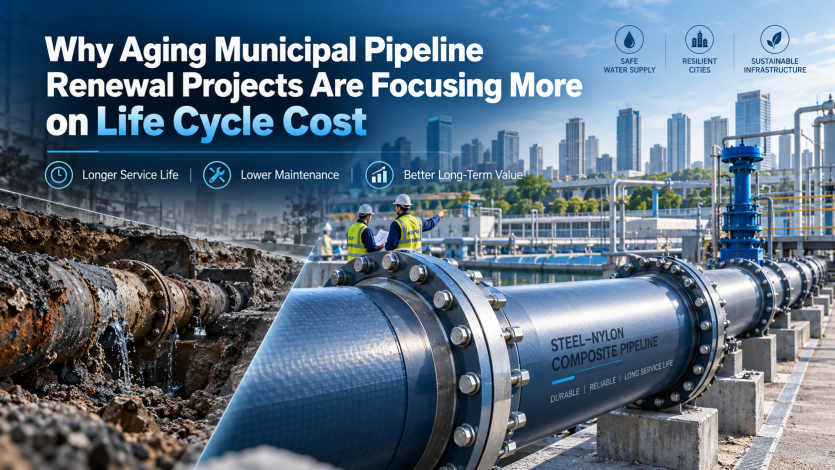
Why Aging Municipal Pipeline Renewal Projects Are Focusing More on Life Cycle Cost
A large number of cities around the world are entering a period of intensive infrastructure renewal.
Many water distribution networks, industrial park utility pipelines, drainage systems, and raw water transmission lines have already been in service for decades. As these systems age, problems such as corrosion, leakage, pipe bursts, scaling, and declining hydraulic efficiency are becoming increasingly common.
In the past, municipal pipeline renewal projects often focused on one simple question when selecting pipe materials:
Which pipe has the lowest purchase price?
Today, however, more infrastructure owners are asking a different and much more important question:
How much will this pipeline actually cost over the next 30, 40, or even 50 years?
This is the concept of Life Cycle Cost (LCC), also commonly discussed in industrial procurement as Total Cost of Ownership (TCO).
For large-diameter municipal pipelines, trunk water mains, and critical transmission systems where shutdowns are difficult or costly, the real economics of a pipeline are determined not only by the initial pipe price, but also by maintenance, shutdowns, leakage, repairs, replacement frequency, and long-term operational risk.
1. Why Are Aging Municipal Pipeline Networks Entering a Major Renewal Cycle?
Many underground pipeline networks were built decades ago and have now reached a stage where material aging and accumulated deterioration are becoming increasingly visible.
Typical problems include:
-
Internal and external corrosion
-
Aging joints and leakage
-
Internal scaling
-
Wall thickness loss
-
Localized pitting
-
Joint stress caused by ground settlement
-
Water hammer damage
-
Reduced hydraulic capacity
-
Localized pipe bursts
-
Increasing water loss
These problems cannot always be solved by simply replacing a short section of damaged pipe.
For a major urban water main, a single pipe burst can lead to road excavation, traffic restrictions, water service interruptions, emergency repairs, and substantial indirect economic losses.
As a result, municipal utilities are no longer asking only:
How can we replace the old pipeline?
They are increasingly asking:
What material should the next-generation pipeline use so that the next replacement cycle can be delayed as long as possible?
2. The Most Expensive Part of a Municipal Pipeline Is Not Necessarily the Pipe Itself
During the initial budgeting stage, it is easy to focus heavily on pipe price.
A simple calculation might look like:
Pipe Price × Pipeline Length
At first glance, this appears to represent the main material cost of the project.
However, for a municipal pipeline expected to operate for 30 years or longer, this figure represents only one part of the true cost.
A more complete life cycle cost model should include:
LCC = Initial Investment + Installation Cost + Maintenance Cost + Energy Cost + Leakage Loss + Shutdown Cost + Replacement Cost
In other words:
Life Cycle Cost = Initial Cost + Installation + Maintenance + Energy + Leakage + Downtime + Replacement
Once these factors are included, the economic comparison between different pipe materials can change significantly.
A pipe with a lower initial purchase price but frequent repair and replacement requirements may ultimately cost more over 30 years than a more durable pipeline system with somewhat higher initial investment but lower maintenance requirements.
3. Initial Purchase Cost Is Becoming Only One Part of the Decision
Consider a city planning a major water transmission pipeline.
Option A
The initial investment is relatively low, but the pipeline may require repeated maintenance and partial replacement during its operating life.
Option B
The initial investment is somewhat higher, but the pipeline offers better resistance to corrosion and abrasion and requires less maintenance.
If only the initial procurement price is compared, Option A may appear more attractive.
But over 20, 30, or even 50 years, the economics may look very different.
This is why more infrastructure projects are evaluating:
CAPEX + OPEX
CAPEX represents the initial capital expenditure.
OPEX represents the long-term operating and maintenance expenditure.
Modern municipal infrastructure planning is increasingly based on one important principle:
The objective should not be to minimize CAPEX alone, but to optimize the total cost of the infrastructure throughout its service life.
4. Maintenance Is Becoming One of the Largest Hidden Costs in Municipal Pipeline Networks
Underground municipal pipelines are very different from easily accessible industrial piping inside a plant.
For underground infrastructure, the cost of repairing a failure can be much greater than the value of the damaged pipe itself.
A typical repair process may involve:
Road excavation
→ Traffic control
→ Pipeline location
→ Water shutdown
→ Emergency repair
→ Pipe section replacement
→ Backfilling
→ Pavement restoration
As a result, even a failure involving only a few meters of pipeline may generate repair costs many times greater than the value of the replacement pipe.
For major urban water mains or utility pipelines serving industrial parks, the indirect losses caused by system shutdowns may be even more significant.
From an LCC perspective:
Reducing the frequency of pipeline failures is itself a major form of cost reduction.
5. Why Corrosion Can Significantly Increase Municipal Pipeline Life Cycle Cost
For conventional metallic pipelines, corrosion is one of the major factors affecting long-term service life.
Corrosion can result from:
-
Transported media
-
Soil conditions
-
Groundwater
-
Chloride ions
-
Dissolved oxygen
-
Electrochemical reactions
-
Stray electrical currents
As operating time increases, pipe walls may gradually become thinner.
Localized pitting may also develop in certain areas.
The challenge is that corrosion usually does not occur suddenly. It accumulates gradually over many years.
As a result, pipeline operators may need to continuously invest in:
-
Inspection
-
Maintenance
-
Corrosion protection
-
Repair
-
Partial replacement
All of these costs contribute to the life cycle cost of the pipeline.
Composite piping systems with a corrosion-resistant polymer inner layer can reduce direct contact between the transported medium and the steel structural layer.
This is one of the reasons why composite piping technologies are receiving increasing attention in certain municipal and industrial transmission projects.
6. Scaling and Internal Surface Condition Can Also Affect Decades of Operating Cost
Life cycle cost is not determined by maintenance alone.
It is also closely related to hydraulic efficiency.
During long-term operation, problems such as:
-
Corrosion
-
Scaling
-
Sediment accumulation
-
Increasing internal surface roughness
can reduce the hydraulic efficiency of a pipeline.
To maintain the same flow rate, pumping systems may require more energy.
For a large water transmission system operating continuously for 20 or 30 years, even a relatively small increase in pumping energy can accumulate into a significant operational expense.
Therefore, modern water pipeline selection increasingly considers:
Long-term internal surface condition, not only the hydraulic performance of a newly installed pipe.
A smooth polymer internal surface can help maintain more stable hydraulic characteristics under appropriate operating conditions.
This is another reason why steel–nylon composite piping deserves consideration for certain water transmission applications.
7. Large-Diameter Pipelines Make Life Cycle Cost Even More Important
As pipeline diameter increases, replacement generally becomes more difficult and expensive.
For example:
DN800
DN1000
DN1200
DN1600
and even DN2000
Once pipelines of these sizes are installed in municipal water transmission systems, raw water projects, or industrial utility networks, they are normally expected to remain in service for many years.
The reason is straightforward.
Replacing a large-diameter pipeline may involve:
-
Large-scale excavation
-
Heavy lifting equipment
-
Road closures
-
Larger construction areas
-
More complicated project coordination
-
Longer shutdown periods
Therefore, large-diameter pipeline projects should not focus only on:
How much does the pipe cost per meter?
A more important question is:
How many times will this pipeline need to be repaired or replaced over the next 30 years?
From this perspective, extending pipeline service life has significant economic value.
8. Why Steel–Nylon Composite Pipe Deserves Consideration in Municipal Pipeline Material Selection
The basic concept of steel–nylon composite pipe is not to rely on a single material to solve every engineering problem.
Instead, it combines the advantages of two different materials within one pipeline structure.
In simple terms:
The steel structure provides mechanical strength and pressure resistance, while the nylon layer provides corrosion resistance, abrasion resistance, and a stable internal transport surface.
This design concept is particularly relevant for pipeline systems that must simultaneously address:
Pressure + Corrosion + Abrasion + Long Service Life
9. Advantage 1: Steel Structure Provides Mechanical Strength and Pressure Resistance
For municipal trunk pipelines, particularly large-diameter or relatively high-pressure water transmission systems, structural strength is critical.
Steel provides mature mechanical performance and excellent load-bearing capability.
In a steel–nylon composite pipe, the steel structure carries the primary mechanical loads, allowing the pipeline to benefit from the corrosion-resistant characteristics of the polymer layer while maintaining structural rigidity.
This can be particularly valuable in applications such as:
-
Long-distance water transmission
-
Large-diameter pipelines
-
Pump discharge lines
-
High-elevation water transmission
-
Industrial park utility networks
In these applications, structural stability is an essential design consideration.
10. Advantage 2: Nylon Layer Separates the Medium from the Steel Structure
The internal surface of a steel–nylon composite pipe uses reinforced nylon as the transport interface.
The structural concept is:
Transported Medium → Nylon Layer → Steel Structure
rather than allowing the transported medium to remain in direct contact with the steel.
This design can reduce the continuous impact of internal corrosion on the steel structural layer.
The benefit can become particularly important when transporting water or industrial fluids containing:
-
Salts
-
Chlorides
-
Corrosive ions
-
Other aggressive components
For industrial water systems, utility networks in industrial parks, and certain corrosive water transmission applications, this structural approach can provide significant material advantages.
11. Advantage 3: Corrosion Resistance Can Be Combined with Abrasion Resistance
Municipal pipeline systems are not always free from abrasion.
Some systems may transport:
-
Raw water
-
Sand-containing water
-
Industrial circulating water
-
Water containing suspended solids
-
Fluids carrying a certain amount of particulate matter
Local erosion can become especially significant at:
-
Elbows
-
Tees
-
Reducers
-
Pump discharge sections
where velocity changes and turbulence may increase.
Reinforced nylon offers good abrasion resistance and can provide an additional protective layer under suitable operating conditions.
For applications where corrosion and abrasion occur simultaneously, simply upgrading to a higher-grade metal is not always the only engineering option.
12. Advantage 4: Suitable for Large-Diameter Pipeline Engineering
As the diameter of conventional non-metallic pipelines increases, engineers must pay increasing attention to:
-
Ring stiffness
-
Structural support
-
Vacuum conditions
-
Installation deformation
-
Pressure capacity
Steel–nylon composite pipe uses a steel structural framework, providing another design approach for large-diameter composite piping.
Depending on project requirements, different diameters and pressure classes can be engineered for specific operating conditions.
Large-diameter pipeline solutions can be evaluated according to:
-
Pipe diameter
-
Design pressure
-
Operating temperature
-
Transported medium
-
Flow velocity
-
Installation conditions
-
Required service life
This makes steel–nylon composite piping relevant to large municipal water transmission, industrial utility systems, and long-distance pipeline projects.
13. Advantage 5: Flanged Connections Can Simplify Installation and Maintenance
In many industrial and municipal projects, connection methods directly affect installation efficiency and future maintenance.
Steel–nylon composite pipelines can be designed with flanged connections.
This can simplify connections to:
-
Valves
-
Pumps
-
Equipment
-
Adjacent pipe sections
and reduce the need for complicated field fabrication.
In certain projects, flanged systems can also reduce on-site welding and hot-work requirements.
This can provide practical advantages in:
-
Aging pipeline rehabilitation
-
Operating facilities
-
Industrial parks
-
Areas with strict construction safety requirements
14. What Should Be Compared When Replacing an Aging Pipeline?
When planning a municipal pipeline renewal project, it is not sufficient to compare only:
Pipe Price
A more complete material evaluation matrix should be developed.
For example, the comparison should include:
-
Initial procurement cost
-
Pressure capability
-
Corrosion resistance
-
Abrasion resistance
-
Structural rigidity
-
Installation method
-
Maintenance requirements
-
Hydraulic performance
-
Expected service life
-
Replacement frequency
-
Life cycle cost
Different materials—including steel, FRP, HDPE, and steel–nylon composite pipe—have different advantages and limitations.
There is no single pipe material that is ideal for every municipal pipeline project.
Correct material selection must always be based on actual operating conditions.
However, when corrosion resistance, abrasion resistance, structural strength, pressure capability, and large diameter are required simultaneously, steel–nylon composite piping deserves serious consideration during material evaluation.
15. Municipal Pipeline Renewal Projects Should Consider a 30-Year Cost Model
For major infrastructure projects, a more rational engineering approach is to establish a 30-year or even 50-year life cycle cost model.
For example:
Option A
Initial investment: 100
Maintenance frequency: Relatively high
Repairs during operation: Multiple
Potential major replacement within 20–30 years
Option B
Initial investment: 120
Maintenance frequency: Lower
Repairs during operation: Fewer
Longer overall replacement cycle
If the comparison is limited to Year 1:
Option A appears cheaper.
But if the analysis covers 30 years:
Option B may ultimately have a lower accumulated cost.
This is the real purpose of life cycle cost analysis.
16. Water Shutdown and Production Downtime Should Be Included in Pipeline Material Selection
Traditional project budgets often calculate:
Material + Installation
For critical pipeline systems, however, another factor should be included:
Downtime Cost
When a major urban water main fails, it may affect:
-
Residential water supply
-
Commercial operations
-
Industrial users
-
Fire protection systems
If a utility pipeline in an industrial park fails, the impact can extend to multiple production facilities.
Therefore:
Reliability itself has economic value.
If a pipe material can reduce the frequency of failures and maintenance interventions, its value cannot be measured simply by its cost per meter.
17. The Procurement Logic for Municipal Pipelines Is Changing
Future infrastructure procurement is likely to place less emphasis on:
Lowest Initial Price
and more emphasis on:
Lowest Life Cycle Cost
In other words, the decision-making process is gradually shifting from:
Lowest Purchase Price
to:
Lowest Long-Term Total Cost
This reflects a broader transformation in infrastructure management.
In the past, the objective was often:
Build the pipeline.
Today, the objective is increasingly:
Operate the infrastructure reliably for decades.
This represents the transition from a construction mindset to an asset management mindset.
18. Pipe Material Selection Ultimately Determines When the Next Repair Will Be Required
For an underground urban pipeline, successful engineering should not be judged only by how well the system performs immediately after installation.
The real test is whether the pipeline can continue operating reliably after:
10 years,
20 years,
or even 30 years.
Therefore, the material selected today can influence:
When the next repair occurs,
When the next road excavation is required,
When the next water shutdown occurs,
and even when the next major investment cycle begins.
From this perspective:
A pipeline is not simply a one-time purchase. It is a long-term infrastructure investment.
19. The Value of Steel–Nylon Composite Pipe Should Be Evaluated Over the Entire Service Life
The value of steel–nylon composite pipe should not be reduced to a simple question of whether it is cheaper per meter than another pipe material.
A more appropriate evaluation should compare:
-
Expected service life
-
Corrosion risk
-
Abrasion risk
-
Pressure capability
-
Maintenance frequency
-
Downtime
-
Replacement interval
-
Energy consumption
-
Installation complexity
-
30-year accumulated cost
For pipeline systems requiring:
High Strength + Corrosion Resistance + Abrasion Resistance + Large Diameter + Long-Term Reliability
steel–nylon composite piping can be an important solution to include in the technical evaluation.
20. Conclusion: The Future of Municipal Pipeline Renewal Is Not About the Lowest Price, but About Longer Reliable Operation
Urban underground pipeline networks are long-term infrastructure assets.
Once installed, the ideal objective is not to replace them again after only a few years, but to keep them operating safely and reliably for as long as reasonably possible.
For this reason, aging municipal pipeline renewal is gradually moving toward a new material-selection philosophy:
From purchase-price-driven decisions to life-cycle-cost-driven decisions.
Future pipeline solutions will increasingly need to balance:
Strength, Corrosion Resistance, Abrasion Resistance, Installation, Maintenance, and Long-Term Economics.
Steel–nylon composite pipe combines:
Steel Structural Strength + Reinforced Nylon Corrosion and Abrasion Resistance
and can provide an alternative material solution for municipal water transmission, industrial park utility networks, large-diameter pipelines, and selected complex water service applications.
For project owners planning to construct or upgrade major pipeline systems, instead of asking only:
“Which pipe has the lowest price per meter?”
it may be more useful to ask:
“Which solution will deliver the lowest total cost over the next 30 years?”
That question is becoming increasingly important in the next generation of municipal pipeline infrastructure renewal.
Engineering Information Recommended for Municipal Pipeline Material Selection
For aging pipeline rehabilitation, large-diameter water transmission projects, or industrial utility network upgrades, the following information should be evaluated during the material-selection stage:
Pipe Diameter
Design Pressure
Operating Temperature
Transported Medium
Flow Velocity
Pipeline Length
Installation Environment
Expected Service Life
Based on these parameters, different material solutions—including carbon steel, stainless steel, HDPE, FRP, and steel–nylon composite pipe—can be compared using a dedicated Life Cycle Cost (LCC) model.
This approach allows project owners, engineers, and EPC contractors to move beyond initial purchase price and identify a pipeline solution that delivers better long-term technical and economic performance.
What Pipe Material Demands Will Be Driven by the Growth of Seawater Desalination Projects?
What Pipeline Opportunities Will Be Created by Global Urban Water Network Renewal?