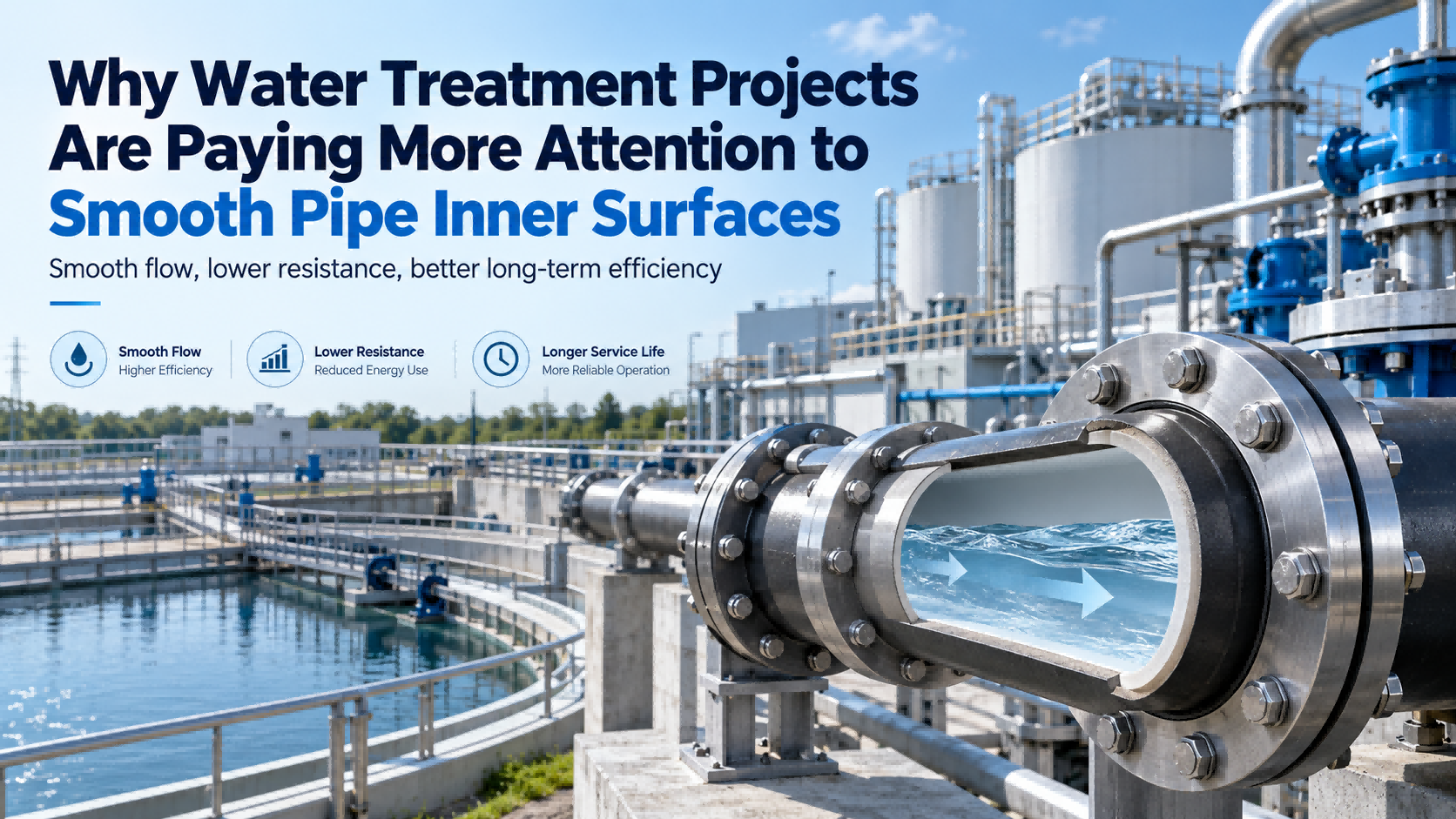
Why Water Treatment Projects Are Paying More Attention to Smooth Pipe Inner Surfaces
In many traditional water treatment projects, pipeline selection has usually focused first on several obvious parameters:
-
Nominal diameter
-
Design pressure
-
Operating temperature
-
Corrosion resistance
-
Pipe material cost
-
Installation method
However, as large-scale water treatment plants, industrial wastewater treatment systems, desalination projects, circulating water systems, and high-salinity water treatment projects place greater emphasis on long-term operating costs, one factor that was often underestimated in the past is receiving increasing attention:
the smoothness of the pipe's inner surface.
For a pipeline designed to operate for 10, 20, or even more years, its function is not simply to transport water from Point A to Point B.
The condition of the inner surface continuously affects:
hydraulic resistance, pumping energy consumption, sediment accumulation, scaling, biofilm formation, effective flow area, cleaning frequency, and overall system efficiency.
Therefore, in modern water treatment projects, whether a pipeline can maintain a smooth, stable, and corrosion-resistant internal surface over the long term is becoming an increasingly important material-selection criterion.
For steel–nylon composite pipes, this is also one of their key technical advantages in water treatment and industrial fluid transportation systems.
1. Why Does Pipe Inner-Surface Roughness Affect the Entire Water Treatment System?
From a fluid mechanics perspective, liquid flowing through a pipeline must overcome both friction losses along the pipe and local resistance caused by fittings and equipment.
Typical pressure-loss calculations consider factors such as:
-
Pipe diameter
-
Flow velocity
-
Pipeline length
-
Fluid properties
-
Internal pipe roughness
-
Local resistance from elbows, valves, tees, and other fittings
Among these factors, the condition of the pipe's inner wall directly affects friction between the fluid and the pipe surface.
Under the same operating conditions:
the rougher the internal surface, the greater the hydraulic resistance tends to be; the smoother the surface, the easier the fluid can flow.
For a small system with only a few dozen meters of piping, this difference may not seem significant.
But for pipelines extending:
500 meters, 1 kilometer, 5 kilometers, or even longer,
or for large-diameter main pipelines such as DN500, DN800, and DN1200,
even relatively small differences in hydraulic efficiency can translate into substantial energy-cost differences after thousands or tens of thousands of operating hours.
This is why modern engineering design is increasingly moving beyond the simple question:
“Can this pipe be used?”
Instead, engineers are asking:
“Will this pipeline still maintain stable hydraulic performance after 10 years of operation?”
These are two fundamentally different approaches to pipeline selection.
2. Smooth Inner Surfaces Directly Affect Pumping Energy Consumption
Many water treatment systems operate continuously, 24 hours a day.
Examples include:
-
Raw water transmission systems
-
Filtration systems
-
Circulating water systems
-
Backwash systems
-
RO pretreatment systems
-
Concentrated brine pipelines
-
Industrial wastewater reuse systems
In these systems, even a relatively small increase in pressure loss per meter can become significant when accumulated across long pipeline distances and many years of continuous operation.
The principle is simple:
The greater the pipeline resistance, the higher the pump head required to maintain the same flow rate.
Higher pump head usually means:
-
Higher motor power requirements
-
Increased electricity consumption
-
Greater pump operating load
-
Higher system operating costs
Therefore, from a life-cycle perspective, pipe purchase cost represents only one part of the total project cost.
For large water treatment projects, the more meaningful economic consideration is:
CAPEX + OPEX
or:
Initial Capital Cost + Long-Term Operating Cost
If a pipeline has a low initial purchase price but gradually develops corrosion, scaling, deposits, or reduced effective flow area, its long-term economic performance may be much less attractive than expected.
3. What Matters Is Not Just Being Smooth When New — but Remaining Smooth for Years
This is one of the most frequently overlooked issues in pipeline selection.
Almost every new pipeline has relatively good internal surface conditions when it is first installed.
After several years of operation, however, different pipe materials may behave very differently.
For example, carbon steel pipelines may experience:
Corrosion → Rust Formation → Increased Surface Roughness → More Deposits → Higher Hydraulic Resistance
In water containing salts, chlorides, or other aggressive components, this process may occur even faster.
Scaling can create a similar cycle:
Initial Scale Formation → Increased Surface Roughness → Greater Particle Adhesion → Further Scale Accumulation
This is a progressive process.
Therefore, high-quality water treatment pipeline design should evaluate both:
Initial Hydraulic Performance
and
Long-Term Hydraulic Performance
For infrastructure expected to operate for decades, the second factor is often more important.
4. Why Do Rougher Pipe Surfaces Encourage Sediment Accumulation?
Water treatment pipelines do not always transport perfectly clean water.
Many systems contain substances such as:
-
Suspended solids
-
Fine particles
-
Salts
-
Iron and manganese compounds
-
Sand and silt
-
Sludge
-
Microorganisms
-
Crystalline solids
-
Corrosion products
When the pipe's inner surface is rough, microscopic irregularities can create localized low-velocity zones.
These areas may become starting points for particle accumulation.
Once particles begin to adhere to the surface, the pipe wall becomes even more irregular, making it easier for additional solids to accumulate.
This can create a progressive cycle:
Rough Surface → Local Deposition → Flow-Field Changes → More Deposition
This phenomenon deserves particular attention in pipelines transporting sludge, solids-bearing wastewater, mineralized water, and high-salinity industrial water.
5. Internal Surface Smoothness Can Also Influence Scaling Behavior
Scaling is one of the most common problems in water treatment systems.
Typical deposits may include:
-
Calcium carbonate scale
-
Sulfate scale
-
Silica scale
-
Iron oxide deposits
-
Salt crystallization
-
Mixed deposits
It is important to clarify one point:
A smooth pipe surface does not eliminate chemical scaling.
Scaling still depends strongly on factors such as:
-
Water chemistry
-
Temperature
-
Concentration
-
pH
-
Ionic composition
-
Operating conditions
However, from an engineering perspective, a smoother and chemically stable internal surface can help reduce opportunities for mechanical attachment and retention of deposits.
This becomes particularly important in systems involving continuous recirculation, concentration, or high-salinity fluids.
For this reason, more water treatment projects are moving beyond simply selecting a “corrosion-resistant pipe.”
Instead, they are evaluating three factors together:
Corrosion Resistance + Reduced Deposition + Low Hydraulic Resistance
6. Inner-Surface Condition Also Matters for Biofilm Control
Biofilm formation is another long-term concern in municipal water systems, industrial circulating water systems, and certain water treatment facilities.
Microorganisms tend to attach more easily to:
-
Surface defects
-
Existing deposits
-
Corrosion products
-
Low-flow zones
-
Rough internal surfaces
Therefore, corrosion and biological fouling are often interconnected rather than completely separate problems.
A typical sequence may be:
Pipe Wall Corrosion
↓
Accumulation of Corrosion Products
↓
Increasing Surface Roughness
↓
More Sediment Accumulation
↓
Greater Opportunity for Microbial Attachment
↓
More Difficult Cleaning
When the internal surface remains relatively smooth and stable over time, it can help reduce conditions favorable to complex fouling.
Of course, biofilm control must still be combined with proper water-quality management, disinfection, flow velocity, and operating practices.
7. Why Are Large Water Treatment Projects Increasingly Concerned About Effective Flow Area?
Pipeline capacity is normally calculated according to nominal pipe diameter during the design stage.
However, after many years of operation, the true hydraulic capacity of a pipeline depends on its:
effective internal diameter.
If significant scaling, corrosion products, or sediment accumulate inside the pipe, the actual available flow area may gradually decrease.
This can create the following chain reaction:
Internal Deposits
→ Reduced Effective Diameter
→ Higher Flow Velocity
→ Higher Hydraulic Resistance
→ Higher Pumping Energy Requirement
→ Higher Operating Cost
Therefore, maintaining a stable internal pipe surface is essentially a way of protecting the pipeline's long-term:
Hydraulic Capacity
For large-scale water treatment facilities, this has direct implications for the plant's total processing capacity.
8. Why Is This Especially Important for Large-Diameter Pipelines?
As water treatment projects continue to increase in scale, large-diameter pipelines are becoming increasingly common.
Examples include:
-
DN500
-
DN600
-
DN800
-
DN1000
-
DN1200 and larger
These pipelines often carry a significant percentage of the entire facility's flow.
If their hydraulic performance deteriorates, the impact may extend across the entire water treatment system.
Large-diameter pipeline replacement can also involve:
-
Large-scale shutdowns
-
Civil construction and demolition
-
Heavy lifting equipment
-
Major installation works
-
Custom fabrication of fittings
-
System recommissioning
The cost of replacement can easily exceed the original cost of the pipe itself.
For this reason, major water treatment projects increasingly ask whether a pipeline can deliver:
long-term stable operation after a single installation.
The focus is shifting away from simply comparing initial pipe prices per meter.
9. Why Are Steel–Nylon Composite Pipes Suitable for These Applications?
The engineering concept behind steel–nylon composite pipe is to allow different materials to perform different functions.
In the composite structure:
The steel structural layer provides mechanical strength and pressure-bearing capability, while the nylon inner layer provides corrosion resistance, abrasion resistance, and a relatively smooth fluid-contacting surface.
This structure allows the pipeline to combine:
Mechanical Strength + Internal Corrosion Resistance + Smooth Internal Surface + Reliable Engineering Connections
Compared with systems that rely entirely on metallic material to withstand corrosive fluids, the composite structure helps reduce direct contact between the conveyed medium and the steel structural layer.
For long-term operation, this means that the internal surface is less likely to become severely roughened by metallic corrosion and rust accumulation.
10. Advantage One: Smooth Internal Surface Helps Reduce Long-Term Flow Resistance
The nylon inner layer of a steel–nylon composite pipe provides a relatively smooth fluid-contacting surface.
For continuously operating pipeline systems, this can help reduce frictional resistance and support more stable hydraulic performance over time.
The benefits become especially meaningful in long-distance transmission systems.
For example:
Industrial Park Water Supply
Main transmission pipelines may extend for several kilometers.
Water Treatment Plant Circulating Water Systems
Pipelines may operate continuously throughout the year.
Seawater Desalination Systems
Pumping energy represents a significant part of long-term operating costs.
High-Salinity Industrial Wastewater Systems
Both corrosion and deposition must be considered in addition to energy consumption.
In these applications, maintaining a stable inner-surface condition over many years can be more valuable than simply achieving the lowest initial purchase price.
11. Advantage Two: Reducing the Risk of Internal Roughness Caused by Metal Corrosion
One of the major long-term challenges of conventional carbon steel piping is that its internal surface condition can continue to change as corrosion progresses.
A newly installed carbon steel pipe may initially have an acceptable internal surface.
Over time, however, it can develop:
-
Pitting
-
General corrosion
-
Rust products
-
Irregular internal surfaces
These changes may eventually affect:
-
Hydraulic efficiency
-
Water quality
-
Pipeline service life
-
Cleaning frequency
-
Pumping energy consumption
In steel–nylon composite pipe, the nylon layer isolates the conveyed medium from the steel structural layer.
This helps reduce the risk of internal-surface deterioration caused by metallic corrosion.
For this reason, steel–nylon composite pipe can provide particular value in corrosive industrial water, high-salinity water, circulating water, and complex wastewater systems.
12. Advantage Three: Combining Corrosion Resistance with Abrasion Resistance
Not every water treatment pipeline carries clean water.
Industrial systems may transport:
-
Solids-bearing wastewater
-
Sand-containing water
-
Sludge
-
Concentrated brine
-
Crystalline slurry
-
Process wastewater
This means that pipeline materials may need to resist not only corrosion, but also abrasive wear caused by solid particles.
If the inner surface gradually becomes rough due to particle erosion, long-term hydraulic performance can also deteriorate.
Steel–nylon composite pipe combines corrosion resistance with abrasion resistance, making it suitable for many operating environments where:
corrosion and wear occur simultaneously.
This is a significant difference compared with pipeline materials designed primarily for clean-water service.
13. Advantage Four: Steel Structure Provides Higher Mechanical Reliability
Many industrial water treatment projects have demanding requirements for:
-
Pressure
-
Diameter
-
Mechanical strength
-
Structural stability
This is particularly important in:
-
Large-diameter main pipelines
-
High-head pumping stations
-
Long-distance pipelines
-
Industrial park utility networks
-
Mining water treatment systems
-
Chemical wastewater systems
Corrosion resistance alone is not sufficient.
Engineers must also consider:
-
Internal pressure
-
Water hammer
-
Installation loads
-
Support loads
-
External mechanical impact
-
Flanged connections
-
Valve weight
-
Pump discharge vibration
The steel structure of a steel–nylon composite pipe provides mechanical support, while the nylon inner layer protects the fluid-contacting surface.
This concept — allowing each material to perform the function it does best — is one of the major advantages of composite pipeline technology.
14. Integrated Flange Design Is Also Important in Water Treatment Projects
In real pipeline systems, failures often occur not in straight pipe sections but at:
connection points.
Typical critical locations include:
-
Flanged joints
-
Elbows
-
Tees
-
Pump outlets
-
Valve connections
-
Reducers
Therefore, a reliable pipeline system cannot focus only on the straight pipe itself.
In our steel–nylon composite pipe design, significant attention is given to the integrity of the pipe-to-flange connection.
Integrated flange structures can help improve the overall consistency and reliability of the piping system.
This is particularly important in water treatment projects where pipelines frequently connect to:
-
Pumps
-
Valves
-
Filters
-
Heat exchangers
-
Membrane systems
-
Other treatment equipment
15. Which Water Treatment Systems Should Pay Particular Attention to Internal Surface Smoothness?
1. Raw Water Transmission Systems
Especially long-distance, high-flow raw water pipelines.
Key considerations include:
-
Hydraulic efficiency
-
Pumping energy consumption
-
Sediment accumulation
-
Long-term transmission capacity
2. Industrial Circulating Water Systems
Circulating water systems operate continuously and may experience changes in temperature, concentration, and water chemistry.
Key concerns include:
-
Corrosion
-
Scaling
-
Biological fouling
-
Energy consumption
3. High-Salinity Wastewater Systems
These are commonly found in industries such as:
-
Chemical processing
-
Coal chemical processing
-
Salt chemical production
-
Zero-liquid-discharge systems
Key concerns include:
-
Chloride-related corrosion
-
Salt deposition
-
Crystallization
-
Combined corrosion and scaling
Under such operating conditions, conventional carbon steel can face significant long-term maintenance challenges.
4. Seawater and Desalination Systems
Seawater places high demands on corrosion resistance, particularly for metallic materials.
At the same time, large-scale desalination facilities are energy-intensive.
Therefore, any factor that may influence pumping efficiency deserves careful evaluation.
5. Sludge and Solids-Bearing Wastewater Systems
These pipelines may face corrosion, abrasion, and sediment accumulation simultaneously.
Material selection therefore needs to consider:
Corrosion Resistance + Abrasion Resistance + Smooth Internal Surface
rather than focusing on corrosion alone.
16. Why Is Comparing Pipe Price Alone No Longer Enough?
Consider two pipeline options.
Pipeline A has a lower initial purchase price.
However, after several years of operation:
-
Significant corrosion develops
-
Internal roughness increases
-
Scaling begins
-
Pumping pressure increases
-
Annual cleaning becomes necessary
-
Certain sections require replacement
Pipeline B has a somewhat higher initial cost, but provides:
-
More stable internal surface conditions
-
Lower corrosion risk
-
Longer cleaning intervals
-
More stable energy consumption
-
Longer service life
From the perspective of the entire operating period, Pipeline B may actually be the more economical solution.
This is why modern water treatment projects increasingly evaluate:
Total Cost of Ownership — TCO
A meaningful TCO analysis should include:
Pipe Purchase Cost
Installation Cost
Pumping Electricity Cost
Cleaning and Maintenance Cost
Shutdown Losses
Pipeline Replacement Cost
System Service Life
Rather than simply comparing:
USD/m or RMB/m
A lower unit price does not necessarily mean a lower total project cost.
17. Water Treatment Pipeline Selection Is Evolving from Material Procurement to System Optimization
In the past, pipelines were often treated as relatively simple auxiliary equipment.
As industrial facilities become larger, environmental requirements become stricter, and energy costs receive greater attention, pipelines are increasingly becoming part of overall system-efficiency design.
A high-performance pipeline system should provide:
1. Sufficient Mechanical Strength
It must withstand design pressure and long-term operating loads.
2. Reliable Corrosion Resistance
The pipe wall should resist deterioration caused by the conveyed medium.
3. Good Abrasion Resistance
It should tolerate solids-bearing and particle-laden fluids where required.
4. Stable Long-Term Internal Surface Conditions
This helps reduce hydraulic resistance and deposition risks.
5. Reliable Connection Systems
Flanges and fittings should not become the weakest points in the system.
6. Lower Life-Cycle Cost
The system should reduce maintenance, cleaning, shutdowns, and replacement requirements.
These are also the engineering values emphasized by steel–nylon composite piping systems.
18. What Operating Conditions Should Be Evaluated Before Selecting Steel–Nylon Composite Pipe?
Although steel–nylon composite pipe is suitable for many water treatment and industrial fluid transportation applications, no pipeline material should be selected without evaluating the actual operating conditions.
Before engineering design, the following parameters should normally be confirmed:
-
Fluid composition
-
pH range
-
Chloride concentration
-
Solids content
-
Particle size
-
Design flow velocity
-
Operating temperature
-
Design pressure
-
Pipeline diameter
-
Transportation distance
-
Pumping parameters
-
Installation environment
-
Flange standard
-
Required service life
Particular attention should be given to:
high-concentration acids, strongly oxidizing media, high-temperature fluids, and complex chemical mixtures.
Material compatibility should be evaluated according to actual concentration, temperature, pressure, and operating conditions.
Professional industrial pipeline selection should never be based simply on statements such as:
“It is wastewater.”
or:
“It is seawater.”
Reliable material selection requires a complete understanding of the actual service conditions.
19. From “Preventing Corrosion” to “Maintaining Long-Term Hydraulic Performance”
In the past, the primary objective when selecting corrosion-resistant water treatment pipelines was often:
to prevent leakage.
Today, project requirements are becoming more comprehensive.
Modern water treatment facilities increasingly expect pipelines to:
-
Maintain long-term flow capacity
-
Reduce energy consumption
-
Minimize scaling and sediment accumulation
-
Reduce maintenance requirements
-
Extend cleaning intervals
-
Reduce shutdown risks
As a result, the standard for evaluating pipeline materials is evolving from:
Can it survive?
to:
Can it perform efficiently for decades?
A pipeline should not only remain functional.
It should remain efficient.
20. Conclusion: Inner-Surface Smoothness Is Ultimately a Life-Cycle Performance Issue
The reason water treatment projects are paying more attention to pipe inner-surface smoothness is not because “smoothness” is simply a marketing concept.
The real reason is that internal surface condition can affect:
hydraulic efficiency, pumping energy consumption, sediment deposition, scaling, biofilm formation, effective flow area, cleaning frequency, and long-term maintenance costs.
These factors become especially important in water treatment systems involving:
-
High flow rates
-
Large pipe diameters
-
Long-distance transmission
-
Continuous operation
-
High salinity
-
Corrosive media
-
Solids-bearing fluids
Steel–nylon composite pipes combine the structural strength of steel with the corrosion resistance, abrasion resistance, and low-friction characteristics of a nylon inner layer.
This makes them a solution worth evaluating for applications such as:
-
Industrial water treatment
-
Circulating water systems
-
High-salinity wastewater
-
Solids-bearing wastewater
-
Long-distance water transmission
-
Seawater-related systems
-
Large-diameter industrial pipelines
For project owners and EPC contractors, the key question should no longer be only:
“How much does this pipe cost per meter?”
A more important question is:
“After 10 or 20 years of operation, can this pipeline still maintain stable and efficient hydraulic performance?”
That is the real reason why internal pipe smoothness is becoming an increasingly important consideration in modern water treatment pipeline design.
What Special Challenges Do Water Pipelines Face in Island and Coastal Regions? A Comprehensive Guide to Corrosion Resistance and Long-Term Reliability
The Future of Non-Metallic and Composite Pipes in Urban Infrastructure