Future Trends in the Large-Diameter Water Supply and Drainage Pipeline Market

As global urbanization continues, aging water networks enter a new cycle of rehabilitation, industrial water consumption expands, water reuse becomes increasingly important, and extreme weather places greater pressure on urban water infrastructure, the market for large-diameter water supply and drainage pipelines is entering a new stage of development.
In the past, large-diameter pipeline projects often focused primarily on two questions:
Can the pipeline deliver the required flow, and what is the initial purchase price?
In the future, project owners, EPC contractors, engineering companies, and water utilities will increasingly ask a broader set of questions:
Can the pipeline operate reliably for decades? Can it reduce leakage? Can it withstand corrosion? Can maintenance and shutdowns be minimized? And what will the pipeline actually cost over its entire service life?
This shift will significantly influence material selection for future large-diameter water transmission and drainage systems.
Global infrastructure investment trends already indicate that pipeline rehabilitation will become an increasingly important part of water infrastructure spending.
According to the U.S. Environmental Protection Agency's Seventh Drinking Water Infrastructure Needs Survey and Assessment, approximately $422.9 billion of identified infrastructure needs relate to water distribution and transmission systems, highlighting the enormous long-term investment required to rehabilitate aging water networks.
At the same time, growing investment in water security, climate resilience, wastewater treatment, desalination, and industrial water reuse demonstrates that water infrastructure development is not a temporary regional opportunity.
It is becoming a long-term global investment trend.
Against this background, demand for:
large-diameter, corrosion-resistant, long-life, and low-maintenance pipelines
is likely to continue growing.
1. Why Will Demand for Large-Diameter Water Pipelines Continue to Grow?
Large-diameter pipelines usually perform the role of the main transmission arteries within municipal and industrial water systems.
Typical applications include:
-
Raw water transmission
-
Municipal water supply trunk mains
-
Pressurized wastewater pipelines
-
Industrial park water supply and drainage
-
Seawater transmission
-
Reclaimed water pipelines
-
Power plant circulating water systems
-
Mine water supply and drainage
-
Long-distance water transmission
-
Large-scale desalination projects
These applications share one important characteristic:
They transport large volumes of water, and a pipeline failure can affect an entire system.
Compared with smaller DN100 or DN200 branch pipelines, DN600, DN800, DN1000, DN1200, DN1600 and larger trunk pipelines therefore require a much higher level of reliability.
Over the next 10–20 years, demand for large-diameter water infrastructure is likely to be driven by three major forces.
New Infrastructure Construction
Growing cities, expanding industrial parks, mining developments, power projects, coastal industrial facilities, and new urban districts all require additional water supply and drainage capacity.
As individual projects become larger, the required pipeline diameter also increases.
Rehabilitation of Aging Pipeline Networks
Many steel, cast iron, concrete, and other traditional pipeline systems have already been operating for several decades.
As leakage, corrosion, scaling, joint deterioration, and burst risks increase, the traditional approach of simply repairing individual failures becomes increasingly expensive.
Utilities and industrial operators are therefore shifting from reactive maintenance toward systematic pipeline rehabilitation.
Expansion of Transmission Capacity
In many projects, the existing pipeline network still operates, but its capacity is no longer sufficient.
Pipeline rehabilitation may therefore involve not only replacing old pipes but also increasing pipeline diameter.
This means that the future large-diameter pipeline market will be driven by both:
new infrastructure and replacement of existing infrastructure.
2. Trend One: Pipeline Diameters Will Continue to Increase
One important trend in water infrastructure is clear:
Individual pipelines are being designed to transport increasingly large volumes of water.
For long-distance water transmission, industrial parks, desalination plants, power station circulating water systems, and municipal trunk mains, increasing pipeline diameter can help achieve greater transmission capacity while reducing hydraulic resistance under appropriate design conditions.
As a result, pipelines such as:
DN800, DN1000, DN1200, DN1400, DN1600 and even larger
will continue to appear in industrial and municipal water projects.
However, increasing diameter also increases engineering complexity.
Large-diameter pipelines must simultaneously address:
-
Structural strength
-
Internal pressure
-
Ring stiffness
-
Vacuum resistance
-
Transportation and lifting
-
Joint reliability
-
Foundation settlement
-
Thermal expansion and contraction
-
Installation tolerances
For this reason, large-diameter pipelines cannot simply be designed by scaling up the material selection logic used for smaller pipes.
The next generation of competitive large-diameter pipeline systems must achieve a balance between:
Structural Strength + Corrosion Resistance + Reliable Connections + Practical Installation
This is one reason why steel–nylon composite pipe deserves increasing attention.
In a steel–nylon composite structure, the steel component provides structural strength and pressure-bearing capability, while the nylon functional layer provides resistance against corrosion and abrasion from the transported medium.
The objective is to combine the mechanical advantages of steel with the chemical and wear resistance advantages of engineering polymers.
3. Trend Two: From Initial Purchase Price to Total Life-Cycle Cost
Historically, some water pipeline tenders placed significant emphasis on the price per meter of pipe.
However, project owners increasingly recognize an important fact:
The cheapest pipe is not necessarily the lowest-cost pipeline system.
The actual cost of a large water transmission project can include:
-
Pipe procurement
-
Transportation
-
Installation
-
Welding
-
Corrosion protection
-
Field coating repair
-
Inspection
-
Maintenance
-
Leakage repair
-
Replacement
-
Road excavation
-
Water supply interruption
-
Production shutdown
-
Energy consumption
-
Accident risk
Consider a DN1200 main transmission pipeline.
If one material costs 10% less initially but experiences repeated corrosion, leakage, scaling, coating damage, or joint problems during operation, the maintenance cost over the next 20 or 30 years can easily outweigh the initial savings.
For this reason, future pipeline evaluation is increasingly moving from a simple CAPEX model toward:
CAPEX + OPEX + Maintenance + Service Life + Failure Risk
In other words:
Pipeline Economics ≠ Pipe Purchase Price
A more realistic equation is:
Life-Cycle Pipeline Cost = Initial Investment + Installation Cost + Energy Cost + Maintenance Cost + Replacement Cost + Shutdown Risk
This change in procurement philosophy creates an important opportunity for corrosion-resistant and low-maintenance composite pipeline systems.
4. Trend Three: Corrosion Resistance Will Become a Key Competitive Factor
Water pipelines are sometimes assumed to operate in relatively mild environments because they transport "water."
In reality, water quality and external operating conditions can vary dramatically.
For example:
-
Seawater contains high concentrations of chlorides.
-
Industrial circulating water can have elevated salinity.
-
Wastewater systems may contain H₂S.
-
Reclaimed water quality can fluctuate considerably.
-
Underground pipelines may be exposed to aggressive soils.
-
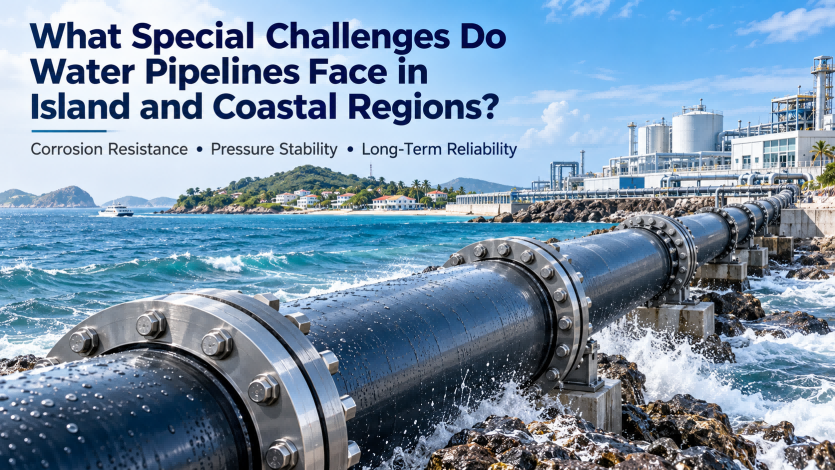
Coastal installations may experience high humidity and salt spray.
Traditional carbon steel pipelines often depend heavily on coatings, linings, and cathodic protection systems.
Once the protective system becomes damaged, localized corrosion can gradually develop into a serious integrity problem.
This becomes even more important as pipeline diameter increases.
A failure in a DN1000 or DN1600 trunk pipeline can cause far greater repair costs, water interruption, production losses, and construction difficulties than a failure in a small branch line.
As a result, an increasingly important material design philosophy is:
Let the structural layer carry the pressure, and let the functional layer resist the medium.
Steel–nylon composite pipe follows this concept.
The steel structure provides mechanical strength, while the nylon layer isolates the steel from the transported medium and provides resistance to corrosive and abrasive conditions.
This structure can be particularly valuable in applications involving:
-
Seawater
-
Brine
-
Industrial wastewater
-
Reclaimed water
-
High-salinity water
-
Other corrosive aqueous media
5. Trend Four: The Boundaries Between Municipal Water, Reclaimed Water, and Industrial Water Are Changing
The future urban water system will no longer be based only on the traditional model:
Water Source → Water Treatment Plant → Consumer → Wastewater Treatment Plant
Instead, a more circular water system is developing:
Raw Water → Treatment → Municipal/Industrial Use → Wastewater Treatment → Reclaimed Water → Industrial Reuse
As water scarcity becomes more serious in many regions, reclaimed water, industrial recycled water, and desalinated seawater will play increasingly important roles.
This also means pipeline operating environments will become more complex.
For conventional potable water systems, key concerns may include:
-
Water quality
-
Hygiene
-
Long-term stability
Industrial reclaimed water systems may additionally require consideration of:
-
Chloride concentration
-
Salinity
-
pH
-
Suspended solids
-
Temperature
-
Abrasion
-
Scaling
Therefore, the future large-diameter water pipeline market is likely to become increasingly segmented.
The era of assuming that one pipeline material is suitable for every water service is gradually disappearing.
Instead, pipeline materials will increasingly be selected according to the actual:
medium + pressure + temperature + flow velocity + solids content + installation environment.
6. Trend Five: Large-Diameter Pipelines Will Increasingly Require Both Corrosion and Abrasion Resistance
Traditional water transmission systems are often evaluated mainly for corrosion.
However, future large-diameter pipelines will not always transport completely clean water.
Applications such as:
-
Mine drainage
-
Industrial wastewater
-
Water containing suspended solids
-
Sludge-containing water
-
Seawater intake
-
Certain circulating water systems
may contain particles capable of producing mechanical wear.
In these conditions, the internal surface of the pipeline can experience two simultaneous degradation mechanisms:
Corrosion + Abrasion
Improving corrosion resistance alone may therefore not be enough.
Enhanced nylon materials offer favorable abrasion resistance, which makes steel–nylon composite pipe particularly interesting for applications where both corrosion and wear are present.
Rather than relying only on increasing metal wall thickness to compensate for future wear, composite pipeline design provides another approach:
Use different materials to perform different engineering functions.
This represents an important direction for future industrial water pipeline development.
The objective is not simply to make pipes thicker.
It is to make the material combination more appropriate for the actual operating conditions.
7. Trend Six: Connection Reliability Will Become Increasingly Important
Pipeline failures do not always occur in straight pipe sections.
Many failures occur around:
-
Flanges
-
Joints
-
Elbows
-
Tees
-
Reducers
-
Pump discharge sections
-
Other high-stress components
For large-diameter pipelines, connection quality becomes even more important.
If a large pipeline contains numerous joints or if connection quality varies significantly during field installation, the overall leakage risk of the system can increase.
Future project owners will therefore evaluate more than just the pipe body.
They will increasingly evaluate the entire system:
Pipe + Fittings + Flanges + Connection System
Our steel–nylon composite piping solutions place particular emphasis on the integrated design of the pipe body, fittings, and flange connections.
Depending on project requirements, integrated flange and connection solutions can reduce complicated secondary fabrication in the field and improve compatibility between different pipeline components.
This is particularly valuable in facilities where extensive hot work is undesirable, including:
-
Chemical plants
-
Oil and gas facilities
-
Mining operations
-
Existing water treatment plants
-
Brownfield retrofit projects
In these applications, simplifying field installation can create significant engineering value.
8. Trend Seven: Construction Efficiency Will Become a Major Competitive Factor
Installing large-diameter pipelines in urban and industrial environments is becoming increasingly difficult.
Underground corridors may already contain:
-
Power cables
-
Natural gas pipelines
-
Telecommunications lines
-
Sewer pipelines
-
Existing water mains
-
Other municipal utilities
At the same time, cities and industrial operators increasingly want to minimize:
-
Road closures
-
Excavation periods
-
Water supply interruptions
-
Production shutdowns
As a result, future competition between pipeline systems will not be based only on material performance.
It will also depend on:
installation efficiency.
If a pipeline system can reduce field welding, field coating repair, complicated secondary processing, and other installation steps, overall construction efficiency may improve significantly.
This is particularly important for international EPC projects.
Labor costs, contractor capabilities, climate, site conditions, and technical resources vary considerably between countries.
Therefore:
The greater the level of factory prefabrication and the fewer operations required on site, the easier project quality and schedule risks can be controlled.
In the future, successful large-diameter pipeline manufacturers will increasingly move beyond simply supplying pipe.
They will need to become:
Pipeline System Suppliers.
9. Trend Eight: Climate Change Will Accelerate the Development of Resilient Water Networks
One of the most important keywords for future water infrastructure is:
Resilience.
Extreme heat, floods, droughts, coastal corrosion, groundwater changes, and geological hazards can all increase the operational risks faced by water systems.
Future transmission pipelines therefore cannot be designed only for normal operating conditions.
Engineers must increasingly consider:
-
Extreme temperatures
-
Pressure fluctuations
-
Water hammer
-
Long shutdown periods
-
Changing groundwater conditions
-
Aggressive soils
-
Coastal environments
-
Long-term corrosion
This places greater emphasis on the long-term reliability of large-diameter pipeline materials.
A pipeline expected to operate for decades must do more than simply satisfy its initial design pressure.
Its materials and connections must remain stable under complex real-world operating conditions.
10. Which Large-Diameter Water Projects Are Most Suitable for Steel–Nylon Composite Pipe?
Steel–nylon composite pipe is not intended to replace every conventional water pipeline material.
Its strongest value appears in projects where:
corrosion risk is high, pressure requirements are demanding, maintenance is expensive, or pipeline shutdowns would create significant operational losses.
Typical applications include:
| Application | Main Challenges | Value of Steel–Nylon Composite Pipe |
|---|---|---|
| Industrial park water supply and drainage | Corrosion and complex water chemistry | Corrosion resistance + pressure capability |
| Seawater transmission | Chloride corrosion | Corrosion-resistant internal layer |
| Desalination projects | High-salinity environment | Reduced corrosion-related maintenance |
| Power plant circulating water | Corrosion, scaling, continuous operation | Corrosion resistance + smooth internal surface |
| Industrial reclaimed water | Variable and complex water chemistry | Better adaptability to aggressive media |
| Pressurized wastewater | Corrosion and potential H₂S exposure | Reduced internal corrosion risk |
| Mining water supply and drainage | Corrosion + suspended solids | Corrosion resistance + abrasion resistance |
| Long-distance water transmission | High reliability requirements | Combination of structural strength and durability |
For DN600–DN1600 and larger projects, material performance becomes increasingly important when high pressure, corrosive media, or critical trunk-line service is involved.
For potable water projects, material selection must also consider the applicable local or national hygienic requirements, certification standards, and regulations for materials in contact with drinking water.
11. Why Is the Steel–Nylon Composite Structure Worth Considering?
Large-diameter pipeline materials have historically faced a fundamental engineering trade-off:
Metals provide excellent strength, but they can corrode.
Polymer materials provide excellent corrosion resistance, but structural design becomes increasingly challenging as diameter and pressure increase.
The concept behind steel–nylon composite pipe is to allow each material to perform the function it handles best.
Steel Structure
Provides:
-
Mechanical strength
-
Structural rigidity
-
Pressure-bearing capability
Enhanced Nylon Layer
Provides:
-
Corrosion resistance
-
Abrasion resistance
-
Isolation between the transported medium and steel structure
Under appropriate engineering design conditions, this structure can provide a combination of:
high structural strength, corrosion resistance, abrasion resistance, wide temperature adaptability, and pressure capability.
Our company specializes in the development and manufacturing of enhanced MC nylon pipes and steel–nylon composite pipes.
Depending on project conditions, pipeline selection can be optimized according to:
-
Transported medium
-
Nominal diameter
-
Design pressure
-
Operating temperature
-
Flow velocity
-
Solids concentration
-
Installation method
-
Environmental conditions
For large water supply and drainage projects, our objective is not simply to tell customers:
"This material is better."
Instead, we focus on answering three more important engineering questions.
1. Is the material chemically compatible with the actual medium?
Pipeline selection should begin with real operating conditions rather than general material descriptions.
2. Can the pipeline operate reliably at the required pressure and temperature?
Both short-term mechanical performance and long-term service conditions must be evaluated.
3. How does the total life-cycle cost compare with alternative materials?
The real comparison should include conventional steel pipe, HDPE, FRP, stainless steel, and other pipeline materials where relevant.
This approach allows project owners to make decisions based on:
engineering reliability + operating risk + total cost of ownership.
12. The Future Competition in Large-Diameter Pipelines Will Be a Life-Cycle Competition
No single material is likely to dominate every future large-diameter water supply and drainage project.
Ductile iron, carbon steel, prestressed concrete, HDPE, FRP, stainless steel, and various composite pipeline systems will continue to serve different application areas.
What is changing is not simply the range of available materials.
What is changing is:
how project owners evaluate them.
In the past, one of the first questions might have been:
Which pipe has the lowest price per meter?
Increasingly, the question will become:
Which pipeline system can operate more reliably for the next 20, 30, or even more years while minimizing maintenance, leakage, and shutdowns?
As procurement logic evolves, the following characteristics will become increasingly important:
-
Corrosion resistance
-
Abrasion resistance
-
Reliable connections
-
Low maintenance requirements
-
Long service life
-
Reduced shutdown risk
-
Lower total life-cycle cost
These trends create an important future opportunity for steel–nylon composite pipeline systems.
Conclusion
Global water supply and drainage infrastructure is undergoing three changes simultaneously:
New Construction + Capacity Expansion + Pipeline Rehabilitation
Urban growth is creating new water demand.
Industrial development is increasing transmission capacity requirements.
At the same time, a huge installed base of aging pipelines is entering a new replacement and rehabilitation cycle.
Meanwhile, climate change, water scarcity, seawater desalination, industrial water recycling, and reclaimed water utilization are increasing the strategic importance of reliable water infrastructure.
Therefore, the future large-diameter pipeline market will not simply require more pipes.
It will require more:
high-reliability, corrosion-resistant, low-maintenance, and long-life large-diameter pipeline systems.
For steel–nylon composite pipe, this creates a clear development opportunity.
Its application potential can extend beyond conventional industrial corrosion-resistant pipelines into:
-
Large industrial water supply and drainage systems
-
Seawater transmission
-
Desalination facilities
-
Power plant circulating water
-
Reclaimed water systems
-
Mining water supply and drainage
-
Long-distance water transmission
Ultimately, future competition in the pipeline industry will not be determined by material price alone.
It will be determined by which pipeline solution can help customers build a system that is:
safer, more reliable, easier to maintain, and more economical throughout its entire service life.
The Future of Non-Metallic and Composite Pipes in Urban Infrastructure
Why Coastal Infrastructure Needs More Corrosion-Resistant Piping