
Caustic Soda Pipeline Material Selection for the Chlor-Alkali Industry: Why “Alkali Resistance” Alone Is Not Enough
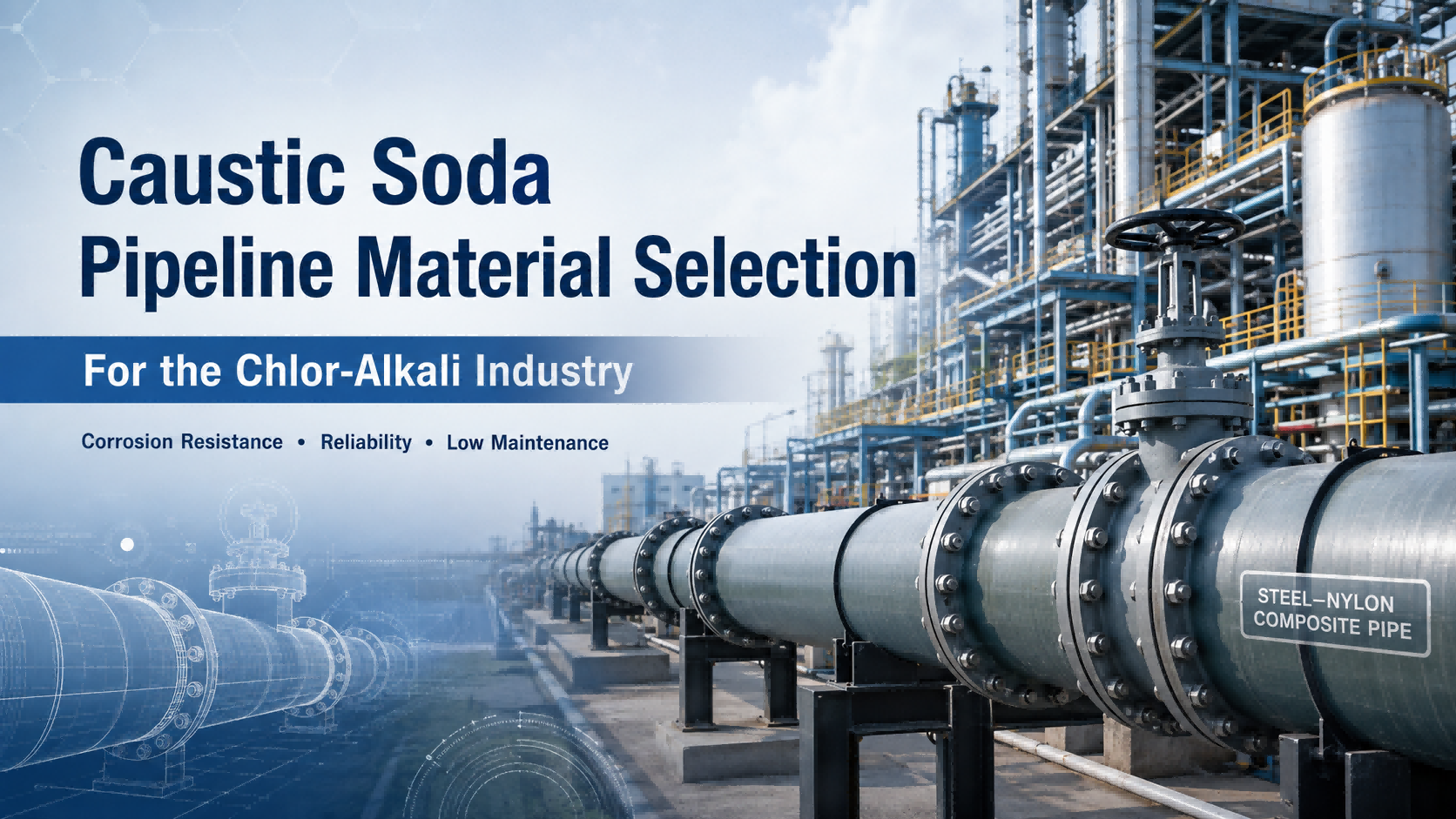
In the chlor-alkali industry, caustic soda (NaOH) is one of the most important basic chemical products.
From electrolytic units and evaporation/concentration systems to caustic soda storage, transfer, circulation, and downstream process units, extensive piping systems are continuously exposed to sodium hydroxide solutions at different concentrations and temperatures.
When selecting piping materials, many projects begin with a simple question:
“Which pipe material is resistant to caustic soda?”
For a pipeline expected to operate reliably over the long term, however, this question is far from sufficient.
The reliability of a caustic soda pipeline depends not only on whether the pipe material is chemically compatible with NaOH, but also on:
-
Caustic soda concentration;
-
Actual operating temperature;
-
System pressure;
-
Fluid velocity;
-
Solid particles and impurities;
-
Pipe diameter;
-
Support span;
-
Pipe rigidity;
-
Loads and impacts near pumps and valves;
-
Flange and joint reliability;
-
Start-up and shutdown frequency;
-
Installation environment;
-
Maintenance conditions;
-
And total lifecycle cost.
For modern chlor-alkali plants, caustic soda pipeline selection is therefore evolving from a simple comparison of corrosion-resistant materials toward a more comprehensive engineering evaluation involving:
Corrosion + Mechanical Strength + Temperature + Pressure + Installation + Maintenance + Lifecycle Cost.
1. What Makes Caustic Soda Piping So Challenging?
Sodium hydroxide is a typical strong alkali, but actual pipeline conditions inside a chlor-alkali plant are considerably more complex than a laboratory environment containing a single, pure NaOH solution.
1.1 Different NaOH Concentrations Create Different Operating Conditions
Different stages of chlor-alkali production involve caustic soda solutions at different concentrations.
Depending on the process stage, evaporation system, and final product specification, pipelines may transport dilute caustic soda, medium-concentration solutions, or more concentrated NaOH.
A material that performs well at one concentration does not necessarily provide the same service life under every combination of caustic soda concentration and temperature.
Pipeline material selection should therefore confirm three fundamental parameters simultaneously:
NaOH Concentration + Temperature + Pressure
rather than considering only the name of the chemical medium.
2. Temperature Can Be More Critical Than the Fact That the Medium Is a Strong Alkali
Many materials demonstrate excellent alkali resistance at room temperature. As temperature rises, however:
-
Chemical reaction rates increase;
-
Material degradation may accelerate;
-
Corrosion mechanisms in metals can change;
-
Mechanical properties of non-metallic materials may decline;
-
Thermal expansion becomes more significant;
-
Greater loads may be imposed on seals and connections.
Therefore, even though two pipelines may both transport caustic soda, a system operating at 30°C cannot necessarily follow the same material-selection logic as one operating at 80°C, 100°C, or higher.
At the design stage, engineers should first establish three key variables:
NaOH Concentration × Operating Temperature × Design Pressure
Fluid velocity and impurity content should then be incorporated into the final assessment.
3. Why “Low-Cost” Carbon Steel May Not Actually Be Low-Cost
Carbon steel remains one of the most commonly used piping materials in traditional chemical plants.
Its advantages are clear:
-
Relatively low initial material cost;
-
High mechanical strength;
-
Mature fittings and component systems;
-
Familiar installation practices;
-
Good availability for large-diameter pipelines.
Under suitable operating conditions, carbon steel can still be a reasonable engineering choice.
The problem is that industrial pipeline cost cannot be evaluated solely on the basis of initial purchase price.
Over years of operation, the plant may also need to consider:
-
Corrosion;
-
Internal scaling;
-
Wall-thickness reduction;
-
Weld deterioration;
-
Localized leakage;
-
Pipeline replacement;
-
External and internal corrosion protection;
-
Shutdown maintenance;
-
Labor costs;
-
Safety risks.
When a pipeline transports chemical fluids containing salts, suspended solids, or erosive particles, simply increasing the wall thickness of a steel pipe does not fundamentally eliminate the problem of direct contact between the corrosive medium and the steel.
This leads to a more important engineering question:
Why should the corrosive process fluid be allowed to contact the steel structure directly?
This question is one of the key reasons why composite piping technologies continue to develop.
4. Is Stainless Steel the Ultimate Solution for Caustic Soda Pipelines?
When conventional steel pipelines experience corrosion, one of the first solutions considered by many projects is:
If carbon steel is not sufficient, upgrade to stainless steel.
This can be a reasonable strategy for certain operating conditions, but it does not mean stainless steel is universally suitable for every chlor-alkali pipeline.
Stainless steel selection must consider factors such as:
-
NaOH concentration;
-
Operating temperature;
-
Chloride concentration;
-
Welded areas;
-
Stress conditions;
-
Localized corrosion environment;
-
Stainless steel grade;
-
Project budget.
In complex chlor-alkali process systems, the transported medium may not be a clean, single-component caustic soda solution.
When salts, chlorides, temperature fluctuations, and complex chemical environments are present simultaneously, a more comprehensive corrosion assessment becomes necessary.
For large-diameter pipelines, stainless steel can also significantly increase:
Material Cost + Welding Cost + Installation Cost + Fitting Cost
For this reason, more industrial projects are no longer evaluating only:
Carbon Steel vs. Stainless Steel
but instead comparing:
Metal Pipe vs. Lined Pipe vs. Composite Pipe
5. Why FRP Cannot Be Selected Simply Because It Is “Corrosion Resistant”
Fiberglass reinforced plastic (FRP) piping is widely used in corrosive chemical services.
Its obvious advantages include:
-
Corrosion resistance that does not depend on a metallic wall;
-
Relatively low weight;
-
Compatibility with many corrosive media.
However, for long-term industrial operation, other factors must also be evaluated carefully:
-
Long-term pressure-bearing performance;
-
Rigidity of large-diameter pipelines;
-
Support spacing;
-
Operating temperature;
-
Flange connection performance;
-
Structural stability between layers;
-
Mechanical impact;
-
Vacuum conditions;
-
Frequent start-up and shutdown cycles.
For critical chemical process pipelines operating continuously under demanding conditions, corrosion resistance is only the first requirement.
The pipeline must also function as a reliable:
Pressure-Bearing Structure
over its entire service life.
6. Why HDPE and Other Plastic Pipes Also Have Application Limits
Polyethylene piping systems have well-established applications in low-temperature, lower-pressure, and certain corrosive chemical services.
Typical advantages include:
-
Good corrosion resistance;
-
Low weight;
-
Convenient installation.
However, in chlor-alkali plants, engineers still need to evaluate:
-
Temperature;
-
Pressure;
-
Large-diameter rigidity;
-
Thermal expansion;
-
Long-distance support requirements;
-
Valve loads;
-
Pump discharge impact;
-
Outdoor exposure;
-
Connection reliability.
When a pipeline must simultaneously satisfy:
Large Diameter + Higher Pressure + Elevated Temperature + Industrial Pipe Rack Installation
relying on a single plastic material to provide both chemical resistance and structural strength may not always be the optimum engineering solution.
7. Why Steel–Nylon Composite Pipe Should Be Considered for Caustic Soda Service
The fundamental engineering concept behind steel–nylon composite pipe is not simply to replace one material with another.
Instead, it allows different materials to perform different functions.
The steel structure primarily provides:
-
Pressure-bearing capability;
-
Rigidity;
-
Mechanical strength;
-
Structural stability in large diameters;
-
Adaptability to industrial pipe-rack installations.
The nylon functional layer primarily provides:
-
Isolation between the corrosive medium and the steel;
-
Reduced corrosion exposure;
-
Improved wear resistance;
-
Reduced scaling tendency;
-
Reduced direct contact between the process medium and the steel structure.
In simple terms:
Steel provides structural strength.
Nylon provides corrosion and wear protection.
This engineering philosophy differs significantly from attempting to use one single material to solve every mechanical and corrosion-related challenge.
8. Key Advantages of Steel–Nylon Composite Pipe in the Chlor-Alkali Industry
8.1 Balancing Mechanical Strength and Corrosion Resistance
One of the fundamental challenges in chemical pipeline material selection is the conflict between strength and corrosion resistance.
Metallic materials generally offer:
High strength, but corrosion must be controlled.
Many non-metallic materials generally offer:
Good corrosion resistance, but pressure, rigidity, and temperature limitations must be evaluated carefully.
The purpose of a steel–nylon composite structure is to combine:
Steel Strength + Nylon Corrosion Resistance
This makes the technology particularly relevant for industrial piping systems that require both strong mechanical performance and corrosion protection.
8.2 Smooth Internal Surface Helps Reduce Scaling Risk
Scaling is an important but sometimes underestimated issue in chlor-alkali, soda ash, and salt chemical processing.
Once corrosion begins inside a traditional metallic pipeline, the following cycle may develop:
Corrosion → Rough Surface → Crystal Adhesion → Increased Deposits
Over time, this can cause:
-
Reduced effective flow area;
-
Increased pressure drop;
-
Lower transportation efficiency;
-
Higher pumping energy consumption;
-
More frequent cleaning.
Steel–nylon composite pipe provides a relatively smooth functional inner surface, reducing direct contact between the process fluid and rough, corroded metallic surfaces.
This can help create more favorable conditions for reducing deposition and scaling.
For long-term industrial operation, this advantage may be significantly more important than simply comparing the initial cost per meter of pipe.
9. Why Integral Flange Connections Matter in Chlor-Alkali Plants
One practical challenge in chemical plant maintenance and retrofit projects is:
Hot Work.
Traditional steel piping frequently requires:
-
Cutting;
-
Welding;
-
Grinding;
-
Weld inspection;
-
Corrosion-protection repair after welding.
In chlor-alkali facilities, hot work often requires more extensive:
-
Safety approval procedures;
-
Gas detection;
-
Process isolation;
-
Shutdown coordination;
-
On-site safety management.
Steel–nylon composite pipe with integral flange connections can significantly reduce the need for on-site welding.
This provides particular value for:
-
Existing plant upgrades;
-
Maintenance replacements;
-
Partial pipeline modernization;
-
Replacement of high-wear or high-corrosion sections.
Reducing on-site welding is not merely an installation convenience.
It can also mean:
Shorter Installation Windows + Lower Shutdown Costs + Reduced Hot-Work Requirements
10. Why Structural Strength Becomes More Important in Large-Diameter Caustic Soda Pipelines
Many discussions about chemical pipeline selection focus almost entirely on corrosion.
A critical engineering factor is often overlooked:
As pipe diameter increases, structural performance becomes increasingly important.
Large chlor-alkali facilities may use increasingly large pipe diameters for utility systems, circulation fluids, brine systems, and selected process lines.
As diameter increases:
-
Pipe dead weight increases;
-
Fluid load increases;
-
Flange loads increase;
-
Support design becomes more complex;
-
Deflection control becomes more important;
-
Valve loads become more significant.
For this reason, selecting a large-diameter chemical pipeline cannot be based on only one question:
Is the material corrosion resistant?
Engineers should also ask:
After ten or more years of operation, will the pipeline still remain a stable structural system?
This is where a steel structural framework provides important engineering value.
Steel–nylon composite pipe is therefore particularly suitable for consideration in projects requiring:
Large-Diameter Corrosion-Resistant Industrial Piping
11. What Parameters Should Be Evaluated When Selecting Caustic Soda Pipelines?
Chlor-alkali plants should confirm at least the following parameters during piping material selection.
| Parameter | Why It Matters |
|---|---|
| NaOH concentration | Determines chemical compatibility |
| Operating temperature | Directly affects long-term material performance |
| Design temperature | Defines safety margin under extreme conditions |
| Operating pressure | Determines pressure-bearing requirements |
| Design pressure | Provides the basis for structural design |
| Pipe diameter | Influences material and structural selection |
| Flow velocity | Affects erosion and pressure loss |
| Solid particles | Determines whether wear resistance is critical |
| Chloride content | May affect corrosion risk for certain metals |
| Vacuum conditions | Affect liner and pipeline stability |
| Indoor / outdoor installation | Influences external protection requirements |
| Support span | Affects large-diameter pipe rigidity |
| Connection method | Influences installation and maintenance costs |
| Design service life | Determines lifecycle economics |
This table reflects one of the most important changes in modern industrial pipeline engineering:
From “Selecting a Material” to “Designing a Pipeline System.”
12. How Should Different Caustic Soda Pipe Materials Be Evaluated?
A simplified engineering comparison can help during the preliminary material-selection stage:
| Pipe Type | Corrosion Resistance | Mechanical Strength | Large-Diameter Suitability | Temperature & Pressure Capability | Installation |
|---|---|---|---|---|---|
| Carbon Steel | Depends on specific service conditions | High | High | High | Often requires welding |
| Stainless Steel | Depends on concentration, temperature, and impurities | High | High | High | Often requires welding |
| FRP | Generally good | Medium | Requires structural evaluation | Requires evaluation | Relatively convenient |
| HDPE | Generally good | Relatively low | Requires evaluation | Increasing temperature requires closer assessment | Heat-fusion connection |
| Lined Steel Pipe | Generally good | High | High | Depends on lining system | Lining integrity must be considered |
| Steel–Nylon Composite Pipe | Suitable for verified strong-alkali and other compatible corrosive services | High | Strong | Combines structural strength with a functional protective layer | Flanged connection can reduce on-site hot work |
One point must be emphasized:
No chemical piping material should be selected solely by material name without evaluating the actual chemical concentration, temperature, pressure, and operating conditions.
Material compatibility should always be verified against the specific service conditions of the project.
13. The Real Comparison Should Be 10-Year Total Cost, Not Cost per Meter
Consider two pipeline options.
Option A
Lower initial purchase price, but requires:
-
Repeated corrosion protection;
-
Descaling;
-
Welding repairs;
-
Replacement;
-
Production shutdowns for maintenance.
Option B
Higher initial investment, but offers:
-
Less corrosion;
-
Less scaling;
-
Lower maintenance frequency;
-
Longer service life.
If only the purchase price is compared, Option A may appear less expensive.
But when calculating:
10-Year Total Cost of Ownership (TCO)
the result may be very different.
The real cost of an industrial pipeline should include:
Pipe Procurement
Installation
Corrosion Protection
Cleaning
Inspection
Maintenance
Replacement
Production Downtime
Leakage Risk
For chlor-alkali plants operating continuously, the most expensive part of a pipeline system is often not the pipe itself.
It is:
Unexpected Shutdown.
14. Why Low-Maintenance Piping Is Becoming More Important in the Chlor-Alkali Industry
Modern chemical plants increasingly focus on three key performance indicators:
Reliability
Stable long-term operation.
Maintenance
Lower maintenance frequency and less intervention.
Lifecycle Cost
Lower total cost over the complete operating life of the pipeline.
Traditional pipeline management often followed the logic of:
Replace the pipe after corrosion occurs.
The emerging approach is increasingly:
Reduce corrosion, scaling, and maintenance requirements at the design stage.
This is one of the fundamental reasons why composite industrial piping technologies are receiving greater attention.
The value of steel–nylon composite pipe is therefore not simply that it is “another corrosion-resistant pipe.”
A more accurate positioning is:
A long-life industrial piping solution designed for corrosive environments with high maintenance costs.
15. Which Chlor-Alkali Applications Should Consider Steel–Nylon Composite Pipe?
Steel–nylon composite pipe is particularly worth evaluating for:
-
Caustic soda transfer pipelines;
-
Alkali circulation pipelines;
-
Brine systems;
-
High-salinity alkaline wastewater;
-
Corrosive mother liquor;
-
High-salt process fluids;
-
Pipelines prone to scaling;
-
Fluids containing erosive particles;
-
Large-diameter process pipelines;
-
Long-distance pipe-rack systems;
-
Aging steel pipeline replacement;
-
Areas where on-site hot work is difficult;
-
High-failure-rate pipeline sections;
-
Projects requiring low maintenance and long service life.
In particular, where existing carbon steel, stainless steel, FRP, or conventional lined pipelines have repeatedly experienced:
Corrosion, Scaling, Wear, Leakage, or Frequent Maintenance
a composite piping system based on a different structural philosophy can be evaluated through trial sections or partial replacement.
16. Pipeline Upgrades Do Not Always Require Replacing the Entire System at Once
For an operating chlor-alkali plant, a more practical strategy is often to begin with:
High-Failure Pipeline Sections
Typical locations include:
-
Pump discharge sections;
-
Upstream and downstream of valves;
-
Elbows;
-
Tees;
-
Reducers;
-
Frequently leaking sections;
-
High-velocity zones;
-
High-corrosion areas.
A practical approach is to install a:
100–500 m Trial Section
and evaluate the pipeline under actual operating conditions.
Key indicators can include:
-
Internal surface condition;
-
Corrosion performance;
-
Scaling;
-
Wear;
-
Changes in pressure drop;
-
Connection reliability;
-
Maintenance frequency.
If operating results meet expectations, the application can then be expanded gradually.
For large chemical plants, actual operating data from a trial section can provide greater engineering value than relying solely on laboratory test data.
17. The Future of Chlor-Alkali Piping Is Not About Which Pipe Is Cheapest, but Which System Is More Reliable
As the chemical industry places increasing emphasis on:
-
Process safety;
-
Continuous operation;
-
Energy efficiency;
-
Lower maintenance requirements;
-
Fewer unplanned shutdowns;
-
Longer equipment service life;
the criteria for pipeline material selection are also changing.
In the past, the first question might have been:
How much does the pipe cost per meter?
Increasingly, engineering and procurement teams are asking:
How many years can the pipeline operate reliably?
How many times will it require maintenance?
Is it prone to scaling?
Can hot work be reduced during installation?
What is the risk of leakage?
What is the total cost over ten years?
These questions better define the true value of an industrial piping system.
Conclusion: Caustic Soda Pipeline Selection Is Ultimately a Long-Term Reliability Decision
There is no universal pipeline material suitable for every caustic soda service in the chlor-alkali industry.
A sound selection process must consider:
Chemical Concentration, Temperature, Pressure, Flow Velocity, Impurities, Pipe Diameter, Structural Strength, Connection Method, Maintenance Conditions, and Lifecycle Cost.
For simple, low-risk operating conditions, conventional piping materials may remain technically and economically appropriate.
However, for:
Highly Corrosive, Large-Diameter, Continuously Operated Chlor-Alkali Pipelines Where Maintenance Is Difficult and Reliability Is Critical,
it can become increasingly challenging for a single traditional material to satisfy every requirement simultaneously.
Steel–nylon composite pipe combines:
Steel Structural Strength + Nylon Functional Corrosion and Wear Protection + Smooth Internal Surface + Integral Flange Connection
to provide an engineering approach that differs from conventional steel pipe, plastic pipe, and traditional lined piping systems.
Its real value is not simply to solve one corrosion problem.
Its purpose is to help industrial plants achieve:
Fewer Leaks, Less Scaling, Lower Maintenance Requirements, Less On-Site Hot Work, and a Longer Pipeline Lifecycle.
For chlor-alkali plants planning new construction, capacity expansion, or aging pipeline upgrades, caustic soda pipeline selection should therefore not be based solely on:
“Which pipe has the lowest initial purchase price?”
A more important question is:
Which piping system can provide stable operation with lower maintenance costs over the next 10 years or longer?
That is the real question modern chlor-alkali pipeline material selection should answer.
Soda Ash Industry Pipeline Selection Guide: How to Choose Corrosion-Resistant, Wear-Resistant, and Low-Maintenance Industrial Piping


