Solutions to Extend Equipment Service Life in the Chemical Industry: How Corrosion-Resistant Piping Technology Reduces Maintenance Costs and Improves Long-Term Operational Reliability

In the chemical industry, equipment service life affects not only the return on fixed-asset investments but also production efficiency, operating costs, and safety management.
Whether in chlor-alkali production, soda ash manufacturing, salt chemical processing, petrochemicals, or phosphate chemical production, industrial equipment must often operate continuously while handling corrosive chemicals, high-temperature liquids, highly saline solutions, and complex materials containing solid particles.
Under these demanding conditions, conventional industrial equipment may experience corrosion, abrasion, leakage, and connection failures. These problems can gradually reduce equipment performance, increase maintenance requirements, and even cause unplanned production shutdowns.
For modern chemical manufacturers, extending equipment service life is no longer simply a matter of maintenance and repair. It is a systematic engineering challenge involving material selection, structural design, process optimization, and total lifecycle cost management.
How can chemical manufacturers improve equipment reliability and reduce long-term operating costs through material upgrades and technological improvements?
This question has become increasingly important for companies seeking to improve operational efficiency and maintain reliable production.
Industrial piping systems, which connect processing equipment and transport chemical media throughout production facilities, play a particularly important role in determining overall system reliability.
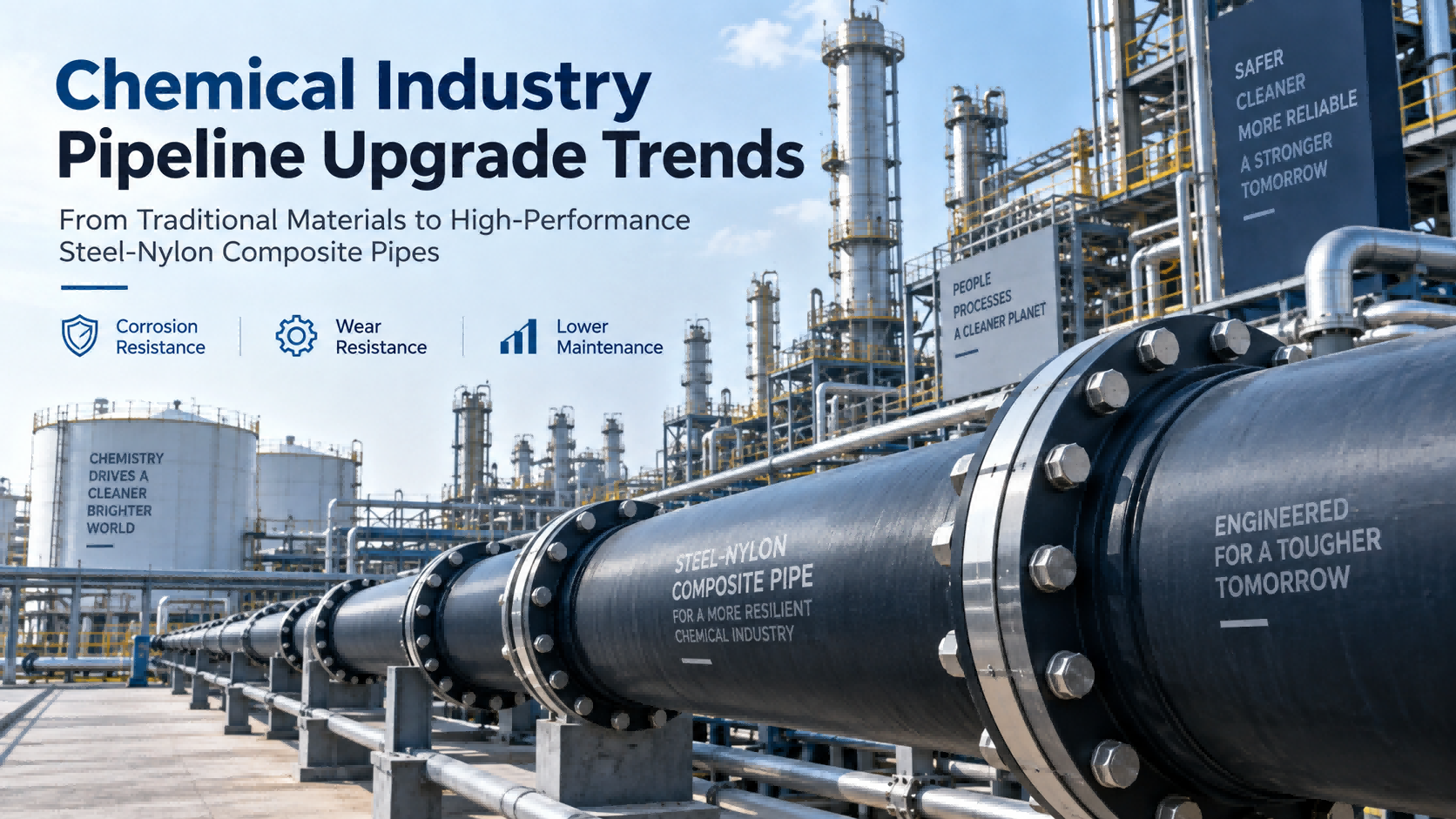
Advanced composite piping materials, such as steel-nylon composite pipes, combine the structural strength of steel with the corrosion resistance and wear resistance of nylon.
This material combination provides chemical manufacturers with an alternative solution for extending pipeline service life, reducing maintenance requirements, and improving long-term operational performance.
1. Why Is Equipment Service Life Often Limited in the Chemical Industry?
Chemical processing environments are inherently complex.
Unlike equipment used in many conventional industrial applications, chemical processing equipment must withstand not only continuous mechanical loads but also prolonged exposure to corrosive chemicals, temperature fluctuations, pressure variations, and abrasive materials.
Equipment deterioration is rarely caused by a single factor. Instead, multiple degradation mechanisms often interact over time.
Understanding these mechanisms is the first step toward developing an effective equipment life extension strategy.
1.1 Chemical Corrosion Causes Gradual Material Degradation
Corrosion is one of the major factors affecting the service life of chemical processing equipment.
In chlor-alkali production, soda ash manufacturing, salt chemical processing, and related industries, piping systems may be continuously exposed to:
-
Alkaline media, including sodium hydroxide solutions.
-
Highly saline solutions containing sodium chloride.
-
Certain acidic process liquids.
-
Industrial wastewater containing corrosive impurities.
-
Complex process fluids containing chlorides, sulfides, and other potentially corrosive substances.
Different chemicals can damage metallic materials through different corrosion mechanisms.
For example, certain stainless steel grades may experience pitting or crevice corrosion under specific chloride concentrations and temperature conditions.
Carbon steel may also suffer electrochemical corrosion in aqueous environments containing oxygen, acidic components, or other corrosive substances.
For industrial pipelines operating continuously, corrosion can result in gradual wall thinning, perforation, leakage, and eventual structural failure.
If the underlying corrosion problem is not adequately addressed, pipelines with relatively low initial purchase costs may generate substantial maintenance and replacement expenses over their operating life.
1.2 Abrasive Particles Accelerate Pipeline Deterioration
In addition to corrosion, abrasive wear is another important factor affecting equipment service life.
In phosphate chemical processing, slurry transportation, soda ash manufacturing, and industrial wastewater treatment, pipelines frequently transport liquids containing suspended solid particles.
As these particles move through the pipeline, they may contact, rub against, and impact the internal pipe surface, gradually damaging the material.
Wear can be particularly severe at elbows, reducers, valve connections, and locations where flow velocity or direction changes significantly.
When corrosion and abrasion occur simultaneously, they may produce complex degradation mechanisms in which erosion and corrosion accelerate one another.
For this reason, selecting a pipe material based solely on corrosion resistance may not be sufficient for certain chemical processing applications.
Pipeline materials must also provide appropriate wear resistance under the actual operating conditions.
1.3 Temperature and Pressure Variations Affect Equipment Reliability
Chemical production processes frequently involve continuous changes in operating temperature and pressure.
During long-term operation, equipment must withstand internal pressure, temperature fluctuations, repeated startup and shutdown cycles, and potentially transient pressure surges.
These operating conditions can affect the pipe body, connection components, and sealing structures.
For example, different materials have different coefficients of thermal expansion.
In composite piping systems, inadequate consideration of dimensional changes and thermal stresses may increase the risk of connection failure during temperature fluctuations.
Therefore, extending equipment service life requires more than evaluating individual material properties.
Engineers must consider the relationship between operating temperature, pressure, structural strength, thermal expansion, and connection design.
1.4 Pipeline Connections Are Critical to Overall System Reliability
Pipeline leakage does not necessarily originate from the pipe body itself.
Flanges, gaskets, valve connections, and other joints can also become vulnerable points within a chemical processing system.
Inadequate connection design, installation errors, unsuitable sealing materials, vibration, and long-term temperature fluctuations may increase the risk of leakage.
Even when a highly corrosion-resistant pipe material is selected, the overall piping system may still experience frequent maintenance requirements if the connections are not properly designed.
Consequently, chemical manufacturers must evaluate pipe material performance and connection reliability as parts of a complete engineering system.
2. The Key to Extending Chemical Equipment Service Life: Moving from Reactive Maintenance to Preventive Engineering
Traditional chemical equipment maintenance often focuses on repairing or replacing components after visible damage, leakage, or operational abnormalities occur.
Although this approach can address immediate problems, it does not necessarily eliminate the underlying causes of repeated equipment failure.
Consider a carbon steel pipeline used to transport a highly saline solution.
If the pipeline repeatedly develops leaks due to internal corrosion, replacing individual damaged sections may restore operation temporarily.
However, if the pipe material remains incompatible with the operating conditions, similar failures may continue to occur.
An effective equipment life extension strategy should therefore begin during the equipment design and material selection stages.
2.1 Select Materials According to Actual Operating Conditions
Material selection should account for chemical composition, concentration, operating temperature, pressure, and flow conditions.
For corrosive applications, engineers may evaluate different solutions, including corrosion-resistant alloys, non-metallic piping materials, and composite pipes.
Each material has its own advantages and limitations.
A pipeline should not be selected solely because it demonstrates good resistance to one particular chemical.
2.2 Implement Targeted Protection in High-Wear Areas
In systems transporting liquids containing solid particles, special attention should be given to elbows, reducers, and areas experiencing high local flow velocities.
Optimizing pipeline geometry, controlling flow velocity, and selecting suitable wear-resistant materials can help reduce the risk of premature failure caused by localized abrasion.
2.3 Improve Pipeline Connection Reliability
For chemical pipelines designed for continuous operation, connection systems should provide appropriate sealing performance while supporting efficient installation and maintenance.
Properly designed flange connections, compatible sealing materials, and suitable installation procedures can help reduce failures associated with pipeline joints.
2.4 Establish a Lifecycle-Based Maintenance Strategy
Equipment management should consider more than initial purchase costs.
Installation expenses, operating costs, inspection requirements, maintenance, replacement, and production downtime should all be included in the evaluation.
Through regular inspections, equipment failure analysis, and monitoring of high-risk locations, chemical manufacturers can identify potential problems before they develop into major failures.
Moving from repeated repairs to appropriate material selection, reliable engineering design, and preventive maintenance is an important strategy for extending chemical equipment service life.
3. How Can Steel-Nylon Composite Pipes Help Extend the Service Life of Chemical Piping Systems?
Material upgrades are an important part of improving the service life of chemical processing equipment.
Guangdong Kejin New Materials Co., Ltd. specializes in the development and manufacturing of reinforced MC nylon pipes and steel-nylon composite pipes.
The company focuses on providing corrosion-resistant and wear-resistant piping products for chemical processing, energy production, and industrial material transportation.
Steel-nylon composite pipes combine steel and nylon within a composite structure, allowing the two materials to perform complementary functions.
Rather than simply replacing one material with another, this design approach combines different material properties to meet the structural, chemical resistance, and operational reliability requirements of industrial pipelines.
3.1 Steel Provides Structural Support While Nylon Forms the Medium-Contact Layer
One of the main advantages of steel-nylon composite pipes is their combination of different material properties.
The steel component provides structural support and pressure-bearing capability, while the internal nylon layer forms the functional surface in direct contact with the transported medium.
Under suitable chemical and temperature conditions, the nylon layer acts as a protective barrier between the transported liquid and the steel structure.
This barrier can reduce the risk of internal corrosion affecting the steel component.
Compared with conventional metal pipes in which the transported medium directly contacts the metal surface, this composite structure offers an alternative material solution for certain corrosive environments.
For highly saline water, selected alkaline process liquids, and other industrial media demonstrated to be compatible with the product, steel-nylon composite pipes can be considered as a potential material upgrade.
However, actual suitability depends on chemical composition, concentration, temperature, pressure, and other operating conditions.
Steel-nylon composite pipes should not be assumed to be compatible with every corrosive chemical.
3.2 Combining Corrosion Resistance and Wear Resistance
In some chemical processing systems, corrosion and abrasive wear occur simultaneously.
For example, soda ash production may involve the transportation of salt mud and other process materials containing suspended solid particles.
Even if a pipe material offers good chemical resistance, inadequate wear resistance may still result in premature damage caused by continuous particle abrasion.
Reinforced nylon materials can provide useful wear-resistant properties in suitable applications.
Through appropriate material modification and structural design, steel-nylon composite pipes can address both corrosion and abrasion requirements.
This makes them a potential material solution for selected corrosive slurries, salt mud, and industrial wastewater transportation applications.
Rather than relying solely on increasing the wall thickness of metallic pipes, composite piping technology focuses on improving the properties of the surface in contact with the transported medium.
Nevertheless, applications involving highly abrasive particles, elevated flow velocities, or severe particle impact require specific evaluation of the nylon layer's wear resistance.
3.3 Combining Corrosion Resistance with Industrial Pressure Requirements
Chemical manufacturers cannot select piping materials based solely on corrosion resistance.
Operating pressure is another critical factor.
Although some non-metallic piping materials offer excellent resistance to certain chemicals, their applications may be limited under elevated temperatures, higher pressures, or particular mechanical loading conditions.
Steel-nylon composite pipes use steel to provide structural support while incorporating an internal nylon functional layer.
This configuration allows the piping system to address corrosion resistance and pressure-bearing requirements under appropriate design conditions.
Guangdong Kejin New Materials Co., Ltd. manufactures steel-nylon composite pipes in pressure-rating series ranging from 1.0 to 4.0 MPa, providing material options for different industrial applications.
Actual allowable operating conditions must be confirmed according to the specific product design, pipe diameter, connection type, operating temperature, and applicable engineering standards.
In particular, a pressure rating specified at room temperature should not automatically be regarded as the allowable operating pressure at elevated temperatures.
By combining a suitable pressure-bearing structure with a corrosion-resistant functional layer, chemical manufacturers can address both operational safety and pipeline service life when evaluating material upgrades.
4. Optimizing Pipeline Connections to Reduce Maintenance Requirements
Pipeline connection design plays an important role in installation efficiency and long-term reliability.
Large chemical production facilities often contain numerous pipeline joints.
Failure at any connection may cause localized leakage, maintenance requirements, or production interruptions.
Therefore, extending pipeline service life requires improvements in both pipe material performance and connection design.
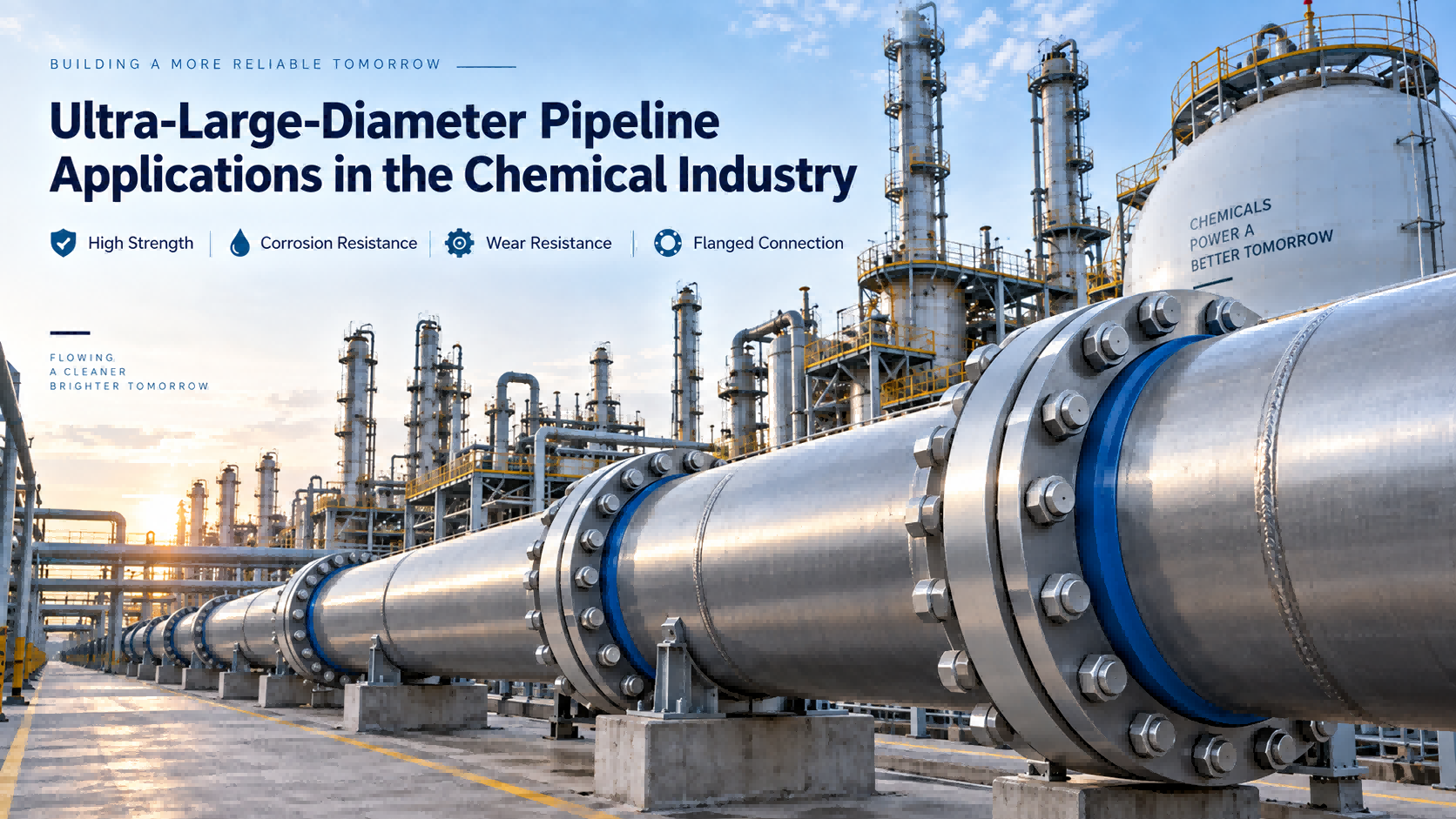
4.1 Integrated Flange Design
Guangdong Kejin New Materials Co., Ltd. places considerable emphasis on flange connection design in the development of its steel-nylon composite piping products.
Integrated molded flange technology can be used to create connection structures suitable for industrial pipeline installation, depending on product specifications and engineering requirements.
A properly designed flange connection can simplify certain on-site installation procedures and provide convenient access for gasket installation, inspection, and subsequent maintenance.
For corrosive chemical applications, the design of flange sealing surfaces and medium-contact areas is particularly important.
The connection structure should prevent transported chemicals from directly contacting unprotected steel components.
4.2 Reducing On-Site Welding Requirements
Welding operations in chemical production facilities often require specific hot-work safety management procedures.
This is particularly important in areas containing flammable or explosive materials, where welding may involve complex work permits, safety isolation measures, and risk control procedures.
Flange-connected piping systems can reduce certain on-site welding requirements when they are appropriate for the project.
For pipeline replacement, existing plant modifications, and projects where hot-work activities need to be minimized, prefabricated flanged pipe sections can provide additional installation options.
However, reducing welding requirements does not eliminate the need for installation inspections, pressure testing, or other applicable safety procedures.
4.3 Improving Maintenance Convenience
Properly designed flange connections allow individual pipe sections to be disconnected and replaced when maintenance is required.
In chemical processing systems containing valves, filters, and other components requiring periodic servicing, this connection method can simplify certain maintenance operations.
Appropriate pipeline layout, connection design, and maintenance access can further reduce the complexity of future inspection and repair activities.
5. How Can Different Chemical Industries Improve Equipment Service Life Through Pipeline Upgrades?
Chemical processing industries differ significantly in their operating conditions and the properties of the materials they transport.
Equipment life extension strategies must therefore be tailored to specific applications.
The following examples illustrate how steel-nylon composite pipes can be evaluated for different chemical processing environments.
| Industry | Typical Operating Conditions and Challenges | Potential Benefits of Steel-Nylon Composite Pipes |
|---|---|---|
| Chlor-alkali industry | Transportation of selected caustic soda solutions and brine, involving corrosion and temperature variations | Under verified material compatibility conditions, the nylon layer can help reduce direct contact between corrosive media and the steel structure. |
| Soda ash industry | Transportation of brine, mother liquor, and particle-containing materials, where corrosion and abrasion may occur simultaneously | The combination of a nylon functional layer and steel structure addresses corrosion resistance, wear resistance, and pressure-bearing requirements. |
| Salt chemical industry | Highly saline solutions containing elevated chloride concentrations | Provides an alternative composite piping solution for selected high-salinity transportation applications. |
| Phosphate chemical industry | Transportation of certain process slurries involving solid particle abrasion and chemical corrosion | Can be evaluated for compatible slurry transportation applications following chemical compatibility and wear resistance testing. |
| Petrochemical industry | Transportation of industrial wastewater and selected corrosive process fluids | Offers a potential alternative piping material based on verified chemical composition, temperature, and pressure requirements. |
| Chemical wastewater treatment | Transportation of selected high-salinity, alkaline, or particle-containing wastewater | The composite structure can improve the corrosion and wear resistance of medium-contact surfaces under suitable conditions. |
An important consideration: The suitability of steel-nylon composite pipes must be determined by actual operating conditions rather than the name of the industry alone.
For example, experience gained from transporting brine or alkaline solutions cannot automatically be applied to highly concentrated acidic media in phosphate chemical production.
Likewise, complex fluids containing strong oxidizing agents, special organic solvents, or other substances that may affect nylon performance require careful material compatibility assessment.
Only when the selected pipe material is compatible with the actual operating environment can composite piping technology deliver meaningful service life improvements.
6. Engineering Application: Pipeline Service Life Management in Soda Ash Production
For chemical manufacturers, the practical performance of piping materials must ultimately be demonstrated through actual industrial operation.
An application of reinforced MC nylon pipes and steel-nylon composite pipes in the soda ash production facilities of Shandong Haihua provides a useful example of how material upgrades can support pipeline service life management.
6.1 Project Background
The soda ash production system at Shandong Haihua involves the transportation of various process liquids.
Some pipelines continuously handle mother liquor, brine, salt mud, and industrial wastewater.
These operating conditions place significant demands on corrosion resistance, wear resistance, and overall pipeline reliability.
In continuous chemical production, reliable material transportation is essential for maintaining stable operations throughout the processing system.
6.2 Application of Composite Piping Materials
The project began using reinforced MC nylon pipes and reinforced MC nylon steel composite pipes supplied by Guangdong Kejin New Materials Co., Ltd. in 2002.
The products were installed in process pipelines transporting calcination cold mother liquor, brine and salt mud, and heavy soda environmental wastewater.
The use of these composite piping products provided an alternative to conventional metallic piping materials for selected process applications.
6.3 Operational Feedback
According to a usage report issued in July 2010, the customer provided positive feedback regarding product quality, operational performance, and service.
This engineering application demonstrates that reinforced nylon pipes and steel-nylon composite pipes have practical operating experience in soda ash production systems under suitable conditions.
It also highlights the importance of evaluating actual industrial performance rather than relying exclusively on laboratory material comparisons.
However, the report reflects the project's operating experience as documented up to July 2010.
It does not establish that every pipeline installed during the project remains in operation today, nor does experience from a single project establish a universal service life for every application.
For new chemical processing projects, material selection should still be based on current operating conditions, project design requirements, and the relevant product technical documentation.
7. Why Is Total Lifecycle Cost Essential to Extending Chemical Equipment Service Life?
During industrial equipment procurement, some companies continue to place considerable emphasis on initial purchase price.
However, for continuously operating chemical production systems, purchasing costs typically represent only one component of the total cost of equipment ownership.
A pipeline with a relatively low initial purchase price may require frequent repairs, replacement, or shutdown-related maintenance.
Over its operating life, these additional expenses may exceed the cost of an initially more expensive system with lower maintenance requirements.
Therefore, evaluating advanced piping materials such as steel-nylon composite pipes requires more than comparing the purchase price per meter.
A more comprehensive approach is to evaluate total lifecycle cost.
7.1 Components of Total Pipeline Lifecycle Cost
A basic lifecycle cost model can be expressed as follows:
Total Cost of Ownership (TCO) = Initial Procurement Costs + Installation Costs + Operating Energy Costs + Inspection and Maintenance Costs + Replacement Costs + Downtime Losses + End-of-Life Disposal Costs
The relative importance of these cost components varies considerably between applications.
For example, in continuously operating chemical facilities where production interruptions are expensive, unplanned downtime may represent a significant factor in material selection.
For pipelines installed in complex environments, construction time, connection methods, and on-site installation requirements may also have a substantial effect on total project costs.
7.2 Potential Economic Benefits of Steel-Nylon Composite Pipes
Under suitable operating conditions, steel-nylon composite pipes may improve long-term economic performance in several ways.
Reducing maintenance requirements associated with corrosion
When the internal nylon layer is compatible with the transported medium and maintains its integrity, it can help reduce the risk of internal corrosion affecting the steel structure.
Reducing pipe replacement caused by abrasive wear
In suitable particle-containing transportation applications, a wear-resistant internal layer can help reduce pipe wall deterioration and the need for replacement caused by localized abrasion.
Optimizing installation and maintenance costs
For projects where prefabricated flange connections are suitable, this approach can reduce certain on-site welding requirements and simplify subsequent disassembly and maintenance.
Improving long-term piping system reliability
When pipe materials, connection structures, and operating conditions are properly matched, certain material failure risks can be reduced, potentially decreasing unplanned production interruptions associated with pipeline problems.
These potential economic benefits should be assessed using actual project data rather than assumptions based solely on material names or individual performance characteristics.
7.3 How Should Chemical Manufacturers Evaluate the Economics of Material Replacement?
Before upgrading an existing piping system, chemical manufacturers can compare the current pipe material with a proposed steel-nylon composite piping solution.
The evaluation should focus on the following information:
| Evaluation Category | Required Data |
|---|---|
| Initial investment | Pipe materials, fittings, connection components, and installation expenses |
| Historical performance | Actual service life and replacement frequency of existing pipelines |
| Maintenance costs | Annual repair frequency, labor expenses, and replacement material costs |
| Downtime losses | Production interruptions caused by pipeline failures and associated financial losses |
| Operating costs | Pumping energy consumption, periodic inspections, and other operating expenses |
| Material suitability | Chemical compatibility, design pressure, operating temperature, and wear resistance |
| Expected economic benefits | Long-term cost differences calculated using clearly defined operating assumptions |
This approach allows chemical manufacturers to make more objective assessments of the potential investment value of a piping system upgrade.
The economic value of extending chemical equipment service life is not limited to increasing the operating life of an individual pipe. It also involves reducing the total long-term operating costs of the entire production system.
8. Guangdong Kejin New Materials: Corrosion-Resistant and Wear-Resistant Industrial Piping Solutions for Chemical Manufacturers
As chemical manufacturers place greater emphasis on equipment reliability and operating efficiency, the role of industrial pipe manufacturers is gradually expanding.
Rather than simply supplying individual piping products, manufacturers increasingly need to provide solutions that address specific operating conditions and engineering requirements.
Guangdong Kejin New Materials Co., Ltd. specializes in the development, production, and application of reinforced MC nylon pipes and steel-nylon composite pipes.
The company focuses on the complex operating conditions encountered in chemical processing, energy production, and industrial material transportation.
Through continuous improvements in piping materials and structural design, Kejin aims to provide industrial piping products that address corrosion resistance, wear resistance, and long-term operational reliability.
8.1 Material and Structural Design for Complex Operating Conditions
Chemical processing projects differ significantly in medium concentration, operating temperature, pressure, and abrasion conditions.
By evaluating chemical compatibility, product structure, and connection requirements, suitable piping solutions can be developed for different project conditions.
This application-oriented approach allows material selection to reflect the actual challenges of the intended operating environment.
8.2 Multiple Pipe Diameters and Pressure Ratings
Kejin manufactures steel-nylon composite pipes in pressure-rating series ranging from 1.0 to 4.0 MPa and has large-diameter pipe manufacturing capabilities.
Product selection and technical discussions can be tailored to specific engineering requirements.
For large chemical processing facilities, industrial wastewater treatment systems, and high-volume material transportation projects, large-diameter piping products provide additional options for pipeline engineering.
Available dimensions, design pressures, and allowable operating temperatures should be confirmed using the relevant product specifications and project requirements.
8.3 Flange Connection Technology and On-Site Installation Requirements
To address the installation and modification requirements of chemical production facilities, Kejin places emphasis on connection technologies such as integrated molded flanges.
Through appropriate connection design, the company provides piping solutions for projects seeking to reduce certain on-site welding operations, simplify installation procedures, and improve maintenance convenience.
8.4 Long-Term Operation and Lifecycle Value
For chemical manufacturers, the long-term value of a piping system ultimately depends on its performance under actual operating conditions.
Guangdong Kejin New Materials Co., Ltd. focuses on combining corrosion-resistant and wear-resistant materials with appropriate structural design.
The objective is to help customers reduce certain pipeline failure risks and minimize unnecessary maintenance and replacement activities.
The company's product development approach considers not only pipe body performance but also connection reliability, application suitability, and practical engineering requirements.
9. Five Key Steps for Implementing an Equipment Life Extension Strategy in Chemical Plants
Chemical manufacturers can follow a systematic process when planning equipment upgrades.
Step 1: Identify the Main Causes of Equipment Failure
Review historical equipment and pipeline failure records to determine the primary degradation mechanisms.
Corrosion, abrasion, fatigue, connection leakage, and installation defects should be evaluated separately.
Replacing piping materials without identifying the actual cause of failure may not resolve recurring problems.
Step 2: Analyze Actual Operating Conditions
Collect detailed information on chemical composition, concentration, operating temperature, pressure, flow velocity, solid particle characteristics, and startup and shutdown frequency.
This information provides the foundation for material selection and structural design.
Step 3: Evaluate Suitable Material Upgrade Options
Compare the technical performance and economic characteristics of different piping materials.
For systems involving simultaneous corrosion, abrasion, and pressure-bearing requirements, steel-nylon composite pipes can be included among the candidate materials for further technical evaluation.
Step 4: Conduct Necessary Product Verification
Before implementing a large-scale pipeline upgrade, candidate products should undergo appropriate material compatibility, pressure resistance, sealing performance, and wear resistance evaluations.
For complex chemicals, elevated temperatures, or severe abrasive conditions, project-specific testing or trial operation may be necessary.
Step 5: Establish a Long-Term Monitoring and Maintenance Program
Upgrading pipeline materials does not eliminate the need for appropriate inspection and maintenance.
Chemical manufacturers must continue inspecting pipe bodies, connections, and other critical components according to applicable standards and risk management requirements.
Continuous collection of operating data can also support further improvements in pipeline selection and equipment maintenance strategies.
10. Future Trends in Chemical Equipment Life Extension
As chemical manufacturers place greater emphasis on production continuity, operational safety, and total cost control, equipment life management is expected to involve closer integration between materials, engineering design, and operating practices.
Three important development directions deserve particular attention.
10.1 Greater Emphasis on Comprehensive Material Performance
For complex chemical transportation applications, relying on a single material property may not be sufficient to meet all engineering requirements.
By combining the complementary properties of different materials, composite piping systems can provide additional options for applications requiring corrosion resistance, wear resistance, and pressure-bearing capability.
10.2 A Stronger Focus on Preventive Engineering Design
Identifying potential failure mechanisms during the project design stage allows manufacturers to address material selection and structural requirements before equipment enters service.
Appropriate preventive design measures can help reduce future maintenance and replacement requirements.
10.3 Increasing Importance of Total Lifecycle Value
Chemical manufacturers are likely to evaluate piping investments based on more than initial procurement costs.
Maintenance expenses, operational reliability, installation requirements, and long-term investment returns will remain important factors in equipment selection.
Within this development direction, advanced composite piping materials such as steel-nylon composite pipes have the potential to play a greater role in industrial applications where their material properties are compatible with actual operating conditions.
Conclusion: Improving Long-Term Chemical Equipment Reliability Through Pipeline Material Upgrades
Extending the service life of chemical processing equipment requires a systematic approach involving material performance, structural design, operating conditions, installation quality, and maintenance management.
For chemical production systems that continuously transport corrosive liquids and particle-containing materials, pipeline material selection is an important factor influencing long-term operational reliability.
Conventional metallic pipelines may experience corrosion and abrasion under certain demanding operating conditions.
Steel-nylon composite pipes provide an alternative material solution by combining the structural strength of steel with the corrosion-resistant and wear-resistant properties of nylon.
When properly selected and applied, steel-nylon composite pipes can help reduce certain pipeline failure risks, minimize unnecessary maintenance and replacement activities, and improve the long-term economic performance of industrial piping systems.
However, an effective equipment life extension strategy must always be based on appropriate material selection and engineering verification.
Only when material performance is properly matched to actual operating conditions can the technical advantages of advanced piping products be translated into long-term operational value for chemical manufacturers.
Looking for a More Reliable Piping Solution for Your Chemical Processing Project?
Is your chemical production facility experiencing pipeline corrosion, abrasive wear, recurring leakage, or increasing maintenance costs?
Guangdong Kejin New Materials Co., Ltd. specializes in the development and manufacturing of reinforced MC nylon pipes and steel-nylon composite pipes.
We provide corrosion-resistant and wear-resistant industrial piping products for soda ash production, chlor-alkali processing, salt chemical manufacturing, phosphate chemical processing, and other industrial applications.
Our technical team can assist in evaluating material suitability and identifying appropriate piping solutions based on your specific operating conditions.
Contact Guangdong Kejin New Materials today to request steel-nylon composite pipe product information and technical guidance for your project.
Share your transported medium, chemical concentration, operating temperature, design pressure, pipe diameter, and other relevant operating parameters with our team.
We will work with you to explore industrial piping solutions suited to your project's specific requirements.
Chemical Industry Pipeline Upgrade Trends: From Traditional Metal Pipes to High-Performance Composite Piping Systems
Chemical Industry Energy-Saving Case Study: How Steel-Nylon Composite Pipes Help Reduce Energy Consumption and Long-Term Operating Costs