Ultra-Large-Diameter Pipeline Applications in the Chemical Industry: From High-Flow Transportation to High-Reliability System Design
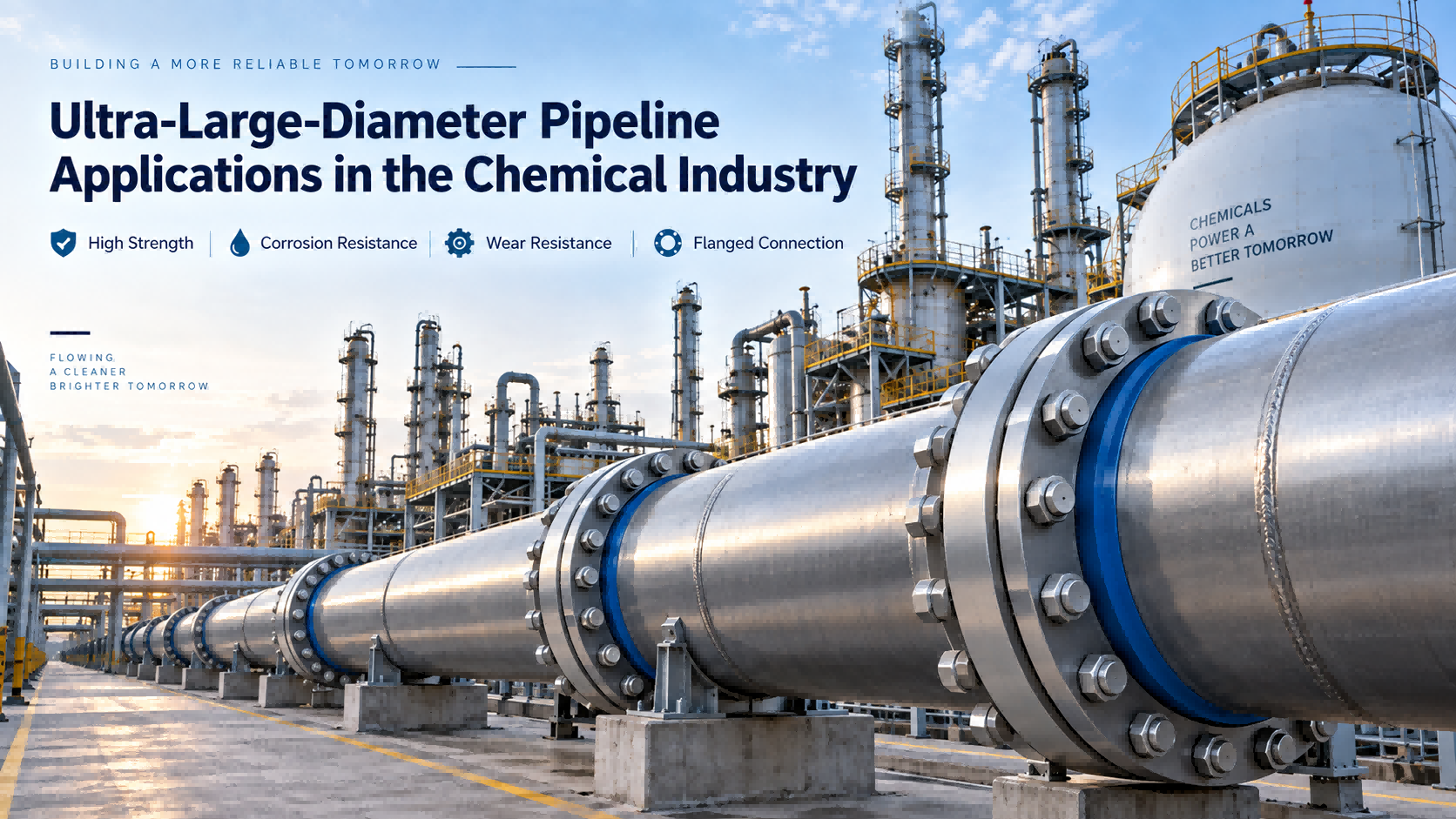
Across large-scale chemical plants, salt chemical facilities, soda ash plants, chlor-alkali operations, phosphate chemical projects, and slurry transportation systems, one trend is becoming increasingly clear:
Industrial pipelines are getting larger.
In the past, many process pipelines were concentrated around conventional sizes such as DN100, DN200, and DN300. Today, as production units continue to expand, circulation volumes increase, slurry handling capacity grows, and chemical industrial parks become more centralized, large-diameter pipelines such as DN600, DN800, DN1000, and even DN1600 and above are becoming increasingly common.
However, for chemical companies, the real technical challenge of an ultra-large-diameter pipeline is not simply making the pipe bigger.
As pipe diameter increases, multiple engineering factors become more critical at the same time, including:
-
Material strength
-
Corrosion resistance
-
Wear resistance
-
Structural stability
-
Connection reliability
-
Installation efficiency
-
Long-term maintenance cost
As a result, large-diameter pipeline selection is gradually evolving from simply choosing a pipe material into:
Designing a complete transportation system capable of reliable long-term operation.
For industrial applications involving corrosion, abrasion, pressure, and high flow rates at the same time, steel-nylon composite piping therefore represents an increasingly valuable engineering solution.
1. Why Does the Chemical Industry Need Larger-Diameter Pipelines?
The growing demand for ultra-large-diameter pipelines is fundamentally driven by increasing production capacity and transportation efficiency requirements.
1.1 Chemical Plants Are Becoming Larger
Modern chemical production facilities continue to develop toward larger and more centralized production units.
Typical examples include:
-
Large soda ash plants
-
Chlor-alkali production bases
-
Salt chemical industrial parks
-
Phosphate chemical projects
-
Slurry transportation systems
-
Industrial circulating water systems
-
Large industrial wastewater treatment systems
As the processing capacity of individual production units increases, the volume of liquid or slurry that must be transported per unit of time also increases significantly.
If a project continues to rely on multiple smaller pipelines operating in parallel, it may require more:
-
Pipelines
-
Valves
-
Flanges
-
Pipe-rack space
-
Installation work
-
Maintenance points
This significantly increases system complexity.
Using a larger main pipeline to increase transportation capacity can therefore simplify the overall system and improve operating efficiency.
2. Larger Diameters Can Reduce Flow Velocity and System Resistance
For the same required flow rate, increasing the internal diameter of a pipeline can generally reduce fluid velocity.
From an engineering perspective, this can provide several benefits.
Lower Friction Loss
A larger internal diameter can reduce hydraulic resistance, potentially lowering the energy required by pumping systems.
Reduced Local Erosion
When transporting slurry containing solid particles, excessive flow velocity can cause severe erosion around elbows, tees, valves, and other areas where flow direction changes.
An appropriately selected larger diameter can help optimize flow velocity while maintaining the required transportation capacity.
Reduced Pressure Drop
For long-distance industrial pipelines, pressure loss directly influences pump configuration and operating costs.
Therefore, the purpose of a large-diameter pipeline is not simply to transport more material.
More importantly, it can help:
Optimize the energy efficiency and reliability of the entire fluid transportation system.
3. Pipeline Diameter Increases — But Engineering Difficulty Increases Even Faster
It is easy to assume that a large-diameter pipeline is simply a scaled-up version of a smaller pipe.
In reality, this is not the case.
When pipeline diameter increases from DN300 to DN800, DN1200, DN1600, or even larger, several engineering problems change significantly.
One of the most important is structural stability.
4. Structural Stability Becomes Critical
As pipeline diameter increases, the weight of the pipe and the transported medium can increase substantially.
At the same time, large-diameter pipe walls become increasingly sensitive to factors such as:
-
External loads
-
Support spacing
-
Vacuum conditions
-
Negative pressure
-
Thermal expansion and contraction
-
Pipe ovality
-
Installation deviation
If the structural rigidity of the pipe is insufficient, large-diameter pipelines may experience:
-
Deformation
-
Ovalization
-
Local instability
-
Connection misalignment
This is why corrosion resistance alone is not enough when selecting ultra-large-diameter industrial piping.
Structural strength must also be considered.
5. Why Can Large-Diameter Thermoplastic Pipes Face Structural Limitations?
PE and HDPE pipes offer excellent corrosion resistance and are widely used in many industrial transportation systems.
However, when diameter, pressure, temperature, or support span increases, the structural rigidity of a single polymer material becomes an increasingly important design consideration.
For large industrial pipelines in particular, engineers need to evaluate:
-
Ring stiffness
-
Long-term creep behavior
-
Temperature effects
-
Support spacing
-
Flange deformation
-
Vacuum stability
Therefore, for applications that simultaneously require:
Large diameter + pressure resistance + high structural stability
a single polymer material may require thicker walls or more complex structural design.
This is one of the reasons steel-nylon composite structures can provide an alternative engineering approach.
6. The Core Design Logic of Steel-Nylon Composite Pipe: Steel Provides Strength, Nylon Handles the Process Medium
Steel-nylon composite pipe is not simply a combination of two materials.
Its fundamental engineering principle is:
Allow different materials to perform the functions they are best suited for.
The steel structure primarily provides:
-
Pipeline rigidity
-
Pressure-bearing capability
-
Resistance to external mechanical loads
-
Structural support
-
Stability for large-diameter pipelines
The nylon functional layer primarily provides:
-
Isolation between the process medium and steel
-
Corrosion resistance
-
Wear resistance
-
A smoother internal surface
-
Reduced tendency toward scaling and deposits
This creates a typical composite-material design philosophy:
Steel handles the structural requirements, while nylon handles the medium-contact environment.
This division of functions becomes particularly valuable in ultra-large-diameter industrial piping.
A single material can find it difficult to provide all of the following simultaneously:
High strength + corrosion resistance + abrasion resistance + large diameter + industrial pressure capability.
7. Why Is Corrosion Especially Important in Large-Diameter Chemical Pipelines?
When corrosion causes failure in a large-diameter pipeline, the consequences can be significantly greater than those associated with smaller secondary piping.
The reason is straightforward:
Large-diameter pipelines often serve as major process lines.
A leak may therefore affect not only one section of piping but potentially an entire production unit.
Typical corrosive media can include:
-
Brine
-
High-chloride wastewater
-
Certain weak-acid media
-
Strong alkaline media
-
Mother liquor
-
Industrial wastewater
-
High-salinity water
When conventional carbon steel is used, long-term operation may lead to:
-
General corrosion
-
Pitting
-
Weld corrosion
-
Wall thinning
-
Perforation and leakage
For DN800, DN1000, or even larger main pipelines, every replacement operation can involve significant shutdown and construction costs.
Therefore, the economics of ultra-large-diameter pipelines should not be evaluated only on:
Purchase price per meter.
A more meaningful question is:
How many repairs and replacements will this pipeline require over its entire design life?
8. Large-Diameter Slurry Pipelines Must Also Address Abrasion
In phosphate chemical production, mining, soda ash processing, and many other industrial applications, the transported medium is not always a clean liquid.
It may contain:
-
Salt sludge
-
Crystals
-
Mineral particles
-
Precipitates
-
Suspended solids
This means that the inside of the pipeline may be exposed simultaneously to:
Corrosion + erosion + abrasion.
These conditions are much more demanding than conventional clean-liquid transportation.
Carbon steel may experience significant erosion-corrosion.
Some lined piping systems may provide corrosion protection, but if the lining does not have sufficient abrasion resistance, the internal protective layer can still deteriorate rapidly.
Nylon offers good abrasion resistance, which makes steel-nylon composite piping especially relevant for:
Corrosive fluids containing suspended or solid particles.
9. One of the Most Important Challenges in Ultra-Large-Diameter Piping: Connections
One issue that is frequently underestimated in large-diameter industrial piping systems is the:
Connection method.
In many systems, the pipe body itself may have a long service life, while failures first appear around connection points.
Possible causes include:
-
Thermal expansion and contraction
-
Installation misalignment
-
Flange sealing problems
-
Weld corrosion
-
Lining failure around joints
-
Connections between different materials
Therefore, the connection system should be considered an integral part of large-diameter pipeline design.
10. Integrated Flange Design Can Reduce Connection Risks
For steel-nylon composite piping, flange connection design is particularly important.
Flanged systems can provide several advantages for large chemical projects.
10.1 Reduced On-Site Welding
Hot work inside chemical facilities normally requires strict safety procedures and approvals.
For existing production lines, welding may require:
-
Production shutdown
-
Pipeline cleaning
-
Purging
-
Gas detection
-
Hot-work permits
Flanged connections can significantly reduce the amount of on-site welding required.
10.2 Better Suited to Large-Diameter Installation
On-site welding becomes considerably more difficult when pipeline diameters reach DN800, DN1000, or larger.
Flanged connections can make it easier to implement:
-
Prefabricated pipe sections
-
Modular installation
-
Faster assembly
-
Future dismantling
-
Localized maintenance
10.3 Suitable for Existing Pipeline Upgrades
Many chemical plants do not replace an entire pipeline system at once.
A more common strategy is to initially replace the sections experiencing the highest corrosion or wear, such as:
-
Pump discharge sections
-
Pipe sections before and after valves
-
Elbows
-
Tees
-
High-velocity sections
A flanged piping system is well suited to this type of phased replacement and upgrading.
11. Why Does a Smooth Internal Surface Matter More in Large-Diameter Pipelines?
The internal roughness of an industrial pipeline directly affects hydraulic resistance.
Over time, conventional carbon steel pipelines may develop:
-
Corrosion products
-
Rust layers
-
Scaling
-
Deposits
These can gradually reduce the effective flow area.
In other words:
A pipeline originally designed as DN1000 may experience significant deterioration in hydraulic performance after years of operation.
A relatively smooth nylon internal surface can help reduce:
-
Deposition
-
Crystal adhesion
-
Growth in surface roughness
This becomes particularly valuable in long-distance, high-flow transportation systems.
Even a relatively small difference in hydraulic resistance can translate into meaningful energy-cost differences when large pumping systems operate continuously for many years.
12. Ultra-Large-Diameter Pipelines Require a New Approach to Lifecycle Cost
Suppose a large chemical main pipeline uses a conventional material.
The initial investment may appear lower.
However, if corrosion leakage develops after several years, the company may face costs far beyond the replacement pipe itself.
These can include:
-
Production shutdown losses
-
Labor
-
Crane and lifting operations
-
Dismantling
-
Scaffolding
-
Hot-work management
-
Disposal of old piping
-
Safety management costs
For this reason, large-diameter industrial pipelines should increasingly be evaluated using:
TCO — Total Cost of Ownership
A simplified model is:
TCO = Initial Purchase Cost + Installation Cost + Maintenance Cost + Replacement Cost + Shutdown Losses + Energy Cost
When pipeline diameter reaches DN800, DN1000, DN1600, or larger, the cost of even a single major maintenance event can become significant.
Therefore:
The longer the service life, the greater the potential economic value.
13. Advantages of Steel-Nylon Composite Pipe in Ultra-Large-Diameter Chemical Systems
For chemical projects involving long-term transportation of corrosive or abrasive media, steel-nylon composite pipe provides several important characteristics.
13.1 Steel Structure Provides Mechanical Strength
The external steel structure provides rigidity and mechanical stability, which supports the structural requirements of large industrial pipelines.
13.2 Nylon Layer Isolates the Corrosive Medium
The transported medium primarily contacts the nylon functional layer, helping reduce direct exposure of the steel structure to corrosive process fluids.
13.3 Corrosion and Wear Resistance
For liquids containing solid particles or slurry, nylon can provide useful abrasion resistance in addition to corrosion protection.
13.4 Smooth Internal Surface
A smooth internal surface can help reduce hydraulic resistance and mitigate certain deposition and scaling problems.
13.5 Suitable for Industrial Pressure Systems
Through the combination of steel reinforcement and composite functional layers, the pipe can be designed for industrial systems with meaningful operating pressure requirements.
Our steel-nylon composite pipe portfolio can be engineered for approximately 1.0–4.0 MPa pressure classes, depending on specific project conditions and design requirements.
13.6 Ultra-Large-Diameter Manufacturing Capability
For large industrial projects, manufacturing capability itself becomes an important criterion when selecting a supplier.
Our steel-nylon composite pipe manufacturing system supports large-diameter industrial piping and has the engineering and manufacturing capability to extend toward the DN2000-class ultra-large-diameter range.
This allows the technology to serve applications such as:
-
Large-scale mother liquor transportation
-
Industrial circulating water
-
Chemical wastewater
-
Large brine systems
-
Slurry transportation
-
Existing main-pipeline upgrades
14. Typical Application: Soda Ash Industry
Soda ash production involves numerous complex process media, including:
-
Mother liquor
-
Brine
-
Salt sludge
-
Process wastewater
These media may simultaneously involve corrosion, crystallization, solids, and abrasion.
For a large soda ash project, a main process pipeline therefore needs to address more than corrosion resistance alone.
Other important factors include:
-
High flow capacity
-
Continuous operation
-
Abrasion resistance
-
Scaling control
-
Maintenance intervals
These conditions make composite piping an important option for system optimization.
15. Typical Application: Chlor-Alkali Industry
Some chlor-alkali pipelines continuously transport highly alkaline media.
For conventional metallic piping systems, material selection and long-term corrosion control therefore become important engineering considerations.
Using a steel structure to provide mechanical performance while using a medium-resistant functional layer to isolate the transported fluid is one approach to managing demanding corrosive environments.
For large-diameter transportation systems in particular, this design can potentially reduce reliance on expensive solid-alloy piping materials in suitable applications.
16. Typical Application: Phosphate Chemical and Slurry Transportation
Phosphate chemical and mining operations frequently involve highly abrasive media.
A typical process condition may include:
Liquid + solid particles + corrosive medium.
This means the pipeline is not exposed to corrosion alone.
Instead, it may experience:
Combined corrosion and abrasion.
Once corrosion begins to damage the internal surface, increased roughness can further intensify particle erosion.
This can create a reinforcing failure cycle:
Corrosion → Surface Damage → Increased Erosion → Accelerated Wall Loss
Combining corrosion resistance and abrasion resistance is therefore an important advantage of steel-nylon composite piping in these applications.
17. Ultra-Large-Diameter Pipeline Design Must Include the Support System
The larger the pipe diameter, the more important the support design becomes.
Practical engineering design should consider:
-
Pipe self-weight
-
Weight of the transported medium
-
Valve weight
-
Thermal displacement
-
Support spacing
-
Fixed support locations
-
Sliding supports
-
Pipe-rack structure
For DN1000 and larger pipelines in particular, poor support design may eventually cause:
-
Pipeline sagging
-
Excessive joint loading
-
Flange misalignment
-
Local deformation
Therefore:
Ultra-large-diameter piping requires material design and structural design to be considered together.
18. DN2000-Class Pipelines Put the Entire Manufacturing System to the Test
Many manufacturers can produce conventional pipe sizes.
However, manufacturing difficulty increases significantly as diameter approaches DN1600 or the DN2000 class.
Several areas become particularly challenging.
Dimensional Control
As pipe diameter increases, controlling roundness, wall dimensions, and flange geometry becomes more difficult.
Composite Layer Quality
A large-area composite structure must maintain:
-
Continuity
-
Uniformity
-
Density and integrity
-
Structural consistency
Flange Accuracy
Significant dimensional deviation in an ultra-large-diameter flange can create major installation problems at the project site.
Factory Inspection
Large industrial pipes require a systematic quality-control process covering:
-
Dimensional inspection
-
Visual inspection
-
Pressure testing
-
Composite-layer inspection
-
Flange inspection
Therefore, what ultimately determines the reliability of an ultra-large-diameter pipe is not simply the material formulation.
It is:
The entire manufacturing and quality-control system.
19. Large-Diameter Industrial Pipeline Procurement Is Shifting from “Buying Pipe” to “Buying Reliability”
In the past, many procurement decisions focused heavily on one question:
How much does the pipe cost per meter?
As industrial plants become larger, companies are increasingly asking a different question:
How many times will this pipeline need to be repaired or replaced over the next ten years?
This represents an important shift in industrial pipeline procurement.
Evaluation criteria are moving away from focusing only on:
-
Unit price
-
Material weight
and toward:
-
Service life
-
Failure frequency
-
Maintenance frequency
-
Installation efficiency
-
Energy consumption
-
Shutdown risk
This is one reason why high-performance composite piping is receiving increasing attention in demanding industrial projects.
20. Which Ultra-Large-Diameter Applications Are Suitable for Steel-Nylon Composite Pipe?
Steel-nylon composite pipe is not the only solution for every industrial application.
Pipeline material selection should always be based on actual process conditions and medium compatibility.
However, it deserves particular consideration in applications involving:
-
Corrosive industrial wastewater
-
Brine transportation
-
Mother liquor transportation
-
Strong alkaline media
-
High-salinity water
-
Liquids containing solid particles
-
Slurry
-
Chemical circulating water
-
Oilfield produced water
-
Long-distance industrial transportation
Its advantages become particularly relevant where the following requirements exist simultaneously:
Corrosion resistance + abrasion resistance + pressure resistance + large diameter
21. The Future of Ultra-Large-Diameter Pipelines Is Not About a Single Material — It Is About System Performance
The future development of industrial piping is unlikely to be simply:
“Steel replacing plastic”
or:
“Plastic replacing steel.”
A more important engineering direction is:
Allowing different materials to perform the functions they are best suited for.
Steel is well suited to:
Structural strength and pressure resistance.
High-performance nylon materials are well suited to:
Corrosion resistance, abrasion resistance, and isolation of the transported medium.
Through appropriate composite structural design, a pipeline can combine:
-
Mechanical strength
-
Corrosion resistance
-
Abrasion resistance
-
Large-diameter manufacturing capability
-
Industrial pressure capability
-
Long-term operational reliability
This is the fundamental engineering logic behind steel-nylon composite pipe.
Conclusion: Ultra-Large-Diameter Pipelines Are Ultimately About Reliability in Large Industrial Systems
Demand for ultra-large-diameter pipelines in the chemical industry will continue to grow as production facilities become larger and transportation requirements increase.
However, the larger the pipeline becomes, the more important material selection, structural design, connection design, and manufacturing quality become.
A failure in a major industrial pipeline can create consequences far greater than the original purchase price of the pipe itself.
For this reason, the most important performance criteria for future ultra-large-diameter industrial piping will increasingly include:
Corrosion resistance, abrasion resistance, pressure capability, structural stability, connection reliability, and total lifecycle cost.
Steel-nylon composite pipe combines:
Steel structural strength + nylon corrosion and abrasion resistance + flanged connection design
to provide a composite piping solution for demanding industrial transportation systems.
For applications in large chemical plants, salt chemical facilities, soda ash production, chlor-alkali operations, phosphate chemical projects, slurry transportation, and other highly corrosive industrial environments, this design philosophy offers significant engineering value.
A truly advanced ultra-large-diameter pipeline should not simply be:
“Bigger.”
It should be capable of:
Maintaining reliable operation even as transportation scale becomes significantly larger.
That is the real technical value of ultra-large-diameter industrial piping.
Best Pipe Materials for Strong Alkali Applications: How to Choose Industrial Piping with Corrosion Resistance, Wear Resistance, and Pressure Performance
Applications of High Wear-Resistant Piping in the Chemical Industry: From Frequent Replacement to Long-Service-Life Pipeline Systems