Chemical Industry Energy-Saving Case Study: How Steel-Nylon Composite Pipes Help Reduce Energy Consumption and Long-Term Operating Costs

Introduction: Why Chemical Companies Need to Reevaluate Their Pipeline Systems
Against the backdrop of fluctuating global energy costs, increasingly stringent environmental requirements, and intensifying competition in the chemical industry, energy conservation and consumption reduction have become important priorities for chemical manufacturers seeking sustainable development.
Traditionally, energy-saving initiatives in chemical plants have focused primarily on production equipment, heat recovery, motor efficiency, and automated control systems.
However, one important factor is often overlooked: Industrial pipeline systems connecting production equipment also have a significant impact on energy consumption, production efficiency, and long-term operating costs.
In industries such as soda ash, chlor-alkali, salt chemicals, phosphate chemicals, and petrochemicals, industrial pipelines must transport complex media that may be corrosive, abrasive, or subject to elevated temperatures. At the same time, these pipelines must maintain stable transportation performance during long-term continuous operation.
Over time, conventional industrial pipelines may experience internal corrosion, scaling, wear, localized blockages, and leakage at connection points.
These problems not only affect pipeline service life but may also increase flow resistance, raise pumping energy consumption, increase maintenance requirements, and ultimately reduce overall production efficiency.
Therefore, industrial pipeline energy-saving projects should not focus solely on initial procurement costs. Instead, companies should systematically evaluate material performance, transportation efficiency, operational reliability, and total lifecycle costs.
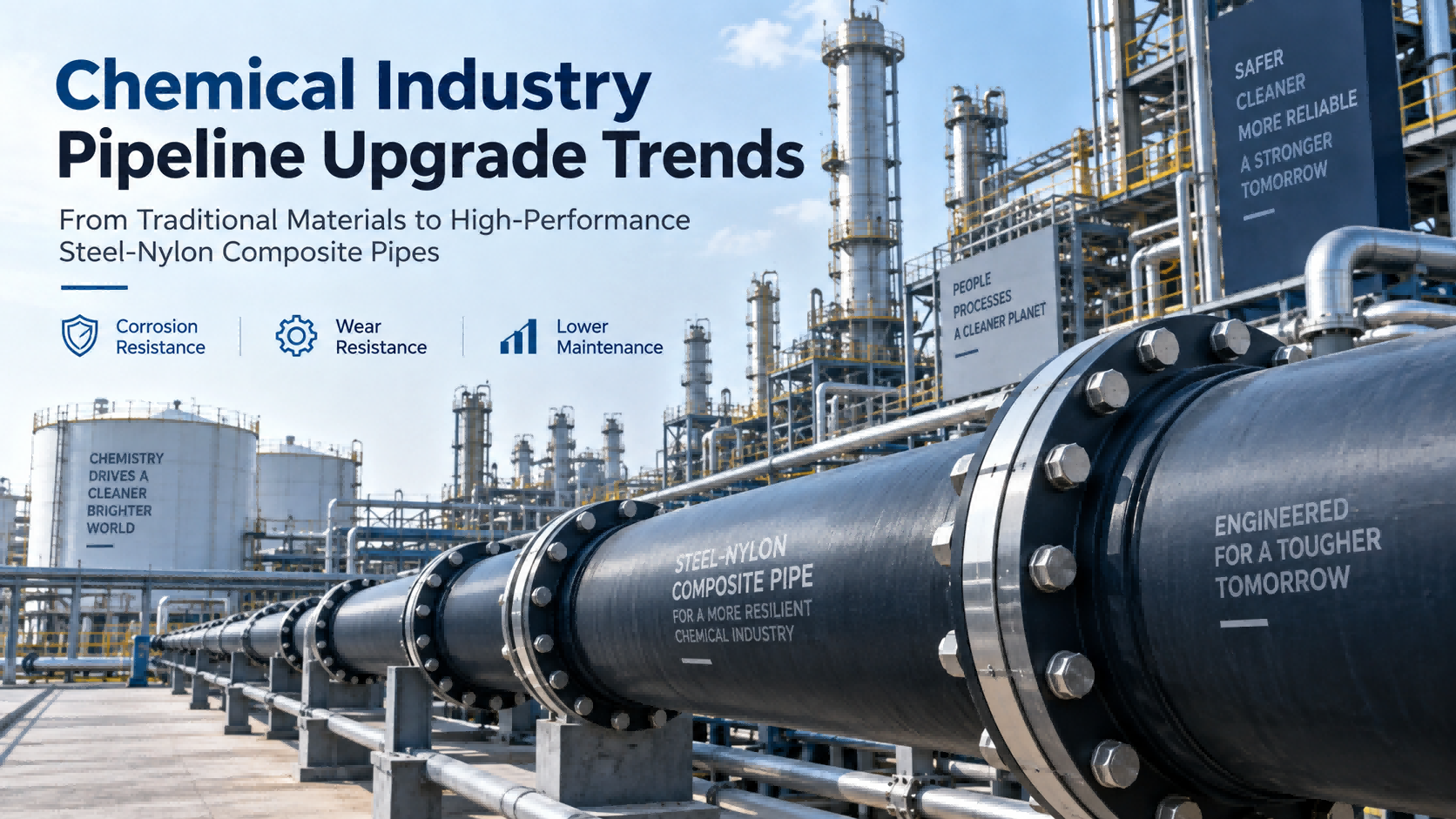
Steel-nylon composite pipes are a composite piping solution developed to address the industrial demand for corrosion resistance, wear resistance, pressure-bearing capacity, and long-term transportation stability.
By combining the structural strength of steel with the corrosion and wear resistance of reinforced nylon, steel-nylon composite pipes can help chemical companies reduce operational problems caused by pipeline corrosion and abrasion.
Under suitable operating conditions, they may also contribute to improved long-term transportation efficiency, allowing companies to achieve energy savings while enhancing pipeline reliability.
1. Why Do Pipeline Systems Become a Hidden Source of Energy Consumption in Chemical Plants?
For chemical companies operating continuous production processes, the condition of the pipeline system directly affects the energy efficiency of transportation equipment.
This is particularly important in long-distance transportation, high-flow circulation, and highly corrosive media transportation systems, where internal pipe conditions, effective flow area, and pipeline layout influence overall pressure losses.
The U.S. Department of Energy has identified pipe diameter, internal roughness, flow rate, and pipeline length as factors affecting friction losses and operating costs in industrial pumping systems.
Therefore, optimizing pipeline systems is an important approach to improving industrial pumping efficiency.
1.1 Pipeline Corrosion Increases Flow Resistance
In chlor-alkali, salt chemical, and soda ash production, certain process media contain high concentrations of salts, alkalis, or other corrosive substances.
When conventional carbon steel pipes remain in contact with incompatible corrosive media for extended periods, internal corrosion, corrosion-product accumulation, and reductions in effective flow area may occur.
As the internal condition of a pipeline deteriorates, a higher pumping pressure differential may be required to maintain the same transportation flow rate.
This means that companies may need to consume more electricity to transport the same volume of process media.
For continuous production systems operating thousands of hours annually, even a relatively small increase in pipeline pressure loss can accumulate into substantial long-term energy expenses.
However, corrosion does not necessarily cause resistance to increase continuously under all operating conditions. Actual changes depend on the type of corrosion, deposits, internal pipe diameter, and fluid-flow characteristics.
1.2 Scaling and Deposits Affect Long-Term Transportation Efficiency
Salt solutions, mother liquors, mineral slurries, and other chemical process media containing solid particles may form deposits or scale under specific temperature, flow velocity, and concentration conditions.
When deposits accumulate inside pipelines, the effective flow area may decrease, potentially changing both localized resistance and friction losses along the pipeline.
To maintain the flow rate required for production, companies may need to increase pumping energy consumption or arrange periodic pipeline cleaning.
Frequent cleaning also generates additional labor costs, cleaning-agent consumption, and production downtime.
Consequently, selecting pipeline materials that are compatible with the transported media and capable of maintaining favorable internal conditions over time is an important consideration in chemical plant energy-saving projects.
Nevertheless, pipeline materials alone cannot completely eliminate crystallization or deposition caused by supersaturated media, temperature fluctuations, or insufficient flow velocity.
1.3 Pipeline Leakage and Frequent Repairs Increase Overall Energy Consumption
The losses associated with pipeline leakage extend far beyond the value of the leaked material itself.
For example, when a corrosive liquid pipeline develops a leak, the company may need to isolate the affected system, shut down equipment, drain the pipeline, perform repairs, replace damaged components, and restart production.
These activities may generate additional energy and resource consumption, including:
-
Loss of transported media and the resources required to replenish it.
-
Additional electricity, steam, or other energy consumed during shutdown and restart.
-
Materials and labor required for pipeline cleaning, maintenance, and replacement.
-
Indirect costs associated with production interruptions, product losses, or reduced output.
For chemical companies operating continuous production processes, reducing unplanned downtime is just as important as reducing direct energy consumption.
2. How Can Steel-Nylon Composite Pipes Help Chemical Companies Save Energy and Reduce Consumption?
Unlike conventional pipes that depend on the properties of a single material, steel-nylon composite pipes use a composite structural design in which different materials perform complementary functions.
Their fundamental design principle is:
Steel provides structural support and pressure-bearing capacity, while reinforced nylon forms a corrosion-resistant and wear-resistant layer in contact with the transported media.
This structure allows steel-nylon composite pipes to combine mechanical performance with the requirements of industrial fluid transportation under suitable chemical processing conditions.
2.1 Corrosion-Resistant Inner Layer: Reducing Long-Term Transportation Losses Caused by Corrosion
For chemical media with high salinity or alkalinity, the corrosion resistance of the internal pipe surface is an important factor affecting long-term operating performance.
When material compatibility has been verified, the reinforced nylon inner layer can reduce direct contact between corrosive media and the steel structure, thereby reducing the risk of internal steel corrosion.
Compared with conventional carbon steel pipes directly exposed to corrosive media, appropriately designed steel-nylon composite pipes offer several potential advantages.
First, reduced internal corrosion.
The corrosion-resistant inner layer separates the transported media from the steel structure, reducing the risk of material degradation and corrosion-product accumulation caused by direct steel corrosion.
Second, improved long-term transportation stability.
Reducing internal corrosion and related deposits helps control changes in flow resistance caused by internal surface deterioration.
Third, potentially lower maintenance frequency.
Under compatible media and operating conditions, a corrosion-resistant composite structure may reduce maintenance and replacement requirements associated with internal corrosion.
It is important to emphasize that these benefits depend on media composition, concentration, temperature, pressure, and actual operating conditions.
For concentrated acids, strongly oxidizing media, and other complex chemical substances, material compatibility must be evaluated separately.
Experience obtained from conventional alkaline applications should not be directly applied to all chemical environments.
2.2 Wear Resistance: Reducing the Long-Term Impact of Abrasive Media on Pipeline Systems
Phosphate chemical plants, mining operations, and certain salt chemical production processes require pipelines to transport mineral slurries, salt mud, and other media containing solid particles.
When these materials pass through elbows, tees, and areas with changing flow velocities, abrasive particles may cause erosion and wear on internal pipe surfaces.
Over time, severe wear, localized deformation, corrosion, or other damage can affect pipeline safety and transportation performance.
Reinforced nylon materials have wear-resistant properties suitable for certain abrasive media transportation applications.
By combining a wear-resistant inner layer with a steel supporting structure, steel-nylon composite pipes provide a material option for industrial pipeline systems requiring both abrasion resistance and pressure-bearing capacity.
For chemical manufacturers, the value of this structure lies not only in its potential to extend pipeline service life but also in reducing the risk of unplanned maintenance caused by wear.
In continuously operating mineral slurry and salt mud transportation systems, reducing frequent pipe replacement and associated production shutdowns can contribute to lower overall operating costs.
However, actual wear rates must be evaluated according to particle hardness, particle size, solids concentration, flow velocity, and pipeline structure.
2.3 Optimized Internal Surface Design: Improving Long-Term Transportation Efficiency
Pipeline flow resistance is closely related to internal surface roughness, effective internal diameter, flow velocity, fluid properties, and pipeline configuration.
Through appropriate inner-layer manufacturing processes and structural design, steel-nylon composite pipes can provide internal surfaces suitable for industrial fluid transportation.
When pipe material, structural dimensions, and operating conditions are properly matched, maintaining a favorable internal surface condition helps control friction losses along the pipeline.
If conventional metal pipelines experience severe corrosion, scaling, or deposit accumulation during long-term operation, corrosion-resistant composite pipes may be capable of maintaining lower pressure losses at the same flow rate.
However, replacing conventional pipes with steel-nylon composite pipes does not automatically guarantee lower pumping energy consumption.
If the composite inner layer significantly reduces the effective flow area, or if the pipeline contains numerous components that generate localized flow resistance, a relatively smooth internal surface may not be sufficient to reduce the overall system pressure drop.
Therefore, actual energy-saving projects require hydraulic calculations based on effective internal diameter, internal surface roughness, flow rate, pipeline length, and connection structure.
2.4 Combining Steel Strength with a Nylon Inner Layer: Meeting Pressure and Corrosion Resistance Requirements
For chemical companies, pipeline materials must not only be compatible with the transported media but also meet the required design pressure and temperature conditions.
Non-metallic and conventional metallic pipelines each have their own applicable operating ranges.
Through composite structural design, steel-nylon composite pipes combine the rigidity and pressure-bearing capacity of steel with the chemical resistance of the nylon inner layer, providing additional options for complex industrial applications.
Our company specializes in manufacturing steel-nylon composite pipes and reinforced MC nylon pipes.
Our steel-nylon composite pipe product range covers pressure ratings from 1.0 to 4.0 MPa, and we have manufacturing capabilities for large-diameter industrial pipes.
For different chemical projects, we can evaluate pipe structure, inner-layer materials, and connection methods based on design pressure, pipe diameter, temperature, and media characteristics.
It should be noted that the 1.0–4.0 MPa range represents the pressure ratings available across our product series.
It does not mean that every pipe specification can operate at the same maximum allowable pressure under all temperature and media conditions.
For continuous high-temperature service, pressure fluctuations, and large-diameter applications, suitability should be confirmed using product-specific design conditions and testing documentation.
3. Chemical Industry Energy-Saving Case Study: Evaluating the Benefits of Upgrading a Corrosive Liquid Transportation Pipeline
To illustrate how upgrading pipeline materials can affect energy consumption in chemical plants, the following section presents an energy-saving analysis model based on a typical corrosive liquid transportation system.
Important note: The following example is a hypothetical engineering scenario intended to demonstrate an energy-saving calculation method. It is not a completed customer project and does not represent guaranteed energy-saving performance for our products under all operating conditions.
Actual projects require verification through on-site measurements, material selection analysis, and operating data.
3.1 Project Background: Long-Term Operating Challenges in a Conventional Pipeline System
Consider a chemical manufacturing facility operating a corrosive process liquid transportation system.
The system uses pumps to transfer process liquids from an upstream storage tank to downstream production equipment.
The pipeline operates continuously over extended periods.
The transported medium has certain corrosive properties and may contain solid particles under specific operating conditions.
During the operation of the existing pipeline, the company needs to address several potential problems.
First, the internal pipe surface may be affected by the corrosive medium, resulting in progressive deterioration over time.
Second, corrosion products or accumulated deposits may increase transportation resistance, requiring greater pumping power to maintain the same flow rate.
Third, corrosion, wear, and failure at pipeline connections may increase maintenance frequency and affect continuous production.
The company aims to optimize its pipeline system to control pumping energy consumption and reduce long-term maintenance costs while maintaining safe production.
3.2 Proposed Upgrade: Evaluating Steel-Nylon Composite Pipes
To address these challenges, the company could consider including steel-nylon composite pipes that meet the operating requirements in its pipeline upgrade evaluation.
The objective is not simply to replace one material with another.
Instead, the upgrade should include a comprehensive assessment of pipeline structure, internal surface condition, effective internal diameter, connection methods, and compatibility with the pumping system.
Within the proposed upgrade, steel-nylon composite pipes would serve three primary functions.
First, the reinforced nylon inner layer would act as the functional surface in contact with the transported medium. When material compatibility is confirmed, it can reduce direct corrosion of the steel structure.
Second, the steel structure would provide the mechanical support and pressure-bearing capacity necessary to meet the design requirements of the industrial transportation system.
Third, through appropriate pipe sizing and internal structural design, the upgraded system would aim to control both frictional and localized pressure losses while maintaining stable transportation capacity over time.
Before implementing an actual project, the company should obtain media analysis reports, historical pipeline operating records, and existing pressure-drop measurements to determine the appropriate material and structural solution.
3.3 Energy-Saving Calculation: How Much Electricity Can Be Saved by Reducing Pipeline Pressure Loss?
In industrial liquid transportation systems, pumping power is primarily related to flow rate, pressure increase, and the combined efficiency of the pump and motor.
At the same flow rate, reducing pipeline pressure losses may result in electricity savings if the pumping equipment can correspondingly reduce its actual input power.
The basic calculation is:
Change in pumping power:
Where:
-
ΔP = Change in electrical power, measured in watts (W).
-
Q = Volumetric flow rate, measured in m³/s.
-
Δp = Reduction in system pressure differential at the same flow rate, measured in pascals (Pa).
-
η = Combined pump and motor efficiency.
This formula is suitable for simplified estimates under corresponding steady-state operating conditions.
If pump efficiency changes significantly with the operating point, actual input power should be calculated separately for the conditions before and after the upgrade.
The U.S. Department of Energy recommends that industrial pumping systems be evaluated by considering flow rate, pipe diameter, friction losses, and lifecycle operating expenses when comparing the economic performance of different pipeline designs.
Assumed Operating Parameters
Consider a chemical plant with the following hypothetical transportation system:
| Parameter | Assumed Value |
|---|---|
| Transported medium | Corrosive process liquid compatible with the selected pipe material |
| System flow rate | 300 m³/h |
| Annual operating hours | 8,000 hours |
| Pipeline pressure differential before upgrading | 0.25 MPa |
| Pipeline pressure differential after upgrading | 0.20 MPa |
| Reduction in pipeline pressure differential | 0.05 MPa |
| Combined pump and motor efficiency | 70% |
| Industrial electricity price | RMB 0.80/kWh |
The pressure differentials before and after upgrading are hypothetical values used to demonstrate the calculation method.
They are not measured performance data for steel-nylon composite pipes.
The calculation also assumes that the transportation flow rate remains unchanged, the combined pump and motor efficiency stays at 70%, and the reduction in pressure differential can be converted into an actual reduction in electrical power consumption.
Step 1: Calculate the Reduction in Pumping Power
Convert 300 m³/h to 0.08333 m³/s.
Convert 0.05 MPa to 50,000 Pa.
Substitute these values into the formula:
ΔP=0.08333×50,0000.70\Delta P=\frac{0.08333\times50,000}{0.70}The result is:
ΔP≈5.95 kW\Delta P\approx5.95\text{ kW}Under the assumed conditions, the transportation system could reduce its electrical input power by approximately 5.95 kW.
Step 2: Calculate Annual Electricity Savings
E=5.95×8,000E=5.95\times8,000Therefore:
E≈47,600 kWhE\approx47,600\text{ kWh}The estimated annual electricity savings would be approximately 47,600 kWh.
Step 3: Calculate Annual Electricity Cost Savings
Assuming an electricity price of RMB 0.80/kWh:
C=47,600×0.80C=47,600\times0.80Therefore:
C≈38,080 RMBC\approx38,080\text{ RMB}Under this hypothetical scenario, a single transportation pipeline could achieve theoretical annual electricity cost savings of approximately RMB 38,000.
If a chemical plant operates multiple pipelines under similar conditions, and independent evaluations confirm comparable energy-saving opportunities, the overall economic benefits could increase further.
However, a reduction in pipeline pressure loss does not necessarily translate into a proportional reduction in motor input power.
For example, when a fixed-speed centrifugal pump is used, reducing pipeline resistance may change the operating point and increase the system flow rate.
Therefore, actual electricity savings must be verified by considering the pump performance curve, speed-control strategy, valve-control method, and measured electricity consumption before and after the pipeline upgrade.
4. Beyond Reducing Pumping Energy Consumption: What Other Operating Costs Can Steel-Nylon Composite Pipes Help Reduce?
For chemical companies, the economic value of a pipeline upgrade should not be measured solely by the amount of electricity saved.
Under certain corrosive and abrasive operating conditions, maintenance expenses, production downtime, and pipeline replacement costs may be equally important factors influencing the overall return on investment.
4.1 Reducing Maintenance Costs in Corrosive Media Transportation Systems
For companies that need to regularly inspect or replace corroded pipeline sections, upgrading to corrosion-resistant materials may reduce maintenance requirements caused by internal corrosion.
Steel-nylon composite pipes use a corrosion-resistant inner layer to separate the transported medium from the steel structure, reducing the risk of internal corrosion under suitable operating conditions.
During long-term operation, this structure may reduce the need for replacing corroded pipeline sections, performing certain corrosion-related repairs, and arranging associated production shutdowns.
However, the outer steel structure still requires appropriate external corrosion protection according to environmental conditions.
4.2 Reducing Pipeline Replacement Caused by Wear
In the transportation of mineral slurries, salt mud, and other media containing solid particles, pipeline wear is an important factor affecting system reliability.
By selecting a reinforced nylon inner layer compatible with the abrasive characteristics of the transported medium, steel-nylon composite pipes can provide a solution for wear-resistant pipeline design.
If actual operating conditions demonstrate that the composite pipes have a longer service life than the original pipes, the company may be able to reduce the frequency of pipeline replacements and the associated installation costs.
Actual service life should be established using field operating records or representative wear-testing results rather than assumptions based solely on the material name.
4.3 Reducing Production Losses Caused by Unplanned Downtime
For continuously operating soda ash, chlor-alkali, and salt chemical facilities, pipeline failures may disrupt the normal operation of related production units.
If upgrading the pipeline material reduces failures caused by corrosion or abrasion, the company may experience fewer associated production interruptions.
Reduced pipeline maintenance requirements can also help lower related labor and construction resource consumption.
These savings represent indirect economic benefits.
They should be calculated separately using actual maintenance records, downtime duration, and production-loss data rather than being treated as direct electricity savings.
5. Real Engineering Application: How Steel-Nylon Composite Pipes Meet Long-Term Transportation Requirements in the Soda Ash Industry
In addition to the hypothetical energy-saving scenario described above, real long-term operating projects can help chemical companies understand the practical application value of corrosion-resistant composite pipelines.
Shandong Haihua Soda Ash Production Facility: Industrial Pipeline Application Case
The Shandong Haihua soda ash production facility is one of the industrial projects in which our company's reinforced MC nylon pipes and reinforced MC nylon steel composite pipes have been applied.
According to our existing project records, the facility began using the relevant products in 2002.
The applications involved multiple process-media transportation operations within the soda ash production system.
The main transported media included:
-
Calcination cold mother liquor.
-
Brine and salt mud.
-
Environmental wastewater associated with heavy soda ash production.
These media present different requirements for pipeline corrosion resistance, wear resistance, and long-term operating reliability.
When selecting conventional pipelines for these applications, companies need to consider alkaline corrosion, abrasion caused by salt mud, and maintenance requirements during continuous operation.
To address these needs, reinforced MC nylon pipes and reinforced MC nylon steel composite pipes provided material solutions for the relevant process pipelines.
According to our company's retained project records, as of July 2010, the customer had provided positive feedback regarding product quality, operating performance, and related technical services.
This project demonstrates the practical application of reinforced MC nylon and steel-nylon composite pipes in the transportation of process media within the soda ash industry.
It also provides an engineering reference for material selection in similar operating environments.
It should be noted that the existing project documentation primarily covers product applications and operating evaluations. It does not provide comparative measurements of pumping energy consumption, pressure differential, or carbon emissions before and after installation.
Therefore, this project can be presented as an engineering application case involving corrosion-resistant composite pipelines.
However, the available information does not support a claim that the project achieved a specific percentage of energy savings or emissions reductions.
For chemical companies seeking to quantify energy-saving benefits, independent evaluations must be conducted using actual flow rates, pipeline pressure losses, motor power consumption, and operating hours.
6. Energy-Saving Potential of Steel-Nylon Composite Pipes Across Different Chemical Industries
The chemical industry involves a wide range of complex process media, and the performance requirements for industrial pipelines vary significantly between production processes.
The application value of steel-nylon composite pipes must therefore be evaluated according to specific operating conditions.
| Industry | Typical Transported Media | Main Pipeline Challenges | Potential Energy-Saving and Cost-Reduction Benefits |
|---|---|---|---|
| Soda ash | Mother liquor, brine, salt mud | Alkaline corrosion, deposition, abrasion | Reduce internal corrosion and related maintenance requirements while controlling long-term transportation losses |
| Chlor-alkali | Caustic soda solutions, brine | Media corrosion, temperature fluctuations | Reduce internal corrosion risks and related repair costs under suitable operating conditions |
| Salt chemicals | High-salinity process liquids, salt mud | High-salinity corrosion, abrasion | Improve pipeline operating reliability and reduce downtime caused by corrosion and wear |
| Phosphate chemicals | Phosphate slurry and selected process liquids | Solid-particle abrasion, media corrosion | Reduce wear-related maintenance and replacement costs under suitable operating conditions |
| Petrochemicals | Selected corrosive process liquids | Corrosion, pressure fluctuations | Improve transportation reliability when material compatibility and structural design requirements are satisfied |
| Industrial wastewater treatment | Selected saline and alkaline wastewater | Corrosion, deposits, frequent maintenance | Reduce maintenance associated with internal corrosion and improve long-term operating stability |
All applications must undergo suitability assessments based on media concentration, temperature, pressure, and actual operating conditions.
For strongly oxidizing media, concentrated acids, and special chemical substances incompatible with the relevant nylon materials, the suitability of steel-nylon composite pipes cannot be determined solely by the industry in which they are used.
7. Why Is Total Lifecycle Cost More Important Than Initial Pipe Procurement Price?
In traditional chemical project procurement, pipeline purchase price is often an important factor in supplier selection.
However, as companies place greater emphasis on continuous production and long-term operating reliability, comparing materials based solely on initial purchase price may not accurately reflect the economic performance of different pipeline solutions.
For example, two types of pipelines may have different procurement prices, but they may also differ in corrosion resistance, maintenance frequency, actual service life, and transportation efficiency.
Chemical companies should therefore conduct comprehensive evaluations based on Life Cycle Cost (LCC).
7.1 Establishing a Complete Pipeline Cost Model
The total lifecycle cost of an industrial pipeline can be simplified as follows:
Total Lifecycle Cost = Initial Procurement and Installation Costs + Operating Energy Costs + Inspection and Maintenance Costs + Replacement Costs + Downtime Losses + Decommissioning and Disposal Costs
Operating energy costs are primarily affected by system pressure losses, transportation flow rate, pumping efficiency, electricity prices, and annual operating hours.
Maintenance costs are influenced by media corrosiveness, material wear resistance, installation quality, and operating management.
When evaluating long-term economic performance, companies should also consider the time value of money and apply a consistent discounting method to future costs.
The U.S. Department of Energy identifies lifecycle cost analysis as an important method for evaluating energy efficiency and equipment investment in industrial pumping systems.
7.2 Shifting from Short-Term Procurement Savings to Long-Term Return on Investment
For chemical production facilities expected to operate over extended periods, a pipeline material capable of reducing maintenance, replacement, and unplanned shutdowns may offer more favorable lifecycle economics, even if its initial procurement cost is higher.
The advantage of steel-nylon composite pipes lies in their combination of a corrosion-resistant inner layer, wear-resistant materials, and a steel supporting structure.
This configuration provides an option for industrial applications requiring several complementary performance characteristics.
However, this does not mean that steel-nylon composite pipes have lower overall costs than stainless steel, fiberglass-reinforced plastic (FRP), HDPE, or other pipeline materials under every operating condition.
Companies should compare the actual procurement costs, installation expenses, maintenance requirements, and expected service life of different pipeline solutions according to their specific media, pressure, temperature, diameter, and intended operating period.
For continuously operating chemical projects, the key consideration is not simply how much money can be saved on each meter of pipe, but how much overall economic value the entire transportation system can deliver over many years of operation.
8. What Technical Parameters Should Chemical Companies Consider When Implementing Pipeline Energy-Saving Projects?
Upgrading pipeline materials involves more than simply replacing one material with another corrosion-resistant alternative.
It requires a comprehensive reevaluation of the entire transportation system.
For companies considering steel-nylon composite pipes as part of an energy-saving and consumption-reduction project, the following technical factors deserve particular attention.
8.1 Media and Material Compatibility
Before selecting pipeline materials, companies should identify the chemical composition, concentration, temperature, and solid-particle content of the transported medium.
For complex mixtures, interactions between different chemical components must also be considered.
Reinforced nylon materials offer potential application value in certain corrosive and abrasive environments, but they are not suitable for all chemical media.
Material selection should be based on compatibility data for the specific material grade, necessary testing results, and relevant engineering experience.
8.2 Effective Internal Diameter and Flow Resistance
For pipeline upgrading projects primarily intended to reduce pumping energy consumption, the actual effective internal diameters of the existing and proposed pipelines must be compared.
Internal surface roughness, pipeline length, flow rate, flow velocity, and localized resistance generated by connections and fittings should also be evaluated.
In practical engineering design, methods such as the Darcy-Weisbach equation can be used to estimate pipeline friction losses.
These calculations can then be combined with pump performance curves to analyze the operating conditions of the entire system.
If the effective internal diameter decreases significantly after upgrading, the reduction may offset some of the potential energy-saving benefits associated with improved internal surface conditions.
Therefore, the energy-saving design of steel-nylon composite pipeline systems should be based on actual hydraulic calculations rather than assumptions about material performance alone.
8.3 Design Pressure and Operating Temperature
Different chemical production facilities may have significantly different design pressures, operating temperatures, and process fluctuations.
Steel-nylon composite pipes must simultaneously satisfy the operating requirements of the steel structure, inner-layer material, composite interface, and connection components.
For continuous high-temperature applications, frequent thermal cycling, and pressure fluctuations, particular attention should be paid to differences in thermal expansion, material creep, interface stability, and sealing reliability.
If a pipeline upgrading project also aims to reduce heat losses during the transportation of high-temperature media, the thermal insulation structure and heat-loss characteristics must be evaluated separately.
Steel-nylon composite pipes should not automatically be regarded as thermally insulated pipelines.
The thermal performance of the entire pipeline system cannot be determined solely from the properties of its inner-layer material.
8.4 Connection Methods and Installation Maintenance
Pipeline connections are among the important factors affecting the sealing reliability of industrial transportation systems.
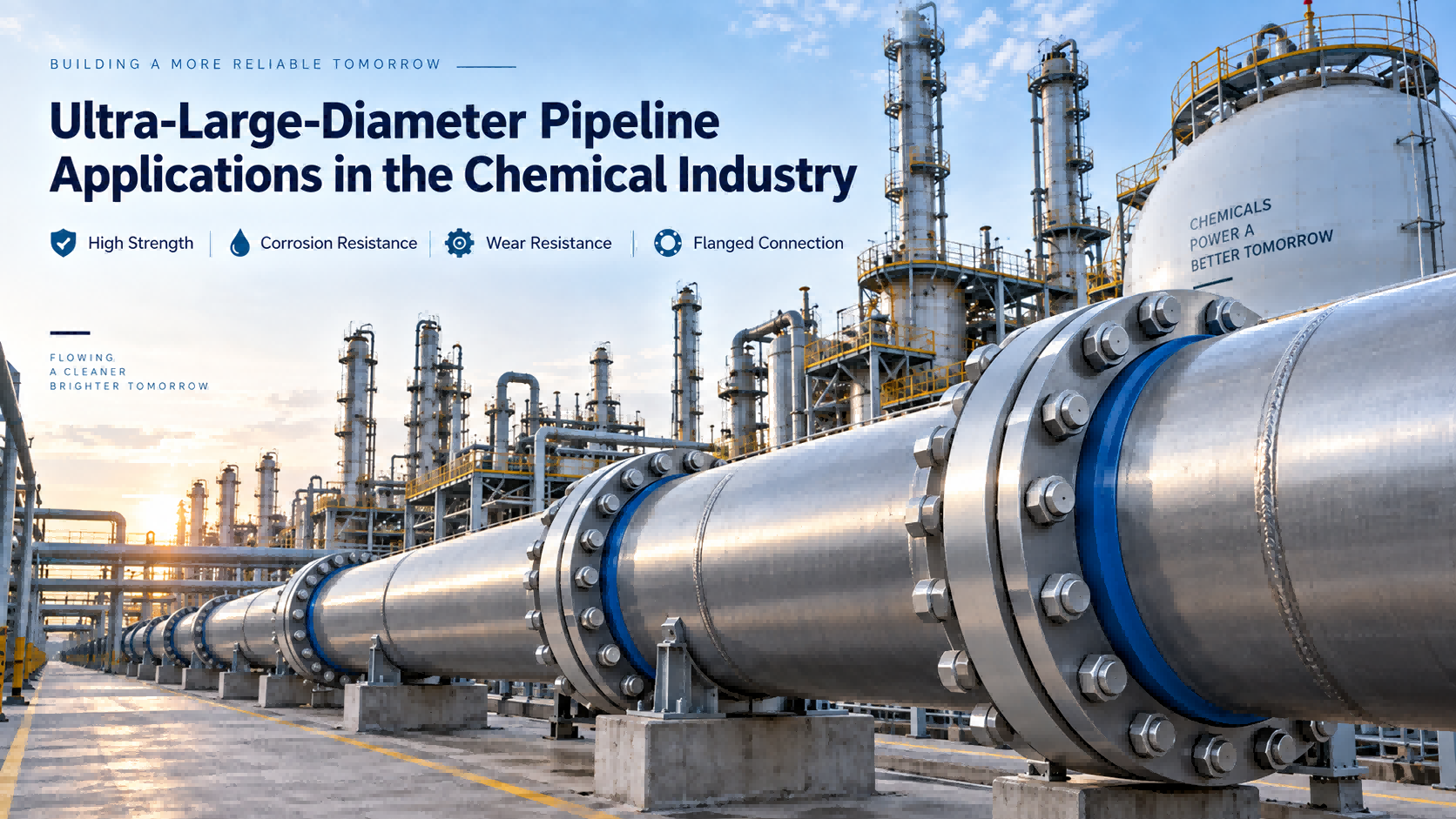
In the development of our steel-nylon composite pipe products, we place particular emphasis on flange connection structures and integrated molded flange technology.
When project design and installation conditions are satisfied, flange connection solutions can reduce certain on-site pipeline welding requirements and provide greater convenience during chemical plant upgrading projects.
For facilities seeking to reduce on-site hot work, appropriate prefabrication and flange connection solutions can offer practical engineering benefits.
However, flange connections alone cannot guarantee a completely leak-free pipeline system.
Actual sealing performance depends on flange structure, gasket materials, bolt preload, installation quality, transported media, and operating conditions.
9. Our Solution: From Corrosion-Resistant Pipe Manufacturing to Long-Term Value Creation for Chemical Companies
For chemical companies, energy conservation and consumption reduction are not merely matters of energy management.
They are also closely related to material selection, structural design, and long-term operational reliability.
Our company has long focused on the development and manufacturing of reinforced MC nylon pipes and steel-nylon composite pipes.
We are committed to providing industrial pipeline solutions suitable for complex media transportation across the chemical, energy, and other industrial sectors.
To address the chemical industry's requirements for corrosion resistance, wear resistance, pressure-bearing capacity, and long-term operating reliability, we focus on the following technical areas.
Corrosion-Resistant Materials and Structural Optimization
By combining reinforced nylon inner layers with steel structures, we provide pipeline material options for high-salinity, high-alkalinity, and other corrosive media applications where material compatibility has been verified.
Improved Wear Resistance
For applications involving particle-containing media, we optimize reinforced nylon materials and pipeline structures to provide solutions for abrasive operating conditions such as mineral slurry and salt mud transportation.
Large-Diameter Pipe Manufacturing
According to the transportation flow rates and pipe diameter requirements of industrial projects, we provide large-diameter steel-nylon composite pipe products to meet the piping configuration needs of different production facilities.
Flange Connection Technology
Through appropriate flange connection design, we aim to improve the convenience of pipeline prefabrication, installation, and maintenance.
Our flange connection solutions also provide an option for projects seeking to reduce certain on-site welding operations.
Total Lifecycle Value
We focus not only on initial pipeline procurement costs but also on the relationship between corrosion resistance, transportation stability, maintenance requirements, and long-term operating expenses.
Our objective is to continuously improve materials, structures, and manufacturing processes to help customers select industrial pipeline products suited to their actual operating conditions.
By doing so, we aim to reduce the maintenance burden associated with corrosion and wear while improving the long-term reliability of industrial transportation systems.
10. Future Trends: Chemical Industry Energy Conservation Will Shift from Individual Equipment Upgrades to System-Wide Optimization
As the chemical industry faces increasingly demanding requirements for energy efficiency, production safety, and resource management, energy-saving initiatives are gradually expanding from individual equipment improvements to the optimization of entire production systems.
In this process, industrial pipelines will no longer be viewed merely as auxiliary facilities connecting production equipment.
Instead, they should be incorporated into the energy management and lifecycle cost evaluation of the entire transportation system.
Looking ahead, chemical companies can focus on three important areas of pipeline system optimization.
First, by selecting appropriate corrosion-resistant and wear-resistant materials, companies can reduce internal pipeline deterioration and related maintenance problems.
Second, by optimizing pipe diameters, pipeline layouts, and pumping control strategies, they can reduce unnecessary transportation resistance and energy consumption.
Third, by establishing pipeline inspection procedures, pressure-differential monitoring, and equipment energy-consumption analysis, companies can identify changes in pipeline operating conditions before minor problems develop into costly failures.
For steel-nylon composite pipes, their value lies not only in the combination of different materials but also in the overall engineering benefits that can be achieved when material selection is integrated with process design, pumping systems, and long-term maintenance strategies.
Only when corrosion-resistant materials, appropriate hydraulic design, and effective operating management work together can the advantages of pipeline materials be converted into measurable energy-saving results.
Conclusion: True Energy Conservation Means Creating Long-Term Value Through Industrial Pipeline Systems
For chemical companies, energy conservation and consumption reduction are not simply about reducing equipment investments or minimizing initial procurement costs.
They involve improving energy efficiency, reducing unnecessary maintenance and replacement activities, and minimizing production interruptions through systematic optimization.
As an essential component of chemical production systems, industrial pipelines directly influence production efficiency and overall operating costs through their material performance and long-term operating conditions.
By combining the mechanical properties of steel with the corrosion and wear resistance of reinforced nylon, steel-nylon composite pipes provide chemical companies with a pipeline solution that integrates structural performance with the requirements of complex media transportation.
Under suitable operating conditions, properly selected steel-nylon composite pipes may reduce maintenance problems caused by pipeline corrosion and abrasion.
When combined with scientific hydraulic design and pumping system optimization, they may also help companies control long-term transportation energy consumption.
For continuously operating industries such as soda ash, chlor-alkali, salt chemicals, and phosphate chemicals, this material selection approach—which emphasizes long-term reliability and total lifecycle costs—offers important engineering value.
We will continue to focus on the development and manufacturing of steel-nylon composite pipes and reinforced MC nylon pipes.
Through material modification, structural optimization, and continuous improvements in manufacturing processes, we aim to provide industrial customers worldwide with pipeline products suitable for complex operating conditions.
From reducing maintenance costs to improving transportation efficiency, and from optimizing material selection to enhancing long-term operating reliability, our goal is to help chemical companies achieve more stable, efficient, and economically sustainable industrial fluid transportation.
Contact Us | Get a Steel-Nylon Composite Pipe Solution for Your Project
If your chemical plant is experiencing pipeline corrosion, abrasion, increasing flow resistance, frequent maintenance, or high long-term operating costs, we welcome you to contact our technical team.
Based on your actual operating conditions, we can help evaluate the suitability of steel-nylon composite pipes and explore appropriate pipeline selection and optimization solutions.
To facilitate an initial technical assessment, we recommend providing the following information:
-
Transported media and chemical concentrations.
-
Operating temperature and design pressure.
-
Required pipe diameter and pipeline length.
-
Transportation flow rate.
-
Current pipeline materials and operating conditions.
-
Existing corrosion, abrasion, or maintenance problems.
For projects primarily focused on energy conservation and consumption reduction, you may also provide the operating pressure differential, motor power consumption, and annual operating hours of your existing pumping system.
This information will help support a more detailed assessment of the potential economic benefits of upgrading your pipeline system.
Choosing the right pipeline material is not only about meeting today's production requirements—it is also an investment in long-term operating efficiency and reliability.
Solutions to Extend Equipment Service Life in the Chemical Industry: How Corrosion-Resistant Piping Technology Reduces Maintenance Costs and Improves Long-Term Operational Reliability
Best Pipe Materials for Strong Alkali Applications: How to Choose Industrial Piping with Corrosion Resistance, Wear Resistance, and Pressure Performance