Case Study: Chemical Mother Liquor Pipeline System Upgrade — How to Solve Corrosion, Abrasion, Leakage, and Frequent Maintenance at the Same Time
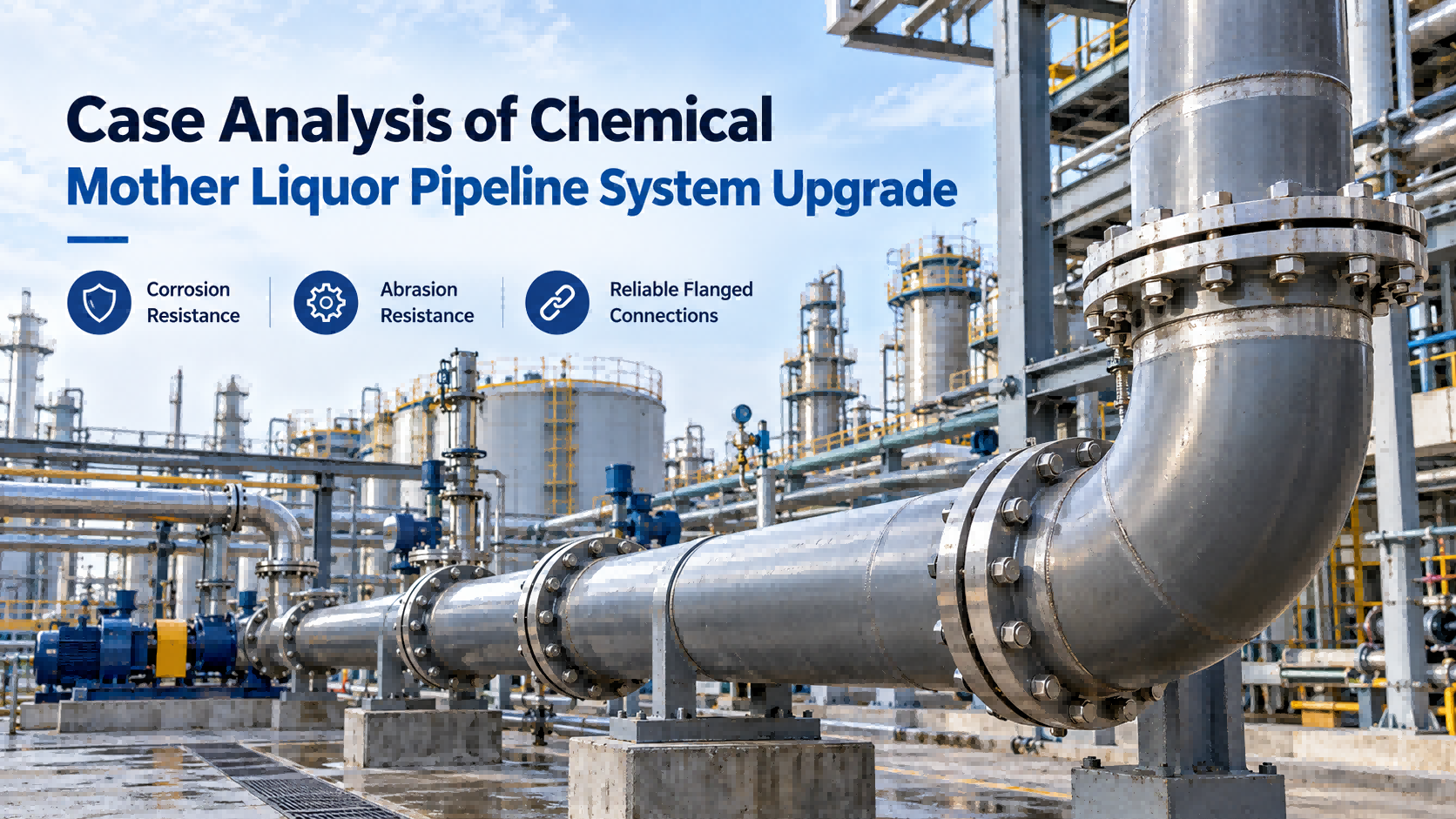
In chemical production plants, mother liquor pipelines may not be the most visible part of the process, but they can have a major impact on the continuous operation of the entire facility.
Unlike conventional industrial water pipelines, chemical mother liquor systems often handle far more complex fluids. Depending on the process, the medium may contain high concentrations of salts, acidic or alkaline components, suspended solids, crystals, and other process by-products. In some applications, corrosion, abrasion, crystallization, erosion, and temperature fluctuations may all occur simultaneously.
This means that pipeline material selection should not focus on only one question:
“Is this material corrosion-resistant?”
A more important question is:
“Can this piping system maintain structural integrity, connection reliability, and stable long-term performance while reducing leakage, maintenance frequency, and unplanned shutdowns?”
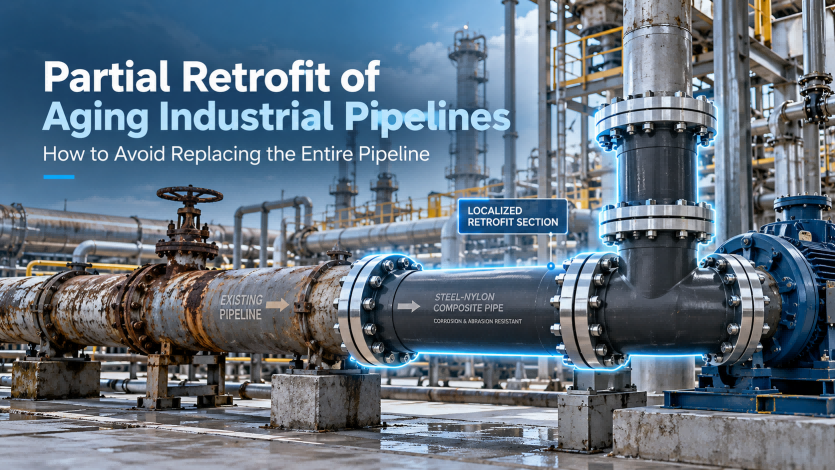
For chemical plants that have been operating for many years, once traditional metallic pipelines, lined pipes, or certain non-metallic systems begin to experience repeated corrosion perforation, lining failure, flange leakage, or localized wear, simple spot repairs usually provide only temporary relief.
A truly effective upgrade often requires a complete reassessment of the entire fluid transport system.
This article analyzes the key technical challenges involved in chemical mother liquor pipeline upgrades and explains why steel-nylon composite pipe can become a valuable solution for highly corrosive and abrasive chemical transport applications.
1. Project Background: Why Are Mother Liquor Pipelines Difficult to Maintain?
A chemical production system had been operating a mother liquor circulation and transfer network for many years.
The pipeline connected multiple process sections, including reaction, separation, filtration, storage, and downstream treatment equipment, making it an important fluid transport link within the production process.
As the system aged, several problems gradually became more frequent:
-
Internal pipeline corrosion
-
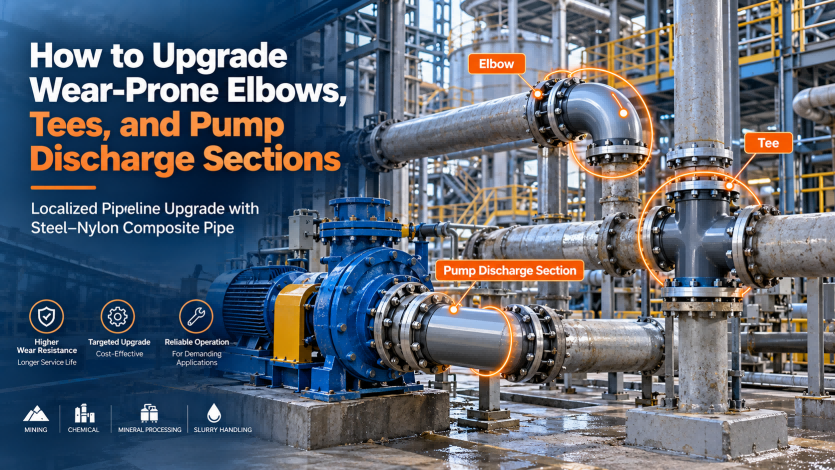
Severe wear at elbows and tees
-
Leakage at flange connections
-
Frequent replacement of local pipe sections
-
Lining delamination or failure
-
Increasing maintenance frequency
-
Growing risk of unplanned shutdowns
If each individual repair is considered separately, replacing a short section of pipe may not appear to be a major cost.
However, for a continuously operating chemical plant, the real financial impact often comes from:
Production downtime.
A single pipeline leak may involve far more than the cost of replacing a pipe section. It can also require:
-
Process shutdown
-
Fluid drainage
-
System cleaning
-
Safety isolation
-
Maintenance labor
-
Environmental treatment
-
Restart procedures
-
Production losses
For this reason, the plant eventually decided to carry out a systematic upgrade of the mother liquor transportation system.
2. The Real Challenge Is Not Corrosion Alone
One of the most common reasons for pipeline material failure is treating a complex process condition as a single corrosion problem.
In reality, chemical mother liquor systems often involve multiple failure mechanisms at the same time.
2.1 Chemical Corrosion
Mother liquor may contain:
-
Chloride ions
-
Dissolved salts
-
Alkaline components
-
Acidic components
-
Dissolved chemicals
-
Multiple process by-products
For carbon steel, long-term exposure to these fluids can cause general corrosion or localized attack.
Even stainless steel may need to be carefully evaluated in environments containing chlorides, temperature fluctuations, or aggressive chemical combinations because of the potential for:
-
Pitting corrosion
-
Crevice corrosion
-
Localized chemical attack
Therefore:
“Stainless steel” does not automatically mean “corrosion-proof in every chemical application.”
2.2 Continuous Abrasion Caused by Solid Particles
Mother liquor is not always a completely clear liquid.
In many chemical production processes, it may contain:
-
Crystalline particles
-
Salt sludge
-
Solid impurities
-
Incompletely separated solids
As these particles move with the fluid, they continuously impact and abrade the inner pipe wall.
The most vulnerable areas are often:
-
Elbows
-
Tees
-
Reducers
-
Valve sections
These areas experience changes in flow direction and velocity, resulting in stronger localized erosion.
Therefore, even if a material has good corrosion resistance, poor abrasion resistance can still lead to premature failure.
3. Corrosion and Abrasion Often Reinforce Each Other
This is one of the most overlooked problems in mother liquor transport systems.
Corrosion first damages the pipe surface.
As the surface becomes rougher, suspended particles produce more severe mechanical erosion.
Abrasion then exposes fresh material surfaces, which become vulnerable to renewed corrosion.
This creates a repeating cycle:
Corrosion → Surface Damage → Increased Abrasion → Fresh Surface Exposure → Continued Corrosion
This is a typical corrosion-abrasion synergistic failure mechanism.
It also explains why some materials that appear corrosion-resistant in theory may still experience relatively short service life under actual mother liquor transport conditions.
4. Why Repeated Local Repairs Eventually Stop Working
Many chemical plants initially follow a simple maintenance strategy:
Repair the section that leaks.
In the early years of system operation, this can be a reasonable approach.
However, as the entire piping network ages, the nature of the problem begins to change.
For example:
In the first year, one elbow may need replacement.
In the second year, a section of the main pipeline may need replacement.
In the third year, flange leakage may begin to increase.
In the fourth year, another branch line may suffer corrosion perforation.
At this point, the plant is no longer dealing with isolated failures.
Instead:
The entire piping material system may be approaching the end of its reliable service cycle.
Continuing with localized repairs often leads to:
More frequent maintenance
↓
Higher labor requirements
↓
Larger spare parts inventory
↓
More production interruptions
↓
Higher overall maintenance costs
Therefore, when the same system begins experiencing repeated failures, the key question should no longer be:
“How do we repair this pipe section?”
Instead, the plant should ask:
“Does the entire piping system need to be re-selected?”
5. Build an Operating Condition Database Before Upgrading
In our view, the most important step in a chemical pipeline upgrade is not immediately recommending a material.
The first step should be understanding the actual operating conditions.
At a minimum, the following parameters should be confirmed.
5.1 Transported Medium
This includes:
-
Chemical composition
-
Concentration
-
pH
-
Chloride content
-
Presence of oxidizing chemicals
-
Presence of solvents
-
Mixed-media conditions
The same chemical can have very different effects on a material at different concentrations and temperatures.
5.2 Solid Content
If the mother liquor contains solid particles, additional information should include:
-
Solids concentration
-
Particle size
-
Particle hardness
-
Crystallization tendency
-
Sedimentation tendency
These parameters have a direct influence on abrasion.
5.3 Temperature
Both the following should be considered:
-
Normal operating temperature
-
Maximum operating temperature
Material selection should not be based only on average temperature.
Startups, shutdowns, cleaning processes, and production fluctuations may cause temporary temperature increases.
5.4 Pressure
The following should be clearly defined:
-
Normal operating pressure
-
Maximum operating pressure
-
Design pressure
-
Water hammer risk
-
Pressure fluctuations caused by pump start-stop cycles
5.5 Flow Velocity
Flow velocity is an important factor in abrasive applications.
When solid particles are present, higher flow velocities can significantly increase local erosion risk.
5.6 Pipe Diameter and Transport Distance
A DN100 branch pipeline and a DN1000 main pipeline do not follow exactly the same structural design logic.
For large-diameter systems, additional factors must be considered, including:
-
Ring stiffness
-
Support spacing
-
Dead weight
-
Installation loads
-
Flange strength
-
Pipe deformation
-
Thermal expansion and contraction
Therefore, a large-diameter pipeline cannot simply be treated as a larger version of a small-diameter pipe.
6. How Should Common Upgrade Materials Be Compared?
Typical material options for chemical pipeline upgrades may include:
-
Carbon steel
-
Stainless steel
-
Rubber-lined steel pipe
-
Plastic-lined steel pipe
-
FRP pipe
-
HDPE pipe
-
Steel-nylon composite pipe
A professional comparison should not focus only on purchasing price.
At least the following factors should be evaluated:
| Evaluation Factor | Key Question |
|---|---|
| Corrosion Resistance | Is the material compatible with the actual fluid composition and concentration? |
| Abrasion Resistance | Are solids or erosive particles present? |
| Pressure Capacity | Can the pipe withstand long-term operating pressure? |
| Temperature Resistance | Can it handle continuous temperature and thermal fluctuation? |
| Large-Diameter Capability | Does the structure remain stable as diameter increases? |
| Connection Reliability | Are flange joints and interfaces resistant to leakage? |
| Installation Method | Is field welding required? |
| Maintenance Frequency | Will the system require frequent repairs? |
| Design Life | Is it suitable for long-term continuous operation? |
| TCO | What is the total life-cycle cost? |
In other words:
The lowest-priced pipe is not always the lowest-cost piping solution.
7. Why Consider Steel-Nylon Composite Pipe?
The design concept of steel-nylon composite pipe is not simply about combining two materials.
Instead, different materials perform different functions.
A simple way to understand it is:
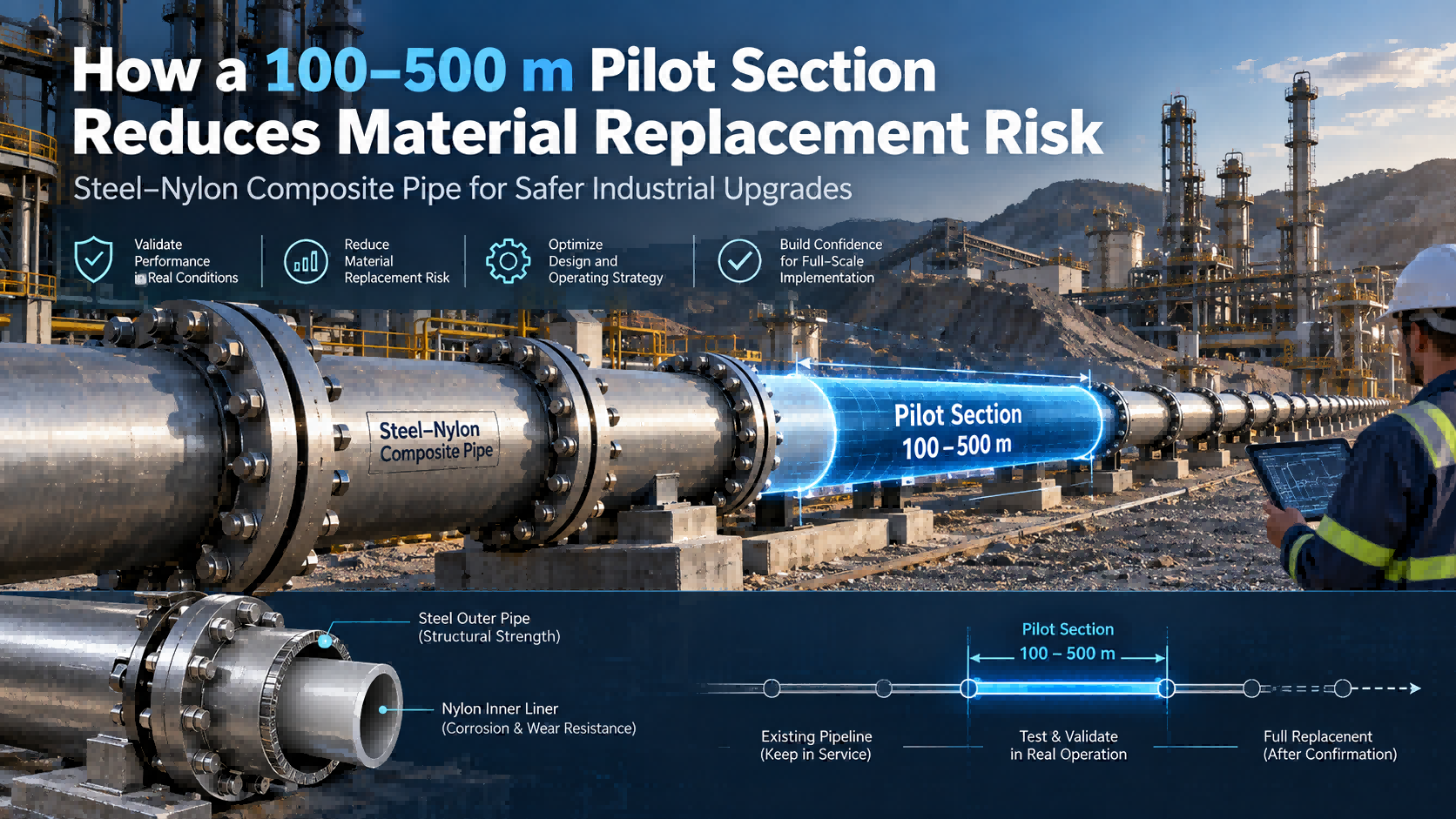
Steel provides strength and pressure resistance, while nylon provides the fluid-contact surface.
This type of structure is especially suitable for industrial transport systems that require a combination of:
-
Corrosion resistance
-
Mechanical strength
-
Pressure capability
-
Structural rigidity
8. Steel Structure: Solving Strength and Pressure Challenges
In large chemical plants, pipelines must do more than transport fluids.
They may also need to withstand:
-
Internal pressure
-
Pipe self-weight
-
Valve loads
-
Installation loads
-
Support loads
-
Startup and shutdown impact
-
External mechanical forces
Therefore, corrosion resistance alone is not sufficient.
The steel structure provides strong mechanical strength and overall rigidity, making steel-nylon composite pipe suitable for a wider range of medium- and high-pressure industrial transport applications.
This is one of the major structural differences between steel-nylon composite pipe and conventional single-material plastic piping.
9. Nylon Layer: Isolating Corrosive Media from the Steel Structure
Another important design principle of steel-nylon composite pipe is:
Minimizing direct contact between corrosive media and the steel structure.
Under properly selected operating conditions, the nylon layer acts as the primary fluid-contact layer.
This can significantly reduce the corrosion risk associated with conventional metallic piping.
Such a structure can be particularly valuable in applications involving:
-
High-salinity fluids
-
Certain alkaline media
-
Chemical mother liquors
-
Corrosive industrial wastewater
However, one important principle must be emphasized:
Every polymer material must be evaluated for chemical compatibility.
Professional material selection should never rely on a simplistic statement such as:
“Nylon is corrosion-resistant, so it can handle every chemical.”
The correct approach is to evaluate:
Medium + Concentration + Temperature + Pressure + Solids Content
as a complete system.
10. Why Abrasion Resistance Matters in Mother Liquor Transport
If the mother liquor contains salt sludge, crystals, or other suspended solids, the process may behave more like a low-concentration slurry transport system.
In this case, the pipeline material must address both:
Chemical Resistance + Abrasion Resistance
or, more simply:
Corrosion Resistance + Wear Resistance
Nylon materials can offer good abrasion resistance and self-lubricating characteristics, which can provide advantages in certain corrosion-abrasion combined applications.
This is particularly important in:
-
Elbows
-
Tees
-
Long-distance main pipelines
-
High-velocity sections
Reducing internal wear can help extend the maintenance interval of the entire system.
11. The Most Overlooked Part of a Pipeline Upgrade: Connections
Many pipeline failures do not occur in the pipe body itself.
They occur at:
The joints.
This is why connection reliability is an important part of chemical piping design.
Traditional installation methods may involve:
-
Cutting
-
Welding
-
Field coating repair
-
Lining repair
-
Joint treatment
For chemical plants that are already in operation, hot work can significantly increase safety management requirements.
For this reason, steel-nylon composite piping systems can be designed with greater emphasis on:
Flanged and modular connections.
Through properly designed integral or engineered flange connection systems, field welding requirements can be reduced.
The value goes beyond convenience.
More importantly:
It can reduce installation and maintenance risks on site.
12. A Proper Upgrade Should Address High-Risk Areas, Not Just Straight Pipe
If a pipeline system has already experienced corrosion and abrasion problems, upgrading only the straight pipe sections is not enough.
Several high-risk areas should be carefully evaluated.
Elbows
Changes in flow direction can create concentrated local erosion.
When solid particles are present, elbows are often among the fastest-wearing sections of the system.
Tees
Flow splitting and merging can create complex turbulent conditions.
Localized turbulence may significantly increase erosion.
Reducers
Sudden increases or decreases in pipe diameter can change fluid velocity and create local recirculation zones.
Reducer geometry should therefore be carefully designed.
Flanges
Flanged connections require attention to:
-
Sealing surfaces
-
Gaskets
-
Bolt preload
-
Flange rigidity
-
Installation alignment
If these details are not properly controlled, leakage may occur even when the pipe body itself remains completely intact.
13. How Should the Success of a Pipeline Upgrade Be Measured?
Many plants judge the success of a pipeline upgrade using only one question:
“Is it still leaking?”
In reality, several other indicators should also be evaluated.
13.1 Has the Number of Annual Repairs Decreased?
If the previous system required ten repairs per year and the upgraded system significantly reduces this frequency, the value is already substantial.
13.2 Has Unplanned Downtime Been Reduced?
For continuous chemical production facilities, this may be more important than the initial pipe purchase cost.
13.3 Has Spare Parts Inventory Been Reduced?
Maintaining too many different pipe materials and fitting specifications increases both inventory and management costs.
13.4 Has Hot Work Been Reduced?
Reducing welding and hot work can simplify maintenance planning and improve site safety management.
13.5 Has the Operating Cycle Been Extended?
A well-designed industrial piping system should gradually shift from:
“Repair after failure”
to:
“Reduce failures through material and structural design.”
14. Life-Cycle Cost Is the Real Metric for Chemical Pipeline Upgrades
Consider two pipeline solutions.
Solution A has a lower purchase price but requires frequent repair.
Solution B has a higher initial cost but offers a longer maintenance cycle.
If only initial purchase cost is considered, Solution A may appear more attractive.
However, a more complete cost model should include:
TCO = Pipe Purchase Cost + Installation Cost + Maintenance Cost + Spare Parts Cost + Downtime Loss + Replacement Cost
For continuous chemical plants, downtime losses can sometimes be far greater than the cost of the pipe itself.
This is why modern industrial projects are gradually shifting from:
Initial Cost
to:
Life-Cycle Cost.
In other words, the focus is moving away from:
“How much does the pipe cost today?”
toward:
“How much will this piping system cost over its entire service life?”
15. Why Can Steel-Nylon Composite Pipe Fit Complex Chemical Transport Systems?
From a material and structural perspective, the value of steel-nylon composite pipe can be summarized in five areas.
1. Corrosion Resistance
The nylon working layer helps reduce direct contact between corrosive media and the steel structure.
2. Abrasion Resistance
It can be suitable for applications where corrosion and particle erosion exist at the same time.
3. Pressure Capacity
The steel structure provides mechanical strength for industrial pressure transport applications.
4. Large-Diameter Manufacturing Capability
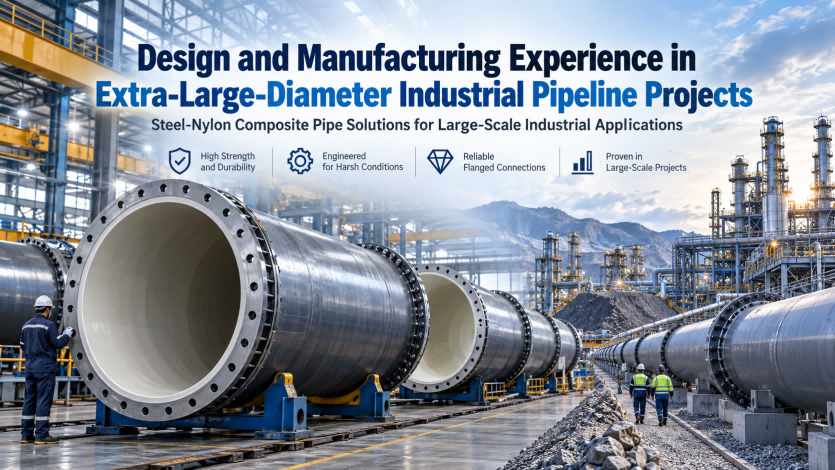
Modern chemical plants increasingly require DN500, DN800, DN1000, and even larger transport pipelines.
For large-diameter applications, corrosion resistance alone is not enough.
Structural stability is equally important.
5. Flanged Connection Design
Flanged connections can reduce complex field welding work and can be especially valuable in pipeline upgrade and retrofit projects.
Therefore, steel-nylon composite pipe is not designed to solve only a single corrosion problem.
Its real advantage lies in balancing:
Corrosion Resistance + Abrasion Resistance + Pressure Capacity + Structural Strength + Connection Reliability
16. Which Mother Liquor Applications Should Evaluate Steel-Nylon Composite Pipe?
Steel-nylon composite pipe is not a universal solution for every chemical fluid.
However, it is worth evaluating for applications such as:
-
High-salinity mother liquor
-
Strong alkaline or alkaline mother liquor
-
Chloride-containing fluids
-
Mother liquor containing crystalline particles
-
Salt sludge transport
-
Corrosive industrial wastewater
-
Media involving both corrosion and abrasion
-
Large-diameter chemical circulation pipelines
-
Retrofit projects requiring reduced field welding
-
Continuous production systems focused on reducing long-term maintenance costs
For strong acids, strong oxidizers, organic solvents, or other special chemicals, compatibility should be evaluated separately based on actual concentration, temperature, and operating conditions.
17. A Successful Pipeline Upgrade Is a System Engineering Project
One of the biggest mistakes in chemical mother liquor pipeline retrofits is treating the project as simply:
“Replacing old pipes.”
In reality, a reliable upgrade should include:
Medium analysis
↓
Corrosion mechanism analysis
↓
Abrasion analysis
↓
Pressure evaluation
↓
Material selection
↓
Structural design
↓
Pipe diameter design
↓
Elbow and tee optimization
↓
Flange design
↓
Installation planning
↓
Operation and maintenance strategy
Failure at any one of these stages can reduce overall service life.
For this reason, we prefer to define steel-nylon composite piping as an:
Industrial Fluid Handling Solution
rather than simply another type of industrial pipe.
18. Moving from Frequent Repair to Long-Term Reliable Operation
Traditional industrial pipeline maintenance often follows a reactive cycle:
Leakage
↓
Repair
↓
Restart
↓
Leakage again
↓
Repair again
The biggest weakness of this approach is that the plant remains in a constant state of reactive maintenance.
Modern industrial piping design is gradually moving toward:
Failure analysis
↓
Material re-selection
↓
Pipeline structural optimization
↓
Improved connection reliability
↓
Longer operating cycles
↓
Lower maintenance frequency
This represents an important transition from:
Equipment Purchasing
to:
Life-Cycle Asset Management.
Conclusion: The Real Goal of Mother Liquor Pipeline Upgrades Is Lower Long-Term Operating Cost
Chemical mother liquor piping may appear to be only an auxiliary part of a production facility, but leakage, blockage, corrosion perforation, or joint failure can directly affect the entire production process.
Therefore, evaluating whether a pipe material is suitable for mother liquor transport should not focus only on:
Purchase Price.
The following questions are more important:
-
Is the material resistant to the actual chemical medium?
-
Can it withstand abrasion?
-
Can it handle long-term operating pressure?
-
Are the connections reliable?
-
Is it suitable for large-diameter applications?
-
Can it simplify installation?
-
Can it reduce maintenance frequency?
-
Can it reduce unplanned shutdowns?
-
Can it lower total life-cycle cost?
By combining the structural strength of steel with the corrosion and abrasion resistance characteristics of nylon, steel-nylon composite pipe provides an alternative technical approach to conventional single-material metallic or non-metallic piping systems.
For high-salinity, alkaline, solids-containing, and corrosion-abrasion combined mother liquor systems, its value goes beyond corrosion resistance alone.
Its greater value lies in:
Using material, structural, and connection design to move industrial piping from frequent maintenance toward longer operating cycles, lower maintenance demand, and greater reliability.
For chemical plants upgrading aging piping systems, the most important comparison is not:
“Which pipe has the lowest purchase price?”
The better question is:
“Which piping system can reduce more total operating cost over the next 5, 10, or even more years?”
That is the real objective of a successful chemical pipeline upgrade.
Why Customers Turn to Composite Piping After Frequent Replacement of Traditional Pipes
High Water-Cut Oilfield Pipeline Upgrade Projects: How to Address Corrosion and Abrasion Challenges