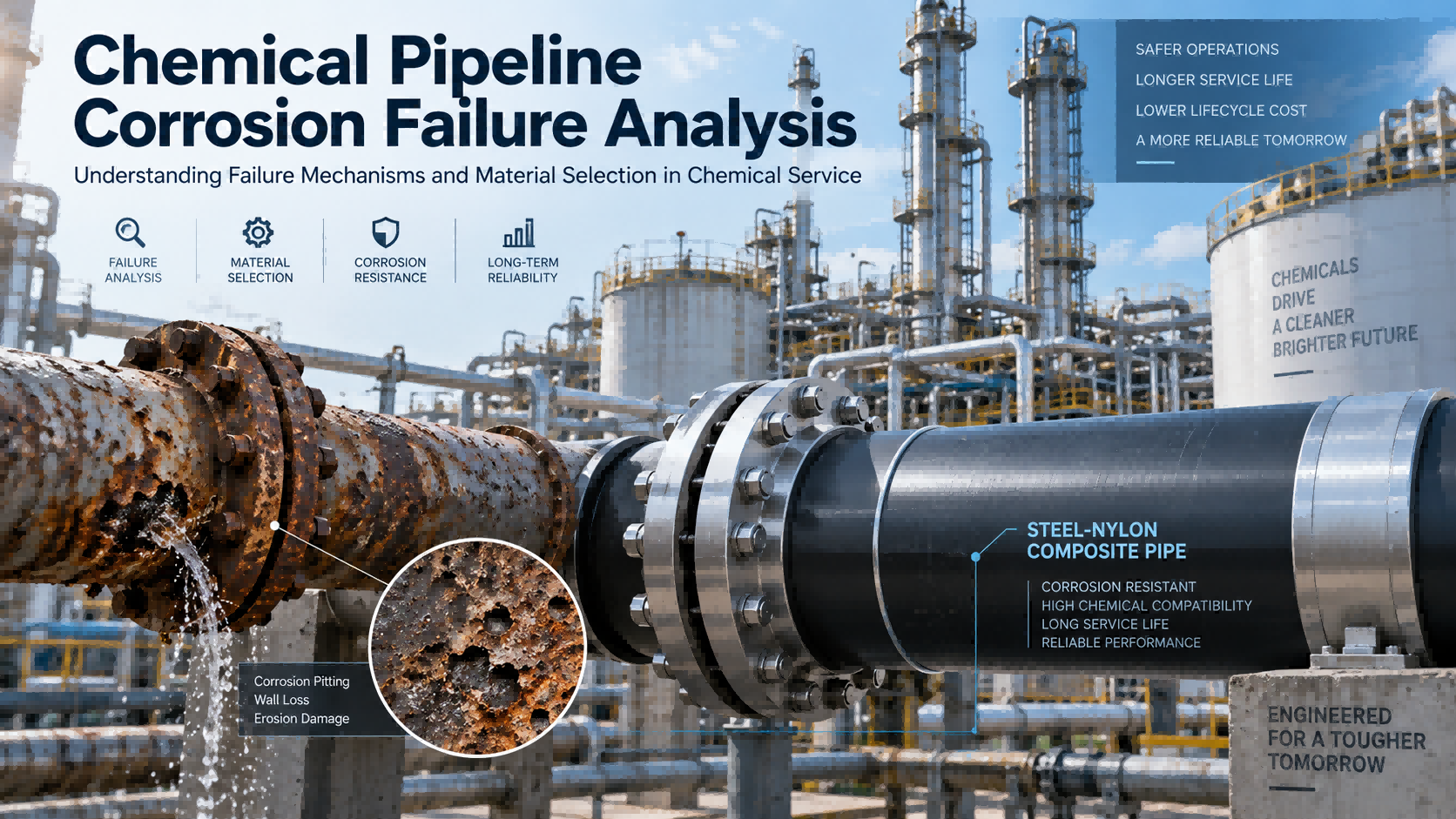
Chemical Pipeline Corrosion Failure Analysis: Why Most Pipeline Failures Are the Result of Long-Term Damage Accumulation
In chemical plants, pipelines are often not the most expensive assets, but they can be among the most critical systems affecting production continuity.
Reactors, towers, heat exchangers, and storage tanks usually receive strict equipment management. However, the process pipelines connecting these units may continuously be exposed to acids, alkalis, salts, elevated temperatures, high flow velocities, solid particles, and complex start-stop operating conditions.
Many chemical pipeline failures appear to occur suddenly:
-
The pipe wall suddenly perforates.
-
Leakage appears near a flange.
-
An elbow is worn through.
-
Corrosion develops near a weld.
-
A lining locally separates or fails.
-
Large areas of the pipe wall become severely thinned after several years of operation.
From a materials failure perspective, however, most corrosion failures do not develop suddenly.
The real damage usually accumulates over months or even years.
Therefore, when analyzing chemical pipeline corrosion, the key question should not simply be:
“Is this material corrosion resistant?”
A more important question is:
“Under the actual medium, temperature, pressure, flow velocity, solids content, and operating cycle, how is this pipeline system likely to fail?”
This is the core of chemical pipeline material selection.
1. Why Is Chemical Pipeline Corrosion So Complex?
When selecting industrial piping materials, many companies first consult chemical resistance charts.
For example:
-
Is the material resistant to NaOH?
-
Is it suitable for brine?
-
Can it handle HCl?
-
Is it resistant to chloride-containing media?
-
Can it operate within the required temperature range?
These data are important, but they only answer part of the engineering problem.
Real chemical process conditions are usually much more complex than laboratory conditions.
A typical chemical pipeline may simultaneously experience:
Corrosion + Abrasion + Temperature Fluctuation + Pressure Fluctuation + Solid Particles + Local High-Velocity Flow
For example, in a slurry pipeline, the pipe wall may simultaneously experience:
-
Chemical corrosion;
-
Erosion from solid particles;
-
Localized wear at elbows;
-
Thermal stress caused by temperature changes;
-
Fatigue resulting from long-term pressure cycling.
This means that:
Many chemical pipeline failures are not caused by a single corrosion mechanism, but by the interaction of several failure mechanisms.
Therefore, selecting a pipeline material based only on a “corrosion resistance rating” is often insufficient.
2. Seven Common Corrosion Failure Modes in Chemical Pipelines
2.1 Uniform Corrosion
Uniform corrosion is one of the easiest types of corrosion to understand.
The corrosive medium continuously reacts with the metal surface, causing the entire inner pipe wall to gradually become thinner.
For example:
Original wall thickness:
10 mm
After several years of operation:
8 mm → 6 mm → 4 mm
When the remaining wall thickness falls below the allowable design limit, the pressure-bearing capability of the pipeline decreases.
If the pipeline remains in service, it may eventually experience:
Bulging, cracking, or perforation.
The main characteristic of uniform corrosion is that it is relatively predictable.
Through regular wall-thickness inspection, operators can establish corrosion-rate models.
However, the most dangerous failures in industrial plants are often not caused by uniform corrosion.
They are caused by localized corrosion.
3. Pitting Corrosion: Why Can a Pipeline Leak Even When Most of the Pipe Still Looks Good?
Pitting corrosion is one of the most dangerous forms of corrosion in chemical pipeline systems.
Its characteristic feature is that most of the pipeline wall may remain in relatively good condition, while very small localized areas corrode rapidly.
The failure process can develop as follows:
Corrosion Pit → Deep Pit → Perforation → Leakage
In environments containing chlorides or high concentrations of dissolved salts, certain metallic materials may be particularly vulnerable to localized corrosion.
This explains an important engineering reality:
Average wall thickness does not always represent the true safety condition of a pipeline.
For example, a pipeline may still have an average wall thickness of 8 mm.
However, a local corrosion pit may leave only:
1–2 mm of remaining wall thickness.
Leakage may eventually begin at this location.
Therefore, in high-salinity produced water, salt chemical processing, brine systems, and similar environments, localized corrosion must be carefully evaluated.
4. Crevice Corrosion: Why Are Flanges, Gaskets, and Connections More Vulnerable?
Another common corrosion problem in chemical pipeline systems occurs around:
-
Flanges;
-
Gaskets;
-
Valve connections;
-
Bolted joints;
-
Areas covered by deposits.
These locations can create narrow crevices.
Once corrosive media penetrate into these gaps, the local environment may gradually change.
For example:
-
Oxygen concentration may decrease;
-
Ion concentration may increase;
-
Local pH may change.
The result can be a more aggressive localized corrosion environment.
This explains why industrial plants often find that:
Straight pipe sections remain in good condition while connection areas fail first.
This reveals an important principle:
Pipeline reliability is not determined solely by the pipe material.
It is determined by the entire system:
Pipe Material + Fittings + Flanges + Sealing System + Installation Quality + Operating Conditions
5. Galvanic Corrosion: Why Can Connecting Different Metals Accelerate Corrosion?
When two metals with different electrochemical characteristics are electrically connected in the presence of a conductive medium, galvanic corrosion may occur.
For example, the issue should be considered when combining:
-
Different grades of steel;
-
Stainless steel and carbon steel;
-
Different metallic fittings.
Under certain conditions, one material becomes the anode and corrodes more rapidly.
Therefore, when upgrading a chemical pipeline system, engineers should not simply replace one pipeline section without considering:
How different materials interact at their connection points.
This is particularly important in partial replacement projects involving aging pipelines.
6. Erosion-Corrosion: Many Chemical Pipelines Are Damaged by Both Corrosion and Abrasion
This is one of the most common problems in slurry transportation systems.
Typical applications include:
-
Salt mud transportation;
-
Mineral slurry pipelines;
-
Lime slurry;
-
Desulfurization slurry;
-
Phosphate chemical slurry;
-
Wastewater containing sand;
-
High-solids mother liquor.
These media often contain significant amounts of solid particles.
When particles repeatedly strike the pipe wall at high velocity, they continuously damage the material surface.
Once the protective surface layer is removed, fresh material becomes exposed.
The process can then continue:
Abrasion → Corrosion → Further Abrasion → Further Corrosion
These mechanisms reinforce each other.
This phenomenon is known as:
Erosion-Corrosion
For many industrial applications, this combined mechanism is significantly more destructive than chemical corrosion alone.
7. Why Do Elbows Often Fail Before Straight Pipe Sections?
In slurry transportation systems, elbows are frequently among the first components to fail.
The reason is straightforward.
When the fluid passes through an elbow, its direction changes.
Because of inertia, solid particles continue moving toward the outer radius of the elbow and repeatedly strike the pipe wall.
This creates a highly concentrated wear zone.
If a straight pipe section has a service life of five years, an elbow under severe operating conditions may require replacement after only two or three years—or even sooner.
Therefore, pipeline material selection should not focus exclusively on:
Corrosion resistance of straight pipe.
Engineers must also evaluate the wear resistance of:
Elbows, tees, reducers, pump discharge sections, and other high-risk components.
These locations may ultimately determine the maintenance cycle of the entire piping system.
8. Why Does Corrosion Near Welds Require Special Attention?
Traditional metallic piping systems often rely heavily on field welding.
However, welding can change the local material condition.
Possible effects include:
-
Changes in the heat-affected zone;
-
Residual stresses;
-
Welding defects;
-
Changes in surface protective layers;
-
Variations in welding quality.
In certain corrosive environments, these areas may become particularly vulnerable.
For chemical plants with pipelines that have been in operation for many years:
The greater the number of welds, the greater the number of potential inspection and maintenance points.
This is one reason some industrial projects are increasingly considering:
Flanged connections, mechanical connections, and piping systems designed to reduce field welding.
9. Why Can Lined Pipelines Also Fail?
To prevent corrosive media from directly contacting structural metal, many chemical projects use a design consisting of:
Metal Structural Layer + Corrosion-Resistant Inner Lining
In principle, this is a very logical engineering solution.
However, the long-term reliability of different lining systems varies significantly.
Typical failures include:
-
Lining blistering;
-
Delamination;
-
Cracking;
-
Damage around connection areas;
-
Separation caused by thermal cycling;
-
Lining deformation under negative pressure.
Once the protective lining is locally damaged, corrosive media may enter the space between:
The inner lining and the metal structure.
This creates a particularly serious problem.
External inspection may not easily reveal the corrosion progressing underneath the lining.
This phenomenon can develop into:
Hidden Corrosion
Therefore, one of the most important questions when evaluating composite piping is not simply:
“Is the lining material corrosion resistant?”
A more important question is:
“Can the lining and structural layer remain stable as an integrated system during long-term operation?”
10. Why Does Temperature Significantly Affect Corrosion?
Temperature is one of the most frequently underestimated factors in chemical pipeline material selection.
Many chemical reactions accelerate as temperature increases.
Corrosion reactions can behave in the same way.
A material may demonstrate excellent corrosion resistance at:
20°C
but perform very differently at:
80°C, 100°C, or higher temperatures.
At the same time, elevated temperature may affect:
-
Mechanical properties of non-metallic materials;
-
Stability of internal linings;
-
Sealing materials;
-
Thermal expansion;
-
Pipeline stress.
Therefore:
Chemical compatibility must always be evaluated together with temperature.
In practical terms, engineers should not simply ask:
“Is the material resistant to this chemical?”
They should ask:
“Can this material transport this chemical reliably at the specified operating temperature over the required service life?”
11. Why Can Serious Corrosion Occur During Shutdowns?
Some operators assume that pipeline corrosion stops when production stops.
This is not always the case.
During shutdown periods, pipelines may experience:
-
Residual liquid accumulation;
-
Oxygen concentration-cell corrosion;
-
Moisture-related corrosion;
-
Salt concentration;
-
Under-deposit corrosion.
For example, if a brine pipeline is shut down without completely draining the residual solution, water may gradually evaporate.
The salt concentration can increase.
As a result, the local environment may become even more corrosive than during normal operation.
Therefore:
Shutdown conditions should also be considered during material selection.
12. How Should Chemical Pipeline Failure Analysis Be Conducted?
A professional pipeline failure analysis should not stop at a simple conclusion such as:
“The material quality was poor.”
Instead, a complete root cause analysis should be established.
Several factors should be examined.
Layer 1: Medium Analysis
At minimum, engineers should understand:
-
Chemical composition;
-
Concentration;
-
pH;
-
Salinity;
-
Chloride concentration;
-
Solid particle content;
-
Oxygen concentration;
-
H₂S;
-
CO₂;
-
Other corrosive components.
Layer 2: Operating Condition Analysis
Important parameters include:
-
Normal operating temperature;
-
Maximum temperature;
-
Minimum temperature;
-
Operating pressure;
-
Pressure fluctuations;
-
Flow velocity;
-
Start-stop frequency;
-
Potential negative-pressure conditions.
These parameters are often more important than simply knowing the nominal design pressure.
Layer 3: Failure Location Analysis
The location of the failure itself often provides important clues.
If elbows fail first:
This often indicates:
Severe erosion or abrasion.
If failure occurs near welds:
Engineers should examine:
Welding quality, the heat-affected zone, residual stress, and localized corrosion.
If corrosion occurs mainly along the bottom of the pipeline:
Possible causes include:
Deposits, solids accumulation, or residual liquid.
If failure occurs near flanges:
The investigation should focus on:
Crevice corrosion and sealing structure.
13. Why Does Upgrading to a More Expensive Metal Not Always Solve the Problem?
When carbon steel pipelines experience serious corrosion, one common solution is to upgrade to a more corrosion-resistant metallic material.
For example:
Carbon Steel →
304 Stainless Steel →
316L Stainless Steel →
Duplex Stainless Steel →
Higher-Grade Alloys
This approach can certainly be effective in many applications.
However, it also presents a practical challenge:
Material cost can increase rapidly.
More importantly, if the actual failure mechanism involves:
Corrosion + Erosion + Solid Particle Abrasion
simply upgrading the metal grade may not provide the most economical solution.
In such cases, a more effective engineering approach may be to separate the functions of:
Structural Strength
and
Media-Contact Performance
This is one of the fundamental design principles behind composite piping systems.
14. Why Can Steel-Nylon Composite Pipes Be Suitable for Certain Highly Corrosive and Abrasive Chemical Services?
Steel-nylon composite pipe follows a relatively clear engineering concept:
Steel Provides Structural Strength
Nylon Provides Media Isolation, Corrosion Resistance, and Wear Resistance
In other words, a single material is not required to solve every engineering problem.
Instead, different layers perform different functions.
15. Advantage 1: Reducing Direct Contact Between Corrosive Media and Steel
One fundamental problem with conventional carbon steel piping is:
The corrosive medium directly contacts the steel surface.
As a result, corrosion is often only a matter of time.
In a steel-nylon composite structure, the nylon layer separates the transported medium from the structural steel.
The corrosion mechanism therefore changes from:
Medium → Steel
to:
Medium → Nylon Corrosion-Resistant Layer → Steel Structural Layer
For media compatible with nylon materials, such as certain:
-
Brines;
-
Weak-acid environments;
-
Strong-alkali environments;
-
Chemical mother liquors;
-
Industrial wastewater streams;
this structure can offer important engineering advantages.
However, every material has application limits.
For strongly oxidizing media, highly concentrated strong acids, or certain special solvents, chemical compatibility must still be verified.
This leads to one of the most important principles of industrial pipeline selection:
There Is No Pipeline Material Suitable for Every Chemical Medium.
The correct solution is always:
A material matched to the specific operating conditions.
16. Advantage 2: Addressing Both Corrosion and Wear
This is particularly important in slurry systems.
Some conventional corrosion-resistant materials perform well chemically but may experience rapid mechanical wear when exposed to high-speed solid particles.
One of the important characteristics of nylon is its combination of:
Corrosion Resistance + Wear Resistance
Therefore, in applications such as:
-
Mineral slurry;
-
Salt mud;
-
Chemical slurry;
-
Wastewater containing solids;
-
Sand-containing media;
where both:
Corrosion + Abrasion
are present, a steel-nylon composite structure can offer significant application value.
17. Advantage 3: Smooth Inner Wall Helps Reduce Deposits and Scaling
Another important problem in chemical pipeline systems is not corrosion itself.
It is:
Scaling and deposition.
As the inner surface becomes rougher:
Flow resistance increases →
Deposits accumulate →
Effective flow area decreases →
Pump energy consumption increases →
System efficiency declines.
In severe cases, plants may need to:
Shut down production for pipeline cleaning.
Nylon has a relatively smooth inner surface.
Therefore, in certain media prone to deposition or scaling, it can help reduce:
Adhesion, solids buildup, and hydraulic resistance.
From a lifecycle perspective, this advantage may be much more important than simply comparing the initial material purchase price.
18. Advantage 4: Steel Structure Provides Stable Pressure-Bearing Capability
Many fully non-metallic pipes provide excellent corrosion resistance.
However, structural stiffness becomes increasingly important in applications involving:
-
Large diameters;
-
Higher pressures;
-
Long above-ground pipelines;
-
Large support spans.
Steel-nylon composite pipe uses the steel structure to carry the primary mechanical load.
This enables the system to maintain a corrosion-resistant inner layer while providing strong structural support.
Our steel-nylon composite pipes can be designed for different pressure classes according to project requirements, including:
1.0–4.0 MPa
and can also be manufactured for large-diameter industrial transportation systems.
This is one of the important design advantages of composite piping compared with certain fully plastic piping solutions.
19. Advantage 5: Flanged Connections Can Reduce Dependence on Field Welding
Chemical plants are paying increasing attention to the risks associated with hot work.
This is particularly important in:
-
Operating chemical plants;
-
Flammable and explosive areas;
-
Oil and gas fields;
-
Aging pipeline replacement projects.
Extensive welding can require more complicated:
-
Hot-work permitting;
-
Gas testing;
-
Fire-watch procedures;
-
Shutdown arrangements.
Steel-nylon composite pipes can use flanged connections.
This can reduce dependence on field welding during installation.
The advantage is particularly valuable for:
Partial replacement of aging pipelines, replacement of high-wear sections, and short trial installations.
20. The Real Comparison Should Be Failure Cycle, Not Price per Meter
One of the most common mistakes in chemical pipeline procurement is comparing only:
Pipe Price
However, what truly affects operating cost is:
Lifecycle Cost
A simplified model can be expressed as:
TCO =
Purchase Cost
-
Installation Cost
-
Maintenance Cost
-
Inspection and Repair Cost
-
Replacement Cost
-
Production Downtime Losses
-
Leakage Risk Cost
For example:
Pipeline Material A has a lower initial purchase price.
But it needs replacement every three years.
Pipeline Material B costs more initially.
But its service interval is significantly longer.
Over a 10-year or even 20-year operating period, the economics of the two options may be completely different.
For continuously operating chemical plants:
The cost of a single unplanned shutdown can sometimes exceed the material cost of the entire pipeline section.
Therefore, industrial pipeline selection is gradually shifting from:
Lowest Purchase Price
to:
Lowest Lifecycle Cost
21. Which Chemical Pipeline Sections Should Be Prioritized for Material Upgrading?
Not every pipeline in a chemical plant needs to be replaced with a high-performance material.
A more practical strategy is to identify:
High-Risk Pipeline Sections
Examples include:
-
Pump discharge sections;
-
Elbows;
-
Tees;
-
Reducers;
-
Upstream and downstream sections of valves;
-
Frequently leaking sections;
-
High-corrosion zones;
-
High-velocity zones;
-
Slurry transportation pipelines.
These locations may represent only a small percentage of the plant's total piping system.
However, they may account for a disproportionately large share of maintenance activity.
A practical pipeline upgrading strategy can therefore follow these steps:
Step 1
Identify the pipeline sections with the highest maintenance frequency during the past three to five years.
Step 2
Determine the actual failure mechanisms.
Step 3
Select a 100–500 meter trial section.
Step 4
Upgrade the pipeline material.
Step 5
Monitor actual operating life and condition.
Step 6
After verifying reliability and economic performance, gradually expand the application.
This approach is often more practical than performing a large-scale replacement all at once.
22. From Pipeline Repair to Failure Prevention
Historically, many chemical plants have managed pipelines using a reactive model:
Leakage → Repair → Leakage Again → Repair Again
As production continuity requirements increase, the limitations of this approach are becoming more obvious.
More companies are shifting toward:
Failure Prevention
The core concept is to analyze in advance:
-
Corrosion mechanisms;
-
Wear locations;
-
Material compatibility;
-
High-risk sections;
-
Remaining service life.
The pipeline material can then be upgraded before leakage occurs.
This represents an important shift in industrial pipeline management.
23. Conclusion: Reliable Chemical Pipeline Design Begins With Understanding Why Pipelines Fail
Pipeline material selection should not begin with a product.
It should begin with:
Failure Mechanisms.
The first question should be:
Why is this pipeline failing?
Is the cause:
-
Uniform corrosion?
-
Pitting corrosion?
-
Crevice corrosion?
-
Erosion-corrosion?
-
Abrasive wear?
-
Weld-related corrosion?
-
Scaling?
-
Lining failure?
-
Temperature?
-
Pressure?
Only after identifying the actual failure mechanism does a material upgrade become meaningful.
For industrial pipeline systems simultaneously exposed to:
Corrosion, abrasion, pressure, and continuous long-term operation,
steel-nylon composite pipe provides an alternative to conventional single-material piping systems.
Its fundamental design philosophy is:
Steel provides mechanical strength, while the nylon inner layer provides corrosion resistance, wear resistance, and isolation from the transported medium.
Its value is not simply in replacing a particular traditional pipe material.
More importantly, it can help industrial operators achieve:
Longer pipeline service intervals, lower maintenance frequency, and more stable continuous production.
In the future, competition among chemical pipeline materials will increasingly shift from:
“Which pipe has the lowest purchase price?”
to:
“Which pipeline delivers greater reliability and better economics throughout its entire lifecycle?”
That is the real engineering question industrial pipeline material selection should address.
Applications of High Wear-Resistant Piping in the Chemical Industry: From Frequent Replacement to Long-Service-Life Pipeline Systems
Cost Reduction and Efficiency Improvement Cases in Chemical Plants: From Frequent Maintenance to Long-Life Pipeline Systems