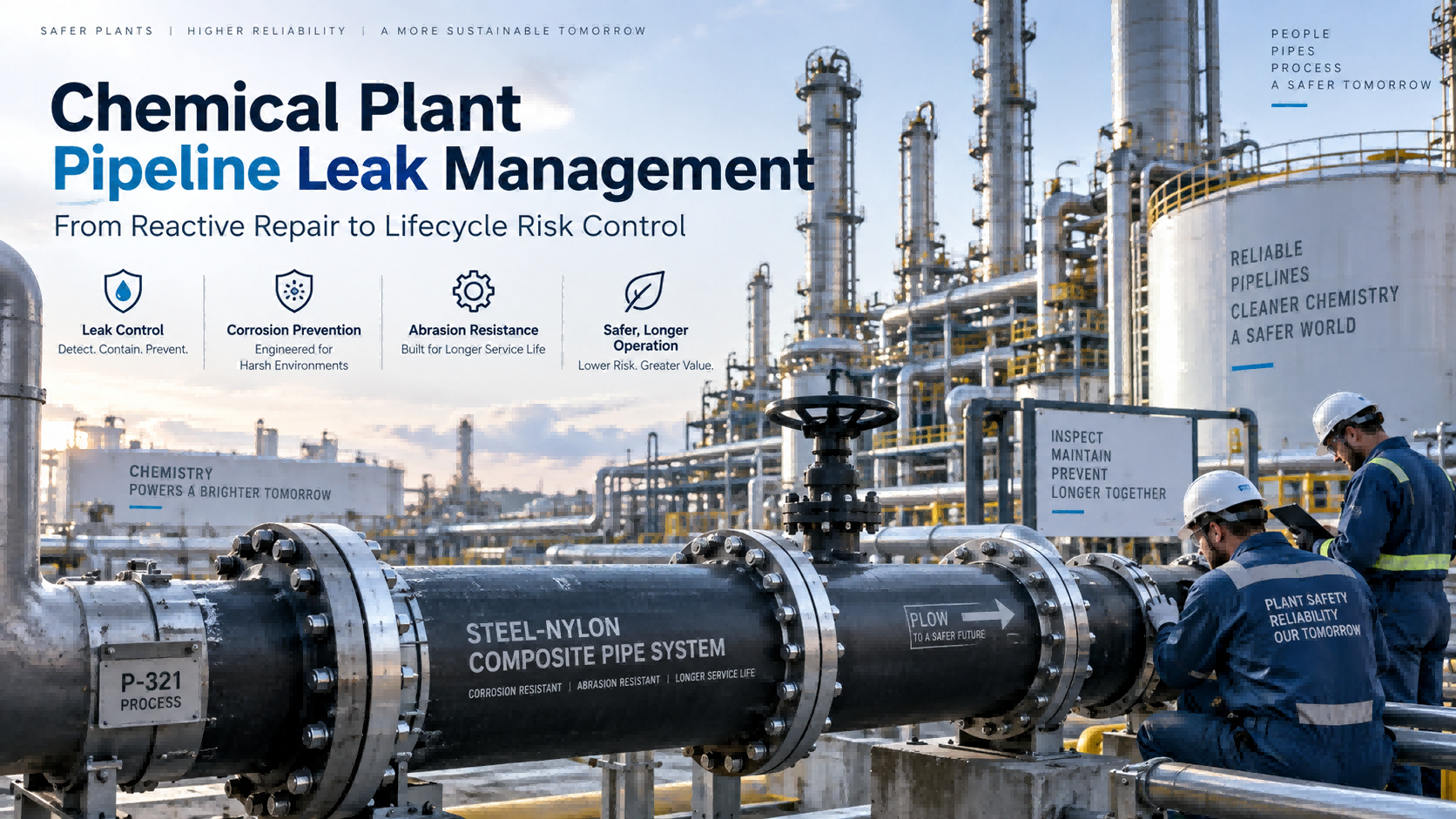
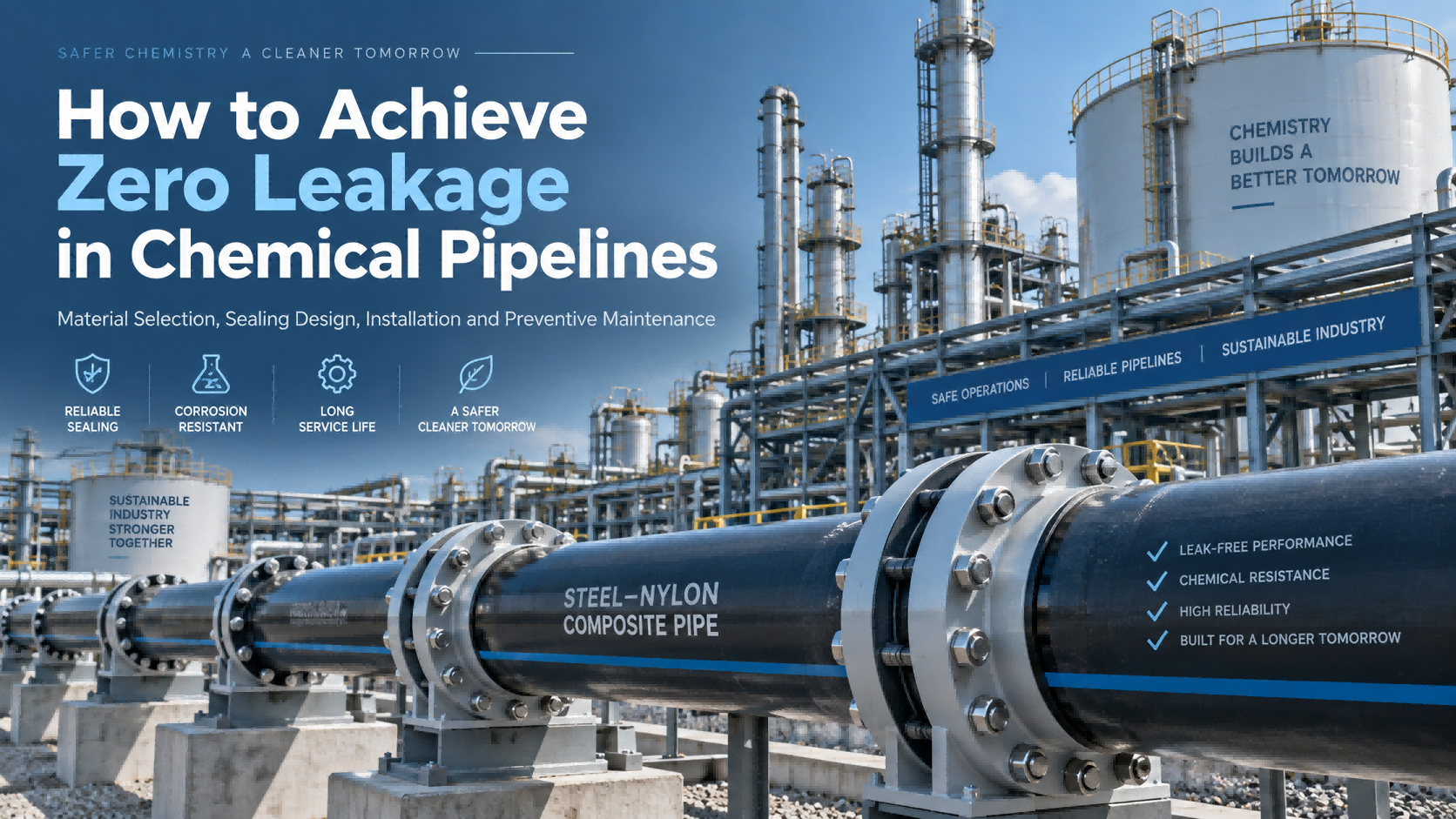
How Can Chemical Piping Systems Achieve Zero Leakage?
A seemingly minor leak can lead to product loss, equipment corrosion, unplanned shutdowns, environmental contamination, and even more serious safety incidents. For piping systems transporting caustic solutions, brine, slurries containing solid particles, high-salinity wastewater, and other corrosive industrial media, leakage risk deserves particular attention.
As a result, more and more chemical companies are pursuing a higher-level objective:
How can we move from “repairing leaks after they occur” to “preventing leakage as much as possible from the design stage”?
This is the real engineering significance of a so-called “zero-leakage piping system.”
It is important to emphasize that “zero leakage” in industrial engineering does not mean that any material or any pipeline can be guaranteed never to leak. Rather, it means reducing the probability and consequences of leakage to the lowest practical level through proper material selection, structural design, manufacturing quality control, reliable connections, and preventive maintenance.
For chemical pipelines operating for long periods under corrosion, erosion, pressure fluctuations, and complex chemical environments, achieving this objective is no longer simply a matter of making the pipe wall thicker.
1. Why Is Long-Term Leak-Free Operation So Difficult in Chemical Piping?
Many pipelines show no obvious problems when they are first commissioned.
The real challenge often emerges after several years of operation.
Chemical pipeline leakage is usually not caused by a single factor. Instead, it results from the long-term combined effects of materials, process media, pressure, temperature, connection design, and installation quality.
Common failure mechanisms include:
1.1 Internal Corrosion and Progressive Wall Thinning
When carbon steel pipelines transport corrosive media, the internal metal surface can undergo continuous chemical or electrochemical corrosion.
Over time, localized areas may develop:
-
Uniform corrosion;
-
Pitting corrosion;
-
Crevice corrosion;
-
Corrosion near welds;
-
Under-deposit corrosion.
The critical issue is that corrosion does not necessarily occur uniformly.
A pipeline that appears sound overall may already contain a severely weakened localized area that eventually develops into perforation and leakage.
2. Leakage Can Accelerate When Corrosion and Erosion Occur Simultaneously
Many chemical process media are not simple liquids.
Typical examples include:
-
Salt sludge;
-
Mineral slurry;
-
Crystallizing slurry;
-
Sand-containing wastewater;
-
Mother liquor;
-
Process liquids containing solid particles.
As these media flow through a pipeline, suspended particles continuously impact and scour the pipe wall.
If the pipeline is also exposed to chemical corrosion, a typical combined mechanism may develop:
Corrosion + Erosion
Corrosion first weakens the material surface, while particle erosion removes the damaged or protective layer and exposes fresh material to further attack.
These two mechanisms reinforce each other and can significantly shorten pipeline service life.
For such operating conditions, simply asking whether a material is “corrosion resistant” is not enough.
A pipeline material intended for long-term operation should provide both:
Corrosion Resistance + Wear Resistance
This is one of the important reasons steel–nylon composite pipe deserves consideration.
3. The First Step Toward Zero Leakage Is Not Repair — It Is Correct Material Selection
Many leakage problems are effectively created at the material-selection stage.
Traditional pipeline design often gives priority to:
-
Pipe diameter;
-
Pressure rating;
-
Initial purchase price.
For corrosive chemical systems, however, proper material selection should consider at least:
-
Chemical composition of the medium;
-
Concentration;
-
Temperature;
-
Operating pressure;
-
Flow velocity;
-
Solid content;
-
Corrosivity;
-
Abrasiveness;
-
Scaling tendency;
-
Required design life.
The same material can perform very differently at different concentrations, temperatures, and chemical compositions.
Therefore:
Pipeline selection should not simply ask, “Is this material corrosion resistant?” The more important question is, “How long can this material operate reliably under this specific service condition?”
These questions may appear similar, but they reflect fundamentally different engineering approaches.
4. Why Is It Increasingly Difficult for a Single Material to Meet Complex Chemical Service Requirements?
Traditional industrial piping systems generally choose among several categories of materials.
Carbon Steel
Carbon steel offers high mechanical strength, mature manufacturing technology, and good pressure-bearing capability.
However, in many corrosive media, internal corrosion becomes one of the main factors limiting service life.
Stainless Steel
Stainless steel can solve certain corrosion problems, but it does not mean that stainless steel is immune to corrosion in every chemical environment.
In environments containing chlorides, high salt concentrations, or certain chemicals, engineers must still consider:
-
Pitting corrosion;
-
Crevice corrosion;
-
Stress corrosion cracking;
-
Compatibility between material grade and process medium.
In addition, large-diameter stainless steel piping can involve significantly higher material costs.
PE and HDPE Piping
Polyethylene piping offers advantages in many low-temperature, low-pressure corrosive applications.
However, as diameter, pressure, temperature, and structural loads increase, strength, stiffness, connection method, and long-term dimensional stability require careful reassessment.
FRP and Other Composite Materials
FRP offers good corrosion resistance, but its application still requires consideration of mechanical properties, joint design, field installation quality, and long-term operating conditions.
For this reason, an increasingly important design concept in industrial piping is:
Allow different materials to perform the functions they are best suited to handle.
Steel–nylon composite pipe is developed around exactly this principle.
5. How Can Steel–Nylon Composite Pipe Reduce Leakage Risk in Chemical Plants?
Steel–nylon composite pipe is not simply a steel pipe combined with a plastic pipe.
Its fundamental engineering concept is:
The steel structure provides mechanical strength and pressure resistance, while the nylon inner layer provides corrosion resistance, wear resistance, and the process-contact surface.
By dividing these functions between two materials, the system reduces the compromises that occur when a single material must satisfy every performance requirement.
5.1 Using the Nylon Inner Layer to Isolate the Process Medium from the Steel Structure
For many corrosive media that are compatible with nylon, the nylon inner layer forms a stable process-contact surface and helps prevent direct contact between the transported medium and the steel substrate.
This changes the corrosion mechanism compared with conventional carbon steel pipe.
Traditional steel pipe:
Process Medium → Direct Metal Contact → Steel Wall Corrosion
Steel–nylon composite pipe:
Process Medium → Nylon Inner Layer → Steel Structure Primarily Carries Mechanical Loads
When the material is correctly matched to the actual medium, temperature, and concentration, the risk of perforation caused by internal metal corrosion can be significantly reduced.
5.2 Addressing Corrosion and Wear at the Same Time
For media containing solid particles, corrosion resistance alone is insufficient.
Another important advantage of steel–nylon composite pipe is the good wear resistance of the nylon material itself.
Therefore, in systems transporting media such as:
-
Salt sludge;
-
Chemical slurry;
-
Sand-containing fluids;
-
High-salinity wastewater;
-
Certain mineral slurries;
-
Crystallizing process fluids;
where corrosion and erosion occur simultaneously, the material can help reduce pipe-wall failure risk from both mechanisms.
This is particularly important for reducing repeated weld repairs, localized replacement, and unplanned shutdowns.
6. The Second Critical Factor Affecting Leakage Probability: Connection Design
When discussing leakage, many projects focus almost entirely on the pipe material.
In actual piping systems, however:
Pipe joints are often among the highest-risk locations.
Typical problems include:
-
Welding defects;
-
Corrosion in heat-affected zones;
-
Flange sealing failure;
-
Incorrect gasket selection;
-
Uneven bolt preload;
-
Pipeline misalignment;
-
Additional loads caused by thermal expansion and contraction.
Therefore, zero-leakage design must always be treated as a system consisting of:
Pipe Material + Joints + Sealing + Installation
7. Why Do We Emphasize Flanged Connection Design?
Our steel–nylon composite pipes use engineered flange connections.
For many chemical projects, this approach offers several advantages.
First: Reduced On-Site Welding Requirements
Conventional steel pipeline modification often involves:
Cutting → Beveling → Welding → Inspection → Coating Repair
In operating chemical plants, hot work itself may require:
-
Work permits;
-
Process isolation;
-
Gas testing;
-
Fire watch;
-
Restricted construction windows.
Flanged connections can reduce some on-site welding requirements in suitable projects and improve installation and maintenance efficiency.
Second: Easier Local Maintenance and Replacement
Industrial piping systems are not static forever.
Future modifications may involve:
-
Valve replacement;
-
Pump replacement;
-
Process modifications;
-
Addition of branch lines;
-
Local fitting replacement.
Detachable flange connections can simplify future system modifications.
Third: Greater Potential for Standardized Installation
If flange dimensions, sealing surfaces, gaskets, bolts, and tightening torque are systematically controlled, joint reliability can gradually shift from being dependent on individual field experience toward:
Standardized Installation Quality Control
This is particularly important for large-volume industrial piping projects.
8. To Reduce Leakage, Control Must Extend Beyond Straight Pipe to Fittings
In real piping systems, leakage does not always occur on straight pipe sections.
Instead, areas such as:
-
Elbows;
-
Tees;
-
Reducers;
-
Pump discharge sections;
-
Upstream and downstream sections of valves;
-
High-velocity zones;
often experience more complex flow erosion and localized stresses.
For example, when fluid enters an elbow, its direction changes and solid particles may become concentrated against the outer radius.
Pump discharge sections may simultaneously experience:
-
High flow velocity;
-
Pressure fluctuations;
-
Vibration;
-
Localized erosion.
Therefore, if the objective is a long-term low-leakage system, upgrading only straight pipe is not enough.
A more effective strategy is:
Identify the locations most susceptible to failure across the entire piping system and prioritize material upgrades at those weak points.
This is why our steel–nylon composite piping system focuses not only on straight pipe but can also incorporate:
-
Elbows;
-
Tees;
-
Reducers;
-
Pump discharge sections;
-
Upstream and downstream valve sections;
into a more integrated system design.
9. Zero Leakage in Large-Diameter Piping Depends Heavily on Manufacturing Consistency
As pipe diameter increases, manufacturing difficulty does not increase in a simple linear manner.
For large-diameter steel–nylon composite pipe, important manufacturing controls include:
-
Roundness of the steel structure;
-
Wall thickness;
-
Concentricity;
-
Uniformity of the inner-layer thickness;
-
Integrity of the composite structure;
-
Flange dimensions;
-
Flatness of sealing surfaces;
-
Dimensional stability of finished products.
If dimensional consistency is insufficient, field installation may experience:
-
Flange misalignment;
-
Forced fit-up;
-
Increased piping stress;
-
Uneven gasket compression;
-
Localized sealing failure.
Therefore, true zero-leakage engineering does not begin at the construction site.
It begins:
The moment raw materials enter the factory.
10. Factory Quality Control Determines Long-Term Reliability
For industrial composite piping, quality cannot be guaranteed by final visual inspection alone.
A more appropriate approach covers the entire process from raw materials to finished products.
For example:
Raw Material Inspection
Including steel structural materials, nylon raw materials, and relevant supporting materials.
Dimensional Control
Including:
-
Outside diameter;
-
Wall thickness;
-
Flange dimensions;
-
Concentricity;
-
Critical structural dimensions.
Composite Structure Inspection
Ensuring that the inner layer is complete and continuous and free from obvious defects that could affect long-term performance.
Pressure and Performance Testing
According to the product design rating and project requirements, pressure-bearing capacity and related performance parameters should be verified.
Our steel–nylon composite pipes can be manufactured for different pressure classes according to engineering requirements, including industrial transport applications in the approximate range of 1.0–4.0 MPa.
However, the final pressure rating must be determined according to pipe diameter, temperature, medium, and specific engineering design conditions rather than any single parameter alone.
11. Installation Quality Determines the “Last Mile” of Leakage Prevention
Even high-performance pipe materials can leak if installation quality is poorly controlled.
For example:
Two flanges may not be parallel, yet installers may force them together simply by tightening the bolts.
The connection may not leak immediately.
However, additional stress has already been introduced into the piping system.
After exposure to:
-
Temperature cycling;
-
Pressure fluctuations;
-
Vibration;
-
Long-term operation;
the sealing system may gradually fail.
Therefore, flange installation should carefully control:
-
Flange parallelism;
-
Flange alignment;
-
Gasket type;
-
Gasket compatibility with the medium;
-
Bolt grade;
-
Bolt tightening sequence;
-
Bolt preload;
-
Pipe supports.
In other words:
Good pipe material cannot compensate for poor installation.
12. Temperature Changes Are an Often-Overlooked Cause of Leakage
Chemical pipelines may experience significant temperature variations.
For example:
Equipment start-up;
Temperature increase;
Steady operation;
Shutdown and cooling.
This means the entire piping system repeatedly experiences:
Thermal Expansion → Contraction → Thermal Expansion Again
If supports, expansion compensation, and piping layout are not properly designed, thermal stresses can gradually be transferred to:
-
Flanges;
-
Valves;
-
Pump nozzles;
-
Tees;
-
Equipment connections.
Eventually, sealing reliability may decline.
Therefore, zero-leakage design should not focus only on the temperature resistance of the pipe material. It must also consider:
How the entire piping system accommodates displacement and stress caused by temperature changes.
13. Why Can Increasing Wall Thickness Alone Not Solve Leakage Problems?
This is a common misconception in industrial projects.
When steel pipe corrodes too quickly, an intuitive response is:
Increase the wall thickness.
Greater wall thickness can indeed provide additional corrosion allowance.
But the fundamental problem remains:
If the corrosion mechanism itself does not change, the solution merely:
Allows the corrosion process to continue for a longer period before failure.
If the corrosion rate remains unchanged, greater corrosion allowance only delays the time at which the wall reaches its failure threshold.
Changing the material in contact with the process medium, by contrast, can potentially alter the corrosion pathway itself.
This is one of the important advantages of composite piping design.
14. Advanced Pipeline Management Is Moving from Repair to Prevention
Historically, many chemical plants have followed a maintenance cycle of:
Leak → Detection → Shutdown → Repair
A more advanced future approach is:
Risk Identification → Material Upgrade → Condition Monitoring → Preventive Replacement
Companies can establish a “high-risk piping map” using historical maintenance data.
For example, if the same production line repeatedly experiences failures over five years at:
-
Pump discharge sections;
-
Elbows;
-
Downstream of valves;
-
Salt-sludge lines;
-
High-velocity zones;
the company may not need to replace the entire pipeline immediately.
Instead, the most failure-prone locations can be upgraded first.
For example, by installing:
100–500 m Trial Sections
or implementing:
Localized Replacement of Vulnerable Fittings
engineers can monitor:
-
Corrosion condition;
-
Wear condition;
-
Number of leakage events;
-
Maintenance cost;
-
Service life.
The company can then decide whether to expand the application.
This approach can significantly reduce the risk associated with introducing a new pipeline material.
15. Why Is Steel–Nylon Composite Pipe Suitable for Upgrading Aging Chemical Pipelines?
Many chemical companies face a practical challenge:
Existing plants must continue operating for years, while parts of the piping network have already entered a stage of frequent maintenance.
Typical symptoms include:
-
Repeated weld repairs on the same pipe section;
-
Frequent elbow wear-through;
-
Recurring local leakage every year;
-
Increasingly short maintenance intervals;
-
Repeated coating repairs;
-
Rising labor costs for maintenance.
If companies continue using the same material and the same repair method, they often simply repeat the original failure mechanism.
Therefore, the real question in aging pipeline upgrades should not be:
“How do we repair this leak?”
It should be:
“How do we prevent this location from becoming a leakage point again over the next several years?”
By combining a steel structural layer with a functional nylon liner, steel–nylon composite pipe offers an alternative technical route for such upgrade projects.
16. The Core Value of Steel–Nylon Composite Pipe Is Not Simply Lower Price — It Is Lower Lifecycle Risk
When purchasing pipe, unit price is the easiest factor to compare.
But in continuous-process industries, the pipe itself is often not the most expensive part of a leakage event.
A leak may create costs associated with:
**Pipeline Repair
-
Labor
-
Production Loss
-
Cleanup
-
Safety Management
-
Environmental Risk
-
Replacement Materials**
As a result, mature chemical-industry procurement is increasingly shifting from:
Purchase Price
toward:
Total Cost of Ownership (TCO)
If a piping solution has a slightly higher initial cost but can:
-
Extend replacement intervals;
-
Reduce leakage frequency;
-
Reduce weld repairs;
-
Lower maintenance frequency;
-
Reduce unplanned shutdowns;
then its long-term economic performance may actually be superior.
This is another important reason steel–nylon composite pipe deserves evaluation in services where corrosion and wear occur simultaneously.
17. How Should a Truly Low-Leakage Piping System Be Designed?
The principles discussed above can be summarized into seven layers of long-term low-leakage piping design.
Layer 1: Process Medium Analysis
First, understand exactly:
What is flowing inside the pipe?
Knowing only the name of the medium is not enough.
Engineers should further evaluate:
-
Composition;
-
Concentration;
-
Temperature;
-
Solids content;
-
Flow velocity;
-
pH;
-
Potential impurities.
Layer 2: Material Compatibility
Based on actual service conditions, compare materials such as:
-
Carbon steel;
-
Stainless steel;
-
PE/HDPE;
-
FRP;
-
Lined pipe;
-
Steel–nylon composite pipe.
No material should be assumed to suit every application.
It is particularly important to recognize that nylon also has a defined chemical compatibility range.
For certain strong acids, high-concentration acids, and special chemical media, compatibility must be verified before material selection.
Professional material selection should be based on real operating data rather than generalized claims such as “acid resistant” or “alkali resistant.”
Layer 3: Structural Design
Confirm:
-
Pressure rating;
-
Pipe diameter;
-
Wall thickness;
-
Support design;
-
Thermal compensation;
-
Allowable displacement.
Layer 4: Connection System
Reliable pipe does not automatically mean reliable joints.
The following should be designed as one system:
-
Flanges;
-
Gaskets;
-
Bolts;
-
Sealing surfaces.
Layer 5: Manufacturing Control
Stable manufacturing processes should control:
-
Dimensions;
-
Inner-layer quality;
-
Flange quality;
-
Pressure performance;
-
Batch-to-batch consistency.
Layer 6: Installation Quality
Strictly control:
-
Pipe alignment;
-
Supports;
-
Bolt tightening;
-
Gasket installation;
-
Forced fit-up.
Layer 7: Operation and Maintenance
Finally, establish:
Inspection + Preventive Maintenance
That means:
Regular Inspection + Preventive Maintenance
18. Moving from “Pipe Products” to “Piping System Reliability”
The industrial piping industry is undergoing an important transformation.
In the past, customers purchased:
A length of pipe.
In the future, more customers will effectively be purchasing:
20 years of reliable fluid transportation.
This means a pipeline supplier should not be evaluated only by product price.
Customers should also consider:
-
Material technology;
-
Service-condition analysis capability;
-
Large-diameter manufacturing capability;
-
Pressure-rated manufacturing capability;
-
Batch consistency;
-
Fitting supply capability;
-
Project experience;
-
Quality management systems;
-
Long-term field performance data.
The value of steel–nylon composite pipe should therefore not be defined merely as an “alternative to conventional steel pipe.”
More accurately, it represents a composite piping technology developed for complex industrial transport requirements involving:
Corrosion + Wear + Pressure + Long Service Life
19. Conclusion: True Zero Leakage Comes from System Engineering, Not from Any Single Material
Chemical pipeline leakage management must ultimately move from:
Reactive Maintenance
to:
Preventive Engineering
In other words, from:
Repairing leakage after it occurs
toward:
Preventing leakage as much as possible from the design stage.
Long-term piping reliability is not determined by one parameter. It depends on an integrated system of:
**Correct Material
-
Correct Structure
-
Correct Connection
-
Consistent Manufacturing
-
Standardized Installation
-
Proper Operation
-
Preventive Maintenance**
For companies facing long-term challenges involving corrosion, wear, high salinity, slurry transport, and other complex industrial media, steel–nylon composite pipe provides a technical solution worth evaluating.
It combines the mechanical strength and pressure-bearing capability of steel with the corrosion resistance, wear resistance, and process-contact performance of a nylon inner layer, together with engineered flange connections and integrated fitting design, helping reduce the risk of failure associated with internal corrosion in conventional metallic pipelines.
A high-quality chemical piping system should not be designed around the question, “How often will we need to repair it?”
A better objective is:
Minimize maintenance, minimize leakage, minimize downtime, and keep the piping system operating safely and reliably throughout its intended design life.
That is the real direction worth pursuing when chemical plants talk about achieving “zero leakage.”
How to Reduce Hot Work Risks in Chemical Plants: From Better Hot Work Management to Reducing the Need for Hot Work