Chemical Industry Pipeline Material Comparison | Selection Guide & Steel–Nylon Composite Pipe Advantages
1. Introduction: Why Pipeline Material Selection Determines Chemical Plant Performance
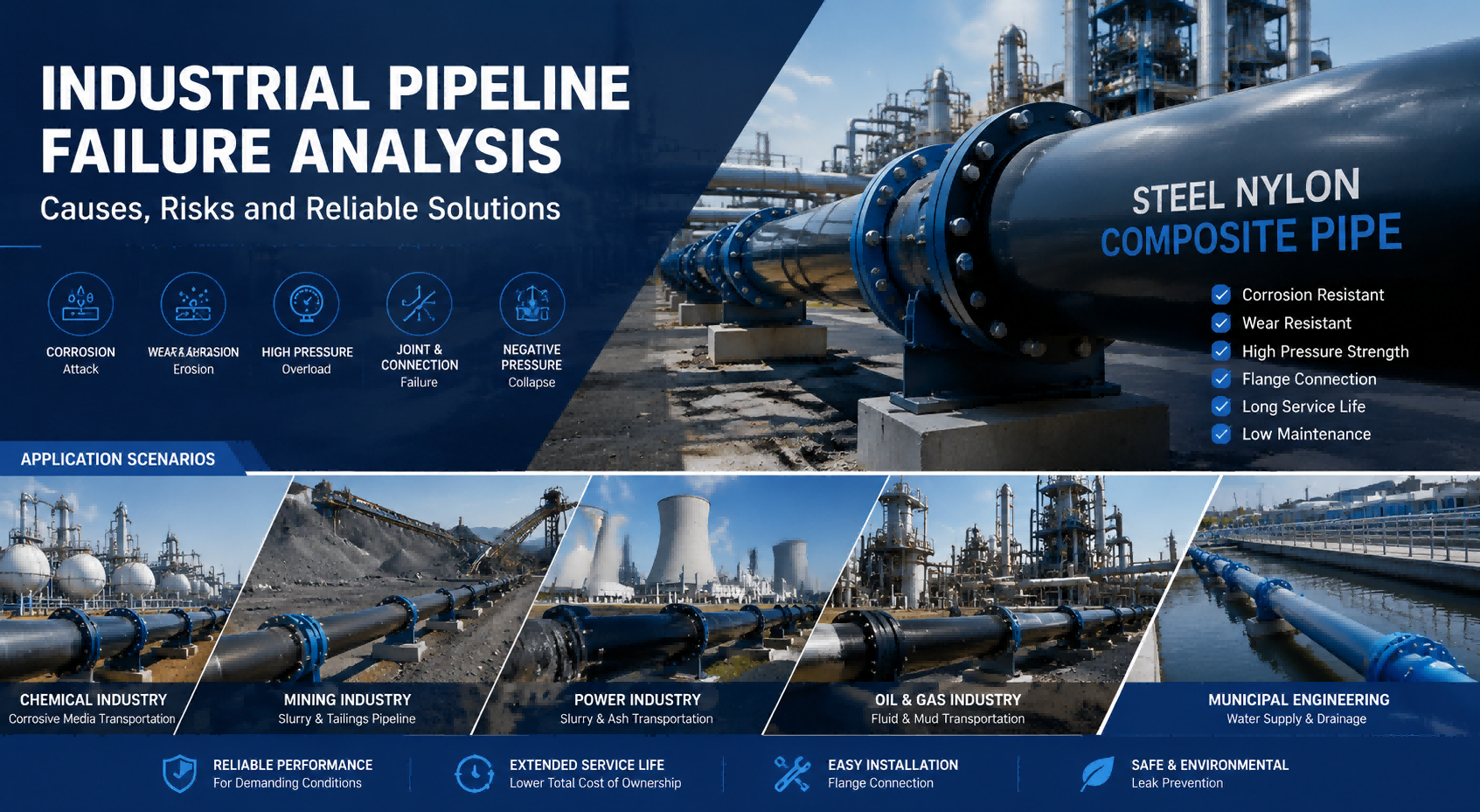
In industries such as chemicals, mining, oil & gas, and chlor-alkali production, pipeline systems are not auxiliary equipment—they are the backbone of safe, continuous, and efficient operation.
An improper material selection can lead to:
-
Corrosion perforation → leakage accidents
-
Scaling and blockage → reduced capacity
-
Abrasion failure → unplanned shutdowns
-
Frequent maintenance → high operating costs
Therefore, understanding the performance boundaries of different pipeline materials is the first step in engineering design.
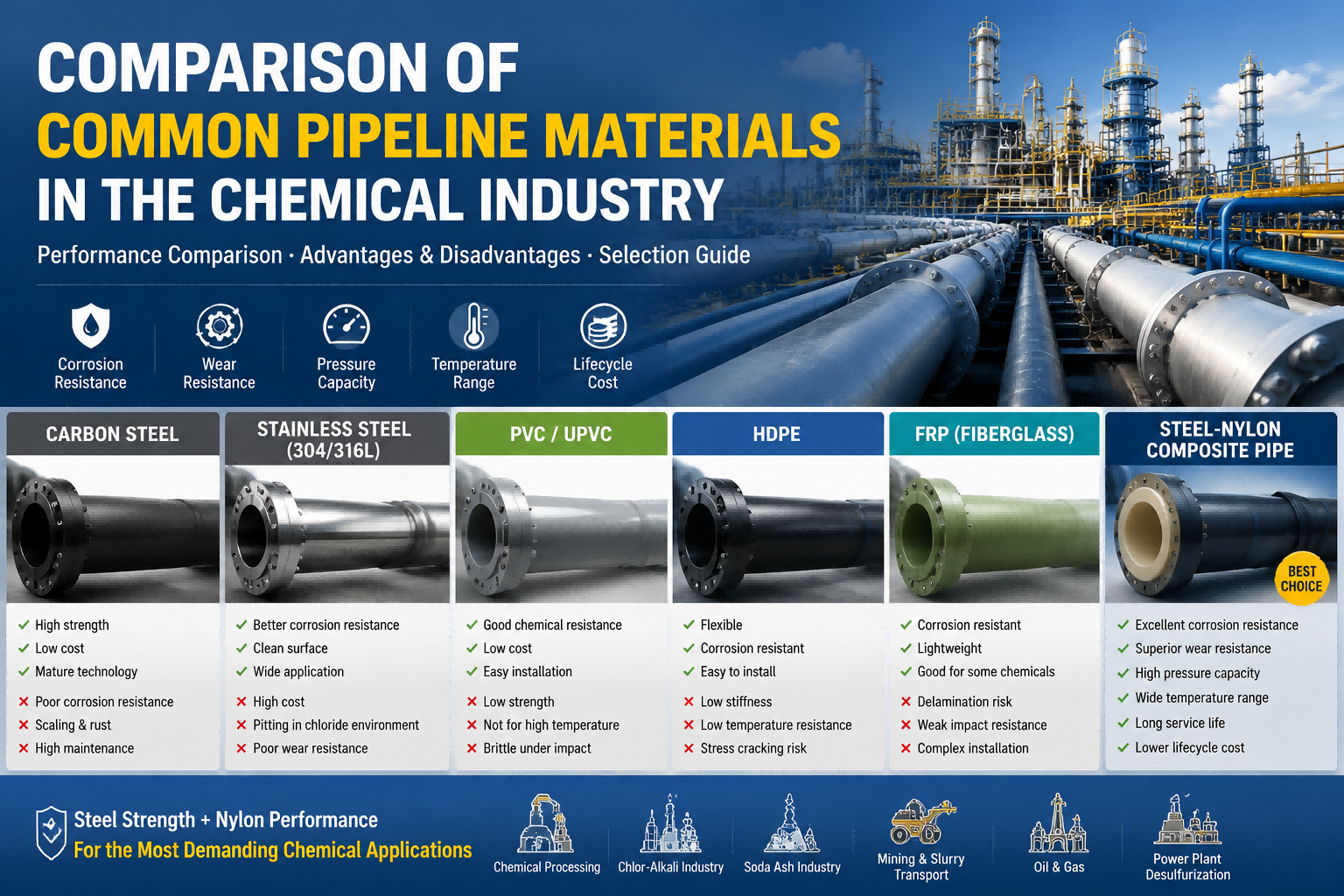
2. Comparison of Mainstream Chemical Pipeline Materials
1. Carbon Steel Pipe
Advantages:
-
High strength and pressure resistance
-
Low cost
-
Mature manufacturing and welding processes
Disadvantages:
-
Highly susceptible to corrosion in acids, alkalis, and salt media
-
Severe internal scaling
-
Requires coatings or liners
-
Frequent maintenance
👉 Application: Low-corrosion environments or structural support systems
2. Stainless Steel Pipe (304/316L)
Advantages:
-
Better corrosion resistance than carbon steel
-
Clean surface and good hygiene performance
-
Used in food and pharmaceutical applications
Disadvantages:
-
Pitting corrosion and stress corrosion cracking in chloride or strong alkaline environments
-
High cost
-
Reduced lifespan in abrasive conditions
👉 Typical issue: Not truly “corrosion-proof” in chlor-alkali systems
3. PVC / UPVC Pipe
Advantages:
-
Good resistance to mild acids and alkalis
-
Low cost
-
Easy installation
Disadvantages:
-
Low mechanical strength
-
Brittle under impact
-
Poor high-temperature resistance (<60°C)
-
Not suitable for high-pressure systems
👉 Application: Low-pressure, room-temperature chemical transfer
4. HDPE Pipe
Advantages:
-
Flexible and easy to install
-
Good general chemical resistance
-
Fusion welding connections
Disadvantages:
-
Insufficient ring stiffness → deformation risk
-
Poor high-temperature performance (<80°C)
-
Long-term stress cracking risk
-
Joint quality depends heavily on installation
👉 Typical issue: Failure under vacuum or high-temperature conditions
5. FRP (Fiberglass Reinforced Plastic) Pipe
Advantages:
-
Good corrosion resistance
-
Lightweight
-
Suitable for some chemical media
Disadvantages:
-
Risk of delamination under long-term stress or temperature fluctuations
-
Weak impact resistance
-
Complex installation and maintenance
-
Reliability highly dependent on manufacturing quality
👉 Typical issue: Uncertain long-term stability
6. Rubber-Lined / Plastic-Lined Steel Pipe
Advantages:
-
Combines steel strength with corrosion protection
-
Suitable for certain corrosive environments
Disadvantages:
-
Lining may delaminate
-
Thermal expansion mismatch
-
Local damage cannot be easily repaired
-
Unstable service life
👉 Industry pain point: “Looks reliable but fails unpredictably”
3. Common Structural Limitations of Traditional Materials
Across all conventional pipeline materials, four key limitations are evident:
-
Difficulty balancing corrosion resistance and strength
-
Fragmented performance under high temperature, pressure, and wear
-
Unstable lifecycle prediction
-
Increasing maintenance costs over time
This is why industries are shifting toward advanced composite pipeline systems.
4. Steel–Nylon Composite Pipe: A New Generation Solution
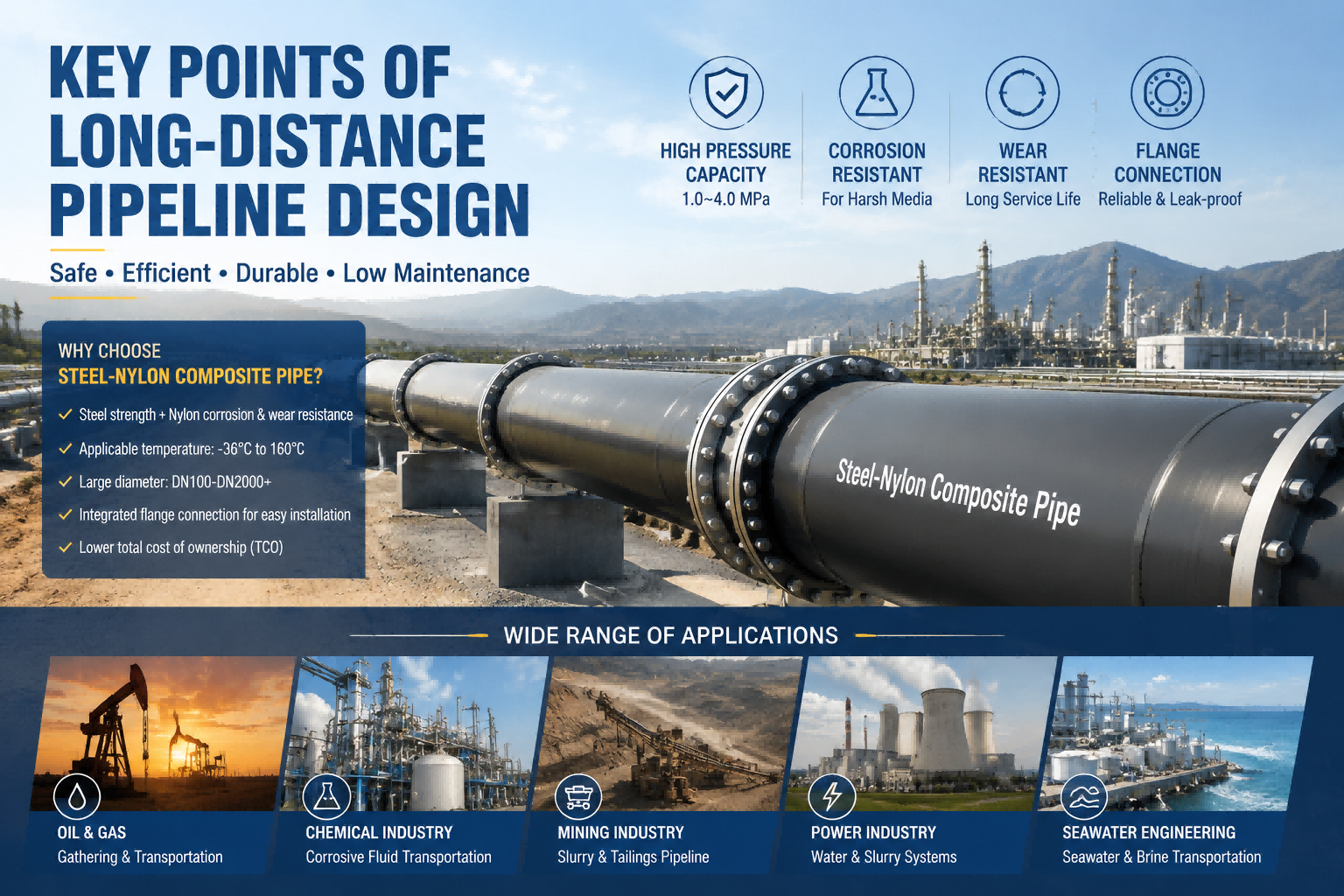
Against this background, steel–nylon composite pipes are becoming a preferred upgrade solution in high-demand industrial systems.
✔ Structural Advantage: Integrated Steel + Nylon System
-
Outer steel layer: provides high strength and pressure resistance
-
Inner nylon layer: provides corrosion resistance, wear resistance, and smooth flow
Result: a true “1 + 1 > 2” performance synergy
5. Core Advantages of Steel–Nylon Composite Pipe
1. Strong Corrosion Resistance
Suitable for:
-
Strong alkali (soda ash, chlor-alkali systems)
-
Mild acids
-
High-salinity wastewater
-
Industrial mother liquor systems
👉 Compared with stainless steel: more stable in harsh chemical environments
👉 Compared with lined pipes: no delamination risk
2. Excellent Wear Resistance (Critical for Slurry Transport)
-
Strong resistance to particle abrasion
-
Inner surface remains smooth over time
-
Reduced flow resistance increase
👉 Significant advantage in mining slurry and tailings transport
3. Wide Temperature Adaptability
-
Operating range: -36°C to 160°C
-
Resists both low-temperature brittleness and high-temperature softening
👉 Superior to HDPE and PVC systems
4. High Pressure Capacity and Structural Stability
-
Stable operation under high-pressure conditions (engineering grade up to ~4.0 MPa)
-
No reliance on adhesive lining structures
-
Flanged connection system improves reliability
5. Lower Lifecycle Cost (Total Cost of Ownership)
Although initial cost may be higher than conventional plastic pipes, it offers:
-
Reduced shutdown and maintenance
-
Longer replacement cycles
-
Lower leakage risk
-
Extended service life
👉 Overall ROI is significantly better
6. Material Comparison Summary
| Material | Corrosion Resistance | Wear Resistance | Pressure Resistance | Service Life | Maintenance Cost |
|---|---|---|---|---|---|
| Carbon Steel | ❌ | ❌ | ✔ | ❌ | High |
| Stainless Steel | ⚠ | ⚠ | ✔ | ⚠ | Medium-High |
| PVC | ✔ | ❌ | ❌ | ❌ | Medium |
| HDPE | ✔ | ⚠ | ⚠ | ⚠ | Medium |
| FRP | ✔ | ⚠ | ⚠ | ⚠ | Medium-High |
| Steel–Nylon Composite Pipe | ✔✔ | ✔✔ | ✔✔ | ✔✔ | Low |
7. Typical Applications
Steel–nylon composite pipes are widely used in:
-
Chlor-alkali industry transport systems
-
Soda ash and mother liquor pipelines
-
Oilfield produced water systems
-
Mining slurry and backfill transport
-
Chemical corrosive media pipelines
-
Power plant desulfurization systems
8. Conclusion: Pipeline Selection Is Entering the “System Era”
Traditional pipeline selection focuses on single-material performance. Modern industrial systems, however, prioritize:
-
Lifecycle cost
-
Operational stability
-
Maintenance frequency
-
System safety
Steel–nylon composite pipes do not merely replace existing materials—they represent a shift toward more stable, long-term, and lower-risk industrial transport systems.
9. CTA
If you are working on:
-
Chemical pipeline system upgrades
-
Replacement of corrosion or abrasion-prone pipelines
-
Reduction of maintenance-intensive systems
-
New high-reliability pipeline design projects
Steel–nylon composite pipes can be a valuable solution for evaluation.
👉 We provide:
Engineering selection support / Media compatibility analysis / Pilot section solutions / ROI comparison assessments
What Pipe Is Suitable for Transporting Highly Corrosive Media? A Comprehensive Guide to Industrial Pipeline Selection
Industrial Pipeline Selection: 7 Key Parameters Explained in Depth