Large Diameter Pipeline Application Case Study: How DN2000+ Steel-Nylon Composite Pipes Achieve High Strength and Long-Term Reliable Operation

With the development of large-scale energy, chemical, mining, and infrastructure projects, industrial transportation systems are moving toward larger flow capacity, longer transmission distances, and more complex operating conditions.
In applications such as slurry transportation, tailings backfilling, chemical mother liquor transfer, oil and gas gathering, and large-scale water supply systems, traditional small-diameter pipelines can no longer meet the requirements of modern engineering projects.
Especially for DN1000, DN1600, and even DN2000+ ultra-large diameter pipelines, the system must withstand not only internal pressure but also long-term challenges including:
-
High-speed flow erosion;
-
Corrosive chemical media;
-
Impact from solid particles;
-
Thermal expansion and contraction stress;
-
Difficult installation and maintenance over long distances.
Therefore, selecting a pipeline material with high strength, corrosion resistance, wear resistance, and low lifecycle maintenance costs has become a critical decision in large-scale industrial projects.
Steel-Nylon Composite Pipe, combining the mechanical strength of steel with the corrosion and wear resistance of reinforced nylon, has become an advanced solution for large-diameter industrial transportation systems.
1. Key Challenges in Ultra-Large Diameter Pipeline Applications
1.1 Larger Diameter Requires Higher Structural Strength
When pipeline diameter exceeds DN1000, the pipeline must withstand not only internal pressure but also:
-
Self-weight of the pipeline;
-
Weight of transported materials;
-
Bending stress caused by support spacing;
-
Additional stress caused by ground settlement;
-
Hydraulic shock during startup and shutdown.
Traditional plastic pipes provide excellent corrosion resistance but have limitations in high-pressure and large-diameter applications, including:
-
Insufficient structural rigidity;
-
Long-term creep deformation;
-
Reduced connection reliability.
On the other hand, traditional steel pipes offer high mechanical strength but are vulnerable to corrosion and abrasion during long-term operation.
Steel-Nylon Composite Pipe solves this contradiction through advanced composite structural design.
2. Structural Advantages of Steel-Nylon Composite Pipe
Steel-Nylon Composite Pipe adopts a unique structure:
Outer Steel Layer for Structural Support + Inner Reinforced Nylon Layer for Protection
This composite design follows the engineering concept of:
"Structural Layer + Functional Layer"
The steel layer provides:
-
Pressure resistance;
-
Mechanical strength;
-
Structural stability.
The nylon layer provides:
-
Corrosion resistance;
-
Wear resistance;
-
Smooth inner surface.
This combination gives the pipeline outstanding advantages.
High Mechanical Strength
The steel structure provides excellent pressure-bearing capability and supports industrial pressure ratings including:
-
1.0 MPa;
-
2.5 MPa;
-
4.0 MPa.
It is suitable for demanding applications requiring high-pressure and large-diameter transportation.
Superior Wear Resistance
Reinforced nylon materials provide excellent impact resistance and abrasion performance.
For transporting:
-
Mineral slurry;
-
Coal slurry;
-
Tailings;
-
Particle-containing fluids;
steel-nylon composite pipes can:
-
Reduce direct particle impact on the pipe wall;
-
Extend service life of elbows, tees, and other high-wear components;
-
Reduce downtime caused by frequent pipeline replacement.
Excellent Corrosion Resistance
The nylon inner layer isolates corrosive media from the steel body, effectively resisting:
-
Saltwater;
-
Chloride-containing solutions;
-
Alkaline chemicals;
-
Chemical mother liquor;
-
Weak acid solutions.
This makes steel-nylon composite pipes especially suitable for complex chemical environments.
3. Case Study 1: Large-Scale Mining Tailings Transportation Pipeline System
Project Background
A large mining enterprise required a long-distance, high-flow tailings transportation pipeline system.
The original design used traditional steel pipes. However, after operation, several problems appeared:
-
Severe internal wear;
-
Corrosion damage;
-
Short maintenance cycles;
-
High replacement costs.
Because the transportation distance was extensive, every shutdown for repair directly affected production efficiency.
Pipeline Upgrade Solution
Large-diameter steel-nylon composite pipes were selected as a replacement solution.
Application conditions:
-
DN1000+ large diameter pipeline;
-
Long-distance continuous transportation;
-
Flange connection installation;
-
High-abrasion slurry environment.
Application Results
After upgrading:
1. Extended Pipeline Service Life
The reinforced nylon inner layer reduced direct impact from abrasive particles, significantly improving pipeline durability.
2. Reduced Maintenance Frequency
Compared with traditional steel pipelines, steel-nylon composite pipes reduce:
-
Welding repairs;
-
Anti-corrosion maintenance;
-
Production interruptions.
3. Improved Transportation Efficiency
The smooth nylon inner surface reduces friction resistance, helping lower operating energy consumption.
4. Case Study 2: Large-Scale Mother Liquor Transportation System in Soda Ash Industry
Operating Conditions
Mother liquor transportation systems in soda ash production represent typical complex industrial conditions.
The medium usually contains:
-
High salt concentration;
-
High chloride content;
-
Solid particles;
-
Combined corrosion and abrasion effects.
Traditional carbon steel pipelines often suffer from:
-
Corrosion thinning;
-
Weld leakage;
-
Reduced service life.
Application of Steel-Nylon Composite Pipe
A large soda ash manufacturer introduced reinforced nylon pipes and steel-nylon composite pipes for mother liquor transportation systems.
After more than 20 years of operation, the pipeline system has maintained stable performance.
Main advantages include:
Strong Corrosion Resistance
The nylon lining prevents direct contact between corrosive media and the steel structure.
Excellent Wear Resistance
The pipe withstands long-term erosion from solid particles contained in the mother liquor.
Reliable Large-Span Installation
The steel structure ensures long-term stability for large-diameter pipeline systems.
5. Comparison Between Steel-Nylon Composite Pipe and Traditional Materials
| Pipeline Material | Advantages | Limitations |
|---|---|---|
| Carbon Steel Pipe | High strength, low initial cost | Corrosion risk, frequent maintenance |
| Stainless Steel Pipe | Good corrosion resistance | High cost, reduced wear resistance |
| HDPE Pipe | Lightweight, corrosion resistant | Limited pressure capability for large diameter |
| FRP Pipe | Corrosion resistant | Risk of delamination and impact damage |
| Steel-Nylon Composite Pipe | High strength + corrosion resistance + wear resistance | Comprehensive performance advantage |
6. Installation Advantages: Integrated Flange Design Reduces Construction Risks
One of the biggest challenges in large pipeline projects is connection reliability.
Traditional pipelines usually require:
-
Field welding;
-
Coating repair;
-
Weld inspection.
These processes increase:
-
Construction time;
-
Installation complexity;
-
Potential leakage risks.
Steel-Nylon Composite Pipe features:
Integrated Flange Design
Advantages include:
Reduced Field Welding
Avoiding:
-
Welding deformation;
-
Damage to protective layers;
-
Fire risks during construction.
More Reliable Connections
Standard flange connections provide:
-
Faster installation;
-
Easier maintenance;
-
Better suitability for modular construction of large engineering projects.
7. Future Development Trends of Large Diameter Pipelines
Future industrial pipeline systems will focus increasingly on:
1. Longer Service Life
Engineering decisions are shifting from:
"Lowest purchase cost"
to:
"Total Cost of Ownership (TCO) optimization."
2. Lower Maintenance Requirements
Reducing:
-
Production shutdowns;
-
Pipeline replacement;
-
Manual maintenance costs.
3. Sustainable Operation
Reducing material consumption and energy waste caused by frequent maintenance.
Steel-Nylon Composite Pipe meets the future development direction of industrial pipeline engineering.
Conclusion: DN2000+ Large Diameter Transportation Requires More Than Size — It Requires Long-Term Reliability
The success of an ultra-large diameter pipeline project depends not only on transportation capacity but also on long-term operational reliability.
Steel-Nylon Composite Pipe provides:
-
High pressure capability from steel reinforcement;
-
Corrosion and wear protection from reinforced nylon;
-
Ultra-large diameter manufacturing capability for major projects;
-
Integrated flange connections for safer and faster installation.
It provides a reliable, efficient, and economical pipeline solution for:
-
Mining;
-
Chemical industries;
-
Energy projects;
-
Municipal infrastructure;
-
Industrial transportation systems.
For future DN1000–DN2000+ large diameter pipeline projects, Steel-Nylon Composite Pipe is becoming an important alternative for upgrading traditional metal pipeline systems.
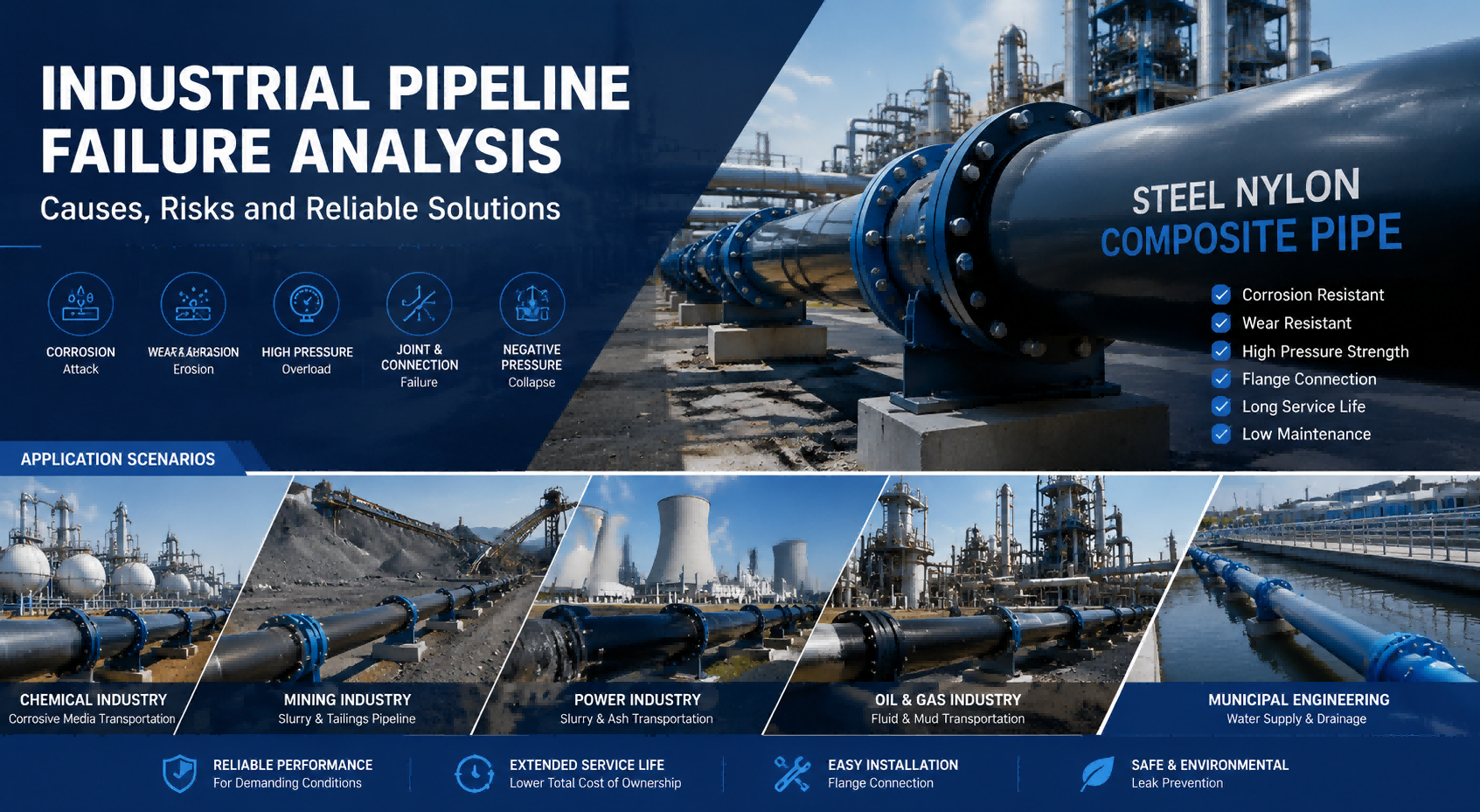
Industrial Pipeline Failure Analysis: Causes and How Steel Nylon Composite Pipes Improve System Reliability
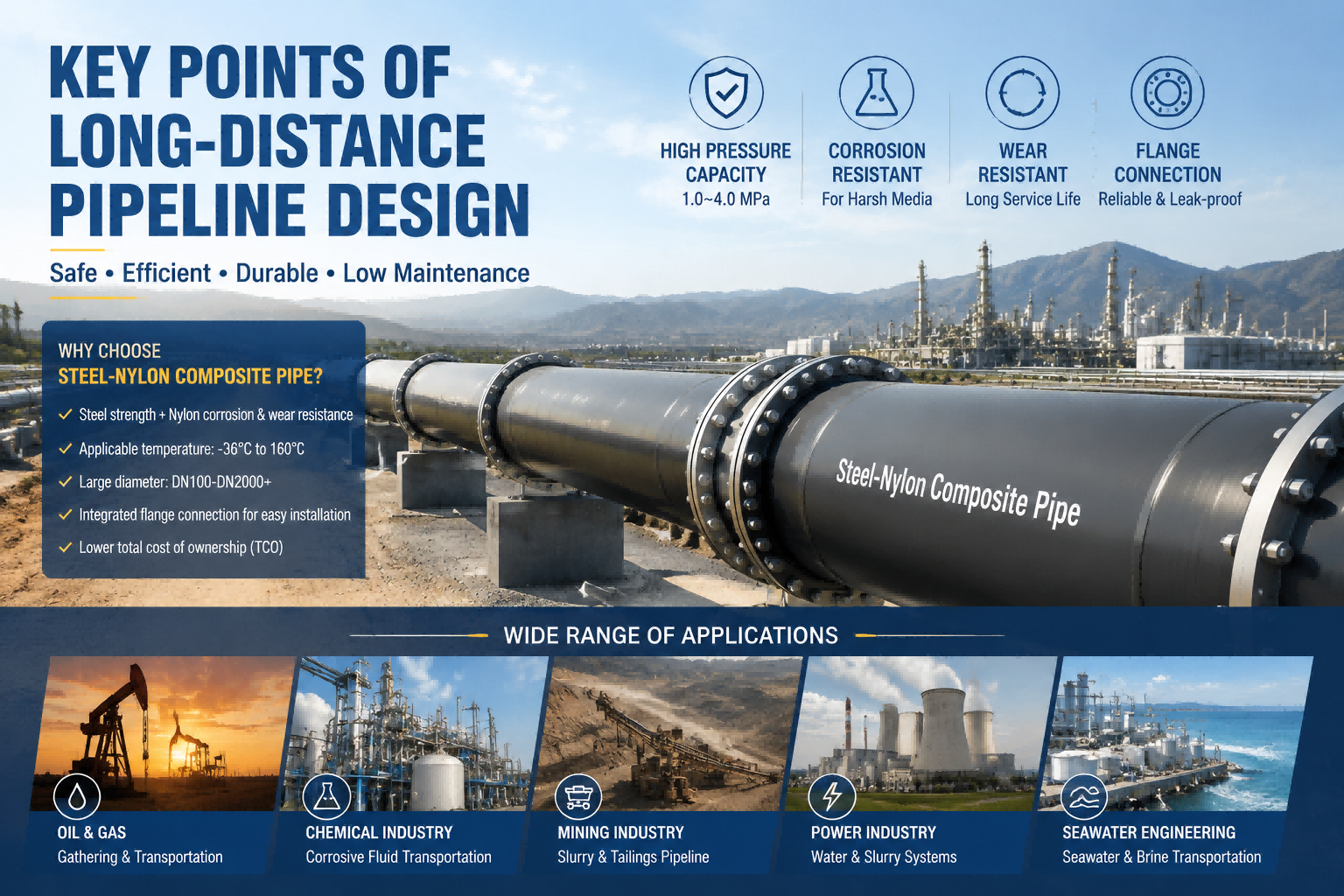
Long-Distance Pipeline Design Guide: How to Select a Safe, Efficient, and Low-Maintenance Pipeline Solution