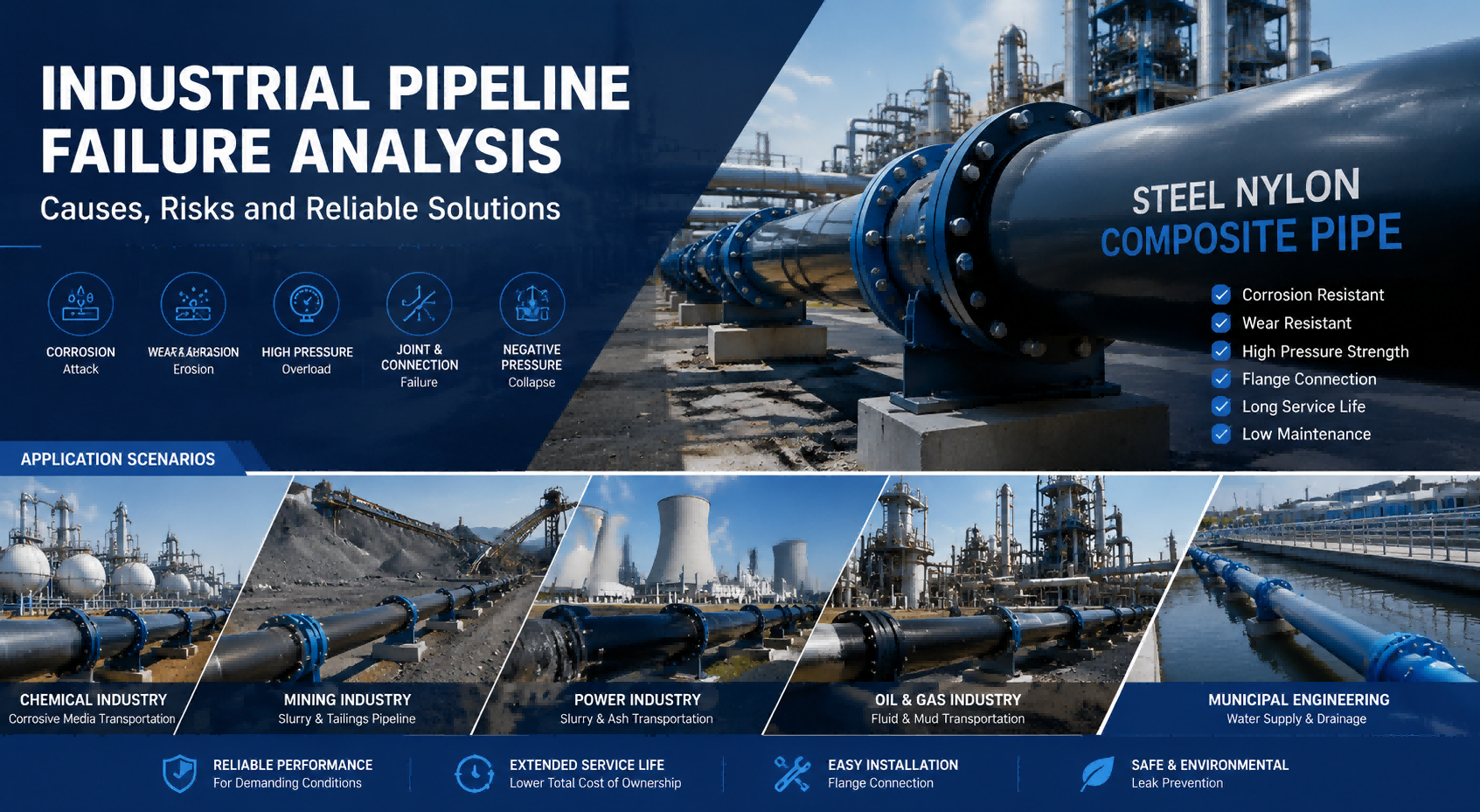
Industrial Pipeline Failure Analysis: Causes and How Steel Nylon Composite Pipes Improve System Reliability
Introduction: Why Do Industrial Pipelines Fail?
Industrial pipelines are critical infrastructure in industries such as chemical processing, mining, oil & gas, power generation, metallurgy, and municipal engineering. They are responsible for transporting corrosive chemicals, abrasive slurries, high-pressure fluids, and complex industrial media under demanding operating conditions.
However, pipeline failures remain a common challenge in many industrial projects, including:
-
Leakage caused by corrosion perforation;
-
Rapid wall thinning due to abrasion;
-
Liner peeling and secondary corrosion;
-
Weld cracking and joint failure;
-
Pipe deformation under negative pressure conditions;
-
Frequent flange leakage problems.
Pipeline failures not only increase maintenance costs but may also result in production shutdowns, safety risks, and environmental issues.
Therefore, understanding the root causes of industrial pipeline failures and selecting the right pipe material are essential for improving system reliability.
As a professional manufacturer of Steel Nylon Composite Pipes, we have found through decades of engineering applications that traditional metal pipes, lined pipes, and FRP pipes have limitations in extreme operating environments. Steel Nylon Composite Pipes combine the mechanical strength of steel with the corrosion resistance and wear resistance of nylon, providing a more reliable solution for demanding industrial transportation systems.
1. Common Failure Modes of Industrial Pipelines
1.1 Corrosion Failure: The Most Common Cause of Pipeline Damage
Chemical Corrosion Causes Wall Thinning and Leakage
In chemical industries, pipelines often transport:
-
Acid solutions;
-
Alkaline solutions;
-
Brine;
-
Mother liquor;
-
Chemical slurry;
-
Corrosive wastewater.
Traditional carbon steel pipes provide good mechanical strength but are vulnerable to long-term corrosion caused by aggressive media.
Common corrosion problems include:
-
Uniform corrosion;
-
Pitting corrosion;
-
Crevice corrosion;
-
Electrochemical corrosion.
For example, in soda ash production plants, mother liquor pipelines often contain chloride ions, carbonate compounds, and solid particles. Traditional steel pipelines may suffer from:
-
Internal corrosion;
-
Wall thickness reduction;
-
Frequent leakage.
How Steel Nylon Composite Pipes Solve Corrosion Problems
Steel Nylon Composite Pipes adopt a unique structure:
Outer Steel Layer + Inner Reinforced Nylon Layer
This creates dual protection:
Outer Steel Layer
Provides:
-
High mechanical strength;
-
Excellent pressure resistance;
-
Structural stability.
Inner Nylon Layer
Provides:
-
Strong corrosion resistance;
-
Protection against chemical attack;
-
Smooth inner surface for efficient flow.
Unlike traditional steel pipes, the transported medium does not directly contact the steel body, significantly reducing corrosion risks.
2. Wear Failure: A Major Challenge in Slurry Transportation
2.1 Particle Erosion Causes Rapid Pipe Wear
Industries such as mining, power generation, phosphate chemicals, and coal processing frequently transport:
-
Mineral slurry;
-
Tailings slurry;
-
Coal slurry;
-
Phosphate slurry;
-
High-density ash slurry.
High-speed solid particles continuously impact the pipe wall, causing:
-
Abrasive wear;
-
Erosion wear;
-
Localized pipe failure.
Wear Resistance Comparison of Different Pipeline Materials
| Pipeline Material | Wear Resistance |
|---|---|
| Carbon Steel Pipe | Low |
| Stainless Steel Pipe | Medium |
| Rubber Lined Pipe | Good but aging problems |
| FRP Pipe | Limited impact resistance |
| Nylon Composite Pipe | Excellent |
Advantages of Steel Nylon Composite Pipes in Abrasive Conditions
Reinforced nylon provides:
-
High toughness;
-
Excellent impact absorption;
-
Low friction coefficient;
-
Self-lubricating performance.
When solid particles hit the pipe wall, the nylon layer absorbs impact energy instead of cracking like rigid materials.
Therefore, Steel Nylon Composite Pipes are especially suitable for:
-
Mining slurry pipelines;
-
Tailings transportation systems;
-
Chemical slurry pipelines.
3. Liner Peeling Failure: A Hidden Risk of Traditional Composite Pipes
3.1 Problems with Steel-Lined Plastic and Rubber-Lined Pipes
Many industrial projects use:
-
Steel lined PE pipes;
-
Steel lined PP pipes;
-
Rubber lined steel pipes.
Although these solutions perform well initially, long-term operation may cause:
① Poor Bonding Between Liner and Steel
Different thermal expansion rates between steel and plastic materials can create stress during temperature changes.
Over time, problems may occur:
-
Delamination;
-
Bulging;
-
Liner separation.
② Secondary Corrosion After Liner Damage
Once the protective liner is damaged:
Corrosive media enters the steel layer
↓
Accelerated corrosion occurs
↓
Pipeline failure happens.
Structural Advantages of Steel Nylon Composite Pipes
Steel Nylon Composite Pipes use an integrated forming process:
-
Strong bonding between nylon and steel;
-
No traditional adhesive lining;
-
No large-area liner peeling risk.
The result is a truly integrated composite protection system combining:
-
High strength;
-
Excellent wear resistance;
-
Superior corrosion resistance.
4. Welding Failure: Hidden Risks During Pipeline Installation
4.1 Welded Joints Are Weak Points in Pipeline Systems
Traditional metal pipelines often rely heavily on field welding.
During welding, potential issues include:
-
Welding defects;
-
Residual stress concentration;
-
Corrosion in heat-affected zones.
This becomes especially challenging in chemical plants where:
-
High corrosion protection is required;
-
Hot work permits are restricted;
-
Inspection costs are high.
Flange Connection Advantages of Steel Nylon Composite Pipes
Steel Nylon Composite Pipes feature:
Integrated Flange Design
Installation method:
Pipe → Flange Connection → Bolt Fixing
Advantages:
1. Reduced On-Site Welding
Minimizes hot work operations and improves construction safety.
2. Lower Leakage Risk
Standardized flange connections improve system reliability.
3. Faster Installation
Especially suitable for:
-
Chemical plant renovation projects;
-
Mining transportation systems;
-
Large industrial pipe galleries.
5. Pressure Failure: Risks Caused by Insufficient Pressure Capability
Industrial pipelines commonly operate under:
-
1.0 MPa;
-
1.6 MPa;
-
2.5 MPa;
-
4.0 MPa.
Some plastic pipes have limited pressure ratings.
For example, conventional PE pipes may experience:
-
Pipe deformation;
-
Reduced stiffness;
-
Burst risks
under:
-
Long-distance transportation;
-
High-pressure pumping;
-
Large-diameter pipeline systems.
Pressure Performance Advantages of Steel Nylon Composite Pipes
The steel outer structure provides:
-
High pressure resistance;
-
Excellent rigidity;
-
Dimensional stability.
The nylon inner layer provides:
-
Corrosion protection;
-
Wear resistance;
-
Reduced flow resistance.
Steel Nylon Composite Pipes can cover:
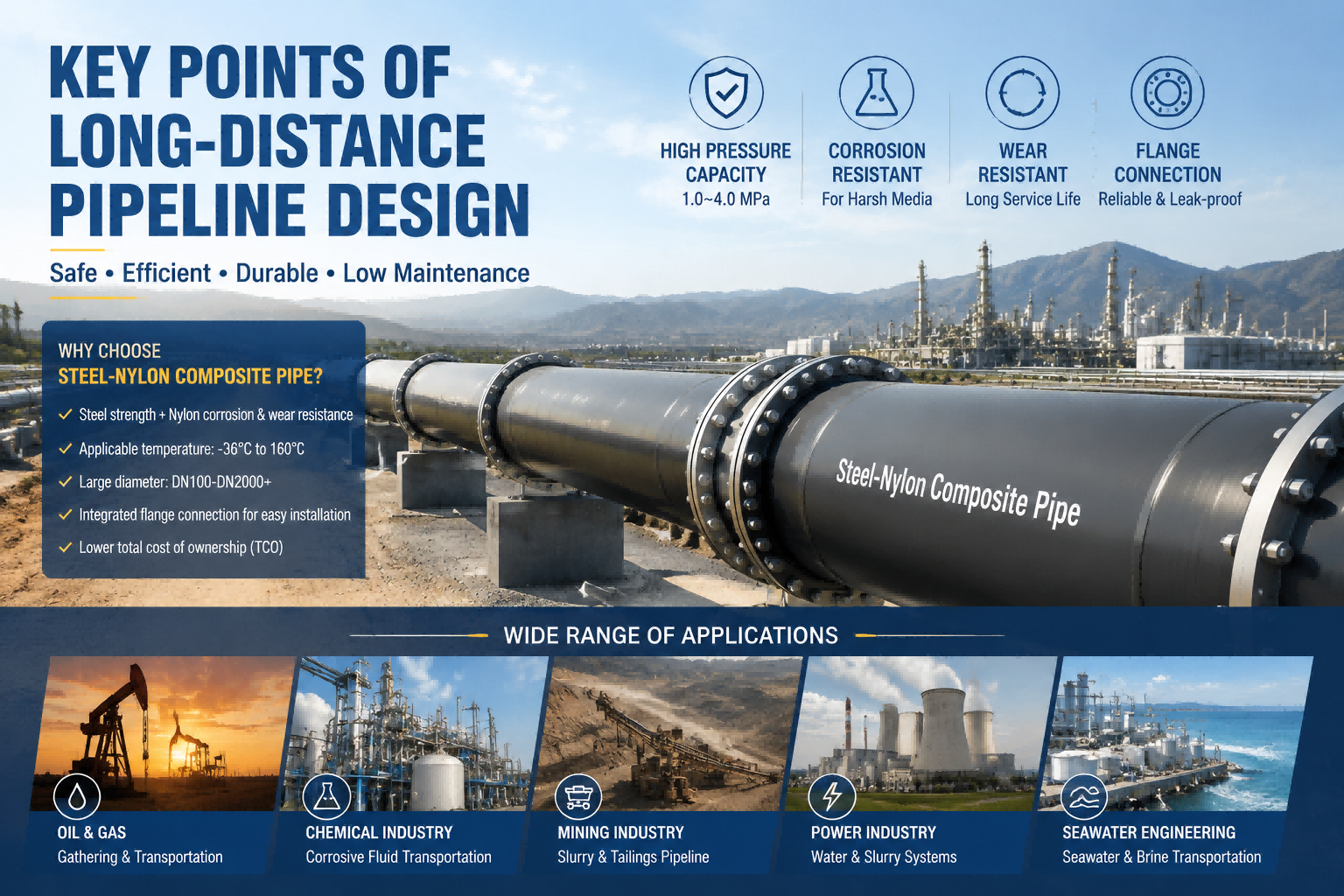
DN100–DN2000+ large diameter applications
with pressure ratings:
1.0–4.0 MPa
meeting the requirements of large-scale industrial transportation systems.
6. Negative Pressure Failure: A Problem Often Ignored
Some industrial processes involve:
-
Pump shutdown;
-
Pipeline drainage;
-
Thermal contraction during cooling.
These conditions may create negative pressure inside pipelines.
Traditional plastic pipes may suffer from:
-
Collapse;
-
Permanent deformation;
-
Structural damage.
Steel Nylon Composite Pipe Solution
The steel outer layer provides:
-
Strong resistance against vacuum conditions;
-
Excellent structural stability.
The nylon inner layer maintains:
-
Smooth flow surface;
-
Corrosion protection performance.
This makes the pipe suitable for complex pressure fluctuation environments.
7. The Root Cause of Pipeline Failure: Incorrect Material Selection
Many pipeline failures are not caused by manufacturing defects but by:
Mismatch between pipe material and operating conditions.
| Operating Condition | Common Problem | Recommended Solution |
|---|---|---|
| Strong acid/alkali media | Corrosion | Steel Nylon Composite Pipe |
| High wear slurry | Wall erosion | Reinforced Nylon Pipe |
| Large diameter transportation | Insufficient stiffness | Steel Nylon Composite Pipe |
| High pressure systems | Pipe rupture risk | Steel reinforced composite structure |
| Long-distance pipelines | High maintenance cost | Low-friction wear-resistant pipe |
8. Reducing Lifecycle Cost Through Steel Nylon Composite Pipes
Although the initial purchase cost may not always be the lowest, industrial projects focus on:
Total Cost of Ownership (TCO)
Including:
-
Initial investment;
-
Installation cost;
-
Production downtime;
-
Replacement cost;
-
Maintenance expenses.
Steel Nylon Composite Pipes help reduce lifecycle costs through:
✔ Longer service life
✔ Fewer maintenance requirements
✔ Lower leakage risk
✔ Faster installation
9. Industrial Applications of Steel Nylon Composite Pipes
Steel Nylon Composite Pipes are widely used in:
Chemical Industry
-
Soda ash production;
-
Chlor-alkali industry;
-
Salt chemical industry;
-
Phosphate chemical industry.
Energy Industry
-
Oil & gas gathering pipelines;
-
Power plant slurry transportation.
Mining Industry
-
Tailings pipelines;
-
Mineral slurry pipelines;
-
Backfill transportation systems.
Municipal Engineering
-
Water supply;
-
Drainage systems;
-
Seawater desalination projects.
Conclusion: Choosing the Right Material Is the First Step to Prevent Pipeline Failure
Industrial pipeline failures are usually caused by multiple factors:
Corrosion + Wear + Pressure + Connection Method + Operating Environment
Traditional materials often struggle to achieve all of the following simultaneously:
-
High mechanical strength;
-
Excellent corrosion resistance;
-
Superior wear resistance;
-
Large diameter capability;
-
Long service life.
Steel Nylon Composite Pipes overcome these challenges through advanced composite technology, combining:
The strength of steel + the corrosion and wear resistance of nylon
to provide a more reliable solution for demanding industrial transportation systems.
For chemical plants, mining operations, energy projects, and other high-performance applications, choosing Steel Nylon Composite Pipes is not simply replacing a pipe material — it is upgrading the reliability and efficiency of the entire pipeline system.
How to Avoid Frequent Industrial Pipeline Replacement?From Material Selection to Lifecycle Cost Optimization
Large Diameter Pipeline Application Case Study: How DN2000+ Steel-Nylon Composite Pipes Achieve High Strength and Long-Term Reliable Operation