Slurry Pipeline Selection Guide: How to Choose Wear-Resistant, Corrosion-Resistant and High-Reliability Industrial Slurry Pipes

In industries such as mining, chemical processing, power generation, metallurgy, salt chemical production, and phosphate chemical manufacturing, slurry transportation systems face multiple challenges, including abrasion, corrosion, impact, pressure fluctuations, and complex chemical environments.
Unlike ordinary liquid transportation, slurry usually contains a large amount of solid particles, such as:
-
Ore particles and tailings in mining slurry;
-
Phosphate rock particles in phosphate chemical processes;
-
Crystals and alkaline components in soda ash production;
-
Limestone particles in power plant desulfurization slurry;
-
High-salt and corrosive media in salt chemical industries.
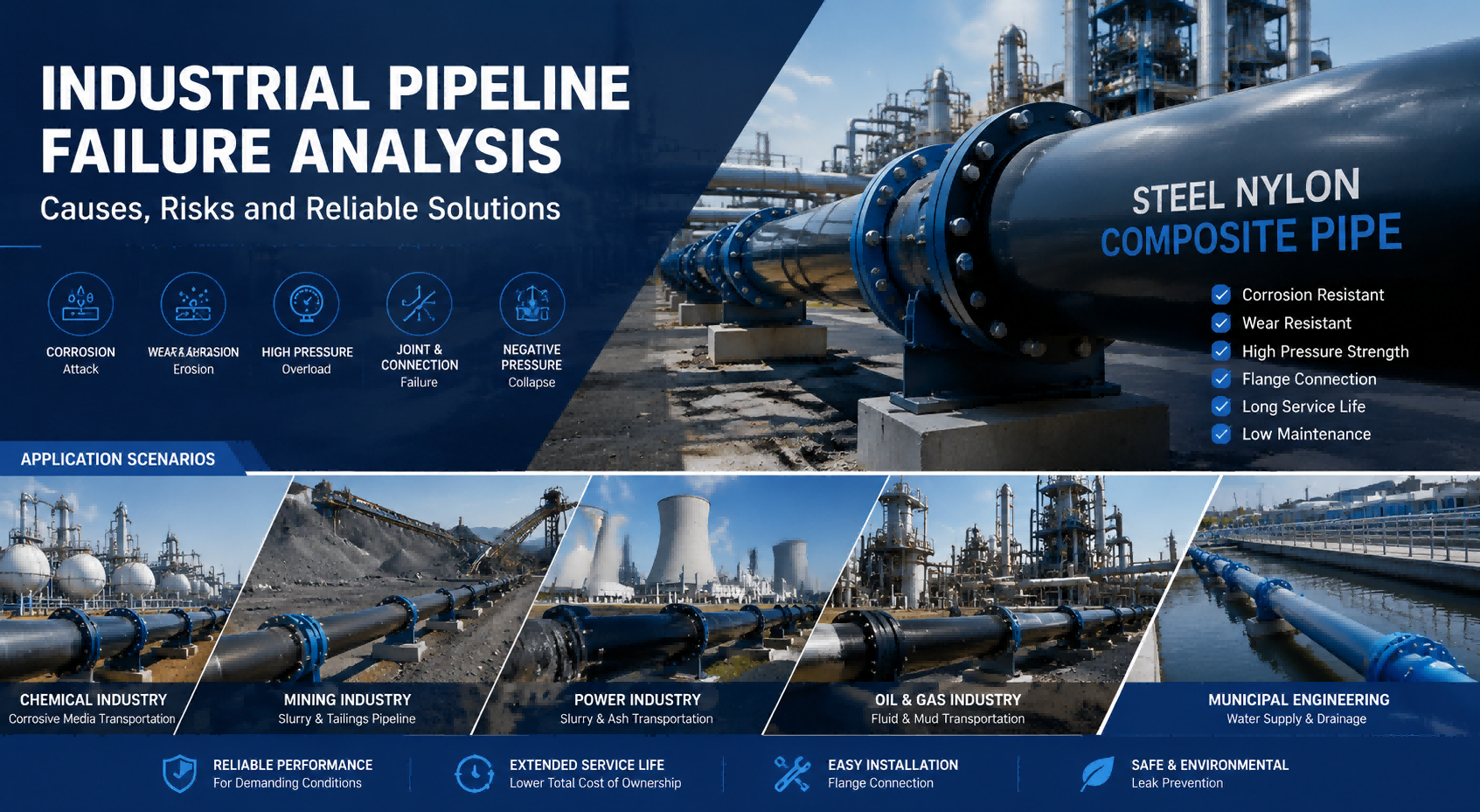
These solid particles continuously impact and wear the inner surface of pipelines. As a result, traditional carbon steel pipes, stainless steel pipes, rubber-lined pipes, and FRP pipes may experience various problems:
-
Rapid wall thinning and pipe wear;
-
Lining failure and corrosion;
-
Weld leakage;
-
Frequent maintenance shutdowns;
-
Increasing replacement costs.
Therefore, slurry pipeline selection should not only focus on initial purchase costs. The key is to consider wear resistance, corrosion resistance, service life, maintenance requirements, and total lifecycle cost (TCO).
This article provides a comprehensive analysis of common slurry pipeline materials and explains why steel-nylon composite pipes are becoming an ideal solution for demanding slurry transportation applications.
1. What Performance Requirements Should Slurry Pipelines Meet?
1.1 High Wear Resistance: Preventing Continuous Particle Erosion
The biggest challenge in slurry transportation is solid particle abrasion.
During high-speed slurry flow, particles continuously impact the pipe wall, especially in areas such as:
-
Elbows;
-
Tees;
-
Pump outlet sections;
-
Flow transition zones.
Wear rates can increase significantly in these locations.
Although carbon steel pipes provide high mechanical strength, their wear resistance is limited:
-
Good initial performance;
-
Rapid wall thickness reduction under continuous abrasion;
-
Risk of leakage after long-term operation.
Therefore, slurry pipelines require an inner layer with excellent abrasion resistance.
1.2 Corrosion Resistance: Protecting Against Chemical Attack
Many slurry systems contain not only solid particles but also corrosive chemicals.
Examples include:
| Slurry Medium | Main Challenges |
|---|---|
| Phosphate slurry | Acid corrosion + particle abrasion |
| Desulfurization slurry | Sulfate corrosion |
| Salt chemical slurry | High chloride corrosion |
| Soda ash mother liquor | Alkaline corrosion + crystal erosion |
| Seawater slurry | Chloride corrosion |
Traditional metal pipelines may suffer from:
-
Wall corrosion;
-
Pitting corrosion;
-
Stress corrosion cracking.
Therefore, slurry pipelines must provide both wear resistance and chemical corrosion protection.
1.3 Impact Resistance: Handling Complex Industrial Conditions
During slurry transportation, pipelines often experience:
-
Pump start-up impact;
-
Pressure fluctuations;
-
Particle collision;
-
Mechanical vibration.
Some traditional non-metallic pipes have excellent corrosion resistance but insufficient mechanical strength:
-
FRP may suffer from delamination;
-
PE pipes have pressure limitations;
-
Ordinary plastic pipes have poor impact resistance.
For large-diameter and high-pressure slurry transportation, the ideal pipeline should combine:
Metal strength + Non-metallic corrosion and wear resistance.
2. Comparison of Common Slurry Pipeline Materials
2.1 Carbon Steel Pipe
Advantages:
-
High mechanical strength;
-
Low initial cost;
-
Mature installation technology.
Disadvantages:
-
Poor wear resistance;
-
Susceptible to corrosion;
-
Shorter service life in aggressive environments;
-
Requires frequent maintenance.
Suitable Applications:
Low-abrasion and low-corrosion fluid transportation systems.
2.2 Stainless Steel Pipe (304/316L)
Advantages:
-
Good appearance;
-
Resistance to general corrosion;
-
High mechanical strength.
Limitations:
For slurry applications, stainless steel is not always the best choice.
Problems include:
-
Solid particles continuously damage the metal surface;
-
Chloride environments may cause pitting corrosion;
-
High material costs do not always provide proportional lifetime improvement.
Especially in:
-
High-abrasion slurry;
-
Strong alkaline slurry;
-
Particle-containing chemical media;
stainless steel may have limited cost-effectiveness.
2.3 Rubber-Lined Steel Pipe
Advantages:
-
Good initial wear resistance;
-
Certain corrosion protection capability.
Common Problems:
During long-term operation:
-
Rubber aging;
-
Lining separation;
-
Bulging;
-
Vacuum collapse.
Once the rubber lining fails, the steel substrate can rapidly corrode.
2.4 FRP (Fiberglass Reinforced Plastic) Pipe
Advantages:
-
Excellent corrosion resistance;
-
Lightweight.
Disadvantages:
In slurry applications:
-
Inner surface erosion;
-
Layer separation risk;
-
Pressure limitations;
-
Difficult repair.
2.5 Steel-Nylon Composite Pipe: A New Solution for Slurry Transportation
Steel-nylon composite pipe combines:
High mechanical strength of steel
Excellent wear and corrosion resistance of reinforced nylon
to create an advanced pipeline solution for challenging industrial slurry applications.
3. Why Steel-Nylon Composite Pipe Is Ideal for Slurry Transportation?
3.1 Outstanding Wear Resistance: Reducing Pipeline Replacement Frequency
Steel-nylon composite pipes use high-performance reinforced nylon as the medium-contact layer.
Nylon provides:
-
Low friction coefficient;
-
Excellent impact resistance;
-
Self-lubricating properties;
-
Superior resistance to particle erosion.
Compared with traditional metal pipes, steel-nylon composite pipes significantly reduce:
-
Elbow wear;
-
Pump outlet erosion;
-
Long-distance pipeline abrasion.
They are especially suitable for:
-
Mining slurry transportation;
-
Tailings pipelines;
-
Phosphate slurry;
-
Desulfurization slurry systems.
3.2 Excellent Corrosion Resistance
The reinforced nylon inner layer directly contacts the transported medium.
This prevents:
-
Direct contact between steel and corrosive fluids;
-
Internal rust formation;
-
Pitting corrosion.
Applications include:
-
Acidic slurry;
-
Alkaline slurry;
-
Saltwater slurry;
-
Chemical mother liquor transportation.
3.3 High Pressure Capability with Steel Reinforcement
The biggest limitation of traditional plastic pipes is:
restricted pressure capacity and size range.
Steel-nylon composite pipes use a steel structural layer to provide mechanical reinforcement.
They can support:
-
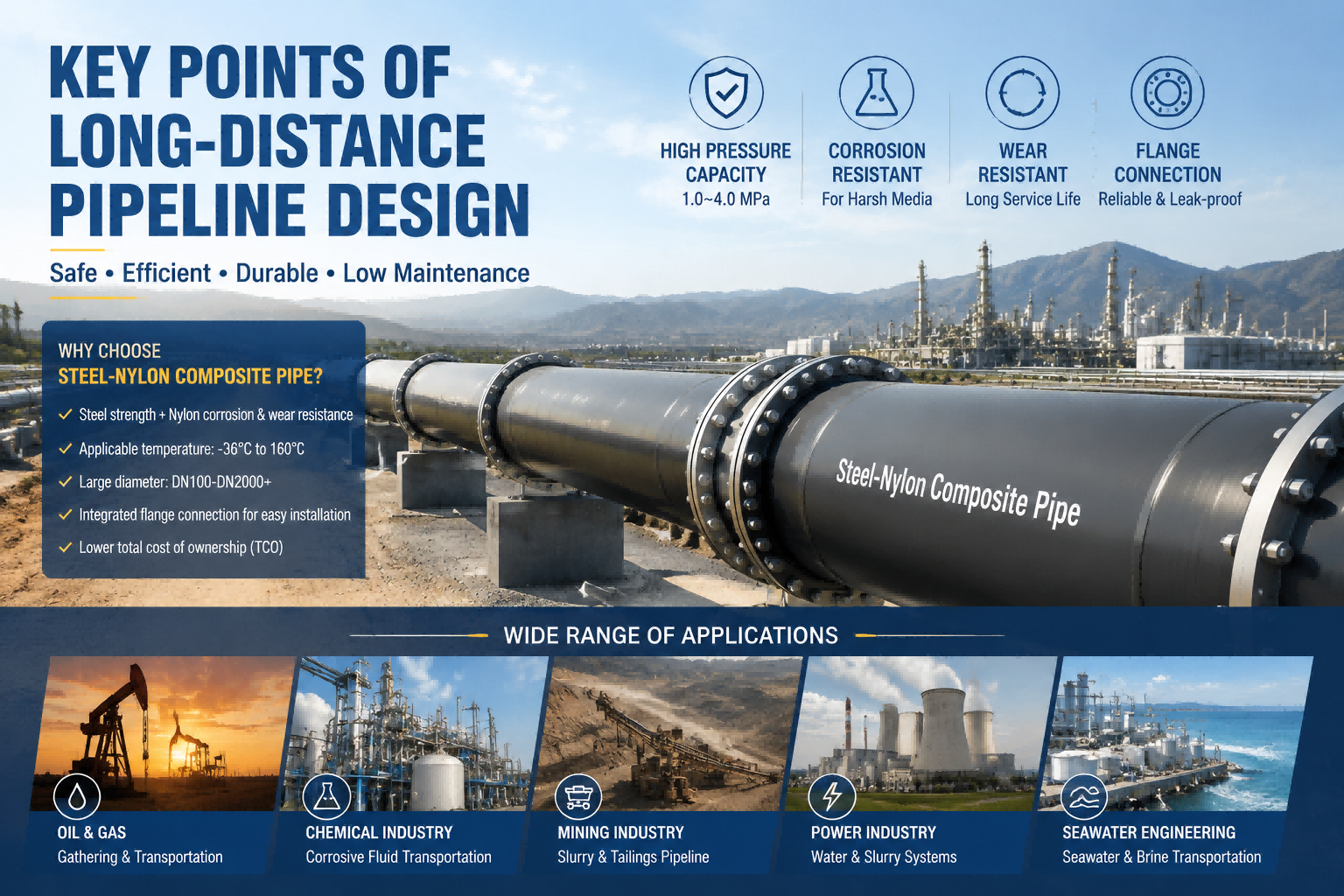
DN100-DN2000 ultra-large diameters;
-
Pressure ratings from 1.0 to 4.0 MPa.
This makes them suitable for large-scale industrial slurry transportation systems.
3.4 Integrated Flange Design: Safer and Faster Installation
Traditional pipeline systems often require:
-
Welding;
-
Additional lining processes;
-
Complex installation procedures.
These processes may create:
-
Weld defects;
-
Interface corrosion;
-
Installation quality variations.
Steel-nylon composite pipes feature:
integrally formed flange connections
Advantages:
-
No on-site welding required;
-
Faster installation;
-
Fewer leakage points;
-
Better reliability for large engineering projects.
4. Recommended Pipeline Selection for Different Slurry Applications
| Application | Recommended Pipeline |
|---|---|
| Mining tailings slurry | Steel-Nylon Composite Pipe |
| Phosphate slurry transportation | Steel-Nylon Composite Pipe |
| Soda ash mother liquor | Steel-Nylon Composite Pipe |
| Chlor-alkali slurry systems | Steel-Nylon Composite Pipe |
| Power plant desulfurization slurry | Steel-Nylon Composite Pipe |
| Seawater containing sand | Steel-Nylon Composite Pipe |
5. Pipeline Selection Should Focus on Total Lifecycle Cost (TCO)
Many projects initially choose:
-
Carbon steel pipes;
-
Rubber-lined pipes;
-
PE pipes;
because of lower purchase costs.
However, after several years of operation:
maintenance costs, replacement expenses, and production losses often exceed the initial investment.
Industrial pipeline selection should consider:
Total Lifecycle Cost (TCO)
Including:
-
Initial purchase cost;
-
Installation cost;
-
Maintenance expenses;
-
Shutdown losses;
-
Replacement costs.
Although steel-nylon composite pipes may have a higher initial investment than conventional pipes, they provide significant long-term economic benefits through:
-
Longer service life;
-
Lower maintenance frequency;
-
Higher operational reliability.
6. Future Development Trend of Slurry Transportation Pipelines
With industrial development moving toward:
-
Higher pressure;
-
Larger diameter;
-
Longer transportation distances;
-
Lower maintenance requirements;
traditional single-material pipelines can no longer meet increasingly complex operating conditions.
Future slurry pipeline systems will focus on:
✅ Superior wear resistance
✅ Strong corrosion protection
✅ Higher pressure capability
✅ Longer service life
✅ Faster installation
Steel-nylon composite pipes are designed precisely for these requirements.
Conclusion: Selecting the Right Pipeline Ensures Stable Slurry Transportation for Decades
Slurry transportation is not simply the movement of liquid. It is a long-term engineering challenge involving abrasion, corrosion, pressure, and operational reliability.
Choosing the right pipeline material can significantly reduce maintenance costs and improve production continuity.
With advantages including:
-
Reinforced nylon wear-resistant inner layer;
-
High-strength steel structural support;
-
Excellent corrosion resistance;
-
DN100-DN2000 large diameter capability;
-
1.0-4.0MPa pressure rating;
-
Integrated flange connection design;
Steel-Nylon Composite Pipe is becoming a reliable solution for slurry transportation systems in mining, chemical, power, salt chemical, and other demanding industries.
Long-Distance Pipeline Design Guide: How to Select a Safe, Efficient, and Low-Maintenance Pipeline Solution
Strong Alkali Service Pipeline Selection Guide: How to Choose Corrosion-Resistant and Long-Life Industrial Pipes?