How to Avoid Frequent Industrial Pipeline Replacement?From Material Selection to Lifecycle Cost Optimization

In heavy industry—whether processing chemicals, managing slurry, or operating high-pressure compressed air lines—pipe failure is never just about the cost of a replacement pipe. The real financial impact comes from unplanned downtime, emergency maintenance labor, lost production yield, and potential safety hazards.
If your facility finds itself replacing critical piping every 12 to 24 months, you are not just experiencing bad luck—you are likely using a material class ill-suited for the dual demands of mechanical stress and chemical/abrasive wear.
The Hidden Costs of Frequent Pipe Failures
When calculating the budget for piping systems, many procurement teams focus heavily on CAPEX (Initial Capital Expenditure). However, frequent piping replacements quickly inflate OPEX (Operational Expenditure), leading to severe profit leakage.
The True Cost Equation:
Total Failure Cost = Pipe Material Cost + Emergency Freight + Specialized Labor + Downtime Losses + Safety Risk Exposure
To end the cycle of frequent replacements, engineers must first identify why traditional single-material pipes fail under harsh operating conditions.
Why Traditional Piping Materials Fail Prematurely
Most industrial piping options force engineers to compromise between structural strength and surface resistance.
| Material Type | Primary Strength | Weakness / Failure Mechanism | Average Lifespan in Harsh Conditions |
| Carbon Steel | High pressure & structural integrity | Severe internal/external corrosion; heavy weight | 1 - 3 Years |
| Stainless Steel | Moderate corrosion resistance | Susceptible to pitting, chloride attack, high cost | 3 - 5 Years |
| HDPE / Plastic | Excellent chemical resistance | Low pressure rating, high thermal expansion, sags | 2 - 4 Years |
| FRP / Fiberglass | Corrosion resistant & lightweight | Extremely brittle, prone to impact damage during install | 2 - 4 Years |
-
Metal pipes offer the strength required for high-pressure systems, but bare metal inevitably succumbs to electrochemical corrosion and slurry erosion.
-
Pure plastic pipes eliminate corrosion, but they lack the mechanical rigidity and pressure capacity needed for demanding industrial environments, leading to sagging, thermal deformation, and pressure bursts.
The Breakthrough: Steel-Nylon Composite Piping Systems
To resolve the trade-off between structural integrity and surface protection, modern industrial facilities are turning to Steel-Nylon Composite Pipes.
By seamlessly bonding an outer carbon steel backbone with an inner high-density polyamide (Nylon) lining, this material class combines the structural advantages of metal with the exceptional tribological and chemical properties of engineering plastics.
+-------------------------------------------------------------+
|  Outer Layer: Carbon Steel Pipe                             |
|  --> High Mechanical Strength, Pressure Resistance (PN16+)  |
|  +-------------------------------------------------------+  |
|  |  Inner Layer: Specialty Nylon (Polyamide) Lining      |  |
|  |  --> Corrosion Proof, Friction-Free, Anti-Scaling    |  |
+--+-------------------------------------------------------+--+
Key Technical Advantages of Steel-Nylon Composite Pipes
1. Superior Abrasion Resistance (Slurry & Particle Transport)
Nylon (specifically PA11/PA12 formulations) possesses one of the lowest coefficients of friction among engineering polymers. In abrasive slurry or pneumatic conveying systems, its molecular elasticity absorbs particle impacts rather than wearing down, yielding an abrasion resistance up to 3–5 times higher than standard carbon steel.
2. Total Chemical & Corrosion Immunity
The internal nylon lining acts as an impermeable barrier against aggressive acids, alkalis, salt solutions, and organic solvents. Because the fluid never touches the structural steel shell, internal rusting, pinhole pitting, and wall thinning are eliminated entirely.
3. Smooth Internal Bore & Anti-Scaling
With an exceptionally low surface roughness ($Ra < 0.8\ \mu\text{m}$), the nylon lining prevents mineral deposits, bio-fouling, and scaling build-up. This maintains optimal flow velocity, reduces pumping energy costs by up to 15–20%, and prevents localized blockages.
4. High Pressure & Shock Capacity
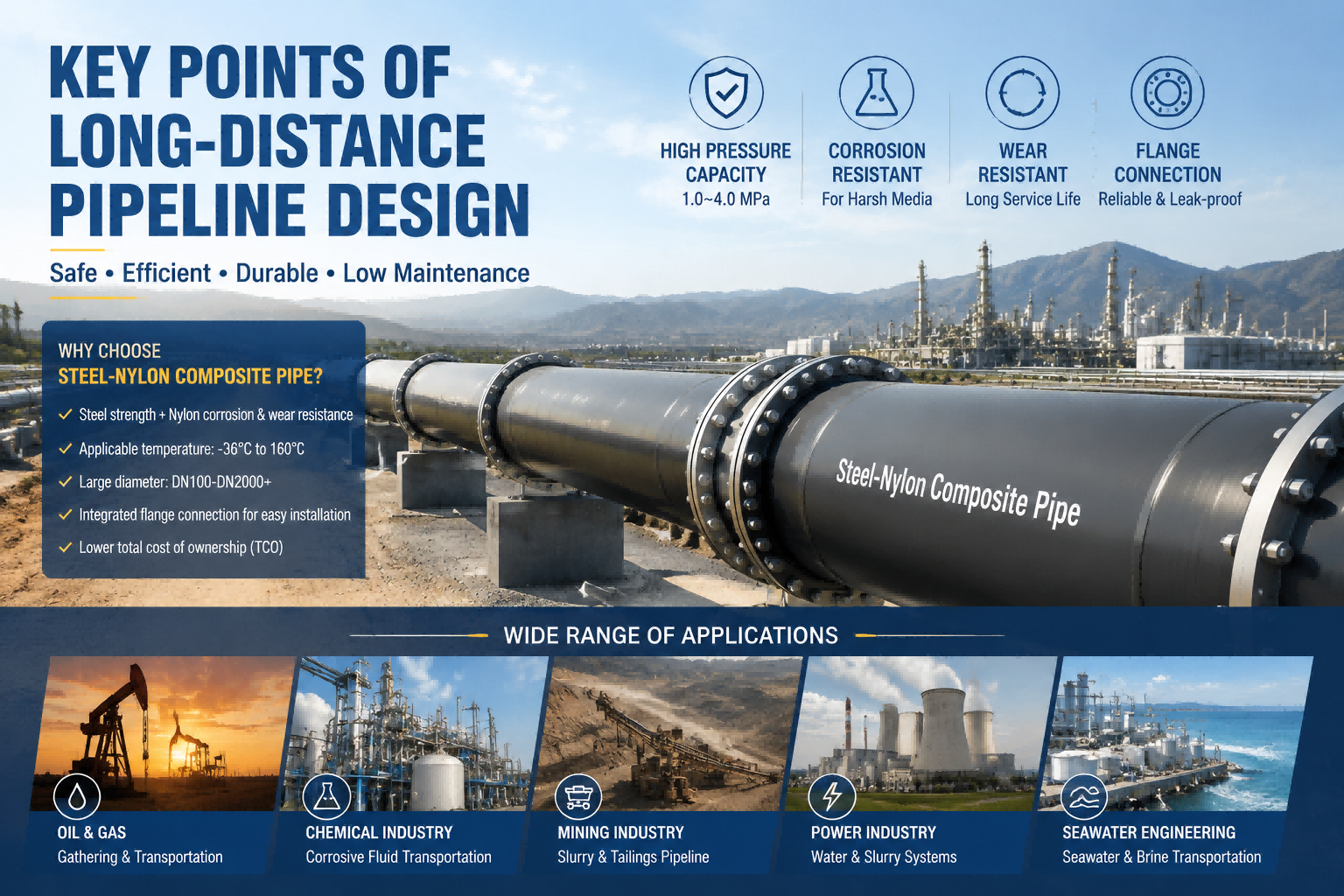
Unlike pure plastic lines that expand or creep under cyclic pressure, the outer steel shell carries the full structural load, allowing system operations at pressures well exceeding 1.6–4.0 MPa while easily resisting hydraulic water hammer shocks.
Action Plan: How to Upgrade Your Facility for Zero-Unplanned-Downtime
If you are currently evaluating a piping overhaul, follow these four steps to ensure a long-term solution:
Document the exact chemical composition, pH levels, operating temperatures, working pressures, and solid-particle ratios of the media passing through your lines.
Focus first on elbows, reducers, and header lines where turbulent flow causes accelerated wall degradation in traditional metal pipes.
Compare initial material quotes against a 10-year lifespan model. Incorporate labor savings, reduced downtime, and lower pump power requirements.
Replace failing sections with precision-engineered Steel-Nylon Composite pipes to establish a maintenance-free fluid transfer network.
Conclusion: Invest in Reliability, Eliminate Downtime
Frequent pipe replacements are a symptom of a material-application mismatch. Continuing to replace corroded steel with more steel only perpetuates costly downtime.
By upgrading to Steel-Nylon Composite Piping, industrial operations gain the extreme durability of steel alongside the corrosion and wear resistance of advanced polyamide linings—delivering a reliable, long-term solution that lowers total cost of ownership.
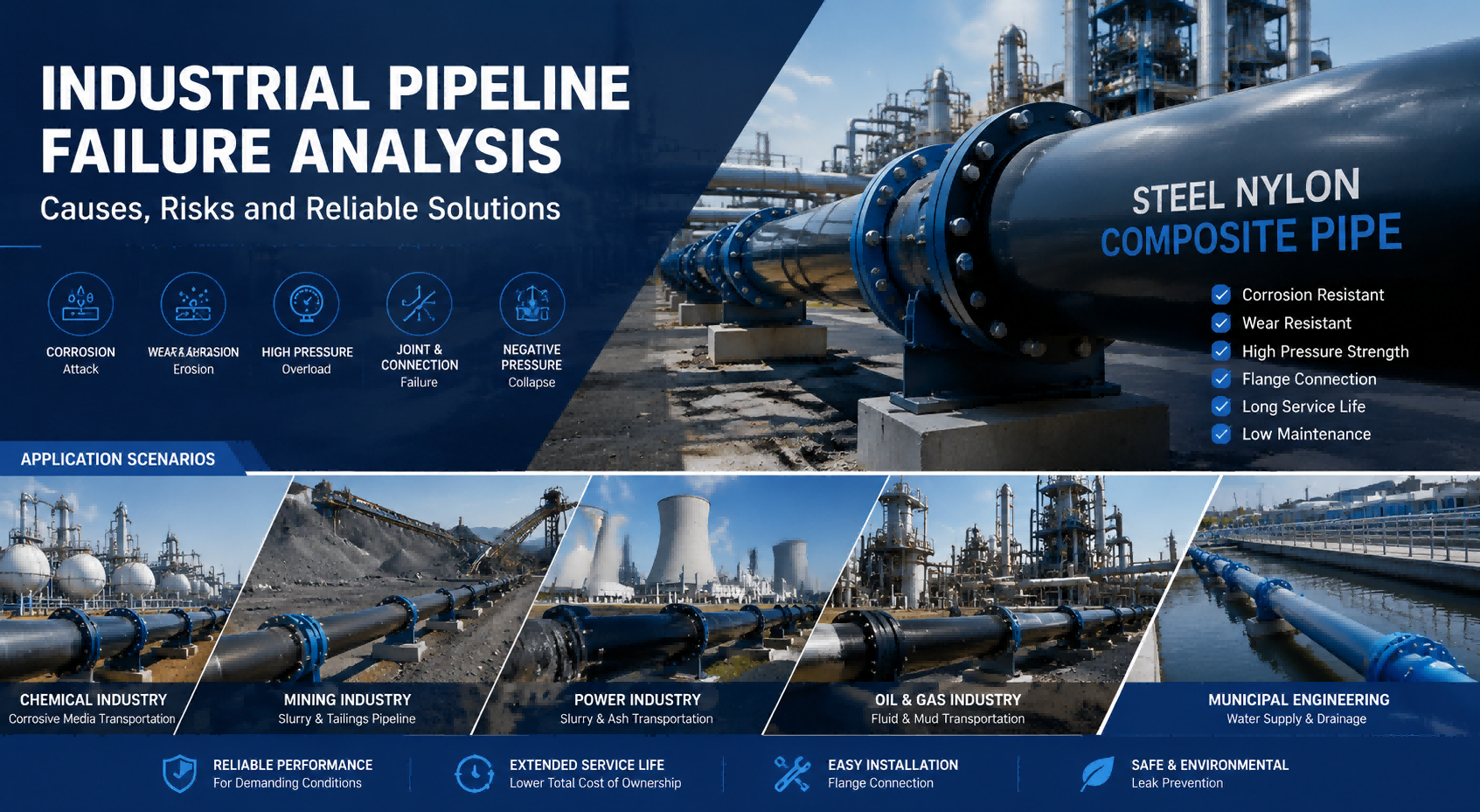
Industrial Pipeline Failure Analysis: Causes and How Steel Nylon Composite Pipes Improve System Reliability