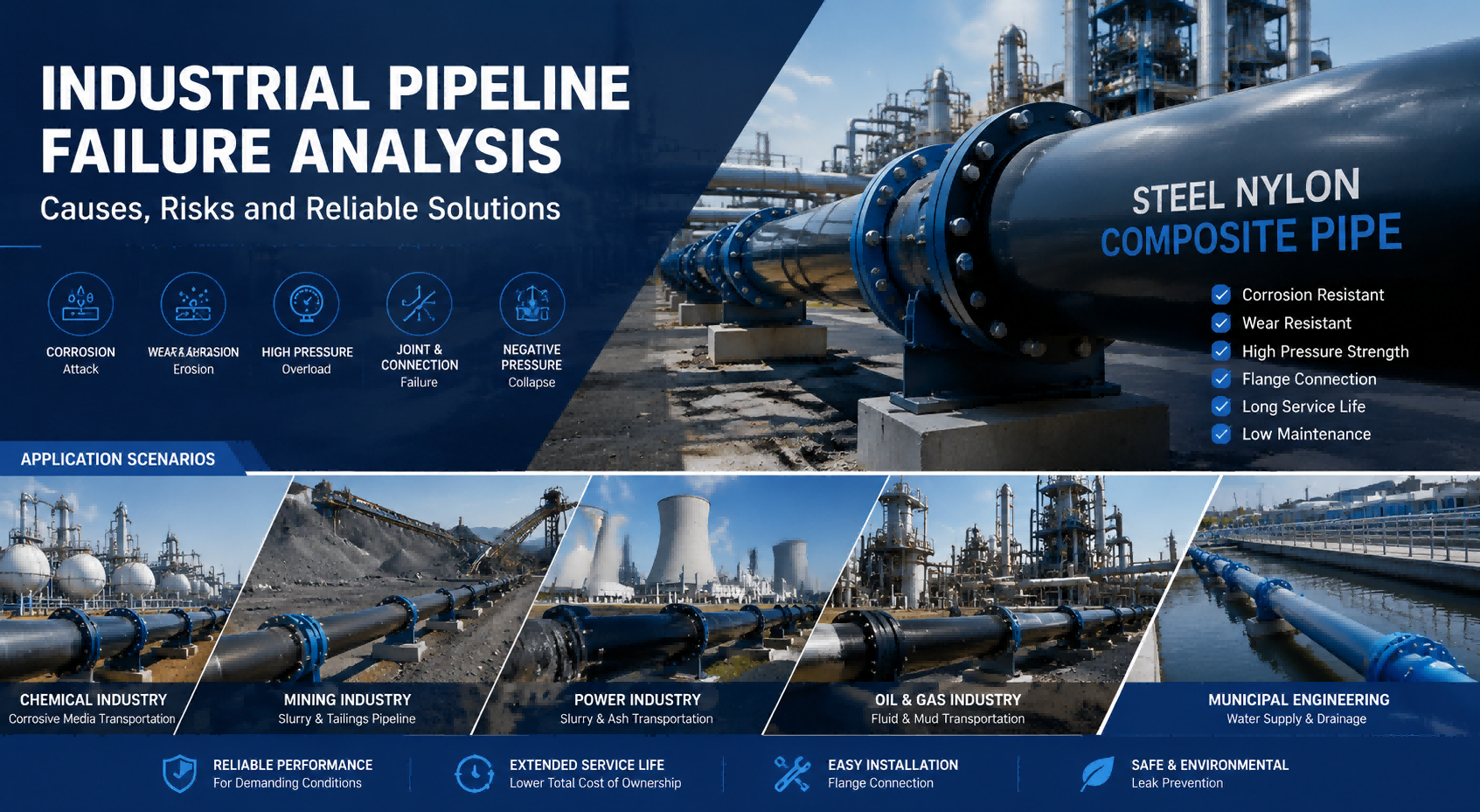
Long-Distance Pipeline Design Guide: How to Select a Safe, Efficient, and Low-Maintenance Pipeline Solution
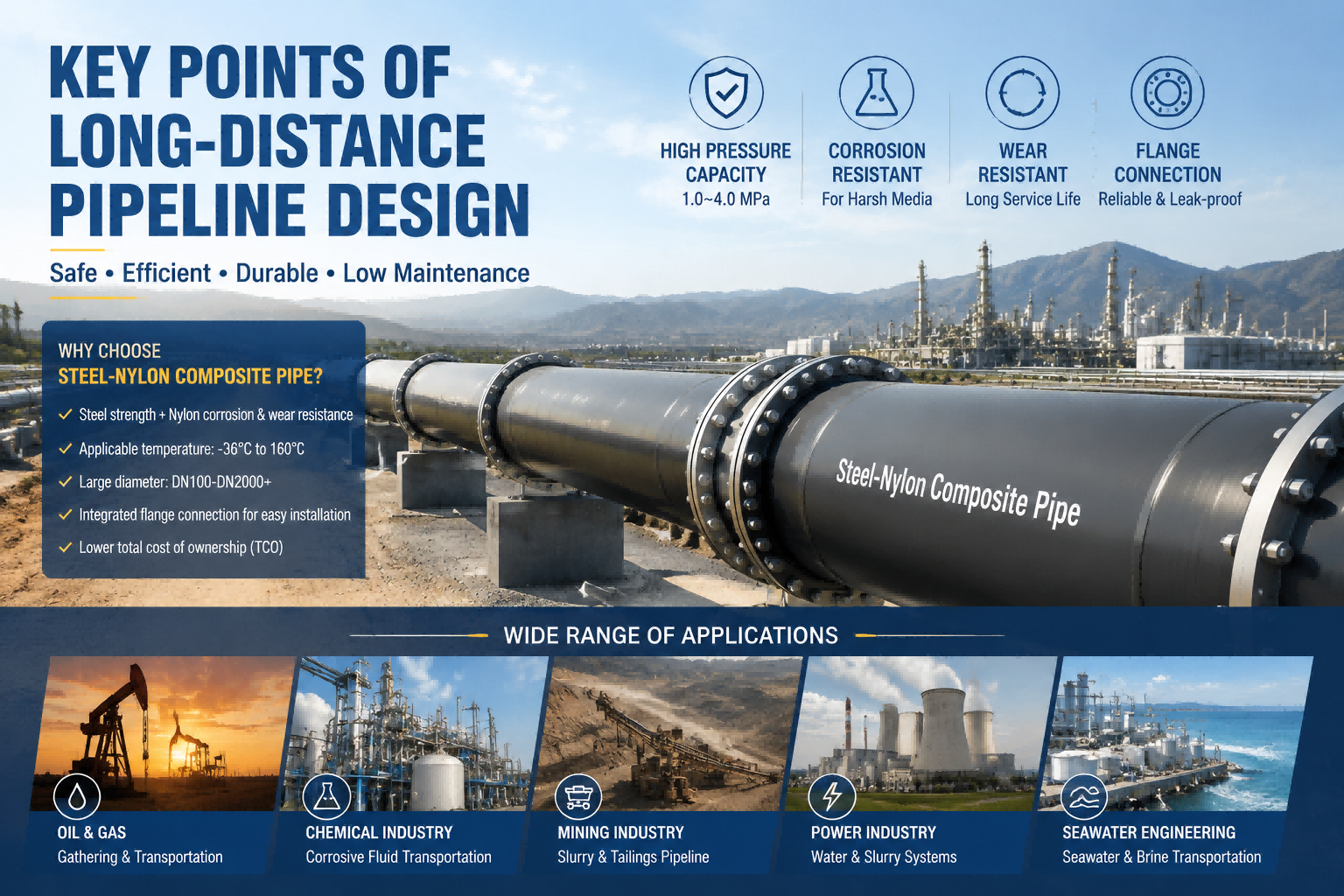
Long-distance pipelines are widely used in industries such as oil & gas, chemical processing, mining, salt chemical production, soda ash, power generation, seawater desalination, and urban infrastructure.
Compared with short-distance piping systems, long-distance transportation pipelines face more complex challenges:
-
Pipeline lengths ranging from hundreds of meters to dozens of kilometers;
-
Complex transportation media, including corrosive liquids, abrasive slurries, and high-solid-content fluids;
-
Extremely high maintenance costs caused by shutdowns;
-
Higher requirements for installation efficiency, sealing reliability, and long-term operation.
Therefore, long-distance pipeline design should not focus only on initial purchasing costs. A complete evaluation must consider:
Material performance, pressure rating, corrosion resistance, wear resistance, installation efficiency, and total lifecycle cost (TCO).
For long-term industrial operation, selecting the right pipeline material often determines whether a system can operate reliably for 10, 20, or even 30 years.
Steel-Nylon Composite Pipe, combining the mechanical strength of steel with the corrosion and wear resistance of nylon, is becoming an increasingly preferred solution for long-distance industrial transportation systems.
1. Key Challenges in Long-Distance Pipeline Design
1.1 Controlling Pressure Loss
Pressure loss is one of the most important factors in long-distance pipeline transportation.
During fluid movement, resistance is generated by:
-
Friction between fluid and pipe wall;
-
Local resistance caused by elbows, valves, reducers, and fittings;
-
Changes in pipeline diameter and flow conditions.
Improper design may lead to:
-
Increased pump pressure requirements;
-
Higher energy consumption;
-
Reduced transportation efficiency.
Therefore, pipeline design must properly match:
-
Pipe diameter;
-
Flow velocity;
-
Pressure rating;
-
Pumping system capacity.
For large-scale transportation projects, large-diameter pipelines ranging from DN100 to DN2000 require careful consideration of flow stability and long-term operating efficiency.
Steel-Nylon Composite Pipes can be manufactured in ultra-large diameters exceeding DN2000, meeting the requirements of large industrial transportation projects.
2. Pipeline Material Selection Determines Long-Term Reliability
Different transportation media require different pipeline materials.
Common pipeline materials include:
| Pipeline Material | Advantages | Limitations |
|---|---|---|
| Carbon Steel Pipe | High strength, low initial cost | Requires corrosion protection and maintenance |
| Stainless Steel Pipe | Good corrosion resistance | High cost, limited resistance in some aggressive media |
| FRP Pipe | Lightweight, corrosion resistant | Risk of delamination and impact damage |
| HDPE Pipe | Flexible and corrosion resistant | Limited pressure and temperature capability |
| Steel-Nylon Composite Pipe | High strength + corrosion resistance + wear resistance | Excellent comprehensive performance |
For long-distance industrial transportation, corrosion resistance alone is not enough.
A reliable pipeline must also provide:
-
Pressure-bearing capability;
-
Resistance to particle erosion;
-
Temperature adaptability;
-
Long-term dimensional stability.
Steel-Nylon Composite Pipe adopts a dual-layer structure:
Outer steel layer for mechanical strength + inner reinforced nylon layer for corrosion and wear protection.
This combination provides a balanced solution for demanding industrial applications.
3. Why Steel-Nylon Composite Pipe Is Ideal for Long-Distance Transportation
3.1 Steel Strength for High-Pressure Transportation
One major limitation of traditional plastic pipes is pressure capability.
In long-distance transportation systems:
-
Larger diameters;
-
Higher operating pressures;
-
More demanding safety requirements;
all require stronger structural support.
Steel-Nylon Composite Pipes can achieve pressure ratings of:
1.0–4.0 MPa
making them suitable for:
-
Chemical liquid transportation;
-
Slurry pipelines;
-
Oil and gas gathering systems;
-
High-pressure industrial process pipelines.
Compared with conventional PE and HDPE pipes, Steel-Nylon Composite Pipes provide higher reliability for high-pressure and large-diameter applications.
3.2 Nylon Lining Provides Long-Term Corrosion Protection
Many industrial transportation media are highly corrosive, including:
-
Brine;
-
Mother liquor;
-
Alkaline solutions;
-
Acidic wastewater;
-
Chemical circulating water.
Traditional carbon steel pipelines often require:
-
Anti-corrosion coatings;
-
Regular inspections;
-
Periodic maintenance.
Steel-Nylon Composite Pipes use the excellent chemical stability of nylon as the contact layer, preventing corrosive media from directly attacking the steel structure.
They are widely used in:
-
Chlor-alkali industry;
-
Soda ash industry;
-
Salt chemical industry;
-
Phosphate chemical industry;
-
Seawater transportation systems.
4. Wear Resistance Is Critical for Long-Distance Pipelines
Many pipeline failures are caused not by corrosion, but by abrasion.
Typical abrasive applications include:
-
Mining slurry transportation;
-
Tailings pipelines;
-
Sand-containing crude oil;
-
High-concentration slurry systems.
Continuous impact from solid particles can cause:
-
Pipe wall thinning;
-
Elbow erosion;
-
Frequent shutdowns for replacement.
Reinforced nylon provides:
-
Low friction coefficient;
-
Excellent abrasion resistance;
-
Smooth internal surface.
In mining, oilfield, and chemical applications, Steel-Nylon Composite Pipes can significantly reduce:
-
Elbow replacement frequency;
-
Maintenance downtime;
-
Operating costs.
5. Connection Design Directly Affects Long-Term Pipeline Reliability
One of the biggest risks in long-distance pipelines is:
Connection leakage.
Traditional steel pipelines usually rely on:
-
Welding;
-
Welded flange connections.
Potential problems include:
-
Weld corrosion;
-
Installation quality variations;
-
Longer construction periods.
Steel-Nylon Composite Pipes feature:
Integrated Flange Structure
① Reduced Field Welding
No extensive welding work is required:
-
Lower installation difficulty;
-
Reduced construction risks;
-
Faster project completion.
② Fewer Leakage Points
The integrated flange design provides:
-
Stable sealing performance;
-
Higher long-term reliability.
③ Faster Installation for Long Pipeline Systems
Especially suitable for:
-
Pipe racks;
-
Outdoor transportation pipelines;
-
Large industrial projects.
6. Temperature Adaptability in Long-Distance Pipeline Design
Industrial pipelines may experience:
-
High-temperature fluids;
-
Cold climates;
-
Large temperature fluctuations.
Conventional plastic pipes may suffer from:
-
Aging;
-
Embrittlement;
-
Deformation.
Steel-Nylon Composite Pipes can operate within:
-36°C to 160°C
covering applications such as:
-
Cold-region transportation systems;
-
Hot chemical process pipelines;
-
Industrial circulation systems.
7. Lifecycle Cost (TCO) Analysis for Long-Distance Pipelines
Many projects choose low-cost materials initially but discover that maintenance expenses become much higher over time.
A complete TCO evaluation includes:
Initial Investment
-
Pipeline material cost;
-
Installation cost;
-
Construction time.
Operating Cost
-
Energy consumption;
-
Leakage repair;
-
Production losses caused by shutdowns.
Lifecycle Cost
-
Replacement frequency;
-
Labor costs;
-
Safety risks.
Although Steel-Nylon Composite Pipe may have a higher initial investment than conventional steel pipe, it provides better long-term economic value through:
-
Longer service life;
-
Reduced maintenance requirements;
-
Lower downtime risks.
8. Typical Applications of Long-Distance Steel-Nylon Composite Pipelines
Oil & Gas Industry
Applications:
-
Oil gathering pipelines;
-
Well site process pipelines;
-
Sand-containing crude oil transportation.
Advantages:
-
Corrosion resistance;
-
Erosion resistance;
-
Adaptability to complex oilfield conditions.
Chemical Industry
Applications:
-
Mother liquor transportation;
-
Brine pipelines;
-
Alkali circulation systems.
Advantages:
-
Excellent chemical resistance;
-
Long-term stable operation.
Mining Industry
Applications:
-
Slurry transportation;
-
Tailings pipelines;
-
Backfill pipelines.
Advantages:
-
High wear resistance;
-
Reduced replacement frequency.
9. Recommendations for Long-Distance Pipeline Design
During the planning stage, engineers should focus on:
① Transportation Medium Parameters
Including:
-
pH value;
-
Temperature;
-
Solid content;
-
Corrosiveness.
② Operating Pressure
Determine:
-
Normal working pressure;
-
Maximum pressure;
-
Safety margin.
③ Pipe Diameter Selection
Consider:
-
Required flow rate;
-
Flow velocity;
-
Energy consumption.
④ Pipeline Service Life
Do not compare only purchasing prices.
Evaluate:
-
10+ years operating cost;
-
Maintenance cycles;
-
System reliability.
Conclusion: Steel-Nylon Composite Pipe Provides a Reliable Solution for Long-Distance Industrial Transportation
Long-distance pipelines are long-term infrastructure investments.
A high-performance pipeline system must provide:
✓ High pressure capability
✓ Excellent corrosion resistance
✓ Long service life against abrasion
✓ Reliable connection technology
✓ Low lifecycle maintenance cost
Steel-Nylon Composite Pipe combines the structural strength of steel with the corrosion resistance and wear resistance of reinforced nylon, providing a reliable and efficient transportation solution for industries including oil & gas, chemical processing, mining, power generation, and seawater engineering.
With advantages including:
-
DN100–DN2000+ large diameter manufacturing capability;
-
Pressure ratings from 1.0–4.0 MPa;
-
Operating temperature range of -36°C to 160°C;
-
Integrated flange connection design;
-
More than 40 years of industrial application experience;
Steel-Nylon Composite Pipe is becoming an advanced choice for upgrading modern long-distance industrial pipeline systems.
Large Diameter Pipeline Application Case Study: How DN2000+ Steel-Nylon Composite Pipes Achieve High Strength and Long-Term Reliable Operation
Slurry Pipeline Selection Guide: How to Choose Wear-Resistant, Corrosion-Resistant and High-Reliability Industrial Slurry Pipes