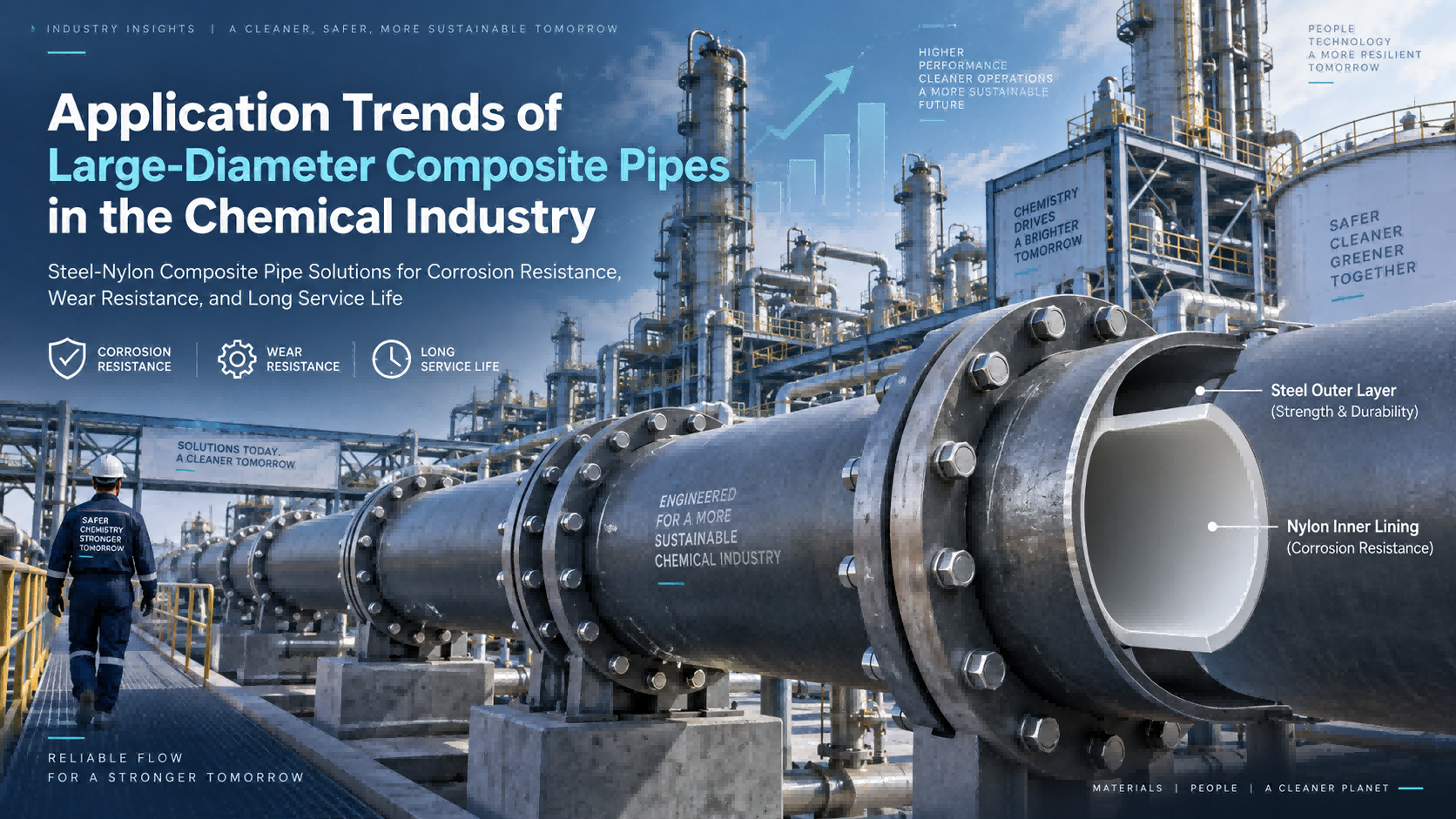
Severe Corrosive Service Is Driving Continuous Upgrades in Chemical Pipeline Materials
In chemical processing plants, pipelines may appear to be basic infrastructure used simply to connect equipment and transport fluids. However, from the perspective of overall plant reliability, piping systems are often a critical factor affecting continuous production, operational safety, maintenance frequency, and total operating costs.
This is especially true in industries such as chlor-alkali, soda ash, salt chemicals, phosphate chemicals, industrial wastewater treatment, and high-salinity fluid transportation.
In these applications, pipelines are rarely exposed to a single corrosion mechanism. Instead, multiple degradation mechanisms may occur simultaneously, including:
-
Corrosion caused by high concentrations of salt ions;
-
Chemical attack from acidic or alkaline media;
-
Erosion and abrasion caused by suspended solids;
-
Material aging and stress changes caused by temperature fluctuations;
-
Scaling and reduced flow capacity after long-term operation;
-
Localized leakage at flanges, welds, and connection points;
-
Mechanical stress caused by shutdowns, startups, and pressure fluctuations.
As a result, modern chemical companies are gradually moving away from the traditional concept of simply selecting a "corrosion-resistant pipe."
Instead, they are looking for pipeline solutions that can simultaneously provide:
corrosion resistance, wear resistance, pressure capability, mechanical strength, temperature adaptability, reliable connections, and lower lifecycle maintenance costs.
This is one of the key reasons why chemical pipeline materials continue to evolve.
1. Why Is the Chemical Industry One of the Main Drivers of Pipeline Material Innovation?
The fundamental purpose of an industrial pipeline is to transport fluids.
Chemical pipelines, however, operate under much more complex conditions.
Within the same chemical plant, different sections of a process line may have completely different:
-
Chemical compositions;
-
Concentrations;
-
Temperatures;
-
Pressures;
-
Solid particle contents;
-
Flow velocities;
-
Operating conditions.
This makes chemical pipeline material selection significantly more complicated than ordinary fluid transportation.
Chlor-Alkali Industry
Pipelines in chlor-alkali plants may be continuously exposed to media containing high concentrations of chloride ions.
Chloride ions can cause severe localized corrosion in certain metallic materials, especially around:
-
Welds;
-
Crevices;
-
Surface defects;
-
Flanges;
-
Heat-affected zones.
Under certain operating conditions, pitting corrosion and crevice corrosion can therefore become serious reliability concerns.
Soda Ash Industry
Mother liquor transportation systems typically involve highly saline and corrosive media that may also contain suspended solids or crystalline particles.
This means the pipeline must withstand not only chemical corrosion but also continuous erosion caused by the flowing medium.
Phosphate Chemical Industry
Some phosphate chemical processes involve acidic fluids, slurry, and suspended mineral particles simultaneously.
If a pipe material offers good corrosion resistance but insufficient abrasion resistance, continuous erosion can still reduce the pipe wall thickness and eventually lead to premature failure.
Industrial Wastewater and High-Salinity Wastewater
The chemical composition of industrial wastewater can be highly complex.
Operating conditions may also fluctuate according to changes in upstream production processes.
A pipe material designed for only one specific chemical environment may therefore fail to provide adequate long-term reliability.
For this reason, what modern chemical plants really require is not simply:
a corrosion-resistant pipe.
They increasingly require:
An industrial transportation system capable of handling multiple interacting operating challenges.
2. Why Are Conventional Carbon Steel Pipes Increasingly Challenged by Severe Corrosive Service?
For decades, carbon steel has been one of the most widely used piping materials in chemical plants.
The reasons are obvious.
Carbon steel provides:
-
High mechanical strength;
-
Mature manufacturing technology;
-
Wide availability;
-
Extensive size ranges;
-
Established fabrication methods;
-
Good pressure-bearing capability.
However, carbon steel also has an inherent weakness:
The steel itself is vulnerable to chemical and electrochemical corrosion.
When carbon steel continuously transports saline, acidic, alkaline, or otherwise corrosive media, its degradation may gradually progress from:
corrosion → wall thinning → localized pitting → perforation → leakage.
The problem becomes even more complicated because corrosion does not necessarily occur uniformly.
In many industrial piping systems, the first failures occur around:
-
Welds;
-
Elbows;
-
Tees;
-
Reducers;
-
Valve connections;
-
Pump outlets;
-
Areas where flow velocity changes suddenly.
These sections frequently experience corrosion and erosion simultaneously.
Therefore, even if most of the straight pipe remains operational, frequent failures at localized sections can significantly increase the maintenance burden of the entire system.
3. Stainless Steel Does Not Mean Complete Immunity to Corrosion
To improve corrosion resistance, many chemical projects consider materials such as:
-
304 stainless steel;
-
316L stainless steel;
-
Higher-alloy stainless steels.
Compared with ordinary carbon steel, stainless steel can significantly improve corrosion resistance in many environments.
However, stainless steel is not a universal solution for every chemical application.
In environments involving high chloride concentrations, high salinity, elevated temperatures, or other aggressive conditions, engineers may still need to evaluate risks such as:
-
Pitting corrosion;
-
Crevice corrosion;
-
Weld-area corrosion;
-
Stress corrosion cracking;
-
Localized corrosion.
Another challenge is cost.
As pipe diameter, wall thickness, and alloy grade increase, the material cost of stainless steel piping can rise substantially.
For DN500, DN1000, or even larger industrial piping systems, using high-alloy stainless steel throughout an entire system may result in significant capital expenditure.
This raises an important engineering question:
Can we retain the structural strength of steel while preventing corrosive media from continuously contacting the steel surface?
This is one of the fundamental reasons why composite piping systems have continued to develop.
4. Chemical Pipelines Are Moving from Single Materials Toward Composite Structures
Traditional piping design often follows a simple philosophy:
Select one material and ask it to perform all functions simultaneously.
That single material is expected to provide:
-
Structural strength;
-
Pressure resistance;
-
Corrosion resistance;
-
Abrasion resistance;
-
Temperature resistance;
-
Long-term stability.
However, very few individual materials can achieve the ideal balance among all these requirements.
For example:
Metal provides excellent strength, but corrosion can be a problem.
Some polymer pipes offer excellent corrosion resistance, but high temperature, high pressure, and large-diameter applications may require additional structural consideration.
FRP piping can offer strong chemical resistance, but long-term pressure performance, joint reliability, and complex mechanical loading must also be evaluated for each specific application.
As a result, an increasingly important engineering philosophy is emerging:
Let different materials perform the functions they are best suited to perform.
For example:
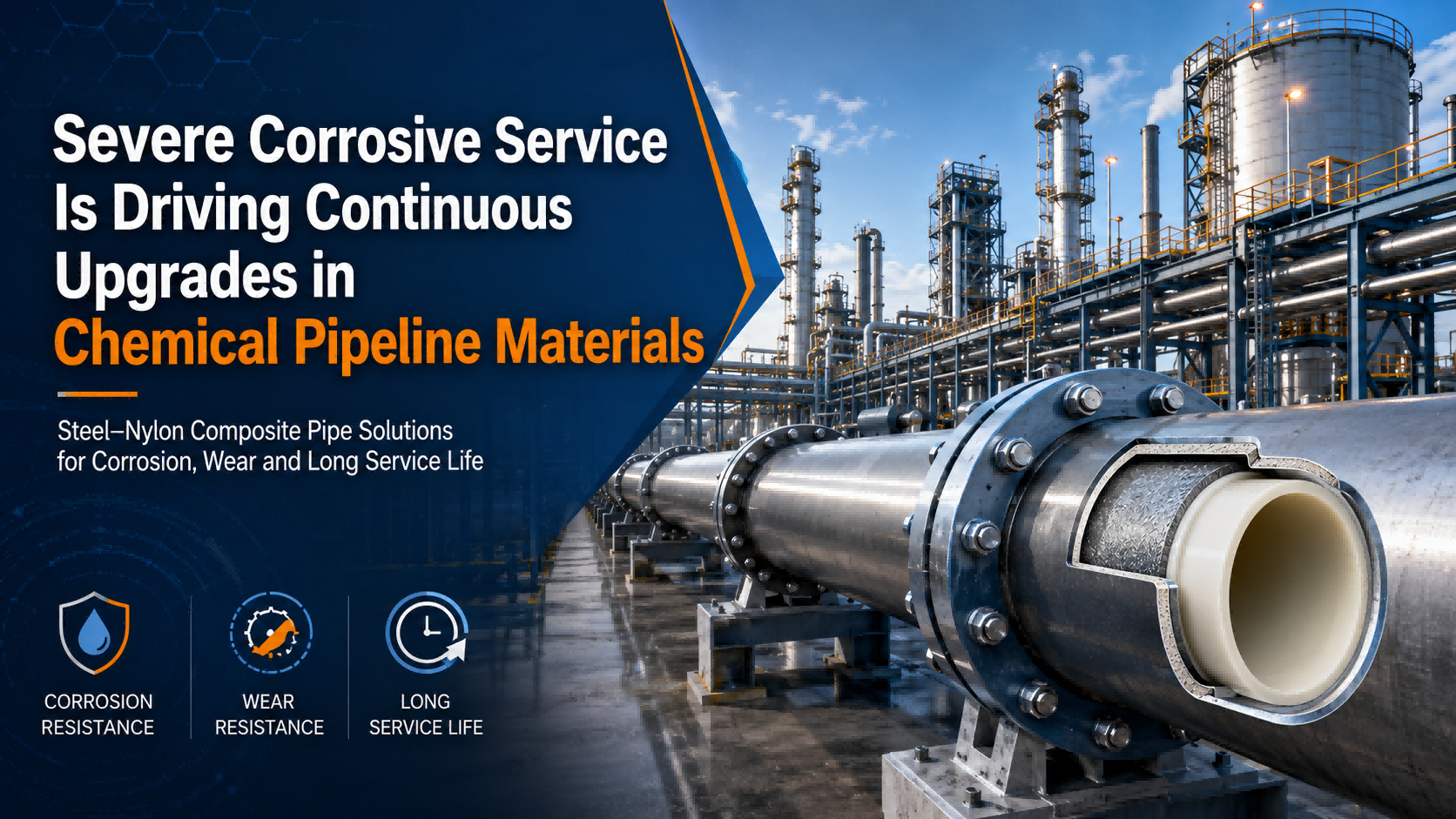
The structural layer provides mechanical strength and pressure capability.
The internal functional layer isolates corrosive media while delivering corrosion resistance, wear resistance, and reduced scaling tendency.
This is the basic engineering principle behind steel-nylon composite pipe.
5. Why Is Steel-Nylon Composite Pipe Suitable for Complex Chemical Transportation Systems?
A steel-nylon composite pipe is not simply a steel pipe with a plastic layer placed inside it.
The actual performance of a composite piping system depends on the design of the complete structure, including:
-
Steel structural layer;
-
Nylon functional layer;
-
Bonding or integration between the materials;
-
Flange structure;
-
Fittings;
-
Thermal expansion compatibility;
-
Long-term pressure stability;
-
Overall structural integrity.
Our product design philosophy is to combine the respective advantages of steel and nylon.
Steel Provides Structural Strength
The steel structure is responsible for:
-
Withstanding internal pressure;
-
Providing hoop rigidity;
-
Supporting large-diameter pipe structures;
-
Resisting mechanical loads during transportation and installation;
-
Maintaining structural stability in complex industrial piping networks.
Compared with piping systems that rely entirely on polymers to carry structural loads, steel reinforcement can provide significant engineering advantages in large-diameter, pressure-bearing, and mechanically demanding applications.
6. The Nylon Functional Layer Isolates Corrosive Media from the Steel Structure
Another key feature of steel-nylon composite pipe is that the transported medium primarily contacts the nylon working layer rather than the steel structure.
This changes the fundamental corrosion mechanism associated with traditional steel pipelines.
In a conventional steel pipe:
Process medium → Steel
In a steel-nylon composite structure:
Process medium → Nylon functional layer → Steel structural layer
When properly selected according to chemical composition, concentration, temperature, pressure, and operating conditions, this structure can significantly reduce direct exposure of the steel reinforcement to corrosive media.
This is one of the major reasons steel-nylon composite pipe can be attractive for:
-
High-salinity media;
-
Weak acidic environments;
-
Strong alkaline environments;
-
Complex industrial chemical fluids.
7. The Most Difficult Applications Often Involve Both Corrosion and Erosion
One challenge frequently underestimated during chemical pipeline material selection is that:
Corrosion and erosion often occur simultaneously.
Chemical fluids may contain:
-
Crystals;
-
Suspended solids;
-
Mineral particles;
-
Process residues.
As these particles travel through the pipeline at high velocity, they continuously impact the internal pipe wall.
If a material provides corrosion resistance but poor wear resistance, the pipe may still fail prematurely as its protective surface is gradually eroded.
Particular attention should be paid to:
-
Elbow outer walls;
-
Reducers;
-
Tees;
-
Downstream sections of valves;
-
Pump outlets;
-
Areas where flow velocity changes rapidly.
These locations often experience stronger turbulence and localized flow velocity, making them common wear points within industrial piping networks.
Nylon materials can provide good wear resistance.
Therefore, the value of steel-nylon composite piping extends beyond corrosion protection.
For applications where corrosion and erosion occur together:
Corrosion resistance + wear resistance
may be much more important than corrosion resistance alone.
8. A Smooth Inner Surface Can Help Reduce Scaling and Hydraulic Resistance
Scaling is another important challenge frequently overlooked in chemical piping systems.
As deposits accumulate inside a pipeline, several problems may gradually develop:
Reduced internal diameter → Increased hydraulic resistance → Higher pumping energy consumption → More frequent cleaning
In severe cases, localized blockage may occur.
The problem can become even more serious when corrosion begins on the internal surface of a conventional metal pipe.
As corrosion progresses, surface roughness increases.
A rougher surface can make it easier for deposits to attach.
This can potentially create a cycle such as:
Corrosion → Increased surface roughness → More deposits → Deteriorating flow conditions → Accelerated localized corrosion
Steel-nylon composite pipe uses a relatively smooth nylon working surface.
This can help reduce friction between the transported medium and the pipe wall while reducing opportunities for deposits to adhere under appropriate operating conditions.
For chemical plants requiring long-term continuous operation, this characteristic may directly influence lifecycle operating costs.
9. Large-Diameter Chemical Pipelines Require Both Corrosion Resistance and Structural Strength
As pipe diameter increases, material selection becomes significantly more complicated.
There are many material options available for small-diameter piping.
However, once pipeline sizes increase to:
DN600
DN800
DN1000
DN1200
DN1600
or even DN2000
engineers must consider a much broader range of factors.
These may include:
-
Pipe stiffness;
-
Support spacing;
-
Dead weight;
-
Internal pressure;
-
Vacuum or negative pressure;
-
Thermal expansion and contraction;
-
Flange loads;
-
Installation deformation;
-
Long-span pipe racks;
-
Outdoor exposure;
-
Long-term structural stability.
This is why large-diameter industrial piping cannot be selected based only on chemical compatibility charts.
Engineers must consider the complete system:
Material properties + Structural design + Connection design + Long-term operating conditions
One advantage of the steel-nylon composite concept is that the steel structure can provide mechanical support and pressure resistance, while the internal nylon working layer addresses corrosion and wear from the transported medium.
We can provide steel-nylon composite pipe solutions for large-diameter industrial projects, including DN2000-class and larger diameters, with designs adapted to project pressure, process medium, and installation conditions.
10. Integral Flange Connections Can Reduce On-Site Installation Complexity
The reliability of a chemical piping system does not depend solely on the pipe body.
Connections are equally important.
In practice, many industrial pipeline leaks occur not in straight pipe sections but around:
-
Joints;
-
Welds;
-
Flanges;
-
Valve connections.
Therefore, a reliable industrial piping system should address both:
Pipe body reliability + Connection reliability
Our steel-nylon composite pipes can be designed with integral flange connections.
This allows pipeline sections to be connected through flanges during installation without requiring extensive field hot-melt joining or complicated welding procedures associated with certain alternative piping systems.
This can be particularly valuable for:
-
Chemical plant revamping;
-
Existing pipeline replacement;
-
Maintenance shutdown projects;
-
Partial pipeline upgrades.
Many chemical plants cannot afford extended shutdown periods.
Reducing field welding, simplifying installation procedures, and improving installation standardization can therefore help reduce the total cost associated with plant shutdown and pipeline replacement.
11. Chemical Companies Are Shifting from Purchase Price to Lifecycle Cost
Historically, pipeline procurement decisions were often based on a simple question:
Which pipe has the lowest purchase price?
Increasingly, chemical companies are recognizing that the initial purchase price may not represent the largest cost over the life of the pipeline.
If a pipeline begins experiencing corrosion perforation, leakage, scaling, or frequent maintenance after several years, the plant may need to pay for:
-
Replacement pipe;
-
Removal of the old pipeline;
-
Installation;
-
Labor;
-
Lifting equipment;
-
Insulation restoration;
-
Coating restoration;
-
Cleaning;
-
Production shutdowns;
-
Safety management;
-
Environmental remediation;
-
Future maintenance.
For continuous-process chemical plants, the financial impact of unplanned shutdowns can sometimes exceed the cost of the piping itself.
A more mature procurement model therefore considers:
TCO = Initial Material Cost + Installation Cost + Maintenance Cost + Shutdown Cost + Replacement Cost
Instead of asking which material is cheapest today, engineers and procurement teams should ask:
Which pipeline provides the lowest total cost over 10, 15, or even more years of operation?
This is one reason why long-life and low-maintenance composite piping systems are receiving increasing attention in industrial projects.
12. Typical Chemical Industry Applications for Steel-Nylon Composite Pipe
Based on the combination of steel structural strength and nylon functional performance, steel-nylon composite piping can be evaluated for a number of demanding chemical applications.
1. Soda Ash Production
Potential applications include:
-
Mother liquor transportation;
-
Brine systems;
-
Process circulation fluids;
-
Crystalline media;
-
Applications involving simultaneous corrosion and erosion.
2. Chlor-Alkali Industry
Potential applications include:
-
Brine systems;
-
Alkaline media;
-
High-chloride transportation;
-
Corrosive wastewater.
3. Salt Chemical Industry
High-salinity environments can create significant corrosion risks for conventional metal piping, making composite piping solutions particularly worth evaluating.
4. Phosphate Chemical Industry
Certain process streams involve corrosion and particle erosion simultaneously.
Pipeline materials must therefore provide both chemical resistance and abrasion resistance.
5. Chemical Wastewater
Complex ionic compositions, high salinity, changing pH, and suspended solids make industrial wastewater transportation a typical severe-corrosion application.
6. Large-Diameter Process Pipelines
For DN500 and above—and particularly for DN1000 to DN2000-class industrial pipelines—combining a steel structural layer with a corrosion-resistant functional layer can provide significant engineering value.
13. There Is No Single "Best" Pipeline Material for Every Application
One of the most important principles in engineering material selection is:
No single material is suitable for every operating condition.
Steel-nylon composite pipe should also be selected according to actual project conditions.
Before determining the appropriate pipeline material, engineers should evaluate at least the following parameters:
-
Process medium: Detailed chemical composition;
-
Concentration: Acid, alkali, salt, and other chemical concentrations;
-
Temperature: Normal and maximum operating temperature;
-
Pressure: Normal operating and design pressure;
-
Diameter: Required nominal pipe size;
-
Flow velocity: Potential for high-velocity erosion;
-
Solid content: Presence of crystals, sand, minerals, or other particles;
-
Installation environment: Indoor, outdoor, buried, or pipe rack;
-
Operating mode: Continuous or intermittent;
-
Design life: Expected pipeline service period.
Only after evaluating these factors together can engineers determine whether the most suitable solution is:
-
Carbon steel;
-
Stainless steel;
-
FRP;
-
HDPE;
-
Lined steel pipe;
-
Steel-nylon composite pipe;
-
Or another piping material.
14. The Future of Chemical Piping Will Be Defined by System Reliability
Future competition among chemical pipeline materials will likely no longer revolve around one single performance parameter.
It will not simply be about:
Which material is more corrosion resistant?
Nor will it simply be about:
Which pipe has the lowest initial purchase price?
The more important questions will be:
Can the pipeline reduce leakage?
Can it reduce maintenance frequency?
Can it extend replacement intervals?
Can it withstand complex temperature and pressure conditions?
Can it support large-diameter industrial systems?
Can it reduce scaling?
Can it improve connection reliability?
Can it reduce total lifecycle cost?
This means the industrial pipeline market is gradually evolving from:
Selling pipe materials
toward:
Providing industrial fluid transportation solutions.
15. Why We Continue to Develop Steel-Nylon Composite Pipe Technology
Our objective is not simply to manufacture another conventional industrial pipe.
The engineering problems we are focused on solving are the long-standing challenges found in real industrial facilities:
corrosion, wear, scaling, leakage, and high maintenance costs.
For this reason, we continue to develop steel-nylon composite pipe and reinforced nylon piping technologies for demanding industrial applications.
Our key application industries include:
-
Oil and gas;
-
Soda ash;
-
Chlor-alkali;
-
Salt chemicals;
-
Phosphate chemicals;
-
Mining;
-
Power generation;
-
Seawater and high-salinity media;
-
Municipal water supply and drainage.
Depending on specific project requirements, our steel-nylon composite pipes can be designed for pressure classes of approximately 1.0–4.0 MPa and large diameters extending to DN2000 and above.
Under suitable chemical and operating conditions, the nylon working layer provides corrosion and wear resistance, while the steel structure provides the mechanical strength and stiffness required by industrial piping systems.
Through this composite structure, our goal is not simply to replace one traditional pipe material with another.
Our goal is to help industrial projects achieve:
longer stable operating periods, fewer maintenance interventions, and lower total lifecycle costs.
Conclusion: Severe Corrosive Environments Are Redefining Chemical Pipeline Materials
The chemical industry is entering an era in which equipment reliability and lifecycle economics are becoming increasingly important.
In the past, a pipeline material that could simply "resist corrosion" might have been considered sufficient.
Today, project requirements are significantly more demanding.
Corrosion resistance is only the starting point.
Modern pipeline systems must also address:
wear resistance, pressure capability, temperature performance, large-diameter structural stability, connection reliability, scaling, maintenance intervals, and total lifecycle cost.
As a result, the future of chemical pipeline materials may not simply involve finding a "more advanced single material."
Instead, the industry is increasingly adopting composite structures and advanced engineering designs that allow different materials to perform different functions.
Steel provides structural strength. Nylon provides isolation from corrosive media together with corrosion and wear resistance.
This is the fundamental value proposition of steel-nylon composite pipe in demanding industrial transportation systems.
For chemical companies currently dealing with frequent corrosion, leakage, scaling, or repeated pipeline replacement, the most important question may no longer be:
"Which pipe should we replace it with next?"
The better question is:
"How can we build a fluid transportation system that operates reliably for longer periods while reducing maintenance frequency and total lifecycle cost?"
That will be one of the defining directions in the next generation of chemical pipeline material development.
Why Are Chemical Companies Paying More Attention to Hot-Work-Free Piping Installation?
Aging Chemical Pipelines Are Entering a New Upgrade Cycle