Chemical Plant Pipeline Leak Management: From Reactive Repair to Lifecycle Risk Control
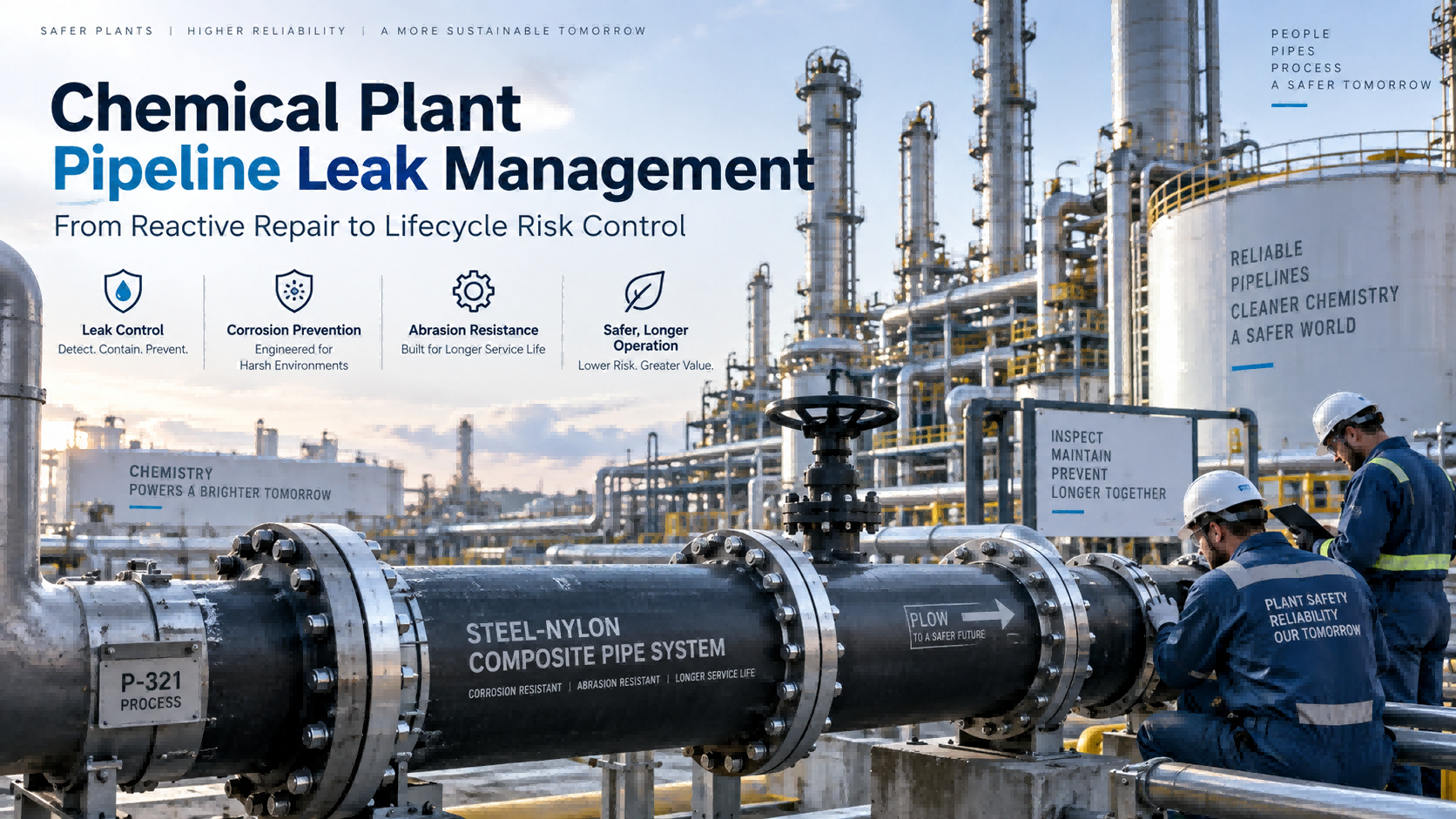
In chemical production facilities, pipelines often receive less attention than reactors, compressors, storage tanks, or other major equipment. Yet a wide range of corrosive chemicals, slurries, brine, caustic solutions, process wastewater, and intermediate products depend on complex pipeline networks for continuous transportation.
Once a pipeline leak occurs, the consequences often extend far beyond a single damaged pipe section.
Potential impacts include:
-
Unplanned shutdowns
-
Loss of raw materials or finished products
-
Corrosion of surrounding equipment
-
Increased environmental and safety risks
-
Higher repair and labor costs
-
Repeated replacement of the same pipeline sections
-
Reduced overall plant reliability
As a result, more chemical companies are recognizing that effective pipeline leak management should not simply mean “repairing the pipe wherever a leak occurs.”
Instead, pipeline systems should be reconsidered from multiple perspectives, including material selection, operating conditions, structural design, connection methods, and lifecycle management.
1. Why Is Pipeline Leakage Such a Complex Problem in Chemical Plants?
Pipeline leakage in chemical facilities rarely has a single cause.
In real operating environments, corrosion, abrasion, temperature, pressure, flow velocity, deposits, mechanical stress, and connection failures may occur simultaneously.
This explains why the same pipe material may operate reliably for many years in a conventional water system but experience a much shorter service life when exposed to aggressive chemical media.
Chemical Corrosion
Chemical corrosion is one of the most common pipeline failure mechanisms in chemical processing plants.
Acids, alkalis, salts, chloride-containing solutions, and other aggressive chemicals can attack conventional metallic piping in different ways.
Typical corrosion mechanisms include:
-
Uniform corrosion that gradually reduces wall thickness
-
Pitting corrosion that causes localized perforation
-
Crevice corrosion around flanges, joints, and stagnant areas
-
Electrochemical corrosion between dissimilar materials
One of the greatest risks is that corrosion does not always produce an immediate visible leak.
By the time operators identify a problem, local pipe wall thickness may already have been significantly reduced.
Therefore, repeatedly welding or patching damaged areas cannot fundamentally solve a systemic corrosion problem.
2. When Corrosion and Abrasion Occur Together, Pipeline Failure Can Accelerate
Many chemical process fluids are not clean liquids.
Typical examples include:
-
Salt mud
-
Lime slurry
-
Phosphate slurry
-
Crystallization mother liquor
-
Wastewater containing suspended solids
-
Catalyst slurry
-
Process fluids containing solid particles
As these media flow through a pipeline, suspended solids continuously impact and abrade the internal surface.
If chemical corrosion has already weakened the material surface, mechanical erosion can remove the damaged layer and expose fresh material to further chemical attack.
This creates a typical corrosion-abrasion synergistic failure mechanism.
Such operating conditions can be significantly more difficult to manage than corrosion alone.
The problem is particularly severe at:
-
Elbows
-
Tees
-
Reducers
-
Pump discharge sections
-
Upstream and downstream sections of valves
-
High-velocity flow areas
Local wear rates at these locations can be much higher than those in straight pipe sections.
This is why some chemical plants experience a common situation:
Most of the pipeline remains operational, while several critical locations repeatedly develop leaks.
This indicates that effective leak management must consider not only pipe material but also the specific failure mechanism at each location.
3. Why Is the Traditional “Leak–Repair–Leak Again” Model Becoming Unsustainable?
Many older chemical plants have historically relied on a simple maintenance cycle:
Leak detected
↓
Shutdown
↓
Remove damaged pipe section
↓
Weld or replace
↓
Restart production
↓
Another leak occurs months or years later
If leaks are isolated events, this maintenance model may be acceptable.
However, when the same process pipeline repeatedly experiences corrosion perforation, continued local repair can lead to rapidly increasing maintenance costs.
At this stage, companies should no longer ask only:
“How much does one meter of pipe cost?”
A more important question is:
“What will this pipeline system cost to operate over the next five or ten years?”
The calculation should include:
-
Pipe procurement cost
-
Installation cost
-
Production losses caused by shutdowns
-
Maintenance labor
-
Lifting and construction costs
-
Hot-work management expenses
-
Leak response costs
-
Fitting replacement costs
-
Environmental and safety management costs
This is why more industrial projects are moving toward Total Cost of Ownership (TCO) evaluation rather than comparing only the initial purchase price of different pipe materials.
4. Pipeline Leak Management Should Begin by Identifying Where and Why Failures Occur
Before upgrading pipeline materials, chemical companies should review their maintenance and leak records from previous years.
Four questions are particularly important.
Which Process Media Have the Highest Leak Frequency?
For example:
-
NaOH
-
Brine
-
Mother liquor
-
Process wastewater
-
Acidic media
-
Slurry
-
High-salinity solutions
If repeated leakage is concentrated within pipelines carrying the same medium, this often indicates a long-term compatibility problem between the existing pipe material and the operating environment.
Which Locations Fail Most Frequently?
Different failure locations usually indicate different root causes.
Frequent perforation along straight pipe sections
This may indicate insufficient overall corrosion resistance.
Rapid wear-through at elbows
Flow velocity, particle concentration, impact angle, and abrasion resistance should be investigated.
Frequent leakage around flanges
Potential causes include sealing problems, mechanical stress, installation issues, and localized corrosion.
Failure around welds
Welding quality, heat-affected zones, residual stress, and chemical corrosion conditions should be evaluated.
Only after identifying the actual failure mechanism does a material upgrade become technically meaningful.
5. Why Do Traditional Chemical Pipeline Materials Have Different Limitations?
Common pipeline materials used in chemical plants include:
-
Carbon steel
-
Stainless steel
-
Plastic-lined steel pipe
-
Rubber-lined steel pipe
-
FRP
-
PE / HDPE
-
Various composite piping systems
No single material is suitable for every chemical process.
Therefore, the real question in pipeline material selection should be:
Which material best matches the corrosion, abrasion, temperature, pressure, and installation requirements of the specific operating condition?
Carbon Steel
Carbon steel offers high mechanical strength and a mature supply chain.
However, under long-term exposure to corrosive media, wall thickness may gradually decrease. Maintaining reliability may require corrosion allowance, coatings, corrosion protection systems, or periodic replacement.
Stainless Steel
Stainless steel offers excellent overall performance in many chemical applications.
However, in chloride-rich, high-salinity, or other specific aggressive environments, localized corrosion and pitting must be carefully considered. Material costs can also become significant for large-diameter pipeline systems.
FRP
FRP provides good corrosion resistance in many applications, but pressure capability, mechanical impact resistance, connection design, and long-term structural reliability should all be considered during engineering evaluation.
PE / HDPE
PE and HDPE can be effective for many low-pressure corrosive fluid applications.
However, when higher temperatures, higher pressures, greater mechanical loads, or large structural spans are involved, additional engineering verification is required.
The objective of chemical pipeline leak management is therefore not to find a so-called “universal material.”
The objective is:
Matching the right material to the right operating conditions.
6. Why Can Steel-Nylon Composite Pipe Be an Effective Solution for Corrosive and Abrasive Chemical Services?
The design philosophy of steel-nylon composite pipe is not simply to add another protective layer to a conventional steel pipe.
Instead, different materials are used to perform different functions.
The basic structural concept is:
The steel structure provides mechanical strength and pressure resistance, while the nylon inner layer directly contacts the transported medium.
This composite structure is particularly valuable for industrial piping systems that simultaneously require:
-
Mechanical strength
-
Corrosion resistance
-
Abrasion resistance
-
Pressure capability
-
Large-diameter availability
-
Long-term operational reliability
7. Advantage 1: Separating the Process Medium from the Steel Structure
One of the main causes of internal corrosion in conventional steel pipe is prolonged direct contact between aggressive process media and the metallic pipe wall.
Steel-nylon composite pipe uses nylon as the medium-contacting internal layer, creating a barrier between the transported fluid and the structural steel.
For applications where material compatibility has been properly verified, the system may be suitable for media such as:
-
Alkaline solutions
-
Salt-containing fluids
-
Brine
-
Certain weak acidic media
-
Process wastewater
-
Mother liquor
This can help reduce direct exposure of the steel substrate to aggressive process environments.
The design philosophy differs fundamentally from simply increasing the wall thickness of a carbon steel pipe.
Increasing steel wall thickness essentially means:
“Allow corrosion to continue, but provide more material for corrosion to consume.”
A composite pipeline takes a different approach:
“Reduce direct contact between the corrosive medium and the pressure-bearing steel structure.”
These are two fundamentally different approaches to pipeline service-life design.
8. Advantage 2: Addressing Both Corrosion and Abrasion
For fluids containing suspended solids, corrosion resistance alone is often insufficient.
The pipe must also withstand continuous erosion and particle impact.
Nylon materials offer good wear resistance, making steel-nylon composite construction valuable for certain applications involving simultaneous corrosion and abrasion.
Typical applications may include:
-
Chemical slurries
-
Salt mud
-
Industrial wastewater
-
Mineral slurry
-
Mother liquor
-
Particle-containing circulation fluids
-
Certain high-solids process media
At high-wear locations such as elbows, tees, reducers, and pump outlets, improved abrasion resistance can help reduce frequent localized replacement.
For chemical plants experiencing repeated failures at these critical points, upgrading only the vulnerable sections can sometimes provide a practical first step toward reducing overall maintenance frequency.
9. Advantage 3: Steel Provides Strong Mechanical Support
Corrosion resistance alone is not enough for industrial piping systems.
Pipelines must also withstand:
-
Internal pressure
-
External loads
-
Pipe support spans
-
Equipment vibration
-
Installation stresses
-
Structural stability requirements for large diameters
Steel-nylon composite pipe retains steel as the primary load-bearing structure, allowing the pipeline to combine mechanical strength with internal corrosion protection.
Our steel-nylon composite piping systems can be engineered for different pressure requirements, with typical industrial pressure ratings ranging from 1.0 to 4.0 MPa, depending on pipe size, design, service conditions, and project requirements.
Large-diameter configurations can also be manufactured for industrial pipeline projects.
This allows steel-nylon composite pipe to serve not only as an alternative for conventional corrosion-resistant piping but also as an option for industrial systems where pressure and structural reliability are important considerations.
10. Advantage 4: Smooth Internal Surfaces Can Help Reduce Scaling and Deposits
Another hidden problem in chemical pipelines is scaling and deposition.
Even when a pipeline does not leak, gradual internal buildup can reduce its effective flow area.
Potential consequences include:
-
Reduced flow capacity
-
Increased pressure loss
-
Higher pumping energy consumption
-
More frequent pipeline cleaning
-
Severe blockage in extreme cases
Nylon provides a relatively smooth internal surface, which can help reduce conditions that encourage certain deposits to adhere to the pipe wall.
For process media that are prone to sedimentation, crystallization, or suspended particle deposition, this characteristic may help maintain pipeline hydraulic performance over longer operating periods.
However, scaling is also influenced by fluid chemistry, temperature, concentration, velocity, and process conditions.
Pipe material alone cannot completely eliminate every type of deposit.
11. Advantage 5: Flanged Connections Can Simplify Chemical Plant Retrofit Projects
Many chemical pipeline projects involve upgrading an existing plant rather than constructing an entirely new facility.
The practical challenge is often:
How can damaged pipeline sections be replaced without creating excessive disruption to existing operations?
In older chemical plants, extensive field welding can require:
-
Hot-work permits
-
Pipeline cleaning and purging
-
Gas detection
-
Fire-watch personnel
-
Longer shutdown windows
Steel-nylon composite piping can be designed with flanged connections.
For suitable projects, this can reduce the amount of field welding required and simplify:
-
Pipe installation and removal
-
Fitting replacement
-
Partial replacement of existing pipelines
-
Valve connections
-
Equipment maintenance
Therefore, an aging pipeline system does not necessarily need to be completely replaced at once.
A more practical strategy may be to begin with the areas experiencing the highest failure rates.
12. Chemical Plants Can Adopt a “High-Failure-Point First” Upgrade Strategy
For large chemical facilities that have operated for many years, replacing the entire pipeline network at once may not be economically or operationally realistic.
A more practical approach is to create a pipeline leak risk map.
Pipeline sections can be divided into different risk levels.
Level A: High-Risk Areas
These are locations with a history of frequent leakage, such as:
-
Pump discharge sections
-
Frequently leaking elbows
-
Main pipelines carrying highly corrosive media
-
High-abrasion slurry pipelines
-
Pipe sections upstream and downstream of valves
These areas should receive priority for material upgrades.
Level B: Medium-Risk Areas
The pipeline remains operational, but wall-thickness inspections show a clear degradation trend.
These sections can be incorporated into the next scheduled maintenance or turnaround program.
Level C: Stable Areas
Continue monitoring these sections.
There is no need to replace functioning pipelines simply for the purpose of standardizing the entire system with one material.
This approach allows chemical companies to use limited capital expenditure to solve the most serious leakage problems first.
13. A 100–500 Meter Trial Section May Be More Practical Than Replacing the Entire Pipeline
Chemical companies using a new piping material for the first time can consider implementing a controlled trial section.
For example, a 100–500 meter pipeline section exposed to severe corrosion or abrasion can be selected and operated alongside the existing pipe material.
Performance can then be evaluated using measurable data, including:
-
Number of leaks
-
Changes in wall thickness
-
Internal wear
-
Scaling and deposit conditions
-
Number of repairs
-
Shutdown duration
-
Maintenance labor
-
Total operating cost
After a complete operating cycle, the plant can determine whether broader application is justified.
For engineering and procurement decisions, actual field performance data is often more convincing than material specifications alone.
14. Steel-Nylon Composite Pipe Is Not Suitable for Every Chemical Medium
One of the most dangerous mistakes in industrial pipeline selection is purchasing a pipe simply because it is described as “corrosion resistant.”
Every material has operating limits.
Before selecting steel-nylon composite pipe, engineers should confirm:
-
Chemical composition of the medium
-
Concentration
-
Operating temperature
-
Design pressure
-
Solid particle content
-
Flow velocity
-
Pipe diameter
-
Continuous or intermittent operation
-
Whether vacuum or negative pressure may occur
-
Flange standard
-
Indoor or outdoor installation conditions
-
External atmospheric or environmental corrosion
Our reinforced nylon and steel-nylon composite pipe systems can be engineered for certain weak acids, strong alkalis, salt-containing media, slurries, and combined corrosion-abrasion applications.
However, the applicable temperature and pressure range must always be confirmed according to the specific product design and operating conditions.
For strong acids, highly concentrated acids, or other aggressive chemical media, a detailed material compatibility assessment must be performed before selection.
Material compatibility should never be assumed solely from the name of the pipe material.
Correct material selection is more important than simply choosing a more expensive material.
15. The Goal of Pipeline Leak Management Is Not Merely “No Leakage” — It Is Predictable Pipeline Performance
Traditional pipeline maintenance often asks:
“When will this pipe fail?”
Modern chemical plants should ask more important questions:
“Why will it fail, where will it fail, how long will it last, and can the problem be addressed before leakage occurs?”
A more advanced chemical pipeline management system should gradually establish the following process:
Process medium analysis
→ Failure mechanism identification
→ Material selection
→ High-wear area design
→ Installation quality control
→ Operational monitoring
→ Periodic inspection
→ Lifecycle cost evaluation
→ Future material upgrades
This is the foundation of systematic pipeline leak management.
16. Moving from “Repairing Pipes” to “Reducing the Probability of Failure”
For continuous-process chemical plants, the most expensive part of a pipeline system is often not the pipe itself.
It is the cost of an unpredictable shutdown.
If a piping material has a moderately higher initial purchase price but helps reduce:
-
Corrosion perforation
-
Frequent fitting replacement
-
Unplanned maintenance
-
Leakage incidents
-
Pipeline cleaning frequency
-
Production downtime
then its total cost over a five- or ten-year operating period may actually be lower.
This is one of the key reasons why steel-nylon composite pipe deserves consideration in chemical processing, salt chemical production, chlor-alkali plants, soda ash production, phosphate chemical processing, and other corrosive and abrasive fluid transportation systems.
Its value should not be judged solely by price per meter.
A more meaningful comparison is:
Cost per year of operation, maintenance frequency, and overall lifecycle reliability of the pipeline system.
Conclusion
Pipeline leak management in chemical plants is undergoing an important transition.
The traditional model was:
Leak → Emergency Repair → Resume Production
The modern approach is increasingly becoming:
Failure Analysis → Material Optimization → Reduced Leakage → Extended Service Life → Lower Lifecycle Cost
For industrial piping systems exposed to corrosion, abrasion, pressure, and complex installation conditions, steel-nylon composite pipe provides an alternative material solution worth evaluating.
By using steel to provide structural and pressure-bearing strength while allowing the nylon inner layer to handle direct media contact, corrosion resistance, and abrasion resistance, this composite structure offers engineers an alternative between conventional metallic piping and standard non-metallic piping systems.
For complex chemical applications, however, pipeline selection should never begin with the product.
It should begin with the operating conditions.
Chemical composition, concentration, temperature, pressure, flow velocity, solid content, pipe diameter, and historical failure data are the key factors that should determine pipeline material selection.
If your chemical plant is experiencing corrosion, abrasion, repeated pipeline leakage, or frequent pipe replacement, a practical starting point is to identify the highest-failure sections of the system, compare the existing material with steel-nylon composite pipe under real operating conditions, and evaluate the results based on total lifecycle performance before expanding the application.
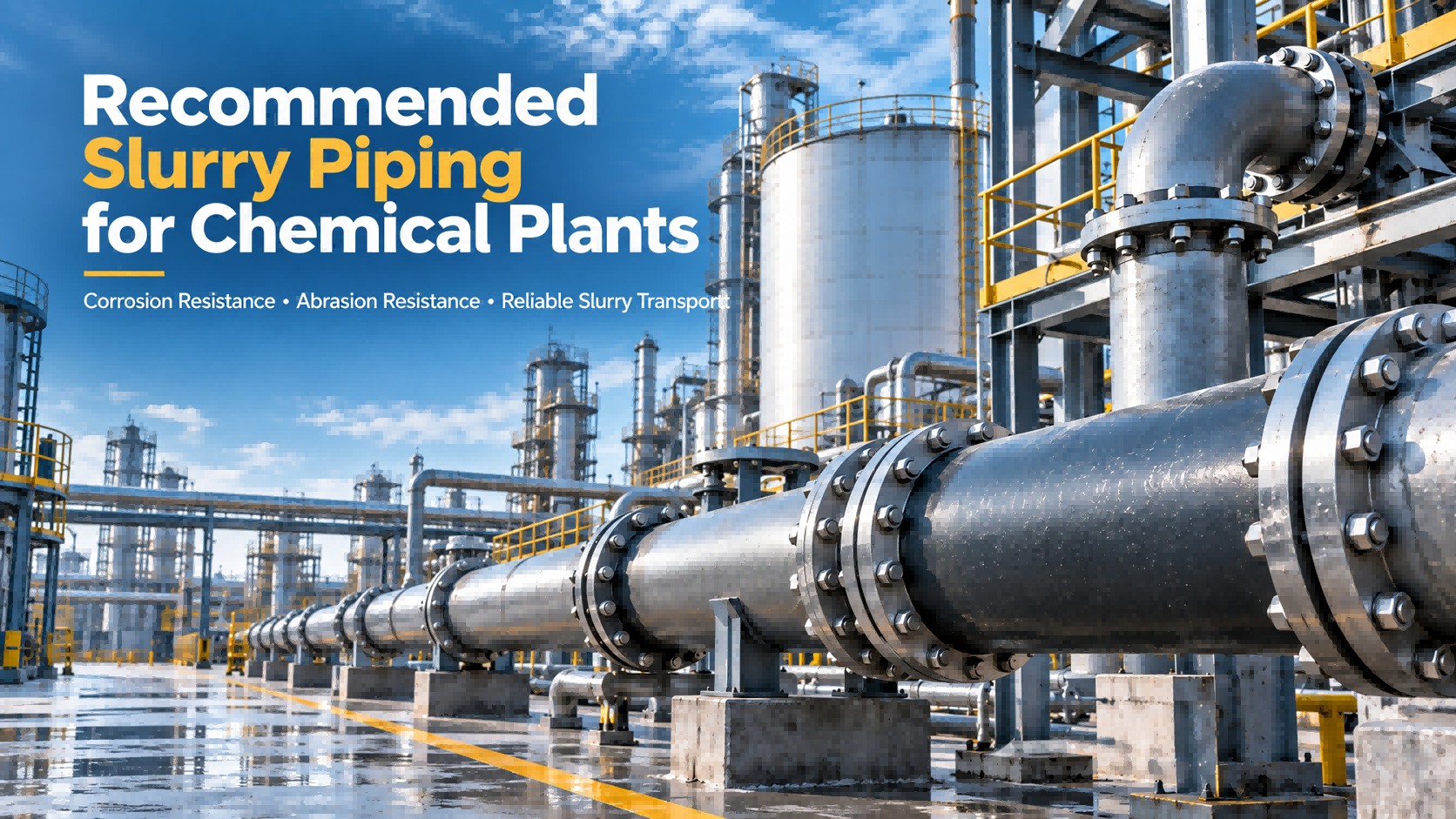
Recommended Slurry Piping for Chemical Plants: How to Select Reliable Pipes for Corrosive and Abrasive Slurry Service