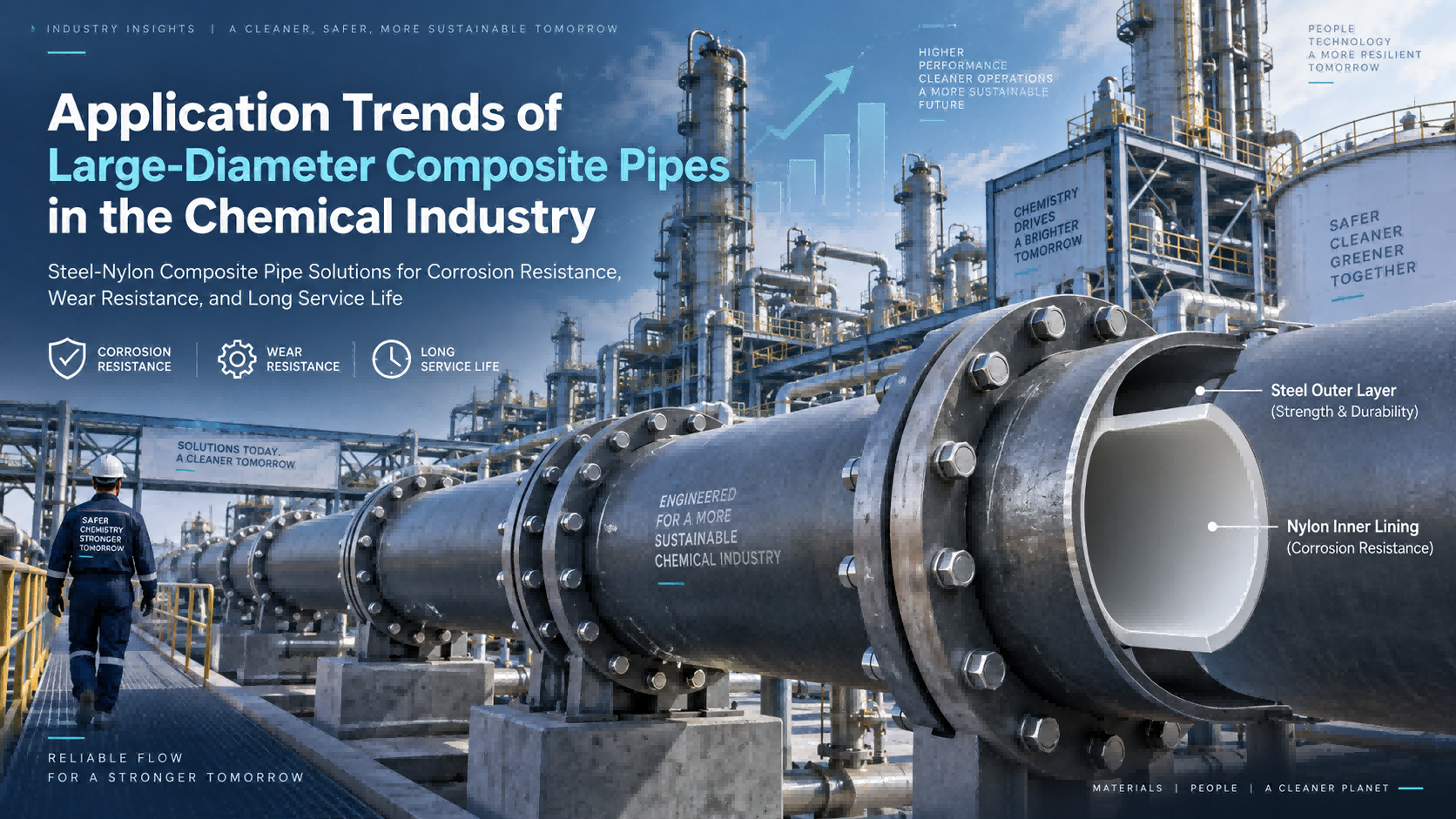
Chemical Plant Pipeline Leak Management Is Shifting from Repair to Prevention
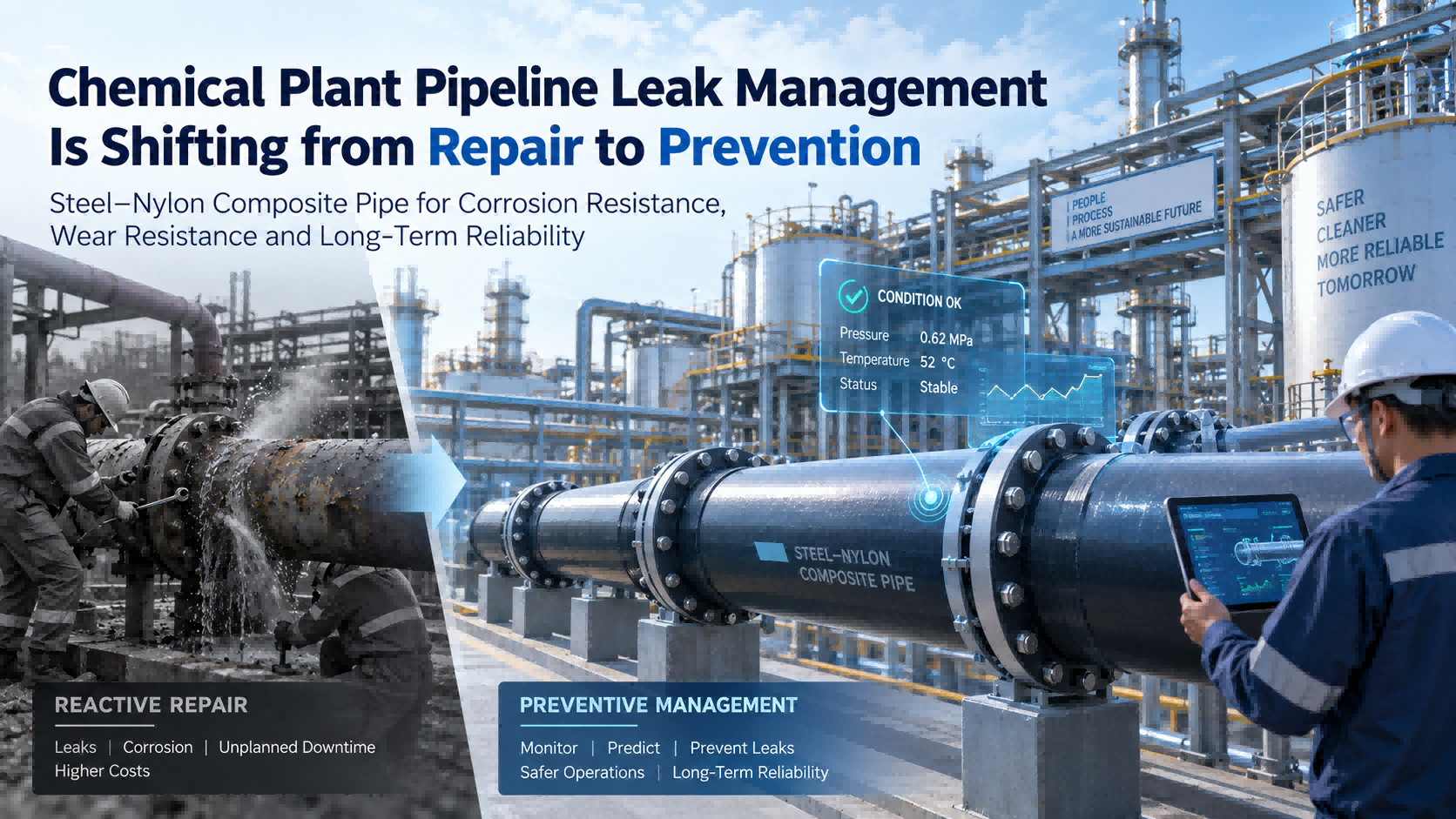
For many chemical plants, pipeline leakage has traditionally been treated as a maintenance problem:
A leak is discovered.
The unit is shut down or production is reduced.
The leaking section is repaired or replaced.
Production resumes—until the next failure occurs.
This reactive approach may have been manageable when chemical facilities were smaller and production continuity was less critical. However, as modern chemical plants become larger, more continuous, and increasingly dependent on high operating rates, companies are beginning to ask a more fundamental question:
Is the best way to reduce pipeline leakage simply to improve repair efficiency—or to prevent failures from occurring in the first place through better material selection and system design?
Increasingly, the industry is moving toward the second approach.
Pipeline management is gradually shifting from Reactive Maintenance to Preventive Pipeline Management.
And this transition is fundamentally changing the way industrial piping materials are selected.
1. Why Chemical Plants Can No Longer Rely on “Repair After Leakage”
In an ordinary industrial environment, a pipeline leak may appear to be a relatively simple issue involving the replacement of a short section of pipe.
In a chemical plant, however, one leak can trigger a much larger chain of costs and operational consequences.
A typical repair may require:
-
Reducing plant operating capacity or shutting down equipment
-
Draining and cleaning the pipeline
-
Isolating hazardous areas
-
Obtaining hot-work permits
-
Installing scaffolding or lifting equipment
-
Removing damaged pipe sections
-
Installing replacement piping
-
Welding and non-destructive testing
-
Pressure testing
-
Restarting the process system
If the pipeline carries strong alkalis, high-salinity mother liquor, corrosive wastewater, slurry, or particle-containing fluids, leakage may also create environmental, safety, and secondary equipment corrosion risks.
Therefore, the real cost of a pipeline failure is rarely just the price of the damaged pipe.
The actual cost is closer to:
Pipe Cost + Maintenance Cost + Shutdown Cost + Safety Risk + Production Loss
In other words, the issue must be evaluated from a Total Cost of Ownership (TCO) perspective.
This is why more chemical companies are changing the question from:
“Which pipe has the lowest purchase price?”
to:
“Which piping system is least likely to leak, require maintenance, or cause production interruptions over the next 10 years?”
These two questions can lead to completely different material-selection decisions.
2. Why Do Chemical Plant Pipelines Repeatedly Leak?
Pipeline leakage in chemical plants is rarely caused by a single factor.
In real operating environments, corrosion, abrasion, temperature, pressure, installation quality, material aging, and fluid characteristics often interact simultaneously.
Several failure mechanisms are especially common.
2.1 Corrosion-Induced Wall Thinning
Traditional carbon steel piping exposed to aggressive chemical media may experience:
-
General corrosion
-
Pitting corrosion
-
Crevice corrosion
-
Electrochemical corrosion
-
Weld-area corrosion
As the pipe wall gradually becomes thinner, its pressure-bearing capability decreases.
One of the most dangerous aspects of corrosion is that:
A pipeline that appears normal externally may already be severely corroded internally.
This is especially important in high-salinity, chloride-rich, or chemically complex environments, where localized corrosion may progress rapidly.
A typical failure process becomes:
Corrosion → Wall Thinning → Local Perforation → Leakage
2.2 Corrosion and Abrasion Can Accelerate Each Other
In soda ash production, salt chemical processing, mineral slurry transport, chemical wastewater treatment, and similar applications, the transported medium often contains suspended solids.
These particles continuously impact and scour the internal pipe surface.
If the material is also being chemically corroded, a phenomenon known as:
Corrosion-Erosion
may occur.
The mechanism is relatively straightforward:
Corrosion weakens the material surface.
Solid particles remove the weakened layer.
Fresh material is exposed.
Corrosion begins again.
The process repeats continuously.
As a result, the rate of material loss can become significantly higher than that caused by corrosion or abrasion alone.
This explains why elbows, tees, reducers, pump outlets, and other turbulent-flow areas often fail much earlier than straight pipeline sections.
2.3 Welds Can Become Potential Weak Points
Many conventional chemical piping systems require extensive field welding.
This means that a large piping network may contain hundreds or even thousands of welded joints.
From a system-reliability perspective:
The more connection points a piping system contains, the more potential failure points must be managed.
This becomes particularly important when upgrading old chemical plants, where installation conditions may include:
-
Restricted working space
-
Congested existing pipelines
-
Elevated pipe racks
-
Flammable or explosive areas
-
Corrosive environments
-
Very short shutdown windows
All of these factors increase construction complexity.
As a result, reducing field welding itself is becoming an important strategy for lowering installation and long-term leakage risks.
3. True Preventive Leak Management Means Moving from “Leak Location” to “Failure Mechanism”
Traditional maintenance asks:
Where did the pipeline fail?
Preventive management asks:
Why did the pipeline fail?
The difference is critical.
If a leaking pipe section is simply replaced with the same material under the same operating conditions, similar failures may eventually occur again nearby.
More advanced pipeline management therefore analyzes the entire failure mechanism.
Process Medium Conditions
Typical parameters include:
-
pH
-
Chemical composition
-
Ion concentration
-
Solid particle concentration
-
Salinity
-
Corrosive components
-
Operating temperature
Operating Conditions
These include:
-
Working pressure
-
Flow velocity
-
Temperature fluctuations
-
Pressure fluctuations
-
Positive or negative pressure conditions
-
Start-stop frequency
Pipeline Configuration
Important factors include:
-
Pipe diameter
-
Number of elbows
-
Reducer locations
-
Valve positions
-
Pump discharge sections
-
Support spacing
Historical Failure Records
Plant operators should ask:
-
Which sections leak repeatedly?
-
How often does the pipeline require repair?
-
Do elbows fail significantly faster than straight pipes?
-
Where is corrosion most severe?
-
Is scaling occurring inside the pipeline?
Once these data are analyzed systematically, companies often discover that:
Many pipeline leaks are not random accidents—they are predictable material failures.
4. Preventing Pipeline Leakage Means Reducing Four Major Failure Sources
Although industrial pipeline failure mechanisms can be complex, most preventive strategies focus on reducing four major risks:
-
Corrosion
-
Abrasion
-
Joint Failure
-
Scaling and Flow Problems
An ideal industrial piping material should address several of these problems simultaneously rather than solving only one.
This is one of the reasons composite piping technology is receiving increasing attention.
5. Why Steel–Nylon Composite Pipe Fits Preventive Pipeline Management
The concept behind steel–nylon composite pipe is not to rely on a single material to perform every function.
Instead, different materials are used according to their respective strengths.
The basic concept can be expressed as:
Steel Structure + Nylon Functional Layer
The steel structure provides:
-
Mechanical strength
-
Structural rigidity
-
Pressure resistance
-
Large-diameter dimensional stability
The nylon functional layer provides:
-
Corrosion resistance
-
Abrasion resistance
-
Reduced scaling tendency
-
Improved internal flow characteristics
This composite structure is particularly valuable in applications requiring both mechanical strength and resistance to corrosion, erosion, and complex chemical media.
6. Advantage 1: Reducing Corrosion-Related Perforation at the Material Level
In strong-alkali, high-salinity, mother-liquor, brine, and certain industrial wastewater systems, direct contact between the process medium and metallic pipe wall is one of the fundamental causes of corrosion.
Steel–nylon composite pipe uses a nylon functional layer to isolate the conveyed medium from the steel structure.
This means the process fluid contacts the corrosion-resistant nylon layer rather than a conventional steel internal surface.
Depending on the specific operating conditions, this can significantly reduce the risks of:
-
Internal corrosion
-
Pitting
-
Wall thinning
-
Corrosion perforation
-
Leakage
This material system can be particularly valuable for certain weak-acid, strong-alkali, and high-salinity industrial services.
However, no industrial piping material should be selected simply because it is described as “corrosion resistant.”
Proper chemical pipeline selection should always evaluate:
Medium Composition + Concentration + Temperature + Pressure + Flow Velocity
before confirming material compatibility.
7. Advantage 2: Combining Corrosion Resistance and Abrasion Resistance
Some traditional corrosion-resistant solutions perform well against chemical attack but may not be suitable for highly abrasive media.
Likewise, some wear-resistant materials may perform well against particle erosion but have limitations in certain chemical environments.
One important advantage of steel–nylon composite pipe is that:
Corrosion resistance and abrasion resistance can be considered within the same piping system.
This is particularly important for transporting:
-
Salt sludge
-
Mother liquor
-
Chemical slurry
-
High-salinity wastewater
-
Fluids containing suspended solids
-
Industrial circulating water
-
Corrosive slurry media
At elbows, tees, pump outlets, reducers, and other areas with turbulent or high-velocity flow, abrasion resistance can have a major influence on overall pipeline service life.
8. Advantage 3: A Smooth Inner Surface Can Reduce Scaling-Related Risks
Scaling is often treated merely as a flow-efficiency issue.
In reality, long-term scaling can indirectly increase pipeline failure risks.
As the effective internal diameter decreases:
Flow velocity may increase.
Local flow resistance rises.
Pumping energy consumption increases.
Erosion may become more severe in certain areas.
Eventually, new pipeline failure mechanisms may develop.
Reducing scaling is therefore not only an energy-efficiency issue—it is also a reliability issue.
The relatively smooth nylon internal surface can help reduce the tendency of certain materials to adhere to the pipe wall.
For process systems prone to deposition or scaling, this can contribute to more stable long-term flow performance.
9. Advantage 4: Flanged Connections Can Reduce Field Hot Work
For many chemical plants, one of the biggest challenges in replacing old pipelines is not the pipe itself, but installation.
This is particularly true in:
-
Flammable and explosive areas
-
Areas adjacent to operating process units
-
Congested pipe racks
-
Projects with very limited shutdown windows
Field welding can significantly increase construction and safety-management complexity.
Our steel–nylon composite pipes can be designed with integral flange connections.
Field installation can therefore mainly rely on:
Flange + Gasket + Bolt
connections.
This can reduce the amount of welding required on site.
Potential project benefits include:
-
Less hot work
-
Lower construction risk
-
Faster installation
-
Easier partial disassembly
-
Easier future maintenance and modification
For this reason, weld-free or reduced-hot-work installation is becoming an increasingly important consideration in chemical plant pipeline upgrades.
10. Advantage 5: Composite Technology Can Extend into Large-Diameter and Higher-Pressure Applications
Many non-metallic piping systems perform very well in small-diameter and low-pressure applications.
However, as pipeline diameter increases to:
-
DN500
-
DN800
-
DN1000
-
DN1600
-
DN2000
or even larger sizes, structural rigidity, pressure resistance, and long-term dimensional stability become increasingly important.
This is where a steel–nylon composite structure offers a significant engineering advantage:
Steel provides structural performance, while nylon protects the medium-contacting surface against corrosion and abrasion.
Our steel–nylon composite piping systems can be engineered for large-diameter industrial applications and designed for pressure classes of approximately 1.0–4.0 MPa, depending on project requirements.
This expands the potential use of composite piping solutions in large chemical process systems.
11. From “Replace the Entire Pipeline” to “Prioritize High-Risk Sections”
Preventive pipeline management does not necessarily mean replacing every pipeline in an entire chemical plant at once.
A more practical strategy is to classify pipeline sections according to failure risk.
Level 1: Highest-Risk Locations
These may include:
-
Pump discharge sections
-
Elbows
-
Tees
-
Sections upstream and downstream of valves
-
Frequently leaking pipe sections
-
Highly corrosive process lines
These areas can be upgraded first.
Level 2: High-Risk Process Pipelines
Examples include:
-
Strong-alkali pipelines
-
High-salinity mother liquor
-
Chemical wastewater
-
Salt sludge
-
Slurry transportation systems
These pipelines can then be upgraded progressively.
Level 3: Lower-Risk Pipelines
Lower-risk lines can remain in service under continued inspection and monitoring.
This strategy enables companies to upgrade their piping systems according to:
Risk + Cost + Shutdown Window
rather than attempting a complete plant-wide replacement at once.
For many chemical companies, this is significantly more practical from both a budgeting and operational perspective.
12. Another Practical Strategy: Start with a 100–500 m Trial Section
When introducing a new piping material, we often recommend beginning with verification under real operating conditions.
For example, a chemical plant may install a:
100–500 m Pipeline Trial Section
and continuously evaluate:
-
Internal wear
-
Corrosion condition
-
Scaling
-
Flange sealing performance
-
Pressure stability
-
Maintenance frequency
The results can then be compared directly with the existing pipeline system.
The major advantage of this approach is that:
Material selection moves from laboratory specifications to real engineering data.
For large chemical groups, a successful trial section may eventually be expanded from:
One Pipeline → One Process Unit → One Plant → Multiple Production Bases
This provides a controlled pathway for implementing new pipeline technology.
13. Why Future Chemical Pipeline Competition Will Shift from “Material Price” to “Probability of Leakage”
Consider two pipeline options.
Pipeline A has a lower purchase price but requires repair or replacement every three to five years.
Pipeline B has a somewhat higher initial cost but significantly reduces long-term maintenance requirements.
Traditional procurement logic may favor Pipeline A.
However, from a 10-year or even 20-year perspective, a more appropriate calculation is:
TCO = Initial Cost + Installation + Maintenance + Shutdown + Replacement + Risk
This is the Total Cost of Ownership.
In large continuous chemical plants, one of the most expensive consequences is often not the pipe itself, but:
Unplanned Shutdown
The production loss caused by a major pipeline leak may far exceed the amount originally saved through lower material procurement costs.
For this reason, the future of industrial pipeline selection is likely to move beyond:
$/Meter
toward:
$/Operating Year
In other words:
The total cost of maintaining reliable pipeline operation over time.
14. Why Different Chemical Media Require Different Pipeline Solutions
One important principle must be emphasized:
There is no universal pipeline material suitable for every chemical service.
Different systems have fundamentally different engineering priorities.
Caustic Soda Systems
Key considerations usually include:
-
Strong-alkali corrosion resistance
-
Temperature
-
Pressure
-
Connection reliability
Soda Ash Mother Liquor Systems
In addition to corrosion, engineers must consider:
-
High salt concentration
-
Crystallization
-
Solid particles
-
Erosion
-
Scaling
Salt Chemical Industry
Important factors may include:
-
High chloride concentration
-
High salinity
-
Long-term corrosion
-
External environmental exposure
Phosphate Chemical Industry
These applications may involve:
-
Acidic media
-
Slurry
-
Solid particles
-
Combined corrosion and erosion
For this reason, we prefer to position steel–nylon composite pipe as an:
Engineered Pipeline Solution
rather than simply another standardized pipe material.
15. The Core Value of Steel–Nylon Composite Pipe Is More Than Corrosion Resistance
Describing steel–nylon composite pipe simply as a corrosion-resistant pipe underestimates the value of the technology.
Its real purpose is to address several fundamental conflicts in long-term industrial piping operation.
Traditional Steel Pipe
Provides good mechanical strength,
but may face significant corrosion problems.
Conventional Non-Metallic Pipe
Offers strong corrosion resistance,
but certain high-temperature, high-pressure, and large-diameter applications may present structural limitations.
Some Lined Piping Systems
Combine a steel structure with a corrosion-resistant internal layer,
but long-term interface stability must be carefully considered.
The engineering objective of steel–nylon composite pipe is therefore to achieve a better balance among:
Strength + Corrosion Resistance + Wear Resistance + Installation Efficiency
for demanding industrial environments.
16. What Is the Ultimate Goal of Preventive Pipeline Management?
The objective is not to create a piping system that will “never require maintenance.”
No industrial asset is completely maintenance-free.
A more realistic objective is:
To transform unpredictable leakage into predictable maintenance.
In other words, companies should move from:
“We do not know when the pipeline will leak.”
to:
“We know which pipelines present the highest risk, when they should be inspected, and when they should be replaced.”
That is the direction modern industrial asset management is moving toward.
Pipeline material upgrading is one of the fundamental steps in achieving this objective.
17. From Repairing Leaks to Designing a System That Leaks Less
For decades, chemical pipeline management has focused largely on:
How to Repair a Pipeline
The more important question for the future may be:
How to Design a Pipeline That Requires Less Repair
This represents a fundamental shift:
From leakage repair,
to leakage prevention;
From procurement price,
to lifecycle cost;
From individual pipe products,
to complete fluid-transport solutions;
From short-term service,
to long-term reliability.
For industrial companies transporting corrosive, high-salinity, abrasive, or chemically complex media, this transition is especially important.
Conclusion: The Best Leak Management Strategy Is to Prevent More Leaks from Occurring
Pipeline leakage is not simply a maintenance-department problem.
It involves:
-
Materials
-
Engineering design
-
Process conditions
-
Installation
-
Operation
-
Maintenance
-
Asset management
Effective pipeline leak management therefore cannot remain limited to:
“Repair wherever leakage occurs.”
A more advanced approach requires a complete lifecycle management system:
Material Selection → Engineering Design → Installation → Monitoring → Preventive Maintenance
Steel–nylon composite pipe can provide significant engineering value within this transition.
By combining the mechanical strength of steel with the corrosion resistance, wear resistance, and flow-performance advantages of a nylon functional layer—and combining these features with integral flange connections and application-specific engineering design—chemical plants can gradually move their pipeline management strategy from:
Repair After Failure
to:
Prevent Failure Before It Happens
For chemical companies seeking to reduce leakage risks, maintenance frequency, shutdowns, and long-term pipeline ownership costs, this shift may become one of the most important directions in future pipeline asset management.
Looking for a Long-Life Pipeline Solution for Your Chemical Plant?
If your project is experiencing:
-
Strong-alkali pipeline corrosion
-
High-salinity corrosion
-
Mother liquor pipeline leakage
-
Salt sludge or slurry abrasion
-
Frequent pipeline replacement
-
Restrictions on field hot work
-
Large-diameter corrosion-resistant pipeline requirements
we can evaluate whether steel–nylon composite pipe is suitable for your operating conditions.
For an initial engineering assessment, we recommend preparing the following information:
Medium / Concentration / Temperature / Pressure / Diameter / Flow Velocity / Existing Pipe Material / Current Failure Mode
Based on these parameters, we can evaluate material suitability and further determine the appropriate pipe diameter, pressure class, connection method, and potential trial-section implementation plan.
How Chemical Companies Should Reassess the Total Life-Cycle Cost of Industrial Piping
Why Is Demand for Strong Alkali-Resistant Piping Materials Growing in the Chemical Industry?