Recommended Slurry Piping for Chemical Plants: How to Select Reliable Pipes for Corrosive and Abrasive Slurry Service
In many chemical plants, the greatest challenge to long-term piping reliability is not corrosion alone. The real difficulty arises when corrosion, abrasion, particle erosion, solids deposition, scaling, and pressure fluctuations occur simultaneously.
Phosphate slurry, salt mud, lime slurry, process mother liquor containing solids, desulfurization slurry, crystallized salt slurry, and industrial wastewater containing suspended solids are all typical examples of solid-liquid two-phase flow.
Unlike ordinary liquid service, these media create a much more complex internal environment:
The liquid phase may corrode the pipe wall, while suspended solids continuously abrade and erode it.
Therefore, even a material with excellent corrosion resistance may fail quickly if its wear resistance is insufficient. Conversely, a very hard material may still provide poor service life if it cannot withstand the chemical environment.
This is why more chemical companies are reassessing conventional carbon steel, stainless steel, rubber-lined steel, FRP, HDPE, and other single-material piping systems, while paying increasing attention to composite piping solutions that combine structural strength, corrosion resistance, and abrasion resistance.
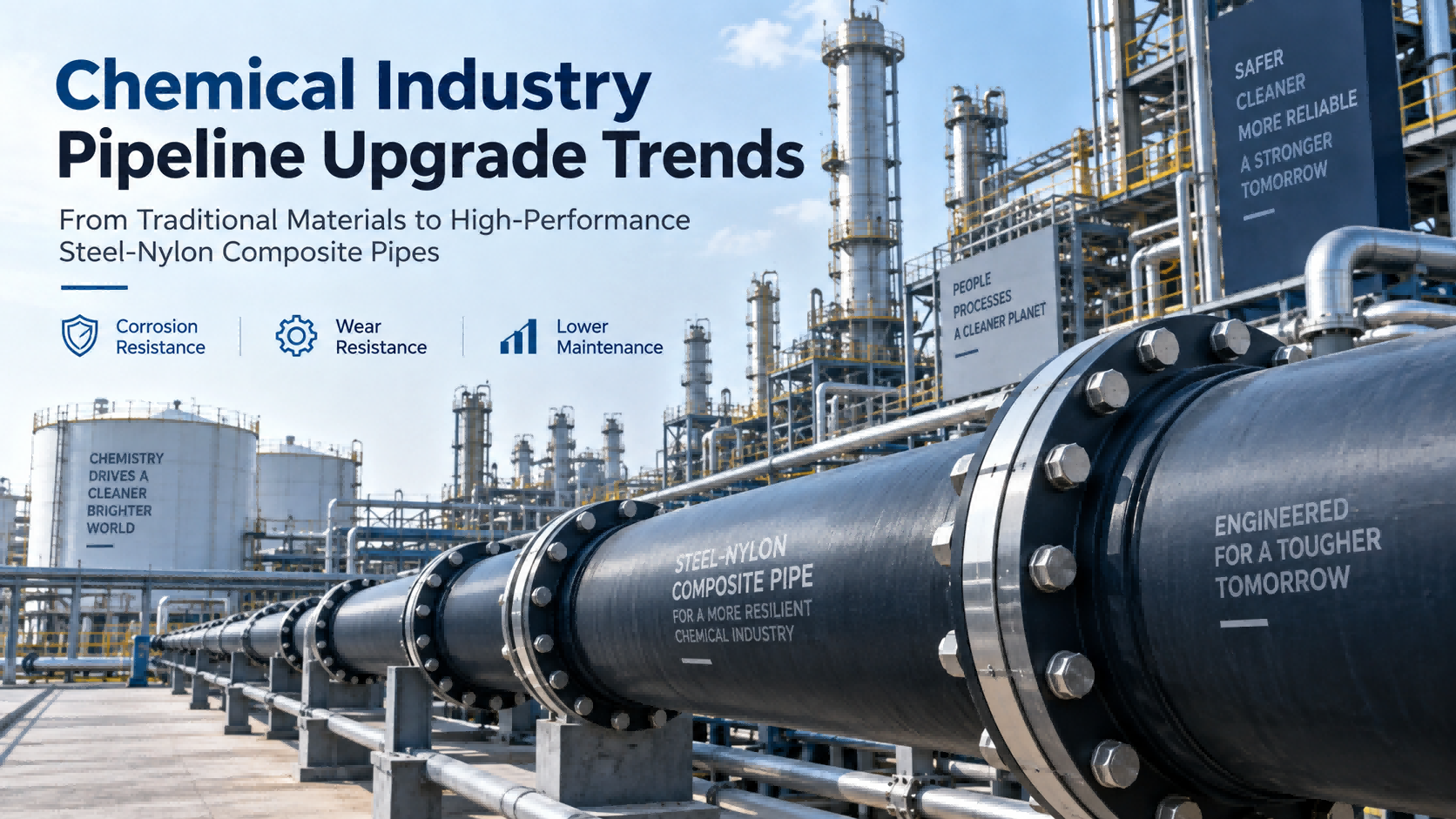
For many medium- to high-pressure slurry applications where corrosion and abrasion occur together, steel-nylon composite pipe is becoming an increasingly valuable option to evaluate.
1. Why Are Slurry Pipelines in Chemical Plants Particularly Vulnerable to Failure?
Failure mechanisms in ordinary liquid pipelines are relatively straightforward. Slurry pipelines, however, are exposed to multiple interacting degradation mechanisms.
A typical chemical slurry may contain:
-
A continuous liquid phase
-
Suspended solid particles
-
Salts
-
Acids or alkalis
-
Suspended matter
-
Crystals
-
Sediment or mud
-
Chemical process by-products
As a result, the internal surface of the pipeline is not exposed to a single corrosion mechanism.
Chemical Corrosion
The liquid phase of a slurry may contain substances such as:
-
NaOH
-
NaCl
-
Chlorides
-
Dissolved salts
-
Weak acids
-
Alkaline mother liquor
-
Other corrosive chemicals
When ordinary carbon steel is used, the pipe wall may gradually experience:
-
Uniform corrosion
-
Pitting
-
Localized corrosion
-
Weld corrosion
-
Wall thinning
-
Perforation and leakage
Once corrosion begins, the internal surface becomes rougher. This can further intensify the impact and scouring action of solid particles.
In other words:
Corrosion accelerates abrasion, while abrasion continuously damages protective surface layers and exposes fresh material to further corrosion.
This is the typical corrosion-abrasion synergy found in slurry transportation systems.
2. Particle Erosion Can Be More Dangerous Than Corrosion Alone
When slurry contains mineral particles, crystals, salt mud, sand, or other solids, these particles continuously strike and scour the pipe wall as they move through the system.
The problem becomes particularly severe at:
-
Elbows
-
Tees
-
Reducers
-
Upstream and downstream sections of valves
-
Pump discharge sections
-
Locations with sudden changes in pipe diameter
At these points, the direction and velocity of the slurry change, significantly increasing localized erosion.
A common situation in chemical plants is therefore:
The straight pipe remains operational, while elbows, tees, or pump discharge sections have already experienced severe wall thinning or even perforation.
This is why slurry pipeline selection cannot focus on straight pipe alone.
A reliable system must evaluate the entire piping network:
Straight Pipe + Elbows + Tees + Reducers + Valve Sections + Pump Discharge Sections
as one integrated corrosion- and abrasion-resistant system.
3. What Performance Characteristics Does a Slurry Pipeline Really Need?
For chemical slurry transportation systems, at least seven major factors should be evaluated.
3.1 Corrosion Resistance
The first step is to determine the chemical composition of the liquid phase.
Important parameters include:
-
pH
-
Acid or alkali type
-
Chemical concentration
-
Chloride concentration
-
Salt concentration
-
Temperature
-
Oxidizing characteristics of the medium
The presence of solids does not eliminate corrosion.
In fact, suspended particles may continuously remove corrosion products or protective films from metal surfaces, exposing fresh metal to the corrosive medium.
For this reason, relying solely on conventional metallic piping may require significant corrosion allowance.
3.2 Abrasion Resistance
The following parameters must also be analyzed:
-
Solids concentration
-
Particle size
-
Particle hardness
-
Particle shape
-
Flow velocity
-
Transportation distance
The same piping material may have dramatically different service lives under different slurry concentrations and flow velocities.
One important principle must be recognized:
Wear may increase much faster than linearly as slurry velocity rises.
Increasing flow velocity to prevent solids settlement may therefore create another problem: significantly higher erosion of the pipe wall.
A properly designed slurry transportation system must find an appropriate balance between:
Minimum Velocity to Prevent Solids Deposition
and
Maximum Acceptable Velocity to Control Pipe Wear
3.3 Smooth Internal Surface
Another frequently overlooked problem in slurry pipelines is solids deposition.
As internal surface roughness increases:
Flow resistance increases
→ More solids tend to accumulate
→ Deposits become more severe
→ Effective pipe diameter decreases
→ Pumping energy consumption rises
→ Blockage risk increases
Therefore, a high-performance slurry pipe should not only resist abrasion. It should also maintain a relatively smooth internal surface.
This is why the idea that:
“The harder the pipe material, the better it is for slurry service”
is incomplete.
What matters is the overall balance between:
Abrasion Resistance + Smooth Bore + Corrosion Resistance + Structural Strength
4. Comparison of Common Slurry Pipeline Materials
4.1 Carbon Steel Pipe
The major advantages of carbon steel include:
-
High structural strength
-
Relatively low initial cost
-
Mature specifications
-
Easy fabrication
However, its disadvantages become significant in corrosive slurry service.
Solid particles continuously remove corrosion products from the internal surface, repeatedly exposing fresh metal.
The degradation mechanism can therefore become:
Corrosion → Surface Damage → Particle Erosion → Fresh Metal Exposure → Further Corrosion
Over long-term operation, substantial wall thinning may occur.
Ordinary carbon steel is therefore generally more suitable for slurry applications where both corrosion and abrasion are relatively limited.
5. Why Stainless Steel Is Not Always the Best Choice for Slurry Transportation
When corrosion becomes a concern, many projects immediately consider 304 or 316L stainless steel.
However:
“Stainless steel is corrosion resistant” does not mean that stainless steel is suitable for every slurry application.
In systems containing chlorides, salts, or complex chemical compositions, engineers must evaluate the risk of:
-
Pitting corrosion
-
Crevice corrosion
-
Localized corrosion
-
Combined corrosion and erosion
At the same time, continuous particle impact can still cause mechanical wear.
For many slurry applications, therefore, selecting a higher-grade stainless steel may result in a substantial initial material investment without necessarily eliminating severe abrasion.
The real project question should not be:
Which material has the highest purchase price?
It should be:
Which material provides the most reasonable lifecycle cost under the actual operating conditions?
6. Is HDPE Suitable for Every Chemical Slurry Application?
HDPE offers clear advantages in certain low-pressure and moderate-temperature corrosive applications.
Its benefits include:
-
Excellent corrosion resistance
-
Low weight
-
Relatively convenient installation
-
Smooth internal surface
However, industrial slurry projects require additional consideration of:
-
Operating pressure
-
Operating temperature
-
Pipe diameter
-
Pipe support requirements
-
Long-distance transportation
-
Vacuum or negative-pressure conditions
-
Thermal expansion
-
Jointing method
As pressure, temperature, and diameter increase, purely thermoplastic piping systems may face limitations related to structural rigidity and pressure capability.
Therefore:
HDPE is not a universal solution for every slurry transportation system.
7. Why Long-Term Abrasion Must Also Be Considered with FRP
FRP offers good corrosion resistance and is therefore widely used in chemical plants.
However, its long-term abrasion performance must be evaluated carefully in high-solids and high-velocity slurry service.
Particular attention should be paid to:
-
Elbows
-
Pump discharge sections
-
High-velocity zones
-
High-solids slurry sections
Continuous particle erosion can damage the internal resin-rich or corrosion-resistant layer.
If this internal barrier is compromised and the structural layer becomes exposed, pipeline reliability may deteriorate further.
Therefore:
Corrosion resistance does not automatically mean resistance to slurry erosion.
8. Rubber-Lined Steel Pipe: Why Interface Reliability Still Matters
Rubber-lined steel pipe is another commonly used solution for abrasive slurry service.
Its structure typically combines:
Steel Structural Shell + Rubber Lining
This provides a combination of structural strength and abrasion resistance.
However, during long-term operation, engineers must still consider:
-
Lining aging
-
Localized wear
-
Blistering
-
Delamination
-
Joint-area damage
-
Performance changes at elevated temperatures
At elbows and other geometrically complex fittings, lining quality and interface reliability become especially important.
This is one reason some industrial users are evaluating composite piping systems that retain the structural strength of steel while using an integrated polymer inner layer for corrosion and abrasion resistance.
9. Why Steel-Nylon Composite Pipe Is Suitable for Many Chemical Slurry Applications
The engineering principle behind steel-nylon composite pipe is not simply to combine two materials.
The key concept is:
Let the steel provide structural strength, while the nylon handles contact with the transported medium.
The external steel structure is primarily responsible for:
-
Mechanical strength
-
Internal pressure resistance
-
External mechanical loads
-
Installation loads
-
Structural stability in large-diameter piping
The reinforced nylon inner layer is primarily responsible for:
-
Direct contact with the transported medium
-
Corrosion resistance
-
Resistance to solid-particle abrasion
-
Maintaining a smoother internal surface
-
Reducing the tendency for deposits to adhere
This creates a:
Structural Layer + Functional Layer
composite design.
Instead of forcing a single material to satisfy every performance requirement, the composite structure allows different materials to perform the functions they are best suited for.
10. Key Advantage No. 1: Corrosion and Abrasion Resistance in One Pipe
Traditional slurry pipeline material selection often requires a compromise between:
Corrosion Resistance
and
Abrasion Resistance
Reinforced nylon provides good wear resistance while also offering resistance to many salts, alkaline media, and selected chemical environments.
This makes steel-nylon composite pipe worth evaluating for applications involving:
-
Salt mud
-
Alkaline slurry
-
Selected mineral slurries
-
Chemical process mother liquor
-
High-salinity wastewater containing solids
-
Other solid-liquid mixtures
Its ability to address both primary degradation mechanisms is one of its major advantages over conventional metallic piping.
However, chemical compatibility must always be confirmed according to the actual:
Chemical Type + Concentration + Temperature + Pressure + Solids Content
For concentrated strong acids, strongly oxidizing chemicals, and other particularly aggressive media, pipe selection should never be based solely on material name. A specific chemical compatibility assessment is required.
11. Key Advantage No. 2: Smooth Internal Surface Helps Reduce Hydraulic Resistance
Slurry pipeline performance is not only about answering the question:
How long will the pipe survive?
Another important consideration is:
How efficiently can the slurry be transported?
After years of operation, a severely corroded or scaled internal surface can result in:
-
Reduced effective internal diameter
-
Higher pressure losses
-
Increased pump head requirements
-
Higher electricity consumption
-
Reduced transportation capacity
The nylon inner layer provides a relatively smooth surface and does not develop corrosion roughness in the same way as conventional carbon steel.
For long-term slurry systems, this can be highly valuable.
Pipeline lifecycle cost includes more than:
Pipe Purchase Price
It also includes:
Pumping Energy Cost
12. Steel Structure Makes Composite Pipe More Suitable for Medium- and High-Pressure Industrial Systems
One of the major benefits of all-plastic piping is corrosion resistance.
However, industrial chemical plants frequently require:
-
Higher pressure capability
-
Larger pipe diameters
-
Greater mechanical strength
-
More stable pipe support
-
Higher resistance to external loads
Steel-nylon composite pipe uses the steel structure to carry pressure and mechanical loads, allowing different pressure classes to be engineered according to project requirements.
For example, certain industrial applications can be designed within a pressure range of:
1.0–4.0 MPa
This structural characteristic is particularly valuable for slurry transportation systems involving:
-
Pump discharge lines
-
Long-distance pipelines
-
Significant pressure fluctuations
-
Larger pipe diameters
13. Composite Structures Become Especially Valuable in Large-Diameter Slurry Pipelines
As pipe diameter increases, pipeline engineering changes significantly.
A DN100 pipeline and a DN1000 pipeline are not simply the same design at different scales.
Large-diameter pipelines require careful evaluation of:
-
Ring stiffness
-
Self-weight
-
Support spacing
-
Flange rigidity
-
Transportation and lifting
-
Thermal deformation
-
Internal pressure
-
External loads
For DN500, DN800, DN1000, and even larger slurry pipelines, structural strength becomes increasingly important.
Steel-nylon composite pipe combines:
Steel Structural Strength + Polymer Corrosion and Abrasion Resistance
making it particularly worth evaluating for large chemical processing installations.
14. The Most Vulnerable Parts of a Slurry Pipeline Are Often the Fittings
This is one of the most important considerations in slurry pipeline engineering.
In many operating plants, the components that fail first are not the straight pipes.
Typical high-wear locations include:
-
Pump discharge sections
-
90-degree elbows
-
Tees
-
Reducers
-
Upstream and downstream valve sections
-
Areas with sudden flow-direction changes
The reason is simple:
Solid particles have inertia.
When slurry changes direction rapidly, particles impact the outer radius of the pipe or fitting, producing intense localized erosion.
Therefore, a slurry pipeline upgrade should not focus exclusively on straight pipe.
A better strategy is to establish a:
High-Wear Component Reinforcement Program
covering:
-
Wear-resistant elbows
-
Wear-resistant tees
-
Reducers
-
Pump discharge sections
-
Upstream and downstream valve sections
If a chemical plant does not want to replace an entire pipeline immediately, these high-failure-rate locations can be upgraded first.
15. Why Flanged Connections Provide Practical Advantages in Chemical Slurry Systems
Slurry transportation systems frequently require:
-
Pump maintenance
-
Valve servicing
-
Pipe section replacement
-
Pipeline flushing
-
Equipment removal
A standardized flanged connection system can make maintenance and localized replacement considerably easier.
Steel-nylon composite pipes can be designed with flanged connections so that:
-
Straight pipes
-
Elbows
-
Tees
-
Reducers
-
Valves
-
Pump discharge sections
can form an integrated piping system.
This is particularly valuable when upgrading an existing chemical plant.
In many brownfield projects, the main challenge is not simply selecting a better pipe material.
It is:
How to reduce on-site construction work and minimize plant shutdown time.
16. Do Not Compare Pipe Materials Only by Price Per Meter
This is one of the most common mistakes in chemical slurry pipeline procurement.
Consider a simplified example.
Option A
Pipe cost:
100
Service life:
2 years
Option B
Pipe cost:
160
Service life:
8 years
If the decision is based only on initial purchase cost:
Option A appears cheaper.
However, the actual project cost also includes:
-
Pipe procurement
-
Installation
-
Lifting
-
Scaffolding
-
Production shutdowns
-
Cleaning
-
Removal of old piping
-
Disposal
-
Labor
-
Pumping energy
-
Leakage losses
-
Safety risks
A more realistic model should therefore consider:
Pipeline Total Cost of Ownership
TCO = Initial Cost + Installation + Maintenance + Replacement + Downtime + Energy + Failure Cost
For slurry pipelines exposed to severe corrosion and abrasion:
Replacement Cost
and
Downtime Cost
may be far more significant than the original pipe purchase price.
17. When Should Steel-Nylon Composite Pipe Be Considered?
Steel-nylon composite pipe is particularly worth evaluating under the following conditions.
1. Corrosion and Abrasion Occur Simultaneously
Examples include:
-
High-salinity slurry
-
Alkaline slurry
-
Salt mud
-
Selected mineral slurries
-
Chemical mother liquor containing solids
2. Carbon Steel Requires Frequent Replacement
If the same pipe sections require replacement:
Every one to two years, or even more frequently
continuing to use the same material may no longer be the most economical strategy.
3. Stainless Steel Is Too Expensive
When a project is considering 304, 316L, or higher-grade alloys, it is worthwhile comparing:
The lifecycle cost of composite piping solutions.
4. HDPE Does Not Provide Sufficient Pressure or Structural Performance
This is particularly relevant for:
-
Medium- and high-pressure systems
-
Large-diameter pipelines
-
Long support spans
-
Industrial pipe racks
A composite structure may provide a more suitable balance.
5. FRP Is Experiencing Severe Erosion
If the primary problem has changed from:
Chemical Corrosion
to:
Corrosion + Particle Abrasion
the material strategy should be reassessed.
18. Typical Industrial Applications
Steel-nylon composite pipe is particularly worth evaluating in the following applications.
Phosphate Chemical Industry
For selected mineral slurries, solids-containing process media, and systems where corrosion and abrasion occur simultaneously.
Soda Ash Industry
For salt mud, mother liquor, and selected process wastewater pipelines.
Salt Chemical Industry
For high-salinity fluids and solids-containing process media.
Chlor-Alkali Industry
For selected alkaline media and corrosive process pipelines.
Mining and Mineral Processing
For selected mineral slurry, tailings, and solids-containing fluid systems.
Power Plant Environmental Systems
For selected slurry and solids-containing liquid transportation systems.
Oil and Gas Fields
For fluids containing sand, salts, high water content, and corrosive components.
Final material selection must always be based on the actual operating parameters rather than the industry name alone.
19. How Should a Slurry Pipeline Be Properly Selected?
Before selecting the pipeline material, engineers should obtain at least the following information.
| Parameter | Why It Matters |
|---|---|
| Transported medium | Determines chemical compatibility |
| pH | Provides an initial indication of corrosiveness |
| Chemical composition | Determines material corrosion resistance |
| Concentration | Corrosion behavior may vary significantly with concentration |
| Solids content | Strongly influences abrasion intensity |
| Particle size | Affects particle impact energy |
| Particle hardness | Influences wear rate |
| Operating temperature | Affects long-term material performance |
| Operating pressure | Determines structural design requirements |
| Flow velocity | Directly affects erosion rate |
| Pipe diameter | Influences structural and hydraulic design |
| Transportation distance | Affects pressure losses |
| Number of elbows | Helps identify localized erosion risks |
If a pipe supplier recommends a material without understanding these operating parameters, the selection process is incomplete.
Professional slurry piping design should combine four areas:
Material + Hydraulics + Mechanical Design + Chemical Compatibility
20. How Should an Existing Slurry Pipeline Be Upgraded?
Not every chemical plant needs to replace an entire pipeline immediately.
For existing facilities, a phased approach may be more practical.
Step 1: Identify High-Failure Areas
Review the previous three to five years of operating records, including:
-
Leakage locations
-
Frequently replaced pipe sections
-
Perforation locations
-
Elbow wear
-
Ultrasonic wall-thickness inspection results
Step 2: Create a Pipeline Failure Map
For example:
High Risk
Pump discharge sections
Elbows
Tees
Medium Risk
High-velocity straight pipe
Lower Risk
Normal low-velocity straight pipe
Step 3: Upgrade the Most Vulnerable Sections First
There is no need to replace several kilometers of piping immediately.
Instead, the plant can begin with:
A 100–500 Meter Trial Section
or:
Replacement of High-Wear Fittings
Wall thickness and operating performance can then be compared after six months, twelve months, or a longer operating period before expanding the application.
For a new composite material entering a large chemical plant, this is often a lower-risk method of technical validation.
21. The Future of Slurry Pipeline Selection Is Changing
Historically, many industrial pipeline projects followed a simple selection philosophy:
Meet the pressure requirement and minimize the purchase price.
More chemical projects are now moving toward:
Safety + Service Life + Energy Efficiency + Maintenance + Total Lifecycle Cost
As a result, the way piping materials are evaluated is also changing.
Industrial users are moving from:
Purchase Price
toward:
Lifecycle Value
In other words, the best slurry pipeline is not necessarily the one with the lowest initial purchase cost.
It is the one that can deliver:
-
Fewer leaks
-
Less maintenance
-
Less downtime
-
Less scaling
-
Longer service life
-
More stable operation
throughout the operating life of the plant.
Conclusion: The Key to Chemical Slurry Piping Is Not Choosing the Most Expensive Material, but Choosing the Right Material
Chemical slurry transportation is one of the most demanding applications in industrial piping.
This is because the system often experiences:
Corrosion + Abrasion + Pressure + Solids + Scaling
at the same time.
There is therefore no single piping material that is automatically the best solution for every slurry application.
A scientifically sound material-selection process should consider:
-
Chemical composition
-
Solids concentration
-
Particle characteristics
-
Flow velocity
-
Pressure
-
Temperature
-
Pipe diameter
-
Maintenance frequency
-
Lifecycle cost
For slurry systems where corrosion and abrasion occur simultaneously and where higher mechanical strength, larger diameters, or medium-to-high operating pressures are required, steel-nylon composite pipe offers a different engineering approach from conventional single-material piping systems.
The steel structure carries pressure and mechanical loads, while the reinforced nylon inner layer provides corrosion resistance, abrasion resistance, and a smooth surface for fluid transportation.
This composite structure can be particularly valuable in:
-
Salt chemical plants
-
Soda ash plants
-
Phosphate chemical plants
-
Mining operations
-
Oil and gas fields
-
Other corrosive solids-containing process systems
For existing slurry pipelines suffering from repeated leakage, replacement, or erosion failure, complete replacement is not always necessary at the beginning.
Plants can first evaluate steel-nylon composite piping in:
Elbows, tees, reducers, pump discharge sections, upstream and downstream valve sections, and 100–500 meter trial sections.
Actual operating data can then be used to verify performance and support wider application.
Because the real question in industrial pipeline selection is not:
“Which pipe is the cheapest?”
The more important question is:
“Which piping system can keep the plant operating reliably for five years, ten years, or even longer?”
For highly corrosive and abrasive slurry transportation systems, that is where the real value of pipeline material selection lies.
Chemical Plant Pipeline Leak Management: From Reactive Repair to Lifecycle Risk Control
Caustic Soda Transfer System Design: How to Balance Corrosion Resistance, Safety, and Long-Term Operating Cost