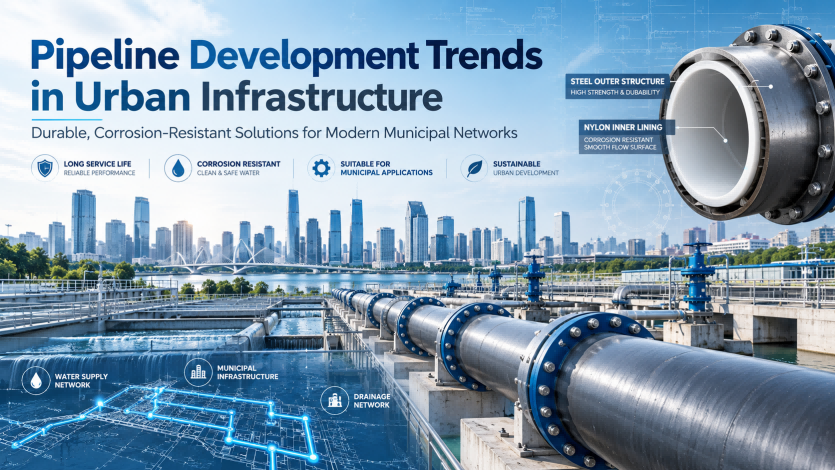
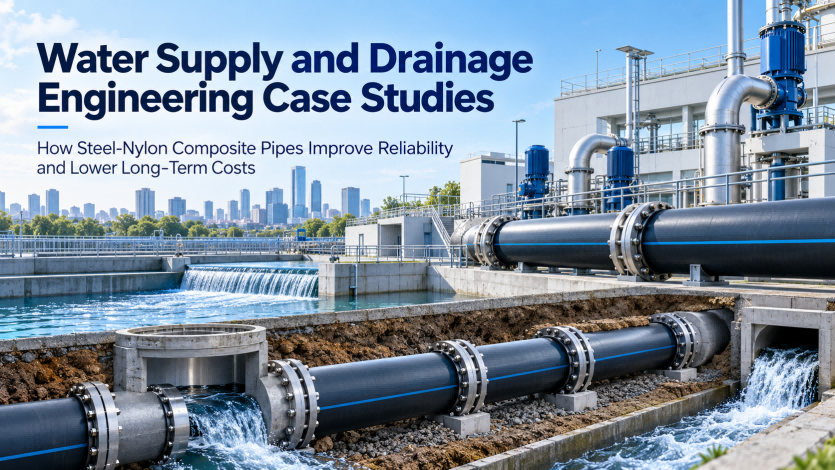
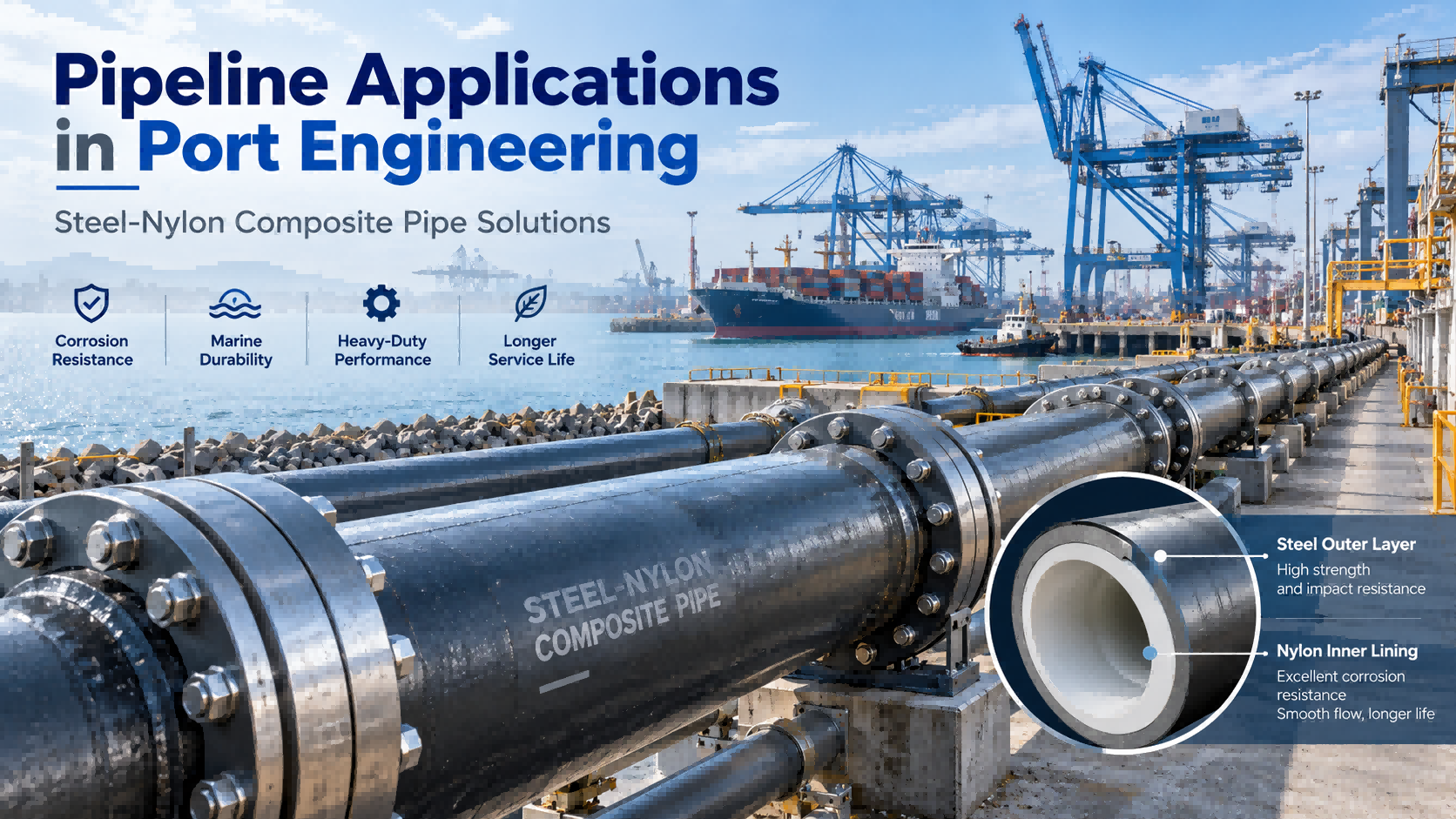
Corrosion-Resistant Piping Solutions for Coastal Areas: How Steel–Nylon Composite Pipes Address High Salinity, Humidity, and Harsh Corrosive Environments
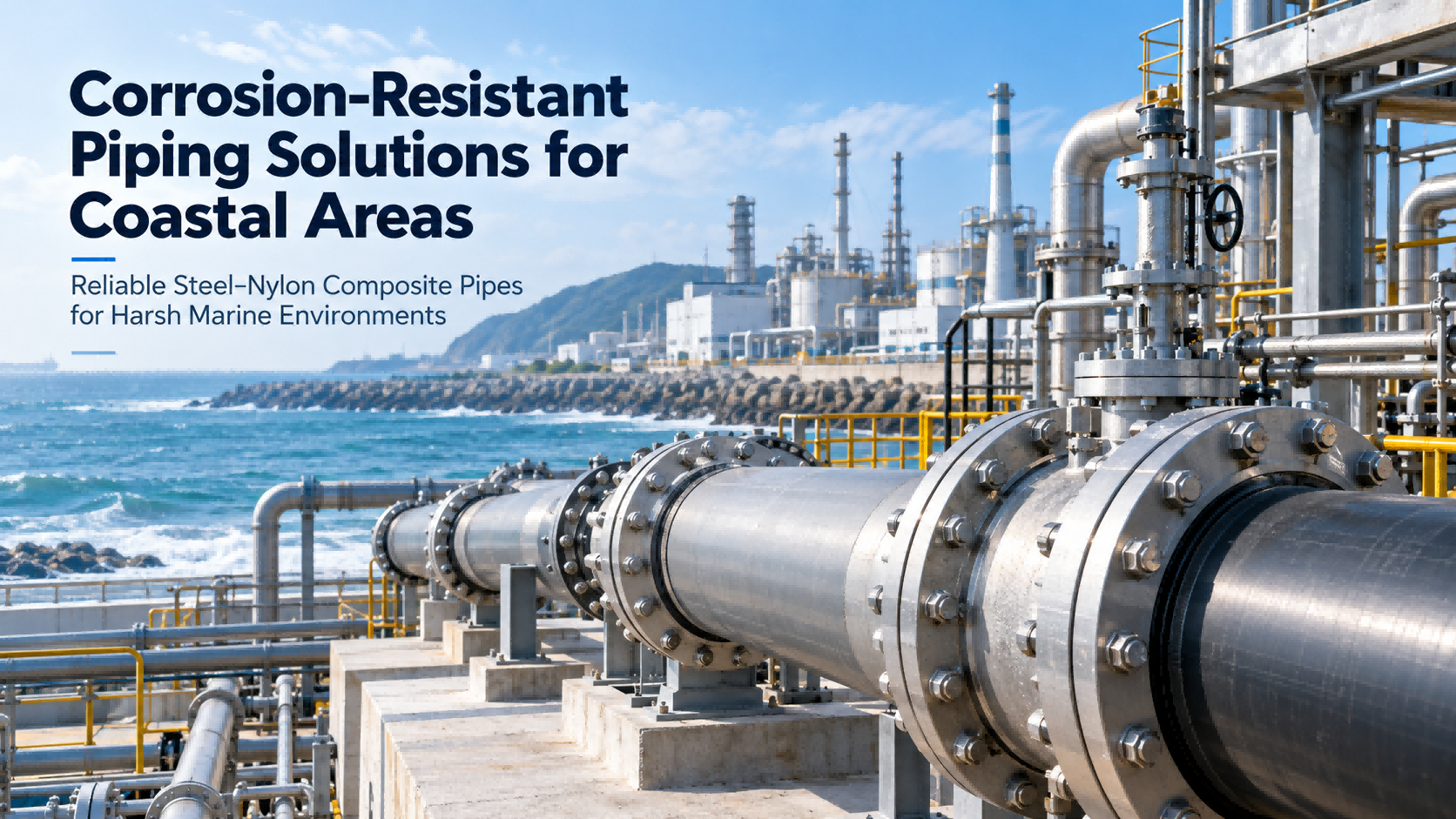
As coastal industrial parks, desalination facilities, port infrastructure, power plants, and petrochemical projects continue to expand worldwide, corrosion has become one of the most significant challenges affecting the reliability and service life of industrial piping systems.
Unlike pipelines installed in many inland industrial environments, coastal pipelines must withstand a combination of high salinity, persistent humidity, chloride exposure, seawater corrosion, pressure fluctuations, and, in some applications, abrasive particles.
Traditional carbon steel pipes are vulnerable to corrosion without adequate protection. Stainless steel pipes provide improved corrosion resistance in many applications, but certain grades remain susceptible to pitting and crevice corrosion in chloride-rich environments. Meanwhile, non-metallic alternatives such as HDPE and fiberglass-reinforced plastic (FRP) require careful consideration of pressure ratings, structural rigidity, temperature limitations, and connection design.
As a result, engineering companies and industrial operators are increasingly evaluating composite piping systems that combine corrosion resistance, wear resistance, mechanical strength, and long-term cost efficiency.
Steel–Nylon Composite Pipes offer a promising engineering solution by combining the structural strength of steel with the corrosion-resistant and wear-resistant properties of engineered nylon.
This article explores the major corrosion challenges facing coastal industrial facilities, compares common piping materials, and explains how steel–nylon composite pipes can contribute to reliable, cost-effective industrial fluid transportation.
1. Why Do Coastal Areas Require More Advanced Corrosion-Resistant Piping Systems?
Coastal industrial environments present unique challenges because pipes may be continuously exposed to salts, moisture, oxygen, and chemically aggressive media.
Understanding these corrosion mechanisms is essential for selecting the right piping material.
1.1 High Chloride Concentrations Increase the Risk of Metal Corrosion
Seawater contains significant concentrations of chloride ions (Cl⁻).
These ions affect not only pipes that transport seawater directly but also pipelines exposed to marine aerosols, saline groundwater, and chloride-contaminated soils.
In carbon steel piping systems, seawater and saline solutions can accelerate electrochemical corrosion.
For certain stainless steel grades, chloride ions may promote localized breakdown of the protective passive film, increasing the risk of pitting and crevice corrosion.
These problems are particularly important around:
-
Flanged connections and sealing surfaces
-
Welded joints and heat-affected zones
-
Areas where water accumulates
-
Dead legs and low-flow sections
-
Components exposed to stagnant seawater
Even 316L stainless steel cannot be considered completely resistant to corrosion under all seawater conditions.
Its suitability depends on temperature, chloride concentration, oxygen availability, flow conditions, and component geometry.
1.2 Marine Salt Spray Accelerates External Pipeline Corrosion
A pipeline does not need to transport seawater to experience serious corrosion in a coastal environment.
For example, a pipeline carrying ordinary industrial cooling water may be installed in a coastal chemical plant where the external surface is continuously exposed to salt-laden air.
Salt deposition, condensation, and repeated wet-dry cycles can gradually damage protective coatings and accelerate corrosion of exposed steel.
International standards such as ISO 9223 and ISO 12944 provide frameworks for evaluating atmospheric corrosivity and selecting appropriate protective coating systems.
Depending on local environmental conditions, highly aggressive coastal or offshore environments may fall within C5 or CX corrosivity categories.
Therefore, coastal pipeline design must address not only internal corrosion but also the protection of external steel surfaces, flanges, pipe supports, and fasteners.
1.3 Saline Groundwater and Coastal Soils Increase Underground Corrosion Risks
Many coastal industrial facilities are located in areas with high groundwater levels, saline soils, or groundwater influenced by seawater intrusion.
For buried metallic pipelines, corrosion risk is influenced by several factors, including:
-
Soil resistivity
-
Moisture content
-
Chloride concentration
-
Oxygen distribution
-
Stray electrical currents
-
Coating integrity
Under these conditions, conventional coatings alone may not always provide sufficient long-term protection.
Some projects require integrated corrosion-control strategies combining external coatings, cathodic protection, inspection, and maintenance.
1.4 Corrosion and Abrasion Often Occur Simultaneously
Industrial pipelines in coastal areas do not always transport clean seawater.
They may also carry suspended solids, sand, salt crystals, industrial wastewater, chemical additives, or other abrasive materials.
When particles repeatedly impact the internal pipe surface, particularly at elbows, tees, reducers, and pump discharge sections, abrasion and corrosion may occur together.
This creates a more demanding service environment.
Consequently, a reliable coastal industrial piping system should be evaluated using five key criteria:
Corrosion Resistance + Wear Resistance + Pressure Capability + Connection Reliability + Lifecycle Cost
2. Comparison of Common Corrosion-Resistant Pipe Materials for Coastal Applications
Several piping materials are commonly used in coastal industrial projects.
Each material has distinct advantages and limitations, and selection should never be based on purchase price alone.
| Pipe Material | Main Advantages | Key Considerations in Coastal Environments |
|---|---|---|
| Carbon Steel Pipes | High strength, established manufacturing technology, relatively low initial cost | Require reliable internal and external corrosion protection |
| 316L Stainless Steel Pipes | Good mechanical properties and corrosion resistance in many industrial environments | Susceptible to localized corrosion under certain chloride-rich conditions |
| HDPE Pipes | No metallic electrochemical corrosion, mature joining technology | Temperature limitations, creep behavior, thermal expansion, and structural support requirements |
| FRP Pipes | Lightweight and resistant to various corrosive media | Performance depends on resin selection, long-term loading, external forces, and joint design |
| Rubber-Lined Steel Pipes | Steel provides strength while the lining protects against selected corrosive or abrasive media | Lining integrity, aging, and maintenance require attention |
| Steel–Nylon Composite Pipes | Combine steel structural support with a corrosion-resistant, wear-resistant nylon inner layer | Require confirmation of chemical compatibility and protection of exposed steel components |
From an engineering perspective, steel–nylon composite pipes offer a different approach to corrosion management.
Instead of relying entirely on expensive corrosion-resistant alloys or requiring a single non-metallic material to carry all structural loads, a composite pipe distributes functions between its constituent materials.
The steel structure provides mechanical support, while the nylon layer helps protect the internal surface from compatible industrial fluids.
This combination is particularly attractive for applications where corrosion resistance, abrasion resistance, and mechanical performance must be considered together.
3. Why Are Steel–Nylon Composite Pipes a Promising Solution for Coastal Industrial Projects?
Steel–nylon composite pipes are engineered piping products that combine steel and nylon materials in a composite structure.
Depending on the product design, steel provides the primary structural support or pressure-bearing function, while the nylon inner layer creates a protective interface between the transported fluid and the steel structure.
This approach can address several limitations associated with conventional piping materials.
3.1 Nylon Inner Layers Help Reduce Internal Corrosion from Seawater and Saline Fluids
In conventional metallic piping systems, direct exposure to seawater, saline industrial water, and corrosive fluids can result in metal loss, corrosion-product accumulation, and localized leakage.
Steel–nylon composite pipes incorporate a continuous nylon inner layer designed to separate the transported medium from the underlying steel structure.
Unlike carbon steel, nylon does not undergo metallic electrochemical rusting.
When chemical compatibility, lining integrity, and joint sealing are properly verified, this design can help reduce internal corrosion risks.
Potential applications include:
-
Coastal industrial cooling-water transportation
-
Selected seawater transportation systems
-
Saline industrial water pipelines
-
Compatible industrial wastewater systems
-
Salt-processing and chemical-industry pipelines
However, nylon is not universally resistant to all chemicals.
Applications involving strong oxidizing agents, sodium hypochlorite, concentrated acids, or elevated temperatures require specific chemical compatibility assessments.
Long-term immersion behavior, moisture absorption, dimensional stability, and retention of mechanical properties should also be evaluated.
3.2 Steel Reinforcement Provides Mechanical Support for Industrial Pressure Requirements
Industrial pipelines used in coastal power plants, chemical complexes, and seawater treatment facilities must satisfy more than corrosion-resistance requirements.
They also need to accommodate operating pressure, pipe diameter, flow velocity, transient pressure loads, and external mechanical forces.
Steel–nylon composite pipes combine the mechanical support capability of steel with the internal protection characteristics of nylon.
This makes them worth evaluating for industrial applications requiring both pressure-bearing performance and corrosion resistance.
For projects with pressure requirements in the range of 1.0–4.0 MPa, suitable steel–nylon composite pipe configurations may be evaluated according to their specific structural design, diameter, temperature, and verified pressure rating.
However, a pressure rating established for one product size or configuration must not automatically be applied to all dimensions.
Engineering evaluations should include:
-
Design and operating pressure
-
Maximum transient pressure
-
Pipe diameter and wall thickness
-
Support spacing and external loading
-
Axial thrust forces
-
Thermal expansion and stress
-
Joint and flange pressure ratings
3.3 Wear-Resistant Nylon Helps Address Abrasive Industrial Fluids
Some coastal industrial projects face both corrosion and mechanical abrasion.
For example, seawater intake pipelines may transport sand and suspended solids.
Coastal chemical plants may handle industrial liquids containing crystallized particles, while industrial water systems near ports may encounter suspended sediment.
Engineered nylon materials can offer useful wear-resistant properties.
With appropriate lining thickness, product structure, and manufacturing processes, steel–nylon composite pipes can be designed for selected abrasive-fluid applications.
Potential benefits are particularly relevant in high-wear areas such as:
-
Pipeline elbows
-
Tees and reducers
-
Pump discharge pipelines
-
Sections exposed to turbulent flow
-
Pipelines carrying sand or suspended particles
Actual abrasion resistance depends on particle hardness, size, concentration, velocity, impact angle, and other operating conditions.
Therefore, material performance should be verified for the specific application rather than assuming that nylon outperforms every alternative wear-resistant material.
3.4 Smooth Internal Surfaces Can Support Efficient Fluid Transportation
Energy efficiency is another important factor in industrial pipeline selection.
Pumping energy requirements are influenced by pipe diameter, internal roughness, fluid velocity, pipeline length, and system configuration.
In metallic pipelines, internal corrosion products, deposits, and scale can increase hydraulic resistance over time.
Steel–nylon composite pipes have relatively smooth nylon inner surfaces, which may help maintain a stable flow passage under suitable operating conditions.
Compared with metallic pipelines experiencing severe internal corrosion, this can help reduce the risk of increasing flow resistance caused by corrosion-product accumulation.
This characteristic is especially relevant for continuous-duty systems such as:
-
Coastal power plant cooling-water pipelines
-
Large-diameter seawater transportation networks
-
Industrial circulating-water systems
-
Industrial water distribution pipelines
However, actual energy savings should always be calculated using project-specific hydraulic parameters rather than assumed solely from the pipe material.
3.5 Integrally Molded Flanges Support Reliable and Convenient Installation
Pipeline connections are critical to long-term system reliability, particularly in industrial environments where inspection, equipment replacement, and maintenance may be required.
Depending on the product design, our steel–nylon composite pipes can incorporate integrally molded flange configurations.
Properly engineered integral flange structures may provide several practical benefits:
-
Reduced requirements for certain on-site connection processes
-
Improved dimensional consistency of manufactured connections
-
Convenient connection to valves, pumps, and other equipment
-
Support for modular installation
-
Easier disassembly during planned maintenance
-
Reduced need for on-site hot work in selected applications
In coastal industrial facilities, flange-based installation can be particularly valuable in locations where welding activities are restricted or require extensive safety procedures.
Nevertheless, flange integrity also depends on gasket selection, sealing-surface design, bolt preload, installation quality, and operating conditions.
An integral flange alone does not guarantee leak-free performance.
3.6 Customizable Designs Support Large-Diameter Coastal Pipeline Projects
Large coastal industrial facilities frequently require pipelines capable of transporting substantial volumes of seawater, cooling water, process water, and industrial wastewater.
These systems may involve large pipe diameters, complex layouts, and non-standard connection requirements.
Steel–nylon composite pipes can be engineered with project-specific combinations of:
-
Nominal pipe diameter
-
Wall thickness
-
Steel structural configuration
-
Nylon lining thickness
-
Flange design
-
Elbows, tees, and special fittings
-
Installation and support arrangements
This customization capability is especially valuable in industrial retrofits, large-diameter pipeline systems, and applications involving localized corrosion or abrasion.
For larger pipe sizes, manufacturers and engineers must also verify pressure resistance, production quality, transportation limits, lifting arrangements, and on-site support requirements.
4. Five Major Applications of Steel–Nylon Composite Pipes in Coastal Areas
4.1 Seawater Desalination and Seawater Transportation
Seawater desalination facilities typically include several process stages:
-
Seawater intake
-
Pretreatment
-
Reverse osmosis or other desalination processes
-
Brine discharge
-
Treated-water transportation
Each stage has different operating requirements.
Steel–nylon composite pipes may be evaluated for selected seawater intake, pretreatment, and low- to medium-pressure transportation systems where the material is compatible with the service conditions.
Their advantages may include a combination of internal corrosion protection, steel reinforcement, and engineered flange connections.
However, reverse osmosis high-pressure lines, chemically aggressive pretreatment systems, and specialized discharge applications require independent assessment of pressure ratings and material compatibility.
4.2 Coastal Power Plants and Industrial Cooling-Water Systems
Coastal power plants often rely on large-volume cooling-water circulation systems.
These systems may transport seawater, industrial cooling water, or chemically treated process water.
Traditional steel pipes can experience internal corrosion, potentially increasing cleaning, maintenance, and replacement requirements.
Properly designed steel–nylon composite pipes may help reduce internal corrosion exposure while retaining the structural support provided by steel.
For continuously operating cooling-water systems, engineers may also evaluate the effect of long-term internal surface condition on hydraulic efficiency and pumping costs.
4.3 Coastal Chemical Parks and Salt-Chemical Industries
Coastal chemical complexes frequently handle saline solutions, industrial mother liquors, alkaline media, and high-salinity wastewater.
These applications can be more challenging than ordinary water transportation.
In addition to chloride concentrations, engineers must evaluate:
-
Operating temperature
-
Fluid pH
-
Chemical composition
-
Crystallization potential
-
Suspended solids
-
Deposits and scaling
-
Corrosion and abrasion mechanisms
Steel–nylon composite pipes may be considered for compatible saline solutions and selected chemical-process applications.
Their composite structure is particularly worth evaluating where both corrosion and abrasive particles affect pipeline reliability.
4.4 Port Infrastructure and Coastal Industrial Wastewater Systems
Pipelines in ports and coastal industrial facilities may experience external salt-spray exposure, internal industrial wastewater corrosion, and continuous mechanical wear.
For compatible industrial fluids, steel–nylon composite pipes can help separate the transported medium from the underlying steel structure.
When combined with suitable external protective coatings, flange protection, and corrosion-resistant support systems, they can form part of an integrated pipeline protection strategy.
4.5 Rehabilitation of Aging Coastal Industrial Pipelines
Many coastal industrial facilities operate piping networks that have been in service for decades.
Over time, some pipeline sections may suffer severe localized corrosion or repeated leakage.
Common problem areas include:
-
Pump discharge sections
-
Low points where fluids accumulate
-
Flanged connections
-
Pipeline elbows
-
Areas with damaged external coatings
Replacing an entire piping network is not always necessary.
A more targeted approach begins with identifying the actual failure mechanisms and prioritizing high-risk pipe sections.
Steel–nylon composite pipes can be evaluated as an alternative material for localized pipeline rehabilitation.
Pilot installations, performance monitoring, maintenance records, and operating data can then help determine whether broader replacement is technically and economically justified.
5. Key Engineering Considerations for Coastal Steel–Nylon Composite Piping Systems
Choosing a corrosion-resistant material is only the first step toward designing a reliable coastal pipeline system.
Long-term performance also depends on operating conditions, structural design, corrosion protection, installation quality, and inspection practices.
5.1 Evaluate Internal Fluid Chemistry
Before material selection, engineers should collect essential operating data, including:
-
Fluid composition
-
Salinity and chloride concentration
-
pH level
-
Maximum and minimum temperatures
-
Operating pressure
-
Suspended solids concentration
-
Chemical additives
-
Flow rate and velocity
For systems containing hypochlorites, disinfectants, or other strong oxidizing chemicals, the long-term chemical resistance of the nylon material must be specifically evaluated.
Chemical resistance testing methods such as ASTM D543 may provide useful supporting information when appropriate test conditions are selected.
5.2 Protect Exposed Steel Components Against External Corrosion
One of the most important considerations for steel–nylon composite pipes in coastal applications is the distinction between internal and external corrosion protection.
A corrosion-resistant nylon inner layer does not automatically make the external steel structure corrosion-resistant.
Steel surfaces exposed to coastal humidity, salt spray, or other aggressive environments require suitable protection.
Depending on the application, this may include:
-
Surface preparation
-
Protective coating systems
-
Corrosion protection for flange exteriors
-
Appropriate fastener protection
-
Corrosion-resistant support components
-
Regular inspection and maintenance
For buried or submerged metallic components, cathodic protection may also require evaluation, including its compatibility with the external coating system.
An integrated approach to internal and external protection is essential for long-term reliability.
5.3 Optimize Flange Connections and Sealing Systems
Flanged connections must provide both internal sealing performance and resistance to external environmental exposure.
Poor drainage, coating defects, incompatible metallic components, or unsuitable sealing materials can increase the risk of localized corrosion.
Engineers should select gasket materials, bolts, flange configurations, and protective systems according to the transported fluid, pressure, temperature, and installation environment.
Galvanic corrosion risks should also be assessed where dissimilar metals are used.
5.4 Verify Water Hammer, Pipe Supports, and Thermal Expansion
Large industrial pipeline systems may experience transient operating conditions caused by pump starts and stops, rapid valve closure, or changes in flow demand.
These events can create pressure surges above normal operating pressure.
Therefore, pipeline design should consider:
-
Maximum transient pressure
-
Water hammer analysis
-
Anchoring and pipe supports
-
Axial loads and thrust forces
-
Thermal expansion
-
Differential thermal behavior of composite materials
For steel–nylon composite pipes, long-term connection reliability should also be evaluated under expected temperature cycles and operating loads.
5.5 Establish Quality Control and Performance Monitoring
Reliable industrial piping requires more than selecting a suitable material.
Manufacturing quality and ongoing inspection are essential.
Depending on project requirements, quality control may include:
-
Raw material verification
-
Nylon lining inspection
-
Composite structure verification
-
Dimensional inspection
-
Flange quality checks
-
Hydrostatic pressure testing
-
Production documentation
After installation, operators should monitor pipeline leakage, pressure changes, abnormal flow behavior, external coating condition, and critical joints.
These measures help translate material performance into long-term operational reliability.
6. Lifecycle Cost Analysis: Can Steel–Nylon Composite Pipes Reduce 20-Year Pipeline Costs?
A common mistake in industrial pipe procurement is assuming that the lowest purchase price represents the lowest overall project cost.
In reality, coastal industrial piping should be evaluated using Total Cost of Ownership (TCO).
6.1 What Is Included in Pipeline Total Cost of Ownership?
A simplified TCO model is:
TCO = Initial Procurement and Installation Cost + Maintenance Cost + Replacement Cost + Downtime Losses + Energy Cost + Other Operating Costs
For coastal industrial pipelines, corrosion-related maintenance, replacement expenses, and production interruptions can represent substantial costs.
A pipe material with a higher initial purchase price may still provide better long-term economic performance if it reduces maintenance frequency, unexpected replacement, and downtime.
6.2 Illustrative 20-Year Pipeline Cost Comparison
Consider a hypothetical coastal industrial project requiring a 1,000-meter pipeline.
Two design options are compared:
Option A: Conventional coated steel piping system.
Option B: Steel–nylon composite piping system with appropriate external corrosion protection.
The following figures are hypothetical and provided solely to demonstrate lifecycle cost analysis. They are not actual product quotations, verified field performance results, or guaranteed savings.
| Cost Component | Option A: Conventional Steel | Option B: Steel–Nylon Composite |
|---|---|---|
| Initial Procurement and Installation | $100,000 | $125,000 |
| Annual Maintenance | $9,000 | $3,000 |
| Annual Downtime Losses | $4,000 | $1,000 |
| Additional Replacement in Year 12 | $50,000 | $0 |
| 20-Year Total, Undiscounted | $410,000 | $205,000 |
In this illustrative scenario, the steel–nylon composite piping system requires 25% more initial investment.
However, because the model assumes lower maintenance expenses, fewer downtime losses, and no additional major replacement, its 20-year undiscounted total cost is 50% lower.
If an annual discount rate of 8% is applied to the assumed payment schedule:
-
Conventional steel piping has a present-value cost of approximately $247,500.
-
Steel–nylon composite piping has a present-value cost of approximately $164,300.
-
The resulting present-value cost difference is approximately $83,200.
This example demonstrates an important principle:
The economic value of an industrial pipeline depends not only on the initial material price but also on maintenance requirements, replacement frequency, operating reliability, and long-term performance.
Actual savings must be established using verified project-specific procurement prices, operating records, testing results, and maintenance data.
Different operating conditions may produce substantially different economic outcomes.
6.3 Why Is TCO Particularly Important for Coastal Projects?
Pipeline maintenance in coastal industrial facilities often involves more than the direct cost of repair.
Unexpected leakage or pipeline failure may also result in:
-
Production interruptions
-
Emergency construction
-
Equipment damage
-
Environmental remediation
-
Additional inspection and maintenance
-
Increased operating risk
For continuously operating chemical plants, power stations, and seawater treatment facilities, unplanned shutdowns can be especially expensive.
Therefore, a composite piping solution may be economically attractive even when its initial procurement cost is not the lowest.
For international EPC contractors and industrial asset owners, evaluating pipeline alternatives over a 20- to 30-year planning horizon can provide a more useful basis for material selection than comparing unit prices alone.
7. How Should Overseas EPC Contractors Select a Coastal Corrosion-Resistant Pipe Supplier?
For international industrial piping projects, selecting a reliable supplier involves much more than comparing material specifications.
A capable manufacturer should understand real operating conditions, offer appropriate engineering support, maintain consistent manufacturing quality, and provide reliable project documentation.
Technical Understanding
A professional piping supplier should be able to evaluate the transported medium, operating pressure, temperature, corrosion risks, and abrasion conditions before recommending a material.
The objective should be to identify a technically suitable solution rather than simply quote a pipe diameter.
Product Structure and Manufacturing Quality
Buyers should understand the product's structural design, including the nylon layer, steel load-bearing components, external corrosion protection, and connection method.
Appropriate material specifications, inspection reports, and test documentation should be available for review.
Customization and Production Capabilities
Large industrial projects frequently require non-standard pipe dimensions, customized fittings, integral flange structures, and consistent batch production.
The supplier's ability to manufacture such products within the required tolerances and delivery schedule can significantly affect project execution.
International Project Support
Overseas EPC projects often require:
-
Technical drawings and product specifications
-
Material and inspection documentation
-
Quality assurance records
-
Packaging and shipping arrangements
-
Installation guidance
-
Technical communication during project execution
-
After-sales support
The real value of a steel–nylon composite pipe manufacturer lies not only in manufacturing pipes, but also in helping customers develop technically appropriate and cost-effective piping solutions for their specific operating conditions.
8. Future Trends in Corrosion-Resistant Piping for Coastal Industries
As coastal industrial infrastructure continues to develop, pipeline selection is gradually shifting from simple purchase-price comparisons toward system reliability, durability, and lifecycle economics.
8.1 From Corrosion Resistance Alone to Combined Corrosion and Wear Protection
Industrial fluids often create several forms of material degradation simultaneously.
A pipeline may need to resist chemical corrosion, particle abrasion, mechanical loading, and pressure fluctuations.
This is encouraging the development of composite piping systems that combine complementary material properties.
Steel–nylon composite pipes reflect this engineering approach by assigning different functions to steel and nylon.
8.2 From Frequent Repairs to Low-Maintenance Operations
Industrial operators increasingly prioritize equipment availability and the prevention of unplanned downtime.
Pipeline materials are therefore evaluated not only for initial strength but also for long-term internal protection, joint integrity, and maintenance requirements.
For compatible applications, composite pipes may help reduce maintenance associated with internal metallic corrosion.
8.3 From Standard Pipe Procurement to Customized Engineering Solutions
Future coastal industrial projects are likely to involve more demanding fluid compositions, higher transportation capacities, and stricter reliability requirements.
Different projects will require different combinations of materials, external protection systems, pipe fittings, and connection configurations.
Manufacturers capable of delivering customized products and engineering support will be better positioned to participate in complex international piping projects.
9. Frequently Asked Questions (FAQ)
Q1: Can 316L stainless steel completely eliminate corrosion problems in coastal pipelines?
No.
316L stainless steel provides good corrosion resistance in many industrial environments, but it may still experience localized corrosion under certain chloride-rich, high-temperature, or crevice conditions.
Its suitability must be evaluated against the specific operating environment.
Q2: Are steel–nylon composite pipes completely corrosion-proof?
No piping material should be considered universally corrosion-proof.
The nylon inner layer does not undergo metallic electrochemical corrosion and can help protect the underlying steel from compatible transported fluids.
However, exposed steel components still require external corrosion protection, and the chemical compatibility of nylon must be verified.
Q3: Are steel–nylon composite pipes suitable for seawater transportation?
Steel–nylon composite pipes may be suitable for selected seawater and saline industrial water applications.
However, engineering verification should include seawater chemistry, operating temperature, system pressure, chemical additives, disinfectant concentration, long-term immersion behavior, and joint reliability.
Q4: Can steel–nylon composite pipes last 50 years?
Actual service life depends on operating conditions, product design, manufacturing quality, installation practices, and maintenance.
A 50-year service-life claim should only be made when supported by appropriate long-term testing, relevant field performance data, or a reliable service-life assessment.
Without such evidence, a fixed service life should not be guaranteed.
Q5: Are steel–nylon composite pipes always better than HDPE or FRP pipes?
Not necessarily.
HDPE and FRP are established materials with important advantages in many seawater and industrial corrosion-control applications.
Steel–nylon composite pipes are particularly worth evaluating when corrosion resistance, wear resistance, steel structural support, and specific connection requirements must be considered together.
Final material selection should be based on technical suitability, project requirements, and total lifecycle cost.
10. Conclusion: A More Integrated Approach to Coastal Corrosion-Resistant Piping
Industrial pipelines in coastal areas operate under challenging conditions involving seawater, salt spray, persistent humidity, aggressive process fluids, and continuous mechanical loading.
Traditional carbon steel, stainless steel, HDPE, FRP, and composite piping systems each have suitable application areas.
No single material provides the best performance under every coastal operating condition.
However, for industrial projects requiring a combination of structural strength, internal corrosion resistance, and wear protection, steel–nylon composite pipes represent a valuable engineering alternative worth considering.
By combining steel reinforcement with an engineered nylon inner layer, and integrating appropriate external corrosion protection, connection design, and quality control, these systems can help project teams pursue reliable and economically competitive industrial fluid transportation.
The ultimate objective of coastal pipeline material selection is not simply to purchase the cheapest pipe.
It is to achieve the best balance between engineering suitability, operational safety, long-term reliability, and total cost of ownership.
Looking for a Reliable Corrosion-Resistant Piping Solution for Your Coastal Project?
Whether you are developing a seawater transportation system, coastal chemical pipeline, industrial cooling-water network, saline-water transfer system, or pipeline rehabilitation project, choosing the right piping material is essential to long-term performance.
As a manufacturer specializing in Steel–Nylon Composite Pipes, we focus on providing industrial piping solutions that combine mechanical strength, corrosion resistance, wear protection, and customizable engineering design.
Our team can assist with product selection and technical evaluation based on your project requirements.
To discuss your application, please provide:
-
Required pipe diameter (DN)
-
Design and operating pressure
-
Operating temperature
-
Transported fluid and chemical composition
-
Pipeline length
-
Installation environment
-
Special corrosion or abrasion requirements
We aim to provide more than industrial piping products. Our goal is to help customers identify reliable, application-specific solutions that balance engineering performance with long-term economic value.
Contact Us Today to Discuss Your Coastal Corrosion-Resistant Piping Project.
Steel–Nylon Composite Pipes — Engineered for Corrosion Resistance, Wear Protection, and Long-Term Industrial Performance.
Municipal Water Supply Pipe Material Comparison: Ductile Iron, HDPE, PVC, Stainless Steel, and Steel–Nylon Composite Pipes
Recommended Pipes for Seawater Desalination Projects: How to Choose Corrosion-Resistant, Wear-Resistant, and Long-Life Piping Systems 1. Introduction: Why Pipeline Selection Matters in Seawater Desalination Projects