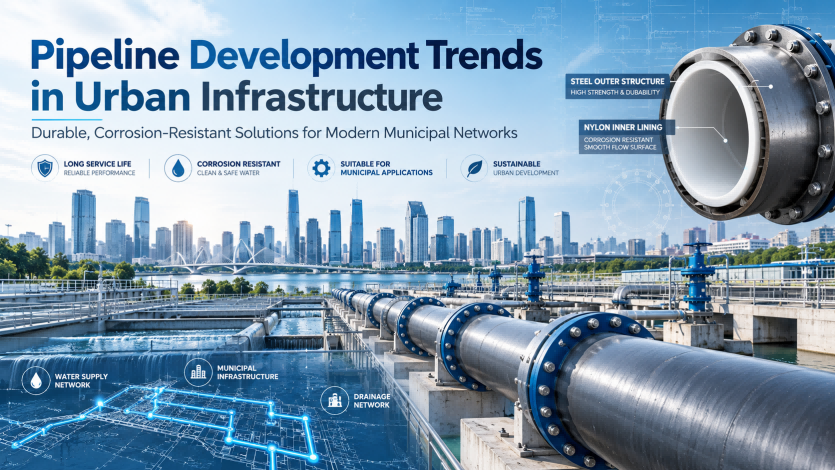
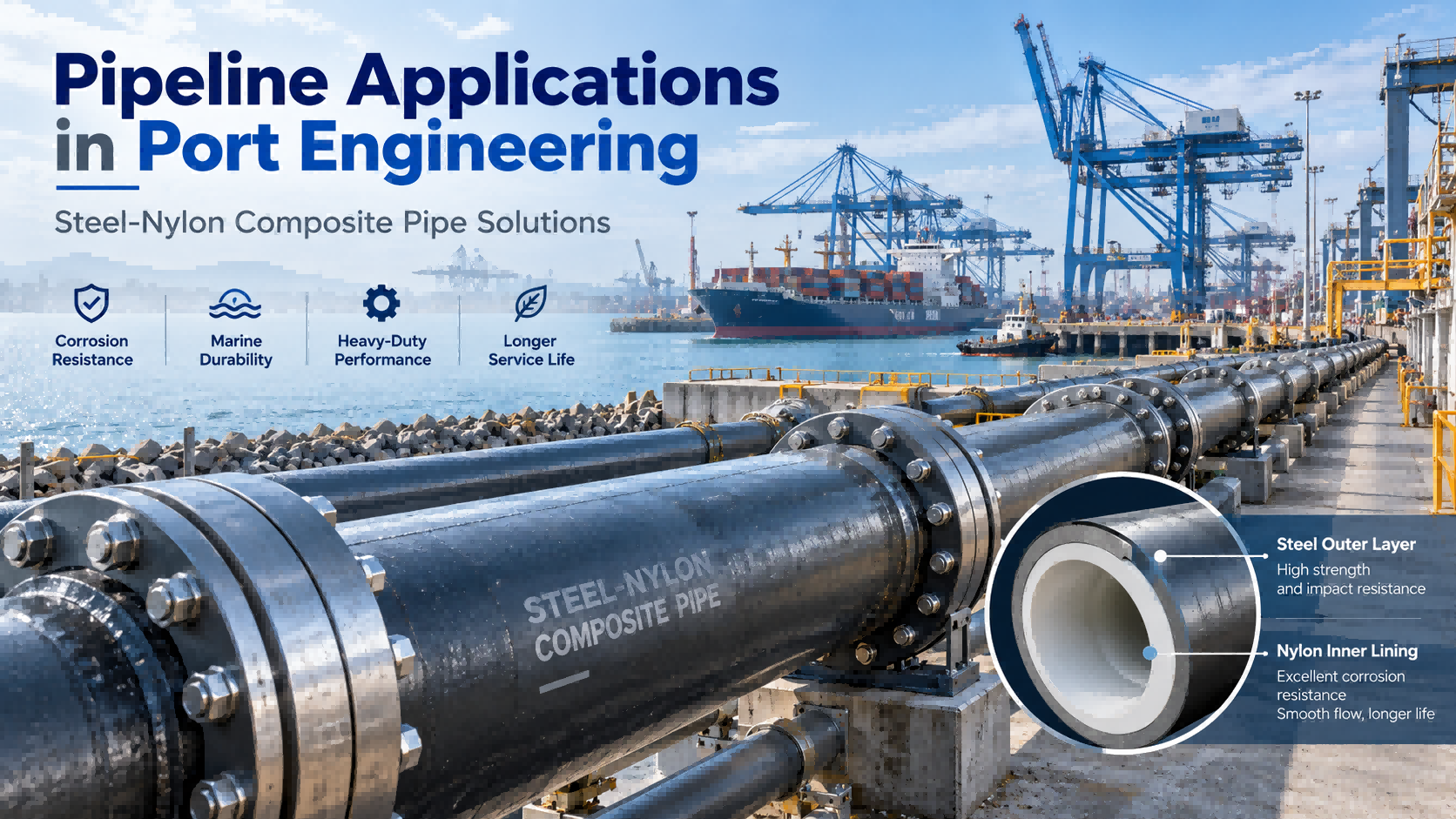
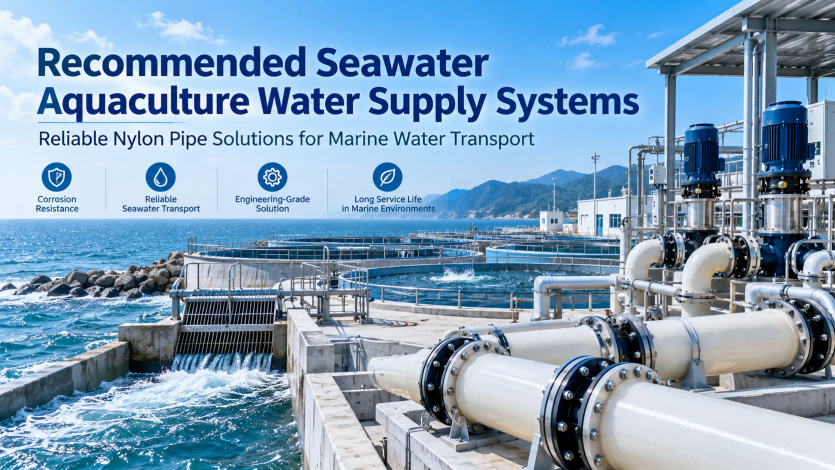
Water Supply & Drainage Case Studies | Steel-Nylon Solutions
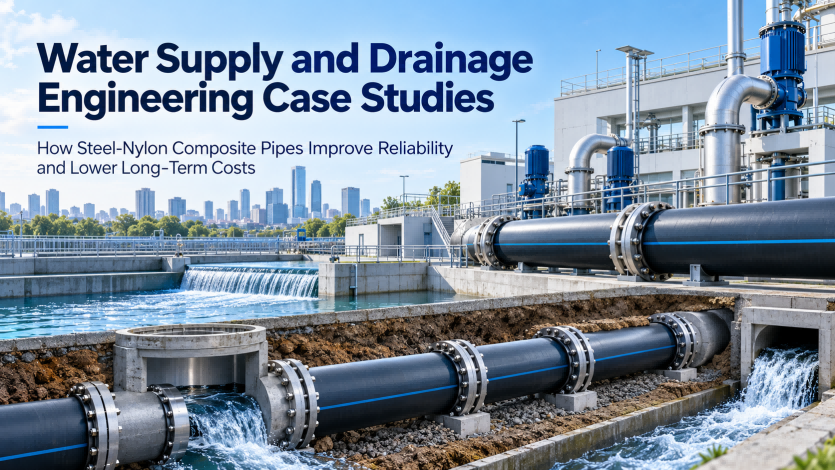
Water Supply and Drainage Engineering Case Studies: How Steel-Nylon Composite Pipes Improve Reliability and Reduce Long-Term Costs
Introduction: Water Infrastructure Is Shifting Toward Lifecycle Performance
In municipal infrastructure, industrial parks, and large-scale water engineering projects, water supply and drainage pipelines do much more than transport water. They directly influence system safety, energy consumption, maintenance expenses, and long-term operational efficiency.
Traditionally, the initial purchase price of piping materials has been a major factor in engineering procurement decisions. However, as underground pipeline networks age, corrosion environments become more challenging, and infrastructure owners demand greater operational reliability, engineers are increasingly reconsidering how pipeline materials should be evaluated.
For large-scale water supply and drainage projects, the critical question is no longer simply "Which pipe material should we use?"
Instead, engineers and project owners must address several important challenges:
-
How can internal corrosion and pipeline leakage be minimized?
-
How can pipelines withstand pressure fluctuations and water hammer?
-
How can pipe wall abrasion caused by suspended solids and sediment be reduced?
-
How can installation be completed within demanding construction schedules?
-
How can maintenance and replacement costs be controlled over the next 20–30 years?
Steel-nylon composite pipes combine the structural strength of steel with the corrosion-resistant and wear-resistant characteristics of nylon materials, offering an alternative solution for demanding water transmission and drainage applications.
This article examines three representative engineering scenarios—municipal water transmission, industrial wastewater drainage, and coastal water infrastructure—to explain the limitations of conventional piping systems, the potential advantages of steel-nylon composite pipes, and the technical considerations that influence material selection.
Case Study Disclaimer: The following examples are illustrative engineering scenarios designed to demonstrate material selection methods and potential project benefits. They should not be interpreted as verified construction references or documented operating results from completed projects.
1. Why Do Conventional Water Supply and Drainage Systems Need Upgrading?
1.1 Internal Corrosion Is a Major Threat to Pipeline Reliability
In conventional carbon steel water transmission systems, several factors can influence corrosion behavior, including:
-
Water chemistry and dissolved oxygen
-
Chloride concentration
-
Flow velocity
-
Operating temperature
-
Variations in water quality
Corrosion prevention becomes particularly important in environments such as:
-
Coastal regions with saline groundwater
-
Industrial cooling water systems
-
Industrial wastewater containing chlorides
-
Industrial parks with fluctuating water quality
-
Continuously operating pressurized water transmission systems
Localized corrosion in carbon steel pipelines can cause wall thinning, perforation, leakage, and, in severe cases, structural failure.
The United States Environmental Protection Agency (EPA) also recognizes pipeline corrosion, material release, and water quality changes as important considerations in drinking water distribution systems.
Consequently, modern pipeline engineering must consider both structural load-bearing capacity and the long-term corrosion resistance of surfaces exposed to transported fluids.
1.2 Scaling and Sediment Accumulation Increase Operating Costs
During long-term operation, water pipelines may experience internal deposits caused by corrosion products, mineral scaling, and suspended particles.
As deposits accumulate or internal surface roughness increases, pipelines may develop several performance problems:
-
Increased hydraulic head loss
-
Higher pumping energy consumption
-
Reduced effective flow capacity
-
Greater risk of localized blockage
-
More frequent cleaning and maintenance
For large pumping stations and long-distance water transmission networks, maintaining stable hydraulic performance is an important economic consideration.
1.3 Pipeline Connections Can Become Critical Weak Points
In large steel pipeline projects, field welding, weld inspection, and corrosion protection of welded joints can account for a significant portion of construction activities.
These tasks become particularly challenging in underground pipeline corridors, confined spaces, and high-humidity environments.
Improperly installed joints, damaged sealing components, or discontinuities in protective linings may increase the risk of leakage and localized corrosion.
Therefore, pipeline reliability depends not only on straight pipe sections but also on elbows, tees, flanges, gaskets, and installation quality.
2. Case Study One: Municipal Pressurized Water Transmission Pipeline Upgrade
2.1 Project Background
Consider a hypothetical municipal project involving the replacement of an aging pressurized water transmission pipeline serving industrial facilities and municipal water infrastructure.
The pipeline is located in an area with relatively high groundwater levels. During operation, it experiences pressure fluctuations, while maintenance requirements for the existing network have gradually increased.
Illustrative Project Specifications
| Parameter | Engineering Condition |
|---|---|
| Application | Municipal and industrial pressurized water supply |
| Nominal diameter | DN600 |
| Pipeline length | 1,200 meters |
| Normal operating pressure | 0.6–0.8 MPa |
| Transported medium | Treated industrial supply water |
| Installation method | Underground installation |
| Major risks | Internal corrosion, joint leakage, external corrosion, pressure fluctuations |
| Evaluation period | 30 years |
These parameters are provided solely to illustrate the engineering selection process.
Actual pipeline design must also consider maximum transient pressure, soil conditions, burial depth, external loading, and applicable engineering standards.
2.2 Challenges Associated with Conventional Steel Pipelines
If conventional carbon steel pipes are selected, engineers must carefully evaluate three major issues.
1. Long-Term Integrity of Internal Corrosion Protection
Traditional steel pipes generally require suitable internal linings or coatings to control corrosion.
The effectiveness of these systems depends on material selection, surface preparation, application quality, fluid characteristics, and possible damage during operation.
2. External Corrosion in Buried Pipelines
Soil moisture, electrical resistivity, salinity, and stray currents can influence the external corrosion risk of buried steel pipelines.
Consequently, external corrosion protection must be considered independently from the internal lining system.
3. Installation and Future Maintenance
For underground municipal pipelines, repair expenses may include much more than replacement pipe materials.
Additional costs may involve:
-
Road excavation
-
Traffic management
-
Water supply interruption
-
Trench restoration
-
Labor and equipment
-
Post-repair inspection
Therefore, comparing only the initial pipe purchase price can substantially underestimate long-term infrastructure expenses.
2.3 Steel-Nylon Composite Pipe Solution
Provided that project pressure requirements, fluid compatibility, and relevant regulatory requirements are satisfied, steel-nylon composite pipes can be included in the material evaluation process.
A typical steel-nylon composite pipe combines:
An external steel pressure-bearing structure with an internal reinforced nylon functional layer.
These two materials perform complementary functions.
The steel structure primarily provides:
-
Pressure-bearing capacity
-
High structural rigidity
-
Resistance to external loads within the designed operating conditions
-
Mechanical support for large-diameter piping systems
The reinforced nylon inner layer primarily provides:
-
Separation between the transported fluid and the steel structure
-
Reduced direct exposure of steel to potentially corrosive fluids
-
A relatively smooth internal fluid-contact surface
-
Potential improvement in resistance to particle-related wear under suitable operating conditions
The key engineering advantage of this composite structure is the separation of structural strength and internal fluid protection functions.
For a DN600 pressurized water pipeline, engineers can independently evaluate the strength of the steel structure, the chemical resistance of the nylon lining, and the sealing reliability of the connection system.
2.4 Flanged Connections and Installation Efficiency
Our steel-nylon composite pipes can be supplied with compatible flanged connection systems according to project specifications.
Compared with conventional steel pipeline construction methods that require extensive field welding and corrosion-protection repairs at welded joints, prefabricated flanged connections may offer several practical advantages.
-
Reduced field welding requirements.
-
Easier assembly of prefabricated pipe sections and fittings.
-
Simplified management of certain on-site hot-work activities.
-
Improved accessibility when replacing valves, equipment, or individual pipe sections.
However, flanged connections do not eliminate installation risks.
Flange surface flatness, gasket compatibility, bolt tightening procedures, pipeline alignment, structural support, and settlement control remain essential factors in construction quality management.
2.5 Expected Engineering Value and Performance Indicators
If properly designed and verified steel-nylon composite pipes are selected, their potential benefits should be assessed using measurable engineering indicators.
| Evaluation Area | Key Performance Indicators |
|---|---|
| Corrosion resistance | Nylon lining integrity and joint protection continuity |
| Structural safety | Hydrostatic strength, water hammer, buried loading |
| Hydraulic performance | Actual internal diameter, design flow, head loss |
| Installation efficiency | Installation time per section, joint assembly time |
| Maintenance expenses | Inspection frequency, leakage repair costs |
| Long-term performance | Pressure retention, sealing condition, lining changes |
Important: A longer pipeline service life must be demonstrated through product testing, construction quality control, and long-term operating evidence. It should not be assumed based solely on the type of pipe material.
For municipal water infrastructure, the principal value of steel-nylon composite pipes lies in providing a technical option that combines mechanical strength with internal corrosion protection.
3. Case Study Two: Industrial Park Wastewater Drainage Pipeline Rehabilitation
3.1 Operating Conditions
Consider an industrial park planning to upgrade a centralized drainage pipeline.
The system transports treated industrial wastewater containing varying amounts of suspended solids.
Illustrative Operating Conditions
| Parameter | Engineering Condition |
|---|---|
| Nominal diameter | DN400 |
| System type | Pressurized industrial wastewater drainage |
| Normal operating pressure | 0.4 MPa |
| Transported medium | Treated wastewater containing suspended solids |
| Main challenges | Corrosion, particle abrasion, localized sediment accumulation |
| Critical locations | Elbows, reducers, valves, pump discharge sections |
In this type of application, the major challenge is that corrosion and abrasion may occur simultaneously.
3.2 How Corrosion and Abrasion Interact
When fluids containing solid particles move through pipelines, particles may strike or slide along internal pipe surfaces.
Local wear can become more significant at:
-
Elbows
-
Tees
-
Reducers
-
High-velocity flow sections
-
Locations with substantial changes in flow direction
In certain conventional metallic pipelines, abrasive particles may damage protective coatings or linings, exposing the underlying metal to corrosive fluids.
This can create a progressive deterioration process:
Particle impact → Protective layer damage → Steel exposure → Localized corrosion → Further pipe wall deterioration
Consequently, industrial wastewater pipe selection should consider both corrosion resistance and abrasion resistance rather than evaluating these properties independently.
3.3 Engineering Advantages of Reinforced Nylon Linings
Our steel-nylon composite pipes use an internal reinforced nylon layer to protect the steel structure.
When material compatibility and abrasion performance have been verified for the intended application, this structure may provide three important advantages.
1. Reduced Direct Contact Between Corrosive Fluids and Steel
When the nylon lining remains continuous, intact, and chemically compatible with the transported fluid, it reduces direct exposure of the pressure-bearing steel structure to potentially corrosive media.
2. Improved Suitability for Certain Abrasive Conditions
Nylon materials offer useful toughness and wear-related characteristics.
However, actual abrasion resistance depends on several factors, including:
-
Nylon grade and formulation
-
Particle hardness
-
Particle size
-
Solids concentration
-
Flow velocity
-
Particle impact angle
For elbows and other high-wear sections, representative laboratory testing or project-specific engineering validation is recommended.
3. Corrosion Protection Across the Complete Piping System
By supplying compatible elbows, tees, reducers, and flanged components, the protective design can be extended beyond straight pipe sections.
A pipeline system in which straight pipes have corrosion-resistant linings but fittings and connections remain unprotected may still experience premature failures at critical locations.
3.4 Engineering Design Recommendations
For wastewater systems containing suspended solids, project engineers should evaluate:
-
Fluid pH and operating temperature
-
Chloride content, oxidizing agents, and other chemical components
-
Particle concentration, size, and hardness
-
Maximum and minimum operating flow velocities
-
Pressure fluctuations during pump startup and shutdown
-
Local abrasion risks at elbows and fittings
Special attention should also be given to the moisture absorption behavior, dimensional changes, and long-term water exposure performance of PA6-based nylon materials.
If the transported wastewater contains strong oxidizing chemicals or other substances that may be incompatible with nylon, dedicated chemical compatibility testing is necessary.
Key Engineering Insight: For industrial wastewater systems, the critical question is not whether a pipe can resist corrosion or abrasion during a short laboratory test. It is whether the complete piping system can maintain its integrity under the combined effects of actual fluid chemistry, pressure, flow velocity, and operating duration.
4. Case Study Three: Coastal Water Supply and Drainage Infrastructure Upgrade
4.1 Engineering Challenges in Coastal Environments
Coastal cities, port industrial parks, and seawater utilization facilities face particularly demanding corrosion conditions.
Common environmental factors include:
-
High chloride concentrations in soil and groundwater
-
Elevated atmospheric humidity
-
Exposure to seawater or saline industrial water
-
Continuously damp operating environments
-
Large-scale water transmission systems requiring structural stability
These factors make internal and external corrosion protection essential elements of pipeline design.
4.2 Material Selection Challenges
Different conventional piping materials offer distinct advantages and limitations.
Carbon Steel Pipes
Carbon steel provides excellent mechanical strength and is widely used in pressure pipelines.
However, appropriate internal and external corrosion protection systems are generally required in aggressive environments.
Stainless Steel Pipes
Stainless steel offers corrosion resistance in many applications.
However, performance varies significantly among stainless steel grades, particularly in chloride-containing environments where pitting and crevice corrosion may occur.
HDPE Pipes
HDPE and other polymer-based pipes provide good corrosion resistance for many fluids.
However, large-diameter or higher-pressure applications require careful evaluation of wall thickness, ring stiffness, long-term deformation, and connection design.
FRP Pipes
Fiberglass-reinforced plastic pipes offer corrosion resistance and relatively low weight.
Their suitability depends on structural design, resin selection, joint performance, transportation conditions, and installation quality.
No single pipe material is suitable for every coastal water infrastructure project.
4.3 Potential Benefits of Steel-Nylon Composite Pipes
Under compatible coastal operating conditions, steel-nylon composite pipes can use their internal nylon functional layer to reduce direct contact between saline fluids and the steel structure.
At the same time, the steel body provides mechanical support and pressure-bearing capability.
For large-diameter pressurized water transmission systems, this composite configuration can be considered alongside conventional steel, polymer, and fiberglass piping solutions.
However, an important distinction must be made:
An internal nylon lining helps protect the steel from transported fluids, but it does not automatically prevent external steel corrosion.
Buried or exposed steel-nylon composite pipes in coastal environments still require suitable external corrosion protection.
Depending on the conditions, additional measures may include:
-
External protective coatings
-
Cathodic protection evaluation
-
Electrical isolation measures
-
Corrosion monitoring programs
-
Periodic inspections
Only when internal protection, external corrosion control, and joint sealing are designed as an integrated system can the potential advantages of composite piping be fully realized.
5. Technical Comparison: Steel-Nylon Composite Pipes vs. Conventional Piping Materials
The following comparison summarizes general engineering characteristics of commonly used piping systems.
Actual performance depends on material grade, manufacturing quality, product specifications, and project conditions.
| Performance Factor | Carbon Steel Pipe | HDPE Pipe | FRP Pipe | Steel-Nylon Composite Pipe |
|---|---|---|---|---|
| Structural rigidity | High | Depends on pipe class and construction | Depends on design | High rigidity from steel structure |
| Internal corrosion resistance | Typically requires lining or coating | Good compatibility with many fluids | Depends on resin system | Reinforced nylon lining provides a protective barrier |
| External corrosion resistance | Requires environmental protection | Not subject to metallic electrochemical corrosion | Generally good | External steel still requires protection |
| Abrasion resistance | Depends on steel grade and surface treatment | Depends on application | Depends on liner and resin system | Can be designed for selected abrasive applications |
| Large-diameter pressure applications | Established engineering use | Requires evaluation of wall thickness and long-term behavior | Requires structural and joint verification | Steel pressure-bearing structure offers potential advantages |
| Connection methods | Welding, flanges, others | Butt fusion, electrofusion, flanges | Socket joints, flanges | Compatible flanged connections |
| Maintenance considerations | Depends on protection and operating conditions | Depends on joints and operating conditions | Depends on structural integrity | Lining, flange sealing, and external protection |
| Initial cost | Specification-dependent | Specification-dependent | Specification-dependent | Requires project-specific quotation |
This comparison highlights an important point.
Steel-nylon composite pipes are not intended to replace every conventional piping material.
Instead, they offer a potentially competitive solution where pressure resistance, corrosion protection, abrasion resistance, and large-diameter requirements must be considered together.
For low-pressure gravity drainage projects with relatively benign water chemistry and strict budget limitations, established non-metallic or concrete pipe solutions may be more economical.
Effective material selection must always begin with the actual engineering requirements.
6. Total Cost of Ownership: Why Initial Purchase Price Is Not the Only Factor
6.1 Understanding the Real Cost of Water Pipeline Infrastructure
For major water infrastructure projects, total pipeline expenditure can be divided into five primary categories:
Total Cost of Ownership (TCO) = Initial Procurement Cost + Installation Cost + Operating Energy Cost + Maintenance and Repair Cost + Failure and Replacement Cost
For continuously operating water transmission systems, indirect losses associated with water interruptions may also need to be considered.
These costs can be particularly significant in industrial facilities where an interruption to water supply may affect production operations.
6.2 Illustrative Lifecycle Cost Comparison
Consider a hypothetical pressurized water pipeline rehabilitation project.
Assume that the initial procurement and installation cost of a steel-nylon composite pipe solution is CNY 400,000 higher than that of a conventional steel pipeline alternative.
For illustration, assume the following annual expenses:
-
Conventional steel pipeline: CNY 110,000 in average maintenance, repair, and associated downtime losses.
-
Steel-nylon composite pipeline: CNY 60,000 in corresponding annual expenses.
-
Both alternatives operate under comparable conditions and are evaluated using the same cost boundaries.
Estimated Annual Cost Difference
CNY 110,000 − CNY 60,000 = CNY 50,000 per year
Simple Payback Period
CNY 400,000 ÷ CNY 50,000 = 8 years
Under these hypothetical conditions, the additional initial investment could be recovered over approximately eight years through reduced operating and maintenance expenses.
However, these figures are illustrative and do not establish that steel-nylon composite pipes will achieve these specific savings in real projects.
Actual financial analysis should consider:
-
Discount rate
-
Probability of maintenance events
-
Energy consumption
-
Expected service life
-
Major replacement expenses
-
Potential production interruption losses
-
Sensitivity to different cost assumptions
For more rigorous evaluation, engineers and procurement teams should use a net present value (NPV) model rather than relying exclusively on a simple payback calculation.
6.3 Why Maintenance Costs Deserve Special Attention
The financial consequences of pipeline failure frequently extend beyond the cost of the damaged pipe section.
For example, a leakage incident beneath a major municipal road may require:
-
Isolating the affected pipeline and interrupting water service.
-
Excavating the road and exposing the damaged section.
-
Repairing or replacing the affected pipeline.
-
Performing pressure testing and restoring operation.
-
Reconstructing the road and associated infrastructure.
For industrial facilities, an additional consequence may be temporary production interruption.
Therefore, improving pipeline reliability may create economic value beyond direct material and installation savings.
7. How Should Engineering Consultants and EPC Contractors Evaluate Steel-Nylon Composite Pipes?
Engineering consultants and EPC contractors generally require more than product descriptions before approving alternative piping materials.
A systematic technical verification process is essential.
7.1 Pressure and Structural Verification
Depending on project requirements, engineers should evaluate:
-
Design pressure and maximum transient pressure
-
Steel wall thickness and mechanical strength
-
Pipe supports, buried loads, and structural stability
-
Positive and negative pressure conditions
-
Flange and fitting pressure-bearing capacity
-
Hydrostatic testing and pressure cycling performance
The rated pressure of a product must be compatible with the actual design conditions.
7.2 Nylon Lining Performance Verification
Important properties of the reinforced nylon layer include:
-
Chemical compatibility with transported fluids
-
Mechanical performance after prolonged immersion
-
Moisture absorption and dimensional stability
-
Long-term temperature and pressure effects
-
Abrasion resistance
-
Lining thickness and defect inspection
-
Protection continuity at pipe ends and connections
For nylon-based composite systems, long-term water exposure requires particular attention.
Short-term material test results should not automatically be interpreted as proof of the complete pipeline system's service life.
7.3 Drinking Water Compliance
When pipelines are intended for potable water distribution, mechanical strength and corrosion resistance alone are not sufficient.
Materials that come into contact with drinking water must comply with applicable public health and regulatory requirements in the destination market.
For example, NSF/ANSI/CAN 61 addresses health-related effects associated with contaminants that may be released into drinking water from system components.
Products and wetted components intended for drinking water applications should have appropriate testing or certification evidence when required by the project and applicable regulations.
7.4 Installation Quality Control
During construction, inspection should focus on:
-
Transportation damage to pipes and flanges
-
Integrity of nylon lining at pipe ends
-
Condition of flange sealing surfaces and gaskets
-
Bolt tightening procedures
-
Pipeline alignment and joint concentricity
-
Trench foundation, backfilling, and supports
-
External corrosion protection integrity
-
Post-installation pressure and leakage tests
A comprehensive installation and quality control program can be just as important as the intrinsic performance of the pipe material.
8. What Can Our Steel-Nylon Composite Pipes Offer Water Supply and Drainage Projects?
As a manufacturer of steel-nylon composite pipes, we focus not only on the performance of individual pipe sections but also on the reliability of complete piping systems operating under challenging conditions.
8.1 Combining Steel Strength with Reinforced Nylon Protection
Our composite piping concept combines a steel pressure-bearing structure with an internal reinforced nylon layer.
When appropriately designed and verified, this structure helps balance mechanical strength, corrosion protection, and abrasion-related requirements.
8.2 Manufacturing Capabilities for Large-Diameter Water Transmission
Based on our existing product portfolio, customized piping solutions can be developed for different nominal diameters and pressure requirements.
Our product range includes pressure classes of approximately 1.0–4.0 MPa and manufacturing capabilities for large-diameter pipes, including DN2000 and above.
However, pipe diameter, pressure class, and operating temperature must be evaluated together.
The maximum values of these parameters should not be assumed to be simultaneously achievable in a single pipe configuration.
8.3 Flanged Connections and Matching Pipe Fittings
Depending on project specifications, we can provide:
-
Steel-nylon composite straight pipes
-
Matching elbows
-
Tees
-
Reducers
-
Flanged connection assemblies
-
Customized equipment connection sections
By coordinating the design of pipes and fittings, we aim to improve system consistency and reduce compatibility issues between different materials and connection structures.
8.4 Technical Support for Different Fluid Conditions
Water supply and drainage projects operate under widely varying conditions.
Our technical support can consider:
-
Fluid composition
-
Operating temperature
-
Design pressure
-
Flow velocity
-
Pipe diameter
-
Installation environment
-
Target service life
For special fluids or demanding projects, final material selection should be supported by appropriate testing and engineering evidence.
8.5 Focusing on Long-Term Operational Value
Our product development philosophy is not simply to provide the lowest initial material cost.
Instead, we aim to help project owners evaluate:
System Reliability + Installation Practicality + Maintenance Requirements + Operational Efficiency + Total Lifecycle Cost
This approach is particularly relevant for infrastructure projects where corrosion, abrasion, and maintenance expenses represent significant operating challenges.
9. Frequently Asked Questions About Steel-Nylon Composite Pipes in Water Engineering
Q1: Are steel-nylon composite pipes suitable for municipal water supply systems?
Steel-nylon composite pipes can be considered for municipal water supply applications when pressure requirements, structural design, fluid compatibility, and relevant engineering regulations are satisfied.
For potable water applications, compliance with applicable drinking water contact material requirements is also essential.
Q2: Can steel-nylon composite pipes transport industrial wastewater?
Steel-nylon composite pipes may be suitable for certain industrial wastewater applications involving saline fluids, suspended particles, or corrosive media.
However, actual suitability depends on fluid composition, chemical concentration, temperature, and operating conditions.
A project-specific compatibility assessment is recommended.
Q3: Can steel-nylon composite pipes completely prevent corrosion?
No.
A continuous, compatible, and intact nylon lining can reduce direct contact between the transported fluid and the steel structure.
However, external steel surfaces, flanges, connections, and damaged areas still require appropriate corrosion protection and inspection.
Q4: What installation advantages do steel-nylon composite pipes offer compared with traditional steel pipes?
Properly designed prefabricated flanged connections may reduce certain on-site welding and corrosion-protection repair activities.
Actual installation efficiency depends on pipe section length, lifting equipment, number of connections, site accessibility, and quality control requirements.
Q5: What is the expected service life of steel-nylon composite pipes?
Service life depends on transported fluid characteristics, operating pressure, temperature, material grade, manufacturing quality, installation conditions, and maintenance practices.
A specific service life cannot be guaranteed solely on the basis of the corrosion resistance of nylon.
Q6: Are steel-nylon composite pipes suitable for large-diameter drainage projects?
Steel-nylon composite pipes may be a valuable option for large-diameter pressurized drainage systems requiring mechanical strength and corrosion protection.
For low-pressure gravity drainage systems, alternative materials should also be evaluated through technical and economic comparisons.
10. Conclusion: Long-Term Reliability Is Becoming the Core Priority in Water Infrastructure
Water supply and drainage engineering is gradually shifting from material-price-driven procurement toward decisions based on overall system reliability and long-term operating value.
For municipal pressurized water supply, industrial wastewater drainage, coastal water transmission, and other demanding applications, a single conventional material may not satisfy every project requirement.
Steel-nylon composite pipes combine the mechanical and pressure-bearing properties of steel with the fluid protection and wear-related characteristics of reinforced nylon.
This configuration provides an alternative engineering solution worth evaluating for challenging pipeline applications.
Its principal advantages include:
Structural Strength: The steel pressure-bearing structure provides mechanical support and can be engineered for specified pressures and external loads.
Internal Corrosion Protection: A continuous nylon lining reduces direct exposure of the steel structure to potentially corrosive transported fluids.
Abrasion-Related Performance: The internal functional layer can be evaluated for suitable particle-transport applications based on verified operating conditions.
Installation Practicality: Compatible prefabricated flanged connections may reduce selected field welding activities.
System Integrity: Matching pipes, elbows, tees, and connection assemblies support more consistent system-level design.
Potential Lifecycle Savings: In projects with significant corrosion and maintenance challenges, composite piping may help optimize total cost of ownership.
Most importantly, successful water supply and drainage engineering should not focus exclusively on immediate installation requirements.
It should also consider the operating challenges that the infrastructure will face over many years.
Choosing the right pipeline material is not just about controlling construction costs. It is a long-term investment in operational reliability, infrastructure performance, and sustainable asset management.
Contact Us: Find the Right Pipeline Solution for Your Water Supply and Drainage Project
Are you planning or upgrading a water infrastructure project?
Our steel-nylon composite piping solutions may be worth considering for:
-
Municipal pressurized water distribution and transmission
-
Industrial park water supply and wastewater drainage
-
Large-diameter industrial water pipelines
-
Coastal corrosion-resistant water infrastructure
-
Pressurized drainage systems carrying abrasive or corrosive fluids
-
Rehabilitation of conventional steel piping systems with high maintenance costs
Our engineering team can help evaluate the technical suitability of steel-nylon composite pipes for your project, including product specifications, connection configurations, and application requirements.
For an initial technical assessment, please provide the following information:
-
Nominal pipe diameter
-
Design and operating pressure
-
Transported fluid composition
-
Operating temperature range
-
Pipeline length
-
Installation environment
Contact us to explore how steel-nylon composite piping solutions can contribute to more reliable, efficient, and cost-effective water infrastructure.
Official Website: //www.nylonpipeline.com
Technical References
-
U.S. Environmental Protection Agency (EPA) — Drinking Water Distribution System Tools and Resources
-
AWWA M11 — Steel Pipe: A Guide for Design and Installation
Disclaimer: The engineering scenarios and cost calculations presented in this article are illustrative. Actual product specifications, service life, material compatibility, and operating performance must be confirmed through appropriate technical evaluation and project-specific verification.
Urban Pipeline Trends | Steel-Nylon Composite Pipe Solutions
Rapid Municipal Pipe Installation | Steel-Nylon Pipe Systems