Seawater Aquaculture Piping: Nylon Pipe Selection Guide
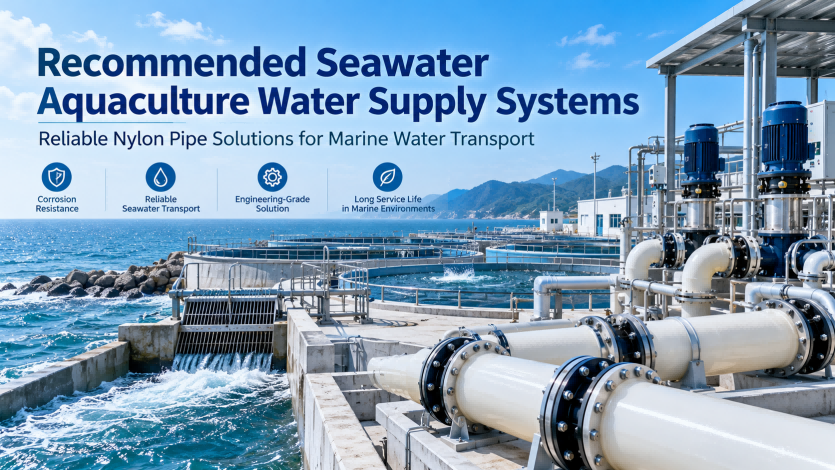
Recommended Seawater Supply Systems for Aquaculture: Why Nylon Pipes Are Worth Considering
Seawater Aquaculture Water Supply Systems: Why Nylon Pipes Are Emerging as a Promising Piping Solution
As the global seawater aquaculture industry moves toward larger-scale, more intensive, and increasingly automated production, aquaculture operators are placing greater demands on the reliability of water supply systems.
Whether for marine fish farming, shrimp aquaculture, shellfish hatcheries, or modern Recirculating Aquaculture Systems (RAS), a stable, safe, and efficient seawater supply is essential to maintaining healthy aquatic environments and ensuring consistent production.
However, seawater transportation pipelines face several long-term challenges, including saltwater corrosion, biological fouling, sediment abrasion, pressure fluctuations, and increasing maintenance costs.
Traditional piping materials have different limitations, encouraging engineering contractors and aquaculture operators to reconsider their material selection strategies.
Nylon pipes, particularly engineering pipes manufactured from Nylon 6 (PA6), offer an alternative worth evaluating for certain seawater aquaculture applications due to their mechanical toughness, wear resistance, and immunity to conventional metallic rusting.
Nevertheless, proper engineering evaluation remains essential. Nylon 6 absorbs moisture, and its long-term performance in seawater, pressure-bearing capability, and chemical resistance must be verified under actual operating conditions.
This article explores the major challenges of seawater aquaculture piping systems, compares common pipe materials, examines the potential advantages of nylon pipes, and provides practical recommendations for system design and Total Cost of Ownership (TCO) optimization.
1. Why Is Pipe Material Selection Becoming More Important in Seawater Aquaculture?
In traditional aquaculture projects, pipelines are often considered basic supporting infrastructure. Purchasing decisions have typically focused on initial material costs and installation convenience.
However, in modern seawater aquaculture facilities, piping systems do much more than transport water. They directly influence water quality management, environmental stability, and operational continuity.
Technical guidance from the Food and Agriculture Organization of the United Nations (FAO) emphasizes the importance of adequate seawater supplies and properly designed intake, pretreatment, filtration, and distribution systems in aquaculture hatchery operations.
Biofouling and reductions in pipeline flow capacity are also practical engineering concerns.
1.1 Long-Term Corrosion Risks in High-Salinity Environments
Natural seawater contains relatively high concentrations of dissolved salts, including significant amounts of chloride ions.
For certain metallic pipes, chloride ions can accelerate localized corrosion, particularly around welds, crevices, deposits, and damaged protective coatings.
Common problems include:
-
Internal rusting and corrosion-product accumulation in carbon steel pipelines.
-
Pitting or crevice corrosion in certain stainless steel grades under specific seawater conditions.
-
Corrosion of metallic fittings, bolts, and flange connections.
-
Contamination risks associated with corrosion products entering aquaculture water.
Therefore, material selection must consider not only whether a pipe can transport seawater but also its long-term material stability and potential effects on water quality.
1.2 Abrasion Caused by Sand and Suspended Solids
Seawater intake systems may carry fine sand, shell fragments, suspended particles, and other abrasive materials.
These particles can cause wear inside pipelines, especially at elbows, reducers, tees, and locations where flow velocity or direction changes.
As internal surfaces deteriorate, pipelines may experience wall thinning, localized damage, leakage, and increased maintenance requirements.
For coastal open-intake systems, engineers must carefully evaluate sediment concentration, particle size, flow velocity, and pipe abrasion resistance.
1.3 Biofouling and Its Impact on Hydraulic Efficiency
Seawater contains microorganisms, algae, and other organisms capable of attaching to pipe surfaces.
Over time, biofilms and biological deposits may develop inside pipelines, causing:
-
Reduction in effective flow area.
-
Increased hydraulic resistance and pumping energy consumption.
-
More frequent cleaning requirements.
-
Greater difficulty maintaining consistent water quality.
It is important to recognize that nylon, HDPE, and other non-metallic pipes do not inherently eliminate biofouling.
Effective solutions include properly designed intake filtration, flushing connections, drainage facilities, and accessible maintenance points.
1.4 Operational Risks Associated with Water Supply Interruptions
In high-density aquaculture facilities, seawater supply systems affect more than water exchange rates. They can also influence dissolved oxygen, temperature, salinity, and waste removal.
These factors are particularly important in industrial recirculating aquaculture systems, where water quality, oxygen levels, and nitrogen compounds require continuous monitoring and control.
If a critical pipeline leaks or becomes severely blocked, pumps may need to be shut down for repairs, potentially interrupting water supply to production tanks.
For this reason, aquaculture operators should move beyond comparing initial pipe prices and evaluate system reliability, operational risks, and Total Cost of Ownership (TCO).
2. What Are the Most Common Pipe Materials Used in Seawater Aquaculture?
Common piping materials used in seawater aquaculture include HDPE, PVC, FRP, stainless steel, carbon steel, and engineering nylon pipes.
Each material offers specific advantages and limitations. No single piping material is suitable for every seawater aquaculture application.
Comparison of Seawater Aquaculture Piping Materials
|
Pipe Material |
Main Advantages |
Key Considerations |
Typical Applications |
|---|---|---|---|
|
Carbon Steel |
High rigidity and established fabrication methods |
Seawater corrosion and protective coating maintenance |
Structural piping and protected water transportation |
|
Stainless Steel |
High mechanical strength and established connection methods |
Localized seawater corrosion risks and material cost |
Equipment connections and appropriately designed piping |
|
HDPE |
Good seawater corrosion resistance, flexibility, and mature heat-fusion technology |
Rigidity, operating temperature, and pressure limitations |
Flexible offshore intakes, buried pipelines, and low-pressure water supply |
|
PVC |
Relatively low cost, smooth internal surfaces, and convenient installation |
Impact resistance, temperature, and mechanical load limitations |
Indoor distribution lines and conventional aquaculture piping |
|
FRP |
Resistance to many corrosive media and relatively low weight |
Impact damage, joint quality, and structural design |
Large-diameter seawater transportation |
|
Nylon 6 (PA6) |
Good mechanical toughness, potential abrasion resistance, and no metallic rusting |
Moisture absorption, long-term water aging, pressure performance, and dimensional changes |
Verified pump connections, main pipelines, and abrasion-exposed sections |
For projects requiring extensive flexible offshore pipe installation, HDPE may offer significant engineering advantages.
For budget-sensitive, low-pressure indoor distribution systems, PVC remains a competitive option.
However, for certain projects requiring a combination of mechanical toughness, abrasion resistance, maintainable connections, and reliable seawater transportation, appropriately designed and tested nylon pipes deserve consideration.
3. Why Should Nylon Pipes Be Considered for Seawater Aquaculture Systems?
3.1 No Metallic Rusting and Reduced Conventional Corrosion Protection Requirements
Nylon 6 is a polyamide engineering thermoplastic.
Unlike carbon steel, the polymer itself does not form iron rust and is not subject to the same chloride-induced electrochemical pitting mechanisms associated with metallic materials.
Under suitable seawater transportation conditions, nylon pipes may reduce the need for conventional metallic anti-corrosion coatings on the pipe body.
This can be particularly relevant for:
-
Coastal aquaculture farms.
-
Seawater intake pumping stations.
-
Aquaculture facility water distribution systems.
-
Industrial seawater transportation pipelines.
However, Nylon 6 should not be considered completely unaffected by seawater.
Long-term water exposure can cause moisture absorption, dimensional changes, and changes in material properties. Suitability must therefore be confirmed according to operating temperature, water chemistry, and design service life.
3.2 Good Abrasion Resistance for Particle-Containing Seawater
Nylon 6 is widely recognized as an engineering polymer with useful toughness and wear-resistant characteristics, particularly in applications involving friction and mechanical contact.
In seawater aquaculture intake systems, abrasion resistance is especially relevant at:
-
Seawater pump discharge lines.
-
Main pipelines transporting sand-containing seawater.
-
Elbows and flow-direction changes.
-
Connections around sediment removal equipment.
Instead of evaluating only the initial purchase price, selecting piping materials with appropriate abrasion resistance may help reduce maintenance associated with localized wear.
Actual abrasion performance depends on particle hardness, concentration, flow velocity, impact angle, and material formulation.
Therefore, it should not be assumed that every nylon pipe outperforms HDPE or other pipe materials under all abrasive conditions.
3.3 Mechanical Toughness for Complex Piping Layouts
Seawater aquaculture systems frequently include pumping stations, valve assemblies, filters, culture tanks, and drainage facilities.
Pipelines must withstand not only internal pressure but also installation loads, support constraints, and equipment vibration.
The mechanical toughness and impact resistance of Nylon 6 make it a material worth evaluating for certain demanding industrial piping configurations.
For systems with frequent pump starts and stops, nylon pipes may be considered as a potential solution, provided that the engineering design addresses:
-
Transient pressure and water hammer.
-
Pipe supports and anchor points.
-
Thermal expansion and moisture-induced dimensional changes.
-
Flange and gasket loading.
-
Long-term pressure and fatigue performance.
Good mechanical toughness does not eliminate the need for water hammer analysis or guarantee resistance to unlimited pressure surges.
3.4 Controlled Internal Surface Quality and Hydraulic Performance
With appropriate manufacturing methods, dimensional control, and connection design, nylon pipes can provide relatively smooth fluid-contact surfaces.
This can help maintain predictable hydraulic characteristics and reduce additional resistance caused by poorly designed joints or internal irregularities.
However, pumping energy consumption cannot be determined by pipe material alone.
Pipe diameter, internal roughness, actual flow velocity, pipeline length, and the number of fittings are often more influential than any single material property.
For continuously operating aquaculture facilities, hydraulic optimization and material selection should be evaluated together.
3.5 Flanged Connections for Easier Equipment Integration and Maintenance
In seawater aquaculture systems where equipment must be inspected, removed, or replaced periodically, flanged connections offer practical maintenance advantages.
Our nylon piping solutions can be evaluated with flange connection designs according to project requirements, especially for:
-
Pump suction and discharge connections.
-
Filters and water treatment equipment.
-
Valve assemblies.
-
Removable pipeline sections.
-
Equipment retrofits and existing pipeline integration.
Compared with permanent joining methods, properly designed flange connections can make it easier to isolate pipeline sections, perform maintenance, and replace individual components.
However, flange structures must account for the long-term deformation behavior of nylon under sustained compression and water exposure.
Appropriate flange design, gaskets, fasteners, and tightening procedures are essential to reducing leakage risks.
4. How Should a Seawater Aquaculture Water Supply System Be Designed?
A reliable seawater aquaculture supply system involves more than transporting seawater from the ocean to culture tanks.
It should integrate seawater intake, pretreatment, transportation, distribution, and return-water management.
4.1 Recommended System Configuration
For land-based marine aquaculture farms, a typical system may follow this configuration:
Recommended Seawater Aquaculture Supply System
Seawater Intake
Intake screens and debris removalSedimentation and Pretreatment
Reduction of sand and suspended solidsNylon Main Supply Pipeline (Candidate Solution)
Integrated with pumps, flanges, and valvesFiltration and Water Treatment
Mechanical filtration, disinfection, and water conditioningAquaculture Tank Distribution
Stable supply, zoned control, and flow monitoringReturn-Water Treatment or Compliant Discharge
Configured for flow-through or recirculating systemsNylon pipes may be particularly worth evaluating for main supply lines downstream of intake pumping stations, connections to filtration equipment, and main water distribution lines within aquaculture facilities.
For long-term subsea installation, wave-exposed sections, or projects requiring continuous flexible pipeline deployment, alternative materials such as HDPE should be compared according to marine structural design requirements.
4.2 Select Pipe Diameters Based on Aquaculture Capacity
Pipe diameter directly affects flow velocity, friction losses, and long-term pumping costs.
Hydraulic design should consider:
-
Required seawater flow rate per hour.
-
Actual internal pipe diameter.
-
Total pipeline length and elevation difference.
-
Friction losses in pipes and fittings.
-
Peak water demand.
-
Future aquaculture facility expansion.
For preliminary design, average water velocity can be calculated using:
Where:
-
\(v\) = Average flow velocity (m/s).
-
\(Q\) = Volumetric flow rate (m³/s).
-
\(D\) = Internal pipe diameter (m).
For continuously operating main pipelines, an appropriate friction-loss model should be used to calculate the total hydraulic head.
Pressure losses through filters, valves, elbows, and other equipment must also be included.
An undersized pipeline may increase friction losses and pumping energy consumption.
An oversized pipeline may increase initial investment and, under some conditions, make sediment management more difficult.
The optimal pipe diameter should be determined through hydraulic calculations and lifecycle cost analysis rather than simply selecting the largest available pipe.
4.3 Pressure Ratings and Connection Design
Seawater aquaculture systems may include both low-pressure gravity pipelines and pressurized pumping systems.
Different sections can have significantly different pressure requirements.
For pump discharge lines, long-distance water transportation, and pipelines with substantial elevation changes, engineers should calculate:
-
Maximum operating pressure.
-
Potential negative pressure.
-
Transient pressure surges.
-
Water hammer effects.
When selecting nylon pipes, long-term pressure design documentation should be requested for the specific product structure.
The short-term tensile strength of a polymer should not be used directly as its allowable long-term pipe operating pressure.
Flanges, gaskets, pipe supports, and anchoring arrangements should also be evaluated as an integrated system.
4.4 Include Cleaning, Maintenance, and Emergency Measures
Even high-performance piping materials cannot replace proper system maintenance design.
Seawater aquaculture piping systems should include drainage points, flushing connections, isolation valves, and removable pipeline sections where appropriate.
For critical aquaculture production areas, standby supply lines or alternative flow paths may be considered according to operational and biosecurity risks.
Such arrangements can reduce the consequences of a single pipeline failure on the overall aquaculture facility.
5. Recommended Nylon Pipe Applications in Different Seawater Aquaculture Systems
5.1 Industrial Marine Fish and Shrimp Farms
Modern marine fish and shrimp farms require continuous seawater circulation, reliable water exchange, and consistent environmental control.
Nylon pipes can be evaluated for:
-
Main water supply pipelines.
-
Pumping station discharge lines.
-
Sedimentation system connections.
-
Primary distribution pipelines.
-
Sections exposed to sediment abrasion.
In these applications, material selection should focus on mechanical performance, internal abrasion, connection reliability, and uninterrupted water supply.
For high-density aquaculture operations, pipeline reliability is particularly important because unexpected water supply interruptions can affect multiple production tanks.
5.2 Recirculating Aquaculture Systems (RAS)
Recirculating Aquaculture Systems are increasingly used in intensive marine aquaculture because they allow greater control over water quality and consumption.
A typical RAS facility integrates:
-
Mechanical filtration.
-
Biological filtration.
-
Oxygenation and degassing.
-
Disinfection.
-
Water temperature control.
-
Continuous water circulation.
Nylon pipes can be considered for selected connections between pumping units, mechanical filtration equipment, and main water distribution systems.
However, special attention should be given to chemical compatibility.
Ozone, chlorine-containing disinfectants, cleaning chemicals, and prolonged exposure to treated water may affect PA6 material properties.
Material suitability must therefore be confirmed before installation.
5.3 Shellfish Hatcheries and Marine Seed Production
Shellfish hatcheries and marine seed production facilities often have strict water quality requirements.
In these environments, pipeline materials must be evaluated not only for mechanical performance but also for their potential effects on water quality.
Nylon pipes may be considered where suitable water-contact safety and long-term immersion test data are available.
Important design priorities include:
-
Material safety.
-
Water quality stability.
-
Cleanable internal surfaces.
-
Reliable connections.
-
Convenient inspection and maintenance.
For sensitive hatchery applications, the compatibility of finished pipes, additives, fittings, and sealing materials must be verified.
5.4 Large Coastal Aquaculture Parks and Centralized Seawater Supply
Large coastal aquaculture parks may serve multiple production facilities through centralized seawater intake and distribution networks.
These systems often require high flow capacity, extensive piping networks, and reliable pumping infrastructure.
Nylon pipes can be evaluated as candidate materials for selected large-flow main pipelines, particularly where:
-
Sediment abrasion is a concern.
-
Equipment connections are complex.
-
Localized maintenance access is important.
-
Corrosion protection requirements are significant.
-
Customized pipeline dimensions are needed.
For such applications, engineering evaluation should include large-diameter manufacturing capability, pressure ratings, installation feasibility, and lifecycle economics.
6. What Should Be Verified Before Using Nylon 6 Pipes in Seawater Aquaculture?
The application of nylon pipes in seawater aquaculture should be based on verified engineering performance rather than general material claims.
This is important not only for pipeline service life but also for the stability of the entire aquaculture operation.
6.1 Long-Term Water Absorption and Dimensional Stability
Nylon 6 is a moisture-absorbing engineering thermoplastic.
Compared with certain low-water-absorption polymers, PA6 may undergo more noticeable moisture absorption, dimensional changes, and changes in mechanical properties during prolonged water exposure.
Research published in 2026 on the aging behavior of PA6 in water and saline-alkaline solutions indicates that significant material degradation may occur under certain elevated-temperature and chemically aggressive conditions.
Although such laboratory results cannot be directly used to predict the service life of finished nylon pipes, they demonstrate the importance of long-term immersion testing.
Therefore, suitability should be assessed under actual design conditions, including:
-
Seawater temperature.
-
Salt concentration.
-
Operating pressure.
-
Exposure duration.
-
Target service life.
6.2 UV Exposure and Outdoor Weathering
For nylon pipelines installed outdoors in coastal environments, prolonged sunlight exposure may create ultraviolet aging risks.
Depending on project requirements, potential protective measures may include:
-
UV-stabilized nylon formulations.
-
Protective covers.
-
Shading systems.
-
External protective layers.
The weathering performance of ordinary Nylon 6 should not be assumed to be equivalent to that of specially UV-modified products.
6.3 Compatibility with Disinfectants and Cleaning Chemicals
Modern aquaculture facilities may use sodium hypochlorite, ozone, peroxide-based treatments, or other chemicals for water treatment and system maintenance.
Differences in chemical concentration, temperature, exposure time, and oxidizing strength can significantly affect the suitability of pipe and gasket materials.
For chemically aggressive operating conditions, specific material compatibility assessments are necessary.
Where appropriate, separate treatment pipelines or alternative materials may be required.
6.4 Water Quality and Aquaculture Safety
Because aquaculture water comes into direct contact with aquatic organisms, material safety must be evaluated carefully.
The absence of metallic rust does not automatically guarantee that a piping material is suitable for every aquaculture application.
Depending on local project regulations and water quality requirements, procurement evaluations should consider:
-
Material composition.
-
Additives and processing agents.
-
Potential extractable substances.
-
Relevant safety testing documentation.
-
Compatibility of seals and fittings.
For hatcheries and sensitive aquaculture environments, finished piping products should be verified to ensure that they do not introduce unacceptable risks to water quality or aquatic organisms.
7. How to Calculate the Total Cost of Ownership of a Seawater Aquaculture Piping System
Traditional pipe purchasing decisions often focus on the cost per meter.
However, modern aquaculture projects require a broader assessment of the total cost of operating and maintaining the piping system over its expected service life.
A simplified Total Cost of Ownership model is:
Where:
|
Cost Component |
Description |
|---|---|
|
\(C_0\) |
Initial pipe, fitting, and installation costs |
|
\(C_e\) |
Pumping energy costs during operation |
|
\(C_m\) |
Inspection, cleaning, and maintenance costs |
|
\(C_r\) |
Pipeline and component replacement costs |
|
\(C_d\) |
Downtime and aquaculture production interruption costs |
For example, when a large marine aquaculture operator compares PVC, HDPE, and nylon pipe solutions, purchasing cost should not be the only criterion.
The operator should also consider the following questions:
-
Which piping solution offers the most appropriate balance of installation, maintenance, and replacement costs?
-
How can the expected pipeline service life be verified under actual water quality and pressure conditions?
-
If a main water supply pipeline fails, how many aquaculture production areas could be affected?
-
Could changes in hydraulic resistance increase long-term pumping energy consumption?
-
Will the existing pipeline system accommodate future increases in water demand?
For continuously operating facilities with complex maintenance requirements and high potential losses from water supply interruptions, piping solutions with suitable mechanical properties, maintainable connections, and verified service life may provide better long-term economic value.
The potential value of nylon pipes does not necessarily lie in the lowest initial purchase price, but in achieving an appropriate balance of performance, reliability, and lifecycle cost under specific operating conditions.
8. How Our Nylon Pipes Support Seawater Aquaculture Projects
As a manufacturer specializing in industrial nylon piping products, we are committed to providing engineering solutions that address wear resistance, mechanical reliability, and long-term operational requirements.
For seawater aquaculture projects, our approach focuses on several key areas.
8.1 Nylon 6-Based Engineering Pipe Solutions
Our primary nylon material is Nylon 6 (PA6).
By evaluating material requirements and designing suitable product structures for individual projects, we can offer potential piping solutions for different water transportation conditions.
Our focus is on matching material characteristics and pipe design with actual operating requirements rather than treating all seawater applications as identical.
8.2 Large-Diameter and Custom Pipe Manufacturing
Large aquaculture farms, centralized seawater intake systems, and coastal pumping stations may require substantial flow capacity and customized pipeline dimensions.
We can evaluate large-diameter and non-standard pipe requirements based on:
-
Required flow rate.
-
Nominal pipe diameter.
-
Design pressure.
-
Installation environment.
-
Project-specific dimensional requirements.
This flexibility can help engineering companies develop piping arrangements suited to individual aquaculture infrastructure projects.
8.3 Flanged Connection Solutions
For seawater pumps, valves, filters, and other equipment, reliable and maintainable connections are essential.
We emphasize connection reliability and maintenance convenience in our nylon piping solutions.
Flanged connection structures can be evaluated according to project-specific engineering requirements.
Properly designed flanged connections may offer advantages for:
-
Equipment installation.
-
Valve replacement.
-
Pipeline inspection.
-
Sectional maintenance.
-
Integration with existing piping systems.
Connection design should account for long-term material behavior and appropriate sealing requirements.
8.4 Project-Specific Engineering Evaluation
Our approach goes beyond supplying pipes based solely on nominal diameter.
We consider important operating parameters such as:
-
Working temperature.
-
Design and operating pressure.
-
Seawater chemistry.
-
Suspended solids and sediment concentration.
-
Installation conditions.
-
Expected operating cycle.
-
Inspection and maintenance requirements.
These factors help determine whether a nylon piping solution is appropriate for a particular project.
8.5 Lifecycle Cost Optimization
We support customers in evaluating nylon piping solutions from a broader economic perspective, including:
-
Initial material investment.
-
Installation requirements.
-
Maintenance planning.
-
Pipeline replacement.
-
Operational risks.
-
Long-term cost efficiency.
Our objective is not simply to supply nylon pipes, but to help industrial and aquaculture customers identify piping solutions that support reliable long-term operation.
9. Frequently Asked Questions (FAQ)
Q1: Can nylon pipes be used for long-term seawater transportation?
Nylon pipes can be considered for seawater transportation, but long-term suitability depends on material formulation, pipe structure, seawater temperature, operating pressure, salinity, exposure duration, and chemical cleaning conditions.
Appropriate long-term immersion, mechanical performance, and pressure design data should be obtained before selecting a product.
The service life of finished pipes should not be predicted solely from general Nylon 6 material properties.
Q2: Which is better for seawater aquaculture, nylon pipes or HDPE pipes?
The answer depends on the application.
HDPE offers low moisture absorption, good flexibility, and extensive experience in seawater intake applications. It is particularly suitable for certain flexible subsea intake pipelines and long-distance installations.
Nylon pipes may be worth evaluating in sections requiring mechanical toughness, abrasion resistance, and detachable industrial equipment connections.
In many projects, the most effective engineering solution may involve combining different materials within the same piping network.
Q3: Are nylon pipes suitable for high-density Recirculating Aquaculture Systems (RAS)?
Nylon pipes may be used in appropriate sections of RAS facilities when material compatibility, long-term reliability, and water-contact safety requirements are satisfied.
For systems involving ozone or strongly oxidizing disinfectants, specific chemical compatibility assessments are required.
Unverified applications should be avoided.
Q4: Can nylon pipes completely prevent marine biofouling?
No.
Although nylon pipes do not experience conventional carbon steel rusting, biofilms and biological deposits can still develop on their internal surfaces.
Effective control requires intake filtration, periodic flushing, accessible cleaning connections, and appropriate flow management.
Q5: What information should be provided when selecting nylon pipes for a seawater aquaculture project?
Customers should ideally provide:
-
Required flow rate.
-
Pipe diameter.
-
Operating pressure.
-
Working temperature.
-
Seawater salinity.
-
Sediment concentration.
-
Disinfection and cleaning chemicals.
-
Pipeline length.
-
Installation method.
-
Connection requirements.
-
Target service life.
This information helps manufacturers and engineering teams assess suitability and recommend appropriate structural designs and verification procedures.
10. Conclusion: The Future of Seawater Aquaculture Piping Lies in Reliability and Lifecycle Value
As seawater aquaculture continues to develop toward higher production densities, industrial-scale facilities, and automated operations, the importance of reliable water supply systems will continue to increase.
Future piping material selection should move beyond initial purchase price and consider a wider range of engineering factors, including:
-
Corrosion and abrasion risks.
-
Mechanical reliability.
-
Hydraulic efficiency.
-
Water quality safety.
-
Maintenance requirements.
-
Total Cost of Ownership.
Nylon 6 pipes offer engineering characteristics worth considering in selected seawater aquaculture applications.
Their mechanical properties, immunity to conventional metallic electrochemical rusting, and potential for project-specific connection design can make them relevant alternatives for certain water transportation systems.
At the same time, moisture absorption, long-term immersion aging, UV exposure, and compatibility with chemical disinfectants must be carefully assessed through appropriate engineering validation.
For modern seawater aquaculture projects, the best piping solution is not necessarily a single material. It is a carefully engineered system that combines appropriate material selection, verified performance, effective risk management, and optimized lifecycle costs.
We will continue to build on our expertise in nylon pipe manufacturing and industrial fluid transportation solutions to support aquaculture operators, coastal industrial water supply projects, and marine engineering customers with piping products designed around real operating requirements.
Looking for a Reliable Nylon Piping Solution for Your Seawater Aquaculture Project?
Are you planning a new marine aquaculture facility, upgrading an existing seawater intake system, or exploring alternative materials for your water transportation pipelines?
Our technical team can help evaluate the suitability of nylon piping solutions based on your project requirements, including pipe diameter, flow capacity, operating pressure, seawater conditions, and installation needs.
Contact us to discuss your project and explore customized nylon piping solutions for seawater aquaculture applications.
Website: www.nylonpipeline.com
Technical Reference Note: This article draws on technical guidance from the Food and Agriculture Organization of the United Nations (FAO) regarding seawater hatchery facility design, engineering information on Nylon 6 (PA6) material properties, and research concerning long-term PA6 aging in aqueous environments. Specific pipe performance and service life must be confirmed through finished-product testing, manufacturer documentation, and project-specific engineering verification.
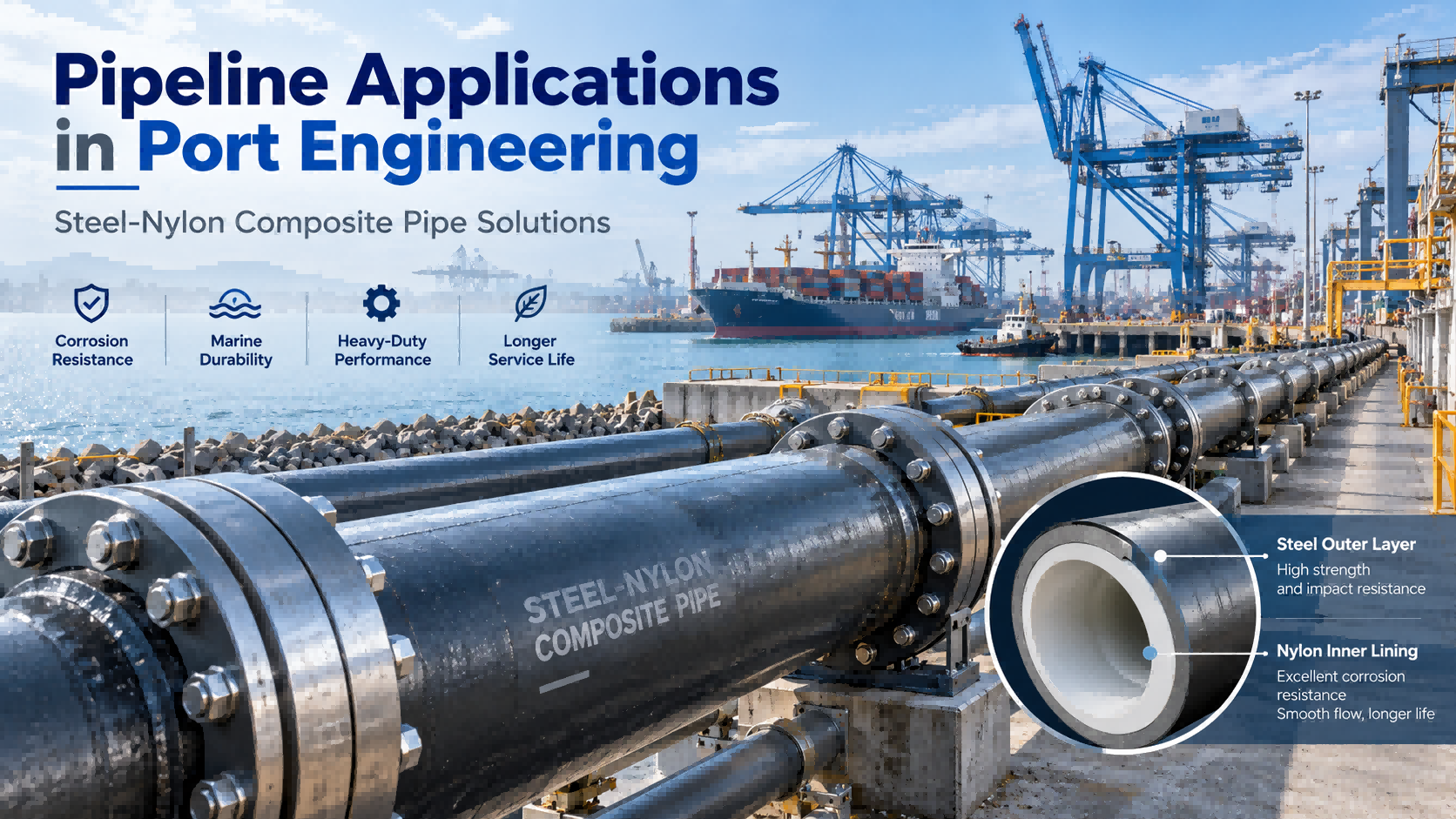
Port Engineering Pipelines: Steel-Nylon Composite Solutions
Marine Engineering Pipe Selection: PA6 Nylon Guide