Rapid Municipal Pipe Installation | Steel-Nylon Pipe Systems

Rapid Installation Piping Solutions for Municipal Engineering: How Steel-Nylon Composite Pipes Reduce Construction Time and Long-Term Costs
As urban infrastructure continues to expand worldwide, municipal water supply networks, wastewater systems, aging pipeline rehabilitation projects, and underground infrastructure upgrades are facing increasingly demanding construction requirements.
For modern municipal engineering projects, pipeline systems must not only provide reliable fluid transportation, corrosion resistance, and structural safety but also meet increasingly tight construction schedules.
In densely populated urban areas, busy commercial districts, and municipal water supply networks that must remain operational, traditional pipeline installation methods can create significant challenges. Extended road closures, on-site welding, complicated installation procedures, and long-term maintenance requirements can increase both project costs and operational risks.
As a result, rapid installation piping systems are becoming an increasingly important consideration in municipal pipeline engineering.
Against this background, steel-nylon composite pipes, which combine the mechanical strength of steel with the functional properties of nylon, offer an alternative solution for certain municipal applications.
Through integrated flanged connections, factory prefabrication, and corrosion-resistant structural design, these pipes can help engineering contractors improve installation efficiency while maintaining long-term system reliability.
However, a truly efficient piping solution is not simply the one that can be installed the fastest. It must optimize the entire project lifecycle, from engineering design and manufacturing to transportation, installation, commissioning, and ongoing maintenance.
1. Why Is Installation Speed Becoming Increasingly Important in Municipal Engineering?
1.1 Urban Construction Windows Are Becoming More Restricted
Traditional municipal pipeline construction generally involves several stages:
Road excavation → Trench support → Pipe transportation → Pipe positioning → On-site connections → Joint inspection → Pressure testing → Backfilling → Road restoration.
Delays at any stage can affect the overall project schedule.
In high-traffic urban environments, construction delays can generate costs far beyond additional labor expenses.
These may include:
-
Traffic management and road closure expenses
-
Equipment rental costs
-
Business disruptions and associated economic losses
-
Project delays and contractual penalties
-
Public inconvenience caused by water supply interruptions
-
Additional construction management expenses
Consequently, municipal infrastructure procurement is gradually shifting from a narrow focus on pipe purchase prices toward a broader evaluation of installation efficiency and total project costs.
1.2 Aging Pipeline Rehabilitation Requires Shorter Service Interruptions
Municipal pipeline rehabilitation projects frequently require temporary shutdowns of existing water supply systems.
When construction affects hospitals, schools, industrial parks, or large residential communities, extended water interruptions can create significant operational challenges.
Pipeline solutions that support factory prefabrication, mechanical connections, and sectional installation can potentially shorten the required shutdown period.
For this reason, installation efficiency has become an important consideration in pipeline rehabilitation projects.
1.3 Labor Costs Are Becoming a Critical Project Variable
Traditional installation methods involving field welding, joint corrosion protection, and specialized equipment require skilled workers.
In markets where skilled labor is expensive or difficult to secure, reducing on-site fabrication processes can improve overall project economics.
However, actual installation efficiency depends on pipe lengths, the number of joints, lifting conditions, site accessibility, and workforce experience.
Mechanical connections do not automatically guarantee faster installation in every application.
2. What Are the Key Requirements for Rapid Installation Municipal Piping Systems?
Fast installation should never compromise engineering reliability.
An effective municipal piping system must balance installation efficiency with structural integrity, corrosion resistance, and long-term performance.
Six important factors should be evaluated during material selection.
| Key Factor | Engineering Requirements | Project Benefits |
|---|---|---|
| Installation efficiency | Reduce on-site joining and fabrication | Shorter construction schedules |
| Connection reliability | Stable pressure resistance and sealing | Lower leakage and rework risks |
| Corrosion resistance | Compatibility with operating media | Reduced corrosion-related failures |
| Structural strength | Resistance to internal and external loads | Improved operational safety |
| System compatibility | Integration with valves, pumps, and existing networks | Easier infrastructure upgrades |
| Maintenance accessibility | Convenient inspection and component replacement | Lower long-term maintenance costs |
These factors must be considered together.
For example, a pipe material may provide excellent installation efficiency but require frequent maintenance because of corrosion, deformation, or joint leakage.
In such cases, initial construction savings may be offset by future operating expenses.
Therefore, the fundamental objective of municipal pipeline selection should be:
To optimize installation efficiency and total lifecycle costs while meeting the project's structural safety, reliability, and design life requirements.
3. Why Are Steel-Nylon Composite Pipes Suitable for Certain Rapid Installation Projects?
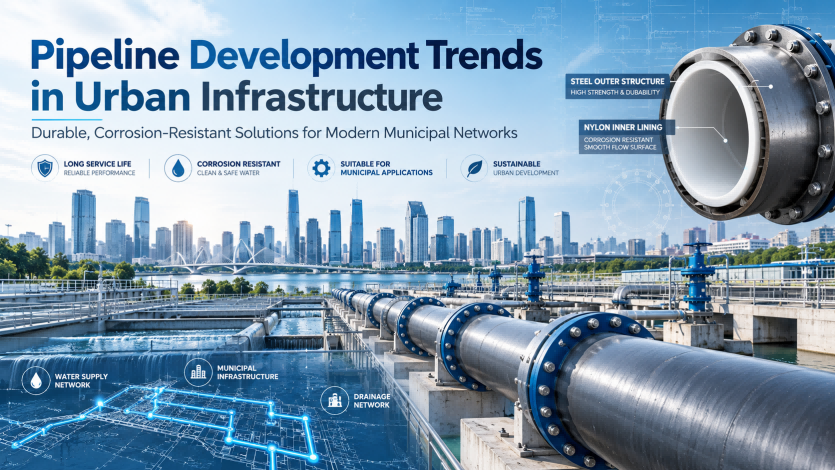
Steel-nylon composite pipes are engineered piping products that combine the mechanical properties of steel with the functional characteristics of nylon.
Their structural concept is straightforward:
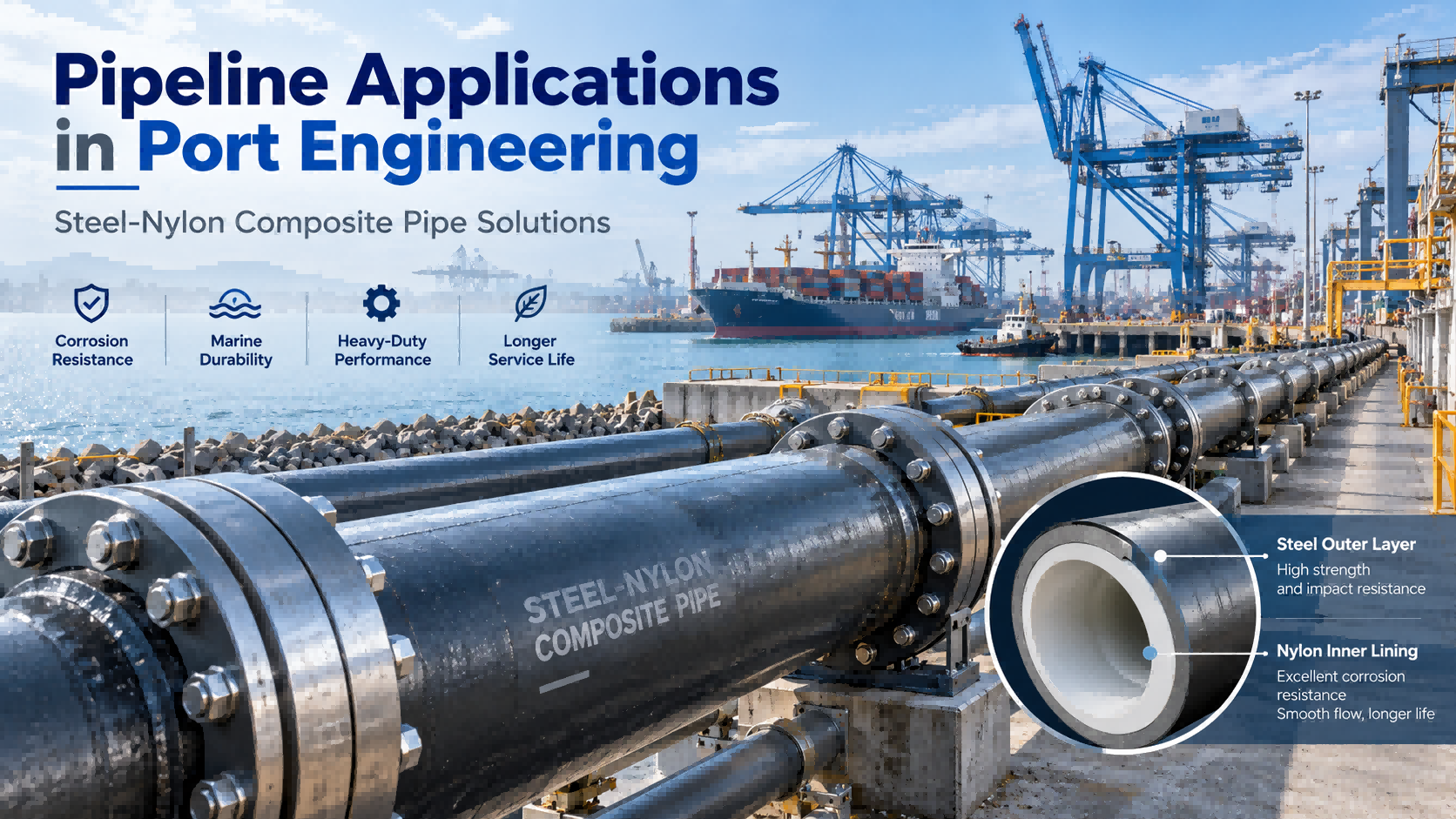
The steel structure provides mechanical strength and pressure-bearing support, while the nylon layer forms the fluid-contacting surface, providing corrosion resistance, abrasion resistance, and a relatively smooth internal surface.
Compared with conventional single-material piping systems, this composite structure allows different performance requirements to be addressed through integrated engineering design.
3.1 Integrated Flanged Connections Reduce On-Site Welding
Conventional welded steel pipelines often require several installation operations, including pipe alignment, welding, weld inspection, and local corrosion protection repairs.
These processes can be affected by weather conditions, limited working space, welding personnel availability, and construction site restrictions.
Our steel-nylon composite pipes can be manufactured with integrated flanged connections.
When pipe sections and fittings are prefabricated according to approved construction drawings, installation generally involves the following steps:
-
Transport prefabricated pipe sections to designated installation locations.
-
Position and align the pipes using appropriate lifting equipment.
-
Clean and inspect flange sealing surfaces.
-
Install gaskets that meet engineering requirements.
-
Tighten flange bolts according to the specified sequence and torque requirements.
-
Complete joint inspections and system pressure testing.
This connection method can significantly reduce the need for field circumferential welding.
It is particularly valuable for municipal projects involving restricted construction spaces, strict hot-work controls, or sectional pipeline replacement.
However, flanged connections still require appropriate gasket selection, bolt preload control, alignment, and pressure testing.
For long-distance buried pipelines, engineers must also evaluate the number of flange joints, installation clearances, and external corrosion protection requirements.
3.2 Factory Prefabrication Reduces On-Site Construction Complexity
One important strategy for improving municipal construction efficiency is transferring selected manufacturing and quality-control activities from the construction site to the factory.
Steel-nylon composite piping systems can be prefabricated according to approved engineering drawings.
Typical prefabricated components may include:
-
Straight pipe sections of different lengths
-
90-degree, 45-degree, and custom-angle elbows
-
Tee fittings and reducers
-
Valve connection sections
-
Pump station inlet and outlet connections
-
Special transition fittings
By completing dimensional verification, connection preparation, and product inspections before delivery, manufacturers can reduce the complexity of on-site fabrication.
This approach can be particularly useful in municipal infrastructure projects involving numerous valves, directional changes, pipeline branches, and equipment connections.
Combining factory prefabrication with modular installation can improve construction coordination and reduce field modification requirements.
Nevertheless, successful prefabrication depends on accurate site measurements and engineering verification.
Unexpected underground utilities, elevation differences, or inaccurate connection positions may still require installation adjustments.
3.3 Steel Structures Provide Strong Mechanical Support
Municipal pipelines are exposed to a combination of internal operating pressures and external mechanical loads.
These may include:
-
Continuous operating pressure
-
Transient pressure caused by water hammer
-
Soil and backfill loads
-
Road traffic loads
-
Differential ground settlement
-
Temporary loads during transportation and lifting
The steel load-bearing structure of steel-nylon composite pipes provides mechanical strength and stiffness.
This can offer engineering advantages in certain large-diameter applications, pressure pipelines, and systems requiring connections to steel equipment.
However, underground installations still require proper evaluation of pipe-soil interaction, structural stability, external pressure resistance, and joint restraint.
The presence of a steel structure alone does not guarantee suitability for every loading condition.
3.4 Nylon Layers Help Reduce Internal Corrosion Risks
Conventional carbon steel pipelines may experience internal corrosion under certain water quality conditions.
This can be particularly problematic when transporting saline water, industrial wastewater, or other corrosive fluids.
Internal corrosion may lead to:
-
Localized pipe wall thinning
-
Corrosion product accumulation
-
Increasing internal surface roughness
-
Changes in hydraulic resistance
-
Leakage and premature maintenance requirements
Steel-nylon composite pipes use a nylon functional layer to separate the transported fluid from the steel load-bearing structure.
This design helps reduce internal electrochemical corrosion risks associated with direct contact between the fluid and steel.
Our nylon technology is based primarily on modified Polyamide 6 (PA6) materials, with material formulations and structural configurations selected according to specific operating requirements.
For certain saline solutions, industrial water systems, and municipal wastewater applications, appropriately selected nylon materials can offer useful chemical resistance.
However, chemical compatibility must be assessed based on fluid composition, concentration, temperature, and exposure duration.
The external steel structure also requires suitable corrosion protection according to soil conditions, moisture exposure, and the potential presence of stray electrical currents.
3.5 Smooth Internal Surfaces Support Hydraulic Performance
One challenge associated with long-term municipal pipeline operation is the gradual increase in flow resistance caused by corrosion products, deposits, and internal surface deterioration.
Nylon functional layers provide relatively smooth fluid-contacting surfaces.
Under suitable operating conditions, they may help reduce the risk of roughness increases associated with internal corrosion of unprotected steel.
This characteristic can be valuable for long-term pressure water transmission systems.
In addition, the abrasion-resistant properties of appropriately engineered nylon materials may provide advantages in selected applications involving suspended solids, industrial discharge, or wastewater.
However, actual pressure losses must still be calculated using the effective internal diameter, design flow rate, velocity, local resistance, and long-term fouling assumptions.
A nylon-lined surface should not automatically be assumed to reduce pumping energy consumption in every application.
4. Steel-Nylon Composite Pipes vs. Traditional Municipal Pipe Materials
Common materials used in municipal pipeline engineering include carbon steel, ductile iron, high-density polyethylene (HDPE), fiberglass-reinforced plastic (FRP), and composite piping systems.
Each material offers different advantages and installation considerations.
| Comparison Factor | Conventional Welded Steel Pipe | HDPE Pipe | FRP Pipe | Steel-Nylon Composite Pipe |
|---|---|---|---|---|
| Common joining methods | Welding or mechanical connections | Butt fusion, electrofusion, or mechanical connections | Bell-and-spigot, mechanical, or flanged connections | Integrated flanged connections |
| Field welding requirements | Depends on connection design | Generally no metal welding | Generally no metal welding | Can reduce field welding |
| Structural stiffness | High | Relatively low | Depends on pipe design | Steel structure provides support |
| Internal corrosion resistance | Depends on fluid and protective measures | Generally good | Depends on resin system | Provided by nylon functional layer |
| Large-diameter applications | Well established | Depends on pressure class and installation conditions | Well established | Custom-engineered options |
| Modular installation | Possible | Possible | Possible | Suitable for prefabricated flange-connected sections |
| Sectional replacement | Depends on connection method | Depends on connection method | Depends on connection method | Flanged sections support planned replacement |
It is important to recognize that other pipe materials also offer significant installation advantages.
For example, HDPE pipelines may benefit from long continuous pipe sections and established fusion techniques, while ductile iron pipelines often use efficient push-on joint systems.
Therefore, steel-nylon composite pipes should not be considered universally faster to install.
Their main differentiation lies in applications requiring a combination of:
High structural strength, a corrosion-resistant internal surface, factory prefabrication, and removable flanged connections.
For these projects, steel-nylon composite pipes provide an additional engineering option worth evaluating.
5. Which Municipal Engineering Applications Can Benefit from Steel-Nylon Composite Pipes?
5.1 Urban Water Supply Pipeline Rehabilitation
Aging municipal water supply networks may require replacement because of corrosion, leakage, structural deterioration, or insufficient hydraulic capacity.
For pipeline sections involving large diameters, pressure requirements, or connections to existing steel equipment, steel-nylon composite pipes may be considered as an alternative.
Factory prefabrication and sectional flange connections can help reduce certain on-site fabrication activities.
This approach may be especially useful near pumping stations, valve chambers, and other locations with restricted construction space.
For drinking water applications, the pipe and all relevant water-contact components must comply with applicable local drinking water hygiene and certification requirements.
Suitability for industrial water transportation does not automatically establish approval for potable water service.
5.2 Municipal Wastewater Pressure Pipelines
Municipal wastewater may contain suspended solids, organic matter, dissolved salts, and other complex constituents.
Certain wastewater pressure pipelines experience a combination of corrosion, abrasion, and difficult maintenance conditions.
Steel-nylon composite pipes may be evaluated for these applications when both structural strength and corrosion resistance are required.
They may be particularly relevant for selected pressure transmission sections.
However, wastewater containing sulfides, strong oxidizing chemicals, or specific industrial contaminants requires additional assessment of the nylon material's long-term compatibility.
5.3 Urban Stormwater Pumping and Drainage Projects
Urban stormwater drainage systems may experience high short-duration flow rates, frequent pump starts and stops, and numerous equipment connections.
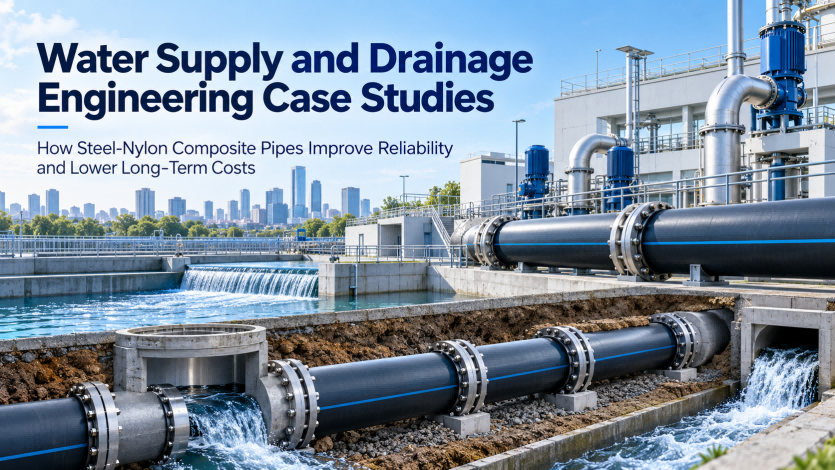
For large drainage pumping stations, steel-nylon composite pipes can provide modular connection options for selected inlet, outlet, and pressure pipeline sections.
Prefabricated flanged pipe components can simplify connections to pumps, valves, and other equipment when properly designed.
5.4 Industrial Park Municipal Infrastructure
Industrial parks often require infrastructure beyond conventional domestic water supply and drainage networks.
Typical applications may include:
-
Industrial circulating water
-
High-salinity wastewater
-
Reclaimed water systems
-
Centralized wastewater treatment
-
Industrial cooling water
These networks may require more complex corrosion control, mechanical performance, and operational reliability considerations.
For compatible operating media and verified design conditions, steel-nylon composite pipes can provide the advantages of combining a steel support structure with a corrosion-resistant fluid-contacting layer.
5.5 Coastal Municipal Infrastructure
Municipal engineering projects in coastal regions may be exposed to saline fluids, humid environments, and potentially corrosive soil conditions.
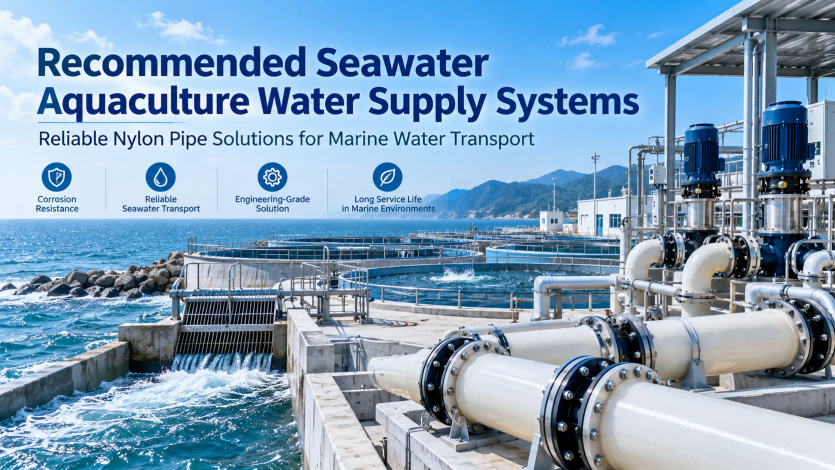
The nylon functional layer can reduce internal steel corrosion associated with direct exposure to certain saline media.
However, external steel surfaces, flanges, fasteners, and valves also require appropriate corrosion protection.
Consequently, coastal municipal projects should consider a complete internal and external corrosion management strategy rather than focusing exclusively on the pipe lining material.
6. How Can Steel-Nylon Composite Pipes Support Modular and Rapid Installation?
For EPC contractors seeking to improve municipal pipeline construction efficiency, a systematic installation strategy is essential.
We recommend the following implementation process.
Step 1: Complete Digital Pipeline Design Before Construction
CAD and Building Information Modeling (BIM) tools can be used to confirm:
-
Pipeline coordinates and elevations
-
Pipe diameters and sectional lengths
-
Flange connection locations
-
Elbow and tee arrangements
-
Valve chambers and equipment interfaces
-
Lifting and transportation clearances
-
Potential ground settlement areas
Accurate preconstruction engineering can help reduce installation errors and costly field adjustments.
Step 2: Optimize Pipe Section Lengths and Joint Quantities
Rapid installation does not necessarily mean using the shortest possible pipe sections.
Short sections may simplify transportation and localized lifting, but they also increase the number of joints, flange bolts, and potential leakage locations.
Therefore, pipe section lengths should be optimized according to:
-
Transportation restrictions
-
Lifting equipment capacity
-
Trench dimensions
-
Pipeline geometry
-
Available installation space
-
Joint accessibility
Where practical, reducing unnecessary connections can improve both installation efficiency and system reliability.
Step 3: Complete Prefabrication and Quality Inspections at the Factory
Once engineering drawings are approved, straight sections, elbows, tees, reducers, and other fittings can be manufactured according to the project requirements.
Critical connection areas should be inspected for:
-
Flange flatness
-
Flange perpendicularity
-
Bolt-hole alignment
-
Sealing surface quality
-
Dimensional accuracy
Pipe body integrity, lining performance, and pressure-related quality tests should also be completed in accordance with the approved project quality plan.
Step 4: Perform Sectional Lifting and Mechanical Connections
On-site construction can then focus on pipe positioning, support, sealing, and mechanical assembly.
For flanged piping systems, installation procedures should clearly specify:
-
Gasket material and dimensions
-
Bolt grades and corrosion protection requirements
-
Tightening sequences and target preload
-
Permissible flange alignment tolerances
-
Thrust restraint and structural support requirements
-
Backfilling and protection around connections
Flange bolts should never be excessively tightened to compensate for significant pipe misalignment.
Step 5: Conduct Sectional Testing and Controlled Commissioning
Where project conditions permit, pipeline construction can be divided into separate installation and testing sections.
Each section should undergo the required inspections, pressure tests, flushing, and commissioning procedures before being placed into service.
For potable water systems, the required disinfection procedures must also be completed.
This approach can reduce the potential impact of rework on the overall project.
However, schedule optimization must never replace mandatory testing, regulatory inspections, or contractual acceptance procedures.
7. How Much Installation Cost Can Steel-Nylon Composite Pipes Potentially Save?
This is one of the most important questions for municipal infrastructure procurement teams.
However, construction costs vary significantly according to project location, pipe diameter, pipe section length, joining method, labor costs, and site conditions.
It would therefore be misleading to claim that a particular pipe material always reduces installation costs by a fixed percentage.
A more reliable approach is to analyze the complete construction cost structure.
7.1 Initial Construction Cost Model
Total Installation Cost = Pipe Procurement Cost + Transportation and Lifting Cost + Joint Installation Cost + Inspection Cost + Trenching and Backfilling Cost + Traffic Management and Service Interruption Costs
Steel-nylon composite pipes may offer potential savings through reduced field welding, prefabrication, and simplified replacement of selected pipe sections.
However, flange components, gaskets, and installation clearance requirements must also be included in the analysis.
7.2 Illustrative Construction Cost Comparison
Consider a hypothetical municipal project involving the installation of a 1,000-meter pressure water transmission pipeline.
The following comparison uses normalized cost indices for illustrative purposes only.
These figures are not actual project quotations or verified cost-saving results.
| Cost Category | Conventional Solution (Example) | Optimized Solution (Example) |
|---|---|---|
| Pipes and fittings | 100 | 115 |
| Field joining labor | 50 | 25 |
| Joint inspection and repair | 20 | 10 |
| Equipment and site management | 30 | 20 |
| Civil works and other expenses | 100 | 100 |
| Total Cost Index | 300 | 270 |
In this hypothetical scenario, the optimized solution has a higher material cost but reduces the total construction cost index from 300 to 270.
This represents a 10% reduction in the illustrative total.
The example demonstrates an important principle:
A higher pipe purchase price does not necessarily result in a higher total project cost.
However, the outcome may differ for projects involving long, straight buried pipelines, highly efficient push-on or fusion connections, or relatively high flange and civil construction costs.
Actual savings must be calculated using project-specific bills of quantities, labor rates, supplier quotations, and construction schedules.
8. Beyond Fast Installation: How Should Long-Term Operating Costs Be Evaluated?
For municipal infrastructure designed to operate for several decades, installation expenses represent only one component of the total investment.
Long-term operating costs may include:
-
Pipeline inspection expenses
-
Corrosion management
-
Emergency leakage repairs
-
Pipeline cleaning
-
Pumping energy consumption
-
Repeated road excavation
-
Unplanned shutdown losses
-
Rehabilitation and replacement costs
Therefore, municipal pipeline procurement should increasingly consider the Total Cost of Ownership (TCO).
A simplified model is:
TCO = Initial Procurement Cost + Installation Cost + Operating and Maintenance Cost + Failure-Related Losses + Replacement Cost − Residual Value
For long-term financial analysis, future expenditures should be discounted to present value using a consistent evaluation period and discount rate.
Steel-nylon composite pipes may contribute value in three important areas.
Corrosion-Resistant Functional Layer
For compatible transported fluids, the nylon layer can help reduce internal corrosion risks that may otherwise create additional maintenance requirements.
Abrasion Resistance and Internal Surface Performance
For selected fluids containing suspended particles, appropriately engineered nylon layers may help control internal wear and limit surface deterioration.
Modular Connections
Flanged connections can improve accessibility during planned maintenance or replacement of selected pipe sections, particularly around valves, equipment connections, and serviceable pipeline components.
However, lifecycle evaluations must also consider flange gasket performance, external corrosion protection, and thermal expansion differences between materials.
Only a comprehensive comparison can determine whether steel-nylon composite pipes offer an economic advantage for a particular project.
9. What Engineering Risks Should Be Considered When Selecting Steel-Nylon Composite Pipes?
For engineering consultants and procurement departments, understanding the technical limitations of a piping system is just as important as identifying its potential advantages.
9.1 Flange Design and Protection
Flanged connections can reduce field welding requirements, but every joint must meet the project's pressure, sealing, and structural performance requirements.
For underground installations, flange dimensions, assembly clearances, and maintenance accessibility should be considered during engineering design.
Where pipelines experience axial thrust or differential settlement, joint restraint and support systems must be designed for the associated loads.
9.2 External Steel Corrosion Protection
The nylon functional layer primarily addresses performance requirements on the fluid-contacting side of the pipe.
In areas with high groundwater levels, aggressive soils, or stray electrical currents, the external steel structure requires a separate corrosion risk assessment.
An appropriate and verified external corrosion protection system should be selected where necessary.
9.3 Chemical Compatibility
The chemical resistance of nylon depends on the transported medium, concentration, operating temperature, and exposure duration.
Applications involving oxidizing chemicals, specialized industrial wastewater, or elevated temperatures require material compatibility verification.
9.4 Combined Pressure, Temperature, and Diameter Requirements
Maximum pressure or temperature ratings established for one product configuration should not automatically be applied to all pipe sizes.
For large-diameter composite pipes, engineering evaluations should consider:
-
Steel structural strength
-
Nylon functional layer properties
-
Composite interface performance
-
Flange connection integrity
-
Operating pressure and temperature conditions
9.5 International Standards and Certifications
For international municipal projects, applicable regulations and tender specifications must be reviewed according to the project location.
Relevant references may include:
-
EN 805:2025: Requirements relating to water supply systems and components outside buildings, including installation, site testing, and commissioning.
-
Applicable AWWA standards and installation guidelines: Technical references for the design and field installation of relevant water pipeline systems, subject to engineering approval.
-
NSF/ANSI/CAN 61: Health effects evaluation for drinking water system components. Where certification is required, the certification status and scope of the specific product and water-contact components must be verified.
Reference to these standards does not imply that every steel-nylon composite pipe product has automatically obtained certification under them.
10. How Should Municipal Engineering Contractors Select a Rapid Installation Pipe Supplier?
Municipal pipeline procurement should not be based solely on the quoted pipe price.
We recommend that EPC contractors, engineering consultants, and municipal purchasing departments evaluate suppliers in five key areas.
10.1 Complete Piping System Supply Capability
A qualified supplier should be capable of providing not only straight pipe sections but also compatible elbows, tees, reducers, flanges, and other fittings.
Integrated system supply can reduce procurement coordination and improve component compatibility.
10.2 Custom Manufacturing Based on Engineering Drawings
Municipal projects often involve complicated underground layouts, valve positions, and equipment interfaces.
Suppliers capable of producing customized pipe lengths, special fittings, and project-specific connection dimensions can provide important support for prefabricated installation projects.
10.3 Engineering and Technical Support
A professional supplier should assist engineering and construction teams in evaluating:
-
Fluid and material compatibility
-
Design pressure and temperature
-
Pipe diameter and flow requirements
-
Pipe body and joint design
-
Flange specifications and sealing systems
-
External corrosion protection
-
Installation environments
-
Inspection and acceptance documentation
10.4 Quality Control and Traceability
Procurement teams should review manufacturing procedures, material traceability, dimensional inspections, pressure testing, and related quality documentation.
For critical municipal infrastructure projects, product performance verification should be consistent with the actual design conditions.
10.5 Flexible Delivery and Project Coordination
Municipal construction projects may involve several work zones and multiple road closure stages.
Phased manufacturing, sectional delivery, and coordination with the construction schedule can directly influence project efficiency.
A supplier's delivery management capabilities are therefore an important part of the overall evaluation.
11. How Our Steel-Nylon Composite Pipes Support Rapid Municipal Pipeline Installation
As a manufacturer specializing in reinforced nylon pipes and steel-nylon composite piping systems, Guangdong Kejin New Materials Co., Ltd. (GDKJ) focuses on developing corrosion-resistant, abrasion-resistant, and application-oriented pipeline solutions for industrial and infrastructure projects.
For municipal engineering applications, we emphasize several important product advantages.
Integrated Flanged Connection Design
Our steel-nylon composite pipes can be manufactured with integrated flanged connections.
This design can reduce on-site circumferential welding and facilitate connections to compatible valves, fittings, and equipment.
Combined Steel Strength and Nylon Performance
The steel structure carries the primary mechanical loads, while the nylon functional layer provides fluid-contacting corrosion resistance and abrasion resistance.
This combination allows engineers to address mechanical strength and internal corrosion control within a single composite piping structure.
Large-Diameter Pipe Customization
For major municipal water transmission projects, pumping station connections, and industrial infrastructure applications, we can evaluate customized large-diameter steel-nylon composite piping solutions.
Available dimensions, pressure classes, and operating conditions must be confirmed through project-specific engineering and product performance verification.
Matching Fittings and Modular Delivery
We can supply straight pipes, elbows, tees, reducers, and special connection components according to project requirements.
These capabilities support factory prefabrication and modular installation strategies.
Technical Communication for International Projects
For overseas EPC contractors, engineering procurement teams, and pipeline distributors, we can assist with early-stage technical discussions covering:
-
Transported media
-
Pipe diameters
-
Design pressures
-
Operating temperatures
-
Flange standards
-
Installation methods
-
Project-specific engineering requirements
Our objective is not simply to supply pipe products.
We aim to help customers improve pipeline installation efficiency and long-term operational performance through appropriate product design, manufacturing, and engineering coordination.
12. Future Trends in Rapid Installation Municipal Piping Systems
Municipal pipeline technology is evolving beyond conventional comparisons of material prices and individual product specifications.
Future pipeline systems are likely to place greater emphasis on the following areas.
12.1 Modular Construction and Factory Prefabrication
More manufacturing, inspection, and quality-control activities will be completed in controlled factory environments.
This approach can improve installation consistency and reduce site-dependent construction risks.
12.2 Integrated Material and Structural Engineering
Pipe materials and structural configurations will increasingly be selected according to actual pressure requirements, corrosion conditions, and external loading environments.
Composite piping technologies can offer additional flexibility in addressing multiple engineering requirements.
12.3 Digital Engineering and Construction Planning
BIM technology, digital site surveys, and pipe section identification systems can improve installation accuracy and reduce dimensional errors.
12.4 Lifecycle Cost Management
Procurement decisions will increasingly consider initial material costs, installation expenses, maintenance requirements, and shutdown risks together.
12.5 System-Level Reliability
Engineering evaluation will continue moving beyond individual pipe performance toward integrated assessments of pipes, joints, valves, fittings, and protective systems.
Within these developments, steel-nylon composite pipes provide a practical alternative for selected municipal projects through their combined structural properties, integrated flanged connections, and prefabrication potential.
Conclusion: Fast Installation Is Only the Beginning — Long-Term Reliability Is the Real Objective
For modern municipal engineering projects, pipeline material selection should involve more than comparing purchase prices or installation speeds.
A successful piping solution must balance:
Construction schedules, installation complexity, structural safety, corrosion resistance, joint reliability, maintenance requirements, and total lifecycle costs.
Steel-nylon composite pipes combine the mechanical strength of steel with the fluid-contacting properties of nylon.
Through integrated flanged connections and factory prefabrication, they offer an alternative solution for selected municipal water supply, wastewater pressure transmission, industrial water transportation, and infrastructure rehabilitation projects.
Their potential benefits are especially relevant where structural strength, internal corrosion control, and modular installation are important engineering priorities.
Nevertheless, the final selection of pipe materials must always be based on verified design conditions, product testing, installation environments, and applicable local standards.
The most effective municipal piping solution is not necessarily the one with the lowest initial purchase price.
It is the one that provides the best combination of construction efficiency, operational reliability, and long-term economic performance.
Looking for a More Efficient Piping Solution for Your Municipal Engineering Project?
Are you planning a project involving:
-
Municipal water supply and drainage upgrades
-
Aging urban pressure pipeline rehabilitation
-
Industrial park water and wastewater networks
-
Large-diameter pressure water transmission
-
Municipal pumping station piping systems
-
Corrosion-resistant water pipelines for coastal infrastructure
Contact GDKJ — Guangdong Kejin New Materials Co., Ltd.
Our team can help evaluate suitable steel-nylon composite piping solutions based on your pipe diameter, design pressure, operating temperature, transported medium, installation method, and engineering drawings.
Website: //www.nylonpipeline.com
Product Details: //www.nylonpipeline.com/oil-chemical-mine/nylon-steel-composite-pipe-flanged.html
Email: lloyds.royqiu@gmail.com
Improve pipeline installation efficiency. Build more reliable municipal infrastructure with steel-nylon composite piping solutions.
Water Supply & Drainage Case Studies | Steel-Nylon Solutions
Port Engineering Pipelines: Steel-Nylon Composite Solutions