Port Engineering Pipelines: Steel-Nylon Composite Solutions
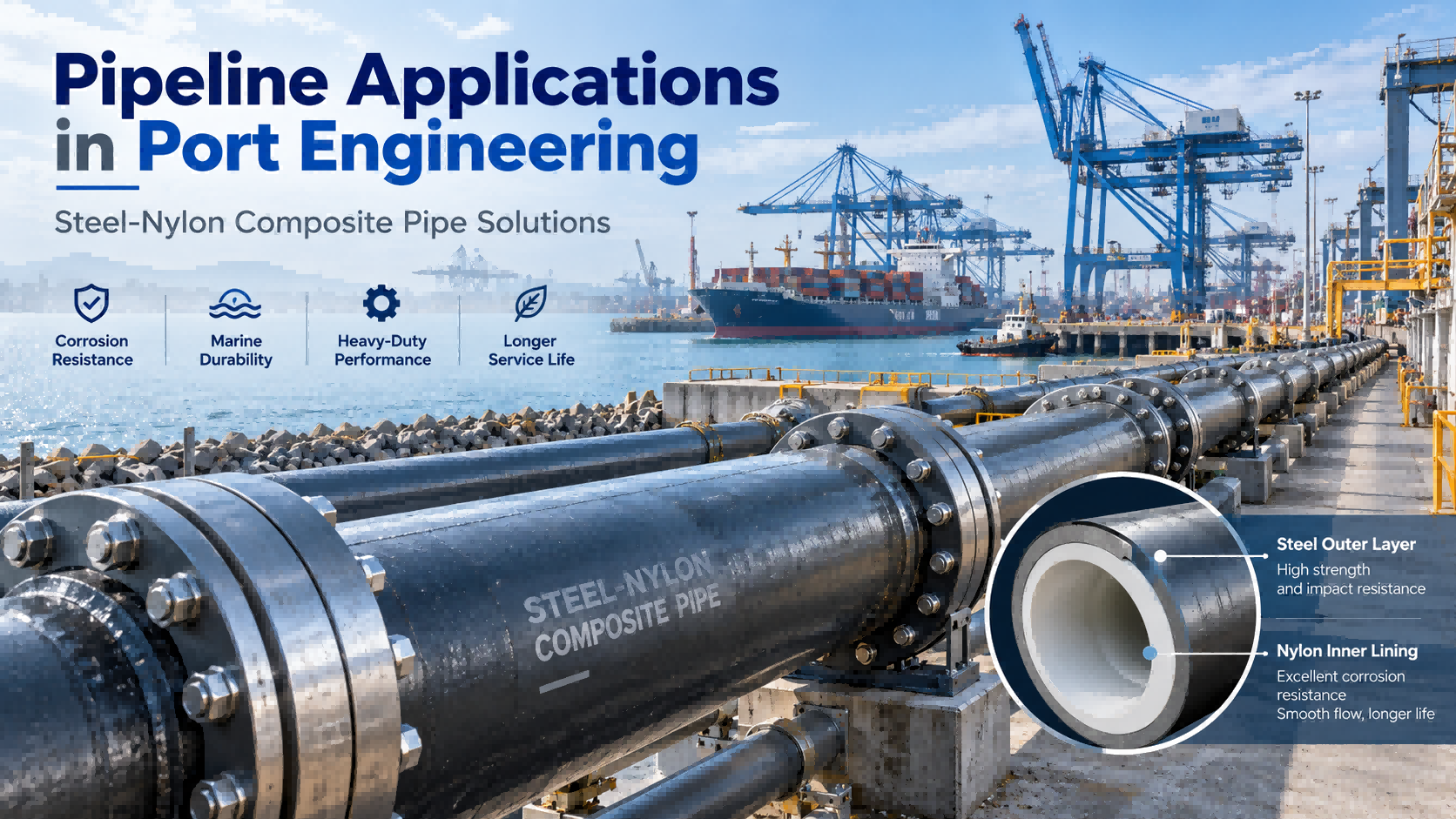
Pipeline Applications in Port Engineering: How Steel-Nylon Composite Pipes Address Corrosion and Abrasion Challenges in Marine Environments
Introduction: Why Port Engineering Requires a New Approach to Pipeline Material Selection
Ports are essential infrastructure supporting global trade, industrial logistics, and international supply chains. From container terminals and bulk cargo ports to petrochemical terminals, liquid storage facilities, and coastal industrial zones, pipeline systems play a vital role in seawater transportation, industrial cooling, wastewater discharge, slurry handling, and the transfer of various industrial fluids.
Compared with conventional inland industrial pipelines, port pipeline systems operate under significantly more demanding environmental conditions.
High-salinity seawater, tidal fluctuations, salt spray, sediment erosion, humid atmospheres, and continuous cargo-handling operations expose pipelines to multiple operational challenges.
Traditional carbon steel pipelines are vulnerable to corrosion and localized wall thinning. Certain stainless steel grades may experience chloride-induced pitting and crevice corrosion. Meanwhile, some non-metallic pipelines require additional consideration regarding structural stiffness, external loads, connection strength, and temperature limitations.
Consequently, modern port engineering is no longer focused solely on comparing the initial purchase prices of pipeline materials.
Engineers, EPC contractors, and project owners increasingly evaluate:
-
Corrosion resistance in high-salinity environments.
-
Abrasion resistance when transporting sand-containing fluids.
-
Long-term pressure resistance and structural stability.
-
Resistance to external loads and mechanical impacts.
-
Installation efficiency and maintenance accessibility.
-
Long-term operational reliability and total cost of ownership.
Against this background, steel-nylon composite pipes are emerging as a promising option for certain industrial port pipeline applications involving corrosion, abrasion, and demanding mechanical requirements.
By combining the structural strength of steel with the corrosion-resistant and wear-resistant characteristics of engineering nylon, these composite pipelines offer an alternative to traditional single-material piping systems.
1. Five Major Challenges Facing Pipeline Systems in Port Engineering
1.1 Seawater Corrosion: The Long-Term Impact of Chloride-Rich Environments
Seawater contains chloride ions and various dissolved salts that significantly influence the corrosion behavior of metallic materials.
In port engineering, seawater pipelines may continuously transport natural seawater, concentrated brine, or circulating water containing different concentrations of dissolved oxygen.
For carbon steel pipelines without adequate protection, long-term seawater exposure may result in general corrosion and localized corrosion.
Even stainless steel pipelines require careful evaluation of material grade, operating temperature, chloride concentration, flow conditions, and crevice geometry.
Importantly, corrosion conditions can vary considerably depending on the installation location.
Atmospheric exposure zones: Pipelines are affected by salt spray, humidity, and airborne contaminants.
Tidal and splash zones: Pipelines experience repeated wetting and drying, salt accumulation, and wave impact.
Submerged zones: Pipelines remain in continuous contact with seawater, making external corrosion protection particularly important.
Underground and buried sections: Pipelines may be affected by soil corrosion, groundwater, and stray electrical currents.
These conditions demonstrate why effective corrosion management must address both internal and external pipeline surfaces.
1.2 Sediment Abrasion: A Hidden Cost in Port Hydraulic Transportation Systems
Port dredging operations, sediment discharge systems, bulk material handling facilities, and certain industrial wastewater pipelines frequently transport fluids containing sand, mineral particles, and other suspended solids.
As these particles move through pipelines at relatively high velocities, they repeatedly strike internal pipe surfaces.
Localized abrasion can be especially severe at elbows, tees, reducers, and other locations where the flow direction or velocity changes.
In conventional metal pipelines, continuous particle erosion may cause progressive wall thinning and, eventually, leakage or failure.
Several factors make sediment transportation particularly challenging:
-
Particle size and solids concentration may fluctuate.
-
Flow velocity influences both sediment deposition and abrasive wear.
-
Elbows and lower pipe surfaces may experience concentrated abrasion.
-
Some transported fluids cause corrosion and abrasion simultaneously.
Therefore, selecting a pipeline for port applications requires evaluating both corrosion resistance and abrasion resistance under actual operating conditions.
1.3 Continuous Operation: Downtime Can Cost More Than the Pipeline Itself
Major ports and industrial terminals often rely on continuously operating pipeline systems.
A failure in a seawater cooling pipeline may interrupt essential industrial equipment.
Leakage from wastewater or chemical drainage pipelines may create environmental risks and additional cleanup expenses.
A malfunction in a critical transfer pipeline at a liquid bulk terminal may disrupt loading schedules and storage operations.
As a result, the economic consequences of pipeline failure extend far beyond the cost of replacing damaged pipe sections.
Potential expenses include:
Maintenance costs + Production downtime + Labor expenses + Environmental remediation + System restart costs
For critical port infrastructure, improving pipeline reliability can provide substantial economic value over the project lifecycle.
1.4 Complex Installation Conditions and Limited Maintenance Access
Port pipelines frequently pass through terminal platforms, pipe racks, pumping stations, underground utility corridors, and equipment-intensive industrial areas.
Some pipelines are installed close to the waterfront, where construction activities are affected by tides, weather conditions, and operating restrictions.
Consequently, installation methods can directly influence project schedules.
Traditional piping systems may require extensive onsite welding, corrosion protection, and connection inspection.
For steel-nylon composite pipelines designed with flanged connections, prefabricated sections and modular installation can reduce certain onsite welding requirements.
However, reliable flange connections still depend on correct gasket selection, bolt preload, flange sealing surfaces, and proper installation procedures.
1.5 Marine Climate and Dynamic Loads Demand Greater Structural Reliability
Port pipeline systems may be exposed to wind and wave action, terminal vibration, temperature fluctuations, equipment loads, and differential ground settlement.
Under these conditions, corrosion resistance alone cannot guarantee long-term pipeline safety.
Engineering teams must also evaluate:
-
Internal pressure and pressure transients.
-
Thermal expansion and contraction.
-
Pipe support spacing and localized stresses.
-
Foundation settlement and pipeline displacement.
-
Mechanical impacts from port equipment and operations.
-
Fatigue resistance and long-term joint sealing performance.
This is one reason steel-nylon composite structures deserve consideration.
By combining the complementary characteristics of steel and nylon, they may provide a practical balance between structural strength and internal corrosion protection for selected port applications.
2. Structural Principles and Technical Advantages of Steel-Nylon Composite Pipes
Steel-nylon composite pipes are industrial pipelines consisting of a steel load-bearing structure combined with an internal nylon lining or composite layer.
Their engineering concept is based on assigning different functions to materials according to their respective strengths.
The steel structure primarily provides pressure resistance, mechanical support, and overall structural rigidity.
The nylon inner layer primarily provides a protective surface in contact with the transported fluid, contributing to internal corrosion resistance and abrasion protection.
This composite structure can help prevent direct exposure of the steel substrate to corrosive fluids when the lining remains intact and the operating conditions are suitable.
2.1 Internal Corrosion Protection: Reducing Direct Contact Between Metal and Transported Fluids
One of the principal challenges of conventional carbon steel seawater pipelines is direct contact between seawater and the internal metallic surface.
Steel-nylon composite pipes use a continuous nylon lining to separate the transported fluid from the steel structure.
This approach offers a potential solution for reducing internal corrosion risks.
For saline solutions, certain industrial wastewater streams, and other compatible fluids within suitable temperature and concentration ranges, engineering nylon can provide useful chemical resistance.
However, chemical compatibility must always be verified against the actual fluid composition, especially when strong oxidizing agents, acidic substances, or high-temperature chemicals are present.
Potential advantages include:
-
Reduced internal metallic corrosion.
-
Lower risk of corrosion-related wall thinning.
-
Reduced requirements for certain internal corrosion maintenance activities.
-
Improved potential for maintaining pipeline integrity during long-term operation.
It is important to recognize that a nylon lining does not automatically protect the external steel surface.
Pipelines installed in marine atmospheres, tidal zones, or underwater locations still require appropriate external corrosion protection systems.
2.2 Abrasion Resistance: A Material Solution for Sand-Containing and Particle-Laden Fluids
Engineering nylon offers a combination of toughness, friction-related performance, and resistance to certain forms of particle impact.
Under suitable particle sizes, concentrations, flow velocities, and impact angles, a properly designed and tested nylon lining can help protect pipelines transporting abrasive fluids.
Potential applications include:
Port sediment transportation: Reducing internal wear caused by suspended sand particles.
Industrial wastewater handling at bulk terminals: Addressing the combined effects of suspended solids and corrosive substances.
Coastal mineral transportation systems: Managing pipeline abrasion caused by mineral particles and carrier fluids.
Nevertheless, abrasion resistance cannot be determined by material classification alone.
Actual wear rates depend on particle hardness, particle size distribution, flow velocity, elbow geometry, and the specific nylon formulation.
For high-solids-concentration systems, high-velocity abrasive transport, or major dredging operations, simulated wear testing and field trials are recommended.
2.3 Combining Steel Pressure Resistance with Nylon Protection
One potential advantage of steel-nylon composite pipes over single-material polymer pipes is their steel load-bearing structure.
Steel provides structural rigidity and pressure-bearing capability, making this composite configuration attractive for certain industrial port applications.
This combination may be valuable for projects requiring higher operating pressures, larger pipe diameters, or more demanding support arrangements.
Our steel-nylon composite pipe product range can be designed for different pressure classes and structural requirements.
Available product configurations include pressure ratings within the 1.0–4.0 MPa range, depending on the specific design.
However, allowable operating pressure must always be confirmed based on pipe diameter, wall thickness, operating temperature, material properties, connection configuration, and validated engineering calculations.
The product range should not be interpreted as indicating that every pipe size can operate at every pressure or temperature condition.
2.4 Improved Hydraulic Conditions and Potential Reduction in Operating Resistance
The condition of a pipeline's internal surface plays an important role in hydraulic performance.
Under otherwise comparable conditions, relatively smooth internal surfaces can help reduce friction losses and prevent the excessive flow restriction associated with severe corrosion deposits.
Properly manufactured and validated steel-nylon composite pipes may help maintain relatively stable internal flow passages over time.
For continuously operating seawater transportation and industrial circulating water systems, potential benefits include:
-
Reduced formation of rough surfaces caused by severe internal corrosion.
-
More stable flow and pressure-loss characteristics.
-
Reduced need for certain internal cleaning activities.
-
Improved long-term hydraulic system management.
However, actual energy savings must be calculated using flow rate, pipe diameter, friction losses, local resistance, and pump efficiency.
A fixed energy-saving percentage should never be assumed without project-specific hydraulic analysis.
2.5 Flanged Connections and Factory Prefabrication for Port Construction
Port engineering projects frequently prioritize installation efficiency and reliable equipment connections.
We can provide flanged connection solutions, prefabricated pipe sections, customized dimensions, and project-specific configurations according to engineering requirements.
Flanged connections offer several practical benefits.
Modular installation: Pipe sections can be partially prefabricated in the factory, reducing complex onsite fabrication.
Equipment integration: Properly designed flanges can connect pipelines with pumps, valves, filtration systems, and other industrial equipment.
Convenient disassembly: Individual pipeline sections can be maintained or replaced when sufficient space is provided.
Adaptability to complex pipe racks: Customized lengths and flange orientations help accommodate existing terminal infrastructure.
For steel-nylon composite pipes, special attention must be given to lining continuity at flange faces, gasket compatibility, and corrosion protection at connection points.
These areas must not become weak points in the overall piping system.
3. Six Typical Applications of Steel-Nylon Composite Pipes in Port Engineering
Application 1: Port Seawater Intake and Transportation Systems
Large industrial facilities located near ports frequently use seawater for cooling or process-related applications.
Typical pipeline systems include:
-
Seawater intake pumping station connections.
-
Industrial seawater transmission mains.
-
Cooling water supply pipelines.
-
Seawater pretreatment facility connections.
Traditional metallic pipelines in these applications generally require suitable internal corrosion protection.
Steel-nylon composite pipes combine a protective nylon inner layer with a steel structural body, making them a potential material option for selected seawater transportation systems.
Key potential advantages: Internal corrosion protection, structural strength, flanged installation, and maintenance accessibility.
For prolonged seawater exposure, engineering teams should verify water absorption effects, long-term aging performance, lining integrity, and pressure retention.
Application 2: Port Dredging and Sand-Laden Slurry Transportation
Port channels and berths require periodic maintenance dredging to manage sediment accumulation.
During dredging operations, mixtures of water and sediment may be transported through pipelines to designated discharge or reclamation locations.
These systems often demand strong abrasion resistance.
Steel-nylon composite pipes may be considered for selected fixed or auxiliary slurry transportation pipelines, where the nylon lining provides potential abrasive wear protection.
However, dedicated wear-resistant pipelines and specialized connection systems may be more suitable for highly concentrated coarse particles, extremely severe erosion, frequent dragging, or temporary pipelines requiring substantial flexibility.
Key potential advantages: Abrasion resistance, steel structural support, and adaptability through prefabricated sections.
Application 3: Industrial Utility Pipelines at Petrochemical Terminals
Petrochemical terminals typically include seawater cooling, industrial water, drainage, and other utility systems.
These pipelines may experience high salinity, corrosive components, and periodic temperature changes.
For non-hazardous or appropriately controlled media compatible with nylon, steel-nylon composite pipes can be included in material selection studies.
However, pipelines handling flammable, explosive, strongly oxidizing, or otherwise hazardous fluids require specific safety assessments.
Fire performance, electrostatic control, chemical compatibility, and applicable engineering codes must be carefully considered.
Corrosion resistance alone does not establish suitability for all petroleum products or chemical transfer pipelines.
Key potential advantages: Internal corrosion protection in utility systems, structural stability, and customized connections.
Application 4: Port Industrial Wastewater and Saline Effluent Transportation
Industrial zones surrounding ports may generate several categories of wastewater, including saline wastewater, particle-laden water, and process effluents.
The chemical characteristics of these fluids can vary significantly.
Properly designed steel-nylon composite pipes may be considered for certain wastewater transportation applications involving salts and suspended particles.
Engineering evaluation should include:
-
Actual wastewater pH.
-
Operating temperature and chemical fluctuations.
-
Oxidizing agents and cleaning chemicals.
-
Suspended solids concentration.
-
Internal pressure and possible vacuum conditions.
-
Environmental consequences of pipeline leakage.
Key potential advantages: Fluid isolation, potential abrasion protection, and reduced maintenance requirements under validated conditions.
Application 5: Large Port Pipe Racks and Coastal Industrial Infrastructure
Modern ports often feature extensive pipe racks and complex industrial pipeline networks.
Pipelines may extend over long distances between pumping stations, treatment facilities, and other operating areas.
Where appropriate, steel-nylon composite pipes can combine the rigidity of steel with customized pipe configurations to meet specific large-diameter industrial pipeline requirements.
For large-diameter installations, additional design considerations include:
-
Pipe self-weight and fluid-filled weight.
-
Pipe support and foundation capacity.
-
External loads and wind or wave effects.
-
Thermal movement and settlement.
-
Transportation and lifting arrangements.
-
Flange loading and sealing integrity.
Key potential advantages: Customized diameters, prefabricated construction, structural support, and internal protection.
Application 6: Port Circulating Water and Auxiliary Industrial Systems
Port industrial parks, coastal power plants, and related facilities frequently operate circulating cooling water systems.
These systems require stable flow performance, high operational reliability, and practical maintenance arrangements.
Steel-nylon composite pipes may be evaluated for selected circulating water applications based on the transported fluid, operating pressure, and temperature requirements.
For regulated systems such as firewater pipelines, applicable fire protection standards and material certification requirements must be satisfied.
Experience from ordinary industrial water pipelines should not be treated as a substitute for required fire protection approvals.
4. Comparison of Common Port Pipeline Materials
Selecting the right pipeline material requires balancing corrosion resistance, mechanical performance, operating conditions, installation requirements, and lifecycle cost.
| Pipeline Material | Main Advantages | Key Limitations or Verification Requirements |
|---|---|---|
| Carbon Steel Pipe | High strength, established manufacturing and installation practices | Internal and external corrosion protection, wall thinning, maintenance |
| 316L Stainless Steel Pipe | Good corrosion resistance in many industrial environments | Pitting and crevice corrosion under certain seawater conditions, material cost |
| HDPE Pipe | No electrochemical metal corrosion, relatively lightweight | Temperature, pressure, long-term creep, support and joint design |
| FRP Pipe | Lightweight, corrosion resistance to selected fluids | Impact resistance, joint design, long-term mechanical behavior, installation quality |
| Rubber-Lined Steel Pipe | Steel pressure-bearing structure with protective rubber lining | Lining aging, localized debonding, repair requirements |
| Steel-Nylon Composite Pipe | Combines steel structural strength with nylon internal protection | Nylon water absorption, long-term aging, interface stability, external steel corrosion protection |
No pipeline material is universally superior under all operating conditions.
For lightweight, flexible, low-pressure water transmission projects, HDPE may be an appropriate solution.
For certain highly corrosive chemical applications, properly selected FRP or other specialized materials may offer significant advantages.
However, where industrial port pipelines require a combination of pressure resistance, structural rigidity, internal corrosion protection, and abrasion resistance, steel-nylon composite pipes deserve serious consideration.
The best material selection is determined by verified performance under actual operating conditions, not simply by material classification.
5. Which Performance Characteristics Should Be Verified for Steel-Nylon Composite Pipes in Port Applications?
Engineering design institutes and EPC contractors typically require reliable engineering evidence before introducing new composite materials into major infrastructure projects.
Therefore, port pipeline projects should prioritize the following technical assessments.
5.1 Long-Term Seawater Immersion and Nylon Material Performance
Our composite pipeline products use engineering nylon as an internal protective material, with Nylon 6 (PA6) serving as one of the primary base materials.
PA6 offers useful mechanical properties and potential wear resistance, but it is also a moisture-absorbing polyamide.
Long-term seawater exposure can affect its dimensions, elastic modulus, and other mechanical characteristics.
Elevated temperatures, chemical composition, and prolonged immersion may also influence material aging.
Therefore, long-term immersion testing, water absorption measurements, tensile property retention tests, and dimensional stability evaluations are recommended.
5.2 Integrity of the Nylon Lining and Steel Structure
The performance of a composite pipe depends not only on the individual properties of steel and nylon but also on the interface between them.
Recommended assessments include:
-
Reliability of interfacial bonding or mechanical locking.
-
Lining thickness and uniformity.
-
Interface integrity after thermal cycling.
-
Lining stability under pressure cycling.
-
Resistance to instability caused by vacuum or rapid depressurization.
-
Lining continuity at flanges and special fittings.
5.3 External Corrosion Protection
External corrosion protection is one of the most important considerations in port engineering.
Although steel-nylon composite pipes use nylon to isolate transported fluids from the internal steel surface, the external steel structure may still be exposed to marine corrosion.
For pipelines installed in salt-spray environments, tidal zones, or submerged conditions, suitable external protective coatings must be selected.
Where applicable, cathodic protection, corrosion protection at connection points, and periodic inspection programs should also be evaluated.
A comprehensive marine pipeline protection strategy must integrate internal fluid protection with external corrosion control.
5.4 Pressure Resistance and Hydraulic Transient Analysis
Port seawater intake pumping stations and industrial transportation systems may experience water hammer and other hydraulic transients.
Pipeline engineering must therefore consider not only normal operating pressure but also pump starts and stops, valve closure, air release, pressure-wave propagation, and possible local vacuum conditions.
Steel-nylon composite pipes should be evaluated through appropriate pressure testing, structural calculations, and system-specific transient analyses.
5.5 Abrasion Testing and Field Performance Evaluation
For sand-containing or slurry applications, wear testing should use particle characteristics and flow conditions that closely represent the actual operating environment.
Where necessary, pilot pipeline sections can be installed to evaluate material performance.
After commissioning, inspection programs should monitor wall thickness, lining condition, and locations particularly susceptible to abrasive wear.
This evidence-based approach can help international EPC companies and engineering consultants assess new pipeline materials with greater confidence.
6. Why Total Cost of Ownership Matters in Port Pipeline Projects
Modern port infrastructure procurement requires more than an evaluation of initial material costs.
Project owners increasingly need to assess the total economic impact of a pipeline system throughout its intended service life.
Total Cost of Ownership (TCO) can be expressed as:
TCO = Initial Procurement and Installation Costs + Maintenance Costs + Replacement Costs + Operating Energy Costs + Downtime Losses + Decommissioning Costs
For projects with long operating periods, the time value of money should also be considered by calculating the discounted present value of future expenditures.
Lower Initial Cost Does Not Necessarily Mean Lower Lifetime Cost
Consider a port industrial water transmission project comparing conventional corrosion-protected carbon steel with steel-nylon composite pipes.
Carbon steel may offer a lower initial purchase cost.
However, its long-term cost assessment must account for coating inspections, corrosion monitoring, localized repairs, and possible pipe replacement.
Steel-nylon composite pipes may require a different initial investment and still need external corrosion protection, lining inspection, and connection maintenance.
If validated composite pipe designs can extend maintenance intervals, reduce localized failures, or decrease unexpected downtime, they may provide better lifecycle economics.
Nevertheless, such savings must be supported by project-specific maintenance data, expected service life, construction conditions, and reliability analysis.
Composite pipes should not automatically be assumed to be the lowest-cost solution in every application.
Downtime Costs Are a Critical Economic Variable
For continuously operating port facilities, pipeline failures can affect multiple interconnected processes.
A failure in a critical industrial water pipeline, for example, may interrupt pumping operations, reduce equipment output, require emergency maintenance, and increase energy consumption.
Engineering teams should therefore consider both the probability of failure and the consequences of that failure.
For critical industrial systems at ports, reducing the risk of unplanned downtime over the pipeline lifecycle may deliver greater value than minimizing the initial pipe purchase price.
7. How Our Steel-Nylon Composite Pipes Support Port Engineering Projects
As a manufacturer of steel-nylon composite pipes, we focus on industrial pipeline solutions that balance structural strength, internal protection, and practical installation requirements.
For port and coastal industrial projects, our capabilities focus on the following areas.
7.1 Material Selection for Complex Operating Conditions
We evaluate potential pipeline suitability based on the customer's transported fluid, salinity, temperature, pressure, suspended solids concentration, and installation environment.
For seawater and saline fluids, the evaluation emphasizes internal corrosion protection, long-term water absorption, and chemical compatibility.
For sand-containing transportation systems, abrasion risks and lining design receive additional attention.
7.2 Large-Diameter and Customized Pipeline Manufacturing
Port seawater intake, circulating water, and industrial transportation systems frequently require large-diameter pipes.
We have manufacturing and customization capabilities for large-diameter industrial pipeline products.
Depending on project requirements, we can evaluate pipe diameter, wall thickness, pressure class, and specialized fittings.
For extra-large-diameter projects, manufacturing feasibility, structural calculations, inspection procedures, and transportation arrangements must be confirmed individually.
7.3 Flanged Connections and Matching Pipe Fittings
For complex port pipe racks and equipment installations, we can provide flanged connection solutions and customized fittings according to project specifications.
Our engineering approach considers connection compatibility, sealing reliability, installation efficiency, and long-term maintenance accessibility.
7.4 Manufacturing Quality Control and Engineering Support
For international EPC projects and industrial customers, consistent product quality and complete technical documentation are essential.
We emphasize quality control throughout raw material selection, pipe manufacturing, composite processing, and finished-product inspection.
For specific projects, dimensional inspection, visual examination, pressure testing, and material performance validation can be defined according to the agreed quality plan.
7.5 Engineering Support for International EPC Contractors and Project Owners
Port development projects involve engineering consultants, EPC contractors, equipment suppliers, and end users.
Our objective extends beyond supplying individual pipe products.
We aim to support customers throughout material comparison, technical specification review, connection design, and project delivery planning.
By identifying operating requirements, material limitations, and validation needs early in the project, we help engineering teams assess whether steel-nylon composite pipes are suitable for their applications.
8. Seven Essential Parameters for Port Pipeline Material Selection
Before selecting steel-nylon composite pipes or alternative industrial pipeline materials, engineers should establish the following design conditions.
| Key Parameter | Information to Confirm |
|---|---|
| Transported Fluid | Seawater, industrial water, saline wastewater, slurry, or other fluids, including complete chemical composition |
| Design Pressure | Normal operating pressure, design pressure, transient pressure peaks, and possible vacuum conditions |
| Operating Temperature | Normal, maximum, and minimum temperatures, including thermal cycling frequency |
| Abrasion Conditions | Solids concentration, particle size, particle hardness, flow velocity, and impact angle |
| Installation Environment | Aboveground, pipe rack, underground, tidal-zone, or submerged installation |
| Connection Method | Flange specifications, gasket materials, valves, and equipment interfaces |
| Design Service Life | Target operating years, maintenance intervals, and allowable downtime |
For marine ports and coastal industrial facilities, the design process should also consider external corrosion protection, ultraviolet exposure, wind and wave loading, marine biofouling, and inspection accessibility.
A comprehensive operating-condition assessment helps avoid material selection decisions based solely on purchase price or isolated material properties.
9. Three Important Trends in Port Engineering Pipeline Development
Trend 1: From Single Materials to Multi-Material Composite Solutions
As industrial pipeline operating conditions become increasingly complex, it can be difficult for a single material to achieve the desired balance of pressure resistance, corrosion protection, abrasion resistance, weight, and cost.
Composite pipe technologies provide more design options by assigning different functions to different materials.
Steel-nylon composite pipes represent one practical approach to this multi-material engineering concept.
Trend 2: From Initial Purchase Price to Long-Term Operational Value
For port infrastructure with long design lives, limited maintenance access, and significant downtime consequences, lifecycle cost analysis offers a more comprehensive basis for material selection.
Future pipeline procurement decisions are likely to place greater emphasis on long-term economic performance supported by actual reliability data.
Trend 3: From Pipe Procurement to Integrated Engineering Solutions
Modern port projects increasingly require coordination among material selection, engineering design, manufacturing, construction, monitoring, and maintenance.
For composite products such as steel-nylon pipelines, manufacturers must do more than describe material advantages.
They must also provide suitable design information, validation data, and quality control documentation.
A systematic technical verification process is essential for expanding the application of new pipeline solutions in international port infrastructure and EPC projects.
10. Frequently Asked Questions (FAQ)
Q1: Can steel-nylon composite pipes be used for seawater transportation?
Steel-nylon composite pipes can be considered for seawater transportation applications, subject to verification of nylon formulation, actual seawater conditions, operating temperature, pressure, and expected service life.
Appropriate external corrosion protection for the steel structure is also required.
Q2: Are steel-nylon composite pipes more corrosion-resistant than ordinary carbon steel pipes?
When the nylon lining remains intact and the transported fluid is chemically compatible, it can reduce direct contact between the fluid and the internal steel surface.
This provides the potential to reduce internal corrosion risks.
However, additional measures are still necessary to protect the external steel surface against marine corrosion.
Q3: Can steel-nylon composite pipes transport sand-containing fluids and slurry?
Steel-nylon composite pipes can be evaluated for selected sand-containing and slurry transportation applications.
Their suitability depends on particle characteristics, flow velocity, abrasion testing, and project-specific operating conditions.
Q4: Are steel-nylon composite pipes suitable for large port infrastructure projects?
Steel-nylon composite pipes may be suitable for selected industrial seawater intake, cooling water, auxiliary fluid transportation, and wastewater pipeline applications.
Actual suitability must be confirmed through evaluations of pipe diameter, operating pressure, structural conditions, external environmental exposure, and applicable engineering standards.
Q5: Can steel-nylon composite pipes reduce maintenance costs in port applications?
If validated composite pipe designs successfully reduce internal corrosion, extend maintenance intervals, or decrease unexpected failures, they may help lower long-term maintenance expenditures.
However, the actual economic benefits should be confirmed through project-specific total cost of ownership analysis.
Conclusion: Port Pipeline Selection Is Moving Toward System-Level Reliability Engineering
The complexity of port engineering means that pipeline materials should never be selected solely on the basis of initial purchase price.
Seawater corrosion, sediment abrasion, continuous operation, restricted installation space, and external environmental loads all demand reliable engineering solutions supported by appropriate testing and design.
Traditional carbon steel, stainless steel, HDPE, FRP, and composite pipeline materials each have their own areas of suitability.
By combining a steel load-bearing structure with an internal nylon protective layer, steel-nylon composite pipes offer a potential solution for selected port industrial applications requiring structural strength, internal corrosion resistance, and abrasion protection.
For projects focused on reducing internal corrosion, managing abrasive wear, and improving long-term operational stability, this composite technology deserves consideration during engineering design and material procurement.
At the same time, the reliability of any marine pipeline system must be established through detailed operating-condition analysis, material testing, external corrosion protection, connection verification, and manufacturing quality control.
The future of port pipeline engineering is not simply about choosing a stronger or more corrosion-resistant material.
It is about developing reliable piping systems that achieve the right balance of safety, performance, maintenance requirements, and lifecycle cost.
Looking for a Reliable Pipeline Solution for Your Port Engineering Project?
We specialize in the development and manufacturing of nylon pipes and steel-nylon composite pipes, providing industrial piping solutions for port engineering, seawater transportation, chemical processing, mining, and coastal industrial infrastructure.
Whether your project involves seawater corrosion, abrasive sediment transportation, large-diameter pipelines, or challenging installation requirements, we welcome technical discussions with engineering consultants, EPC contractors, distributors, and end users.
Our team can assist with material selection, product specifications, customized pipe dimensions, flanged connections, and application-specific technical evaluations.
Visit our website: www.nylonpipeline.com
Contact us today with your project requirements, including design pressure, operating temperature, transported fluid, pipe diameter, and installation conditions.
Let us explore how steel-nylon composite piping solutions can support the safety, reliability, and long-term performance of your port engineering project.
Rapid Municipal Pipe Installation | Steel-Nylon Pipe Systems
Seawater Aquaculture Piping: Nylon Pipe Selection Guide