Why Coastal Infrastructure Needs More Corrosion-Resistant Piping
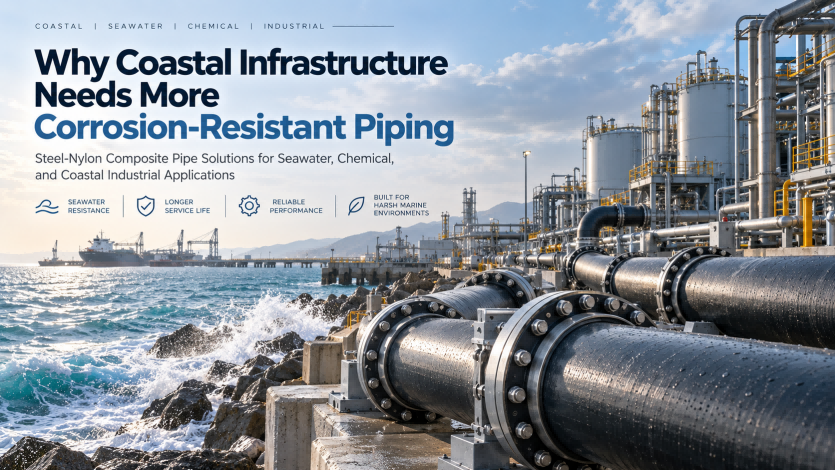
Ports, marine terminals, desalination plants, coastal chemical parks, seaside power plants, offshore energy facilities, and municipal water systems in coastal regions are becoming increasingly important parts of global infrastructure development.
Compared with inland industrial projects, however, coastal infrastructure faces one particularly serious challenge:
Corrosion.
For structural facilities, corrosion may shorten the service life of steel structures. For industrial piping systems, corrosion can have much more immediate consequences, including leakage, unplanned shutdowns, rising maintenance costs, environmental risks, and interruptions to plant operations.
In coastal environments, pipelines may be exposed simultaneously to seawater, salt spray, high humidity, chlorides, temperature fluctuations, and aggressive industrial fluids.
As a result, conventional piping materials can face much more complicated corrosion mechanisms than those found in ordinary industrial environments.
For this reason, pipeline selection for coastal infrastructure is gradually shifting from a traditional approach based mainly on:
“Can the pipe withstand the required pressure and flow?”
to a much broader engineering question:
“Can the piping system provide corrosion resistance, abrasion resistance, pressure capability, long service life, and low maintenance costs at the same time?”
This is also why advanced composite piping solutions such as steel-nylon composite pipes are attracting increasing attention in coastal industrial applications.
1. Why Are Coastal Environments So Aggressive to Pipelines?
The challenge facing coastal pipelines is not simply “seawater.”
In reality, several corrosion factors often act simultaneously.
Chlorides from Salt Spray
Ocean waves, sea winds, and evaporation continuously carry salt-containing particles into the surrounding atmosphere.
These salts can accumulate on:
-
Pipeline surfaces
-
Flanges
-
Bolts
-
Pipe supports
-
Welded joints
-
Structural supports
-
Valve connections
Chlorides are one of the important factors contributing to atmospheric corrosion in marine environments.
When salts remain on metal surfaces together with moisture, they create favorable conditions for continuous electrochemical corrosion.
This means that even pipelines that do not directly transport seawater can still experience severe external corrosion simply because they are installed near the coast.
2. Coastal Pipelines Face Both Internal and External Corrosion
In conventional industrial piping design, engineers often focus primarily on corrosion caused by the transported medium.
Coastal projects, however, must consider corrosion from two directions:
Internal corrosion caused by the process fluid
and
External corrosion caused by the marine environment
Consider a pipeline installed in a coastal chemical complex.
Internally, it may transport:
-
Brine
-
Industrial wastewater
-
Acidic or alkaline liquids
-
Circulating water
-
Chemical mother liquor
Externally, the same pipeline may be continuously exposed to:
-
Sea breeze
-
Salt spray
-
High humidity
-
Rain
-
Sunlight
-
Temperature fluctuations
-
Marine atmosphere
A conventional carbon steel pipe may therefore require corrosion protection not only on the inside but also on the outside.
Even if the internal surface is protected, the external coating still requires inspection and maintenance.
Conversely, improving only the external coating does not solve the problem if aggressive process fluids continue to corrode the internal pipe wall.
Therefore, the key engineering question should not simply be:
“Which material does not rust?”
Instead, engineers should ask:
Can both the internal and external corrosion risks be effectively controlled throughout the design life of the pipeline?
3. Seawater Is Not a Simple Transport Medium
When selecting seawater piping, many purchasing teams initially ask:
Which pipe material can transport seawater?
In practice, the engineering question is much more complex.
A seawater system may require evaluation of:
-
Chloride concentration
-
Temperature
-
Flow velocity
-
Sand content
-
Suspended solids
-
Microorganisms
-
Dissolved oxygen
-
Sedimentation during shutdown
-
Pressure fluctuations
-
Water hammer
-
Pipeline diameter
In seawater intake systems, circulating cooling water systems, and coastal industrial water networks, seawater may also carry sand, shells, and suspended particles.
Under these conditions, the challenge is no longer corrosion alone.
It becomes:
Corrosion + Erosion + Abrasion
A material may have excellent corrosion resistance but still suffer rapid wall loss if it cannot withstand long-term abrasive or erosive flow.
4. Typical Pipeline Applications in Coastal Infrastructure
Different coastal projects require different piping solutions.
However, several applications deserve particular attention.
4.1 Seawater Intake Pipelines
Typical applications include:
-
Seawater desalination plants
-
Coastal power plants
-
Chemical complexes
-
LNG terminals
-
Marine engineering projects
These pipelines are often characterized by:
High flow rates, large diameters, and continuous operation.
If a major seawater intake pipeline fails, the consequences may affect much more than one section of pipe.
The operation of the entire plant can be disrupted.
Reliability is therefore critical.
4.2 Seawater Cooling Systems
Many coastal power plants, refineries, and chemical facilities use seawater as a cooling medium.
Typical characteristics include:
-
High flow capacity
-
Large pipe diameters
-
Long operating cycles
-
Limited maintenance windows
For these systems, material selection should not be based solely on the initial purchase price.
The more important question is:
What will the total cost be over 20 years or more of operation?
4.3 Desalination Plants
A seawater desalination facility may include several very different process sections:
Seawater Intake
↓
Pretreatment
↓
Filtration
↓
Desalination
↓
Brine Discharge
Each stage may have different:
-
Salinity
-
Pressure
-
Flow velocity
-
Suspended solids content
Therefore, a large desalination project rarely has one pipe material that is ideal for every line.
A more rational engineering strategy is:
Select materials according to the actual operating conditions of each pipeline system.
4.4 Coastal Chemical Parks
Conditions in coastal chemical facilities can be even more complicated.
Internally, pipelines may transport:
-
NaCl brine
-
NaOH
-
Acidic solutions
-
Process wastewater
-
High-salinity wastewater
-
Chemical mother liquor
Externally, the pipes are continuously exposed to marine salt spray and humid air.
This creates a combined environment of:
Chemical Corrosion + Marine Atmospheric Corrosion
For conventional metallic piping, this can significantly increase both corrosion protection requirements and long-term maintenance costs.
4.5 Ports and Marine Terminals
Port facilities may include pipelines for:
-
Mineral slurry
-
Dredging media
-
Industrial wastewater
-
Seawater
-
Bulk-material handling systems
Where the transported medium contains large quantities of solid particles, abrasion resistance becomes another major requirement.
This is one reason why composite piping systems are increasingly being considered for port and marine industrial applications.
5. Why Are Conventional Piping Materials Becoming More Challenging in Coastal Projects?
There are many mature piping materials available for coastal applications.
The challenge is that:
Every material has its own operating limits.
Carbon Steel Pipe
Carbon steel offers several advantages:
-
High mechanical strength
-
Mature manufacturing technology
-
Well-established engineering standards
-
Wide availability
Its major weakness, however, is that its corrosion performance normally depends heavily on additional protection systems.
These may include:
-
Protective coatings
-
Linings
-
Cathodic protection
-
Regular inspection
-
Coating repair
-
Corrosion allowance
Once a coating is damaged, localized corrosion may develop rapidly.
Therefore, the real challenge of carbon steel may not be its initial purchase cost.
It is often:
The accumulation of maintenance costs throughout the pipeline lifecycle.
Stainless Steel Pipe
Grades such as 304 and 316L stainless steel are commonly used in corrosive environments.
However, chloride-rich conditions require careful material evaluation.
Depending on temperature, chloride concentration, stress, and local conditions, some stainless steels may still be vulnerable to:
-
Pitting corrosion
-
Crevice corrosion
-
Stress corrosion cracking
Higher alloy grades can provide improved corrosion resistance, but material costs can increase significantly.
For large-diameter pipelines such as DN500, DN800, DN1000, or larger, extensive use of high-alloy stainless steels may substantially increase project CAPEX.
FRP Pipe
FRP offers good corrosion resistance and is widely used in seawater and chemical applications.
However, large industrial projects also need to evaluate:
-
Mechanical strength
-
Impact resistance
-
Pipe support spacing
-
Flanged connections
-
Large-diameter manufacturing
-
Installation quality
-
Long-term pressure performance
-
Abrasion resistance
Therefore:
Good corrosion resistance does not automatically mean that a material is suitable for every operating condition.
HDPE and Other Thermoplastic Pipes
HDPE is widely used in low-pressure seawater systems and municipal infrastructure.
For certain industrial projects, however, engineers must also consider:
-
Pressure capability
-
Operating temperature
-
Large-diameter pipe stiffness
-
Support requirements
-
Thermal expansion
-
Flanged connections
-
Limited installation space inside industrial plants
As a project moves from ordinary water transportation toward:
Industrial-grade, higher-pressure, large-diameter, and complex-service piping,
the material-selection logic often changes.
6. Why Can Steel-Nylon Composite Pipe Be a Strong Option for Coastal Piping?
The fundamental idea behind composite piping is not to:
Completely replace metal.
Instead, it is to:
Allow different materials to perform the functions they are best suited for.
This is the basic principle behind steel-nylon composite pipe.
The steel structure primarily provides:
Mechanical strength and pressure resistance.
The nylon functional layer primarily provides:
Corrosion resistance, media isolation, and abrasion resistance.
Together, they create:
Steel Strength + Nylon Corrosion Resistance
This material architecture can be particularly valuable in demanding coastal infrastructure.
7. Advantage One: Reducing Direct Corrosion of the Steel Structure
In a conventional carbon steel pipeline:
Process Fluid
↓
Direct Contact with Steel Wall
↓
Corrosion
With a steel-nylon composite pipe, the principle is different:
Process Fluid
↓
Contact with Nylon Functional Layer
↓
Steel Structure Primarily Provides Mechanical Strength
The steel load-bearing structure is therefore not intended to serve as the primary fluid-contact surface.
For media such as:
-
Brine
-
Seawater
-
High-salinity industrial wastewater
-
Alkaline fluids
-
Certain corrosive chemical liquids
this structure can help reduce direct contact between aggressive media and the steel substrate.
8. Advantage Two: Combining Corrosion and Abrasion Resistance
This is an important requirement that can easily be overlooked in coastal projects.
Many engineers initially ask:
“Can the pipe resist seawater?”
However, after operation begins, they may discover that the real cause of rapid pipe-wall deterioration is:
Sand and suspended solids.
This is particularly relevant in:
-
Seawater intake systems
-
Ports
-
Dredging applications
-
Tailings transportation
-
Coastal mining
-
Industrial circulating water
When solid particles are present in the fluid, long-term erosion and abrasion can occur.
Enhanced nylon materials offer both corrosion resistance and favorable wear resistance.
As a result, steel-nylon composite piping can better combine:
Corrosion Resistance
and
Abrasion Resistance
in a single piping system.
9. Advantage Three: Maintaining the Pressure Capability Required by Industrial Systems
One of the major differences between industrial coastal piping and ordinary municipal water pipelines is the higher demand for mechanical strength.
Applications such as:
-
Pump discharge lines
-
Higher-pressure transportation
-
Long-distance pipelines
-
High-flow systems
-
Process pipelines
may experience significant internal pressure as well as transient pressure fluctuations.
Because steel-nylon composite pipe retains steel as its main structural load-bearing layer, it can combine corrosion resistance with industrial-grade mechanical strength.
This is one of the major benefits of the composite-material approach.
10. Advantage Four: Flanged Connections Support Industrial Maintenance
Industrial piping design must consider not only:
How will the pipeline be installed?
but also:
How will it be maintained 10 years from now?
Industrial systems frequently contain:
-
Pumps
-
Valves
-
Flowmeters
-
Filters
-
Heat exchangers
-
Storage tanks
-
Process equipment
Flanged connections are therefore extremely important.
Steel-nylon composite pipes can be designed with industrial flanged connections, allowing integration with:
-
Valves
-
Pumps
-
Equipment nozzles
-
Existing pipeline systems
This is especially useful in pipeline retrofit projects.
Many industrial projects do not involve constructing a completely new plant.
Instead, the objective is often to:
Replace only the sections suffering the most severe corrosion or wear.
11. Coastal Infrastructure Should Move from “Pipe Price” to TCO
This is one of the most important changes taking place in industrial piping selection.
Traditional procurement often compares:
Cost per Meter
However, a more meaningful comparison is:
Total Cost of Ownership
A simplified model is:
TCO = Pipe Purchase Cost + Installation Cost + Corrosion Protection Cost + Maintenance Cost + Replacement Cost + Downtime Losses
For example, Solution A may have a lower initial purchase price.
However, over 10 years it may require:
-
Multiple coating repairs
-
Repeated maintenance
-
Several section replacements
-
One or more production shutdowns
Another material may have a somewhat higher initial investment but operate reliably for a much longer period with fewer interventions.
Over the full lifecycle:
The second solution may actually be more economical.
12. The Most Expensive Part of Pipeline Failure Is Often Not the Pipe
This is especially true in industrial facilities.
When a pipeline leaks, the actual financial impact may include:
Pipeline repair
+
Labor
+
Lifting equipment
+
System cleaning
+
Plant shutdown
+
Production losses
+
Environmental treatment
+
Restart costs
For:
-
Desalination plants
-
Power plants
-
Ports
-
Chemical facilities
-
Petrochemical plants
pipeline reliability directly affects:
Plant Availability
Therefore, the value of a corrosion-resistant piping system should not be calculated simply as:
“How many pipe replacements can we avoid?”
Its greater value may be:
Reducing unplanned shutdowns.
13. Why Coastal Projects Are Increasingly Suited to a Composite-Material Approach
Traditional piping selection has often been framed as:
Metal
or
Plastic
Modern industrial material engineering is increasingly moving toward:
Composite Material Engineering
The objective is not to force one material to solve every engineering problem.
Instead:
Metal provides structural strength.
Polymeric materials provide corrosion resistance, abrasion resistance, and isolation from aggressive fluids.
Steel-nylon composite pipe is one example of this engineering approach.
It is not simply a matter of adding a polymer layer inside a steel pipe.
A reliable industrial composite piping system requires careful consideration of:
-
Steel-to-nylon composite structure
-
Bonding and structural stability
-
Continuity of the functional layer
-
Flange design
-
Elbow design
-
Tee design
-
Large-diameter manufacturing
-
Pressure rating
-
Temperature conditions
-
Long-term operating reliability
Therefore, the real competitiveness of an industrial composite pipe lies not only in the raw materials.
It lies in:
Materials + Structural Design + Manufacturing Technology + Engineering Experience
14. Which Coastal Projects Should Consider Steel-Nylon Composite Pipe?
No single piping material is appropriate for every coastal application.
However, steel-nylon composite pipe is particularly worth evaluating in applications such as:
Seawater Systems
-
Seawater intake
-
Seawater circulation
-
Seawater transportation
-
Desalination auxiliary piping
Coastal Power Plants
-
Circulating cooling water
-
Flue gas desulfurization systems
-
Industrial wastewater
Coastal Chemical Facilities
-
Brine
-
Chemical mother liquor
-
Alkaline solutions
-
High-salinity wastewater
-
Corrosive industrial water
Ports and Mining
-
Mineral slurry
-
Tailings
-
Sand-containing media
-
High-abrasion slurry
Oil, Gas, and Energy Projects
-
Produced water
-
Injection water
-
High-salinity water
-
Corrosive industrial liquids
Steel-nylon composite pipe becomes particularly attractive when three challenges occur simultaneously:
Corrosion + Abrasion + Pressure
15. What Parameters Should Be Confirmed Before Selecting Coastal Piping?
Before selecting a pipeline material, we normally recommend confirming at least the following operating data:
| Parameter | Key Question |
|---|---|
| Transported medium | Seawater, brine, wastewater, or chemical fluid? |
| Chemical composition | Does it contain acids, alkalis, chlorides, or other corrosive components? |
| Solid particles | Does the fluid contain sand, minerals, or suspended solids? |
| Concentration | What is the chemical or solids concentration? |
| Temperature | What are the normal and maximum operating temperatures? |
| Operating pressure | What are the normal and design pressures? |
| Pipe diameter | What nominal diameter is required? |
| Flow velocity | What is the design flow velocity? |
| Installation method | Above ground, underground, pipe rack, or coastal outdoor installation? |
| Connection type | Flanged, welded, or another connection method? |
| Design life | How many years is the system expected to operate? |
| Maintenance conditions | Can the system tolerate frequent shutdowns for maintenance? |
Only after these parameters are analyzed together can engineers properly answer:
Which piping material is best suited to this particular project?
Material selection should never be based solely on the phrase “seawater pipeline.”
16. The Future of Coastal Infrastructure Is Low-Maintenance Operation
As industrial facilities continue to increase in scale, owners and operators are placing greater emphasis on:
Low-Maintenance Infrastructure
The reason is straightforward.
For a large industrial plant:
Reducing maintenance frequency can be more valuable than reducing the initial pipe purchase price.
Future coastal piping materials are likely to be evaluated increasingly around several key characteristics:
Corrosion Resistant
Abrasion Resistant
Long Service Life
High Reliability
Low Maintenance
Lower Lifecycle Cost
These requirements closely match the engineering logic behind steel-nylon composite piping systems.
Conclusion: Coastal Pipeline Selection Is Really About Choosing the Next 20 Years of Maintenance Costs
The real question for coastal infrastructure is not:
“Which pipe is the cheapest?”
The more important question is:
Which piping system can operate reliably for the long term under the combined effects of seawater, salt spray, chlorides, high humidity, pressure, and abrasion?
For many demanding coastal industrial projects, conventional single-material piping systems can struggle to provide the ideal balance between:
Corrosion resistance, abrasion resistance, pressure capability, reliability, and lifecycle economics.
Steel-nylon composite pipe provides an alternative approach by combining:
The structural strength of steel with the corrosion and abrasion resistance of nylon.
For industries such as desalination, power generation, ports, chemical processing, mining, and oil and gas, future pipeline competition will increasingly move away from the question:
“How much does the pipe cost per meter?”
and toward:
“How much will this piping system cost over its entire service life?”
Because for industrial infrastructure designed to operate for decades:
The best pipeline is not necessarily the one with the lowest initial purchase price.
It is the one that delivers:
Fewer Repairs, Less Downtime, and More Reliable Long-Term Operation.
Future Trends in the Large-Diameter Water Supply and Drainage Pipeline Market
How Is Material Selection for Seawater Piping Systems Changing?