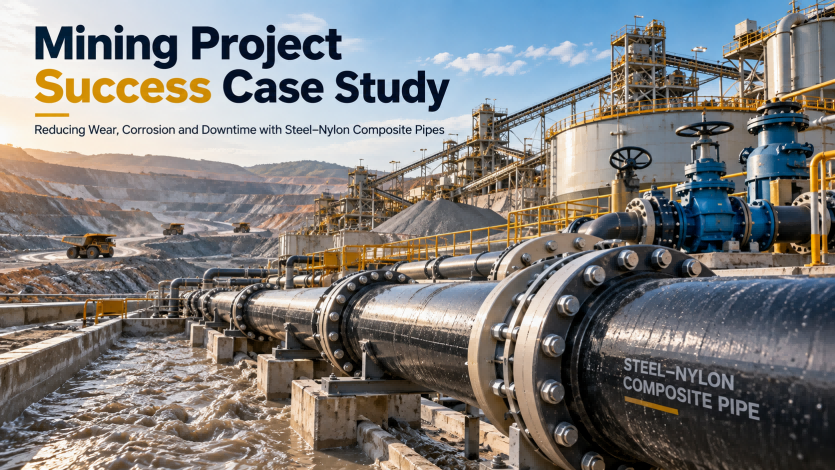
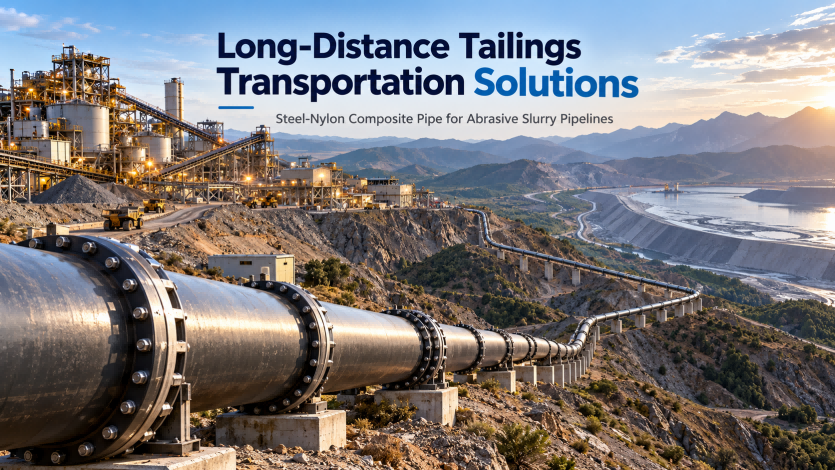
Copper Slurry Transportation Solutions: How to Address Abrasion, Corrosion, Sedimentation, and Long-Term Operating Challenges

In copper mining and mineral processing systems, pipelines are far more than simple transportation equipment.
From grinding, classification, and flotation to thickening, tailings handling, and copper concentrate transportation, large volumes of slurry containing mineral particles must be continuously transported through pipeline systems. As copper mines increase production capacity, raise slurry concentrations, and extend transportation distances, conventional pipelines are increasingly exposed to several recurring problems:
accelerated abrasion, localized wall penetration, short elbow service life, higher blockage risks, and rising shutdown and maintenance costs.
For this reason, copper slurry pipeline selection can no longer focus only on one question:
“How much pressure can the pipe withstand?”
A reliable pipeline system must simultaneously consider:
Abrasion Resistance + Corrosion Resistance + Pressure Capacity + Hydraulic Performance + Connection Reliability + Life-Cycle Maintenance Cost
For these demanding operating conditions, steel-nylon composite pipe is becoming an increasingly valuable slurry transportation solution.
1. Why Is Copper Slurry So Demanding on Pipelines?
Copper slurry is a typical solid-liquid two-phase flow medium.
What moves through the pipeline is not clean water, but a complex mixture consisting of:
-
Water
-
Copper ore particles
-
Gangue minerals
-
Fine and coarse solid particles of different sizes
Pipeline damage is generally driven by several mechanisms.
1.1 Continuous Abrasive Wear from Mineral Particles
As slurry moves through the pipeline, hard mineral particles continuously interact with the inner pipe wall through:
-
Sliding
-
Friction
-
Cutting
-
Impact
Particle shape, hardness, solids concentration, velocity, pipe diameter, bends, and pipeline geometry can all influence slurry pipeline wear.
In copper ore slurry, hard mineral components such as quartz and silicate minerals can further intensify abrasive wear.
Therefore:
One of the core challenges in copper slurry transportation is not corrosion alone, but continuous erosion and abrasion caused by solid particles.
2. Lower Slurry Velocity Is Not Always Better
When dealing with pipeline wear, one of the first ideas is often:
Reduce the slurry velocity.
However, slurry transportation involves an important engineering trade-off.
When the Velocity Is Too High
Higher particle kinetic energy increases the impact on:
-
Pipe walls
-
Elbows
-
Tees
-
Reducers
-
Valves
As a result, erosion and abrasive wear may increase significantly.
In many slurry systems, wear can increase rapidly and non-linearly as flow velocity rises.
Therefore, simply increasing velocity to maintain solids suspension is not always an effective strategy.
When the Velocity Is Too Low
If slurry velocity drops below a certain level, heavier or larger particles may begin settling at the bottom of the pipe.
This may create the following chain of problems:
Particle Settlement → Sliding Bed Formation → Increased Hydraulic Resistance → Further Sedimentation → Pipeline Blockage
This condition is commonly associated with the concepts of:
Deposition Velocity
or
Critical Velocity
The actual critical velocity depends on factors such as:
-
Pipe diameter
-
Particle size
-
Particle density
-
Solids concentration
-
Slurry density
Therefore, copper slurry pipeline design must find a balance:
The velocity must remain high enough to prevent excessive sedimentation, but should not be unnecessarily high because excessive velocity can accelerate pipeline wear.
3. High-Concentration Copper Slurry Creates Additional Design Challenges
Modern mining operations increasingly emphasize water conservation and higher slurry concentrations.
However, as solids concentration rises, slurry rheology can become more complex.
Engineering design should evaluate parameters such as:
-
Solids concentration by weight
-
Solids concentration by volume
-
Slurry density
-
D50 particle size
-
D80 particle size
-
Maximum particle size
-
Particle density
-
Viscosity
-
Yield stress
-
Temperature
-
pH
-
Transportation distance
High-density slurry may behave very differently from clean water.
For this reason, large copper mining projects should not select pipelines based simply on:
“Clean-water flow velocity + safety factor.”
A proper slurry pipeline design may require analysis of:
-
Hydraulic resistance
-
Rheology
-
Deposition velocity
-
Abrasion
-
Startup and shutdown behavior
4. Why Do Copper Slurry Pipelines Often Fail Locally First?
In actual mining operations, pipeline wear is rarely uniform.
The first failures often occur at specific locations.
Elbows
When slurry changes direction, solid particles continue moving due to inertia and strike the outer radius of the elbow.
For this reason, the outside wall of elbows often experiences some of the highest wear rates in the system.
Tees and Branch Connections
Changes in flow direction and localized turbulence can increase particle impact.
Reducers
A sudden change in pipe diameter changes the local flow velocity and flow pattern.
Upstream and Downstream of Valves
Throttling and pressure changes may create highly disturbed flow conditions.
Flanged Connections
If the internal bore is discontinuous, a gasket intrudes into the flow path, or an internal step exists between two pipe sections, localized turbulence may increase.
This means slurry pipeline design should not ask only:
“How many years will the straight pipe last?”
A more important question is:
“Where is the weakest point in the entire pipeline system?”
5. Why Can Conventional Steel Pipe Suffer from Dual Failure Mechanisms?
Carbon steel provides good mechanical strength and pressure resistance, which is why it has traditionally been widely used in mining pipeline systems.
However, in copper slurry transportation, steel pipe may simultaneously experience two types of damage.
First: Abrasion
Mineral particles continuously attack and remove material from the internal steel surface.
Second: Corrosion
Water, dissolved salts, acidic or alkaline environments, and other chemical components in the slurry may contribute to corrosion.
This can result in:
Corrosion-Abrasion Synergy
The steel surface may initially corrode.
The corrosion products are then removed by flowing mineral particles.
Fresh metal is exposed again and the process repeats.
Therefore:
Simply increasing the wall thickness of carbon steel pipe does not necessarily provide the most efficient long-term solution for copper slurry transportation.
6. Why Are More Slurry Pipeline Projects Using a “Structural Layer + Functional Layer” Concept?
Large slurry pipeline systems are increasingly designed around a simple engineering principle:
The structural layer provides mechanical strength and pressure capacity.
The inner functional layer handles direct contact with the transported medium.
This allows different materials to perform the functions they are best suited for.
In other words:
One material does not need to solve every engineering problem by itself.
This is also the fundamental design philosophy behind steel-nylon composite pipe.
7. How Can Steel-Nylon Composite Pipe Address Copper Slurry Transportation Challenges?
Steel-nylon composite pipe is not simply a thicker steel pipe.
Its most important characteristic is the combination of two functional materials.
Outer Steel Structure: Mechanical Strength and Pressure Support
The steel structural layer can provide:
-
Pipeline rigidity
-
External mechanical protection
-
Pressure-bearing capability
-
Structural stability for large diameters
-
Support for flange and connection structures
This is particularly important in:
-
Long-distance slurry pipelines
-
Pump discharge sections
-
Elevated-pressure systems
-
Large-diameter mining pipelines
Inner Reinforced Nylon Layer: Direct Slurry Contact
The slurry primarily contacts the nylon functional layer.
Depending on material formulation and actual operating conditions, reinforced nylon can provide advantages such as:
-
Abrasion resistance
-
Corrosion resistance
-
Relatively low friction characteristics
The objective is to reduce direct exposure of the structural steel layer to aggressive slurry.
The overall structure therefore becomes:
Steel Structural Layer
+
Abrasion- and Corrosion-Resistant Nylon Layer
In simple terms:
Steel provides the structural strength, while nylon handles the transported medium.
8. Why Is This Composite Structure Particularly Relevant to Copper Slurry Systems?
Copper slurry pipelines usually need to satisfy several requirements simultaneously.
| Copper Mining Requirement | Steel-Nylon Composite Design Approach |
|---|---|
| Mineral particle abrasion | Nylon inner layer handles direct slurry contact |
| Corrosive environment | Reduces direct contact between slurry and structural steel |
| Transportation pressure | Steel structure carries mechanical loads |
| Long-distance transportation | Can be designed according to hydraulic losses |
| Large pipe diameter | Steel structure provides rigidity |
| Frequent startup and shutdown | Requires combined strength and sedimentation control |
| Field installation | Flanged connection systems can be used |
| Maintenance requirements | Designed to reduce frequent penetration and replacement |
For this reason, steel-nylon composite pipe should not simply be viewed as:
“an abrasion-resistant pipe.”
A more accurate description is:
A composite piping solution designed for operating conditions where pressure, corrosion, and abrasion occur simultaneously.
9. Copper Slurry Pipelines Should Not Be Selected Based Only on Laboratory Wear Data
A common mistake in slurry pipeline selection is to compare only abrasion test results between different materials.
Laboratory wear results are useful, but real mining pipelines operate under much more complex conditions.
Actual performance is influenced by:
-
Slurry concentration
-
Particle size distribution
-
Particle shape
-
Flow velocity
-
Pipe diameter
-
Temperature
-
Number of elbows
-
Transportation distance
-
Elevation changes
-
Startup frequency
-
Shutdown frequency
Therefore, no pipeline material should be described as universally suitable for every slurry condition without considering actual project data.
A more reliable approach is to design the material and pipeline structure around the real operating environment.
10. What Parameters Should Be Provided Before Selecting a Copper Slurry Pipeline?
Before designing a steel-nylon composite piping solution for a copper mining project, the following information should be evaluated.
Slurry Parameters
-
Mineral type
-
Solids concentration, wt%
-
Slurry density
-
D50 particle size
-
D80 particle size
-
Maximum particle size
-
Particle hardness
-
pH
-
Chloride and other corrosive ion concentrations
-
Operating temperature
Hydraulic Parameters
-
Design flow rate
-
Minimum flow rate
-
Maximum flow rate
-
Pipe diameter
-
Transportation distance
-
Elevation difference
-
Design velocity
-
Operating pressure
-
Design pressure
Pipeline Layout
-
Straight pipe length
-
Number of elbows
-
Bend radius
-
Number of tees
-
Valves
-
Pump station locations
-
Startup and shutdown frequency
Only by combining these parameters can engineers make a more reliable slurry pipeline material selection.
11. The Real Comparison Should Be Based on Total Cost of Ownership
When purchasing mining pipelines, comparing only the price per meter can create a misleading result.
Consider two simplified scenarios.
Option A:
The pipeline costs 20% less initially but requires replacement every two years.
Option B:
The initial investment is higher, but the maintenance and replacement interval is significantly longer.
For a continuously operating copper mine, the total economic outcome can be completely different.
A better evaluation method is:
Total Cost of Ownership — TCO
TCO may include:
**Initial Pipeline Cost
-
Installation Cost
-
Energy Consumption
-
Maintenance Cost
-
Replacement Cost
-
Spare Parts Cost
-
Leakage Loss
-
Production Downtime Cost**
One of the most underestimated factors is often:
Downtime Cost
When a main slurry pipeline fails, only several meters of pipe may need replacement.
However, the impact may extend across the entire production chain:
Grinding → Flotation → Thickening → Slurry Transportation
Therefore, for a large copper mining operation:
The lowest-cost pipeline is not necessarily the pipe with the lowest purchase price. It may be the pipeline that causes fewer shutdowns throughout its service life.
12. How Do We Approach Copper Slurry Transportation Solutions?
For different copper mining projects, we prefer to evaluate the entire transportation system rather than simply recommending a standard pipe model.
The design process can include the following stages.
01. Slurry Medium Analysis
Evaluate:
-
Particle properties
-
Solids concentration
-
Corrosiveness
-
Operating temperature
02. Hydraulic Condition Analysis
Determine an appropriate:
-
Pipe diameter
-
Flow rate
-
Operating velocity range
03. Pressure Class Design
Evaluate:
-
Pump discharge pressure
-
Static pressure
-
Pressure fluctuations
-
Water hammer conditions
04. Identification of High-Wear Locations
Special attention should be paid to:
-
Elbows
-
Tees
-
Reducers
-
Pump outlets
-
High-velocity sections
05. Steel-Nylon Composite Structure Design
The steel structure and nylon functional layer should be selected based on actual operating conditions.
06. Flange and Connection Design
Internal flow continuity should be maintained as much as possible to reduce unnecessary turbulence and localized wear.
07. Life-Cycle Cost Evaluation
Compare:
-
Initial investment
-
Maintenance frequency
-
Replacement frequency
-
Shutdown costs
-
Expected service life
13. Copper Mining Applications Where Steel-Nylon Composite Pipe Can Be Considered
Steel-nylon composite pipe can be evaluated for applications including:
-
Copper ore slurry pipelines
-
Copper concentrate transportation pipelines
-
Mineral processing slurry systems
-
Flotation slurry pipelines
-
High-abrasion tailings pipelines
-
High-density slurry transportation
-
Long-distance slurry pipelines
-
Pump discharge piping
-
Mining pipelines exposed to both corrosion and abrasion
-
Large-diameter slurry transportation systems
However, final material selection should always be confirmed according to:
Particle Characteristics + Chemical Environment + Temperature + Pressure + Hydraulic Conditions
Conclusion: Copper Slurry Transportation Is Moving from “Replacing Pipes” to “Designing for Pipeline Life”
The real challenge in copper slurry transportation is that it is rarely a pure corrosion problem or a pure abrasion problem.
In most cases, the pipeline must operate under a combination of:
High Solids Concentration + Mineral Abrasion + Corrosive Media + Transportation Pressure + Long Distances + Continuous Operation
This is why a material with one outstanding property may still be unable to solve the entire pipeline problem.
The future of copper slurry pipeline selection will increasingly move away from one question:
“How much does this pipe cost?”
and toward a more important question:
“How long can this pipeline system operate reliably?”
By combining the mechanical strength and pressure-bearing capability of steel with the abrasion- and corrosion-resistant properties of reinforced nylon, steel-nylon composite pipe provides an alternative engineering approach for copper slurry, copper concentrate, tailings, and other highly abrasive industrial slurry applications.
If you are planning a new copper slurry pipeline, or if your existing steel, PE, rubber-lined, or other pipelines are experiencing frequent abrasion, leakage, or replacement, the following project information can help support a more accurate pipeline evaluation:
Pipe Diameter + Flow Rate + Solids Concentration + Particle Size + Slurry Density + pH + Temperature + Working Pressure + Pipeline Length
Based on these parameters, the pipeline diameter, pressure class, composite structure, connection method, and critical wear locations can be evaluated to develop a more complete copper slurry transportation solution.
Recommended Pipeline Solutions for Gold Mine Tailings Transportation: How to Select a More Reliable Pipeline for Highly Abrasive and Corrosive Conditions
Iron Ore Slurry Transportation Solutions: How Steel-Nylon Composite Pipes Improve Wear Resistance and Pipeline Reliability