Long-Distance Tailings Transportation Solutions
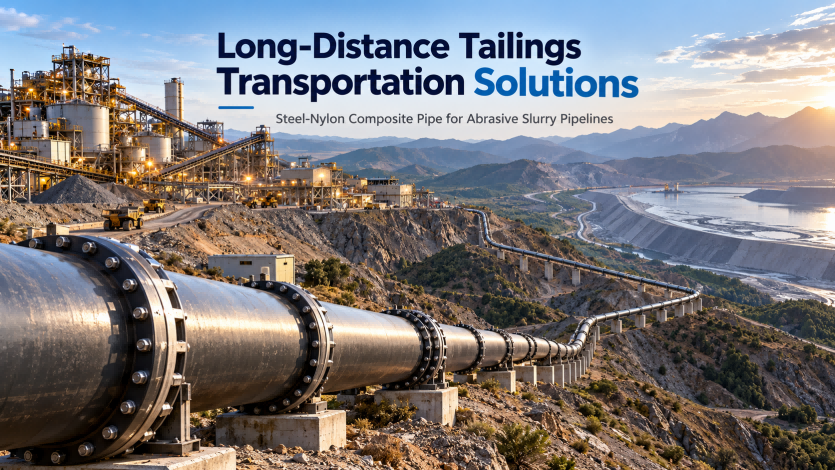
In modern mining operations, transporting tailings from a mineral processing plant to a tailings storage facility may appear to be a simple process of moving slurry from Point A to Point B.
In reality, it is one of the most underestimated pipeline applications in the entire mining process.
As tailings storage facilities are increasingly located farther away from concentrators, transportation distances may increase from several hundred meters to several kilometers—or even tens of kilometers.
At this scale, pipeline design is no longer simply a matter of flow rate and operating pressure.
Engineers must simultaneously consider:
-
Slurry settling
-
Particle abrasion
-
Hydraulic pressure loss
-
Elevation changes
-
Surge pressure
-
Corrosion
-
Pipeline blockage
-
Shutdown sedimentation
-
Flushing requirements
-
Pumping energy consumption
-
Long-term maintenance costs
If the system is poorly designed, a typical failure cycle may develop:
Lower velocity → tailings deposition → reduced effective pipe diameter → higher hydraulic resistance → increased pump pressure → accelerated localized wear → shorter pipeline service life
However, simply increasing slurry velocity is not necessarily the answer.
Excessively high velocity can create another chain of problems:
Higher velocity → stronger particle impact → accelerated pipe and elbow wear → higher energy consumption → more frequent pipeline replacement
Therefore, a reliable long-distance tailings transportation system should not simply focus on using a “thicker pipe.”
The real engineering objective is to achieve the right balance between:
stable slurry transportation, abrasion resistance, pressure safety, energy efficiency, and total lifecycle cost.
1. Why Is Long-Distance Tailings Transportation More Complicated Than Water Pipelines?
Conventional industrial water pipelines transport relatively uniform liquids.
Tailings pipelines, however, usually transport a mixture of water and solid particles with different particle sizes, densities, shapes, and mineral compositions.
This creates a solid-liquid slurry whose hydraulic behavior can change significantly depending on:
-
Tailings concentration
-
Particle size distribution
-
Solids density
-
Mineral composition
-
Slurry velocity
-
Temperature
-
Rheological properties
Changes in particle grading, concentration, and slurry rheology can significantly influence pressure loss, solids settling, and pipe-wall abrasion.
Coarse particle segregation and deposition can also increase hydraulic resistance and create unstable operating conditions.
This is why tailings pipelines cannot simply be designed using the same hydraulic assumptions applied to clean-water pipelines.
The challenge becomes even greater under conditions such as:
-
High-solids-content tailings
-
Quartz-rich abrasive slurry
-
Large particle sizes
-
Frequent startup and shutdown
-
Long horizontal pipeline sections
-
Significant elevation differences
-
Continuous uphill and downhill profiles
-
Large variations in slurry concentration
In real mining projects, several of these conditions often occur simultaneously.
2. The First Critical Design Parameter: Slurry Velocity
One of the most important concepts in tailings pipeline engineering is the:
critical deposition velocity.
In simple terms, this is the minimum slurry velocity required to keep solid particles sufficiently suspended so that excessive deposition does not occur at the bottom of the pipeline.
If pipeline velocity falls too low, larger and heavier particles may begin settling.
Over time, this can create a stationary or partially stationary bed along the bottom of the pipe.
As deposition increases, several problems may follow:
-
Effective internal diameter decreases
-
Local pressure loss increases
-
Pump discharge pressure rises
-
Pipeline capacity decreases
-
Blockage risk increases
In severe cases, the pipeline may become completely blocked.
However, there is another important principle:
Higher slurry velocity does not automatically mean safer operation.
For tailings containing quartz, mineral sand, or other hard particles, increasing velocity can significantly increase particle impact energy against the pipe wall.
The harder the particles, the larger their size, and the higher their velocity, the greater the potential erosion and abrasion.
Therefore, the objective of pipeline design is to determine an appropriate operating velocity range:
High enough to minimize dangerous sedimentation, but controlled enough to avoid excessive abrasion and unnecessary pumping energy.
This is why professional tailings transportation projects should consider laboratory or engineering analysis of:
-
Particle size distribution
-
Slurry concentration
-
Solids density
-
Settling characteristics
-
Slurry rheology
-
Mineral hardness
Pipeline diameter should never be determined by flow rate alone.
3. As Transportation Distance Increases, Pressure Distribution Becomes Critical
For a tailings pipeline only a few hundred meters long, many hydraulic effects may remain relatively manageable.
But when transportation distance increases to 3 km, 5 km, 10 km, or more, the design philosophy changes significantly.
The total pumping head generally consists of:
friction loss + local resistance + elevation difference + required terminal pressure
An incorrect estimate of any of these parameters can affect both pumping system design and pipeline pressure class.
For example:
If tailings concentration increases, slurry viscosity may rise.
If ore characteristics change, particle size distribution may also change.
If throughput increases, slurry velocity and friction losses increase.
If the pipeline includes a large uphill section, pump discharge pressure may rise substantially.
If the route contains a long downhill section, the system may experience:
-
Low-pressure conditions
-
Partial-flow conditions
-
Column separation
-
Transient pressure problems
This means that a reliable long-distance pipeline should not be designed around one single “maximum operating pressure.”
A more appropriate engineering approach is to establish the:
hydraulic grade line and pressure profile along the entire pipeline.
Engineers should evaluate pressure at different pipeline locations, including:
-
Normal operating pressure
-
Minimum operating pressure
-
Maximum transient pressure
-
Pump discharge pressure
-
Terminal pressure
Based on this analysis, engineers can determine:
-
Pipeline diameter
-
Pressure class
-
Pump station requirements
-
Pressure zoning
-
Surge protection measures
4. Why Is Pipeline Wear Often Concentrated in Specific Locations?
In real tailings transportation systems, pipeline wear is rarely uniform.
Some straight pipe sections may operate for many years with relatively limited wear, while certain elbows, tees, reducers, or pump discharge sections may require frequent replacement.
Typical high-wear locations include:
-
Pump discharge sections
-
Elbows
-
Outer radius of bends
-
Tees
-
Reducers
-
Areas near valves
-
High-velocity downhill sections
-
Locations where slurry direction changes suddenly
The reason is straightforward.
Inside a straight pipeline, most particles travel approximately parallel to the pipe axis.
When the slurry enters an elbow, however, solid particles continue moving due to inertia and repeatedly impact the outer radius of the bend.
The harder the particles, the larger their diameter, and the higher the velocity, the greater the erosive effect.
Therefore, an effective abrasion-control strategy does not necessarily mean increasing wall thickness throughout the entire pipeline.
A more rational approach is:
Design normal sections for stable transport while selectively reinforcing high-wear sections.
This approach can extend system life while avoiding unnecessary increases in project capital cost.
5. Why Does Pipe Material Become More Important in Long-Distance Tailings Systems?
Common pipe materials used in tailings transportation include:
-
Carbon steel pipe
-
Abrasion-resistant steel pipe
-
Rubber-lined steel pipe
-
HDPE pipe
-
Various composite and lined pipe systems
Each material has its own advantages and limitations.
| Pipe Type | Structural Strength | Abrasion Resistance | Corrosion Resistance | Long-Distance High-Pressure Capability | Maintenance Characteristics |
|---|---|---|---|---|---|
| Carbon Steel Pipe | High | Moderate | Relatively Low | High | Susceptible to corrosion and wear |
| Abrasion-Resistant Steel Pipe | High | High | Moderate | High | Heavy and difficult to handle |
| Rubber-Lined Steel Pipe | High | High | Good | Relatively High | Lining quality is critical |
| HDPE Pipe | Moderate | Good | Excellent | Pressure capability depends on diameter and SDR | Easy installation |
| Steel-Nylon Composite Pipe | High | High | Good | High | Combines structural and internal wear performance |
The key point is that modern tailings pipelines can no longer always be selected using a simple:
metal pipe vs. plastic pipe
comparison.
Many mining projects actually need:
The mechanical strength of steel combined with the abrasion and corrosion resistance of a non-metallic internal material.
This is one of the major reasons composite pipeline systems are increasingly being considered for severe slurry applications.
As tailings become coarser, more abrasive, and are transported at greater velocities, traditional single-material pipelines may face increasing limitations.
6. Why Is Steel-Nylon Composite Pipe Suitable for Long-Distance Tailings Transportation?
One of the core questions we have focused on is:
Can one pipeline system solve both pressure and abrasion problems at the same time?
This is the fundamental design concept behind steel-nylon composite pipe.
The external steel structure primarily provides:
-
Mechanical strength
-
Pressure resistance
-
Structural stability
The internal reinforced nylon layer comes directly into contact with the transported slurry and mainly provides:
-
Abrasion resistance
-
Corrosion resistance
-
A smoother internal surface
-
Protection of the steel structure from direct slurry exposure
This combination creates several important engineering advantages for tailings transportation.
6.1 Combining Abrasion Resistance with Pressure Capability
Some non-metallic pipes provide excellent corrosion resistance but may require additional engineering consideration in large-diameter, high-pressure, or complex terrain applications.
Steel, on the other hand, provides strong mechanical support and pressure-bearing capability.
In a steel-nylon composite structure, the steel component provides structural strength while the internal nylon layer helps resist abrasive tailings slurry.
This makes the composite structure particularly valuable where the pipeline must deal with both:
pressure + abrasion
at the same time.
6.2 Reducing Combined Corrosion and Abrasion Damage
Mining pipelines are not always affected by mechanical abrasion alone.
Tailings slurry may contain:
-
Dissolved salts
-
Minerals
-
Residual flotation chemicals
-
Corrosive ions
-
Process chemicals
For metallic pipelines, simultaneous corrosion and particle erosion can create more complex material loss than abrasion alone.
With a steel-nylon composite pipe, the transported medium primarily contacts the internal nylon layer rather than directly contacting the structural steel.
This helps reduce direct exposure of the steel component to the slurry environment.
For long-term tailings transportation systems, this can be an important advantage.
7. A Smooth Internal Surface Can Support Long-Term Hydraulic Performance
The operating cost of a long-distance pipeline is strongly influenced by its internal surface condition.
If the internal pipe wall gradually becomes rough because of:
-
Corrosion
-
Scaling
-
Localized erosion
-
Surface deterioration
hydraulic resistance may increase over time.
This means more pumping energy may be required to maintain the same transportation capacity.
Nylon materials generally provide a relatively smooth internal surface.
Under appropriate design conditions, this can help reduce unnecessary hydraulic resistance.
For a pipeline several kilometers or even tens of kilometers long, even a relatively small reduction in pressure loss per meter can accumulate into a meaningful difference across the entire system.
Therefore, pipe material selection influences not only the purchase price.
It can also affect:
long-term pumping energy consumption.
8. How Should a Long-Distance Tailings Transportation System Be Designed?
A professional tailings pipeline design should begin with the properties of the tailings—not with the pipe diameter.
The first step is to determine the fundamental slurry parameters, including:
-
Solids mass concentration
-
Solids volume concentration
-
Maximum particle size
-
D50 / D80 particle size
-
Solids density
-
Slurry density
-
pH
-
Temperature
-
Corrosive ions
-
Mineral composition
For high-concentration slurry or material with significant rheological behavior, engineers should also evaluate:
-
Yield stress
-
Apparent viscosity
-
Flow behavior
Once these parameters are established, hydraulic design can begin.
Different pipe diameters should be evaluated based on:
-
Slurry velocity
-
Pressure loss per unit length
-
Pumping requirements
-
Deposition risk
-
Abrasion risk
The selected pipeline diameter should satisfy two objectives simultaneously:
Prevent excessive solids deposition while avoiding excessive abrasion.
The next step is terrain analysis.
By incorporating the pipeline elevation profile into hydraulic calculations, engineers can determine:
-
Pump discharge pressure
-
Maximum pipeline pressure
-
Minimum pipeline pressure
-
Terminal pressure
If one pump station cannot transport the slurry safely and efficiently, potential solutions may include:
-
Adding intermediate pump stations
-
Increasing pipe diameter
-
Dividing the pipeline into pressure zones
-
Optimizing the pipeline route
Long downhill sections and frequently interrupted systems should also undergo transient hydraulic analysis.
A pipeline that is safe during steady-state operation may not necessarily remain safe during sudden pump shutdown.
9. Why Is Shutdown Design Just as Important as Normal Operation?
Many tailings pipeline blockages do not occur during normal operation.
They occur after shutdown.
Typical causes include:
-
Planned equipment maintenance
-
Concentrator shutdown
-
Electrical power failure
-
Pump failure
-
Emergency shutdown
Once slurry flow stops, suspended solid particles begin to settle.
If the pipeline contains low points, large amounts of solids may accumulate in these sections.
The longer the shutdown period, the more difficult restarting the pipeline may become.
In severe cases, the original slurry pump may no longer have sufficient capability to restart the pipeline.
A reliable long-distance tailings transportation system should therefore consider:
-
Flushing water systems
-
Pipeline drainage
-
Low-point drain connections
-
Emergency water supply
-
Controlled shutdown procedures
-
Controlled restart procedures
In other words:
A good tailings pipeline must be designed not only for how it operates, but also for how it stops and how it restarts.
10. Tailings Pipelines Are Moving Toward Condition Monitoring
Another important trend in tailings transportation is the increasing use of online monitoring systems.
Important monitoring parameters may include:
-
Flow rate
-
Pipeline pressure
-
Slurry concentration
-
Pump power consumption
-
Wall-thickness trends
-
Wear at critical locations
For example, if operating data shows:
pressure gradually increasing while flow rate decreases
this may indicate:
-
Increasing slurry concentration
-
Internal deposition
-
Partial blockage
-
Changes in slurry properties
If pipeline pressure suddenly decreases, engineers may need to investigate:
-
Leakage
-
Pipeline rupture
-
Pump malfunction
-
Abnormal operating conditions
Because tailings pipelines transport abrasive solids under constantly changing hydraulic conditions, leak detection can be more complicated than in conventional clean-water pipelines.
Future tailings transportation systems are likely to integrate:
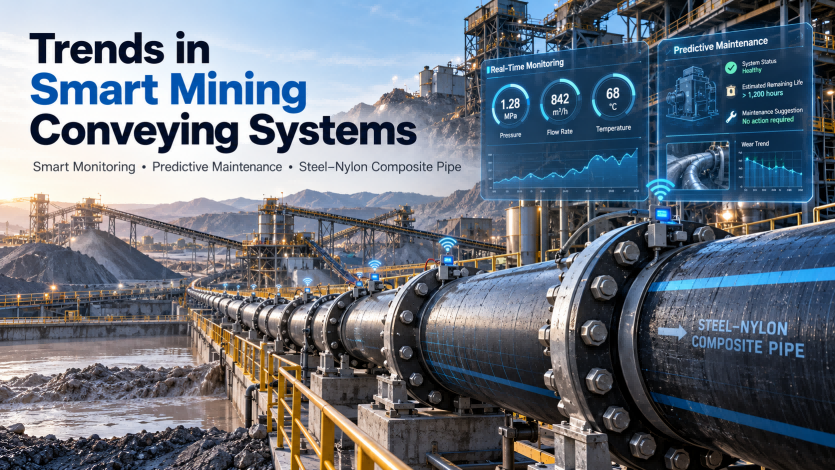
slurry concentration monitoring + flow monitoring + pressure monitoring + wall-wear monitoring + data analytics
into predictive maintenance systems.
Maintenance philosophy will gradually move away from:
replace the pipe after failure
toward:
predict wear and replace components before failure occurs.
11. Why Should Mining Companies Avoid Comparing Pipe Price Only by Cost per Meter?
A common purchasing mistake in mining projects is comparing pipeline alternatives only based on:
USD per meter.
For long-distance tailings transportation, this approach is incomplete.
The more important measurement is:
Total Cost of Ownership (TCO).
A simplified model can be expressed as:
TCO = Initial Pipe Cost + Installation Cost + Pumping Energy + Maintenance Cost + Replacement Cost + Production Downtime Loss
Consider two pipeline alternatives.
Pipeline A may have a lower initial purchase price but require replacement every few years.
Pipeline B may require a higher initial investment but may significantly extend maintenance intervals under suitable operating conditions.
Over a 10- to 20-year project lifecycle, the economic results could be completely different.
For a large mining operation, the largest cost may not even be the pipeline itself.
It may be:
production losses caused by unplanned shutdowns.
For large concentrators operating continuously, improving tailings pipeline reliability also improves the overall continuity and availability of the mining operation.
12. The Real Value of Steel-Nylon Composite Pipe Is Not Replacing Every Other Pipe Material
No single pipeline material is suitable for every tailings transportation project.
Every mining operation has different:
-
Tailings mineralogy
-
Particle size distribution
-
Slurry concentration
-
Transportation distance
-
Elevation profile
-
Design pressure
-
Operating conditions
-
Maintenance requirements
Therefore, the correct engineering approach is:
Select the material according to the actual operating conditions.
For low-pressure, low-abrasion, or temporary pipeline systems, conventional alternatives may already provide satisfactory performance.
However, the advantages of steel-nylon composite pipe become more relevant as a project begins to combine conditions such as:
-
Long-distance transportation
-
Severe abrasion
-
Higher operating pressure
-
Large pipe diameter
-
Complex terrain
-
Simultaneous corrosion and abrasion
-
Difficult maintenance access
-
High downtime costs
Our steel-nylon composite pipes are designed for demanding industrial transportation environments.
The steel structure provides mechanical strength and pressure-bearing capability, while the reinforced nylon internal layer provides abrasion resistance, corrosion resistance, and a smooth flow surface.
Pipeline configuration can be selected according to actual project parameters rather than simply supplying pipe according to nominal diameter.
Key engineering parameters include:
-
Transported medium
-
Operating pressure
-
Temperature
-
Pipe diameter
-
Solid particle size
-
Slurry concentration
-
Flow velocity
13. A Reliable Tailings Transportation Solution Should Begin with Six Key Parameters
When planning a new tailings pipeline, we normally recommend starting with six fundamental project conditions:
Transported Medium + Solids Concentration + Particle Size Distribution + Required Flow Rate + Transportation Distance + Elevation Profile
Additional information should then be confirmed, including:
-
Operating pressure
-
Temperature
-
pH
-
Startup and shutdown frequency
-
Pump station configuration
-
Required service life
The more complete the operating data, the more accurately the pipeline material and structural configuration can be selected.
For complex projects, a trial section can also be used to evaluate actual:
-
Wear performance
-
Operating pressure
-
Hydraulic performance
-
Connection reliability
-
Maintenance requirements
before expanding the solution to the entire pipeline.
In many projects, this approach provides greater engineering confidence than relying only on laboratory material data.
Conclusion: The Future of Tailings Transportation Is Ultimately About Reliability
As mining operations become larger and tailings storage facilities move farther away from mineral processing plants, long-distance tailings transportation is becoming an increasingly important engineering challenge.
In the past, the primary requirement for a tailings pipeline may simply have been:
transport the tailings to the storage facility.
Future systems will increasingly require:
longer transportation distances, higher solids concentrations, lower energy consumption, fewer shutdowns, and longer service life.
This means that pipelines should no longer be viewed simply as consumable components in a mining operation.
They are increasingly becoming an important part of overall mineral processing system reliability.
Steel-nylon composite pipe combines the mechanical strength and pressure-bearing capability of steel with the abrasion resistance, corrosion resistance, and smooth internal surface characteristics of reinforced nylon.
This provides an alternative engineering solution for transporting:
-
Abrasive tailings slurry
-
Mineral slurry
-
High-solids slurry
-
Corrosive and abrasive industrial media
For a true long-distance tailings transportation project, the most important question should not be:
“Which pipe has the lowest price per meter?”
The better question is:
“Over the next 10–20 years, which pipeline solution can minimize total operating cost, reduce downtime, and provide the most stable transportation performance?”
That is the question that should guide material selection for long-distance tailings transportation systems.
Engineering Note: Tailings slurry transportation is highly project-specific. Actual pipeline velocity, diameter, pressure class, pump station configuration, and material structure should be determined through slurry characterization, hydraulic calculations, abrasion assessment, and transient analysis. Design parameters from one mining project should not be directly applied to another without engineering verification.
Corrosion-Resistant Piping Solutions for the Power Industry: Addressing Long-Term Corrosion Challenges in Cooling Water, FGD Slurry, and Industrial Wastewater Systems
Trends in Smart Mining Material Conveying Systems: From Conventional Pipelines to Intelligent, Predictive, and Low-Maintenance Infrastructure