Corrosion-Resistant Piping Solutions for the Power Industry: Addressing Long-Term Corrosion Challenges in Cooling Water, FGD Slurry, and Industrial Wastewater Systems

In the power industry, piping systems may not be the most visible equipment in a plant, but they are critical infrastructure that directly affects the reliability and long-term operation of the entire facility.
Whether in circulating cooling water systems, flue gas desulfurization systems, industrial wastewater treatment, chemical water treatment, brine transport, or pipelines carrying fluids containing solid particles, large quantities of industrial piping are required to connect pumps, tanks, heat exchangers, desulfurization towers, and other process equipment.
These piping systems are rarely exposed to only one type of corrosion.
Instead, they often face a combination of:
-
Water-side corrosion;
-
Chloride-induced corrosion;
-
Acid and alkali corrosion;
-
Erosion-corrosion;
-
Abrasion from solid particles;
-
Combined corrosion and wear;
-
Temperature and pressure fluctuations;
-
Material aging caused by long-term continuous operation.
For modern power plants, pipe material selection is therefore shifting away from simply comparing initial purchase prices.
More attention is now being paid to questions such as:
Can the material withstand the actual operating medium? Can it reduce maintenance frequency? Can it minimize shutdown risks? And does it offer a competitive total cost of ownership over the entire service life?
This is why more power projects are reassessing traditional carbon steel, stainless steel, FRP, rubber-lined steel, and thermoplastic piping systems while looking for composite piping solutions better suited to complex corrosive environments.
Steel–nylon composite pipe offers significant engineering value in this context.
1. Why Does the Power Industry Need Corrosion-Resistant Piping?
Power plants are typical continuous-process industrial facilities.
Unlike ordinary municipal water systems, different pipelines within the same power plant may carry completely different media.
A single facility may contain pipelines transporting:
-
Fresh water;
-
Circulating cooling water;
-
FGD slurry;
-
High-salinity wastewater;
-
Acidic or alkaline solutions;
-
Fluids containing suspended solids.
This means one conventional piping material cannot necessarily solve every corrosion problem within a power plant.
Circulating Cooling Water Creates Long-Term Corrosion Challenges
Circulating cooling water is one of the most important auxiliary systems in a power plant.
Because water continuously evaporates during circulation, dissolved salts, chlorides, and other corrosive ions can gradually become concentrated.
As the concentration cycles increase, conventional carbon steel pipelines may develop:
-
Localized corrosion;
-
Pitting;
-
Internal scaling;
-
Accumulation of corrosion products;
-
Progressive wall-thickness loss.
If the power plant is located in a coastal region, a high-salinity area, or uses reclaimed water as part of its cooling water supply, the corrosion risk may become even more severe.
Therefore, pipe selection for a circulating cooling water system should not be based simply on the fact that the pipeline transports “water.”
Instead, engineers should evaluate:
Water chemistry + chloride concentration + temperature + flow velocity + concentration cycles + required service life.
2. Flue Gas Desulfurization Is One of the Most Aggressive Piping Environments in a Power Plant
Flue gas desulfurization systems in coal-fired power plants are typical environments where both corrosion and abrasion occur simultaneously.
In a limestone–gypsum wet FGD system, piping may transport:
-
Limestone slurry;
-
Gypsum slurry;
-
FGD wastewater;
-
Process water;
-
Absorber circulation slurry;
-
Chloride-containing slurry;
-
Wastewater containing suspended solids.
These media impose two fundamentally different requirements on piping materials.
The first is corrosion resistance.
Chlorides and other corrosive components in the slurry can continuously attack conventional metallic piping.
The second is abrasion resistance.
Limestone and gypsum particles continuously impact and abrade the inner pipe surface as they move through the pipeline.
This problem is particularly severe at:
-
Elbows;
-
Tees;
-
Pump discharge sections;
-
Reducers;
-
Other high-turbulence areas.
For this reason, simply choosing a “corrosion-resistant material” may not be enough.
A piping material used in FGD service must address both:
Chemical Corrosion + Slurry Abrasion
This combination is one of the areas where steel–nylon composite pipe can provide significant advantages.
3. Industrial Wastewater Is Becoming a New Corrosion Challenge for Power Plants
As the global power industry continues to improve water utilization efficiency and environmental performance, more power plants are introducing systems for:
-
Wastewater recycling;
-
High-salinity wastewater treatment;
-
FGD wastewater treatment;
-
Zero-liquid-discharge or near-zero-discharge processes;
-
Concentrated brine transport.
This creates a new engineering challenge:
The more intensively water is reused, the more corrosive the final concentrated wastewater may become.
During concentration processes, ions such as Cl⁻ and SO₄²⁻, together with other dissolved salts, can reach increasingly high concentrations.
For conventional carbon steel piping, this can significantly accelerate corrosion.
Even some stainless steels may face risks such as:
-
Pitting corrosion;
-
Crevice corrosion;
-
Localized corrosion in high-chloride environments.
As a result, more projects are considering piping materials that rely on their inherent material properties for corrosion protection rather than depending continuously on coatings, linings, or frequent maintenance.
4. Why Do Traditional Power Plant Piping Materials Encounter Problems?
There are many piping materials used in the power industry, and each has its own appropriate operating range.
The key question is not which material is universally “best.”
The real question is:
Which material is best suited to the actual operating conditions?
4.1 Carbon Steel Pipe: High Strength but Potentially High Corrosion Costs
One of the greatest advantages of carbon steel is its mechanical strength.
It also offers:
-
Mature manufacturing technology;
-
Wide availability;
-
Good structural performance.
As a result, carbon steel has long been one of the most commonly used industrial piping materials.
However, in circulating water, brine, acidic or alkaline fluids, and industrial wastewater systems, carbon steel may require additional corrosion protection measures such as:
-
Protective coatings;
-
Cathodic protection;
-
Corrosion allowance;
-
Chemical corrosion inhibitors;
-
Regular inspection and maintenance.
The real cost of carbon steel piping is therefore not limited to its initial purchase price.
If corrosion perforation occurs several years after installation, the plant must also consider:
-
Repair costs;
-
Shutdown losses;
-
Labor costs;
-
Potential environmental risks.
4.2 Stainless Steel: Good Corrosion Resistance, but Not Suitable for Every Environment
304, 316L, and higher-grade stainless steels are widely used in many power plant systems.
However, stainless steel is not completely immune to corrosion.
In high-chloride environments in particular, engineers need to evaluate risks including:
-
Pitting corrosion;
-
Crevice corrosion;
-
Stress corrosion cracking;
-
Corrosion around welded areas.
As pipe diameter increases, the material cost of stainless steel can also rise considerably.
For DN300, DN500, and larger industrial pipelines, the economic feasibility of stainless steel should therefore be carefully assessed.
4.3 FRP Pipe: Corrosion Resistant, but Mechanical and Joint Performance Must Be Considered
Fiberglass reinforced plastic, or FRP, offers good chemical corrosion resistance and is therefore widely used in cooling water and certain chemical piping systems.
However, complex industrial installations require engineers to consider more than chemical compatibility.
Important factors include:
-
Mechanical impact;
-
Vacuum conditions;
-
Pipe support design;
-
Joint reliability;
-
Installation quality.
When the transported medium is also highly abrasive, the long-term wear resistance and internal liner design of FRP piping must also be evaluated carefully.
4.4 Rubber-Lined Steel Pipe: Good Corrosion Protection, but Highly Dependent on Lining Integrity
Rubber-lined steel pipe uses an internal rubber layer to isolate the steel substrate from corrosive fluids.
The concept itself can be effective.
However, long-term operating performance depends heavily on the integrity of the lining.
Potential concerns include:
-
Rubber aging;
-
Blistering;
-
Delamination;
-
Joint damage;
-
Local mechanical damage.
Once the lining is damaged, the corrosive medium may directly contact the steel substrate, potentially causing rapid localized corrosion.
5. Why Is Steel–Nylon Composite Pipe Suitable for Corrosion-Resistant Power Plant Systems?
The design philosophy of steel–nylon composite pipe is not to rely on a single material to solve every engineering challenge.
Instead, it combines the strengths of different materials.
In simplified terms:
Steel provides structural strength and pressure resistance, while nylon provides corrosion and abrasion resistance.
This structure can be particularly valuable in power industry applications.
5.1 Isolating Corrosive Fluids from the Steel Structure
The fundamental reason conventional steel corrodes is direct contact between the corrosive fluid and the metal surface.
In steel–nylon composite pipe, the internal nylon functional layer separates most corrosive media from the structural steel layer.
Under suitable chemical conditions, this can significantly reduce common corrosion mechanisms associated with conventional metallic piping, including:
-
Electrochemical corrosion;
-
Rust formation;
-
Localized corrosion;
-
Corrosion-product buildup and detachment.
This design can be particularly valuable in circulating cooling water, high-salinity wastewater, and compatible acidic or alkaline media.
5.2 Combining Corrosion Resistance and Abrasion Resistance
Many piping failures in power plants are not caused by corrosion alone.
For example, in FGD slurry systems:
A material that resists chemical corrosion but has poor wear resistance may still suffer rapid wall loss caused by suspended solids.
Similarly, a material with good abrasion resistance but poor chemical resistance may also experience premature failure.
One important advantage of steel–nylon composite pipe is that its nylon functional layer can provide both:
Corrosion resistance and abrasion resistance.
This makes it particularly suitable for systems where corrosive fluids and solid particles are present simultaneously.
5.3 Steel Structure Provides Reliable Pressure-Bearing Performance
Fully non-metallic piping systems perform well in many low-pressure applications.
However, power plant piping systems must also consider:
-
Pressure fluctuations;
-
Pump startup;
-
Water hammer;
-
Pipe support loads;
-
Mechanical loads at equipment connections.
Steel–nylon composite pipe retains a steel structural layer, which provides stable mechanical support and pressure-bearing capability.
Depending on the project requirements, the pipe structure can be engineered according to:
-
Medium;
-
Pipe diameter;
-
Pressure;
-
Temperature.
For medium- and large-diameter industrial pipelines, this combination can provide an effective balance between corrosion resistance and structural strength.
6. Typical Applications of Steel–Nylon Composite Pipe in the Power Industry
Application 1: Power Plant Circulating Cooling Water Systems
Circulating cooling water systems typically involve:
-
High flow rates;
-
Long-distance transport;
-
Large-diameter pipelines;
-
Long-term continuous operation.
For these systems, the key question is not simply short-term performance.
The more important issue is the total operating cost over:
10 years, 15 years, or even longer service periods.
Steel–nylon composite pipe can be considered for compatible circulating cooling water, industrial water, and related water transmission systems.
By reducing internal corrosion risk, it can help lower maintenance requirements over the operating life of the system.
For large-diameter pipelines, the structural advantages of the steel layer become even more significant.
Application 2: Flue Gas Desulfurization Slurry Transport
FGD systems may include:
-
Slurry circulation pipelines;
-
Limestone slurry pipelines;
-
Gypsum slurry pipelines;
-
Associated wastewater pipelines.
All of these systems may be exposed to both corrosion and abrasion.
Particularly vulnerable locations include:
Elbows, tees, pump discharge sections, and high-velocity zones.
These areas often experience premature wear compared with straight pipe sections.
Steel–nylon composite piping and matching wear-resistant fittings can therefore be designed specifically for these high-wear locations.
Application 3: FGD Wastewater and High-Salinity Wastewater
High-chloride and high-salinity industrial wastewater can create severe corrosion risks for conventional steel piping.
Simply increasing carbon steel wall thickness only extends the time required for corrosion to penetrate the pipe.
It does not fundamentally eliminate the corrosion mechanism.
Using a corrosion-resistant internal layer to isolate the steel structure from the transported fluid addresses the problem from a different material-design perspective.
Steel–nylon composite pipe can therefore be considered as a candidate material for certain high-salinity wastewater transport systems, subject to detailed operating-condition evaluation.
Application 4: Acid and Alkali Chemical Pipelines
Water treatment, chemical dosing, and auxiliary systems in power plants may involve a variety of acidic and alkaline fluids.
Material selection should never be based simply on the classification of a fluid as an “acid” or an “alkali.”
Before selecting the pipe material, engineers should confirm:
-
Chemical composition;
-
Actual concentration;
-
Operating temperature;
-
Design pressure;
-
Presence of other corrosive ions;
-
Presence of suspended solids.
For media that are chemically compatible with nylon materials, steel–nylon composite pipe can provide both corrosion resistance and structural pressure-bearing capability.
7. Power Plant Corrosion-Resistant Piping Should Be Evaluated by TCO, Not Only Purchase Price
One of the most common mistakes in industrial piping procurement is comparing only:
Price per meter of pipe.
In reality, the true cost of an industrial pipeline should be evaluated over its entire operating life.
A more complete model is:
TCO = Initial Purchase Cost + Installation Cost + Maintenance Cost + Replacement Cost + Shutdown Losses + Safety and Environmental Risk Costs
Consider a typical example.
Option A may initially cost 20% less than Option B.
However, if Option A requires major repairs every three to five years while Option B can operate reliably for a much longer period, Option B may ultimately be the more economical choice over a 10- or 20-year project lifecycle.
This is particularly important in power plants.
A pipeline failure may affect much more than one section of pipe.
It may cause:
-
Pump shutdown;
-
Reduced FGD system capacity;
-
Cooling water system instability;
-
Reduced generating-unit output;
-
Unplanned plant downtime.
Therefore, modern power projects increasingly evaluate:
Cost per Year of Operation
rather than simply:
Cost per Meter of Pipe.
This is one of the main reasons corrosion-resistant composite piping systems are receiving greater attention.
8. Large-Diameter Piping Makes Composite Material Solutions Even More Attractive
As power plants increase in capacity, circulating water, FGD, and industrial water systems increasingly use pipe sizes such as:
-
DN300;
-
DN500;
-
DN800;
-
And even larger diameters.
As pipe diameter increases, the cost of using high-grade metallic materials can rise rapidly.
For example, using high-alloy stainless steel throughout a large-diameter corrosion-resistant piping system can significantly increase both pipe weight and total material cost.
Steel–nylon composite pipe provides a different engineering approach:
The entire pipe wall does not need to be manufactured from an expensive corrosion-resistant alloy.
Instead:
-
Steel provides structural strength;
-
The nylon layer provides the fluid-contact corrosion-resistant surface.
This combination can help optimize material costs while maintaining the required engineering performance.
For large-diameter industrial piping systems, this design philosophy can be particularly valuable.
9. Pipe Joints Are Often the Most Overlooked Part of a Corrosion-Resistant System
Pipeline reliability does not depend only on straight pipe sections.
A complete industrial piping system also includes:
-
Flanges;
-
Elbows;
-
Tees;
-
Reducers;
-
Pump connections;
-
Valve connections;
-
Instrument connections.
In many industrial projects, failures occur at connection points rather than in the straight pipe itself.
For this reason, flange and connection design must be treated as an integral part of the overall piping system.
In our steel–nylon composite pipe design, particular attention is paid to the structural integration of the pipe body and flange.
One-piece molded flange structures can help reduce weak points associated with secondary fabrication, welding, or complicated lining structures.
For power plant systems requiring long-term continuous operation:
Connection reliability is just as important as the pipe material itself.
10. How Should Corrosion-Resistant Piping Be Selected for Power Plants?
In actual projects, we do not recommend selecting a pipe material simply based on terms such as:
“power plant,” “FGD,” or “circulating water.”
A more reliable approach is to first establish a complete set of operating parameters.
At minimum, the following information should be confirmed.
1. Transported Medium
This includes the main chemical composition, pH value, and potentially corrosive ions.
2. Concentration
The same chemical medium may require very different materials at different concentrations.
3. Temperature
Chemical compatibility and long-term material performance are often strongly affected by temperature.
4. Design Pressure and Operating Pressure
In addition to normal operating pressure, transient conditions such as startup, shutdown, and water hammer should be considered.
5. Solid Content
For slurry systems, the percentage of suspended solids should be clearly defined.
6. Particle Size and Hardness
These parameters directly influence the abrasion rate of the pipe wall.
7. Flow Velocity
Higher velocity can significantly increase erosion and wear.
8. Pipe Diameter and Transport Distance
Large-diameter and long-distance pipelines must also consider hydraulic losses, pipe supports, and installation methods.
9. Required Design Life
A temporary five-year pipeline and a core process pipeline designed for 20 years should not follow the same material-selection logic.
Only by evaluating these parameters together can engineers determine whether a particular piping material is truly suitable.
11. Power Plant Piping Is Moving from “Periodic Replacement” Toward “Low-Maintenance Design”
Historically, many industrial projects accepted a conventional assumption:
Corrosion is unavoidable, so pipelines must simply be replaced periodically.
Modern industrial engineering is gradually changing this mindset.
As:
-
Environmental requirements become stricter;
-
Labor costs increase;
-
Shutdown losses become more expensive;
-
Reliability requirements rise;
more projects are pursuing:
Low-Maintenance Pipeline Systems
Future pipe material selection will increasingly focus not only on initial purchase cost, but also on:
-
Service life;
-
Maintenance frequency;
-
Installation efficiency;
-
Shutdown risk;
-
Corrosion safety;
-
Total lifecycle cost.
This creates increasing opportunities for composite piping systems that combine:
Corrosion resistance + abrasion resistance + mechanical strength + low maintenance requirements.
12. Why Choose Our Steel–Nylon Composite Piping Solutions?
We specialize in the development and manufacturing of reinforced nylon pipe and steel–nylon composite pipe, providing customized industrial piping solutions for different media and operating environments.
Our engineering philosophy is straightforward:
We do not simply sell one type of pipe. We select and design piping structures according to the customer's actual medium, pressure, temperature, flow velocity, and abrasion conditions.
For the power industry, our solutions can support applications including:
-
Power plant circulating cooling water pipelines;
-
Flue gas desulfurization systems;
-
Limestone slurry transport;
-
Gypsum slurry transport;
-
FGD wastewater pipelines;
-
High-salinity industrial wastewater;
-
Industrial water systems;
-
Chemical media transport;
-
Large-diameter industrial water pipelines.
Steel–nylon composite pipe combines the structural strength of steel with the corrosion and abrasion resistance of nylon.
Depending on project requirements, piping systems can be designed for different diameters and pressure classes, with reliable flanged connection structures suitable for demanding industrial installation conditions.
For large power plant projects, we recommend beginning material evaluation during the early engineering stage.
The selection process should be based on:
Medium + Concentration + Temperature + Pressure + Velocity + Particle Content + Pipe Diameter
rather than relying only on conventional material habits.
Conclusion: The Key Question Is Not Which Pipe Is More Expensive, but Which Pipe Can Operate Reliably for Longer
Pipe material selection in the power industry is changing.
In the past:
Purchase price often determined material selection.
In the future:
Total lifecycle cost will increasingly determine material selection.
This is particularly true for circulating cooling water, flue gas desulfurization, high-salinity wastewater, and other corrosive industrial service conditions.
Piping systems must simultaneously withstand:
-
Corrosion;
-
Abrasion;
-
Pressure;
-
Long-term continuous operation.
Steel–nylon composite pipe combines:
Steel structural strength + nylon corrosion resistance + abrasion resistance + reliable flange connections
to provide a piping solution that balances mechanical performance, corrosion resistance, and lifecycle economics for modern power industry applications.
For power plant construction, retrofit, and aging-pipeline replacement projects, it may be more valuable to reconsider the piping material from the beginning rather than continuing the repeated cycle of:
Corrosion → Repair → Replacement.
A truly effective corrosion-resistant piping solution should not simply make maintenance easier.
It should:
Reduce the need for maintenance in the first place.
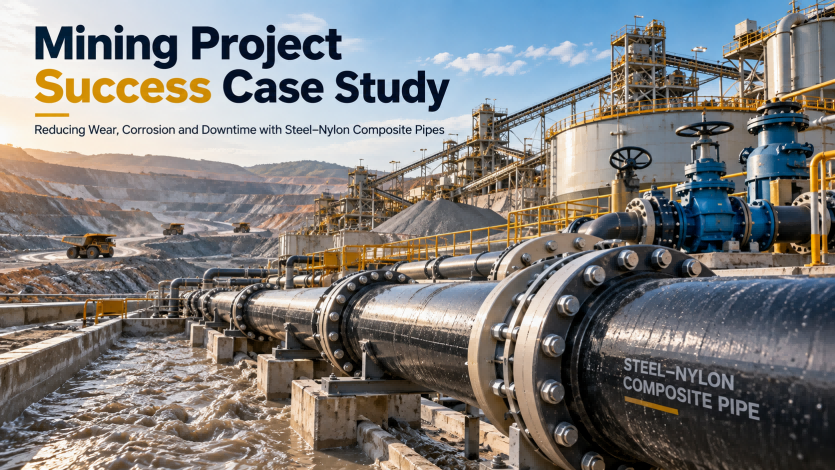
Mining Project Success Case Study: How Steel–Nylon Composite Pipes Reduce Slurry Pipeline Wear and Downtime
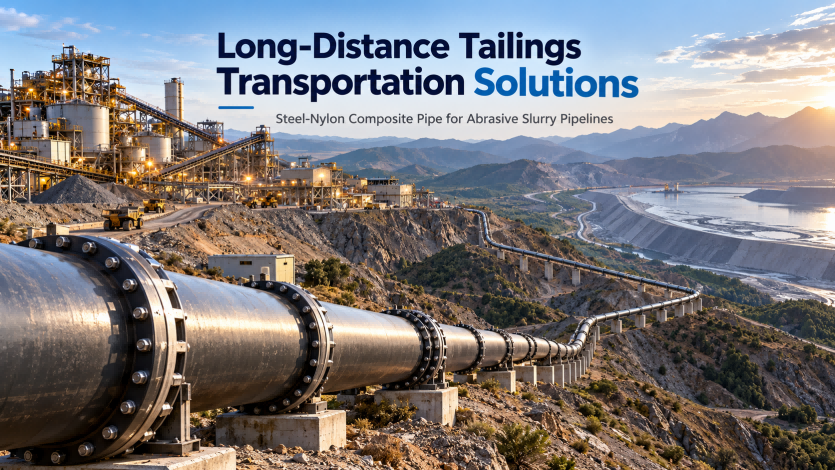
Long-Distance Tailings Transportation Solutions