Trends in Smart Mining Material Conveying Systems: From Conventional Pipelines to Intelligent, Predictive, and Low-Maintenance Infrastructure
In the past, the core objective of a mining conveying system was relatively straightforward: transport slurry, tailings, backfill slurry, process water, or other materials reliably from one location to another.
Today, however, that objective is changing significantly.
As mines become larger, ore grades decline, conveying distances increase, solids concentrations rise, and requirements for safety, environmental performance, and operating efficiency become more demanding, mining companies are beginning to reconsider a fundamental question:
Should the mining conveying system of the future simply be a pipeline that moves material, or should it become an intelligent system capable of continuously sensing, analyzing, predicting, and optimizing its own operating condition?
The industry is increasingly moving toward the second option.
Around 2026, digitalization in the global mining industry is clearly entering a new phase. Mining companies are moving beyond isolated digital pilot projects toward AI-assisted control, remote monitoring, digital twins, predictive maintenance, and broader automation across mining operations.
For slurry and tailings transportation systems, this means one important thing:
The pipeline itself must become part of the smart mine.
And this transformation is beginning to change the way mining companies select pipeline materials.
1. Why Are Mining Conveying Systems Becoming Smarter?
Mining is a highly continuous industrial process.
Crushing, grinding, classification, flotation, thickening, tailings transportation, backfilling, and water circulation systems are closely interconnected.
A blockage, leak, pipe rupture, or severe wear problem in any critical conveying section can disrupt both upstream and downstream production.
Traditional conveying systems often rely on a reactive maintenance model:
Failure detected → Shutdown → Inspection → Pipe or component replacement → Production restart
The biggest weakness of this approach is simple:
By the time the problem is discovered, the failure may already have occurred.
For a large mine, the real cost of a pipeline failure is often much higher than the cost of the pipe itself.
Potential losses include:
-
Production downtime
-
Maintenance labor
-
Spare parts consumption
-
Crane and heavy equipment mobilization
-
Disruption to production schedules
-
Slurry drainage and cleaning
-
Restart costs
-
Environmental and safety risks
As a result, modern mining operations are gradually shifting from:
Reactive Maintenance
to:
Preventive Maintenance
and ultimately toward:
Predictive Maintenance
AI, IoT devices, sensors, and equipment data are increasingly being used to identify abnormal operating conditions before equipment failure occurs.
The same transformation is happening in slurry pipeline systems.
The mining pipeline of the future will not only need to be wear resistant.
It will also need to:
operate reliably for long periods while allowing its condition to be continuously monitored and predicted.
2. Trend One: From Manual Inspection to Real-Time Online Monitoring
Traditional long-distance slurry pipelines have a fundamental limitation:
Many failures do not happen instantly.
Instead, deterioration develops gradually.
Typical examples include:
-
Progressive wall wear
-
Accelerated elbow erosion
-
Changes in slurry concentration
-
Sedimentation inside the pipeline
-
Increasing hydraulic resistance
-
Abnormal pump discharge pressure
-
Partial blockage
-
Minor leakage at connections
When pipeline maintenance depends mainly on manual inspection, these problems can be difficult to detect during their early stages.
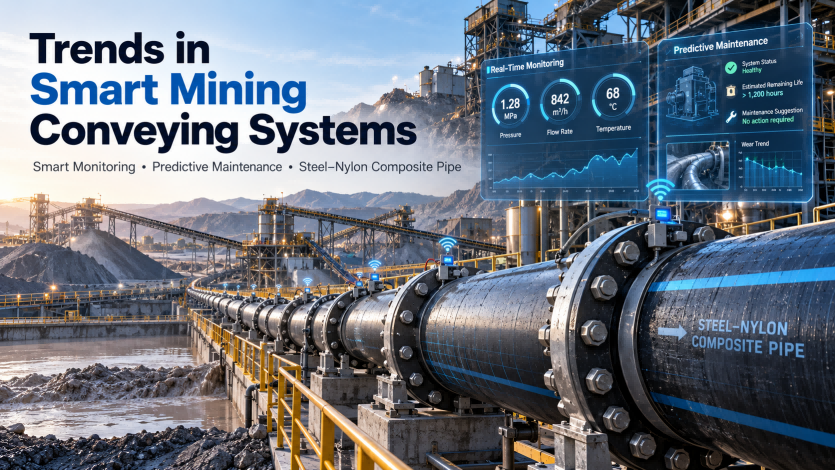
This is why future mining conveying systems will increasingly adopt online monitoring technologies.
Typical parameters may include:
-
Pressure
-
Flow rate
-
Slurry density
-
Solids concentration
-
Flow velocity
-
Pump operating condition
-
Vibration
-
Pipeline wall thickness
-
Wear condition at critical locations
For example, multiple pressure monitoring points can be installed along a slurry pipeline.
Changes in pressure profiles may help identify:
-
Blockage
-
Sedimentation
-
Leakage
-
Abnormal flow conditions
Flow and density data can also help operators understand the actual operating condition of the pipeline.
As this technology develops, the pipeline will gradually evolve from:
“an infrastructure asset whose internal condition is largely invisible”
into:
“an industrial asset that continuously generates operating data.”
3. Trend Two: From Scheduled Replacement to Predictive Maintenance
Traditional mining maintenance is often based on fixed inspection or replacement intervals.
For example, pipelines, elbows, pump discharge sections, and other wear-prone components may be inspected after a predetermined operating period.
Although this approach is relatively simple, it creates two major problems.
If the component is replaced too early:
remaining service life is wasted.
If it is replaced too late:
leakage, perforation, or unexpected shutdown may occur.
Smart conveying systems are beginning to change this logic.
In the future, mines may combine:
Historical operating data + Pressure data + Flow data + Slurry concentration + Wear monitoring + Operating hours
to gradually establish a more accurate pipeline service-life model.
Instead of simply telling maintenance personnel:
“This pipeline has been operating for 12 months.”
the system may eventually be able to determine:
“Based on the current slurry concentration, velocity, operating pressure, and wear trend, this pipeline section is estimated to have a certain amount of remaining service life.”
It may even be able to recommend:
the optimum maintenance window.
This is where predictive maintenance can generate substantial economic value.
4. Trend Three: Smart Conveying Does Not Mean “More Sensors Are Always Better”
This is one of the most common misunderstandings in smart mining projects.
Some projects interpret smart mining simply as:
installing more sensors, adding more software platforms, and installing more monitoring screens.
But a truly intelligent conveying system is not defined by the number of data points it collects.
The real question is:
Can the data help reduce failures and improve operational decisions?
For example, if the system detects steadily increasing pressure in a particular pipeline section, operators need to know why.
Possible causes may include:
-
Increasing slurry concentration
-
Changes in flow velocity
-
Sedimentation
-
Pipeline diameter reduction
-
Valve malfunction
-
Internal scaling
A smart system must therefore convert raw data into actionable decisions.
The real development path should be:
Data → Diagnosis → Prediction → Action
In other words:
Data Collection → Condition Diagnosis → Risk Prediction → Maintenance Action
This is why AI, predictive analytics, and digital twins are becoming increasingly important in modern mining operations.
5. Trend Four: Mining Conveying Systems Will Focus More on Stable Flow Conditions
For slurry transportation, higher velocity is not always better.
Neither is lower velocity.
If the velocity is too low, coarse particles may settle.
Over time, this can lead to:
-
Sediment accumulation
-
Reduced effective pipe diameter
-
Higher hydraulic resistance
-
Pipeline blockage
If the velocity is too high, particle impact and abrasion against the pipe wall can increase significantly.
High velocities can accelerate wear in areas such as:
-
Elbows
-
Tees
-
Reducers
-
Pump discharge sections
They can also increase energy consumption.
Therefore, slurry pipeline design always involves an important engineering objective:
finding an appropriate operating range between preventing particle settlement and controlling excessive wear.
Several factors influence this balance, including:
-
Particle size
-
Particle hardness
-
Slurry concentration
-
Flow velocity
-
Pipe diameter
-
Pipeline layout
-
Internal pipe surface
-
Pipe or liner material
This is where intelligent control systems can create real value.
Future systems may use real-time pressure, flow, and concentration data to dynamically adjust:
-
Pump speed
-
Valve opening
-
Flow rate
-
Operating pressure
Mining conveying systems will gradually move from:
Fixed Operating Parameters
toward:
Dynamic Operating Optimization
based on actual process conditions.
6. Trend Five: Pipeline Materials Will Become an Important Variable in Smart Conveying Systems
When people discuss smart mining, the first technologies that often come to mind are:
AI, autonomous haul trucks, robotics, sensors, digital twins, and automation.
However, there is a fundamental issue in slurry transportation that cannot be ignored:
If the pipeline itself does not have sufficient service life, even the most advanced software cannot eliminate frequent pipe replacement.
Digitalization may tell the operator:
“This pipeline is wearing rapidly.”
But whether the pipe can continue operating still depends on the physical properties of the material.
Therefore, smart mining does not reduce the importance of pipeline materials.
It actually makes material performance even more important.
Future monitoring systems will make the differences between pipeline materials increasingly transparent.
Mining companies will be able to record and compare:
-
Actual service life
-
Wear rate
-
Failure frequency
-
Maintenance frequency
-
Downtime
-
Energy consumption per tonne transported
-
Total lifecycle cost
As a result, pipeline procurement will gradually shift from:
comparing initial purchase price
to:
comparing total operational value over the entire service life.
7. Why Are Steel–Nylon Composite Pipes Suitable for Smart Mining Conveying Systems?
In highly abrasive slurry, tailings, and mine backfill transportation systems, it is often difficult for a single material to meet every engineering requirement.
Steel pipes provide good structural strength and pressure resistance.
However, under certain abrasive or corrosive operating conditions, their internal surfaces may experience continuous deterioration.
Some plastic piping systems offer excellent corrosion resistance, but for large-diameter, higher-pressure, or mechanically demanding applications, structural rigidity, connection reliability, and installation conditions must also be carefully considered.
Steel–nylon composite pipe provides another engineering approach.
Different materials perform different functions.
The steel structure provides mechanical strength and pressure resistance, while the nylon functional layer provides abrasion and corrosion resistance where the medium contacts the pipe.
This concept of combining a structural layer with a functional layer fits well with the long-term reliability requirements of smart mining systems.
7.1 High Wear Resistance Helps Extend Pipeline Service Life
Slurry is very different from ordinary water.
Large quantities of mineral particles continuously slide, impact, and scour the internal surface of the pipeline.
Wear is often especially severe at:
-
Elbows
-
Tees
-
Reducers
-
Pump discharge sections
-
High-velocity areas
Steel–nylon composite pipes utilize the wear-resistant characteristics of nylon to reduce long-term abrasion caused by slurry transportation.
For smart mines, a more stable and predictable pipe service life also makes maintenance data more valuable.
When pipeline wear follows a more stable pattern, predictive maintenance becomes easier to implement.
7.2 Addressing Both Corrosion and Abrasion
Many mining pipelines do not experience abrasion alone.
Process water, tailings water, and complex slurries may contain:
-
Dissolved salts
-
Chemical reagents
-
Corrosive substances
-
Fine abrasive solids
Therefore, the actual failure mechanism may involve:
Corrosion + Abrasion
working together.
The nylon functional layer of a steel–nylon composite pipe helps isolate the steel structure from direct contact with the conveyed medium while also providing abrasion resistance.
This makes the composite structure particularly valuable in demanding mineral processing environments involving:
-
Copper mining
-
Iron ore mining
-
Gold mining
-
Phosphate mining
-
Tailings transportation
-
Backfill systems
7.3 Steel Structure Provides a Reliable Foundation for Pressure Transportation
Mining conveying systems are becoming larger.
As:
-
Conveying distances increase
-
Production capacity rises
-
Elevation differences increase
-
Pipeline diameters become larger
pressure and structural design become increasingly important.
Steel–nylon composite pipe retains a steel structural layer.
This makes it possible to combine the abrasion and corrosion resistance of nylon with the mechanical strength and pressure-bearing characteristics of steel.
For high-capacity slurry transportation and mine backfill systems operating under significant pressure, this can provide an important engineering advantage.
7.4 Suitable for the Development of Large-Diameter Conveying Systems
Large mining operations increasingly seek to improve the capacity of individual conveying systems.
This trend is encouraging the development of:
-
Higher flow rates
-
Larger pipeline diameters
-
Longer conveying distances
As DN sizes increase, pipeline design must consider more than abrasion resistance.
Engineers must also evaluate:
-
Pipe stiffness
-
Support conditions
-
Flange connections
-
Installation tolerances
-
Axial loads
-
Mechanical stability
-
Long-term operating reliability
Steel–nylon composite structures provide significant engineering flexibility for these large industrial conveying systems.
7.5 Integrated Flanges Can Improve Connection Reliability
Smart mining requires not only reliable pipe bodies, but also reliable pipeline connections.
In real industrial projects, many failures do not occur in straight pipe sections.
They can occur at:
-
Flanges
-
Joints
-
Elbows
-
Tees
-
Equipment connection points
An integrated flange structure designed specifically for industrial piping can simplify field connections and make pipeline installation and maintenance more standardized.
For large mining projects involving extensive modular installation, this can help improve:
-
Installation efficiency
-
Connection consistency
-
System reliability
8. Smart Mines Will Ultimately Focus on One Key Indicator: Low Downtime
The real objective of smart mining is not to install the greatest possible number of sensors.
Ultimately, mining companies care about one fundamental question:
How many hours can the operation run reliably every year?
For a mining company, this may be far more important than the initial price of a single pipe.
Consider two pipeline systems.
Option A: Lower initial purchase cost, but requires frequent inspection and replacement.
Option B: Slightly higher initial cost, but significantly longer maintenance intervals.
If one shutdown involves:
-
Lost production
-
Maintenance labor
-
Crane mobilization
-
Spare parts
-
Slurry drainage
-
Cleaning
-
Restart procedures
then comparing only the purchase price of the pipe can lead to the wrong investment decision.
This is why future smart mines will increasingly evaluate pipelines using:
TCO — Total Cost of Ownership
rather than initial procurement cost alone.
9. Mining Pipeline Procurement May Shift from “Buying Pipe” to “Buying Service Life”
This is an important change.
Traditional pipeline procurement often follows a simple process:
Inquiry → Unit Price Comparison → Supplier Selection
In the future, the process may become:
Operating Condition Definition → Service-Life Target → Material Performance Comparison → Lifecycle Cost Evaluation → Pipeline Solution Selection
Instead of simply asking:
“How much does DN500 pipe cost per meter?”
procurement teams may increasingly ask:
“What is the expected service life when transporting slurry at this solids concentration, flow velocity, and operating pressure?”
Or:
“How often is this elbow expected to require replacement?”
Or even:
“What is the estimated total maintenance cost of this pipeline system over ten years?”
This change also affects pipeline manufacturers.
The most competitive suppliers of the future will not simply be:
Pipe Manufacturers
They will increasingly need to become:
Pipeline Solution Providers.
10. Smart Conveying Systems Will Encourage Differential Design for Critical Pipeline Sections
Wear is rarely uniform throughout an entire slurry pipeline.
A straight pipeline section may operate for years without serious problems, while certain elbows may fail much earlier.
Future mining pipeline systems are therefore likely to adopt more zone-specific engineering designs.
Different pipeline sections may be designed according to:
-
Flow velocity
-
Operating pressure
-
Particle impact angle
-
Slurry concentration
-
Historical wear rate
-
Failure risk
For example:
High-wear areas may use enhanced wear-resistant solutions.
Standard straight sections may use conventional composite pipe configurations.
Critical elbows may be equipped with wear monitoring.
Pump discharge sections may use pressure monitoring.
Long-distance pipelines may use multiple pressure and flow monitoring points.
The result is an integrated system combining:
Material Optimization + Structural Optimization + Data Monitoring
This represents a much more advanced approach to smart slurry transportation.
11. Digital Twins May Become an Important Tool in the Next Stage
As mines accumulate more real operating data, digital twins will have greater potential in slurry transportation.
A future slurry pipeline system may effectively exist in two forms:
A physical pipeline in the mine
and
a virtual pipeline in the digital environment.
The digital model may continuously receive data such as:
-
Pressure
-
Flow rate
-
Slurry density
-
Pump condition
-
Valve condition
-
Equipment status
With sufficient historical data, the system may simulate different operating scenarios.
For example:
What happens to system pressure if slurry concentration increases by 5%?
Which pipeline section is most likely to wear faster if production capacity is increased?
How will declining pump efficiency affect the entire pipeline?
When should a heavily worn elbow be replaced?
The true value of a digital twin is not simply creating a 3D model of a pipeline.
Its real value is:
predicting where problems are likely to occur before they become failures.
12. Smart Conveying Will Also Drive Energy-Efficiency Improvements
Slurry transportation often requires significant pumping energy.
For this reason, future pipeline design cannot focus only on wear resistance.
It must also consider:
Hydraulic Efficiency
Poor pipeline diameter selection, excessive local resistance, deteriorating internal surfaces, sedimentation, and pumps operating far from their optimum efficiency point can all increase energy consumption.
Pipeline diameter, layout, internal surface condition, and lining materials can influence:
-
Hydraulic resistance
-
Wear rate
-
System stability
-
Pumping energy
-
Maintenance costs
As a result, smart mining conveying systems will increasingly monitor another important indicator:
Energy Consumption per Tonne Transported
In other words:
How much electricity is required to move one tonne of slurry?
This trend will encourage much closer integration between:
Pipeline Design + Pump Selection + Process Monitoring + Automatic Control
rather than treating each component independently.
13. From “Wear-Resistant Pipe” to “Intelligent Conveying Infrastructure”
The mining industry is undergoing an important change.
In the past, mining companies often asked:
Which pipe is more wear resistant?
In the future, they will increasingly ask:
Which pipeline system can help the mine operate more reliably, with lower maintenance requirements and greater intelligence?
These are very different questions.
The first is based on:
material thinking.
The second is based on:
system thinking.
The value of steel–nylon composite pipe should therefore not be understood simply as:
“a wear-resistant pipe.”
A more appropriate description is:
a high-reliability pipeline foundation for smart mining conveying systems.
The steel structure provides mechanical strength and pressure resistance.
The nylon functional layer provides abrasion and corrosion resistance.
When this material structure is combined with:
-
Pressure monitoring
-
Flow monitoring
-
Slurry concentration monitoring
-
Wear monitoring
-
Equipment condition monitoring
it becomes possible to build a more reliable and more intelligent mining conveying system.
14. Seven Major Changes We May See in Smart Mining Conveying Systems Over the Next 5–10 Years
Based on current developments in mining automation, digitalization, and slurry transportation technology, several major trends are becoming increasingly clear.
1. From Manual Inspection to Real-Time Monitoring
Pressure, flow, density, vibration, and wear data will increasingly be collected continuously at critical pipeline locations.
2. From Reactive Maintenance to Predictive Maintenance
Maintenance decisions will increasingly be based on equipment condition and deterioration trends rather than fixed replacement intervals.
3. From Fixed Operating Parameters to Dynamic Optimization
Pumps, valves, and flow rates will increasingly be adjusted according to real-time slurry and pipeline conditions.
4. From Uniform Pipeline Design to Location-Specific Engineering
Elbows, tees, pump outlets, and other high-wear locations will receive more targeted protection and monitoring.
5. From Initial Purchase Price to Total Lifecycle Cost
The importance of pipe purchase price will decrease relative to service life, maintenance frequency, downtime, and lifecycle economics.
6. From Individual Equipment Automation to Integrated System Control
Pumps, valves, pipelines, instrumentation, and monitoring systems will increasingly become part of a unified operating platform.
7. From “Wear-Resistant Pipelines” to “Low-Maintenance Intelligent Conveying Systems”
Materials, structures, sensors, automation, and maintenance strategies will increasingly be designed as one integrated system.
15. What Problems Should a Truly Smart Mining Conveying System Solve?
A smart conveying project should ultimately answer practical operational questions such as:
Where is abnormal wear occurring?
Which elbow is most likely to require replacement first?
When is the best maintenance window?
Is there a potential blockage developing?
Is the current slurry velocity within the optimum operating range?
Can pumping energy be reduced?
Which pipeline sections are approaching their expected service life?
How many spare parts should be prepared for the next maintenance cycle?
When these questions can increasingly be answered through operating data, mining maintenance will gradually move from:
Experience-Driven Maintenance
to:
Data-Driven Maintenance
That is the real meaning of intelligent mining conveying.
Conclusion: In the Smart Mining Era, Pipelines Remain Critical Infrastructure
AI, autonomous vehicles, robotics, digital twins, and automated control systems are transforming the mining industry.
But no matter how intelligent a mine becomes:
Slurry still needs to be transported.
Tailings still need to be transported.
Backfill slurry still needs to be transported.
Process water still needs to be transported.
Therefore, pipelines will not become less important as mines become smarter.
In fact, the opposite may be true.
As mining production becomes increasingly continuous and automated, the operational impact of a single pipeline failure can become even greater.
The mine of the future will not simply need inexpensive pipes.
It will require conveying infrastructure that is:
More Wear Resistant
More Corrosion Resistant
More Reliable
Easier to Monitor
Capable of Long-Term Stable Operation
Steel–nylon composite pipes combine a steel structural layer with a nylon functional layer, providing important advantages in:
-
Pressure resistance
-
Wear resistance
-
Corrosion resistance
-
Large-diameter engineering
-
Industrial flange connections
-
Adaptability to complex mining conditions
When these material advantages are further integrated with:
Online Monitoring + Intelligent Control + Predictive Maintenance + Digital Twins
mining conveying systems can truly evolve from:
Pipeline Transportation
to:
Smart Conveying.
For future mining projects, the most important question may no longer be:
Which pipe is cheaper?
Instead, it may become:
Which pipeline system can deliver the lowest downtime, lowest lifecycle cost, and highest long-term reliability?
That may ultimately become one of the most important selection criteria for the next generation of smart mining conveying systems.
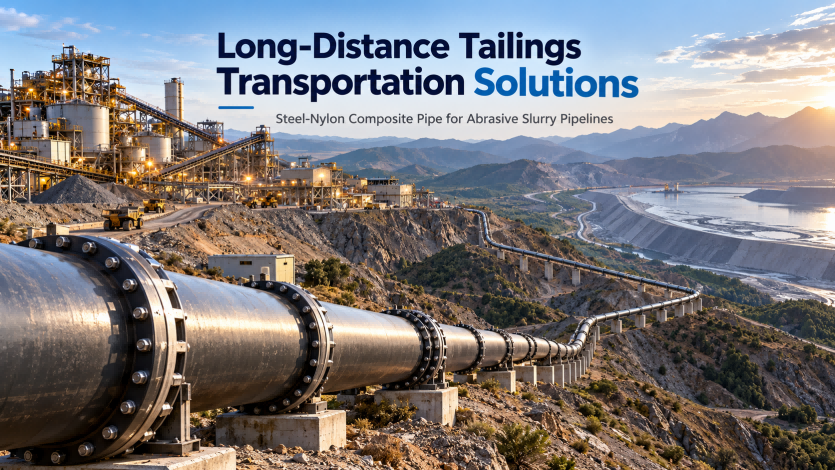
Long-Distance Tailings Transportation Solutions
Applications of Wear-Resistant Pipes in Thermal Power Plants: Reducing Abrasion, Corrosion, and Downtime in Slurry Transport Systems