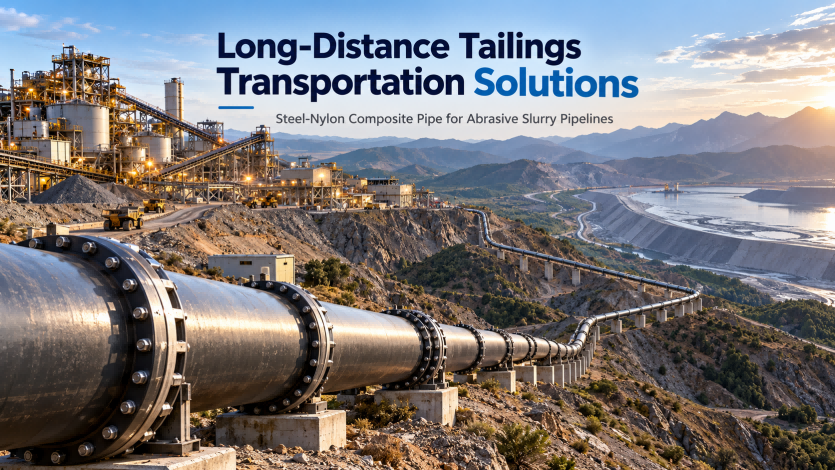
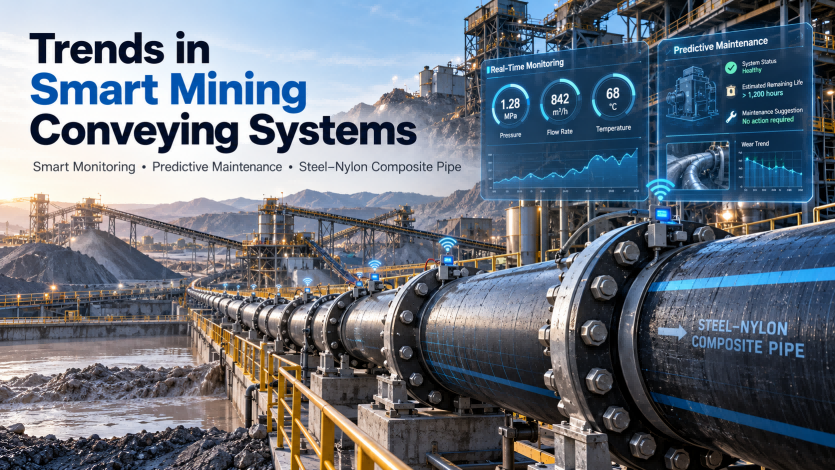
Mining Project Success Case Study: How Steel–Nylon Composite Pipes Reduce Slurry Pipeline Wear and Downtime
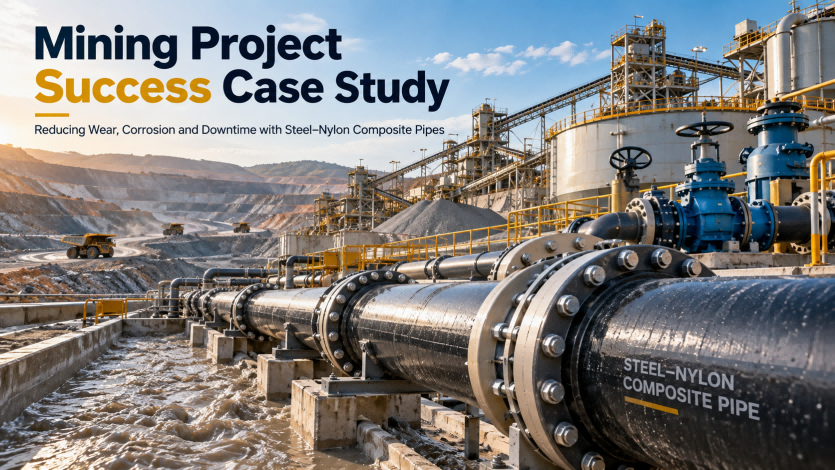
In large-scale mining projects, pipelines are often not the most expensive part of the investment, yet they can become one of the most critical components affecting the continuous operation of the entire production system.
Whether in iron ore, copper, or gold mines, or in large mineral processing plants, tailings facilities, and mine backfill systems, the transportation of slurry, tailings, high-concentration mixtures, and corrosive process water presents several common challenges:
complex media, severe abrasion, long continuous operating hours, and potentially significant production losses when pipeline failure occurs.
For mining companies, therefore, the key question is no longer simply:
“Which pipe has the lowest purchase price?”
A more important question is:
“Which pipe can operate longer under actual mining conditions while reducing replacement, maintenance, and unplanned downtime?”
This article analyzes a typical mining pipeline project and examines pipeline material selection, wear mechanisms, material upgrades, and the engineering value of steel–nylon composite pipes.
1. Project Background: The Challenge of High-Concentration Slurry Transportation
A large mining project required a slurry pipeline system to transport mineral slurry from the processing area to downstream treatment facilities.
The system was designed for continuous operation, and the transported medium contained a high concentration of solid mineral particles.
Typical operating conditions included:
-
High-solids slurry
-
Large quantities of hard mineral particles
-
Long-term continuous transportation
-
Relatively high flow velocity in certain sections
-
Severe erosion at elbows, tees, and pump discharge sections
-
A certain degree of corrosiveness in the transported medium
-
Large pipeline diameters
-
Difficult maintenance conditions in some areas
During the early stages of the project, the engineering team identified a common problem:
Traditional pipelines could meet short-term transportation requirements, but it was difficult for them to simultaneously address abrasion, corrosion, and long-term operational reliability.
Under high-flow-velocity and high-solids conditions, suspended particles continuously impact and erode the internal surface of the pipe.
Over time, the failure process may develop as follows:
Wall thinning → Perforation → Leakage → Shutdown → Replacement
When this happens repeatedly, the original purchase price of the pipeline is no longer the main cost.
The real expense comes from the production losses caused by pipeline failure and plant downtime.
2. Why Are Mining Pipelines Particularly Vulnerable to Failure?
Many mining companies focus primarily on abrasion resistance when selecting pipeline materials.
However, mining pipeline failures are rarely caused by a single factor.
In most cases, several mechanisms act together.
2.1 Solid Particle Erosion
Mining slurry usually contains a significant amount of solid mineral particles.
As the slurry moves through the pipeline at high velocity, these particles continuously strike the internal pipe surface.
This effect is particularly severe at:
-
Elbows
-
Tees
-
Reducers
-
Areas near valves
-
Pump discharge sections
-
Locations where the pipeline changes direction suddenly
At these locations, particles can generate stronger impact forces and turbulence.
As a result, these sections often experience faster wear than straight pipe sections.
2.2 Corrosion and Abrasion Acting Simultaneously
Some mining slurries and process waters may also contain:
-
Acidic components
-
Salts
-
Chloride ions
-
Flotation or mineral-processing chemicals
This means the pipeline may face more than simple mechanical wear.
Instead, it may experience:
Corrosion + Erosion + Abrasion
For conventional carbon steel pipes, corrosion gradually reduces wall thickness, while solid particles continuously attack the already damaged surface.
When these mechanisms interact, the overall pipeline service life can be significantly shortened.
2.3 Larger Pipe Diameters Mean More Difficult Maintenance
For DN500, DN800, DN1000, or even larger slurry transportation systems, replacing a pipeline section can become a major engineering operation.
Large-diameter pipes mean:
-
Greater individual pipe weight
-
More complicated lifting requirements
-
Greater installation space requirements
-
Larger flanges and fittings
-
Longer replacement times
-
Greater impact from plant shutdowns
For large mining projects, therefore:
Extending the effective operating period after installation is often more valuable than simply reducing the initial purchase price.
3. The Core Problems Facing the Project
After analyzing the operating conditions, the project's primary challenges could be summarized in four areas.
| Engineering Challenge | Impact on the Production System |
|---|---|
| Continuous slurry erosion | Gradual reduction in pipe wall thickness |
| Corrosive media | Accelerated material degradation |
| Frequent repair of high-wear sections | Increased maintenance workload |
| Pipeline failure and shutdown | Production losses |
The engineering team therefore expanded the material-selection objective beyond simply meeting pressure requirements.
The new goal became:
Abrasion resistance + Corrosion resistance + Pressure capability + Long-term operational reliability
This is also one of the main reasons why more modern mining projects are reassessing conventional pipeline materials.
4. What Are the Limitations of Traditional Mining Pipeline Solutions?
Different mining projects use different types of pipelines.
Common solutions include:
-
Carbon steel pipe
-
Abrasion-resistant steel pipe
-
Rubber-lined steel pipe
-
HDPE pipe
-
FRP pipe
-
Various composite piping systems
None of these materials is universally “good” or “bad.”
The real question is:
Does the material performance match the actual operating conditions?
For example, conventional steel pipe provides good mechanical strength, but it may be vulnerable to abrasion and corrosion during long-term slurry transportation.
HDPE offers good corrosion resistance, but its structural design must be carefully evaluated for high-pressure, high-temperature, large-diameter, and complex mechanical-loading conditions.
FRP provides good corrosion resistance, but for highly abrasive slurry and impact-intensive environments, abrasion layers, connection reliability, and mechanical performance must also be carefully assessed.
Mining pipeline material selection should therefore never be based on a single performance indicator.
A more appropriate selection framework should consider:
Abrasion resistance + Corrosion resistance + Pressure capability + Connection reliability + Maintenance cost + Service life
5. Why Did the Project Begin Considering Steel–Nylon Composite Pipe?
After reviewing the operating conditions, the project required a piping solution that could combine metallic structural strength with the corrosion and abrasion resistance of a non-metallic material.
Steel–nylon composite pipe is designed around this principle.
Its basic concept can be summarized as:
The steel structure carries pressure and mechanical loads, while the reinforced nylon layer contacts the transported medium.
This structure allows the pipeline to benefit from the advantages of both material systems.
The steel structure primarily provides:
-
Pressure-bearing capability
-
Mechanical strength
-
Structural stability for large diameters
-
Reliable engineering installation
The reinforced nylon layer primarily provides:
-
Resistance to slurry abrasion
-
Corrosion resistance
-
Resistance to saline media
-
Compatibility with selected acidic and alkaline environments
-
Protection against long-term internal erosion
For complex mining transportation systems, this structural layer + functional layer approach can be more effective than expecting a single material to provide every required property.
6. Core Advantages of Steel–Nylon Composite Pipe in Mining Projects
6.1 Abrasion Resistance for Long-Term Slurry Transportation
The first major challenge in slurry transportation is wear.
Reinforced nylon offers good abrasion resistance and can be used in applications involving continuous solid-particle erosion.
Potential applications include:
-
Iron ore slurry
-
Copper ore slurry
-
Gold mine tailings
-
Mine backfill slurry
-
High-concentration tailings
-
Industrial wastewater containing solids
Reducing internal wear can help extend inspection and replacement intervals.
6.2 Corrosion Resistance at the Same Time
Unlike conventional metallic pipelines, the transported medium primarily contacts the corrosion-resistant inner layer under normal design conditions.
For saline water, slurry, process water, and selected acidic or alkaline media, this helps reduce direct exposure of the steel structure to corrosive substances.
This is particularly valuable in mining applications involving both:
Corrosion + Abrasion
6.3 Steel Structure Provides Reliable Pressure Capability
Mining transportation is not only an abrasion problem.
Some slurry systems, mine backfill systems, and long-distance transportation pipelines operate under significant pressure.
The pipeline must therefore provide sufficient structural strength.
In steel–nylon composite pipe, the steel load-bearing structure provides pressure support.
The product can be engineered according to:
-
Pipe diameter
-
Operating pressure
-
Temperature
-
Transportation distance
-
Installation conditions
For industrial pipeline projects requiring pressure classes in the range of 1.0–4.0 MPa, the pipe structure can be selected according to the specific design parameters of the project.
7. Why Is Large-Diameter Manufacturing Capability Important for Mining Projects?
Mining projects are becoming increasingly large in scale.
Production capacities are increasing, and transportation flow rates are rising accordingly.
As a result, mining pipelines are moving toward larger diameters.
Typical sizes may include:
DN500
DN600
DN800
DN1000
DN1200
and even larger industrial pipelines.
For major mining projects, a supplier's large-diameter manufacturing capability directly affects:
-
Wall thickness control
-
Pipe roundness
-
Uniformity of the internal lining
-
Flange dimensional accuracy
-
Batch consistency
-
On-site installation efficiency
Large-diameter industrial pipes cannot simply be treated as scaled-up versions of small pipes.
Their manufacture requires appropriate:
-
Materials
-
Structural engineering
-
Production equipment
-
Tooling
-
Quality-control systems
For manufacturers with large-diameter steel–nylon composite pipe production capabilities, this creates more possibilities for slurry, tailings, and mine backfill applications.
8. Why Can Integral Flange Design Improve Mining Pipeline Reliability?
Pipeline failures do not occur only in the pipe body.
Many problems appear at connection points.
Typical examples include:
-
Corrosion around flanges
-
Lining failure near joints
-
Damage to sealing surfaces
-
Unstable connections between dissimilar materials
For composite pipelines:
The connection design is just as important as the pipe material itself.
Steel–nylon composite pipes can be designed with integral flange structures, allowing the inner corrosion-resistant material to extend toward the flange sealing area.
This design can help reduce the possibility of corrosive media directly contacting exposed metal surfaces while improving consistency at pipeline connections.
For long-distance mining pipelines, reducing potential connection failure points can provide significant engineering value.
9. Project Implementation: More Than Simply Replacing One Pipe with Another
A successful mining pipeline retrofit is not simply a matter of replacing an existing pipe with another material.
Professional implementation begins with a detailed analysis of operating conditions.
The following parameters should normally be confirmed.
Transported Medium
Including:
-
Mineral type
-
Solids concentration
-
Maximum particle size
-
Slurry density
-
pH
-
Chemical composition
Hydraulic Parameters
Including:
-
Flow rate
-
Flow velocity
-
Operating pressure
-
Maximum pressure
-
Water hammer pressure
Temperature Conditions
Including:
-
Normal operating temperature
-
Maximum operating temperature
-
Minimum ambient temperature
Pipeline Conditions
Including:
-
Pipe diameter
-
Total pipeline length
-
Number of elbows
-
Elevation differences
-
Pump station locations
-
Terrain changes
Only after these parameters are evaluated together can engineers determine whether a particular pipeline material is truly suitable for the project.
10. Special Design for High-Wear Locations
Historical maintenance records often show that mining pipeline wear is not uniform.
The most severe wear commonly occurs at:
Elbows, tees, pump outlets, reducers, and high-velocity sections.
These areas can therefore be specifically optimized during project design.
Possible strategies include:
-
Optimizing elbow radius
-
Reducing local turbulence
-
Adjusting pipeline routing
-
Increasing design safety margins at high-wear sections
-
Using higher wear-resistance configurations for vulnerable fittings
This approach can be more economical than simply increasing wall thickness across the entire pipeline.
11. From Purchase Price to Total Cost of Ownership
This is one of the most important changes in successful mining pipeline material selection.
Consider two pipeline options.
Option A
Lower initial purchase price, but:
-
Short replacement cycle
-
Frequent maintenance
-
Shutdowns required for repair
-
Continuous inventory of replacement fittings required
Option B
Potentially higher initial investment, but:
-
Longer operating life
-
Fewer maintenance interventions
-
Less downtime
-
Lower spare-parts demand
If only the initial purchase cost is considered, Option A may appear cheaper.
However, over five years, ten years, or the entire life of the mine:
Option B may have a significantly lower overall cost.
For this reason, mining companies are increasingly focusing on:
TCO — Total Cost of Ownership
12. How Should Mining Pipeline TCO Be Calculated?
The real cost of a mining transportation system should include at least:
TCO = Pipe Purchase + Installation + Maintenance + Replacement + Spare Parts + Downtime Losses + Labor
Among these, one of the most commonly overlooked costs is:
Downtime Loss
In a large mineral processing plant, if a critical slurry pipeline develops a serious leak, the consequences may follow this sequence:
Slurry transportation stops
↓
Related equipment is shut down
↓
The production process is affected
↓
Output decreases
The financial loss from a single serious pipeline failure may therefore be far greater than the cost of the damaged pipe section itself.
This explains why more major mining operations are treating:
Reduction of unplanned downtime
as an important material-selection criterion.
13. What Defines a Successful Mining Pipeline Project?
The success of a mining pipeline project should not be measured simply by whether installation has been completed.
The real evaluation begins after the system enters service.
Mining companies should monitor indicators such as:
-
Annual pipeline wear rate
-
Remaining pipe wall thickness
-
Number of maintenance interventions per year
-
Number of leakage incidents
-
Fitting replacement frequency
-
Unplanned downtime
-
Maintenance cost per unit of transported material
If, after changing pipeline materials:
Maintenance frequency decreases, operating intervals become longer, and downtime is reduced,
then the material upgrade has generated genuine value.
14. From Trial Section to Full Pipeline: A Lower-Risk Upgrade Strategy
For large mining projects, directly replacing several kilometers or even dozens of kilometers of pipeline may not always be the lowest-risk approach.
A more practical strategy is to begin with a:
Trial section.
For example:
100 meters
200 meters
300 meters
500 meters
The trial section can be installed in areas with:
-
The most severe wear
-
Multiple elbows
-
Pump discharge piping
-
The highest maintenance frequency
During operation, engineers can monitor:
-
Wall thickness changes
-
Wear rate
-
Operating pressure
-
Maintenance frequency
-
Overall pipeline condition
Once operational data demonstrates a clear advantage, the material can gradually be expanded to larger sections of the system.
This approach can significantly reduce the risk associated with changing pipeline materials.
15. Why Are More Mining Projects Considering Composite Pipelines?
The priorities of mining transportation systems are changing.
In the past:
Low purchase price was often one of the most important decision factors.
Today, large mining companies increasingly focus on:
-
Longer service life
-
Reduced maintenance
-
Lower downtime
-
Higher reliability
-
Lower total lifecycle cost
The future of mining pipeline materials is therefore unlikely to be a simple question of “metal replacing non-metal” or “non-metal replacing metal.”
Instead, the industry is increasingly moving toward:
Composite structures in which different materials perform the functions they are best suited for.
Steel–nylon composite pipe is one example of this engineering philosophy.
The steel structure provides:
Strength and pressure resistance.
The reinforced nylon provides:
Corrosion and abrasion resistance.
Together, they create a piping solution better suited to complex mining transportation conditions.
16. Which Mining Systems Should Consider Steel–Nylon Composite Pipe?
Steel–nylon composite pipe can be evaluated for a variety of mining applications.
Iron Ore Mining
-
Iron ore slurry transportation
-
Tailings pipelines
-
Mineral-processing water systems
-
Return-water systems
Copper Mining
-
Copper ore slurry
-
Tailings transportation
-
Process water
-
Selected corrosive liquids
Gold Mining
-
Gold mine tailings
-
High-solids slurry
-
Mineral-processing wastewater
-
Process transportation systems
Mine Backfill Systems
-
Tailings slurry
-
Cemented backfill slurry
-
High-concentration backfill mixtures
Long-Distance Transportation
Composite pipes are particularly worth evaluating where the project involves:
High abrasion + High maintenance cost + High downtime cost
at the same time.
17. The Core of a Successful Mining Project Is Not Simply the Pipe — It Is Material Selection Capability
This typical project demonstrates that mining pipeline problems may appear to be material-related.
In reality, they are system-engineering problems.
A proper solution must consider:
Medium + Flow Velocity + Particle Characteristics + Pressure + Temperature + Terrain + Pipe Diameter + Maintenance Conditions + Expected Service Life
A professional industrial pipeline supplier should therefore provide more than a quotation.
More importantly, the supplier should be capable of recommending suitable materials and structures according to actual operating conditions.
For steel–nylon composite pipe projects, we typically evaluate:
-
Transported medium
-
Solids concentration
-
Particle size
-
Flow velocity
-
Operating pressure
-
Temperature
-
Pipe diameter
-
Pipeline length
-
Number of elbows
-
Installation environment
-
Expected service life
Based on these factors, the corresponding pipe structure and specification can then be determined.
18. Conclusion: The Real Value of a Mining Pipeline Is Measured by Stable Operating Time
Mining companies are not simply purchasing pipes.
They are purchasing:
Years of reliable transportation capacity.
If a pipe has a low initial price but requires frequent repair and replacement, it may not actually be the most economical solution.
By contrast, if a pipeline can:
-
Reduce slurry abrasion
-
Resist corrosion
-
Withstand industrial operating pressures
-
Support large-diameter transportation
-
Reduce maintenance requirements
-
Lower leakage risk
-
Extend continuous operating intervals
then even if its initial investment is not the lowest, it may still generate greater economic value throughout the lifecycle of the project.
This is the core value of steel–nylon composite pipe in modern mining projects.
For iron ore, copper, gold, tailings transportation, and mine backfill applications, the direction of pipeline material selection is becoming increasingly clear:
From the lowest purchase price to the lowest total lifecycle cost.
Piping systems capable of simultaneously addressing:
Abrasion resistance, corrosion resistance, pressure capability, large-diameter requirements, and long-term reliability
will continue to attract greater attention in large-scale mining projects.
Need a Pipeline Solution for Your Mining Project?
If your mining project involves:
slurry transportation, tailings pipelines, mine backfill, high-abrasion media, corrosive process water, or large-diameter pipelines,
the appropriate pipe material should be selected according to actual operating conditions rather than purchase price alone.
Our steel–nylon composite pipe solutions can be engineered according to:
medium composition, solids concentration, particle size, flow velocity, pressure, temperature, pipe diameter, and expected project service life.
For new mining projects, pipeline replacement projects, or trial-section evaluations, technical material-selection support can be provided before final pipeline selection.
A more reliable pipeline does more than transport slurry — it helps protect the continuous operation of the entire mining system.
Mining Industry Cost Reduction and Efficiency Improvement: A Practical Pipeline Case Study
Corrosion-Resistant Piping Solutions for the Power Industry: Addressing Long-Term Corrosion Challenges in Cooling Water, FGD Slurry, and Industrial Wastewater Systems