Mining Industry Cost Reduction and Efficiency Improvement: A Practical Pipeline Case Study

In the mining industry, cost reduction and efficiency improvement no longer simply mean purchasing cheaper materials or equipment.
For mineral processing plants, tailings transportation systems, slurry pipelines, and mine backfilling systems, the true cost of a pipeline is often determined not by its initial purchase price, but by questions such as:
-
How long can the pipeline operate continuously?
-
How frequently does it suffer from wear-through, leakage, or failure?
-
How many shutdowns are required for maintenance each year?
-
How often must elbows, tees, pump discharge sections, and other high-wear components be replaced?
-
Do scaling, corrosion, and increasing internal roughness raise pumping energy consumption?
-
Does maintenance require hot work, welding, or heavy construction equipment?
-
How much will the entire pipeline system actually cost over 5, 10, or more years?
As a result, more mining companies are moving away from a simple purchase-price mindset and toward a Total Cost of Ownership (TCO) approach.
This is also why steel–nylon composite pipes are increasingly worth evaluating for mining pipeline systems exposed to severe abrasion, high solids content, corrosion, or combined corrosion and wear.
1. The Most Expensive Pipeline Is Not Necessarily the One with the Highest Purchase Price
Consider a mining company planning a slurry transportation pipeline.
During material selection, if the decision is based only on the price per meter, the project may naturally favor a lower-cost pipe.
However, the true cost often appears only after the system begins operation.
A common failure cycle may look like this:
Pipeline wear → wall thinning → localized leakage → production shutdown → emergency repair → pipe replacement → restart
If this process occurs several times every year, a pipeline with a low initial purchase price may ultimately become the more expensive option.
Mining companies may face several hidden costs.
Pipe Replacement Costs
These include:
Pipe materials, elbows, tees, flanges, fasteners, transportation, lifting equipment, installation, and labor.
If the pipeline is located in mountainous terrain, underground mines, or along a long-distance tailings route, even replacing a short section can become a complex operation.
Production Downtime Losses
For continuous mining and mineral processing operations, downtime can be significantly more expensive than the pipe itself.
A failure in a critical slurry pipeline may result in:
-
Concentrator shutdown;
-
Interrupted slurry transportation;
-
Disruption of tailings handling;
-
Interruption of mine backfilling operations.
If repairs require several hours or even several days, lost production may far exceed the value of the damaged pipeline section.
Maintenance Labor Costs
Frequent inspections, temporary repairs, welding, pipe replacement, and emergency maintenance continuously consume manpower and maintenance resources.
Energy Costs
As corrosion, scaling, and surface roughness increase inside a pipeline, hydraulic resistance may also rise.
To maintain the same flow rate, pumping systems may require additional power.
Safety and Environmental Risks
Leakage of slurry, tailings, or process media is not only a maintenance issue. It can also create operational safety and environmental risks.
Therefore, pipeline material selection should be evaluated using a broader formula:
TCO = Initial Purchase Cost + Installation Cost + Maintenance Cost + Replacement Cost + Downtime Loss + Energy Cost + Risk Cost
This is the real meaning of cost reduction in mining pipeline systems.
2. A Typical Mining Pipeline Cost-Reduction Scenario
Many mining operations encounter a similar problem.
A slurry pipeline continuously transports a high concentration of solid particles.
The transported material may contain:
-
Iron ore particles;
-
Copper ore particles;
-
Tailings;
-
Quartz;
-
Sand;
-
Other hard mineral particles.
When these particles travel through the pipeline at relatively high velocity, they continuously impact and abrade the internal pipe wall.
The areas most susceptible to severe wear typically include:
-
Elbows;
-
Tees;
-
Diameter transition sections;
-
Pump discharge sections;
-
High-velocity zones;
-
Pipeline bends and direction changes.
After a period of operation, conventional piping may gradually experience:
Localized wall thinning → perforation → leakage → replacement
Wear at elbows is often particularly severe because particles continuously impact the outer radius of the bend.
The result is a recurring maintenance cycle.
The pipeline itself may not be expensive, but repeated maintenance, replacement, and shutdowns can significantly increase the total operating cost.
This is one of the main reasons mining companies increasingly look for more wear-resistant pipeline materials.
3. How Steel–Nylon Composite Pipe Changes the Cost Structure
Steel–nylon composite pipe is not simply another pipe material.
Its design concept is to combine the advantages of two materials:
The steel structure provides mechanical strength and pressure resistance, while the nylon layer provides wear and corrosion resistance.
This composite structure can provide important advantages in demanding mining transportation systems.
4. Improved Wear Resistance Helps Extend Replacement Intervals
Abrasion is one of the primary challenges in slurry transportation.
Steel–nylon composite pipes use a wear-resistant nylon internal layer to help reduce damage caused by continuous erosion and abrasion from solid particles.
They are particularly worth evaluating for applications such as:
-
Iron ore slurry transportation;
-
Copper ore slurry transportation;
-
Gold mine tailings transportation;
-
Mineral processing slurry systems;
-
Mine backfilling pipelines;
-
High-solids industrial slurry transportation.
If pipeline service life can be extended, the economic benefit is not limited to lower pipe replacement costs.
More importantly:
Fewer pipe replacements mean fewer production shutdowns.
For a mining company, this may represent the largest source of economic value.
5. Reducing Downtime May Be More Important Than Reducing Pipe Purchase Price
One of the most common mistakes in industrial procurement is focusing too heavily on initial cost.
Suppose Pipe A costs 20% less than Pipe B.
However, Pipe A requires three shutdowns per year, while Pipe B operates reliably for a much longer period.
From a purchasing perspective:
Pipe A appears cheaper.
From an operational perspective:
Pipe B may actually be more economical.
Therefore, an important KPI in mining pipeline evaluation should be:
Annual Pipeline Shutdown Hours
For example, if each pipeline failure causes an 8-hour shutdown and four failures occur each year:
4 × 8 = 32 hours of downtime per year
If improved wear resistance reduces the maintenance frequency from four shutdowns to one, a substantial amount of non-productive downtime can potentially be eliminated.
For a large mineral processing plant, the production value preserved through reduced downtime may be far greater than the difference in pipe purchase price.
6. Another Key Advantage: Addressing Both Wear and Corrosion
The challenge with mining pipelines is that many systems do not suffer from abrasion alone.
Instead, they experience:
Corrosion + Abrasion
This is often referred to as corrosion-abrasion or erosion-corrosion.
Some mining slurries and process fluids may contain:
-
Salts;
-
Acidic components;
-
Alkaline components;
-
Corrosive ions;
-
Other chemically aggressive substances.
With conventional steel pipe, chemical corrosion may begin first.
As corrosion progresses, the internal surface becomes rougher and structurally weaker.
Solid particles then continuously impact the damaged surface.
This can create an accelerated failure mechanism:
Corrosion → Surface Degradation → Particle Erosion → Fresh Surface Exposure → Further Corrosion
The process repeats continuously.
Steel–nylon composite pipe uses nylon as the internal conveying layer.
When the nylon material is compatible with the operating medium, the pipeline can provide both corrosion resistance and wear resistance.
This makes it particularly valuable in complex slurry transportation environments.
7. Lower Internal Friction Can Also Influence Long-Term Operating Costs
Another frequently overlooked factor in long-distance slurry transportation is the condition of the internal pipe surface.
When corrosion and scaling increase internal roughness, hydraulic resistance may rise.
Greater resistance means that pumps must provide higher pressure or consume more electricity to maintain the required flow rate.
For a short pipeline, this difference may appear insignificant.
But for slurry or tailings pipelines extending:
1 km, 3 km, 5 km, or even longer,
pumping energy becomes an important part of the total operating cost.
The relatively smooth nylon internal surface can help maintain more stable hydraulic characteristics under properly designed operating conditions.
Therefore, when evaluating pipeline materials, the key question should not simply be:
“What is the price per meter?”
A better question is:
“What will it cost to transport each ton of slurry over the next 5–10 years?”
8. How Integrally Formed Flanges Can Simplify Mine-Site Maintenance
Maintenance conditions at mining sites are often challenging.
Typical difficulties may include:
-
Limited working space;
-
Dense equipment layouts;
-
Dusty environments;
-
Mountainous terrain;
-
Difficult transportation access;
-
Restrictions on large-scale welding work.
For this reason, the connection design of a pipeline can directly affect maintenance efficiency.
Our steel–nylon composite pipes can be manufactured with integrally formed flange connections.
This design can provide important benefits in mining applications.
Flanged connections can reduce the amount of on-site welding required in many maintenance situations.
They are particularly useful for:
-
Local pipe replacement;
-
Elbow replacement;
-
Tee replacement;
-
Pump discharge modifications;
-
Partial upgrades of aging pipelines.
If one pipeline section requires maintenance, it can often be replaced locally without carrying out extensive reconstruction of the entire line.
9. Partial Pipeline Upgrades Can Be More Economical Than Complete Replacement
Many mining projects do not need to replace the entire pipeline at once.
The most severe wear is often concentrated in specific areas such as:
Elbows, tees, pump discharge sections, and high-velocity zones.
Therefore, during technical discussions with mining customers, we often recommend identifying the actual high-wear locations first.
Then, these critical sections can be selectively upgraded.
For example:
The existing pipeline may remain in service.
However, frequently damaged elbows, tees, or pump outlet sections can be replaced with more wear-resistant steel–nylon composite pipes and fittings.
This creates a highly practical upgrade strategy:
Use critical upgrades to solve the majority of maintenance problems.
For an operating mine, this approach can reduce the need for a large one-time capital investment.
10. A 100–500 Meter Trial Section Can Reduce Material Replacement Risk
When considering a new pipeline material, many mining companies are not primarily concerned about price.
Their biggest question is:
“Will it actually work under our operating conditions?”
For this reason, large mining projects can benefit from an engineering validation approach.
A trial section of approximately:
100–500 meters
can be installed in a high-wear area.
Alternatively, testing may focus on:
-
Pump discharge sections;
-
High-wear elbows;
-
Sections of a tailings main line;
-
Critical slurry transportation sections.
Actual operating performance can then be monitored.
Key data may include:
-
Operating time;
-
Wear rate;
-
Wall thickness changes;
-
Leakage frequency;
-
Maintenance frequency;
-
Overall operating condition.
These results can then be compared with the original pipeline material.
This provides the customer with real operating data instead of relying only on laboratory results or supplier claims.
If the trial section performs well, the application can gradually be expanded:
Trial Section → Partial Pipeline → Complete Pipeline → Mine-Wide Application
This is often a more practical and lower-risk approach when introducing new pipeline materials into mining operations.
11. How to Calculate ROI for a Mining Pipeline Upgrade
Suppose a mine operates a critical slurry pipeline.
With the existing piping system, the pipeline must be replaced twice per year.
Each replacement may involve:
-
New pipe materials;
-
Installation expenses;
-
Crane and lifting costs;
-
Labor;
-
Production shutdown losses.
The annual cost of the traditional pipeline can therefore be expressed as:
Annual Cost A
Annual Cost A =
Pipe Replacement Cost
-
Installation Cost
-
Labor Cost
-
Downtime Loss
-
Energy Cost
After replacing the system with steel–nylon composite pipe, the replacement interval may be significantly extended.
The new annual operating cost becomes:
Annual Cost B
If Annual Cost B is substantially lower than Annual Cost A, the annual savings can be calculated as:
Annual Savings = Annual Cost A − Annual Cost B
The return on investment can then be estimated as:
ROI = Annual Savings ÷ Upgrade Investment
This is the approach we recommend when mining customers evaluate steel–nylon composite pipe.
Instead of comparing only:
Pipe Price per Meter
companies should also consider:
Cost per Operating Year
and even:
Cost per Ton of Slurry Transported
These metrics provide a much clearer picture of the real economics of a mining pipeline.
12. Why Large-Diameter Mining Pipelines Require Greater Focus on TCO
As mining operations expand, more transportation systems are moving toward:
Higher flow rates, larger diameters, and longer conveying distances.
As pipe diameter increases:
-
Individual replacement costs generally increase;
-
Construction becomes more complex;
-
Transportation becomes more difficult;
-
Lifting requirements become greater;
-
Shutdown consequences become more serious.
Therefore, frequent failure in large-diameter pipelines can significantly amplify maintenance costs.
Our steel–nylon composite pipes can be engineered for different project requirements, pipe diameters, and pressure classes, including large-diameter industrial transportation systems.
For major mining projects, the larger the pipeline becomes, the more economically valuable extended service life can be.
13. The Definition of Cost Reduction in Mining Is Changing
In the past, many mining companies reduced costs by purchasing cheaper equipment and materials.
Today, more companies are focusing on:
Reducing the total operating cost over the entire service life of the system.
This represents a fundamental change in thinking.
Effective cost reduction may come from:
-
Extending pipeline service life;
-
Reducing maintenance frequency;
-
Minimizing unplanned shutdowns;
-
Lowering labor requirements;
-
Improving pumping efficiency;
-
Reducing leakage risks.
As a result, the key question in pipeline material selection is gradually changing from:
“How much does this pipe cost per meter?”
to:
“How much will this pipeline cost us over the next 10 years?”
14. Where Can Steel–Nylon Composite Pipe Be Used in Mining?
After evaluating factors such as medium composition, temperature, pressure, particle size, solids concentration, and flow velocity, steel–nylon composite pipes can be considered for a range of mining applications.
Slurry Transportation
Transportation of iron ore, copper ore, gold ore, and other mineral slurries.
Tailings Transportation
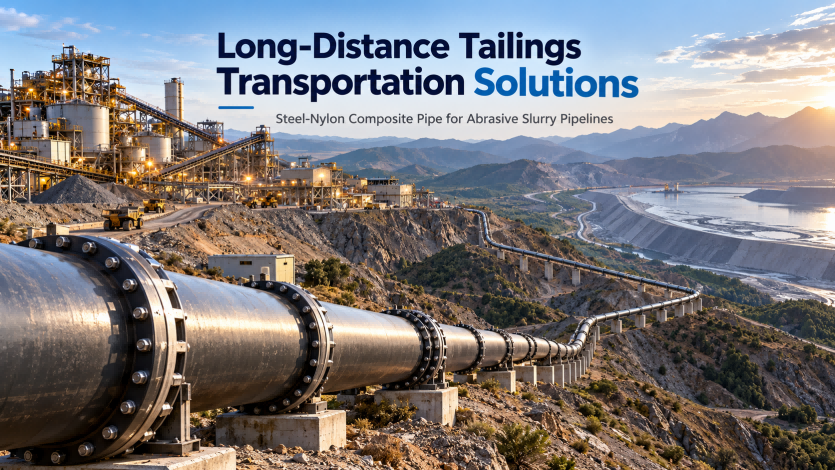
Tailings pipelines between mineral processing facilities and tailings handling or disposal systems.
Mine Backfilling
High-concentration slurry transportation in mine backfilling systems.
Mineral Processing Pipelines
Process pipelines requiring both corrosion resistance and wear resistance.
High-Wear Pipeline Sections
Elbows, tees, pump discharge sections, and high-velocity zones.
Large-Diameter Transportation Systems
Large-scale centralized conveying and long-distance slurry transportation projects.
15. Our Advantage Is More Than Supplying a Pipe
For mining projects, an effective industrial pipeline supplier should provide more than a quotation.
Many factors determine actual pipeline service life, including:
-
Chemical composition of the medium;
-
Solids concentration;
-
Particle hardness;
-
Particle size;
-
Flow velocity;
-
Working pressure;
-
Operating temperature;
-
Pipe diameter;
-
Pipeline layout and elbow design.
For this reason, we place strong emphasis on technical communication during the early stages of a project.
Before recommending a steel–nylon composite pipe solution, we normally suggest that customers provide key operating data such as:
-
Transported medium;
-
Solids concentration;
-
Particle size;
-
Flow rate;
-
Flow velocity;
-
Working pressure;
-
Operating temperature;
-
Pipe diameter;
-
Pipeline length;
-
Existing pipe material;
-
Current pipeline service life;
-
Locations experiencing the most severe wear.
Only after understanding these operating conditions can a supplier properly identify:
Where the pipeline is most likely to fail and which material solution is most appropriate.
Conclusion: Real Mining Cost Reduction Means Fewer Pipeline Problems
For the mining industry, a good pipeline does more than resist abrasion.
Its real value is:
Keeping the production system operating longer, more reliably, and with fewer shutdowns.
When pipeline service life is extended, a chain of economic benefits can follow:
Longer Service Life
→ Fewer Replacements
→ Less Maintenance
→ Less Downtime
→ Lower Labor Costs
→ Lower Production Losses
→ Lower Total Cost of Ownership
This is the real meaning of:
Cost Reduction and Efficiency Improvement.
Steel–nylon composite pipe combines the mechanical strength of steel with the wear-resistant and corrosion-resistant properties of nylon, providing an alternative pipeline solution for mining systems exposed to severe abrasion, corrosion, or combined corrosion-abrasion conditions.
For iron ore, copper ore, gold mining, tailings transportation, mine backfilling, and long-distance slurry transportation projects, instead of asking:
“Which pipe is the cheapest?”
a more valuable question is:
“Which pipeline solution can deliver the lowest total cost over the next 5–10 years?”
That is often the key to achieving real cost reduction and efficiency improvement in a mining pipeline project.
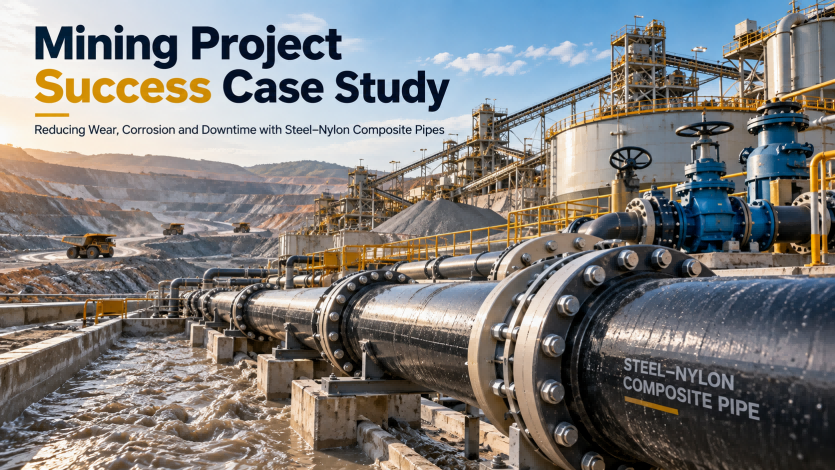
Mining Project Success Case Study: How Steel–Nylon Composite Pipes Reduce Slurry Pipeline Wear and Downtime