Why We Focus on Corrosion-Resistant and Wear-Resistant Industrial Pipeline Technology

For many industrial companies, the real question is not simply:
“Can this pipeline be used?”
The more important question is:
“How long can this pipeline operate reliably?”
Corrosion, abrasion, scaling, erosion, leakage, lining failure, weld corrosion, and frequent replacement may appear to be different problems. But fundamentally, they point to the same challenge:
The performance of conventional pipeline materials is increasingly struggling to match the complexity of modern industrial media and operating conditions.
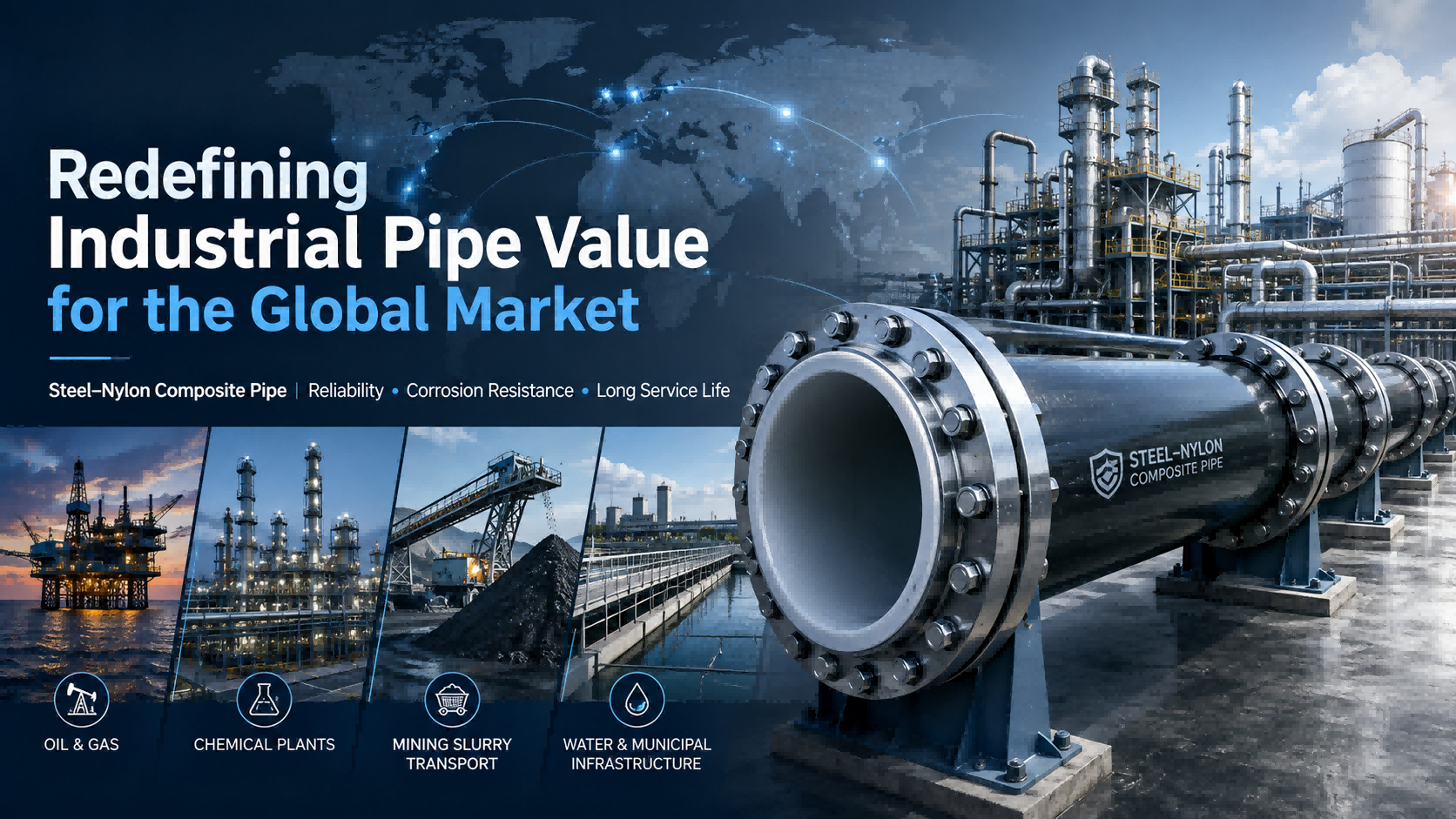
This is why we have long focused our research, development, and manufacturing efforts on corrosion-resistant and wear-resistant industrial pipeline technologies, with steel-nylon composite pipe as one of our core solutions.
Our goal is not simply to manufacture another type of pipe.
What we really aim to solve is a much larger engineering question:
How can industrial fluid transportation systems operate longer, more reliably, and at a lower total lifecycle cost?
1. The Real Cost of Industrial Pipelines Is Often Not the Purchase Price
In industrial procurement, it is easy to compare pipe prices.
For example:
-
How much does carbon steel pipe cost per meter?
-
How much does stainless steel pipe cost?
-
How much does FRP pipe cost?
-
How much does PE pipe cost?
-
How much does composite pipe cost?
However, for continuous-process industrial facilities, comparing initial purchase price alone can be misleading.
When a pipeline fails, the total cost may include:
Pipe cost + installation cost + maintenance labor + lifting and equipment cost + production shutdown losses + media leakage losses + safety risks + environmental remediation costs
Therefore, a pipe with a lower initial price but requiring frequent maintenance or replacement may not actually be the lower-cost solution.
A better way to evaluate industrial pipelines is through:
Total Cost of Ownership — TCO
Consider two pipeline options.
Option A
The initial investment is relatively low, but corrosion and perforation begin after several years, resulting in frequent repairs.
Option B
The initial investment is somewhat higher, but the system can operate reliably for a much longer period, significantly reducing maintenance and shutdown frequency.
For industrial facilities expected to operate for 10, 20, or more years, Option B may ultimately deliver a much lower total lifecycle cost.
This is one of the key reasons we continue to develop corrosion-resistant and wear-resistant composite pipeline technologies.
2. Why Is Corrosion One of the Most Important Problems in Industrial Piping?
Industrial pipelines operate under conditions that are far more complex than ordinary water supply and drainage systems.
Many industrial fluids may contain combinations of:
-
Water
-
Salts
-
Chloride ions
-
Acids
-
Alkalis
-
H₂S
-
CO₂
-
Solid particles
-
Slurries
-
Chemical mother liquor
Temperature, pressure, and flow velocity can further accelerate material degradation.
As a result, industrial pipeline corrosion is rarely caused by only one mechanism.
Several mechanisms may occur simultaneously, including:
Electrochemical corrosion + pitting corrosion + crevice corrosion + erosion-corrosion + stress corrosion + under-deposit corrosion
This is why simply increasing the wall thickness of a steel pipe does not fundamentally solve many industrial corrosion problems.
3. The Limitation of Traditional Steel Pipe: Increasing Wall Thickness Does Not Eliminate Corrosion
Carbon steel offers high mechanical strength and mature manufacturing economics, which is why it has been widely used in industrial piping for decades.
However, it has one inherent weakness:
Steel is directly exposed to corrosive media.
When pipelines contain:
-
High-salinity water
-
Chloride ions
-
H₂S
-
CO₂
-
Acidic fluids
-
High-salt solutions
corrosion can continue throughout operation.
A traditional solution is to increase wall thickness.
In other words, more steel is added to provide greater corrosion allowance and extend the expected operating life.
This is known as the:
Corrosion Allowance Approach
The principle is essentially to allow the material to corrode gradually, provided that sufficient wall thickness remains throughout the design life.
Our approach is different.
We aim, wherever technically appropriate, to:
Prevent the corrosive medium from directly contacting the steel structural layer.
This is one of the fundamental engineering concepts behind steel-nylon composite pipe.
4. Steel-Nylon Composite Pipe: Separating Pressure-Bearing and Corrosion-Resistance Functions
One of the key design principles of steel-nylon composite pipe is to allow different materials to perform the functions they are best suited for.
In simple terms:
Steel Provides Structural Strength and Pressure Resistance
The steel structural layer provides:
-
Mechanical strength
-
Ring stiffness
-
Pressure-bearing capability
-
Structural stability for large diameters
-
Engineering installation reliability
The nylon functional layer primarily provides:
-
Isolation from the transported medium
-
Corrosion resistance
-
Wear resistance
-
Reduced scaling tendency
-
Lower internal flow resistance
This design is not based on asking:
“Is steel better than plastic?”
Instead, it addresses a more useful engineering question:
“How can steel and high-performance polymers each perform the function they are best suited to handle?”
That is the real value of composite material engineering.
5. Why Do We Focus on Wear Resistance as Well as Corrosion Resistance?
Not every industrial pipeline failure is caused primarily by chemical corrosion.
In mining, oilfield, chemical processing, and solid-liquid transportation systems, another major problem is:
Abrasion
When the transported medium contains:
-
Sand
-
Mineral particles
-
Crystals
-
Catalyst particles
-
Solid deposits
-
High-concentration slurry
these moving particles continuously impact and wear the internal pipe surface.
Wear can become particularly severe at:
-
Elbows
-
Tees
-
Reducers
-
Pump outlets
-
Upstream and downstream sections of valves
-
High-velocity sections
For complex industrial media, this means:
Corrosion resistance alone is not enough.
A reliable pipeline system must often withstand:
Corrosion + Abrasion + Erosion
This is why wear resistance has become another major focus of our pipeline technology development.
6. Corrosion and Wear Often Accelerate Each Other
This is an important phenomenon that is frequently underestimated during industrial pipeline material selection.
Consider a corrosive slurry pipeline containing solid particles.
In the first stage:
Particles repeatedly strike and wear the pipe wall.
Then:
The protective surface is damaged.
Next:
The corrosive medium attacks the exposed areas.
Then:
Corrosion further weakens the material surface.
Finally:
The weakened surface becomes even easier for particles to remove.
This creates a continuous cycle:
Wear → Surface Exposure → Corrosion → Material Weakening → Faster Wear
This interaction is often described as:
Erosion-Corrosion Synergy
This is also one reason why some materials may perform well in static laboratory corrosion tests but show a much shorter service life in real industrial operations.
Industrial pipeline conditions are not static.
Real-world pipeline design must consider the combined effects of:
Medium + Temperature + Pressure + Flow Velocity + Solid Content + Pipe Diameter + Fitting Geometry
7. Why Is the Steel-Nylon Composite Structure Suitable for Complex Industrial Piping?
Our product design philosophy is centered around several major industrial pipeline challenges.
1. Corrosion Resistance
The nylon functional layer separates the transported medium from the steel structural layer, reducing direct contact between corrosive fluids and the steel.
For certain weak acids, strong alkalis, salts, and complex industrial media, this composite structure can provide significant advantages.
2. Wear Resistance
Nylon offers good abrasion resistance, making it particularly suitable for industrial environments containing solid particles, crystallized materials, or slurry erosion.
Wear resistance can directly influence pipeline life in applications involving:
-
Mineral slurry
-
Sand-containing oilfield fluids
-
Chemical slurry
-
Mother liquor
-
Flue gas desulfurization slurry
3. Steel Provides Higher Mechanical Strength
Pure thermoplastic pipes perform very well in many conventional applications.
However, in conditions involving:
-
Large pipe diameters
-
Higher operating pressures
-
Long-distance pipelines
-
Large-span pipe racks
-
Higher mechanical loads
structural rigidity becomes increasingly important.
Steel-nylon composite pipe uses the steel layer to carry the main mechanical loads while the nylon layer provides corrosion and wear protection.
Our steel-nylon composite pipe systems can be manufactured for multiple pressure classes and applied to large industrial pipeline networks.
8. Large-Diameter Industrial Pipelines Especially Benefit from Composite Material Design
As industrial projects increase in scale, pipeline diameters continue to grow.
From DN100, DN300, and DN500 to:
DN1000, DN1600, and even DN2000-class pipelines.
As diameter increases, the engineering requirements become more complex.
The pipeline must not only resist corrosion but also account for:
-
Ring stiffness
-
Vacuum stability
-
Support spacing
-
Thermal deformation
-
Structural weight
-
Flange loads
-
Installation stresses
This is why it is difficult for a single material to optimize every performance requirement simultaneously.
For large industrial pipelines, the real value of composite materials is not merely cost reduction.
It is:
Structural Optimization
Different materials are assigned different engineering functions.
Steel provides structural strength.
Nylon handles direct contact with the transported medium.
Together, they deliver:
Mechanical Strength + Corrosion Resistance + Wear Resistance
9. Why Do We Place So Much Importance on Flanged Connections?
Industrial pipeline design involves more than material selection.
Installation methods are equally important.
In oil and gas, chemical, mining, and other industrial facilities, the connection method can directly affect:
-
Construction schedule
-
Maintenance efficiency
-
Site safety
-
Welding quality
-
Long-term serviceability
For this reason, our steel-nylon composite pipeline systems primarily use flanged connections.
Depending on system design, a complete piping network can include:
-
Straight pipes
-
Elbows
-
Tees
-
Reducers
-
Valve connection sections
Compared with systems requiring extensive field welding, flange connections can reduce on-site installation complexity and make pipeline replacement and maintenance more convenient.
This can be particularly valuable in environments where hot work is restricted or tightly controlled.
10. Why Does a Smooth Inner Pipe Surface Matter?
Many industrial companies focus heavily on corrosion but overlook another long-term operating issue:
Scaling
As deposits gradually accumulate on the internal pipe wall, the effective flow area decreases.
For example, a pipeline originally designed as:
DN300
may gradually lose effective internal flow area as scaling develops.
This can lead to:
Reduced flow area
↓
Changes in flow velocity
↓
Higher pressure losses
↓
Increased pumping energy
↓
Further deposition
↓
Cleaning requirements or production shutdowns
Pipeline operating cost is therefore influenced not only by leakage but also by:
Hydraulic Efficiency
The nylon inner surface is relatively smooth, which can help reduce deposition and scaling tendencies and support more stable long-term fluid transportation efficiency.
11. Reliable Industrial Pipeline Technology Cannot Be Evaluated by a Single Parameter
Some materials offer excellent corrosion resistance but limited pressure capability.
Some offer very high mechanical strength but remain vulnerable to corrosion.
Some are inexpensive but have limitations at elevated temperatures.
Others resist corrosion well but may not perform as effectively in highly abrasive slurry service.
This is why we believe:
There Is No Universal Pipeline Material for Every Industrial Application
Proper material selection should evaluate multiple factors simultaneously.
| Parameter | Why It Matters |
|---|---|
| Chemical Resistance | Determines compatibility with the actual process medium |
| Abrasion Resistance | Determines resistance to particle-induced wear |
| Pressure | Must meet system operating and design pressure |
| Temperature | Must remain stable across operating temperatures |
| Diameter | Influences structural design and material selection |
| Flow Velocity | Higher velocities may increase erosion |
| Installation | Affects construction efficiency and risk |
| Maintenance | Influences future operating costs |
| Expected Lifetime | Determines long-term reliability |
| TCO | Measures total lifecycle economics |
This is why we prefer customers to provide actual operating conditions instead of asking only:
“How much does DN300 pipe cost per meter?”
For industrial pipelines:
Material Selection Comes Before Price Comparison.
Choosing the right material is often more important than finding the lowest initial quotation.
12. Why Have We Chosen to Focus on Steel-Nylon Composite Pipe Technology?
Because many industrial pipeline problems repeat themselves across industries.
Carbon Steel
Corrosion, scaling, and perforation.
Stainless Steel
In certain chloride-rich and complex chemical environments, stainless steel may still be exposed to pitting, crevice corrosion, or stress corrosion risks, while material costs can also be relatively high.
FRP
FRP offers excellent corrosion resistance in many applications, but depending on structure, manufacturing quality, loading conditions, and service environment, factors such as delamination, impact resistance, abrasion, and long-term mechanical performance must be carefully evaluated.
PE / HDPE
PE and HDPE perform very well in many water and lower-pressure applications, but temperature, pressure, stiffness, and very large-diameter industrial conditions require careful engineering evaluation.
Rubber-Lined Steel Pipe
Rubber-lined steel can address certain corrosion and wear problems, but long-term lining adhesion, localized damage, and complex negative-pressure conditions require particular attention.
This is why we do not claim:
Steel-nylon composite pipe should replace every other pipeline material.
Instead, we focus on a more practical question:
Which operating conditions are particularly suitable for steel-nylon composite technology?
When a project combines several demanding requirements such as:
Corrosion + Abrasion + Pressure + Large Diameter + Long-Term Operation
the comprehensive advantages of steel-nylon composite construction become much more significant.
13. Our Real Focus Is Pipeline Service Life, Not Simply Selling More Pipe
For an industrial pipeline manufacturer, there is an apparent contradiction:
If pipelines last longer, customers need to replace them less frequently.
Yet from a long-term engineering perspective, this is exactly what pipeline technology should achieve.
Customers do not really want:
To buy another pipeline a few years later.
What they actually want is:
For the production line to keep operating without being interrupted by pipeline failures.
That is why we continue to focus on questions such as:
-
How can corrosion be reduced?
-
How can wear life be extended?
-
How can scaling be minimized?
-
How can lining failure be avoided?
-
How can leakage risk be reduced?
-
How can maintenance time be shortened?
-
How can the service life of the entire pipeline system be extended?
This is the fundamental reason we focus on corrosion-resistant and wear-resistant pipeline technology.
14. The Future of Industrial Pipelines: From Single Materials to Functional Composite Structures
The future of industrial pipeline technology is unlikely to be defined simply by:
Steel vs. Plastic
Instead, an increasingly important direction is:
Multi-Material Engineering
Different materials can be used to perform different functions.
Structural materials provide pressure resistance.
Functional materials provide corrosion resistance.
Wear-resistant materials protect against abrasion and erosion.
External protection systems resist environmental corrosion.
Connection structures improve installation efficiency.
From this perspective, steel-nylon composite pipe is much more than simply:
“A steel pipe with nylon inside.”
The deeper engineering principle is:
Structural performance and media-resistance performance can be designed separately and then integrated into one pipeline system.
This is one of the major advantages of composite industrial pipeline technology.
15. From Pipeline Purchasing to Pipeline Lifecycle Management
A major change in industrial pipeline procurement is the shift from:
Purchase Price
to:
Lifecycle Cost
In other words, from asking:
“How much does this pipeline cost today?”
to asking:
“What will this pipeline cost over the next 10 or 20 years?”
The factors that truly affect plant profitability include:
-
How many times the pipeline must be replaced
-
How many maintenance events occur
-
How many hours of production are lost
-
How many leakage incidents occur
-
How much maintenance labor is required
-
Whether pipeline failures affect the overall production system
If a pipeline material can significantly reduce these costs, then even if its initial purchase price is not the lowest, it may still be the more economical long-term solution.
16. Why Do We Focus on This Technology?
The answer is simple.
We believe that:
A Good Industrial Pipeline Should Not Be Something a Plant Has to Constantly Worry About.
A truly reliable pipeline system should operate quietly and continuously in the background.
It should not require frequent attention because of:
Leaks.
Blockages.
Corrosion.
Perforation.
Cracking.
Replacement.
Shutdown maintenance.
For industrial operators, that is where the real value of a pipeline lies.
This is why we continue to focus on:
Corrosion Resistance
Wear Resistance
Structural Reliability
Long Service Life
Lower Lifecycle Cost
And steel-nylon composite pipe is one of the key technological routes through which we pursue these goals.
Conclusion: The Next Stage of Pipeline Competition Is Service-Life Competition
In the past, industrial pipeline markets often focused on one question:
Which material is cheaper?
In the future, more industrial projects will increasingly ask:
Which pipeline can operate reliably for longer?
This shift will change the way industrial piping systems are evaluated.
The true value of a pipeline is not determined solely by its purchase price on the day it leaves the factory.
Its value becomes much clearer after five, ten, or even more years of operation:
Is it still stable?
Is it still safe?
Does it still maintain good flow efficiency?
Has it helped reduce maintenance and production shutdowns?
This is why we have chosen to focus on corrosion-resistant and wear-resistant industrial pipeline technologies.
Because we believe:
The Best Pipeline Is Not the Cheapest Pipeline to Buy — It Is the Pipeline That Costs the Least to Own.
For industrial projects facing corrosion, abrasion, scaling, higher pressure, large diameters, or complex process media, steel-nylon composite pipe offers an engineering solution worth evaluating for long-term service.
From a Single Pipe Material to an Industrial Conveying Solution: Our Product Evolution Journey
From China to the World: The International Expansion of Advanced Pipeline Solutions